Archive by Author

Small groups band together to attempt to derail autism research funding

21 May

The law that sets in place the structure to steer autism research is up for renewal this year. Public Law 109-406 was introduced as The Combating Autism Act in 2006. It was reauthorized in 2011. And it is up for reauthorization again this year.

The law authorizes congress to appropriate $190,000,000 per year for autism research. But there are those who would like to scuttle this effort.

A number of groups have banded together to form the “Autism Policy Reform Coalition” to oppose continuing with the law funding autism research. From The Hill:

But an upstart group known as the Autism Policy Reform Coalition (APRC) is against the bill, arguing a drastic overhaul is needed in order for the money to be used effectively.

Who are the “Autism Policy Reform Coalition”? Readers to Left Brain/Right Brain will likely recognize many of these groups. And quickly put together the link that ties them together. In case you haven’t already guess it, yes, it’s vaccines. With science against them on vaccines, they are trying to legislate their views into existence.

Many of these groups are very small. Well funded, but small. None has a truly large membership. Most if not all do not allow for their leadership to be selected by a vote of membership. In fact, for most it seems one can not join them as a member, so it’s difficult to understand how they claim to represent a large part of the autism communities. As far as I know, none have an autistic in any prominent position, much less as a leader. And yet they purport to represent the “autism community”.

While many of these groups have toned down their public statements on vaccines over the years, they are still heavily invested in the idea. One marker of their support for the idea and their lack of scientific rigor is their support for Andrew Wakefield. Mr. Wakefield is the disgraced former academic surgeon who lost his medical license for unethical behavior and whose work attempting to link the MMR vaccine with autism was declared one of the great science frauds by Time Magazine. Much more, his work has been shown to be wrong (for one example, here).

Here are the groups in the Autism Policy Coalition:

Autism is Medical

Appears to be involved with Andrew Wakefield and the failed vaccine-causation notion. They are relatively new having just received 501(c)(3) status this year.

Defending Academic Integrity and Research Foundation
Again, a new group. They appear to be in place in large part to give financial assistance to Andrew Wakefield’s lawsuit against Brian Deer and the BMJ (replacing the “Doctor Wakefield Justice Fund”).

Here’s a recent Facebook page post

D.A.I.R. Foundation is committed to integrity in academics and research and exists to support scientists, doctors, and researchers working in the best interest of the public health whose efforts have come under intense and unfair scrutiny.

At the heart of this is Dr. Andy Wakefield whose work challenged special interest groups who responded with opposition and injustice. The Weston A Price Foundation awarded Dr. Wakefield the prestigious Integrity in Science award at the 2013 Wise Traditions Conference where he was also keynote speaker at the banquet. The DAIR Foundation Fundraiser seeks to provide legal support for Dr Wakefield and others in similar situations. We welcome your support. Tickets are tax deductible and attendees receive cocktails, dinner from a Paleo-style buffet, and a copy of Dr Wakefield’s latest book. Dr. Wakefield will speak to dinner guests about his research and his documentary movie.

To purchase tickets visit the DAIR Foundation website and click on the envelope icon next to the text Orlando Fundraiser Event

It is unclear how one would become a member, voting or not, of DAIR, nor how their leadership is selected.

Generation Rescue

Generation Rescue is currently run by Jenny McCarthy, who has been very vocal in her support of the vaccine/autism link. When Andrew Wakefield lost his job at Thoughtful House, Generation Rescue stepped up with a $100,000 donation to his “Strategic Autism Initiative”.

Generation Rescue’s founder wrote:

With less than a half-dozen full-time activists, annual budgets of six figures or less, and umpteen thousand courageous, undaunted, and selfless volunteer parents, our community, held together with duct tape and bailing wire, is in the early to middle stages of bringing the U.S. vaccine program to its knees.

I can not find from their website whether one can join as a member (voting or not) or how their leadership is selected.

National Autism Association

Recently ran into controversy over a fundraiser for their stance on vaccines. Supporter of Andrew Wakefield. They state on their website:

The National Autism Association believes:
Vaccinations can trigger or exacerbate autism in some, if not many, children, especially those who are genetically predisposed to immune, autoimmune or inflammatory conditions.

One can become a dues-paying member of the NAA. Their most recent IRS form 990 shows that they took in $4,775 in dues. That would be fewer than 150 dues paying members at their $35 tier.

I can not see how leadership is selected; whether the membership is allowed to vote in open elections.

SafeMinds

One of the first organizations formed around the idea that vaccines cause autism. In specific, SafeMinds is focused on thimerosal in vaccines. The leadership has many of the same people over the past decade and I can’t see where one could join and whether if members are allowed, if they are allowed to vote for leadership.

Talk About Curing Autism

Another org that is strongly behind the vaccine-autism link.
(and here). It’s unclear if or how one would become a voting member. The leadership has been largely unchanged since founding.

The Thinking Mom’s Revolution

While I’m very fond of blogs, I don’t see them as organizations. Again, where does one join or vote for leadership? How does this blog count membership? Facebook likes?

I believe every one of the above groups considers Andrew Wakefield to be a hero, ignoring his proved ethical lapses (he was stripped of his medical license and the fact that his ideas on vaccines and autism have been shown to be wrong (e.g. Lack of Association between Measles Virus Vaccine and Autism with Enteropathy: A Case-Control Study to select one of many)

I am a public member to the IACC, which was set up by the reathorization in 2011. All views above (and anywhere) are my own. While there are certainly things I would hope could be done differently in the way the U.S. manages autism research, handing control over to a few small groups so they can push a failed agenda on vaccines is not the direction we should go. Scuttling the reauthorization because support is not going into further research on this failed idea is also not the direction we need to take. Not at all.

It’s very telling that these groups for the most part hide or downplay their position on vaccines. The NAA, for example, recently ran into controversy about their stance and lost a fundraising opportunity with the national restaurant chain Chilis. The NAA leadership paid lip service to effect that the statements on their website are old views, but those statements remain. They know this position is a liability in public. But rather than accept that the view is a liability for good reason, they chose to downplay their views.

I don’t know if many in the legislature are giving them a serious listen, but I hope not. These groups do not represent the autism communities. They certainly are not showing an effective leadership, working to scuttle a law and lose hundreds of millions of dollars in funding if their own failed ideas are not supported.


By Matt Carey

Committee on Oversight & Government Reform, subcommittee hearing on autism

20 May

The U.S. House of Representatives, Committee on Oversight & Government Reform, Subcommittee on Government Operations held a hearing today: Examining the Federal Response to Autism Spectrum Disorders. That hearing was live streamed and the video is now available online:


Broadcast live streaming video on Ustream

The hearing focused on a recent Government Accountability Office report: FEDERAL AUTISM ACTIVITIES: Funding and Coordination Efforts.

IACC releases 2013 Strategic Plan Update

20 May

The U.S. Interagency Autism Coordinating Committee releases each year an update the Strategic Plan for ASD Research. This year’s update differs from previous years in that the format was more retrospective: an accounting of the changes in research and understanding in the past five years.

Below is the press release from the Office of Autism Research Coordination announcing the update:

2013 IACC Strategic Plan Update Provides Accounting of ASD Research Progress Over Last 5 Years (pdf-45KB)

The Interagency Autism Coordinating Committee (IACC) has released its 2013 Strategic Plan Update, which provides an overview of funding and scientific advances made in autism research since 2009, when the IACC Strategic Plan for ASD Research was first published. Approximately $1.5 billion has been dedicated to ASD research over the past 5 years through the combined efforts of U.S. government agencies and private organizations. The 2013 Strategic Plan Update describes funding trends and research advances that capture the significant progress that has been made in all seven critical research areas of the Strategic Plan over the past 5 years, providing an accounting for which funding and research goals have been achieved and identifying key areas where intensified efforts are warranted.

IACC Chair and NIMH Director Dr. Thomas Insel said, “The state of the science has dramatically changed in the ASD field over the last 5 years. The 2013 Strategic Plan Update provides an accounting of that change, through investments and the evolution of research since the 2009 publication of the original Strategic Plan. This investment has translated to progress in all seven research areas outlined by the Plan,” which include risk factors, treatments and interventions, services, lifespan issues, and surveillance and infrastructure.

Since the release of the first IACC Strategic Plan in 2009, scientific advances have been made in the understanding of the key windows of fetal and infant development, when changes in gene expression, brain architecture and behavior can be linked to the later development of autism, along with potential environmental contributors to ASD risk such as parental age, maternal health conditions and prematurity. Advances have also been made in the development of new and improved screening tools, demonstration of the efficacy of various early intervention strategies, and increased information about critical services gaps, such as transition and housing, as well as data supporting effective services strategies. Research infrastructure has also greatly expanded in the past 5 years, with shared data repositories providing an unprecedented opportunity for collaboration and large-scale data analysis.

In most research areas, including those where funding fully met recommendations, the Committee suggested that additional investment would be needed to fully achieve the aspirational goals of making appropriate diagnosis, intervention and services available to all individuals with ASD, including people of all ages, cultural groups and levels of ability.

The 2013 Update identified several overarching themes that have emerged and that the Committee felt were critical for accelerating the progress of ASD research in the next 5 years. These include:

Scaling up screening tools, interventions, and services approaches for transition from lab to community settings.
Promoting inclusion of research subjects from the full range of ASD disability, from all periods of the lifespan, and from underserved populations.
Translating “practice to research,” by encouraging study of current real-world practices to inform research studies.
Characterizing the heterogeneity of ASD, including genotypes, subtypes, and co-morbid health conditions, in order to develop a personalized medicine approach.
Leveraging existing infrastructure to increase research speed and efficiency.
Applying strategies from other fields to ASD research.
Standardizing the ways in which outcomes are measured in clinical trials and services research to determine the effectiveness of interventions and services.
In the 2013 Strategic Plan Update, the IACC provides the most detailed accounting to date, using both quantitative and qualitative data. This included review of detailed portfolio analysis data and the literature, as well as consultation with over 25 external experts and review of comments received from the public, to assess progress across all objectives and aspirational goals described in the Strategic Plan since its initial conception.

Overall, the Committee hopes that this latest IACC Strategic Plan Update will provide Congress, federal agencies, advocates, and people with autism and their families with helpful information about important research progress that has been made to date, as well as areas that need further attention, in order to support a robust research effort that will lead to enhanced interventions, services and opportunities for people with autism across cultures, across the full spectrum of ability, and across the lifespan.


By Matt Carey

note: I serve as a public member to the IACC but my comments here and elsewhere are my own

Hearing tomorrow on Examining the Federal Response to Autism Spectrum Disorders

19 May

The Committee on Oversight and Government Reform through the subcommittee on Government Operations will be holding a hearing tomorrow (May 20): Examining the Federal Response to Autism Spectrum Disorders

Testifying will be:

Thomas R. Insel, M.D.
Director, National Institute of Mental Health
Chair, Interagency Autism Coordinating Committee

Mr. Michael K. Yudin
Acting Assistant Secretary, Office of Special Education and Rehabilitative Services
U.S. Department of Education

Marcia Crosse, Ph.D.
Director, Health Care
U.S. Government Accountability Office

Likely this is based partly on the Government Accountability Office report last year: Better Data and More Coordination Needed to Help Avoid the Potential for Unnecessary Duplication and the introduction of the reauthorization bill for the Combating Autism Act.


By Matt Carey

ASAN Letter Expressing Concern re: House Subcommittee Hearing on Autism

18 May

A hearing has been scheduled for next week with the Committee on Oversight and Government Reform for it’s Subcommittee on Government Operations.

The hearing, Examining the Federal Response to Autism Spectrum Disorders, is scheduled for Tuesday, May 20, 2014.

The Autistic Self Advocacy Network (ASAN) has issued a letter expressing concern over the apparent lack of autistic input to the hearing. That letter is quoted below.

ASAN Letter Expressing Concern re: House Subcommittee Hearing on Autism

May 17, 2014
Dear Chairman Mica and Ranking Member Connolly:

On behalf of the Autistic Self Advocacy Network, the nation’s leading advocacy organization run by and for autistic people, I write to express concern about the upcoming May 20th, 2014 Subcommittee on Government Operations hearing entitled “Examining the Federal Response to Autism Spectrum Disorders.” To our knowledge, no autistic witnesses or representatives from organizations run by Autistic people have been invited to testify. ASAN is profoundly concerned by the apparent absence of representatives from organizations run by autistic people and urges that the hearing not go forward without representation by those most directly impacted by federal autism policy.

Autistic individuals are uniquely suited to testify about which federal activities are most needed in order to improve our own lives. Accordingly, when the House Committee on Oversight and Government Reform proposed a hearing on autism in November 2012, ASAN and other disability rights organizations voiced strong opposition to the planned absence of witnesses from organizations run by autistic people at that hearing and was pleased when the organizers of that hearing responded by inviting two autistic witnesses representing organizations run by autistic people to testify. The presence of autistic voices at the November 2012 hearing helped to enrich the conversation about the federal government’s response to autism.

We are disappointed by the prospect that, to our knowledge, the Committee has not invited Autistic witnesses from organizations run by autistic people to the upcoming hearing. It would truly be unfortunate if the progress Congress made in 2012 were reversed in 2014. ASAN appreciates the Subcommittee’s interest in federal autism policy and urges it to ensure the inclusion of witnesses from organizations run by and for autistic adults in its witness list. We stand ready to assist the Subcommittee in its efforts. If we can be of any assistance, please feel free to contact us via ASAN’s Director of Public Policy, Samantha Crane, at scrane@autisticadvocacy.org.

Sincerely,

Ari Ne’eman
President
Autistic Self Advocacy Network

cc: Chairman Darrell E. Issa
cc: Ranking Member Elijah Cummings

Combating Autism Reauthorization Act of 2014

17 May

The text of the bill to reauthorize the Combating Autism Act is below.

A few notes:

The bill does include the “Combating” term that is the topic of controversy. This is contrary to what I wrote in my previous article on the reauthorization.

There are not two legislatively appointed representatives to the IACC as previously reported but four. Two from the House. Two from the Senate.

There is a strong emphasis on focusing on adult autistics. Consider the last section “REPORT TO CONGRESS ON DEMOGRAPHICS AND NEEDS OF ADULTS WITH AUTISM SPECTRUM DISORDER”

Much as I desperately would love to see this work done, I do not generally support legislative mandated research. This is a report to congress to inform them on an area which, frankly, they need to hear about.

The demographics and needs of autistic adults is a huge hole in the body of knowledge we have about autism. And while politically active groups are wasting their time and money on congressional hearings to validate their failed views on vaccines,


By Matt Carey
note: I serve as a public member to the IACC but all comments and views here and elsewhere are my own.

text of the proposed bill:

A BILL

To reauthorize certain provisions of the Public Health Service Act
relating to autism, and for other purposes.

Be it enacted by the Senate and House of Representatives of the
United States of America in Congress assembled,

SECTION 1. SHORT TITLE.

This Act may be cited as the “Combating Autism Reauthorization Act
of 2014”.

SEC. 2. REAUTHORIZATION OF PROGRAMS RELATING TO AUTISM.

(a) National Autism Spectrum Disorder Initiative.–Part R of title
III of the Public Health Service Act (42 U.S.C. 280i et seq.) is
amended–
(1) by redesignating sections 399AA through 399EE as
sections 399BB through 399FF, respectively; and
(2) by inserting before section 399BB, as redesignated, the
following:

“SEC. 399AA. NATIONAL AUTISM SPECTRUM DISORDER INITIATIVE.

“(a) Establishment.–For the purposes described in subsection (b),
the Secretary shall designate an official within the Department of
Health and Human Services to establish and oversee a National Autism
Spectrum Disorder Initiative (in this section referred to as the
`Initiative’).
“(b) Purposes.–The purposes of the Initiative shall be–
“(1) to implement a strategic plan for the conduct of, and
support for, autism spectrum disorder research, taking into
account the strategic plan developed by the Interagency Autism
Coordinating Committee under section 399DD(b); and
“(2) to ensure that autism spectrum disorder research
programs and activities of the Department of Health and Human
Services are not unnecessarily duplicative of other Federal
research programs and activities.”.
(b) Developmental Disabilities Surveillance and Research Program.–
Section 399BB of the Public Health Service Act (42 U.S.C. 280i), as
redesignated, is amended–
(1) in subsection (a), by inserting “for children and
adults” after “reporting of State epidemiological data”;
(2) in subsection (b)(1), by striking “establishment of
regional centers of excellence” and inserting “establishment
or support of regional centers of excellence”;
(3) in subsection (b)(2), by striking “center to be
established” and inserting “center to be established or
supported”; and
(4) in subsection (e), by striking “2014” and inserting
“2019”.
(c) Autism Education, Early Detection, and Intervention.–Section
399CC(g) of the Public Health Service Act (42 U.S.C. 280i-1), as
redesignated, is amended by striking “2014” and inserting “2019”.
(d) Interagency Autism Coordinating Committee.–
(1) Appointment of members by congressional leaders.–
Section 399DD(c)(1) of the Public Health Service Act (42 U.S.C.
280i-2(c)(1)), as redesignated, is amended–
(A) in subparagraph (D), by striking “and” at the
end;
(B) by redesignating subparagraph (E) as
subparagraph (I); and
(C) by inserting after subparagraph (D) the
following:
“(E) one member appointed by the Speaker of the
House of Representatives;
“(F) one member appointed by the majority leader
of the Senate;
“(G) one member appointed by the minority leader
of the House of Representatives;
“(H) one member appointed by the minority leader
of the Senate; and”.
(2) Preventing duplication.–Section 399DD(b) of the Public
Health Service Act (42 U.S.C. 280i-2(b)), as redesignated, is
amended–
(A) in paragraph (5), by striking “and” at the
end;
(B) by redesignating paragraph (6) as paragraph
(7); and
(C) by inserting after paragraph (5) the following:
“(6) include in such strategic plan recommendations to
ensure that autism spectrum disorder research programs and
activities of the Department of Health and Human Services are
not unnecessarily duplicative of other Federal research
programs and activities; and”.
(3) Extension of sunset provision.–Section 399DD(f) of the
Public Health Service Act (42 U.S.C. 280i-2), as redesignated,
is amended by striking “2014” and inserting “2019”.
(e) Report to Congress.–Section 399EE of the Public Health Service
Act (42 U.S.C. 280i-3), as redesignated, is amended–
(1) in subsection (a), by striking “Combating Autism
Reauthorization Act of 2011” and inserting “Combating Autism
Reauthorization Act of 2014”; and
(2) in subsection (b)–
(A) in paragraph (1), by striking “provisions of
the Combating Autism Act of 2006” and inserting
“provisions of this part, section 404H, and section
409C”;
(B) in paragraph (2), by striking “provisions of
Combating Autism Act of 2006” and inserting
“provisions of this part, section 404H, and section
409C”;
(C) in paragraph (3), by striking “Combating
Autism Act of 2006” and inserting “Combating Autism
Reauthorization Act of 2011”;
(D) in paragraphs (4) and (5), by striking “over
the 6-year period beginning on” each place it appears
and inserting “since”;
(E) in paragraph (8), by striking “and” at the
end;
(F) in paragraph (9), by striking the period at the
end and inserting “; and”; and
(G) by adding at the end the following:
“(10) a description of the actions taken to implement, and
the progress made on implementation, of the strategic plan
developed by the Interagency Autism Coordinating Committee.”.
(f) Authorization of Appropriations.–Section 399FF of the Public
Health Service Act (42 U.S.C. 280i-4), as redesignated, is amended–
(1) in subsection (a)–
(A) by striking “399AA” and inserting “399BB”;
and
(B) by striking “fiscal years 2012 through 2014”
and inserting “fiscal years 2015 through 2019”;
(2) in subsection (b)–
(A) by striking “399BB” and inserting “399CC”;
and
(B) by striking “fiscal years 2011 through 2014”
and inserting “fiscal years 2015 through 2019”; and
(3) in subsection (c)–
(A) by striking “399CC” and inserting “399DD”;
and
(B) by striking “$161,000,000 for each of fiscal
years 2011 through 2014” and inserting “$190,000,000
for each of fiscal years 2015 through 2019”.

SEC. 3. REPORT TO CONGRESS ON DEMOGRAPHICS AND NEEDS OF ADULTS WITH
AUTISM SPECTRUM DISORDER.

(a) In General.–Not later than 24 months after the date of
enactment of this Act, the Comptroller General of the United States
shall complete a study and submit to the Congress a report on the
demographics and needs, if any, of individuals in the United States
with an autism spectrum disorder (in this section referred to as
“ASD”).
(b) Issues To Be Addressed.–The study and report under subsection
(a) shall–
(1) address the demographics of individuals with ASD making
the transition from a school-based support system to adulthood;
(2) address the needs, if any, of adults with ASD with
respect to–
(A) community integration;
(B) housing and residential supports;
(C) employment;
(D) transportation;
(E) vocational training and rehabilitation;
(F) continued education;
(G) health care and social services;
(H) speech therapy;
(I) public safety; and
(J) day habilitation activities, including those to
provide a safe, respectful, and stimulating environment
that allows participants to become active members of
their community;
(3) provide an overview of Federal, State, and local
government policies and programs, and any available private
(including private nonprofit) sector assistance, for addressing
the needs identified in paragraph (2); and
(4) provide policy recommendations to–
(A) improve outcomes for adults with ASD making the
transition from a school-based support system to
adulthood;
(B) enhance the effectiveness of the policies,
programs, and assistance described in paragraph (3);
(C) ensure integration of and collaboration among
services for addressing the needs of adults with ASD;
and
(D) encourage independent living, equal
opportunity, full participation, and economic self-
sufficiency.
(c) Survey.–
(1) In general.–In carrying out this section, the
Comptroller General shall conduct a survey of public and
private sector stakeholders on–
(A) the needs, if any, of adults with ASD;
(B) the services and resources available for
addressing such needs; and
(C) the effectiveness of such services and
resources.
(2) Stakeholders.–The stakeholders to be surveyed under
paragraph (1) include the following:
(A) Individuals from the business community
representing both large and small businesses.
(B) Institutions of higher education, community
colleges, vocational schools, and university centers
for excellence in developmental disabilities.
(C) Social service providers, including case
management experts and health care providers.
(D) Vocational rehabilitation experts.
(E) State and local housing departments and
nonprofit organizations that provide housing services
for individuals with disabilities.
(F) Individuals with ASD, parents of individuals
with ASD, and representatives from advocacy groups that
focus on individuals with ASD.
(G) Officials or employees of the Federal
Government responsible for overseeing disability
services at each of the following departments and
agencies:
(i) The Department of Health and Human
Services, including the Administration for
Children and Families, the Centers for Disease
Control and Prevention, the Centers for
Medicare & Medicaid Services, the Health
Resources and Services Administration, and the
Administration for Community Living.
(ii) The Department of Education.
(iii) The Department of Housing and Urban
Development.
(iv) The Department of Labor.
(v) The Department of Justice.
(vi) The Department of Transportation.
(vii) Any other Federal departments and
agencies determined appropriate by the
Comptroller General.

More autism parents believe the “will of God” is behind autism than vaccines

15 May

Why is so much attention and so much money spent on genetics and autism? How about 75.8% of autism parents think that genetics is involved with autism. How many believe in vaccine causation? 41.8%. Less than half. 42% is a sizable minority, but less than the fraction who felt the will of God was involved (46.3%). Parents with a child who regressed were much more likely to endorse vaccines as a possible cause.

What do autistics think? I’ve never seen a study where someone asked.

So often in the online discussions I’ve been told, “well, if you had ever spoken with a parent of a child with autism you’d think differently”. This happens after making it clear that I do not subscribe to the vaccine-induced-autism-epidemic notion. Many people take it as a given that autism parents all think that vaccines are behind the increase in diagnoses. But as we see, that’s just not the case. In fact, the majority of parents don’t endorse vaccine causation. The study I’m referring to is being presented at IMFAR this week: Regression in Children with ASD: Associations with Parents’ Beliefs about Causes of ASD. The abstract is below.

To pull one line from the abstract: “The five causes that families most frequently endorsed were genetics (75.8%), child’s brain structure (59.7%), will of God (46.3%), toxins found in vaccines (41.8%), and environmental pollution (37.4%). ”

It would be interesting to see how the statements are phrased. Saying, “genetics may be involved with autism” is different than “genetics was involved with my child’s autism”.

Here’s the abstract:

Background: Parent-reported developmental regression occurs in an average of one-third of children with autism spectrum disorder (ASD). While prospective, clinician-rated studies detect higher rates of skill losses, understanding parent perception of this phenomenon is valuable, as it may subsequently color parents’ thoughts about ASD and decisions they make on behalf of their families. Limited data suggest that parents who observed regression in their children were significantly more likely to believe that external factors—most often vaccines—caused ASD (Goin-Kochel & Myers, 2005). Fears about immunizations causing autism is now one of the leading reasons behind a growing trend of delayed or refused vaccine uptake (Offit, 2008), which has important public-health ramifications (e.g., increased disease outbreaks). Understanding more about how regression shapes parents’ beliefs and actions is key to developing targeted education efforts.
Objectives: (a) To provide descriptive information about regression status across three related samples; (b) To assess parents’ degree-of-agreement with various potential causes of ASD; and (c) To determine whether child history of regression is associated with beliefs about causes of ASD.

Methods: Data were analyzed for children with ASD (probands; N=2758; M age=9 years, SD=3.6 years, range=4—17.9 years) who participated in the Simons Simplex Collection (SSC). Regression was defined according to the Autism Diagnostic Interview—Revised (ADI-R), with rates of language and social-skill losses calculated for the full SSC sample; SSC probands from the Baylor College of Medicine (BCM) site (n=203); and a subset of BCM probands who were recontacted for additional data collection (n=68), including parents’ beliefs about causes of ASD via the Revised Illness Perception Questionnaire (IPQ-R; Moss-Morris, et al., 2002). Frequencies of agreement/disagreement with possible ASD etiologies were calculated for the IPQ-R’s 21 closed-ended items about potential causes. Qualitative analyses were used to categorize parents’ open-ended rankings of their top three beliefs about causes of ASD. ANOVA’s were conducted to determine whether parents’ degree-of-agreement with various etiologies differed according to their child’s regression status.

Results: Regression rates were only slightly higher in the BCM samples: full SSC=29.5%, full BCM=34%, recontacted BCM=35.3%. The five causes that families most frequently endorsed were genetics (75.8%), child’s brain structure (59.7%), will of God (46.3%), toxins found in vaccines (41.8%), and environmental pollution (37.4%). Parent-provided causes were organized into 10 categories, with genetics/heredity being first-ranked among the largest proportion of parents (42.6%); however, external factors were ranked (i.e., 1st, 2nd, or 3rd) by nearly 84% of families as causing ASD. Parents who reported regression in their children were more likely to agree with “toxins in vaccines” (F[1,66]=3.74, p=.05) and “environmental pollution” (F[1,66]=3.25, p=.07) as causes.

Conclusions: Findings support an association between parent-reported regression in children with ASD and parental endorsement of vaccines/external mechanisms as causing autism, even within this small subsample. That so many also endorsed “will of God” may reflect potential geographical and/or cultural differences within the BCM subsample. Replication of this study at other SSC sites will elucidate varying belief patterns by locale for targeted education efforts.

This isn’t the first of these studies. I’ve seen ~20% and ~40% as the fraction of autism parents who subscribe to vaccine-causation in studies before.


By Matt Carey

ASAN Statement Opposing House CAA Re-authorization Legislation H.R. 4631

15 May

The Autistic Self Advocacy Network (ASAN) has issued a statement on the re-authorization of the Combating Autism Act:

ASAN Statement Opposing House CAA Re-authorization Legislation H.R. 4631

The Autistic Self Advocacy Network is deeply concerned by the recently introduced Combating Autism Re-authorization Act of 2014 (H.R. 4631). H.R. 4631 fails to address many of the longstanding problems in the CAA, including the lack of funding and attention to research on services and the needs of adults, failure to include adequate self-advocate representation on the Interagency Autism Coordinating Committee (IACC) and the use of language offensive to and stigmatizing of Autistic Americans. Currently, only a small fraction of federal research funding focuses on effective delivery of services or on the needs of autistic adults, both of which are issues of pressing concern to autistic people and their families. Of NIH’s $217 million investment in autism research, only 2.4% has gone towards improving services and only 1.5% toward research on the needs of adults.

H.R. 4631 would exacerbate these problems by extending the existing structure of CAA to 2019. In addition, the legislation would create four IACC members appointed by Congress, risking the further politicization of federal autism policy. The addition of four IACC membership positions to be awarded by politicians is particularly troubling in light of H.R. 4631’s continued neglect of a critical group that is currently dramatically underrepresented on the IACC: autistic people themselves. The IACC is only currently required to have one of its members be an individual with an autism spectrum diagnosis, a status quo that H.R. 4631 would perpetrate. Finally, CAA’s use of the language of “combating autism” shows a profound disrespect and lack of concern for the preferences of autistic people and our families who find such language offensive and hurtful. H.R. 4631 maintains that language.

Last month, ASAN was joined by eighteen other disability rights organizations calling for reforms to CAA to address these problems. Regrettably, H.R. 4631 has undertaken no such changes, preferring to deepen commitment in a status quo that actively works against the interests of autistic people and our families. Support for legislation that perpetrates dangerous and hurtful trends in the lives of Autistic Americans is incompatible with friendship with the self-advocate community. Until such time as these issues are addressed, ASAN strongly urges opposition to H.R. 4631.

What Can I Do?

1) Contact Your Member of Congress and Urge Them To Oppose H.R. 4631. You can reach your Representative by calling the Capitol Switchboard at (202) 224-3121 or by using this phone tool from the Arc of Maryland.

2) Tweet to your Representative why you oppose H.R. 4631 – use the hashtag #StopCombatingMe to help build momentum for our campaign.

3) If you belong to an advocacy organization, contact ASAN about signing on to our joint letter opposing H.R. 4631 by e-mailing Samantha Crane, ASAN’s Director of Public Policy, at scrane@autisticadvocacy.org

H.R.4631 – To reauthorize certain provisions of the Public Health Service Act relating to autism, and for other purposes

15 May

Public Law 112-32 was passed in 2011 as “An Act To reauthorize the Combating Autism Act of 2006.” Commonly referred to as the Combating Autism Reauthorization Act (CARA) it was what some have called a “dollars and dates” bill as it took Public Law 109-416 (the Combating Autism Act) and essentially extended it with a new sunset date and new authorized appropriations. This was somewhat of a necessity at the time as Congress had many other issues to face that year and a full revision of the bill would likely not have passed. As it is the bill was passed pretty much last minute.

That was 2011. Here we are three years later and, well, the sunset of the reauthorization is upon us again this September. I’ve been waiting for the new bill to go online so as to discuss it. The bill has been introduced but as of now the text is not available online. The bill, HR 4631, is titled “To reauthorize certain provisions of the Public Health Service Act relating to autism, and for other purposes.”

Right off the bat there’s something to discuss: the lack of the word “combating” in the title. In 2006 we had the Combating Autism Act of 2006. In 2011 we had HR 2005, the Combating Autism Reauthorization Act of 2011. The term “combating” was deemed stigmatizing (and other things) by many, especially autistic self advocates. Some groups, especially certain parent advocate groups, welcomed the term combating.

Perhaps the title will evolve along with the bill. We may yet see a “combating autism reauthorization” this year.

Disability Scoop has already covered the proposed bill in Congress To Weigh Increased Autism Funding.

One change they note is in how people will be appointed to the Interagency Autism Coordinating Committee. Public members are now appointed by the Secretary of Health and Human Services. According to Disability Scoop the proposed bill would add someone to oversee implementation of the Strategic Plan (drafted by the IACC) and:

What’s more, the bill would require that a staffer be designated within the U.S. Department of Health and Human Services to oversee implementation of the strategic plan created annually by the Interagency Autism Coordinating Committee. The makeup of the federal advisory panel would also change, with the top Republican and Democrat in both the House and U.S. Senate appointing one representative to the IACC apiece.

That seems, in my opinion, to politicize he IACC in a way I’d prefer didn’t happen. It will likely end up growing the IACC even larger than it is at present which, again in my opinion, is not a good direction. The second generation IACC was significantly smaller than the present version (3rd generation) and from my view was more efficient for it.

What is vital in this process, again in my opinion, is that the bill move quickly. The previous bills had sunsets with the fiscal year–i.e. the bills and the IACC end in September. The reauthorization in 2011 wasn’t passed until September–giving no time for a new IACC to be seated and start work. The main tasks of the IACC are to provide updates to the Strategic Plan and an summary of advances for the year. Both are due at the end of the calendar year: December. See the gap? For this IACC, we will leave at the end of September and will not provide updates. While it would be a huge task for OARC and a new IACC to provide updates this year, leaving a gap where no IACC exists is not beneficial to the communities.

This week we have IMFAR, the largest autism science conference. It’s huge and, let’s face it, it’s that big in part because the U.S. taxpayer has decided to invest in this area. I, for one, hope that the U.S. taxpayer continues to see the value in helping these communities.


By Matt Carey

note: I serve as a public member to the IACC but my views here and elsewhere are my own.

More embarrassment from faux autism advocates

13 May

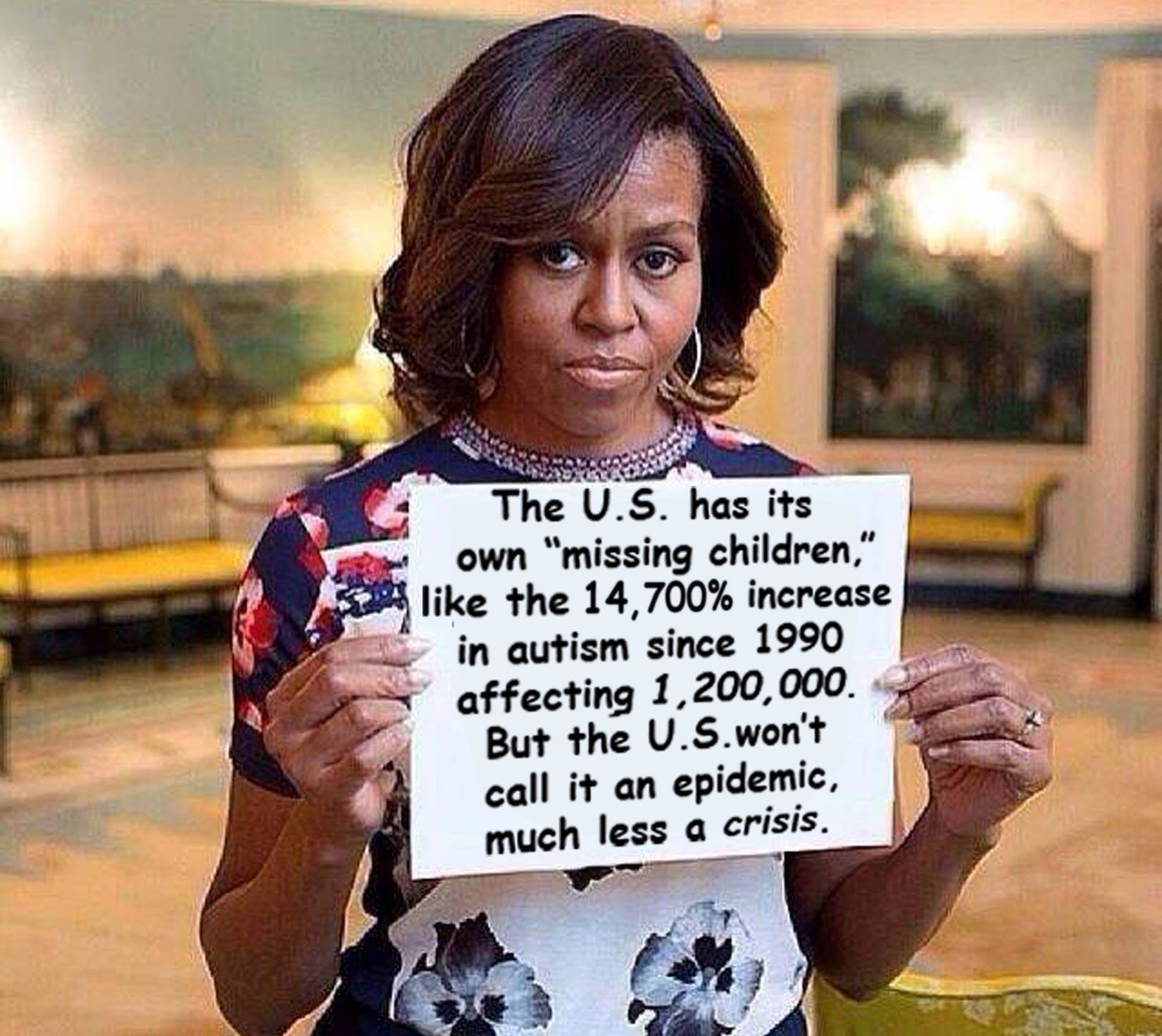
There are groups, some within the autism communities and some external, who are doing the autism communities harm. Ironically they think they are helping, leading, changing the world. Many of these groups and people adhere to the idea that the rise in autism diagnoses is due to vaccines. Yesterday I wrote about how individuals from these groups have stooped so low as to threaten high school student filmmakers (Faux advocates embarrass the autism communities by attacking high school students and their film project). Today I’m sadly writing about another embarrassing incident: making a statement by photoshopping an important statement by Michelle Obama

In case you haven’t seen it, the First Lady of the United States, Michelle Obama, posted this picture to Twitter (click to enlarge):

MO_Nigeria_Tweet

Ms. Obama is referring to the mass abduction of girls from their school in Nigeria.

The Nigerian abduction story has been in the news for some time and Ms. Obama’s statement garnered a great deal of attention. And with good attention sometimes comes bad. Consider this effort by the faux autism advocate community: (click to enlarge)

AnotherBadPhotoshop

Yes, the faux autism advocates decided to try to get some attention for themselves using Ms. Obama’s picture. In case you are wondering, yes I mean attention for themselves. Consider the statement Ms. Obama publicized: “Bring Back Our Girls”. Simple. Direct. Calls for action. Now consider the statement by the faux autism advocates. Long and doesn’t actually call for real action. Read it again if you missed that. All the action they call for is to call autism an epidemic and a crisis. They are calling for someone to accept their views on autism. They didn’t take the opportunity to say, oh, “We need more support”. “We have 1.2M people with great needs”. No. They called for attention for themselves and their agenda. And they did it in a way that reflects very poorly (to be polite) on the autism communities.

I’m not the only one who finds this effort by the faux autism advocates offensive. Consider these comments from the Canary Party’s (one of the faux autism advocate groups) facebook page:

I work with children who have Autism. I don’t know what to get mad at first. The photoshopping? The callous comparison? The horrible idea that children with a genetic disability are “missing”? The inability to understand what the word epidemic means? Revolting.

How sick and sad! This to me appears that you HATE autistic people- seeing how you view them as “missing” or “damaged” or “soulless”
The very fact you think it needs to be cured is disgusting!

Of the three autistic children I know, two are unvaccinated and they are siblings…this makes me think that autism is genetic and absolutely NOT caused by vaccines.

This is a really gross way to push your agenda…photo shopping a pic of the First Lady?! Insulting those with autism…just ick.

What a shameful way to promote your agenda… The Canary Party’s decision to photo shop this image in particular trivializes the real danger and terror that these young Nigerian girls are going through right now.

You can go to the Canary Party Facebook page and see that, yes, there are some comments supporting the picture. And, in some strange irony, advertisements for faux autism cures. Somehow this is a business opportunity for someone to put his wares in front of autism parents. But most of the comments are very critical of this photoshopped picture.

Let’s go through the faux autism advocate message. Let’s call the 1.2M autistics an epidemic. A crisis. That’s what they want. Not help. Not support for autistics. Labels. Consider this: they’ve been calling autism an epidemic and a crisis for many years. When has it ever helped?

Consider that number: 1.2 million autistics. There’s heavy irony in them using that number. 1.2M is based on an estimate of the number of autistic children in the US based on the recent CDC autism prevalence report. Somehow adults just don’t count to whoever did that photoshop. Also, 1.2M is an estimate assuming that the prevalence is flat among all children. Think about that. 1.2M is a number that basically assumes no epidemic in the past roughly 20 years.

This is an example of why I don’t consider these group and these individuals to be autism advocates but faux autism advocates. They are not helping. They are in the way.

Right now the estimate is that there are 1.2 million autistic children in the U.S.. The real number is almost certainly higher. And there are many more adults. When have these supposed autism advocates called for a real count of autistic adults in this country? The answer is that they haven’t. Such a count would likely give more data to counter their message of a vaccine induced epidemic. Ironically it would move us closer to actually determining if there is a real rise in the fraction of our population who are autistic. It would be a big step forward in understanding the needs of autistic adults. It would be a step towards learning what helped some autistics gain independence or greater independence. And what may have held some back. There’s so much we could learn. So much that frankly could help my kid. But instead we have people crying out for acknowledgement of their failed opinions, not real steps forward.


By Matt Carey