Archive | Advocacy RSS feed for this section

An open letter to the Committee on Oversight & Government Reform

23 Nov

Dear Committee on Oversight & Government Reform,

I write to you in regards to your upcoming autism hearing. Much has happened in the decade since the Committee last met on autism.

“1 in 88 Children: A Look Into the Federal Response to Rising Rates of Autism”

We need to shift from seeing autism as primarily a discussion of children to being focused on the entire population. We need to shift from being primarily focused on viewing autism as primarily an epidemiological topic to focusing on improving the lives of our citizens. There are over three million American autistics. Improving the lives of autistics should be a top priority.

Consider this simple paragraph, the description of the hearing:

“The hearing will address the federal response to the recent rise in Autism Spectrum Disorders diagnoses, as well as the allocation of government resources for ASD. The hearing will also review research and treatment options for those diagnosed with ASDs.”

Research and treatment options are after allocation of government resources for ASD, as though these are an afterthought.

Now, consider this simple rewrite:-

“The hearing will address the federal response to the recent rise in Autism Spectrum Disorders diagnoses, as well as research and treatment options for those diagnosed with ASDs. The hearing will also review the allocation of government resources for ASD.”

This sends the message that research and treatment are high enough priorities to include in a discussion of allocation of resources.

Much has been learned since the Committee last met to discuss autism. We know that much of the rise in autism prevalence estimates is due to social factors including changes in how autism is recognized. And we know we aren’t finished quantifying social factors involved in the increase. The question of whether the true incidence of autism is really rising remains open. But there is not a question of whether autistics in previous generations were missed. The question is how many were missed. Further, we know that the characteristics of the autism population are much different than previously thought. The recent CDC estimate of 1 in 88 included the result that the majority identified did not have intellectual disability.

The autism population is larger and a broader spectrum than thought even the short time ago when Pub. Law No. 109-416 (the CAA) was enacted. The government response needs to be broader in response. Greater resources are needed to adequately address the role the government is taking in autism.

An example of an opportunity this new understanding presents is in employment. A study from the UK showed that not only is the adult prevalence about 1%, but that many of these adults are living alone and are un- or under-employed. Another way to look at that is that a large fraction of the un- and under-employed are likely autistic. With an understanding of what supports are needed in the workplace and how to effectively transition from education to employment, we could make a big impact on unemployment.

Appropriate education for autistics can be more expensive than education for non-autistic students. As more children are correctly diagnosed and appropriately served, special education costs rise. The federal government has never lived up to its commitment to fund 40% of special education costs. President Obama promised to make good on this promise while campaigning four years ago. We are still waiting.

I note that the witnesses for this hearing do not include someone from the department of education nor anyone with a primary focus on education.

Autistic children become autistic adults. Today’s autistic adults are largely undiagnosed and unstudied. This is true for those adults with Asperger syndrome as well as those with intellectual disability. We don’t know what supports in living condition, tertiary education or working conditions are most appropriate for autistics. We know there are co-occurring conditions such as epilepsy and intellectual disability with autism, but we don’t know what sort of medical conditions might be more common or have early onset in adult and aging autistics. The title of a study out today drives this home: “Into the unknown: aging with autism spectrum disorders.” We just don’t know the specifics of this population while they age.

The needs of autistics with multiple disabilities are as high as ever.  Often the autism spectrum is presented as having one dimension, with the level of intellectual disability defining one’s place on the spectrum. This approach is far too simplistic and ignores the great variation in other measures. For example, just within the population with autism and intellectual disability there is great variation of the unique needs and strengths.  Unfortunately all too often schools lump autistic children into categories based on intellectual ability rather than needs. We are not giving our educators and our students the tools they need.

“Success” in autism treatment and education is frequently defined as achieving some level of non-autisticness. Of becoming “indistinguishable from peers”. However, what may be considered a small advance by this measure could be huge for an autistic with intellectual disability.  About 5% of autistics are non verbal and a larger fraction are non conversational. A recent review found fewer than 200 examples in the published literature of non-verbal autistics learning to speak past age five. And yet the same team has shown that it is possible to teach verbal communication to older autistics. Since the last autism hearing by the Committee advances in portable technology have led to a boom in augmentative and alternative communication (AAC). Giving a non verbal or minimally verbal individual a more effective means of communication may be small by some measures of success but can be life changing for the individual. To paraphrase on autistic writer: self-advocacy begins with “no”. A single word, spoken or presented through AAC, is a giant leap for some.

The federal response to autism includes congress. 2011 was a year where congress was accused many times of “kicking the can down the road”. Such was the case with autism. Pub. Law No. 109-416 was reenacted at the last minute and for a short time. I am grateful that it was reenacted but autism efforts are long term. Even organizations which criticize the government’s efforts as accomplishing too little over the short term, organizations which promote the idea that answers to tough autism are straightforward, even they are calling for a permanent federal autism infrastructure. Congress needs to accept a long term commitment.

Autism presents a much more broad and long-term topic than the Committee attempted to address a decade ago. It is a more broad and long-term topic than many try to present today. The federal response to autism has been significant and serious but it needs to expand to address the real and serious needs of the autism communities.

Respectfully submitted,

Matthew J. Carey, Ph.D.
San Jose, California
Autism Hearing? Let yourself be heard

21 Nov

It has been reported that a hearing of the Committee On Oversight & Government Reform will held on autism on November 29th:

The panel, chaired by Rep. Darrell Issa (D-Calif.), has invited witnesses from the National Institutes of Health and the Centers for Disease Control and Prevention, as well as Autism Speaks and other advocacy groups.

Autism Speaks appears to be confirming this meeting is being set up.

There hasn’t been such a hearing in many years (think a decade). The previous hearings were held by Congressman Dan Burton, who was a major proponent of the idea that vaccines were causing an epidemic of autism. Congressman Burton is retiring, and the focus of the meeting is likely not going to be as strongly vaccine oriented in the past, but that will likely be a discussion point. From what I’ve been able to gather, so far the meeting will include no Autistic representatives nor Autistic-run organizations.

Should the meeting happen (it isn’t on the calendar for the Committee yet), wouldn’t you like the opportunity to have your views heard? One can fax the Committee, but they are not under an obligation to include public comments. I say this not to dissuade you from sending a comment, but, instead, to encourage you to ask strongly that your comments be included.

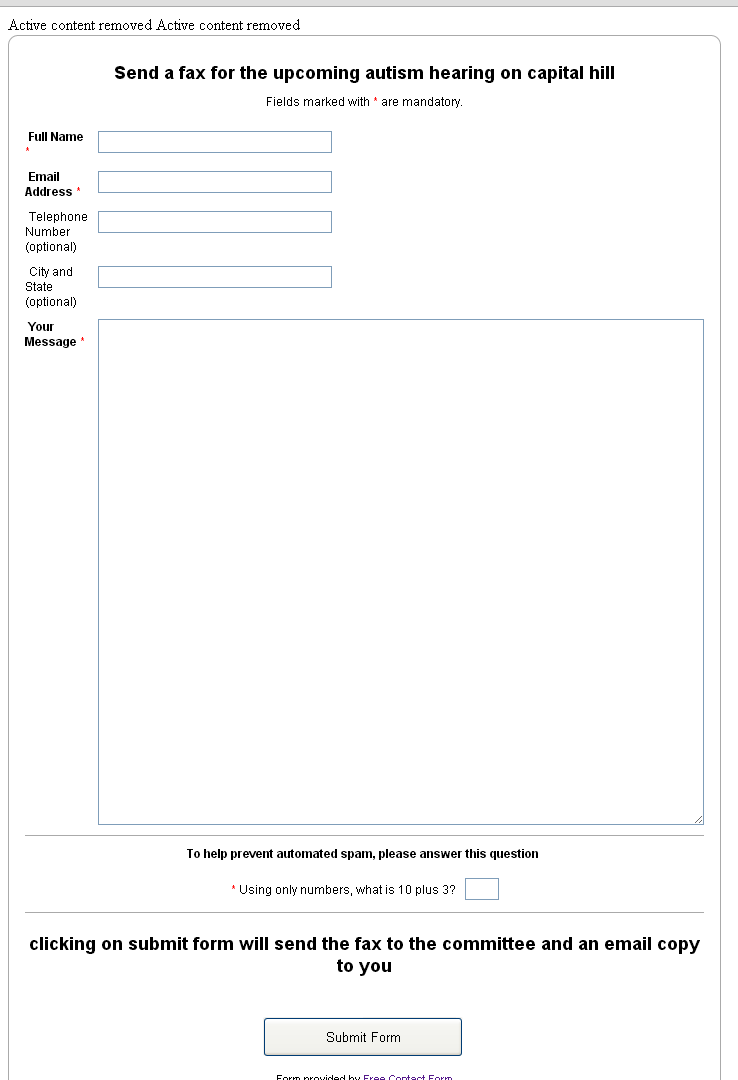
I have set up a website which will allow you to easily send a fax to the committee. Follow this link and you will have a form which you can fill out and send your message. The form is very basic (here is a screenshot). The message you send will be emailed to you and emailed to a fax server which will send it to the committee’s fax number. (alternatively, you can fax them directly at (202) 225-3974).

In my opinion, U.S. Autism policy affects communities the whole world over. As such, I would encourage international readers of Left Brain/Right Brain to submit comments as well. Consider making it clear that you are from outside the U.S..

Privacy issues: the site sends two emails. One to the email address you give and the other to a server which will send the faxes. I have access to the logs on that server and, for some time, I can read the faxes sent. But I don’t.

You are free to chose your talking points. Here are some of mine:

1) We need focus on improving the quality of life of Autistics
2) While not all Autistics can self-advocate, if we are going to have autism organizations represented, we need to have Autistic-run organizations represented.
3) Autism is a very broad spectrum, all with challenges of some sort. The government’s response needs to be broad (read-larger than it is now) in order to encompass all the needs of these communities.
4) The vaccine-epidemic hypothesis has been very damaging to the autism communities. Please don’t allow this meeting to be a way around the science in order to keep that idea alive.
5) There are faux therapies in common use for autism. Many are harmless. Some are dangerous and based on incredibly poor science. We need to get accurate information out about these practices.

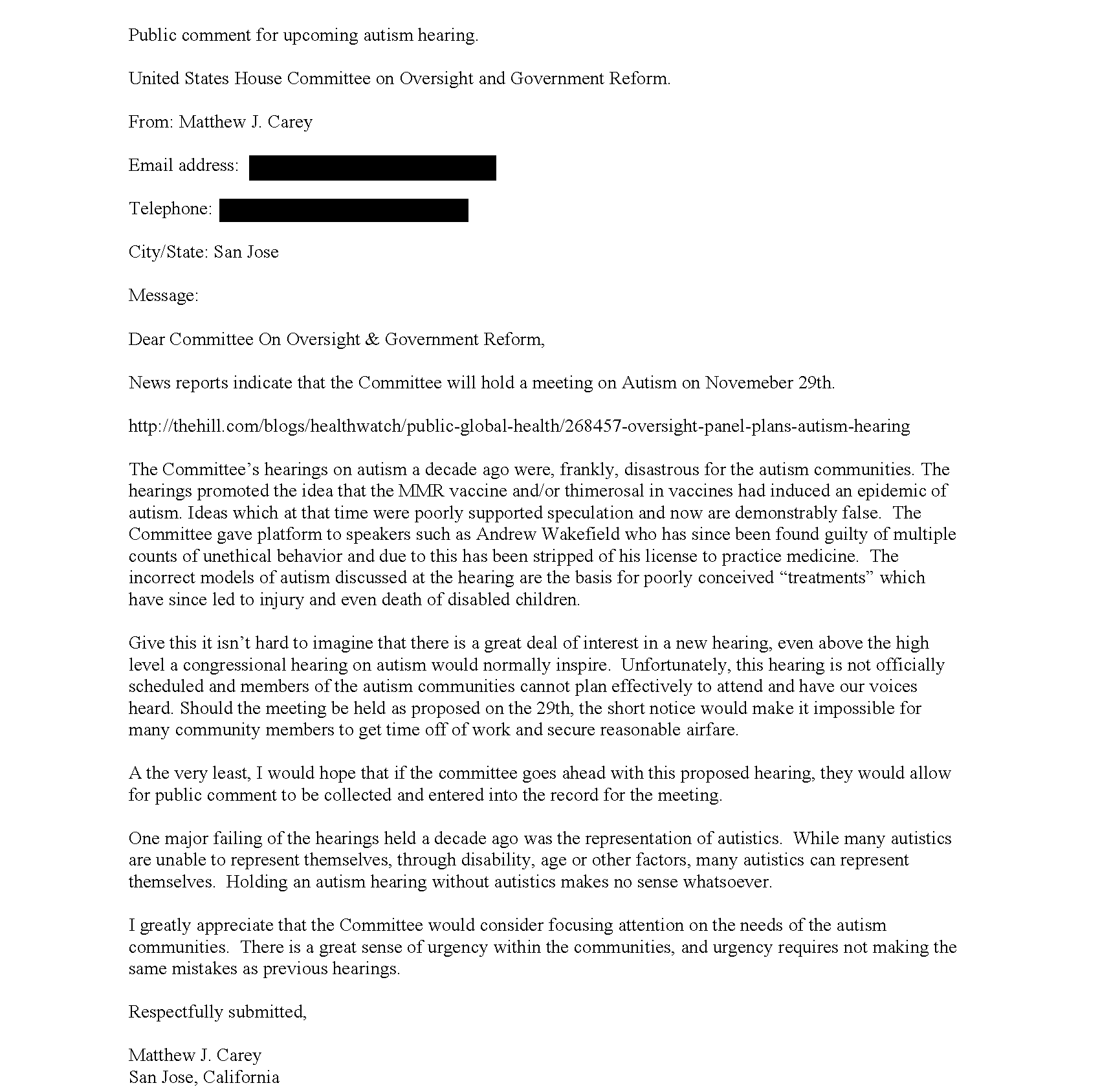
The fax is very basic. Here is a copy of one I sent earlier this week. I redacted my phone number and email address, but those will be included in the fax you send (note that those are voluntary fields. In other words, you can leave the phone number and city/state boxes blank).

Again, take a moment or take longer and put together a comment for the Committee. Follow this link and fill out the form and send a fax.

Thank Mitsubishi for supporting an Autism Campus Inclusion Leadership Program

19 Jun

In February I posted an email from the Autistic Self Advocacy Network describing their program for this summer:

ASAN Invites Autistic College Students to Autism Campus Inclusion Leadership Training

That program was supported by the Mitsubishi Electric America Foundation (MEAF). If you feel grateful for their support of this program, you can contact some of the executives of the Foundation.

Katsuya Takamiya, President and CEO:
http://tinyurl.com/786gdcg

Kevin R. Webb, Director, MEAF:

Mitsubishi Electric Public Relations:

I can’t take credit for finding those links. That credit goes to the “Canary Party”. Never heard of them? Well, they are an offshoot of groups like SafeMinds and others. The sort who are behind the blog, Age of Autism.

No, they didn’t collect those links in order to thank the Foundation for their efforts. They wanted their membership to complain. They have a webpage (Mitsubishi Funds Group that Opposes Preventing or Curing Autism). Their discussion is rather long, but the main points are copied below. (The original has formatting problems which they don’t seem to want to fix.)

Despite the many worthwhile autism charities desperately in need of funding, Mitsubishi Electric America Foundation (MEAF) has chosen to fund one that:
1) opposes all efforts to cure or prevent autism, denies an increase in autism prevalence and now seeks to promote this form of “activism” among college students nationwide.
2) blatantly violates MEAF’s own stated guideline: “We do not fund organizations or programs connected with a controversial social or political issue.” MEAF is funding a “neurodiversity” initiative by ASAN (Autism Self Advocacy Network) – highy controversial in the autism community. According to ASAN, “The training is meant to prepare students to engage in self-advocacy and pro-neurodiversity activism on their college campuses.”
3) promotes “self-diagnosis” of autism, causing students who may have the disorder to not qualify for college disability support services and national testing service accommodations, thus diminishing, not “enhancing” chances for academic success and future employment. “Self-diagnosis” (without medical confirmation) of any disability, disease or disorder is an irresponsible practice and should not receive corporate funding.
4) does not promote “full inclusion of people with disabilities alongside their peers without disabilities,” as called for in Mitsubishi guidelines, but promotes segregation of people with disabilities in extracurricular activities.

Yes, the “canary party”, a group devoted to promoting the failed “mercury in vaccines caused an autism epidemic” idea is claiming that ASAN is “highly controversial”. A group spreading fear of vaccines is pointing fingers claiming someone else is “irresponsible”.

Take the time. Click on the links. Let the good people at Mitsubishi know that people appreciate their support.

Change.org petition:No bleach enemas to “cure” autism in children!

2 Jun

Emily Willingham and Jennifer Byde-Myers have started a petition on Change.org calling for a ban on the “MMS” therapy. This is the so-called therapy that involves making disabled children drink bleach or undergo bleach enemas. This was promoted at this year’s AutismOne convention.

You can read about it below:

Block peddling of bleach enemas as “cure” for autism in children

Greetings,

I just signed the following petition addressed to the US Food and Drug Administration, US Department of Health and Human Services, and the Federal Trade Commission.

Order cease and desist on selling, recommending, or administering Miracle Mineral Supplement, also known as MMS or sodium dichlorite solution (industrial strength bleach), as “curative” for children with autism when used orally, in baths, or in repeatedly administered enemas.

Here is what one autistic child underwent with this “treatment”–A parent writes: “He is nonverbal and fairly low-functioning, so I don’t get any feedback from him as to how he is feeling. Last week, I started him on 1 drop of MMS (bleach solution) then upped the dose to 1 drop, 2x a day this week. After about 4 days at 2 drops/day, he vomited once and had diarrhea all day. I am assuming it is the MMS. His gut tends to be very sensitive to anything I give him.”

A full account of the history of this product is available here: http://www.sciencebasedmedicine.org/index.php/bleaching-away-what-ails-you. It recently was featured at an Autism One conference: http://www.autismone.org/

In her Autism One presentation (here: http://www.livestream.com/autismone/video?clipId=pla_a7e0b96e-deb1-4399-9131-d1f6d0a23157), MMS peddler Kerri Rivera references effects such as diarrhea and fever during application. There is no medical indication for this compound, either orally or as a bath or enema, and no indications for its use or efficacy in autism. Among the recommendations for application of this substance in unconsenting, autistic children is the so-called 72-2 protocol, involving application of this bleach compound every 2 hours for 72 hours “every possible weekend.” More information about that is on Rivera’s Website, http://www.autismo2.com/mms.html.

Given the effects that even the people selling it cite–fever, clear discomfort, vomiting, diarrhea–and the use of it in minor children who often are unable to verbalize their experience, we ask that the relevant authorities turn immediate attention to Kerri Rivera, organizers of the Autism One conference where she presented this information, and anyone who is selling or recommending this product for use in children with autism.

Thank you for your time.

[Your name]

ASAN: Urge For the Ban on Aversives in Massachusetts!

18 May

This action alert is from ASAN:

Urge For the Ban on Aversives in Massachusetts!

Tomorrow, May 18th, 2012, Massachusetts State Senator Brian Joyce will be filing two amendments to the Senate Ways & Means Budget currently pending in the Massachusetts State Senate. One of these amendments calls for a complete ban of aversives – also called “aversive therapy” – while the other would restrict their use. If passed, this would ban or limit the use of practices like the contingent electric shock used at the Judge Rotenberg Center (JRC).

But it takes more than one senator to get an amendment passed. We urge you to contact your Massachusetts State Senator and ask him or her to sign on to the Joyce amendments banning or restricting the use of aversives. But please hurry- they have to have signed on by the noon (12pm EST), May 18th deadline!

You can find your Senator’s phone number or email at http://www.malegislature.gov/People/Senate. Because of the urgent deadline, calling their office will be the most effective way to contact them.

Thank you for your support for the rights and safety of Autistics and other people with disabilities in the great state of Massachusetts.

Nothing About Us, Without Us!

Sincerely,
Autistic Self Advocacy Network
http://autisticadvocacy.org

ASAN’s Ethical, Legal and Social Implications of Autism Research Symposium Goes Live

10 Apr

The Autistic Self Advocacy Network (ASAN) hosted a symposium on the Ethical, Legal and Social Implications of Autism Research recently. They are now making it available online. See the message below:

Dear Friends:

This week, the media reported that over $1 billion has been spent over the course of the last decade on autism research funding. During a time of constant budget cuts and increasing fiscal pressures on government, this is an astonishing sum. What have we purchased for this investment? How successful has the autism research agenda been in making the American dream a reality for Autistic people and our families? Has our society discussed the ethical, legal and social consequences of how autism research findings may be used? We think these questions are worth asking, and with your help, we think it is past time to get more people involved in the discussion.

Last December, the Autistic Self Advocacy Network joined with the Harvard Law Project on Disability and the Petrie-Flom Center for Health Law Policy, Biotechnology and Bioethics to hold a symposium on the Ethical, Legal and Social Implications (ELSI) of Autism Research. Supported by a grant from the Administration on Developmental Disabilities, the ASAN ELSI Symposium served as the launching point for a robust conversation about changing the way our society approaches autism research. From our partnership with federal research funders to get self-advocates on grant review panels to growing attention to ethical issues on topics like prenatal testing, self-determination in service-provision and more, the need to introduce values into our national autism research dialogue remains stronger than ever.

Over the course of the month of April, we will be releasing captioned videos of December’s ELSI Symposium. The first is already available on our YouTube channel. You can help us get the word out by watching it alone or with your friends and colleagues, sharing it on facebook and twitter, and starting to talk about these things in your own community. The time has come for our voices to be heard.

Nothing About Us, Without Us!
Ari Ne’eman
President
Autistic Self Advocacy Network

Los Angeles Times: Discovering Autism

23 Dec

The Los Angeles Times produced a series of articles called “Discovering Autism”. The series is in four parts and represents was researched for years. The articles are:

Autism boom: an epidemic of disease or of discovery?
Autism rates have increased twentyfold in a generation, stirring parents’ deepest fears and prompting a search for answers. But what if the upsurge is not what it appears to be?

Warrior parents fare best in securing autism services
Public spending on children with autism in California varies greatly by race and class. A major reason: Not all families have the means to battle for coveted assistance.

Families cling to hope of autism ‘recovery’
An autism treatment called applied behavior analysis, or ABA, has wide support and has grown into a profitable business. It has its limits, though, and there are gaps in the science.

Autism hidden in plain sight
As more children are diagnosed with autism, researchers are trying to find unrecognized cases of the disorder in adults. The search for the missing millions is just beginning.

The first article brought a great deal of criticism, from many quarters. As you can imagine challenging the way the “autism epidemic” is viewed is not welcomed by those promoting vaccines as a primary cause of autism. This article also brought out at least one commenter who asserted that the rise in autism diagnoses is driven by people seeking social security payments (SSI), which goes to show that readers tend to bring their own preconceptions to what they read.

Interest in the online discussion of the series dropped off dramatically after day one.

Autism boom: an epidemic of disease or of discovery? looked at the rise in autism diagnoses observed in many places. Writer Alan Zarembo points out quite rightly that autism rates vary dramatically by school district in California, as well as state to state.

Such variability of autism rates across geography speak strongly against the idea of a single cause, such as vaccines. Autism Diva wrote about the strong variation by regional center district within California years ago (her piece is not up, but this article from LBRB discusses her article)

The variation by school district and by race/ethnicity was a major factor in helping me see that the vaccine-epidemic of autism did not make sense, back when I first started to read up on autism.

The LA Times quotes Prof. Peter Bearman of Columbia University, who studied the California Department of Developmental Services data closely and showed, amongst other things, that a large autism “cluster” existed in Southern California. The Times notes that similar clusters were found by U.C. Davis Professor Irva Hertz-Picciotto. (I was present when Autism Diva discussed the regional center graph with Prof. Hertz-Picciotto, by the way).

Prof. Bearman also showed that social forces were at work–awareness, if you will–which has aided the increase in autism diagnoses.

In other words, autism is not contagious, but the diagnosis is.

“`Is it real or not?’ is a meaningless question,” Bearman said of the surge in cases. “The sociological processes are as real as the biological processes.”

A diagnostician (neurologist) is quoted in the Times:

Dr. Nancy Niparko, a child neurologist in Beverly Hills, said that whether she identifies a child as autistic can come down to whether she believes it will do any good.

“If it’s going to improve the possibility of getting services that will be helpful, I will give the label,” she said.

“I don’t work for labels. Labels work for me.”

In Warrior parents fare best in securing autism services makes the point that it takes work, hard work, to get the services that a child may need. An autism diagnosis is not a ticket to services, it is a first step. Parents who fight harder and longer tend to get higher levels of services for their children.

The Times points out that within a single district (albeit one of the largest in the U.S., Los Angeles Unified), the fraction of students with 1:1 aides varies by geography and race/ethnicity:

District officials acknowledge that advocacy efforts make a big difference in who gets services, but see things differently than parents on the value of 1:1 aides:

L.A. Unified officials offered a similar explanation for the disparity. As parents successfully lobbied for outside aides, the idea spread, and in certain schools it became standard practice to offer them.

“Parents learned from each other,” said Nancy Franklin, a top special education administrator. “It became a cottage industry in LAUSD.”

The district is trying to break the pattern by persuading parents that its own staff can meet children’s needs in many cases.

“We’re paying lots of money for services that are of questionable value,” said Eileen Skone-Rees, who oversees the district’s contracts with companies that supply one-on-one aides.

In Families cling to hope of autism ‘recovery’, the Times focuses on ABA. Biomedical approaches are not really discussed.

The article talks about ABA from the early work of Ivar Lovaas to the present day, where it is common in some school districts and regional centers. The high costs and the level of research support are discussed along with examples of children who are success stories and those who are not.

In Autism hidden in plain sight, the Times looks at how autism is often missed in adults.

The Times presents an intriguing look at the past in medical records from a child diagnosed by Leo Kanner (whose work coined the term “autism”).

The times provided a number of slide show vignettes of people they interviewed.

I can’t link to them directly, but I’ve watched a few and enjoyed them. Jeane Duquet, autistic adult diagnosed at age 39 (right side, middle). Jesse Castillo, age 11 (bottom right corner)

The author of the series, as well as Catherine Lord were interviewed by NPR:

http://www.npr.org/v2/?i=144022386&m=144022377&t=audiowidth=”400″ height=”446″ />

I would certainly have done some things differently had I written the series. I would have chosen different wording, for example. Yes, the pieces brought out some less than pleasant perspectives. I’ve read a few complaints about the series, from not supporting vaccine causation or biomedical approaches to presenting autism as a costly burden. Ironically, these complaints come from the same people who repeatedly say that “autism costs society $3.5 million per individual”. A big piece of that $3.5M is ABA and if we as a community (or part of the community) are to defend the need for ABA, we have to accept that there is a cost. I believe, and I commented, that the choice of language at times put a negative slant where one was not needed. However, the series put some very good information out, including: 1) the “epidemic” has a large portion which is driven by social factors, with a much smaller part that may be a real change in the number of autistics, 2) services are not handed out on a silver platter. Parents and autistics have to fight for what supports the law says they should get, 3) 1:1 therapies such as ABA may be effective, but they are expensive and the research behind them is still incomplete and 4) adult autistics are out there in greater numbers than is currently reported.

The biggest complaint about the series is that it portrays parents as seeking diagnoses for their kids for some sort of financial gain. Dr. Jay Gordon (a major promoter of the vaccine-epidemic idea) has noted this where Mr. Zarembo has been interviewed (http://www.scpr.org/programs/patt-morrison/2011/12/22/21866/autism-diagnoses-spike-an-epidemic-in-the-making). Mr. Zarembo makes it clear in the interview that this is not his point. That the autism diagnosis “opens the door” and that parents are doing what they should for their children–including fighting hard to obtain appropriate services once the door is opened.

For those complaining that the LA Times series didn’t cover the vaccine-epidemic idea or biomedical approaches to autism: I’d recommend you be thankful. Quite frankly an evidence driven newspaper series on these issues will not go the way you want.

Happy Holidays from the Autistic Self Advocacy Network

22 Dec

Below is an email I received from the Autistic Self Advocacy Network. Their end-of-year letter:

As we approach the end of the year, many of you will be getting ready to spend the holiday season with your families. As you do, we hope you’ll take a moment to remember all that we’ve accomplished together this year.

From our Navigating College handbook to our Symposium with Harvard Law School on Ethical, Legal and Social Issues in Autism Research, this has been an exciting year for the Autistic Self Advocacy Network. We celebrated our fifth anniversary, engaged in advocacy on critical issues like stopping the Judge Rotenberg Center’s abuse of children, fighting for more public support on critical topics like transition supports, true community integration, stopping restraint and seclusion and more.

In addition, our programming has helped build a stronger voice for the Autistic community in many sectors of American life. In our Keeping the Promise report, we partnered with other national self-advocacy groups to help define community living resulting in a document now being used by advocates and policymakers nationwide. Through our participation in the Academic Autistic Spectrum Partnership in Research and Education (AASPIRE), we are breaking new ground by ensuring the participation of Autistic voices in the research process. What’s more, 2012 promises to bring even more progress.

In 2012, our new internship program with Freddie Mac will result in new job opportunities for Autistic adults. Our forthcoming Autism Campus Inclusion initiative will help train the next generation of Autistic leaders and build a network of Autistic-run organizations on college campuses across the country. Not to mention our continued advocacy and activism to ensure that wherever autism is being discussed, we have a voice at the table – together.

Will you help support our work to keep the self-advocate voice front and center in 2012? Please consider an end of year donation to the Autistic Self Advocacy Network. With your help, the momentum we have begun this year can continue and build real and lasting change for our shared community. All donations are tax-deductible.

Sincerely,
Ari Ne’eman
President
The Autistic Self Advocacy Network

PS. If you are unable or uncomfortable making donations online, donations can be sent to

The Autistic Self Advocacy Network
PO Box 66122 NW
Washington, DC 20035

ASAN Symposium on Ethical, Legal and Social Implications of Autism Research

2 Dec

If I were local, I’d take the day off and go to this: ASAN Symposium on Ethical, Legal and Social Implications of Autism Research. The event is December 10th, and there is more seating available now. But you have to register (it is free):

The Autistic Self Advocacy Network, in conjunction with the Petrie-Flom Center for Health Law Policy, Biotechnology and Bioethics, the Harvard Law Project on Disability and the UNESCO Bioethics Chair American Unit, is proud to invite you, to join us on December 10th for a Symposium on Ethical, Legal and Social Implications of Autism Research at Harvard Law School. The free event will run from 9 AM to 3 PM at the Harvard Law School campus, Hauser Hall, Room 105.

Additional seating has become available. Please keep in mind that seating is still limited. Once these seats are taken, there will be no more available. If you are unable to get a seat or cannot make it to Massachusetts, the symposium will also be webcast live. Details to follow next week.

Topics covered will include prenatal testing, community participation in research methodologies, appropriate and inappropriate intervention goals and much more.

This symposium will serve a unique role in shedding light on ethics and values issues within the autism research community. By bringing together self-advocate and researcher participants, we hope this will serve as a starting point for meaningful dialogue between those conducting research on autism and the community of Autistic adults and youth. Confirmed participants include Administration on Developmental Disabilities Commissioner Sharon Lewis, ASAN President and IACC Public Member Ari Ne’eman, National Institute on Child Health and Human Developmental Director Alan Guttmacher, Harvard Law Professor Michael Stein, Paula Durbin-Westby, Emily Titon, Liz Pellicano, David Rose and many more.

This event is open to the general public without charge and is made possible by a grant from the Administration on Developmental Disabilities.
Get more information
Register Now!
I can’t make it
Please join us as we begin this exciting conversation. Space is limited, so please RSVP soon.

Sincerely,

The Autistic Self Advocacy Network

Judge Rotenberg Center banned from shocking new admissions

14 Nov

The Judge Rotenberg Center (JRC) has is a special needs school in Massachusetts which employs electric shocks as part of its program on a subset of its students. This practice is controversial, to put it mildly.

With thanks to Kate Gladstone for bringing this to my attention, the JRC has been banned from including these aversives on future students.

The letter below is from the Autistic Self Advocacy Network (ASAN) Disability Rights International which goes into more detail.

JRC Banned from Shocking New Admissions

Dear Supporters,

This week we can celebrate a major victory against torture of people with disabilities in the United States. The Massachusetts Department of Developmental Services (DDS) adopted new regulations last week that greatly restrict the intentional use of pain as a form of treatment – including the use of electric shock, seclusion, and restraints on young children and adults with disabilities. As documented by a recent report by Disability Rights International (DRI), Torture Not Treatment, The Judge Rotenberg Center (JRC), based in Canton, Massachusetts, has used these practices, called “aversive treatment” for decades.

Facilities licensed by the DDS in Massachusetts can no longer subject new admissions to severe behavioral interventions including electric shock, long-term restraint, or aversives that pose risk for psychological harm — in other words, mainstays of JRC’s “treatment” program.US Report Cover

No other institution in the country – or the world, as far as we can tell – uses such barbaric practices. DRI’s investigation found that the pain caused by this is so severe and outside accepted professional norms, that these practices constitute nothing less than torture. By permitting such treatment, the United States violates its obligations under international law, as defined by the UN Convention Against Torture. DRI filed our report, Torture Not Treatment, in 2010 as an urgent appeal to the United Nations. The top official on torture at the United Nations agreed with DRI, and when asked by ABC Nightline if the practices were torture, he declared, “Yes…I have no doubts about it. It is inflicted in a situation where a victim is powerless…a child in the restraint chair, being then subjected to electric shocks, how more powerless can you be?”

We applaud Massachusetts Governor Deval Patrick on taking a courageous stand by issuing an executive order for the Massachusetts DDS to review their policies regarding electric shock and other severe aversives.

The resulting new policy puts an end to the use of JRC’s electric shocks on new admissions. But we can’t declare success yet. While hundreds of children will be spared from JRC’s behavioral experiments in the future, the new policies do not stop JRC from shocking and causing psychological damage to children already placed in the center. These children and young adults remain prisoners in a very dangerous environment. The center has been repeatedly investigated for suspicious deaths and physical abuse. JRC has been fined for identifying some clinicians hired by the school as psychologists, when in fact, they were not licensed psychologists. And as a result of an investigation into a case of abuse at the facility, JRC’s director was forced to resign earlier this year after being charged with misleading a grand jury about the investigation.

DRI is encouraged by the bold statement by the US National Council on Disabilities, a federal advisory body, which cited DRI’s report, as well as the international definition of torture, to call for the use of painful shock aversives to be brought to an end.

DRI urges the Department of Justice and the Obama Administration to fullfil its obgligations under the UN Convention Against Torture. DRI calls for a blanket ban on the use of electric shock as aversive treatment for children or adults with disabilities across the nation. There is nothing stopping JRC from shocking kids already in their center — or moving their facility to a different state to avoid the new Massachusetts regulations. The Department of Justice has an open investigation into the treatment of children at JRC. We ask you to write a personal appeal to the investigators to help ensure that this torture is put to an end once and for all, and is never allowed to be duplicated anywhere else in the United States.

We are one large step closer.

Thank you for your continued support,

Laurie Signature

Laurie Ahern,
President

Eric R Sig

Eric Rosenthal,
Executive Director