Archive | Autism RSS feed for this section

Via Autistic Hoya: Judge Rotenberg Center Survivor’s Letter

10 Feb

The Judge Rotenberg Center (JRC) is a school for autistic students which incorporates aversives into the program for some of their students. These aversives are electric shocks delivered via remote-control to packs the students wear 24/7.

The JRC has been the focus of a great deal of criticism. To put it mildly. JRC has repeatedly described the shocks in relatively mild terms. Autistic Hoya (whose blog I highly recommend) has an article which includes a letter from a JRC survivor. I do not have permission from the author to copy the letter here, so I will send you to her site. With the warning that this is not an easy letter to read:

Judge Rotenberg Center Survivor’s Letter


By Matt Carey

California’s Legislative Analyst Office report on special education

8 Feb

Recently the California Legislative Analyst’s Office (LAO) released a report on special education in California, Overview of Special Education in California. The report goes over many details of special education, but I will focus on only a few here.

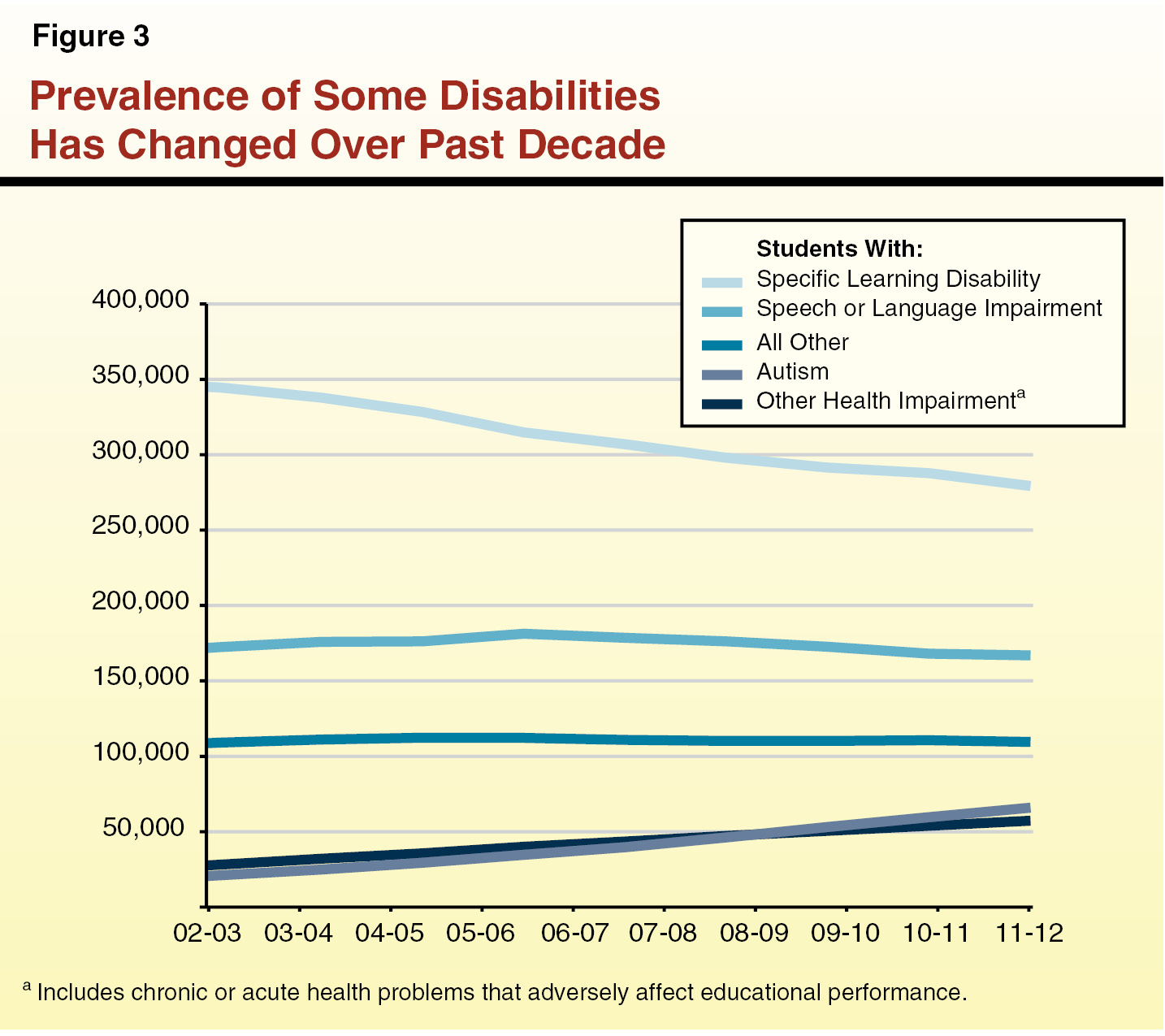
First, the time trend. Yes, the number of students receiving services under the autism label is going up.

LAO Figure 3

Then again, no sign that it is going down after the removal of thimerosal. Also worth noting is the fact that other health impairments as a category is also increasing. Specific Learning Disability is going down. So it’s a bit more complex than just “autism is going up”.

What interests me more is the discussion of costs and finances. On term that often bothers me is the term “encroachment”. As in, “special ed students cost more, and that is an encroachment on the funds for the regular education students”. The LAO report discusses one aspect of that misconception:

(Note: SWD are “students with disabilities”)

Misconceptions About “Encroachment” Some local educational agencies (LEAs) complain that local contributions for special education “encroach” upon their general education programs, sometimes implying that any local dollar spent towards educating a student with disabilities (SWD) imposes unfair expenditure requirements on their general purpose budgets. This argument, however, is a mischaracterization of both federal and state laws. Federal Individuals with Disabilities Education Act (IDEA) and state special education categorical funds never were intended to cover the full costs of educating a SWD—instead the bulk of the “regular” education costs are intended to be covered using local revenue limit and categorical funding, just as for nondisabled students. Moreover, federal IDEA and state special education categorical funds never were intended to fully cover the excess costs of educating a SWD—the special education funding model always has been predicated on a three–way cost–sharing model, including local sources. Despite this basic design of the funding model, LEAs sometimes express frustration that their local share of special education costs is too high. This frustration tends to increase as their local share of special education costs increases, as this leaves them with fewer resources to serve other students.

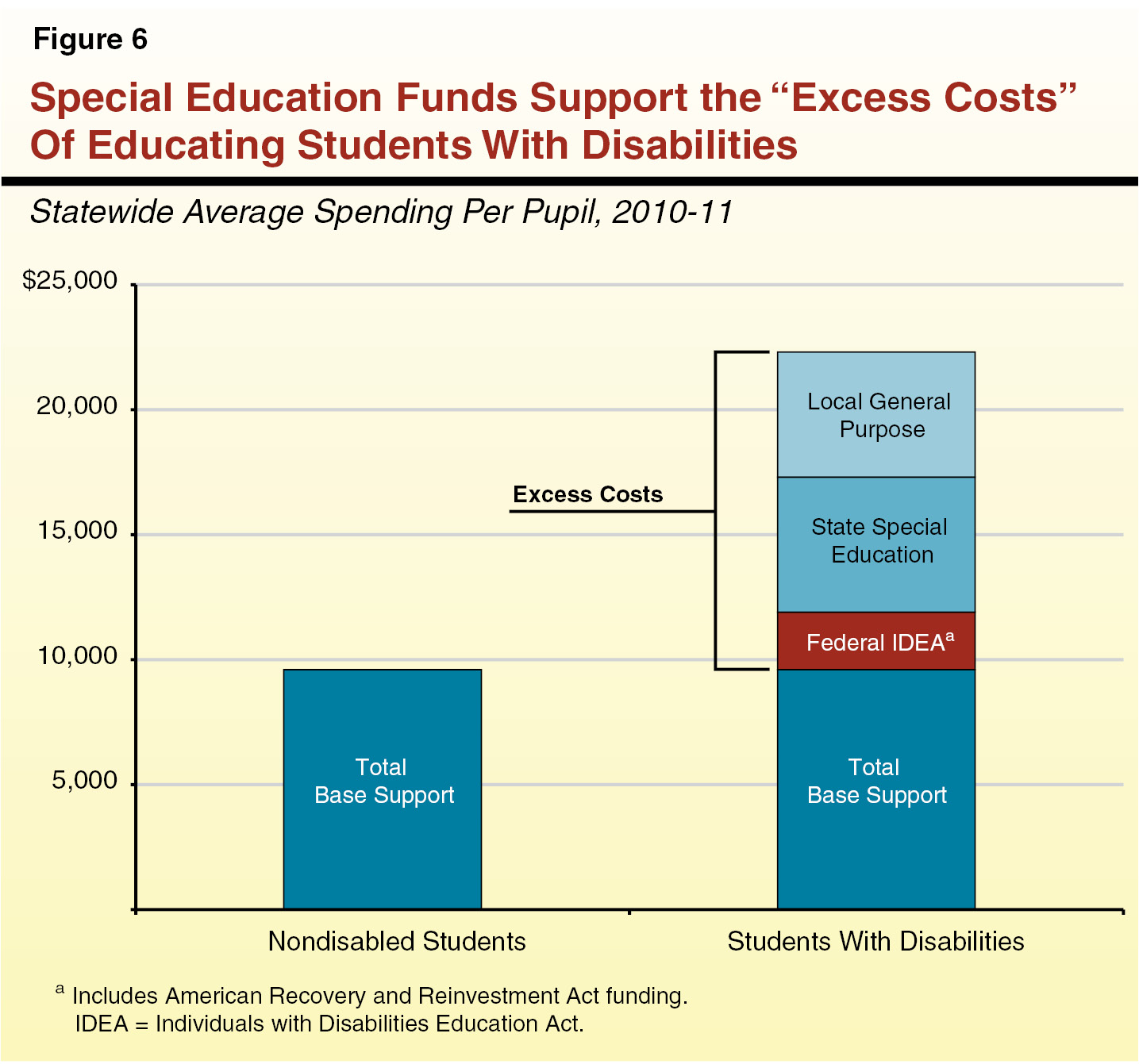
LAO figure 6

Schools are required to provide free appropriate public education (FAPE) to all students, not just students with disabilities. Some students cost more, some cost less, some cost much more. In California, on average, schools spend $9,600 per non disabled student and, on average, $22,300 per disabled student. Where does that money come from to pay for the disabled student’s costs? Well, $9,600 comes from the money the school would spend anyway. The rest is: $2,300 in federal funds, about $5,400 in state funds, and about $5,000 local funds. So, the “extra” cost for special education students is largely paid by state and federal funds. The Federal government has never paid the full amount they committed for special education. The LAO notes:

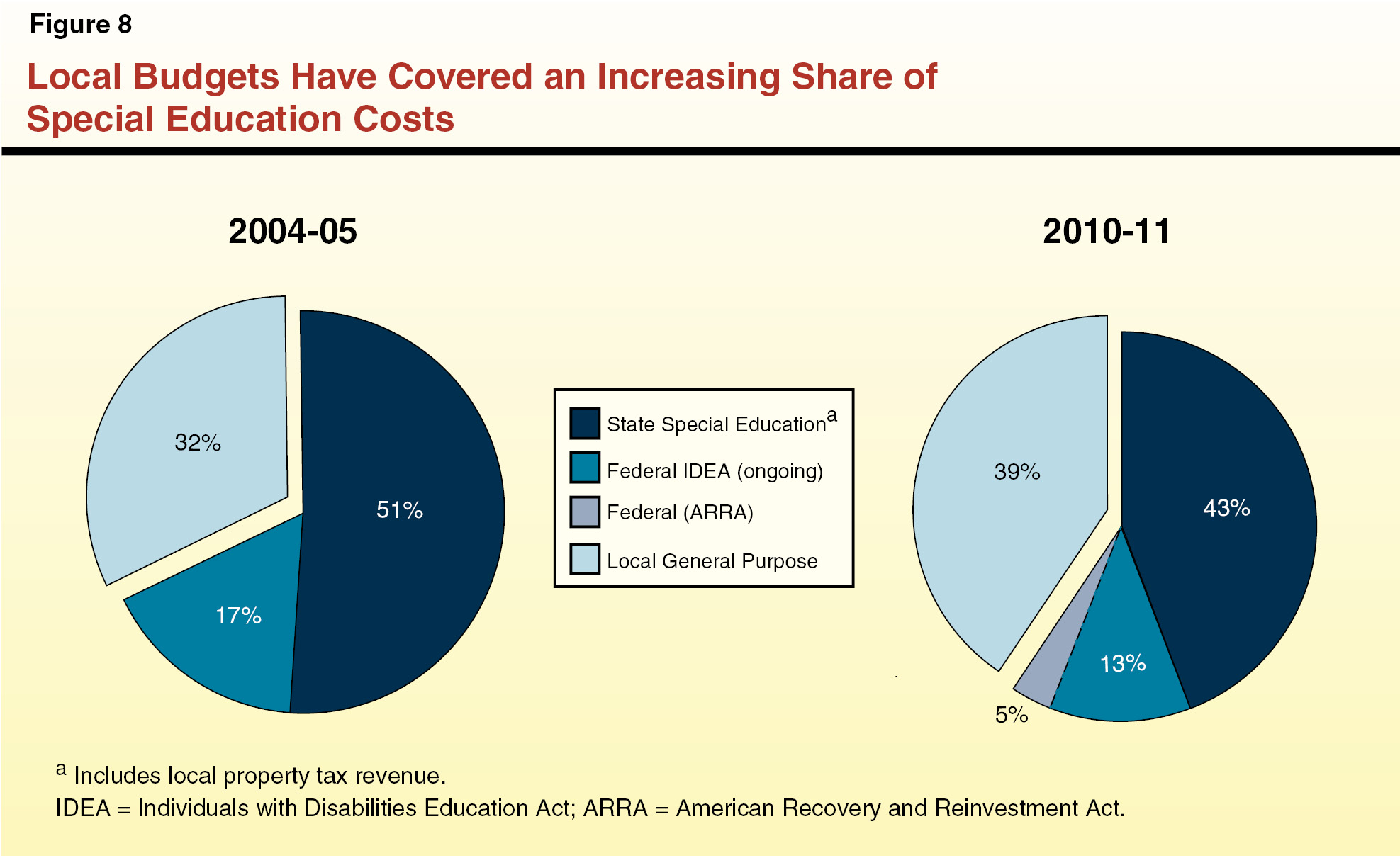
LAO figure 8

Federal Share Has Never Reached Intended Contribution Level. As shown in Figure 8, federal IDEA funds typically cover less than 20 percent of overall special education expenditures. This is notably lower than the amount the federal government originally committed to provide in support of special education services. The IDEA expresses intent to appropriate funding for each SWD up to 40 percent of the national average expenditure level per K–12 pupil, which would equate to roughly 40 percent of California’s overall special education expenditures. The federal budget, however, has never come close to providing states with this amount. We estimate that California would receive roughly $2 billion more annually if the federal government were to “fully fund” the intended level articulated in the IDEA.

If the Federal Government made good on it’s promise, it would be a great help to education. How’s that for an obvious statement. Somehow this obvious fact hasn’t made an impression on our legislators. That all said–just because the Federal Government isn’t helping as much as they should, that doesn’t mean that cost is an “encroachment” by special ed students.

Now, how does the state decide how much to give to each school district? It isn’t based on “your expenses are $XX, so we will give you a fraction of that.” It isn’t based on, “You have so many special ed students, so we will give you $YY per special ed student.” No, it’s, “your student population is ZZZ, so we give you money based on that number.”

In other words, if a school district has 100% special students, they get the same funding as if they have 0%. If the costs are high or low, they get the same amount from the State and Federal Governments. This isn’t the full story, but it is close:

Two Distribution Models Exist. Across the nation, states generally use one of two approaches to distribute special education funding to the local level. Some use a “cost–based” model, with funding allocations driven by how many SWDs are served or the magnitude of special education costs incurred. In contrast, other states rely primarily on a census–based funding methodology that is not linked to particular SWDs. Under this model, the state allocates special education funds based on the total number of students enrolled, regardless of students’ disability status. This funding model implicitly assumes that SWDs—and associated special education costs—are relatively equally distributed among the general student population and across the state. While the majority of federal special education funds are distributed using a census–based model, the IDEA formula does allocate a small portion (typically around 10 percent) of funds based on counts of economically disadvantaged students, on the assumption that this group contains a greater proportion of SWDs.

A district (or SELPA or LEA) gets paid the same amount whether a student is receiving services for special education or not. Whether a student’s special education services cost a little or a lot. And some districts feel that some or all dollars spent on special education are “encroachment”. We can complain, but in the end we’ve built a system which strongly disincentivises schools from taking a true “cost blind” approach to finding an appropriate education.


By Matt Carey

A correction

5 Feb

Last year, following the autism hearing in the Oversight and Government Reform Committee, I wrote a piece Mr. Wright, is autism an epidemic or not? Why not give real examples of how to make a financial impact? In the article I used an example of how getting more autistics employed could make a real impact financially in our country.

It was pointed out to me that the way I framed it, it read that only a fraction of the autistic population would be able to gain employment. An adult self-advocate pointed out to me that this is not the case, that real employment should be a goal for the entire population. And this self advocate is correct and I regret the way I worded that article.

It is worth noting that a self advocate was informing the parent of a child with multiple disabilities, including intellectual disability, that employment should be a goal for all. There is an important lesson in that apparent role reversal. Self-advocacy does not mean one advocates only for one’s self, nor for only other self advocates. This simple message often gets lost in the stereotyped presentations of self-advocates and parents.

The autism community is broad. No one person will advocate great change. No segment of the population will be very effective on its own. We are going to work together or we are going to fail.


By Matt Carey

IACC to take more active role

4 Feb

The U.S. Interagency Autism Coordinating Committee (IACC) met last week. There were presentations on important subjects but for me the real event happened in the final hour, during the discussion. You can get an idea of that from two Autism Speaks articles: IACC Pledges More Assertive Role in Federal Autism Policy and IACC Tackles Healthcare Disparities and Access to Care.

If one looks at Public Law 109-416 (the law based on the Combating Autism Act)

(b) RESPONSIBILITIES.—In carrying out its duties under this section, the Committee shall—
(1) develop and annually update a summary of advances in autism spectrum disorder research related to causes, prevention, treatment, early screening, diagnosis or rule out, intervention, and access to services and supports for individuals with autism spectrum disorder;
(2) monitor Federal activities with respect to autism spectrum disorder;
(3) make recommendations to the Secretary regarding any appropriate changes to such activities, including recommendations to the Director of NIH with respect to the strategic plan developed under paragraph (5);
(4) make recommendations to the Secretary regarding public participation in decisions relating to autism spectrum disorder;
(5) develop and annually update a strategic plan for the conduct of, and support for, autism spectrum disorder research, including proposed budgetary requirements; and
(6) submit to the Congress such strategic plan and any updates to such plan.

If you look at (2) and (3), they constitute a very broad mandate to “monitor Federal activities with respect to autism spectrum disorder [and] make recommendations to the Secretary regarding any appropriate changes to such activities”

This is an area which the IACC has up until not been the primary focus of the IACC, from what I have observed. The IACC has spent much effort, and rightfully so, on developing and updating the strategic plan for autism research.

The IACC is working on a document to offer advice on how autism should be considered in the implementation of the Affordable Care Act and the insurance exchanges the Act will set up.

The meeting started with Tom Insel (chair of the IACC, director of the NIMH) discussing some recent papers in autism. These include studies on elopement, markers of maternal inflammation as a risk factor for autism, an imaging study showing microglial activation in autistic brains, studies by IACC member David Mandell and more.

A presentation was given about the CDC Minnesota Somali Autism Project. The presentation discussed the methodology (using the same system as the ADDM network) and the difficulties in building the infrastructure from scratch. No information on preliminary results.

Jose Cordero spoke about the prevalence of autism in Puerto Rico. It is one of the highest in the United States at 1.6%. This is especially noteworthy given the relatively low prevalence for autism among the Hispanic communities regularly reported. Another presentation was made on the recent “Optimal Outcomes” study, with much discussion afterwards about what “optimal” outcomes really are. Of note was the fact that the study authors never made the statement that people “grow out of autism”, that was an interpretation added by journalists. Anjali Jain of The Lewin Group and Craig Newschaffer of Drexel University spoke about health outcomes among autistics, showing that there are more health issues among autistics. Alan Guttmacher of the National Institute of Child Health and Human Development spoke about the National Children’s study which is starting and will follow 100,000 children’s health outcomes and track possible environmental risk factors.

Public comments were given both orally and written. Unfortunately, there was no time for discussing the comments, which included statements by Dena Gassner, Amy Lutz, Dawn Loughborough and Jake Crosby.

The meeting was recorded by video. (I’ll try to get the embed code to work) http://videocast.nih.gov/launch.asp?17778


By Matt Carey

note: I serve as a public member to the IACC but all opinions here and elsewhere are my own.

Princeton families make $1.5M donation to Rutgers to study adult autism

2 Feb

NJ.com is reporting Princeton families make $1.5M donation to Rutgers to study adult autism. Two families donated $750,000 each, matched by another gift to the university to endow a chair in the psychology department:

Located at the Graduate School of Applied and Professional Psychology, the Karmazin and Lillard Chair in Adult Autism will pay for research and training future professionals to work in the growing field.

I find it very encouraging that the donors are parents of adolescent autistics.


By Matt Carey

IACC to hear about Minnesota Somali Project, Optimal Outcomes and National Children’s Study

28 Jan

The U.S. Interagency Autism Coordinating Committee (IACC) meets tomorrow (January 29th). The agenda is listed online and below.

The committee and the public will hear updates on the Minnesota Somali Autism Project–a project to explore whether there is a high prevalence of autism in the Minnesota Somali community and, if so, why. The autism prevalence in Puerto Rico ranks high for the U.S., even though the territory population is largely Hispanic and Hispanics typically have a low reported autism prevalence in the U.S.. An update on the autism prevalence in Puerto Rico will be presented. A recent study on individuals who achieved what the authors refer to as “optimal outcomes” will be discussed. Also, a study of health outcomes in children with autism and their families will be presented.

The IACC will also discuss plans for moving forward. There are many areas I would like to see some focus applied to. But three I have proposed and hope to discuss are (1) the needs specific to children and adults with autism and intellectual disability and/or communication difficulty and (2) difficulties in delivery of medical services to autistics and (3) autism and epilepsy. It is too late for comments to be included in the record for this meeting, but if you have opinions of where autism research and policy should be moving towards, send the IACC comments at IACCPublicInquiries@mail.nih.gov.

Here is tomorrow’s agenda:

10:00 a.m. Welcome, Roll Call and Approval of Minutes
Thomas Insel, M.D.
Director, National Institute of Mental Health
Chair, IACC

10:05 Science Update
Thomas Insel, M.D.
Director, National Institute of Mental Health
Chair, IACC

10:20 Round Robin

10:50 Centers for Disease Control and Prevention (CDC) Minnesota Somali Project Update
Amy Hewitt, Ph.D.
Director, Research and Training Center on Community Living
University of Minnesota

Mashalyn Yeargin-Allsopp, M.D.
Chief, Developmental Disabilities Branch, National Center on Birth Defects and Developmental Disabilities (NCBDDD)
Centers for Disease Control and Prevention

11:20 Update on Autism Prevalence in Puerto Rico
Jose Cordero, M.D.
Dean, Graduate School of Public Health
University of Puerto Rico
Member, IACC

11:35 Lunch

1:00 p.m. Oral Public Comments

1:30 Optimal Outcomes in Individuals with a History of Autism
Deborah Fein, Ph.D.
University of Connecticut
Board of Trustees Distinguished Professor Department of Psychology
Department of Pediatrics

2:00 Study of Health Outcomes in Children with Autism and their Families
Anjali Jain, M.D.
The Lewin Group

Craig Newschaffer, Ph.D.
AJ Drexel Autism Institute, Drexel University

2:30 National Children’s Study Update
Alan Guttmacher, M.D.
Director, Eunice Kennedy Shriver National Institute of Child Health and Human Development
Member, IACC

2:50 Break

3:05 IACC Business
Thomas Insel, M.D.
Director, National Institute of Mental Health
Chair, IACC

Susan A. Daniels, Ph.D.
Acting Director, Office of Autism Research Coordination
Executive Secretary, IACC

•2012 Strategic Plan Update
•2013 Strategic Plan Update Process
•2012 Summary of Advances
•2011-2012 Portfolio Analysis
•Other Activities

4:15 Public Comments Discussion Period

4:45 Wrap-Up

5:00 Adjournment


By Matt Carey

Note: I serve as a public member to the IACC. However, all comments and opinions, here and elsewhere are my own.
Note: I made small edits after I published this article to include the third area I would like to see get greater focus.

A paper retraction and a strange blog post

25 Jan

My pubmed email alerts had a retraction notice recently. Enhanced Polyubiquitination of Shank3 and NMDA Receptor in a Mouse Model of Autism now shows “retracted”.

Per a tweet from Steve Silberman:

It turns out a blog called “Autism Researchers” noted that figures in the paper included identical data, but in non-identical places. For example:

Aside from the odd possibility that a blog may have contributed to the downfall of a paper (not too odd if you recall ERV’s analysis of an XMRV paper), is the fact that the blog has one real entry. They have a first “hello world” entry, which is a throwaway WordPress first blog entry, and the one discussing this paper (Alleged Image Data Falsification in a CELL Paper). Looks to this observer like someone created a throwaway blog to note the possible problems with this paper.

This is a top journal (Cell), and a top research group and insitution (Johns Hopkins, The University of Texas Southwestern Medical Center, National Institute on Deafness and Other Communication Disorders and Sichuan University, Chengdu). The paper has been cited 54 times. Retraction Watch reports that the Office of Research Integrity (ORI) is aware if thus case.

The “improperly assembled” figures all appear in the same paper in Cell. This is unlike the case of (non autism researcher) Jan Hendrik Schön of Bell Labs, who had what could be phrased as “improperly assembled” figures (in his case, duplicated data) in multiple papers.

We don’t have the time and the money to have multiple researchers pursuing projects based on “improperly assembled” figures in a high profile paper. The Cell paper hasn’t led to public health scares, as another case of improperly assembled research data. But with NIH funding and 54 citations, it may be wasting time and money that are both very scarce in the autism world.


By Matt Carey

An update: Adverse reaction data for alternative therapies for autism?

24 Jan

With apologies for how long this took to put online: Last September I wrote an article Adverse reaction data for alternative therapies for autism? In it I pointed out how the Autism Research Institute (ARI) had a different standard for reporting adverse reactions for FDA approved drugs and for altnerative therapies. Jane Johnson graciously participated in the conversation and saw that the web page in question was changed. The page now includes this paragraph:

If your son/daughter experiences side effects from taking prescribed medications, please contact the FDA at: http://www.fda.gov/medwatch. Since supplements may also lead to side effects, please report them to: http://www.fda.gov/Food/DietarySupplements/Alerts/ucm111110.htm. You can also call: 1.800.FDA.1088 (1.800.332.1088) to report adverse effects associated with prescription drugs and supplements.

I greatly appreciate the change and again apologize for taking so long to acknowledge it here.


By Matt Carey

IACC Full Committee Meeting Tuesday, January 29, 2013

24 Jan

There will be a meeting of the U.S. Interagency Autism Coordinating Committee (IACC) next Tuesday. Full details can be found on the IACC website. The meeting will be from 10am to 5pm.

The agenda is:

The committee will discuss updates on ASD research and services activities, discuss plans for the 2012 IACC Summary of Advances and plans for the update of the IACC Strategic Plan for ASD Research.

And will be held at:

William H. Natcher Conference Center
45 Center Drive, Conference Rooms E1/E2
Bethesda, Maryland 20892
Map and Directions</blockquote>

One can attend in person or watch via videocast

One can submit comments. The deadline to be included for this meeting is today:

Notification of intent to present oral comments: January 24th by 5:00 p.m. Eastern
Submission of written/electronic statement for oral comments: January 25th by 5:00 p.m. Eastern
Submission of written comments: January 24th by 5:00 p.m. Eastern

One can always submit written comments (IACCPublicInquiries@mail.nih.gov), they will be held for the next meeting.

The meeting website has a long “please note”:

Any member of the public interested in presenting oral comments to the Committee must notify the Contact Person listed on this notice by 5:00 p.m. Eastern on Thursday, January 24, 2013, with their request to present oral comments at the meeting. Interested individuals and representatives of organizations must submit a written/electronic copy of the oral presentation/statement including a brief description of the organization represented by 5:00 p.m. Eastern on Friday, January 25, 2013. Statements submitted will become a part of the public record. Only one representative of an organization will be allowed to present oral comments and presentations will be limited to three to five minutes per speaker, depending on number of speakers to be accommodated within the allotted time. Speakers will be assigned a time to speak in the order of the date and time when their request to speak is received, along with the required submission of the written/electronic statement by the specified deadline.

In addition, any interested person may submit written comments to the IACC prior to the meeting by sending the comments to the Contact Person listed on this notice by 5:00 p.m. Eastern on Thursday, January 24, 2013. The comments should include the name, address, telephone number and when applicable, the business or professional affiliation of the interested person. All written statements received by the deadlines for both oral and written public comments will be provided to the IACC for their consideration and will become part of the public record.

The meeting will be open to the public through a conference call phone number and webcast live on the Internet. Members of the public who participate using the conference call phone number will be able to listen to the meeting but will not be heard. If you experience any technical problems with the webcast or conference call, please send an e-mail to IACCHelpDesk2012@gmail.com or by phone at (301) 339-3840.

Individuals who participate in person or by using these electronic services and who need special assistance, such as captioning of the conference call or other reasonable accommodations, should submit a request to the Contact Person listed on this notice at least 5 days prior to the meeting.

To access the webcast live on the Internet the following computer capabilities are required: A) Internet Explorer 5.0 or later, Netscape Navigator 6.0 or later or Mozilla Firefox 1.0 or later; B) Windows® 2000, XP Home, XP Pro, 2003 Server or Vista; C) Stable 56k, cable modem, ISDN, DSL or better Internet connection; D) Minimum of Pentium 400 with 256 MB of RAM (Recommended); E) Java Virtual Machine enabled (Recommended).

NIH has instituted stringent security procedures for entrance onto the NIH campus. All visitors must enter through the NIH Gateway Center. This center combines visitor parking, non-commercial vehicle inspection and visitor ID processing, all in one location. The NIH will process all visitors in vehicles or as pedestrians. You will be asked to submit to a vehicle or personal inspection and will be asked to state the purpose of your visit. Visitors over 15 years of age must provide a form of government-issued ID such as a driver’s license or passport. All visitors should be prepared to have their personal belongings inspected and to go through metal detection inspection.

When driving to NIH, plan some extra time to get through the security checkpoints. Be aware that visitor parking lots on the NIH campus can fill up quickly. The NIH campus is also accessible via the metro Red Line, Medical Center Station. The Natcher Conference Center is a 5-minute walk from the Medical Center Metro Station.

Additional NIH campus visitor information is available at: http://www.nih.gov/about/visitor/index.htm

As a part of security procedures, attendees should be prepared to present a photo ID at the meeting registration desk during the check-in process. Pre-registration is recommended. Seating will be limited to the room capacity and seats will be on a first come, first served basis, with expedited check-in for those who are pre-registered.

Schedule is subject to change.


By Matt Carey

Note: I serve as a public member to the IACC, but I do not represent the IACC here or anywhere else. All comments and opinions are my own.

Optimal Outcomes for Autism

24 Jan

A recent study discussed people who were given autism diagnoses but later did not qualify for the diagnosis.  The study is Optimal outcome in individuals with a history of autism (full text online) and Emily Willingham has a discussion of it as Can People Really Grow Out of Autism? Since she’s discussed the study, I’ll focus on “optimal outcome”. At least my take on it.

The authors of the study refer to Optimal Outcome as

we require that the individual be without any significant autism symptoms and function within the normal intellectual range; however, other difficulties, such as weaknesses in executive functioning or vulnerability to anxiety and depression may still exist.

Other authors have considered individuals who “lose” autism diagnoses but remain intellectually disabled.

There is an additional group of children who lose the diagnosis, but still have significant intellectual or language disability (see for example Turner & Stone, 2007, and Sutera et al., 2007) and this is certainly another kind of good outcome for these children.

I have a different definition of “optimal outcome”. Happiness. Most parents want to see their kids happy. I don’t know why I should change my definition just because I have an autistic kid. And, yes, one can be autistic and happy. And, no, being non autistic is not the same thing as being happy.

It’s not a good definition for research. My guess is that there are reasonable “happiness” measures researchers can use, but it will likely be more difficult to reliably quantify than “not autistic”. But for this discussion I’m not a researcher.

I’ll take happy and autistic over non-autistic and unhappy as an optimal outcome for my kid any day.

Which is a good place to segue into the cure debate. I don’t spend a lot of time on the cure discussion. Partly this is because like optimal outcome, different people have different definitions of “cure”. Is a cessation of self injurious behaviors a cure of autism? Is the ability to mask one’s autism behaviors for long periods of time a “cure”? Is a complete change in the way in which one thinks a cure? The answer is yes–each of these is a definition some people chose. And there are more.

Where the cure discussion goes really wrong, in my opinion, is when people assert that “not autistic” is better than “autistic”. Often to the point of basically trashing autistics in the process by using terms like “train wrecks”, “tsunamis”, “burdens” or worse (yes, it gets worse). A lot of harmful language is used in promoting the idea of a cure.

When told that I am against an autism cure (strangely, I am rarely asked my opinion, I am told it) I sometimes respond, “which cure is that, exactly?” Makes people pause. If the conversation continues, I ask, “tell me the exact steps I need to take which you can guarantee will cure my child of autism”. The cure debate is a hypothetical topic. One which I wish more people would really engage in, but hypothetical. I wish people would engage in it to get to the point of at least accepting as valid the idea of “let’s make a world where if a person is offered a cure, she will be equally accepted either way, and will be offered the support she needs either way.” I guess that’s my idea for an “optimal outcome” for society.


By Matt Carey