Archive | Politics RSS feed for this section

Combating Autism Reauthorization Act of 2014

17 May

The text of the bill to reauthorize the Combating Autism Act is below.

A few notes:

The bill does include the “Combating” term that is the topic of controversy. This is contrary to what I wrote in my previous article on the reauthorization.

There are not two legislatively appointed representatives to the IACC as previously reported but four. Two from the House. Two from the Senate.

There is a strong emphasis on focusing on adult autistics. Consider the last section “REPORT TO CONGRESS ON DEMOGRAPHICS AND NEEDS OF ADULTS WITH AUTISM SPECTRUM DISORDER”

Much as I desperately would love to see this work done, I do not generally support legislative mandated research. This is a report to congress to inform them on an area which, frankly, they need to hear about.

The demographics and needs of autistic adults is a huge hole in the body of knowledge we have about autism. And while politically active groups are wasting their time and money on congressional hearings to validate their failed views on vaccines,


By Matt Carey
note: I serve as a public member to the IACC but all comments and views here and elsewhere are my own.

text of the proposed bill:

A BILL

To reauthorize certain provisions of the Public Health Service Act
relating to autism, and for other purposes.

Be it enacted by the Senate and House of Representatives of the
United States of America in Congress assembled,

SECTION 1. SHORT TITLE.

This Act may be cited as the “Combating Autism Reauthorization Act
of 2014”.

SEC. 2. REAUTHORIZATION OF PROGRAMS RELATING TO AUTISM.

(a) National Autism Spectrum Disorder Initiative.–Part R of title
III of the Public Health Service Act (42 U.S.C. 280i et seq.) is
amended–
(1) by redesignating sections 399AA through 399EE as
sections 399BB through 399FF, respectively; and
(2) by inserting before section 399BB, as redesignated, the
following:

“SEC. 399AA. NATIONAL AUTISM SPECTRUM DISORDER INITIATIVE.

“(a) Establishment.–For the purposes described in subsection (b),
the Secretary shall designate an official within the Department of
Health and Human Services to establish and oversee a National Autism
Spectrum Disorder Initiative (in this section referred to as the
`Initiative’).
“(b) Purposes.–The purposes of the Initiative shall be–
“(1) to implement a strategic plan for the conduct of, and
support for, autism spectrum disorder research, taking into
account the strategic plan developed by the Interagency Autism
Coordinating Committee under section 399DD(b); and
“(2) to ensure that autism spectrum disorder research
programs and activities of the Department of Health and Human
Services are not unnecessarily duplicative of other Federal
research programs and activities.”.
(b) Developmental Disabilities Surveillance and Research Program.–
Section 399BB of the Public Health Service Act (42 U.S.C. 280i), as
redesignated, is amended–
(1) in subsection (a), by inserting “for children and
adults” after “reporting of State epidemiological data”;
(2) in subsection (b)(1), by striking “establishment of
regional centers of excellence” and inserting “establishment
or support of regional centers of excellence”;
(3) in subsection (b)(2), by striking “center to be
established” and inserting “center to be established or
supported”; and
(4) in subsection (e), by striking “2014” and inserting
“2019”.
(c) Autism Education, Early Detection, and Intervention.–Section
399CC(g) of the Public Health Service Act (42 U.S.C. 280i-1), as
redesignated, is amended by striking “2014” and inserting “2019”.
(d) Interagency Autism Coordinating Committee.–
(1) Appointment of members by congressional leaders.–
Section 399DD(c)(1) of the Public Health Service Act (42 U.S.C.
280i-2(c)(1)), as redesignated, is amended–
(A) in subparagraph (D), by striking “and” at the
end;
(B) by redesignating subparagraph (E) as
subparagraph (I); and
(C) by inserting after subparagraph (D) the
following:
“(E) one member appointed by the Speaker of the
House of Representatives;
“(F) one member appointed by the majority leader
of the Senate;
“(G) one member appointed by the minority leader
of the House of Representatives;
“(H) one member appointed by the minority leader
of the Senate; and”.
(2) Preventing duplication.–Section 399DD(b) of the Public
Health Service Act (42 U.S.C. 280i-2(b)), as redesignated, is
amended–
(A) in paragraph (5), by striking “and” at the
end;
(B) by redesignating paragraph (6) as paragraph
(7); and
(C) by inserting after paragraph (5) the following:
“(6) include in such strategic plan recommendations to
ensure that autism spectrum disorder research programs and
activities of the Department of Health and Human Services are
not unnecessarily duplicative of other Federal research
programs and activities; and”.
(3) Extension of sunset provision.–Section 399DD(f) of the
Public Health Service Act (42 U.S.C. 280i-2), as redesignated,
is amended by striking “2014” and inserting “2019”.
(e) Report to Congress.–Section 399EE of the Public Health Service
Act (42 U.S.C. 280i-3), as redesignated, is amended–
(1) in subsection (a), by striking “Combating Autism
Reauthorization Act of 2011” and inserting “Combating Autism
Reauthorization Act of 2014”; and
(2) in subsection (b)–
(A) in paragraph (1), by striking “provisions of
the Combating Autism Act of 2006” and inserting
“provisions of this part, section 404H, and section
409C”;
(B) in paragraph (2), by striking “provisions of
Combating Autism Act of 2006” and inserting
“provisions of this part, section 404H, and section
409C”;
(C) in paragraph (3), by striking “Combating
Autism Act of 2006” and inserting “Combating Autism
Reauthorization Act of 2011”;
(D) in paragraphs (4) and (5), by striking “over
the 6-year period beginning on” each place it appears
and inserting “since”;
(E) in paragraph (8), by striking “and” at the
end;
(F) in paragraph (9), by striking the period at the
end and inserting “; and”; and
(G) by adding at the end the following:
“(10) a description of the actions taken to implement, and
the progress made on implementation, of the strategic plan
developed by the Interagency Autism Coordinating Committee.”.
(f) Authorization of Appropriations.–Section 399FF of the Public
Health Service Act (42 U.S.C. 280i-4), as redesignated, is amended–
(1) in subsection (a)–
(A) by striking “399AA” and inserting “399BB”;
and
(B) by striking “fiscal years 2012 through 2014”
and inserting “fiscal years 2015 through 2019”;
(2) in subsection (b)–
(A) by striking “399BB” and inserting “399CC”;
and
(B) by striking “fiscal years 2011 through 2014”
and inserting “fiscal years 2015 through 2019”; and
(3) in subsection (c)–
(A) by striking “399CC” and inserting “399DD”;
and
(B) by striking “$161,000,000 for each of fiscal
years 2011 through 2014” and inserting “$190,000,000
for each of fiscal years 2015 through 2019”.

SEC. 3. REPORT TO CONGRESS ON DEMOGRAPHICS AND NEEDS OF ADULTS WITH
AUTISM SPECTRUM DISORDER.

(a) In General.–Not later than 24 months after the date of
enactment of this Act, the Comptroller General of the United States
shall complete a study and submit to the Congress a report on the
demographics and needs, if any, of individuals in the United States
with an autism spectrum disorder (in this section referred to as
“ASD”).
(b) Issues To Be Addressed.–The study and report under subsection
(a) shall–
(1) address the demographics of individuals with ASD making
the transition from a school-based support system to adulthood;
(2) address the needs, if any, of adults with ASD with
respect to–
(A) community integration;
(B) housing and residential supports;
(C) employment;
(D) transportation;
(E) vocational training and rehabilitation;
(F) continued education;
(G) health care and social services;
(H) speech therapy;
(I) public safety; and
(J) day habilitation activities, including those to
provide a safe, respectful, and stimulating environment
that allows participants to become active members of
their community;
(3) provide an overview of Federal, State, and local
government policies and programs, and any available private
(including private nonprofit) sector assistance, for addressing
the needs identified in paragraph (2); and
(4) provide policy recommendations to–
(A) improve outcomes for adults with ASD making the
transition from a school-based support system to
adulthood;
(B) enhance the effectiveness of the policies,
programs, and assistance described in paragraph (3);
(C) ensure integration of and collaboration among
services for addressing the needs of adults with ASD;
and
(D) encourage independent living, equal
opportunity, full participation, and economic self-
sufficiency.
(c) Survey.–
(1) In general.–In carrying out this section, the
Comptroller General shall conduct a survey of public and
private sector stakeholders on–
(A) the needs, if any, of adults with ASD;
(B) the services and resources available for
addressing such needs; and
(C) the effectiveness of such services and
resources.
(2) Stakeholders.–The stakeholders to be surveyed under
paragraph (1) include the following:
(A) Individuals from the business community
representing both large and small businesses.
(B) Institutions of higher education, community
colleges, vocational schools, and university centers
for excellence in developmental disabilities.
(C) Social service providers, including case
management experts and health care providers.
(D) Vocational rehabilitation experts.
(E) State and local housing departments and
nonprofit organizations that provide housing services
for individuals with disabilities.
(F) Individuals with ASD, parents of individuals
with ASD, and representatives from advocacy groups that
focus on individuals with ASD.
(G) Officials or employees of the Federal
Government responsible for overseeing disability
services at each of the following departments and
agencies:
(i) The Department of Health and Human
Services, including the Administration for
Children and Families, the Centers for Disease
Control and Prevention, the Centers for
Medicare & Medicaid Services, the Health
Resources and Services Administration, and the
Administration for Community Living.
(ii) The Department of Education.
(iii) The Department of Housing and Urban
Development.
(iv) The Department of Labor.
(v) The Department of Justice.
(vi) The Department of Transportation.
(vii) Any other Federal departments and
agencies determined appropriate by the
Comptroller General.

ASAN Statement Opposing House CAA Re-authorization Legislation H.R. 4631

15 May

The Autistic Self Advocacy Network (ASAN) has issued a statement on the re-authorization of the Combating Autism Act:

ASAN Statement Opposing House CAA Re-authorization Legislation H.R. 4631

The Autistic Self Advocacy Network is deeply concerned by the recently introduced Combating Autism Re-authorization Act of 2014 (H.R. 4631). H.R. 4631 fails to address many of the longstanding problems in the CAA, including the lack of funding and attention to research on services and the needs of adults, failure to include adequate self-advocate representation on the Interagency Autism Coordinating Committee (IACC) and the use of language offensive to and stigmatizing of Autistic Americans. Currently, only a small fraction of federal research funding focuses on effective delivery of services or on the needs of autistic adults, both of which are issues of pressing concern to autistic people and their families. Of NIH’s $217 million investment in autism research, only 2.4% has gone towards improving services and only 1.5% toward research on the needs of adults.

H.R. 4631 would exacerbate these problems by extending the existing structure of CAA to 2019. In addition, the legislation would create four IACC members appointed by Congress, risking the further politicization of federal autism policy. The addition of four IACC membership positions to be awarded by politicians is particularly troubling in light of H.R. 4631’s continued neglect of a critical group that is currently dramatically underrepresented on the IACC: autistic people themselves. The IACC is only currently required to have one of its members be an individual with an autism spectrum diagnosis, a status quo that H.R. 4631 would perpetrate. Finally, CAA’s use of the language of “combating autism” shows a profound disrespect and lack of concern for the preferences of autistic people and our families who find such language offensive and hurtful. H.R. 4631 maintains that language.

Last month, ASAN was joined by eighteen other disability rights organizations calling for reforms to CAA to address these problems. Regrettably, H.R. 4631 has undertaken no such changes, preferring to deepen commitment in a status quo that actively works against the interests of autistic people and our families. Support for legislation that perpetrates dangerous and hurtful trends in the lives of Autistic Americans is incompatible with friendship with the self-advocate community. Until such time as these issues are addressed, ASAN strongly urges opposition to H.R. 4631.

What Can I Do?

1) Contact Your Member of Congress and Urge Them To Oppose H.R. 4631. You can reach your Representative by calling the Capitol Switchboard at (202) 224-3121 or by using this phone tool from the Arc of Maryland.

2) Tweet to your Representative why you oppose H.R. 4631 – use the hashtag #StopCombatingMe to help build momentum for our campaign.

3) If you belong to an advocacy organization, contact ASAN about signing on to our joint letter opposing H.R. 4631 by e-mailing Samantha Crane, ASAN’s Director of Public Policy, at scrane@autisticadvocacy.org

IACC Issues Statement Regarding Implications of Changes in the Diagnostic Criteria for Autism Spectrum Disorder

7 Apr

The update of the DSM to the DSM-5 was met with a great deal of discussion by the autism communities. The U.S. Interagency Autism Coordinating Committee (IACC) has prepared a statement “IACC Statement Regarding Scientific, Practice and Policy Implications of Changes in the Diagnostic Criteria for Autism Spectrum Disorder“. The statement can be found online and as a pdf.

The press release for the statement is below.

For Immediate Release
Wednesday, April 2, 2014

Contact: Office of Autism Research Coordination/NIH
E-mail: IACCPublicInquiries@mail.nih.gov
Phone: (301) 443-6040

IACC Issues Statement Regarding Implications of Changes in the Diagnostic Criteria for Autism Spectrum Disorder (PDF – 115 KB)

Today, on World Autism Awareness Day 2014, the Interagency Autism Coordinating Committee (IACC) issued a statement regarding the scientific, practice, and policy implications of changes in the diagnostic criteria for Autism Spectrum Disorder (ASD) that were made in the most recent update of the Diagnostic and Statistical Manual of Mental Disorders (DSM). This link exits the Interagency Autism Coordinating Committee Web site

In 2013, DSM was revised for the release of its fifth edition, consolidating previous autism-related diagnoses together into a single “autism spectrum disorder” diagnosis defined by two groups of symptoms—social communication impairments and restricted, repetitive behaviors—while including intellectual and language disabilities as additional labels that can be added onto a primary ASD diagnosis.[1, 2] To address a variety of issues surrounding the implementation of the new criteria, the IACC assembled a planning group composed of IACC members and invited experts in the field to advise the IACC on this subject.[3] Based on the group’s findings, the IACC issued a statement, describing a range of scientific, practice, and policy implications that have arisen as a result of the changes in the DSM criteria, and providing recommendations for future research and implementation of the new criteria.

“The new criteria reflect advances in our understanding of ASD. At the same time, many in the community have raised questions about how the changes will affect people in the community,” stated Dr. Geraldine Dawson, who chaired the DSM-5 planning group. “In this report, we considered how the diagnostic changes might affect individuals and families, as well as the future of the field, and tried to anticipate needs that will arise in the research, clinical practice, and services arenas. We hope this report will help address some of the concerns that have been raised and provide valuable guidance to individuals, families and professionals.”

In the statement, the IACC acknowledged concerns about the potential for changes in the diagnostic criteria to impact access to services, urging that, “Any revision of the diagnostic criteria must be made with great care so as to not have the unintended consequence of reducing critical services aimed at improving the ability of persons with autism.” The Committee recommended research to further assess the reliability and validity of the DSM-5 ASD criteria, and to understand the potential impact of these new criteria on diagnosis, prevalence estimates, and access to services.

The IACC also identified several key practice and policy issues that will be important for the community to consider as DSM-5 is implemented in real-world settings, especially with respect to services. As the new criteria have not yet been rigorously tested in young children, adults and ethnically-diverse populations, the Committee cautioned clinicians to pay special attention to individuals with obvious ASD symptoms who narrowly missed being diagnosed with ASD according to the new criteria. In addition, the Committee strongly emphasized that, “Services should be based on need rather than diagnosis; it would not be appropriate for a child to be denied ASD-specific services because he or she does not meet full DSM-5 criteria if a qualified clinician or educator determines that the child could benefit from those services.”

With this statement and its list of recommendations for future research, practice and policy, the IACC endeavors to support implementation of DSM-5 with appropriate caution and rigor. Using these criteria to benefit people with ASD remains the primary goal, ensuring access to interventions, services and supports that will help people on the autism spectrum optimize their health and well-being, and meaningfully participate in all aspects of community life.

References

1 American Psychiatric Association. 2013. Diagnostic and Statistical Manual of Mental Health Disorders: DSM-5 (5th ed.). Washington, DC: American Psychiatric Publishing.

2 Diagnostic Criteria for ASD from the Fifth Edition of the Diagnostic and Statistical Manual of Mental Disorders (DSM-5)

3 Roster of the IACC DSM-5 Planning Group

DSM-5 Resources

Additional resources related to the DSM-5 and autism spectrum disorder can be found on the IACC website.

Note: I serve as a public member to the IACC but my statements here and elsewhere are my own.


By Matt Carey

Presidential Proclamation — World Autism Awareness Day, 2014

6 Apr

April is Autism Awareness month and April 2nd was World Autism Awareness day. Below is the Presidential Proclamation about this.

Presidential Proclamation — World Autism Awareness Day, 2014

BY THE PRESIDENT OF THE UNITED STATES OF AMERICA

A PROCLAMATION

Each year, people across the globe take time to recognize the millions of people living on the autism spectrum, including 1 out of every 68 American children. Americans with autism contribute to all aspects of society and are an essential thread in the diverse tapestry of our Nation. On World Autism Awareness Day, we offer our support and respect to all those on the autism spectrum.

Because our whole Nation benefits when Americans with autism succeed, we must ensure our health care and education systems work for them. Thanks to the Affordable Care Act, insurers can no longer deny coverage to people because they have autism, and new plans must cover preventive services — including autism and developmental screenings — at no out-of-pocket cost to parents. My Administration remains committed to eliminating discrimination against students with autism and to giving schools the resources to help them hone unique talents, overcome difficult challenges, and prepare for bright futures.

We must also do more to improve our understanding of the autism spectrum, which is why I was proud to sign legislation that continued critical investments in research, early detection, and support services for children and adults with autism. Last year, I launched the Brain Research through Advancing Innovative Neurotechnologies (BRAIN) Initiative, a program that aims to revolutionize our understanding of the human mind. By unlocking new knowledge of the brain, we can pave the way for myriad medical breakthroughs, including a greater appreciation for the science of autism. What makes America exceptional are the bonds that hold together the most diverse Nation on earth. Today, let us celebrate our differences — but let us also acknowledge our responsibilities to each other and move forward as one.

NOW, THEREFORE, I, BARACK OBAMA, President of the United States of America, by virtue of the authority vested in me by the Constitution and the laws of the United States, do hereby proclaim April 2, 2014, World Autism Awareness Day. I encourage all Americans to learn more about autism and what they can do to support individuals on the autism spectrum and their families.

IN WITNESS WHEREOF, I have hereunto set my hand this first day of April, in the year of our Lord two thousand fourteen, and of the Independence of the United States of America the two hundred and thirty-eighth.

BARACK OBAMA


By Matt Carey

IACC Meeting this Tuesday

6 Apr

The U.S. Interagency Autism Coordinating Committee (IACC) will meet this Tuesday, April 8. The meeting will be held at the NIH campus in Bethesda, Maryland. For those who can not attend in person, the meeting is videocast live and a listen-in conference call number is available (Dial: 888-950-8042, Access code: 8689681)

The draft agenda is below.

9:00 AM Welcome, Introductions, Roll Call and Approval of Minutes

Thomas Insel, M.D.
Director, National Institute of Mental Health (NIMH) and Chair, IACC

Susan Daniels, Ph.D.
Director, Office of Autism Research Coordination (OARC), NIMH and
Executive Secretary, IACC

9:15 Science Update

Thomas Insel, M.D.
Director, NIMH and Chair, IACC

9:30 CDC Prevalence

Jon Baio, Ed.S.
Epidemiologist
U.S. Centers for Disease Control and Prevention (CDC)

10:00 Birth to 5: Watch Me Thrive!

Linda Smith
Deputy Assistant Secretary and Inter-Departmental Liaison
Early Childhood Development
Administration for Children and Families (ACF)

10:15 Break

10:30 The White House BRAIN Initiative

Story Landis, Ph.D.
Director, National Institute of Neurological Disorders and Stroke (NINDS)

10:45 Autism Research Program (ARP), Congressionally Directed Medical
Research Programs (CDMRP)

Donna Kimbark, Ph.D.
Program Manager, Autism Research Program, Congressionally Directed
Medical Research Programs
U.S. Department of Defense (DoD)

11:15 Teaching a Neurodiversity Course

John Elder Robison
Self Advocate, Parent, Author
Neurodiversity Scholar in Residence
College of William & Mary

11:35 Lunch

1:00 PM Public Comment

1:45 Discussion of Public Comment

2:00 Services Research for Autism Spectrum Disorder across the Lifespan
(ServASD)

Denise Juliano-Bult, M.S.W.
Program Chief, National Institute of Mental Health (NIMH)

2:15 TBD

2:30 Committee Business

Thomas Insel, M.D.
Director, National Institute of Mental Health (NIMH) and Chair, IACC

Susan Daniels, Ph.D.
Director, Office of Autism Research Coordination (OARC), (NIMH) and
Executive Secretary, IACC

3:30 Break

3:45 Committee Business – continued

4:00 Round Robin

5:00 Adjournment

Note: I serve as a public member to the IACC but all statements here and elsewhere are my own.


By Matt Carey

Meeting of the Interagency Autism Coordinating Committee

11 Mar

The U.S. Interagency Autism Coordinating Committee (IACC) will meet next month. People are invited to attend in person, by phone or webinar. People are also invited to submit written comments or present comments live.

Note: I serve as a public member to the IACC but all comments and opinions here and elsewhere are my own.

Here is the announcement:

Meeting of the Interagency Autism Coordinating Committee

Please join us for an IACC Full Committee meeting that will take place on Tuesday, April 8, 2014 from 9:00 a.m. to 5:00 p.m. ET at the National Institutes of Health, 31 Center Drive, Building 31, C Wing, 6th Floor, Conference Room 10, Bethesda, MD 20892. Onsite registration will begin at 8:00a.m.

Agenda: The committee will discuss committee business, agency updates and issues related to autism spectrum disorder (ASD) research and services activities.

Meeting location:
National Institutes of Health
31 Center Drive
Building 31, C Wing, 6th Floor, Conference Room 10
Bethesda, MD 20892

Nearest Metro stop:
Medical Center – Red Line

In the interest of security, NIH has instituted stringent procedures for entrance onto the NIH campus. All visitor vehicles, including taxicabs, hotel, and airport shuttles will be inspected before being allowed on campus. Visitors will be asked to show one form of identification (for example, a government-issued photo ID, driver’s license, or passport) and to state the purpose of their visit.

Pre-Registration:
The meeting will be open to the public and pre-registration is recommended. Seating will be limited to the room capacity and seats will be on a first come, first served basis, with expedited check-in for those who are pre-registered. Please visit the IACC website for access and information about registering.

Public Comment – Deadlines:
Notification of intent to present oral comments: Tuesday, April 1st by 5:00p.m. ET
Submission of written/electronic statement for oral comments: Wednesday, April 2nd by 5:00p.m. ET
Submission of written comments: Wednesday, April 2nd by 5:00p.m. ET

Remote Access:
The meeting will be remotely accessible by videocast (http://videocast.nih.gov/) and conference call. Members of the public who participate using the conference call phone number will only be able to listen to the meeting.

Conference Call Access
USA/Canada Phone Number: 888-950-8042
Access code: 8689681

Individuals who participate using this service and who need special assistance, such as captioning of the conference call or other reasonable accommodations, should submit a request to the contact person listed above at least five days prior to the meeting. If you experience any technical problems with the conference call, please e-mail at helpdeskiacc@gmail.com or call the IACC Technical Support Help Line at 415-652-8023.

Please visit the IACC Events page for the latest information about the meeting, including registration, remote access information, the agenda, materials and information about prior IACC events.

Contact Person for this meeting is:

Ms. Lina Perez
Office of Autism Research Coordination
National Institute of Mental Health, NIH
6001 Executive Boulevard, NSC
Room 6182A
Rockville, MD 20852
Phone: 301-443-6040
E-mail: IACCpublicinquiries@mail.nih.gov

More Canary Party financial documents

2 Mar

The Canary Party grew out of the “vaccines caused an autism epidemic” movement. It’s a small group based in Minnesota. They bill themselves as:

The Canary Party is a movement created to stand up for the victims of medical injury, environmental toxins and industrial foods by restoring balance to our free and civil society and empowering consumers to make health and nutrition decisions that promote wellness.

Last July I wrote about their financial documents in Financial documents for the Canary Party. In that article I made the incorrect statement: “The Canary Party is not a charity, so they do not file form 990′s with the IRS.”

It turns out that they do file form 990. I can’t find them on Guidestar (perhaps because they are new?), but I found this one online. It’s for 2011, when the party formed.

When I wrote last July about the Canary Party, I noted that the financial statements on the Minnesota State Websites indicated that in their founding year (2011) they were largely funded by donations from Canary Party members/officers/founders Jennifer Larson ($40,665) and Mark Blaxill ($15,000).

The form 990 linked to above was an amended form, filed in July of 2013. Coincidentally, filed 10 days after my article about their financials. Per that amended IRS tax form for 2011, those amounts were not donations but loans.

The description of the organization’s mission is given as:

The time has come for a change. The mounting crisis in the health of children and other vulnerable groups has not only been ignored by medical authorities, it has been suppressed. As parents, citizens and advocates for the health of future generations, we must rise up to call attention to this crisis and take action to end it. In nominally democratic societies, which sadly are increasingly corrupted by the power of entrenched interests and economy of influence that surrounds the medical industrial complex, we can most effectively effect change by mobilizing for political action in order to take action against these corrupt forces. It is time to come together to form the Canary Party.

There’s another description as well, but you get the point. It’s a bit much, in my view, but not really out of line with their statements since.

At the time I wrote my previous article, it looked like the revenue to the Canary Party was decreasing. I wrote, “The Canary Party pulled in $72,000 in 2011 and $49,000 in 2012.” (at the time I didn’t know that a large part of the 2011 cash might be from loans). I noted that in 2012 a large fraction of their revenue came from a single donor, one Barry Segal, who apparently has since become disaffected with the Canary Party. I noted:

Per another comment posted to Respectful Insolence, the association between the Canary Party and Mr. Barry Segal appears to be strained. As Mr. Segal accounted for $30,000 of the party’s $49,000 revenue in 2012, one does wonder what 2013 revenue will look like.

Well, from the State of Minnesota site, here is the 2013 financial report on the Canary Party.

The Canary Party took in $17,245 in 2013. Of that, $15,000 was from Mr. Segal on January 2nd. The Canary Party started the year with $15,562.14 and, after $32,300.02 in expenses, ended the year with $687.12 in the bank.

To recap revenue in the last three years:

2011: $72,000 (of which $55,665 may have been in the form of loans)
2012: $49,000
2013: $17,245

Year-end assets

2011: $9,259.07
2012: $15,694.19
2013: $687.12

In other words: revenues and assets are way down. One does wonder how long the Canary Party will last, given these trends.

I find redefining the initial donations as loans to be very interesting. I don’t see evidence that the Canary Party paid back any portion of the loans in 2013. And, given their financial status, I don’t see the possibility of paying back the loans as highly likely. I do have a speculation as to why they might redefine the donations as loans, but I’ll hold off on that for now.

edit to add: here’s the part of the form 990 where they state that they are correcting the original to classify the contributions from the board members as loans.

CP Form 990


By Matt Carey

Meeting of the Interagency Autism Coordinating Committee January 14, 2014

17 Dec

Below is the announcement emailed by OARC (the Office of Autism Research Coordination) announcing the next Interagency Autism Coordinating Committee meeting. The meeting will be held on January 14th. Deadline for submission of comments is January 7th.

Note: I serve as a public member to the IACC but my comments here and everywhere are my own.

Meeting of the Interagency Autism Coordinating Committee
Please join us for an IACC Full Committee meeting that will take place on Tuesday, January 14, 2014 from 8:30 a.m. to 5:00 p.m. ET at the National Institutes of Health, 31 Center Drive, Building 31, C Wing, 6th Floor, Conference Room 6, Bethesda, MD 20892.  Onsite registration will begin at 8:00a.m.

Agenda: The committee will discuss and finalize the 2013 IACC Strategic Plan Update and discuss committee business, agency updates and issues related to autism spectrum disorder (ASD) research and services activities.

Meeting location: National Institutes of Health

31 Center Drive

Building 31, C Wing, 6th Floor, Conference Room 6

Bethesda, MD 20892

Nearest Metro stop:

Medical Center – Red Line

In the interest of security, NIH has instituted stringent procedures for entrance onto the NIH campus.  All visitor vehicles, including taxicabs, hotel, and airport shuttles will be inspected before being allowed on campus. Visitors will be asked to show one form of identification (for example, a government-issued photo ID, driver’s license, or passport) and to state the purpose of their visit.

Pre-Registration:

The meeting will be open to the public and pre-registration is recommended. Seating will be limited to the room capacity and seats will be on a first come, first served basis, with expedited check-in for those who are pre-registered. Please visit the IACC website for access and information about registering.

Public Comment – Deadlines:

Notification of intent to present oral comments: Tuesday, January 7th by 5:00p.m. ET

Submission of written/electronic statement for oral comments: Wednesday, January 8th by 5:00p.m. ET

Submission of written comments: Wednesday, January 8th by 5:00p.m. ET

Remote Access:

The meeting will be remotely accessible by videocast  (http://videocast.nih.gov/) and conference call. Members of the public who participate using the conference call phone number will only be able to listen to the meeting.

Conference Call Access
USA/Canada Phone Number: 888-769-9402
Access code: 4632869

Individuals who participate using this service and who need special assistance, such as captioning of the conference call or other reasonable accommodations, should submit a request to the contact person listed above at least five days prior to the meeting. If you experience any technical problems with the conference call, please e-mail at helpdeskiacc@gmail.com or call the IACC Technical Support Help Line at 415-652-8023.

Please visit the IACC Events page for the latest information about the meeting, including registration, remote access information, the agenda, materials and information about prior IACC events.

Contact Person for this meeting is:

Ms. Lina Perez
Office of Autism Research Coordination
National Institute of Mental Health, NIH
6001 Executive Boulevard, NSC
Room 6182A
Rockville, MD 20852
Phone: 301-443-6040
E-mail: IACCpublicinquiries@mail.nih.gov

Yes, that $29,800 donation is going to Congressman Issa too

15 Sep

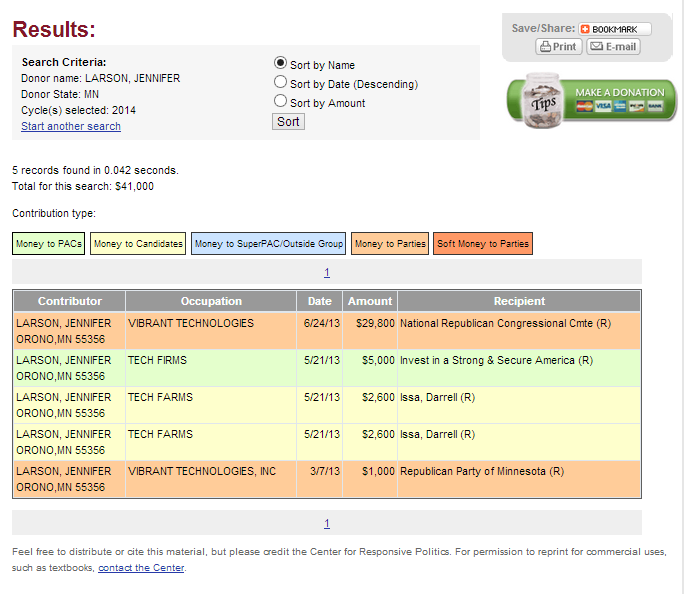
I recently wrote about what appears to be another hearing by the U.S. congress’ Committee on Oversight & Government Reform. If the internet chatter is to be believed, this hearing will be on the National Vaccine Injury Compensation Program. I also noted that internet chatter was pointing to $40,000 in donations made by one Jennifer Larson to the chair of the Oversight Committee. I could find $40,000 in donations from Ms. Larson this year, but I didn’t see the direct connection of the bulk of that amount ($29,800) to Congressman Issa. As I stated in One year and $40,000 later and another hearing:

I found a total of $40,000 donations to Congressman Issa, his PAC and the Republican National Committee though Ms. Larson and her company Vibrant Technologies (click to enlarge):

Larson-OpenSecrets

The bulk went to the Republican National Committee. I’d love to see what, if any, arrangements the RNC has to support Issa with those funds.

Well, I found out about the donation to the Republican National Committee. The Federal Elections Commission shows that that $29,800 donation was earmarked: JFC ATTRIB: DARRELL ISSA VICTORY FUND

larson RNC

Looks to this observer like those funds are going to support Congressman Issa through the “Darrell Issa Victory Fund“.

So we have funds donated to

Invest in a Strong and Secure America ($5,000) Darryll Issa’s political action committee.

Two donations of $2,600 to Darryll Issa directly

and $29,800 to the Republican National Committee, apparently to be used by the Darryll Issa Victory Fund.

As noted by frequent commenter lilady, Congressman Issa appeared at the AutismOne parent convention this year.

By Matt Carey

One year and $40,000 later and another hearing

14 Sep

Last year the U.S. Congress’ Committee on Oversight & Government Reform held a hearing. The buzz on the web was that this prompted by lobbying by people and groups who promote the idea that vaccines have caused the rise in autism diagnoses. In other words, the hearing was supposed to be a hearkening back to the “good old days” when the Committee under Dan Burton held hearings promoting the idea that vaccines cause autism. Instead, the hearing became “1 in 88 Children: A Look Into the Federal Response to Rising Rates of Autism“. The hearing originally did not include autistic representation but, after a phone/fax/email campaign, that changed. Ari Ne’eman of the Autistic Self Advocacy Network and Michael John Carley of GRASP were invited to speak. The Committee then were presented with the false dichotomy of “Parents who believe in the vaccine epidemic” vs. “Autistics who don’t and want a focus on improving the lives of autistics”. Also a long session where Members of Congress berated government public health employees.

All in all a waste of my tax dollars, if you ask me.

The people who lobbied for the hearing apparently were not pleased with various aspects of the hearing.

The buzz has been building that another hearing is in the works. We were told that $40,000 had been donated the Political Action Committee (PAC) for the chair of the Oversight committee, Darryl Issa. The original source for that information (Patrick “Tim” Bolen) is far (far, far, far) from reliable. Also, there are limits on campaign donations and it seemed unlikely to me that $40k could be donated to his PAC. But, with the chatter rising on the hearing to the point that people are claiming it is scheduled for November, I thought I’d check.

The donations were reported to have been made from Jennifer Larson, who is with the tiny “Canary Party”. Tax documents indicate that Ms. Larson is a large financial backer of the Canary Party. Searching for what donations Ms. Larson has made (using OpenSecrets.org, the Center for Responsive Politics) I found a total of $40,000 donations to Congressman Issa, his PAC and the Republican National Committee though Ms. Larson and her company Vibrant Technologies (click to enlarge):

Larson-OpenSecrets

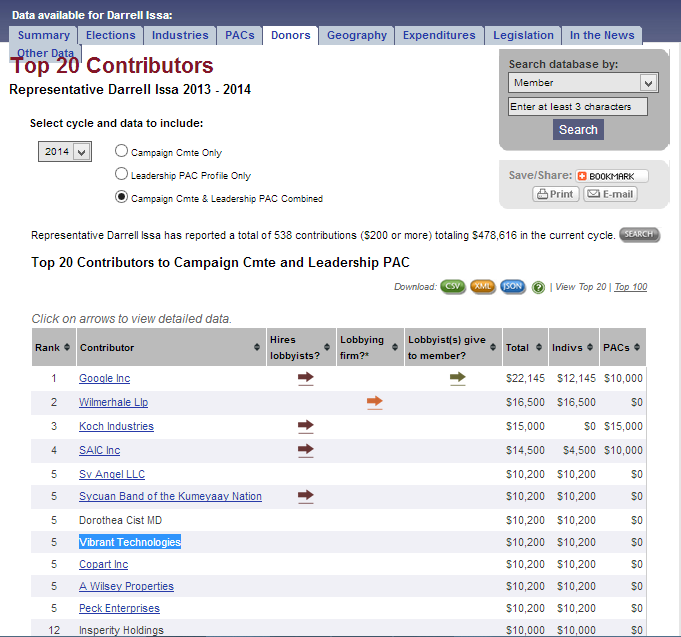
The bulk went to the Republican National Committee. I’d love to see what, if any, arrangements the RNC has to support Issa with those funds. If you think that the $10,200 given directly to ISSA and his PAC is not enough to get noticed, keep in mind that this is the 5th highest amount given to the Congressman this year (click to enlarge):

vibrant

Ms. Larson is quoted in a press release:

“We are thrilled that Rep. Darrell Issa will be holding a second round of vaccine hearings this fall in the Committee on Oversight and Government Reform, to examine just what is happening in the VICP,” said Canary Party President Jennifer Larson. “We are eager for Congress and the American people to see just how far the program has strayed from what it was intended to be when Congress put it in place in the 1980s. It has failed families and become nothing more than a tool to protect vaccine makers and cover government malfeasance in the vaccine program, to the detriment of countless children.”

Notice that the first hearing has been redefined. It wan’t about autism. I suspect in her view it never was. And that is sad. Last year’s hearing and the proposed hearing this year are about vaccines.

Last year’s hearing was preceded by donations from Gary Kompothecras (a Florida chiropractor) to Congressman Issa. Mr. Kompothecras was pictured at the hearing. If internet reports are to be believed, it appears that Mr. Kompothecras is part of the groups that split after the hearing last year. He has not donated this year to Congressman Issa or others on the committee. He and his wife did donate last year, about the time that it was reported that Congressman Issa agreed to hold the hearing.

If the buzz is correct, a hearing will be held soon. It won’t be about autism (and, thus, parents can be in the spotlight without sharing it with those inconvenient autistics). But, as we’ve seen, last year’s hearing wasn’t about autism either, right?

Did last year’s hearing have any impact on the lives of autistics? Can I say that my kid will have a better future because of that hearing? No. Absolutely not. Has congressman Issa joined the Congresional Autism Caucus? No. Has he sponsored or supported autism-relevant legislation? No. We have three bills, stalled in committee, one of which is a vaccine-study bill. None have his support.

And this year’s hearing will be even less relevant.

By Matt Carey