Archive | Thimerosal RSS feed for this section

Dan Olmsted – Autism’s Dick Tracy

2 Mar

Apparently.

Dan Olmsted, who writes for the Moonie owned UPI recently published another interminable piece in his ongoing series on autism (it isn’t really about autism, its about thiomersal causing autism but what the hell…)

In this one, he reveals the shocking results of his ongoing investigation into the private lives of the first set of Kanner’s patients and tries as hard as he can to draw a parallel between them and mercury. This time he’s struck the mother lode.

Patient Frederick W’s father is now identified as Frederick L. Wellman, a scientist who’s collection of papers ‘fill 18 boxes in the Special Collections Research Center at the North Carolina State University Libraries in Raleigh’.

The first item in the first folder in the first box is dated Spring 1922, when the senior Wellman was working toward his doctorate in plant pathology at the University of Wisconsin…..Wellman collected cabbage seeds infected with a common fungus and dunked some of them in a solution of mercury salts and hot water. “The lots treated with mercuric [chloride] were shaken vigorously at first to get thorough contact with the solution,” he wrote.

And that’s not all.

Case 1 grew up in a town called Forest, Miss., surrounded by logging camps, lumber mills, and a national forest being planted by the Civilian Conservation Corps. Forest is 50 miles from the Mississippi sawmills where ethyl mercury fungicides were first tested in the United States in 1929 to preserve lumber, a practice that quickly became widespread;

Case 3 was the son of “a professor of forestry in a southern university,” Kanner wrote….In 1936, he assisted in the planting of pine seedlings in the university’s newly acquired Hofmann Forest. His son was born in 1937. Organic mercury fungicides, including an ethyl mercury brand, were often used to prevent “damping off” or fungal contamination of pine seedlings during that era.

All this led Mark Blaxill of Antivax group SafeMinds to comment:

So now we have learned that Frederick Wellman handled ethyl mercury fungicides that were first introduced to the market in 1929 and that his child was Kanner’s patient No. 2….And we know that cases 1 and 3 grew up around the first application of ethyl mercury products. If that’s not a smoking gun, I don’t know what is…

A smoking gun. Impressive.

Except, lets apply a little less gasping credulity and a little more logic.

Fredrick Wellman’s documented use of ethyl mercury was 14 long years before his son was born. Does ethyl mercury have special time travelling properties no one told me about? And how exactly does Wellman Snr being associated with ethyl mercury lead to his son becoming autistic? By that logic every person who ever worked with ethyl mercury should both be autistic themselves and have autistic kids. Did Wellman inject the ethyl mercury into his scrotum?

And what was he doing during the year of his son’s birth? He wasn’t even in the country:

During most of 1936, Wellman was hunting exotic plant diseases in Turkey, Egypt, and Iran.

Case 1 ‘grew up’ (but where was he born?) 50 miles away from ethyl mercury. Everything else in that particular quote is supposition. Case 3’s Dad once planted seedlings that were planted about the same time that some fungicides that might’ve contained ethyl mercury might’ve been used. Thats a sight to may ‘might’ve’s for me.

Sorry, but this to me is not a smoking gun. Its not even a lukewarm barrell.

Another intriguing thing to note was that, in a follow up paper in 1971 Kanner found only two of his original eleven had had what he termed a favourable outcome. Those two were Wellman’s son and ‘case 1’. I’ll apply some Olmsted logic and conclude that the ethyl mercury obviously mitigated the worst of the ravaging effects of the hellish autism.

David Kirby’s Causation Trail

22 Feb

In a truly fascinating exchange on the Evidence of Harm Yahoo Group, David Kirby has revealed:

…the studies which, when taken together, suggest a plausible biological mechanism for mercury exposure as a contributing factor to regressive autism

The exchange came about as a ‘renegade’ poster to that group started laying down a smidgen of fact regarding the state of the science that props up the thiomersal hypothesis. S/he is not a popular bunny on that group.

The exchange led group big cheese Lenny Schafer to state:

It seems that junk science is in the eye of the beholder. It will probably take an impartial jury in a court of law to substantially settle if there is enough evidence of harm to implicate thimerosal and or vaccines in autism.

Seems like Lenny hasn’t been keeping up with the news in that regard.

Anyway, back to David Kirby. Hot on the heels of his amusing further goalpost shifting (somehow the non-decrease in autism numbers which, in 2005 and 2006 would be a grave blow to the thiomersal hypothesis are now suddenly nothing to trouble this teflon coated hypothesis) comes this – David Kirby’s statement on the existing studies which support mercury exposure (what? Not ‘MERCURY _IN VACCINES_ AND THE AUTISM EPIDEMIC: A MEDICAL CONTROVERSY’ David? Just any old mercury now is it? Bless you for exposing the courage of your convictions.)

So which studies float David’s boat? This is his list:

Richard Deth, Northeastern U;
Martha Herbert, Harvard U;
Jill James, Univ of Arkansas;
Thomas Burbacher, Univ of Washington;
Diana Vargas, Johns Hopkins;
Isaac Pessah, UC Davis;
Mady Hornig, Columbia U;
Mark Noble, Univ of Rochester.

Eight people, eight studies. Thise is the ‘science’ that David thinks suggest a plausible mechanism for mercury being a contributing factor for regressive autism.

As an amusing aside, don’t you love (and appreciate!) how careful David is becoming with his choice of words these days? No more of this ‘thiomersal causes autism’ stuff for him! Now its’mercury’ (not ‘MERCURY _IN VACCINES_ AND THE AUTISM EPIDEMIC: A MEDICAL CONTROVERSY’) and instead of ‘causing’ we have ‘contributing factor’ and instead of autism we now have ‘regressive autism’. best of all we have ‘suggest’ instead of MERCURY IN VACCINES AND THE AUTISM EPIDEMIC. Bless him, all the blog reading he’s been doing from the skeptical folks is finally paying off.

So, lets turn our attention to these studies of David’s. First of all we should note that the Mark Noble cite is a red herring (you lose skeptic points for that David) as, if I’m not mistaken, this study is a) a pilot study and b) not as yet underway. Certainly none of the other ten studies PubMed attributes to Noble, M. appear to discuss autism. Naughty naughty.

Richard Deth

Deth’s paper, if I may quote myself, can be summed up thusly:The basic gist of the Deth paper is that various toxins, including thimerosal, affect methionine synthase activity (a process that helps in building proteins) and that this can adversely affect children. In short, the Deth paper alleges that thimerosal causes methionine synthase dysfunction (MSD).

There are several issues with this as they relate to autism. Firstly, MSD and autism do not resemble each other. Symptoms of MSD are: Anemia, moderate to severe developmental delay, lethargy, anorexia, and homocystinuria (mental retardation, dislocation of the crystalline lens of the eye, sparse blond hair, and cardiovascular and skeletal deformities). Further issues:

1) There is no active transport mechanism into the central nervous system currently known for ethylmercury (thimerosal) whereas there is an known and active transport mechanism for methylmercury.
2) Because its half-life is much longer, methylmercury is more likely to accumulate than ethylmercury, causing higher levels of mercury in the blood.
3) Exposing cells in vitro to ethylmercury eliminates the most important difference between those two forms of mercury, and ignores the fact that ethylmercury is unlikely to enter the central nervous system at concentrations likely to be harmful.
4) The authors chose to use a cell line derived from a metastatic peripheral nervous system tumor to make predictions about developing healthy cells of the central nervous system. If the authors were interested in making claims about the developing central nervous system they should use cells derived from there.
5) The authors make statements in their introduction about developmental disorders such as fetal alcohol syndrome, Rhett’s syndrome, or Fragile-X syndrome, they fail to consider the fact that all of these diseases have their origins in the developing embryo and fetus, not postnatally.
6) The authors’ reference a study that evaluated the causal association between thimerosal and vaccines using the Vaccine Adverse Events Reporting System (VAERS). Remember how good VAERS is?

Bart Cubbins produced a video detailing similar points.

Martha Herbert and Dianne Vargas

These two papers independeintly of each other indicated a role for neuroinflammation in autism (<a href="http://www.generationrescue.org/pdf/herbert.pdf&quot; rel="nofollow"Herbert here and Vargas here but they differ slightly. The Vargas paper states:

neuroinflammatory process appears to be associated with an ongoing and chronic mechanism of CNS dysfunction

and leaves it at that. Herbert specualtes with no basis regarding the fact that metals might play a part in the neuroinflammation. She has no basis for these speculations and it surprises me that they’re in a paper published in such a good journal.

Jill James

Jill James’s studies revolve around glutathione. Glutathione, amongst other things, removes merucry from the human body. James’ studies purport to show that autistic people are deficient in Glutathione and thus when they get mercury they can’t excrete it in the same way non-autistic people do.

However, they don’t. James tried to show that the two types of Glutathione in the body (what she called Active and Inactive) were about 31% (Active) and 33% (Inactive) less in autistic kids than non-autistic kids. However, it should be noted that these are not two differing forms of Glutathione but instead two states of one thing which have a relationship to each other – when one goes up, the other goes down. As Not Mercury states:

Decreased synthetic capability is one possible explanation but this would probably result in a significant deficit of total glutathione not an imbalance between the two oxidation states. _If James found any evidence of impaired glutathione synthesis in this small group of children it wasn’t included in any of her published work_. It doesn’t sound like the children were suffering from a glutathione deficiency as much as an increased oxidative burden greater than the capacity to recycle and glutathione and maintain full oxidative defense capacity.

No deficiency in Glutathione. But Not Mercury takes it a step further:

let’s suppose children with autism had significantly lower levels of glutathione. Would it render them unable to detoxify thimerosal from vaccines? Probably not.

The average human carries about 6milligrams mercury, even if James’ figures were accurate (which they are clearly not) or represent what she claims they do (which they clearly don’t) then the human body would still have several million times more glutathione than needed to excrete the suspect mercury. As Not Mercury says:

A person so severely deficient in glutathione they would be unable to detoxify 250 micrograms of mercury (upper limit of thiomersal in vaccines 5 years ago) probably wouldn’t survive long enough to be vaccinated in the first place. Every breath of air would expose them to lethal levels of ozone, pollutants and other oxidants.

Please read all of Not Mercury’s piece. It’s an eye opener.

Thomas Burbacher

This paper reached one conclusion.

The key findings of the current study are the differences in the disposition kinetics and demethylation rates of thimerosal and MeHg. Consequently, MeHg is not a suitable reference for risk assessment from exposure to thimerosal derived Hg. Knowledge of the biotransformation of thimerosal, the chemical identity of the Hg-containing species in the blood and brain, and the neurotoxic potential of intact thimerosal and its various biotransformation products, including ethylmercury are urgently needed to afford a meaningful interpretation of the potential developmental effects of immunization with thimerosal-containing vaccines in newborns and infants. This information is critical if we are to respond to public concerns regarding the safety of childhood immunizations

In other words, Burbacher blood vs brain is not a valid comparison and that methHG vs ethHG is not valid either. He then goes on to state that more research is needed into what the toxic effects of thimerosal might be. He states that mercury from vaccines doesn’t accumulate as much in blood as it does in the brain and thusly, using blood levels of mercury to represent brain levels of mercury is innacurate.

It was also presented that this paper connected the dots between thiomersal and neuroinflammation (see Herbert and Vargas) but this is a false representation and not claimed or even insinuated by Burbacher.

Two more issues arose from this paper. Firstly, when the Burbacher team performed the extraction of mercury from the blood or brain matter, they failed to introduce controls to ensure that the thimerosal was not degraded in any way as a result of the extraction process. This means they had to basically assume from the resultant possibly contaminated material how much was attributable to methylmercury and how much to thimerosal (ethylmercury). Secondly, Burbacher used thimerosal free vaccines and added pure thimerosal. It is difficult to know how this fresh preparation compares with vaccine formulas when thimerosal is part of the manufacturing process and may have suffered some degradation to inorganic Hg in the vials before administration.

Issac Pessah

The Pessah paper related how the study team found that thiomersal administered to mice caused “dendritic cells” damage. Specifically:

the thimerosal disrupted the normal biological signals that take place in cells, Pessah said. At lower concentrations, the signal disruption caused an inflammatory response; at higher concentrations it caused cell death.

So the position here is that thimerosal has a negative effect on the immune system. Lots of parents think autism is immune-system related. However, this study is a) unreplicated (as far as I know) and b) we may be overestmating the real world effect. Here’s Autism Diva talking about hearing Pessah on Autism One radio.

But the really weird thing is how he described how long the effect would last when the dendritic cells came into contact with mercury. If Autism Diva understood him correctly, lets say a kid gets injected with a vaccine containing thimerosal and the dendritic cells that come into contact with the thimerosal. This is not necessarily all the dendritic cells–some of them, and the DCs are affected by the thimerosal, depending on how much thimerosal they come into contact with. And this effect lasts…. years and years? Is that what he said? No.

Was it months and months? Is that what he said? Maybe it was days and days? Hours and hours? No, actually, what he said, if Autism Diva heard him correctly, was “minutes and minutes.”

So, we know that if you take dendritic cells of a particular kind out of a mouse, and grow them in a glass dish and dump a weak solution of thimerosal on them, they freak out or get a little weird and either way can’t do their job normally, and this effect lasts for,

(gasp)

minutes and minutes.

And speaking of Autism Diva we come around to:

Mady Hornig

Briefly, Mady Horning conducted a study wherein she claimed to have developed a mouse model for autism which she then used to test how the model responded to the introduction of thiomersal. According to Hornig, the study showed that:

1. The mice they used are a good model for autistic people
2. The ‘vaccine’ schedule they used successfully mimicks childhood immunization programs
3. That the outcomes from Auto-immune disease sensitive mice were consistent with autism
4. That this indicates a genetically influenced sensitivity to thimerosal in autistic people

Autism Diva took this study apart when she pointed out that:

Did Dr. Hornig and colleagues find these features [diagnostic criteria for autism] in the ‘SJL Thim” mice?’ No.

Prometheus also had reservations about the design of the study:

So, the human experiences a maximum blood level of 1.63 (arbitrary units) and the mouse – since it is being dosed at a smaller fraction of its half-life – sees a maximum blood level of 2.61. In short, the mouse gets to a blood level 60% higher than the human……I found myself wondering, “Why didn’t they use the 50th percentile (50% weigh more than this weight, 50% weigh less – sort of an ‘average weight’)?” I have no answer – but I have an idea. By using the 10th percentile, they were able to give the baby mice an even bigger dose of mercury……So, by using the 10th percentile weights, the authors were able to give the mice about 15% more thimerosal. This goes nicely with the dosing schedule to significantly raise the dose the mice receive.

One of the big talking points from this study was reported by David Kirby in Evidence of Harm:

… putting up a photo of two mice. “He has groomed through the skull, and eventually destroys his partner,” Hornig said. Every parent of an autistic kid in the room could be seen grimacing in dark recognition of such destructive behavior.”(page 312)

Uh-huh, or maybe they were just grimacing as its not nice looking at mice chewing through the skulls of other mice?

Anyway, hyperbole aside, why did Hornig choose those particular mice? Here’s what else Autism Diva found out.

Why did Hornig pick the SJL/J mice in particular?….Besides being an “autoimmune disease-sensitive” breed what else is known about the SJL/J mice?

Good question. Diva found the answer highly revealing:

Behavior
1. High spontaneous fighting….
2. Severe fighting among males housed together, beginning at about 8 weeks.
3. Most males will be killed by 4-5 months unless caged separately….

Diva also found a separate source that showed that:

…some breeds do a kind of agressive grooming of other mice called, “barbering”

So, it seems that Hornig sourced a set of mice known to be aggressive, she then systematically overdosed them and then reported the fact that this aggression was indicative of autism. Right.

Wrapping It Up

A study that hasn’t yet been done. A study that alleges something it can’t back up. A study with no data and empty conclusions. Two studies that have nothing discernable to do with heavy metals. A study that shows ethylmercury and methylmercury are not comparable. A study that damages cells taken from a mouse for the span of minutes and a study that purposefully overdosed mice known to be aggressive.

Lets remind ourselves of the Judge;s opinion of this same body of science when it was presented by Dr Geier in the RhoGAM hearings as support for the view that thiomersal causes autism:

…the Court notes that, in fact, a literature review can be an appropriate part of a method of determining general causation. However, a literature review must still be performed appropriately. As revealed by his testimony at the Daubert hearing, Dr. Geier, however, relied upon a number of disparate and unconnected studies, including the findings of Dr. Haley and Dr. Lucier, to reach a piecemeal conclusion with respect to general causation…..However, upon being subjected to extensive cross examination, much of Dr. Geier’s analysis, based upon his collective review of a motley assortment of diverse literature, proved, in the Court’s view, to be overstated.

Jeff Bradstreet deserts the sinking ship

12 Feb

Cast you mind back, dear Reader, to July last year when the RhoGAM ruling failed to find general or specific causation for thiomersal causing autism. That little episode has taken a heavy toll on the ‘expert witness’ status of both Mark Geier and Boyd Haley, both of whom were eviscerated by the presiding judge.

But, hey, at least they had the guts to stick around. Some people decide to do a runner at the first sign of trouble.

Enter Jeff Bradstreet, advocate of <a href="exorcism (yes, really) for treating autism.

In September of 2006, Bradstreet was the designated ‘expert witness’ in a case of Aventis Pasteur, Inc. v. Skevofilax, the latter being a family that filed suit on the claim that:

…their minor son’s autism was caused by toxic levels of mercury contained in thimerosal, a preservative used in the vaccines.

This trial ended abruptly when:

After three amended scheduling orders and nearly eleven months of discovery, Respondents’ sole expert on specific causation withdrew from further participation in the case without ever having rendered his expert opinion.

There’s a lot of legal stuff going on in the background of this case regarding whether it was right to hold the Skevofilax’s responsible for the failure of the case. The first trial said it was, they appealed and the appeal judge supported this appeal and now this summary judgement has reversed the appeal.

However, what I’m really interested in is _why_ the ‘expert witness’ failed to materialise.

James Jeffrey Bradstreet, M.D., was designated to testify to specific causation, i.e., “that significant amounts of mercury to which the minor plaintiff was exposed, including bolus doses received as a result of vaccination, was a substantial factor in causing [Michael’s] current injuries and symptoms,” and further, “that the exposure to toxic levels of mercury within the vaccines [was] a substantial contributing factor to the minor Plaintiff’s ultimate injuries and symptoms.”

But what happened? Why did Bradstreet never testify?

On 26 October 2004, Respondents notified Petitioners, by letter, that “due to unforeseen circumstances [genomic profiling] test results critical to [Dr.] Bradstreet’s opinions” would be delayed up to sixty days. The relevant genomic susceptibility tests assertedly needed for Dr. Bradstreet’s expert medical opinion were being performed by a laboratory at the University of Arkansas. An affidavit completed by Dr. Bradstreet stated that an outbreak of leukemia in New Mexico caused the Arkansas lab ‘s director, Dr. Jill James, to be called out of town to consult on that outbreak, and that she would not be returning for several weeks. Drs. James and Bradstreet previously had collaborated on other projects. According to Dr. Bradstreet, he would be unable to formulate an expert medical opinion regarding causation specific to Michael’s injuries until the results of the genetic test results were received fro m Dr. James’ lab

Who else is rolling their eyes right now? Apparently, these ‘tests’ can only be performed by Jill James lab. And only by Jill James herself (I assume the other employees are useless?). There’s further no evidence to assume that these tests provide evedence of anything anyway and apparently the dog once ate his homework.

So, respondents and plaintiffs argued over a new schedule and a new schedule had to be enforced by the court in the end and Jeff Bradstreet was once again instructed to be made available for deposition, this time on 19 Nov 2005. Subjects at that deposition concerning Bradstreets role as an expert witness would include:

[a]ppropriate topics of inquiry for this deposition, [were to] include, but not be limited to, the nature and purpose of the GST [glutathione-S-transferase, a particular family of enzymes in the human genome] M1 [a particular gene which encodes the GST enzyme] polymorphism [i.e., difference or variation] test, the work that Dr. Brad street [had] performed to date in this action, his qualifications, his affidavit submitted in connection with Plaintiff ‘s Motion for Continuance, all of his opinions on the subject of general causation, and the results of those tests that Dr. Bradstreet [had] performed or directed to be performed and that [were] available as of the date of [the] initial discovery deposition.

In other words, a thorough examination of the man, his qualifications and the quality of his science.

But, the court decided if the results of his tests of unknown origin or efficacy that could only be performed by Jill James at Jill James lab ‘became available’ (snigger) then:

Dr. Bradstreet would be made available for additional discovery by no later than 14 January 2005 in order to explain how those results pertained to his expert opinion regarding specific causation.

And then (gasp!) the court received the following:

Counsel for Respondents informed the Circuit Court and opposing counsel, by letter dated 23 November 2004, that Dr. Bradstreet declined to participate further in the litigation. According to Respondents’ counsel, Dr. Bradstreet withdrew due to outside “professional and personal commitments and time constraints.

According to Bradstreet:

…the primary reason for his withdrawal was the impact the time commitment would have on his ability to spend time with his family.

So either he had no family before the start of proceedings or he forgot he had a family and then remembered or…oh hell, I don’t know…but strangely, Bradstreet was not to busy to speak at The Autism One conference in May 2005, or May 2006, or to attend and speak at a conference of the American Dietetic Assoc in October 2005.

I guess ‘too busy’ depends pretty much on how much money each gig pays and how often difficult questions are asked.

The end result for the Skevofilax’s?

Despite three amended scheduling orders, and approximately 11 months allotted to conduct discovery, Respondents failed to produce an expert who could testify to specific causation within a reason able degree of scientific certainty. Without such an expert, Respondents’ claims must fail as a matter of law.

Bradstreet hung them out to dry and they couldn’t find anyone else prepared to take on causation.

Thanks to A for the file :o) .

Rosie O’Donnell vs Evidence of Harm

4 Feb

I have to admit that before this whole thing kicked off, I didn’t really know who Rosie O’Donnell was (I do now so no need for explanations :o) ) and that my first real knowledge was David Kirby’s recent Huffington Post blog entry wherein he describes being invited to a show called The View that Ms O’Donnell presents….and how put out he was that the great DK did not actually end up being called upon to impart his wisdom:

During the breaks, however, I could hear women in the audience murmuring to each other: “But what causes it? Why so many children? What about mercury? How can I get more information?”

Yeah. I’ll bet.

My head spun as the show wrapped up. Had The View finally squelched Rosie O’Donnell? Did mercury trump Trump? Was this the heavy metal that dare not speak its name, at least on a network flush with Pharma ads?

Oho….from what I can gather, Ms O’Donnell is about as outspoken as you can get, even by American standards. Kirby thinks that she’s been ‘got at’ by the Pharma’s.

Over on the EoH Yahoo Group, opinions on Ms O’Donnell were changing from ‘I love Rosie’ to:

I used to be a Rosie Supporter but for some reason, she doesn’t really want to talk about Causation! Who is paying her!

Let’s be clear here. When someone who frequents the EoH group talks about ‘causation’ they really mean thiomersal. There’s a whole bunch of pissed off people here because Ms O’Donnell didn’t venerate David Kirby and wasn’t interested in the thiomersal issue. And why wasn’t she interested in the thiomersal issue?

Because its crap maybe?

No, couldn’t be that:

Too bad our kids are autistic and not gay….We could have show after show on anything we wanted.

I subsequently learned Ms O’Donnell is gay. How unnerving to discover John Best isn’t the only homophobe on EoH.

Ms O’Donnell also has a blog which the EoH members flocked to in an effort to wring ‘the truth’ (you know that evil Pharma had ‘gotten to’ her). The lovely Erik asked her:

Rosie, “The View” avoided any discussion of Autism’s causality, and only picks orgs as resources who have no interest in the thimerosal controversy. Why? Have you been pressured?

To which Ms O’Donnell answered, fairly unequivocally:

pressured? by who
listen
I ROSIE ODONNELL
chose not to do causation
ME

Over on Conspiracy theory Central EoH Roger asks:

Why do we think that the author of these messages is actually Rosie?

Woooo – scary! Good ol’ list Daddy, Lenny adds:

She has a pronounced style. It would not be so hard to do her.

So, here’s Ms O’Donnell not venerating at the feet of David Kirby – this must be a conspiracy. And here’s Ms O’Donnell having her blog authored by Shadowy Figures……I can almost feel the Black Helicopters taking off, can’t you?

In an amusing side issue, the Arthur Allen book, Vaccine was also being discussed on EoH and the members were taking extreme umbrage at being described as:

“much of the “antivaccinist” leadership is composed of countercultural types who view life through the prism of conspiracy
theory: the government lies, the drug companies are evil, the medical profession is corrupt; trust the Internet instead.”

Which characterisation was described as ‘grossly unfair’ by several EoH members. Yeah, how unfair to suggest people who accuse people of Big Pharma gaggings and ghost written blogs as being into conspiracies. How could they come to _that_ conclusion eh?

What’s the actual issue here? According to mainstream reports I’ve read it was a good program that focussed on awareness and adult services. Here’s the unvarnished take an awareness from EoH:

I am so tired of awareness. We are more than aware of autism. We are so over awareness. I understand that her friends children may be young and they are not as far along as we are.

and

I don’t give a shit if my neighbor is enlightened- I want my son to stop banging his head on the floor (my son doesn’t do that anymore- but just as an illustration)

Here are some other commenters from Ms O’Donnell’s blog. Lets hope EoH’ers can someday see why they are true:

You do a wonderful show on autism – whole show – compassionate – building awareness – yet you get critical letters – Look at what you DID do – some people are never happy. Thanks for not giving up.

Rosie – Everyone keeps coming after you for not speaking of causation on the autism show. No one is mentioning that thimerosal has been removed from shots, but autism diagnosis haven’t declined.

Have you read David Kirby recent blog? As a mom of a 5 year old son with autism I think you guys did a wonderful show. Let’s focus on the good

My nephew is severely AUTISTIC -doesn’t speak most of the time- HE HAS HAD NO SHOTS –

People don’t get it. On Autism. Awareness is about enlightening. Cause is looking for blame. Awareness is light and moving forward. Blame is being stuck.

As a health educator/parent of 2 boys with autism, I applaud you on NOT getting into the causes, as no-one is sure of the one or more ways children get autism, its important to understand their world.

Please people – get over it – it didn’t happen. Stop feeding money to quacks. Your kids are going to need a parent focussed on _them_ , not on their own needs to fuel a conspiracy theory because they are stuck in guilt and blame. Your kids are autistic. It wasn’t your fault. It wasn’t your doctors fault. It wasn’t Pharma’s fault. This is just they way life is.

Guest Blogger on CDDS

31 Jan

Manipulating CDDS - guest blogger Dr Nick Riviera

Hi Everybody!

Wow! OK, so here I am again – I’m Dr. Nick Riviera, and I will perform any major operation for just 129.95!

So today I’m supposed to tell you about CDDS data and how, just like VAERS, you can use it to say anything really. And hey – if there’s any Autism Omnibus lawyers reading – You don’t have to make up stories here. Save that for court.

Now there’s this guy called David Kirby who once said that CDDS was the gold standard of autism epidemiology (long word friends – just means numbers) but it seems that now, after the numbers started to disagree with his hypothesis (long word friends – it just means any old thing you want to make up) that they’re suddenly not so important. That makes perfect sense to Dr Nick friends – who wants to be caught right? In fact, Mr Kirby – did you go to Hollywood Upstairs Medical College too?

So, I wanna show you some more number examinations from CDDS – see what you think of them friends.

OK, so, the autism epidemic is thought to be demonstrated by the ever-increasing number of entries to the 3 – 5 age group (side note: the sci-guys only had 1.9% of mercury containing vaccines available by Feb 2002 and the 3 – 5 year olds are still increasing….even Dr. Nick can make the obvious conclusion from _that_ fact friends).

Those people who think that there _isn’t_ an epidemic say that the increase is just due to diagnosis catching up to the actual rate.

Those who say there _is_ an epidemic (man this is tiring) say, if that’s true where are all the older autistics? Some say there can’t be any autistic people over 75 as Eli Lilly invented autism in 1931.

Dr. Nick presents his first graph – ta da (click for bigger version)!

CDDS numbers for 62 - 99 year olds

This is 62 – 99 year old autistic people in CDDS from 1992 – 2005. First thing that seems pretty clear, even to Dr Nick, is that having a reporting category that goes up to 99 years old takes care of the claim that autism was invented by Eli Lilly in 1931.

But _man_ look at that graph – look at that rate climb! Just for your information friends, what you’re looking at there in the 62 – 99 category is a 16 times increase. Woah.

OK! Next graph friends – (click for bigger again, you get the drill right?)

CDDS numbers for 52 - 61 year olds

So this one shows 52 – 61 year olds in CDDS. Another pretty impressive climb there friends! This one shows a 15 times increase. Phew!

So what about the 3 – 5 year old category? They key category? Well this is where Dr Nick gets a bit confused friends. Here’s the graphs (clicky!!)

CDDS numbers for 03 - 05 year olds

So this one shows a climb too but – I dunno – what about the rate of increase? Well, unlike the 62 – 99 year olds which showed a 16 times increase (the biggest of all categories) and unlike the 52 – 61 year olds which showed a 15 times increase, the 3 – 5 year olds showed a 12 times increase.

So from what Dr Nick can _tell_ – it would seem that the age category that’s made the biggest gains since 1992 would be the 62 – 99 year old group.

Damn, Dr Nick just had a delivery of sun cream to put into medicinal looking bottles as well.

David Kirby/Arthur Allen Debate Part III

24 Jan

“It’s understood that Hollywood sells Californication”
~ Red Hot Chilli Peppers

In this section I want to look at Kirby’s presentation regarding what he terms as the first of seven skeptical rebuttals to the autism/thiomersal hypothesis. He says that skeptics say:

Hmm. Not really. I think most people are agreed that autism is a ‘mix’ of genes and environment. However, this is a popular and recurring strawman from the anti-thiomersal hypothesisers – that thiomersal and environment are interchangeable. They’re not. Maybe ice cream is the environmental trigger for autism. What science _is_ pretty sure about however, is that thiomersal (i.e. one _possible_ environmental ‘trigger’) is _not_ in the frame. So straight away we can see the Kirby is proceeding from a misleading position. If his argument is so strong, why does he feel the need to do this I wonder?

However, the point Kirby is (misleadingly) making is to try and push the idea of there having been an epidemic. Lets see how he does this.

(A lot of the next section has been amply covered by Mike – I won’t repeat his work)

NB: The years Kirby refers to here are between 1988 – 1992.

Guess what else happened around that time?

In 1987, one year before the time period Kirby is talking about, the DSM (III-R) was published. This was a revision to the previously published (1980) DSM (III). Here’s what the DSM (III) criteria was for what it called ‘Diagnostic criteria for Infantile Autism’- this is in full by the way:

A. Onset before 30 months of age

B. Pervasive lack of responsiveness to other people (autism)

C. Gross deficits in language development

D. If speech is present, peculiar speech patterns such as immediate and delayed echolalia, metaphorical language, pronominal reversal.

E. Bizarre responses to various aspects of the environment, e.g., resistance to change, peculiar interest in or attachments to animate or inanimate objects.

F. Absence of delusions, hallucinations, loosening of associations, and incoherence as in Schizophrenia.

So that is the sole and only reference for autism in 1980. Next up, this is the 1987 revision – DSM (III-R):

Diagnostic Criteria for Autistic Disorder

At least eight of the following sixteen items are present, these to include at least two items from A, one from B, and one from C.

A. Qualitative impairment in reciprocal social interaction (the examples within parentheses are arranged so that those first listed are more likely to apply to younger or more disabled, and the later ones, to older or less disabled) as manifested by the following:

1.Marked lack of awareness of the existence or feelings of others (for example, treats a person as if that person were a piece of furniture; does not notice another person’s distress; apparently has no concept of the need of others for privacy);

2. No or abnormal seeking of comfort at times of distress (for example, does not come for comfort even when ill, hurt, or tired; seeks comfort in a stereotyped way, for example, says “cheese, cheese, cheese” whenever hurt);

3. No or impaired imitation (for example, does not wave bye-bye; does not copy parent’s domestic activities; mechanical imitation of others’ actions out of context);

4. No or abnormal social play (for example, does not actively participate in simple games; refers solitary play activities; involves other children in play only as mechanical aids); and

5. Gross impairment in ability to make peer friendships (for example, no interest in making peer friendships despite interest in making fiends, demonstrates lack of understanding of conventions of social interaction, for example, reads phone book to uninterested peer.

B. Qualitative impairment in verbal and nonverbal communication and in imaginative activity, (the numbered items are arranged so that those first listed are more likely to apply to younger or more disabled, and the later ones, to older or less disabled) as manifested by the following:

1. No mode of communication, such as: communicative babbling, facial expression, gesture, mime, or spoken language;

2. Markedly abnormal nonverbal communication, as in the use of eye-to-eye gaze, facial expression, body posture, or gestures to initiate or modulate social interaction (for example, does not anticipate being held, stiffens when held, does not look at the person or smile when making a social approach, does not greet parents or visitors, has a fixed stare in social situations);

3. Absence of imaginative activity, such as play-acting of adult roles, fantasy character or animals; lack of interest in stories about imaginary events;

4. Marked abnormalities in the production of speech, including volume, pitch, stress, rate, rhythm, and intonation (for example, monotonous tone, question-like melody, or high pitch);

5. Marked abnormalities in the form or content of speech, including stereotyped and repetitive use of speech (for example, immediate echolalia or mechanical repetition of a television commercial); use of “you” when “I” is meant (for example, using “You want cookie?” to mean “I want a cookie”); idiosyncratic use of words or phrases (for example, “Go on green riding” to mean “I want to go on the swing”); or frequent irrelevant remarks (for example, starts talking about train schedules during a conversation about ports); and

6. Marked impairment in the ability to initiate or sustain a conversation with others, despite adequate speech (for example, indulging in lengthy monologues on one subject regardless of interjections from others);

C. Markedly restricted repertoire of activities and interests as manifested by the following:

1. Stereotyped body movements (for example, hand flicking or twisting, spinning, head-banging, complex whole-body movements);

2. Persistent preoccupation with parts of objects (for example, sniffing or smelling objects, repetitive feeling of texture of materials, spinning wheels of toy cars) or attachment to unusual objects (for example, insists on carrying around a piece of string);

3. Marked distress over changes in trivial aspects of environment (for example, when a vase is moved from usual position);

4. Unreasonable insistence on following routines in precise detail (for example, insisting that exactly the same route always be followed when shopping);

5. Markedly restricted range of interests and a preoccupation with one narrow interest, e.g., interested only in lining up objects, in amassing facts about meteorology, or in pretending to be a fantasy character.

D. Onset during infancy or early childhood

Specify if childhood onset (after 36 months of age)

Slight difference huh? Of key importance – in 1980 we only had ‘infantile autism’. In 1987, we had ‘autistic disorder’.

The DSM (III-R) is a quantum leap in diagnostic precision (far from perfect of course and as we all know the DSM (IV) came along in 1994 and the DSM (IV-R) came along in 2000) but surely it is blindingly obvious what a massively more accurate and precise set of criteria must mean – better recognition. More diagnosis.

Now Kirby says that this increase ties in to the ‘spike in mercury in vaccines’ over the same time period. Could be. But lets _also_ not forget that – as Kirby says in this debate – you need clinical science to support a clinical idea such as thiomersal causing autism.

Nine years now and there is _not one_ paper that even suggests that the symptoms of autism can be attributed to thiomersal (or MMR, or both together come to that). Nine years. In terms of science this hypothesis has four papers that might be considered of publishable quality. One shows that if you take a strain of mice known for aggressiveness and severely overdose them with thiomersal then they get more aggressive. Another shows that if you take a control group high in mercury levels and compare them with new born babies then the babies will look like poor excretors of mercury. The third shows that ethyl mercury and methyl mercury cannot be used to represent each other. The last one shows that thimerosal might cause methionine synthase dysfunction (MSD) – a condition that bears no resemblance to autism.

So here we are with the thiomersal hypothesis resting squarely and solely on epidemiology. Once upon a time, Kirby said CDDS epidemiology was ‘the gold standard’ – now he says its not enough. However, make no mistake. Epidemiology is all this hypothesis has.

So what is the state of this epidemiology? Is it of good quality? Well, no. As Mike has shown (see link above) Kirby’s presentation numbers are awful. As I have shown, his opinion of CDDS fluctuates depending on whether the numbers work for him or not and as Jospeh has shown, his new source is equally as badly reported on as his initial take on CDDS was.

Another example of the epidemiology not only not working for Kirby but being actively manipulated is this:

Have a close look at that graph. Remember in the previous slide Kirby said that the biggest increase in thiomersal was between 1988 and 1992. Take a close look at the dates in _this_ slide. They start in 1993. That’s pretty misleading Mr Kirby. Tut-tut-tut.

Also in this slide I want you to notice that according to this data that Kirby is using, the numbers are continuing to climb in 2001, 2002 and 2003. However, we know from a recently discovered CDC set of meeting minutes that according to a survey, in September 2001, only 5.6%1 of _all vaccines_ contained thiomersal. By Feb 2002, only 1.9% of _all vaccines_ contained thiomersal.

So apparently, Mr Kirby is happy to use data from two sources that shows an increasing amount of autism. CDDS and IDEA data. Both show climbing autism against a backdrop of miniscule amounts of mercury in the general population.

Danger, Will Robinson. Does not compute.

(More Californication to come soon….stay tuned…)

David Kirby/Arthur Allen Debate Part II

22 Jan

Once upon a time, there was a man called David Kirby and he came to believe in a certain hypothesis so much that he wrote a book called ‘Evidence of Harm: _MERCURY IN VACCINES AND THE AUTISM EPIDEMIC: A MEDICAL CONTROVERSY_’ and this man wrote lots of blog posts that he never discussed on his blog and eventually he also agreed to a debate and this debate was called ‘Vaccines and Autism, Is There A Connection’.

The man made an opening statement which outlined his beliefs and these were….

Woah there…._’both in vaccines and in the environment’_ ? Where did that come from? How did this man who wrote a book who’s strapline talks solely about vaccines and who is participating in a debate who’s title refers solely about vaccines suddenly think it was OK to start talking about ‘the environment’.

Now, don’t get me wrong – he may be right, he may be wrong. That is not the point. The book and the debate are about the _vaccine_ hypothesis. Didn’t this debate have moderators?

Woah!!!! What the hell…? The first part of that little soliloquy is fine, but then….ah, lets look at it written down:

_”I’m not here to say thimerosal causes autism, I’m not here to say thimerosal is the only cause of autism. We don’t know what causes autism. But there’s evidence to suggest that **mercury** is one of the culprits in at least one of the cases…**and that’s what we’ll be looking at today.**”_

So David Kirby, all by himself, has abandoned the agenda and decided to stop talking about vaccines in particular and start talking about mercury in general. Did anyone stop him? Didn’t this debate have moderators?

This is getting ridiculous. Why are ‘we’ talking about four different types of mercury. This debate is about _vaccines_ (or that’s what I once thought – that’s what the PDF advertising said – it did, didn’t it? I didn’t hallucinate it did I?) and that means just _one_ type of mercury. Thiomersal. Thimerosal. Ethyl. That’s it. One. Not four. Hello?

Well, kudos for saying it publicly Mr Kirby. In future parts of my look at this debate I’ll be seeing why it doesn’t matter……oh wait….wait, here we go:

Now lets make sure we understand this. In July of 2005, Kirby wrote a Huffington Post entry that talked of these same California numbers in rather different terms:

The Golden State, however, is said to operate the gold standard of autism epidemiology, having always tracked “full-blown” autism only, as defined by the DSM-IV manual. In other words, children with milder forms of the disorder, such as PDD and Apserger Syndrome, need not apply for services. This means that nearly two decades of rising cases in California cannot be attributed to wider diagnostic criteria. The autism epidemic is real.

Hmm. So in 2005, California epidemiology (the gold standard according to Kirby) is good enough to declare ‘the epidemic real’ but in 2007, its not enough to disprove the epidemic when the numbers don’t go your way.

So why is the drop in numbers such a potential bombshell? Because children entering the system today were born in 2001 and 2002, soon after the mercury-based preservative thimerosal began to be phased out of pediatric vaccines in the United States. In California, fewer children with full-blown autism entered the system in 2003 than in 2002……Stay tuned. If the numbers in California and elsewhere continue to drop – and that still is a big if — the implication of thimerosal in the autism epidemic will be practically undeniable.

Hmm. So in 2005, if the numbers ‘continue to drop’ then ‘the implication of thimerosal will be practically undeniable’, but in 2007 when its quite clear the numbers are not dropping and never actually did then the reverse implication – that thiomersal is _not_ implicated in autism -cannot be true.

Weird. Some people might call that hypocrisy.

The next section of the debate has been expertly blogged by Mike. Go have a read. You should also read Joseph’s demolition of David Kirby’s latest epidemiology and Dad of Cameron’s look at Kirby’s grasp of science.

David Kirby/Arthur Allen Debate Part I

15 Jan

ACIP Meeting Minutes, Feb 2002

It’ll be Part I because after the debate video is released I’m sure there will be more to come. This post will concentrate on the pre-debate interview involving both people on Fox and the words of several audience members.

OK, so, first lets look at the joint interview on Fox.

When asked what the issue was with vaccines Kirby replied that it was because up until _”very recently”_ , _”most”_ vaccines contained thimerosal. This is incorrect. Unless your definition of ‘very recently’ is five years ago and your definition of ‘most’ is between 2 and 5 % then its incorrect. Note that I am choosing to believe Kirby is simply incorrect and a sloppy researcher rather than a good researcher who knew about a document we’ll discuss shortly and elected to suppress his knowledge of it.

Kirby’s next error is when he makes reference to the ‘epidemic’ – he says in the the 90’s we start to see the number of autism cases really start to climb and that it ‘almost tracks exactly’ with the addition of thiomersal containing vaccines. This isn’t an error. Kirby knows this isn’t the case. He knows the ‘science’ that argues this hypothesis is poor, published in non peer reviewed, bad quality journals by people who utilised poor data sources.

However, this sentence also damns Kirby to sticking with those sources. If he wants to quote them to back up his points then he needs to realise you can’t simply abandon them when they don’t – and one of those sources is CDDS, and CDDS has very recently contradicted Kirby.

Kirby then proceeds from one error to another. He states that the symptoms of mercury poisoning are very similar to the symptoms of autism. They aren’t.

At what point do these errors that are stacking up become outright lies and dishonesty? I’m not sure but its a pretty fine line.

About a minute and 40 seconds into the interview, Kirby debuts his new adjusted hypothesis. He mentions all the ‘environmental mercury’ and makes special mention of California in order to challenge the CDDS stats I would assume.

Now excuse me if I’m wrong but isn’t the strapline to Kirby’s book _”MERCURY IN VACCINES AND THE AUTISM EPIDEMIC: A MEDICAL CONTROVERSY”_?

It is. So what’s with the sudden interest in ‘environmental mercury’. This interview was booked regarding the upcoming debate with Arthur Allen about the _vaccine_ hypothesis – the hypothesis Kirby made the central subject and content of the book. In this context I’m utterly uninterested in this new, competing theory. Stick to the subject would be my message and stop building convenient strawmen. More about this later too.

About three and a half minutes into the interview Arthur Allen gives Kirby a bit of a shock. He mentions the 2% figure I mentioned at the top of this post.

Let’s make sure we know what we’re talking about here. To do that we’ll skip forward to some remarks made by an EoH Yahoo Group member who attended the debate. These are her words about what Kirby had said.

We do not know when 25 mcg infant vaccines really made it off the shelves. When the CDC says the supply was down to 2% in 2003 (I think that was the stat) it was not official. They called vaccine providers and asked what was in the fridge — not a definitive answer.

First off I urge caution – the video’s not been made available yet so this person could be in error but lets assume for now its not.

This proclamation by Kirby is wrong on many levels.

We _do_ know when the vaccines made it off the shelves, the supply was down to 1.9% in 2002, they did _not_ ‘call vaccine providers and ask them what was in the fridge’. Here’s what actually happened (you can download the document at the top of this post to see for yourself if you want to).

In Feb 2002, a meeting was held by the CDC to discuss many aspects of vaccine policy and supply, one of which was the thiomersal issue. Here are the main points (see page 51 of the document):

1) The thiomersal update was made regarding paediatric vaccines. Babies and kids.
2) There was a _survey_ conducted from Sept 2001 to Feb 2002
3) The survey was performed using site visits from public health officials
4) In September 2001, 225 sites were canvassed, and 447 by February 2002.
5) The decline in thimerosal-containing vaccine went from 5.6 percent to 1.9%, from 33,500 doses out of 63,600; to 2,796 doses out of 149,147
6) Of the 447 interviews, 83.5 percent reported no thimerosal-containing vaccines in stock at any time since October 2001.

Make no mistake, this is a bombshell to the thimerosal hypothesis. When examined in context with the CDDS data which shows _no decline in autism_ this is the smoking gun that kills the thiomersal hypothesis stone dead.

To make it crystal clear – by 2002 thiomersal containing vaccines made up 1.9% of supply. Autism numbers are still rising. Reconcile if you can.

Anyway, back to David Kirby. Not a stupid man, he can see the writing on the wall. So what does he do? He makes up something else to ‘plug the gap’. Now its not ‘mercury in vaccines – a medical controversy’ now the writing is on the wall something else is needed. back to our EoH attendee:

Calif has had horrendous forest fires over the last 5 years (much more so than the previous 20), and pregnant women are breathing the fumes. Forrest fires release a lot more mercury than even coal fired power plants.

The horrific coal generated mercury pollution from China (as we have been reading) is getting worse and the mercury by-product is brought into CA (particularly So Cal) from the jet stream. These coal fired power plants have expontially increased since 2000.

Aha – here we have it. The prelude to Kirby’s second book methinks – he’s going to go all Al Gore on us and expound on the evils of environmental pollution.

Let’s be clear here: this is a de facto admission that the vaccine hypothesis is dead in a ditch. the minute that he reneged on his ‘severe blow’ of 2007 and the minute he went against the strapline of his own book he became openly hypocritical and wrong.

_You cannot have a thiomersal supported ‘epidemic’ when there is no thiomersal and increasing autism_.

I’m not suggesting that mercury has not increased with forest fires and (maybe) from China but to attribute these things as autism causation? Please. First off, the CDDS numbers are collected from regional centres. The data from each varies wildly – if Chinese mercury is an issue why are these numbers so disparate?

Are we also expected to believe that as thiomersal tailed off, the mercury from forest fires and China neatly and exactly dovetailed on in ever increasing amounts year on year until it carried on producing such a flat line increase? Were there no forest fires during the 90’s? Did China not spew mercury in the 90’s?

But all this is way besides the point of the debate – did the debate moderators call Kirby on this? None of this has anything at all to do with vaccines or thimerosal.

I’ll say it again: _You cannot have a thiomersal supported ‘epidemic’ when there is no thiomersal and increasing autism_.

I look forward to the release of the undoctered video.

Stat-tastic!

12 Jan

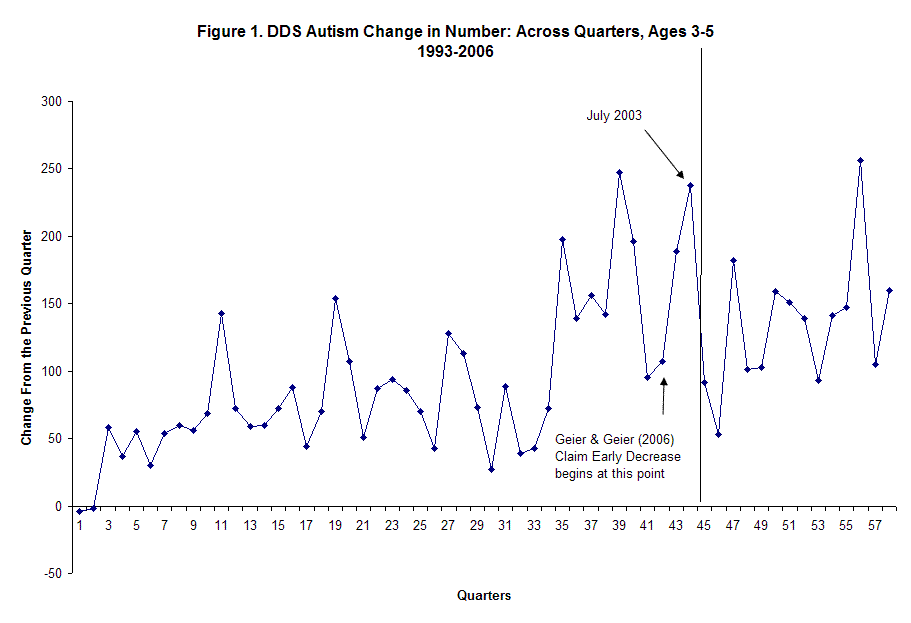
if the total number of 3-5 year olds in the California DDS system has not declined by 2007, that would deal a severe blow to the autism-thimerosal hypothesis…..total cases among 3-5 year olds, not changes in the rate of increase is the right measure.

David Kirby, Nov 2005.

Time’s up Mr Kirby. The last quarter numbers for 2006 are now in.

Jonathon even took the trouble to highlight on his graph where the Geier’s made asses of themselves declaring an early decrease in their 2006 paper. As can be seen from Jon’s graph (and even more clearly on Dad of Cameron’s) – _the numbers are still going up_.

A severe blow to the autism-thimerosal hypothesis has been dealt.

Jospeph tells us what to expect in the coming months in the way of excuses from Kirby. Something I also discussed in April 2006. In short, the militia will argue that there’s still TCV’s sitting around waiting to be used up (rubbish, but even if true, would be a very, very minimal amount, click the link to my previous post to see Sallie Bernard of SafeMinds struggling to locate TCV’s in June 2001), they will also argue that the flu shot supports the ‘epidemic’ (again, rubbish. Are we really comparing mandatory TCV administration culminating in 187 ug Hg with optional flu vaccines, administered in one season of the year, culminating in 25 ug Hg?). They will also argue that RhoGAM was a contributing factor (but as we all kow, that one’s got no legs.). They may also try and argue that some other vaccine/environmental ‘thing’ comes into play. This takes us right back to square one and is a virtual admission that thiomersal doesn’t do a goddamn thing except act as a preservative.

In fact, that process is already under way from the Big Cheese himself. In a post on Jan 9th 2007 to his munchkins on the EoH yahoo group, Kirby said:

I believe this puzzle will be solved by looking at TOTAL “environmental” toxic burden from ALL sources, including other chemicals, and, of course, thimerosal in vaccines,

Oh, of _course_ ;o)

This prompted a bit of controversy: H Coleman replied:

Please stop it- you’re all giving me a headache.

And Robert Krakow replied:

I disagree somewhat with the emphasis of your message. I don’t know anyone who focuses on the vaccine issue who believes that other environmental exposure is unimportant. To suggest so underestimates the intelligence of most of the members of this list.

‘Most’ obviously not including John Best, Rescue Angel, who said on that same group:

I view any talk of mercury in the air as a problem as utter nonsense. It’s just propaganda to deflect blame from pharma and I don’t buy one word of it.

See Robert? There’s more than a few idiots who need things spelled out to them on EoH.

Anyway, the impact of Kirby’s statement has not been lost amongst the rank and file militia members. They know he’s trying to move on. Memo to Mr Kirby: it would be quicker and more painless to just fess up: _A severe blow to the autism-thimerosal hypothesis has been dealt._

Two items of interest for US folks

8 Jan

There will be a debate titled “Vaccines and Autism: Is There a Connection?” between David Kirby and Arthur Allen. The debate will take place in San Diego, California (UC San Diego Price Center, 9500 Gilman Dr. La Jolla CA 92093) on Saturday, January 13, at 10am:

Admission is free, provided you register with TACA before January 10. (Be prepared to give out a mailing address). Or you can pay $10 on-site.

Sponsors include Generation Rescue, SafeMinds, TACA and the Autism Research Institute so as you can imagine, the quackery quotient will be high – anyone who favours a bit of reality and is in San Diego should go and give Mr Allen some support as I think he’s going to need it – the audience sounds like it will be partisan to say the least. Apparently some mercury mum or other has suggested wearing t-shirts with pictures of their autistic kids on them. Sounds like it’ll be conducted on a sound scientific footing.

The other thing regards the NIH which, not being ‘merican I’m not up to speed with so I’ll quote Diva:

Would you like to have a voice in how the National Institutes of Health (NIH) – National Institute of Mental Health (NIMH) spends it’s autism research dollars? The NIMH may be getting a windfall of cash for autism research by way of the “Combatting Autism Act.” Whether or not they get that windfall, money will continue to be spent on autism research. Whether that research will benefit humanity to a greater or lesser degree depends on how the money is spent.

Many people shudder at the thought of science driving a big eugenics campaign where every last unfavored gene is scrubbed from the gene pool by culling or sterilizing the genetically defective, though it should be noted that not all studies of genetics are aimed at eugenics. If prenatal testing for autism sounds bad to you, for instance, or if another kind of research bothers you, what kinds of sensible research can be done with all that money? And how can you have a say in how the money is spent?

Go read this petition that will be sent to the NIH/NIMH, and if you agree with it, sign it. Signatures are needed before January 16th, it would probably be better to sign it by the Friday the 12th as that would give someone a chance to send the petition to the NIMH properly by the Tuesday the 16th. A few hundred or a thousand signatures would be really great.

Spread the word as quickly as possible :o)