Tag Archives: research

Open letter to the IACC: Autism research is stalled. Get secretary Kennedy to make new autism research grants.

11 Jun

Secretary Kennedy has cut back on autism research, and you can act. You should act. You must act.

Here are data from NIH Reporter on new NIH autism grants by fiscal year. I pro-rated the results from 2026, since the fiscal year ends in September. This graph shows only those grants which are new in each fiscal year, not those which are funding ongoing projects.
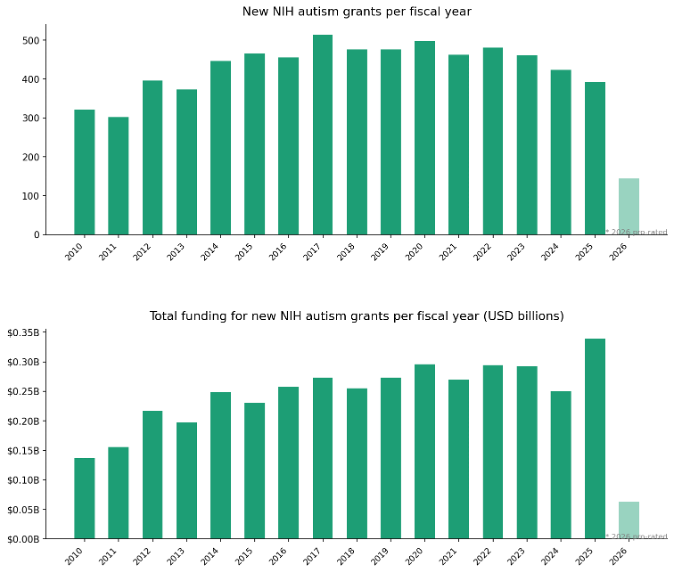
New grants are down 60% from 2025.  Funding is down 80%.

I am going to ask you to read that again. An 80% drop in funding for new research grants.

You should be asking yourself about continuing grants. Continuing grants are also down. Overall, total NIH autism grants and funding are down by about half from 2025. Would you have been angry if such a cut was made under a different secretary? Not only is this a big cut overall, but this is also a Secretary who chooses to just not spend authorized funds. If you would have been silent under a different Secretary, then this letter isn’t for you. If you would have spoken up — you have to speak up now.
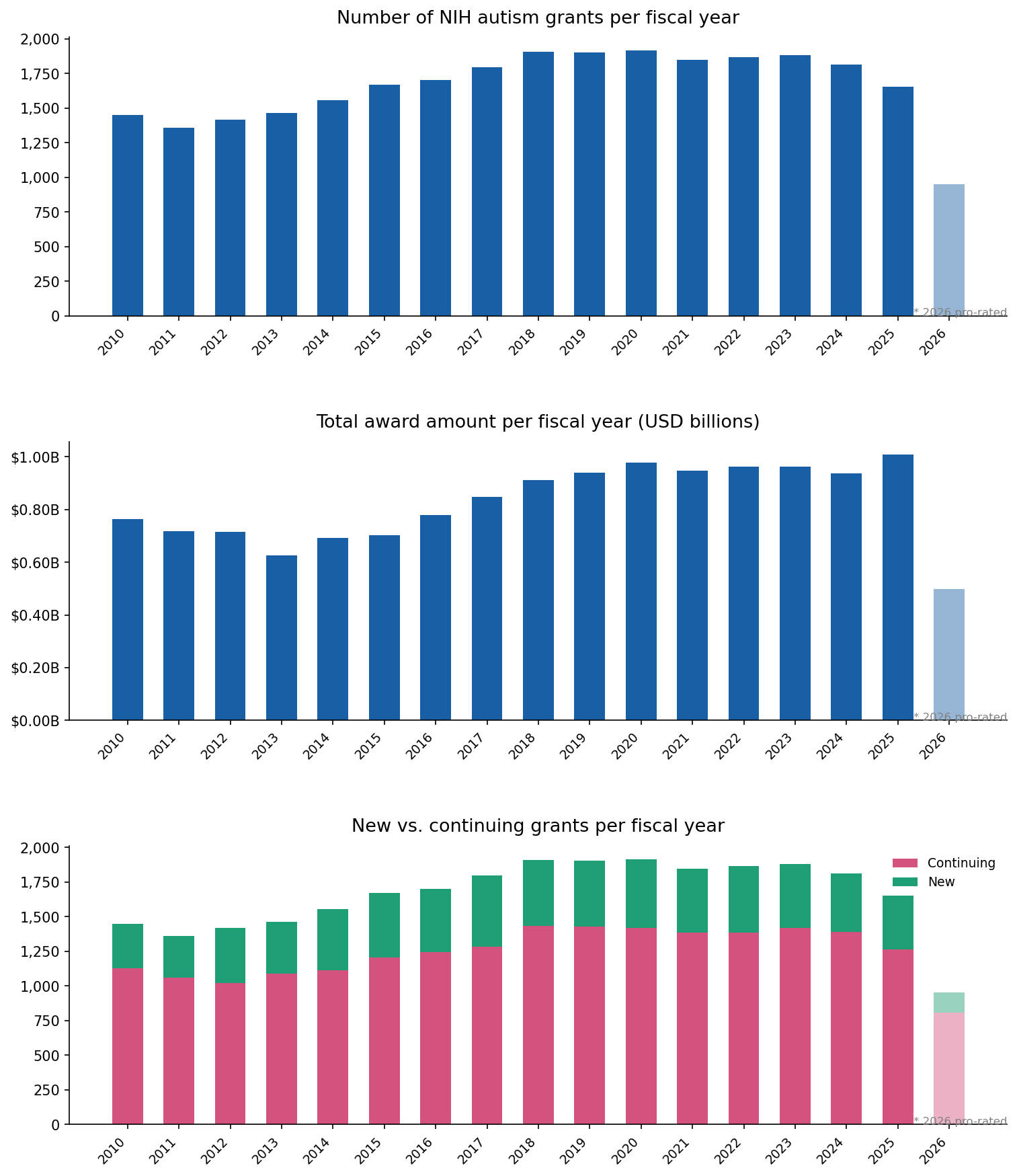
Autism CARES authorizes about $2B in research funding. Think about that. $2B earmarked for autism research. You may not agree with where the priorities have been placed. But you are in danger of being the Committee that not only allows HHS to not spend those funds, but also to see Autism CARES not be renewed.

Renewal of the ACT is far from guaranteed. If you look at past IACC meetings, you will find multiple instances where Tom Insel commented that congress does not like “single disease” bills. Renewal every four years is a real fight.

The Autism CARES Act is up for renewal in 2029, the same time your terms expire. Ask yourself, would congress vote to renew the Act if the funds they authorize aren’t being spent? 

We should address the elephant in the room. Congress is already going to be disinclined to renew the Act if it gives a platform to a Committee that promotes an anti-vaccine and pseudo-science agenda. You may feel validated with the appointment of Mr. Kennedy. But you haven’t convinced congress and you are unlikely to do so in the next couple of years. Moreover, are you willing to bet $2B that could help the autism communities on making your case to Congress?

In short, you have two big problems. First, your agenda is, to be polite, unpopular. Second, you are overseeing not the coordination of autism research, but the lack of autism research. I suggest to you that you focus on getting new autism research funded. Besides helping to ensure that Autism CARES gets renewed, it is your job. 

Many of you have worked with Mr. Kennedy. I wouldn’t be surprised if you have his email and his phone number. You may be the Committee in history that has the best chance to be heard by the Secretary. If he doesn’t hear from you on this, you have no excuse.

You also have the official avenues to make yourselves heard. The Committee can draft a letter to the Secretary. You can make your voices heard by the NIH directors who are sitting with you and who can forward your views up the chain. But, for those of you who know Mr. Kennedy, you have to reach out and make him understand that refusing to fund autism research harms the very communities he has claimed to support for decades.

I once sat on the IACC. I know what it is like to feel the responsibility to the autism communities of ensuring that autism research funding is well spent and that the Federal commitment to autism research doesn’t fade.

Respectfully Submitted 

Matthew J. Carey

New research proposed for diet and autism

30 Aug

LBRB has a record of coming down hard on so-called complementary and alternative medicine (CAM). We support evidence based treatments and therapies. CAM is all too often an opportunity for snake oil merchants to rip off parents and potentially harm their children.

It may be  that some CAM interventions are beneficial. Properly conducted research may provide the data to support the claims for a particular therapy. So far the record is not good. Secretin has been tried and found wanting. Facilitated Communication could not live up to the hype. Holding Therapy was not only wrong it was abusive. Chelation is based upon fraudulent challenge testing that has been dismissed by the American College of Medical Toxicologists.

But that does not necessarily mean that all CAM therapies are bad. It does mean that they lack evidence and only research can provide that evidence. Note that evidence is not the same as the parent testimonials that CAM practitioners display on their websites and in their literature. Evidence is data collected by disinterested researchers whose methods and results are open to scrutiny. This is more reliable thsn testimonials, which may be influenced by all sorts of factors, including the placebo effect, recall bias and good old fashioned wishful thinking.

One researcher in the UK who has taken a scientific interest in CAM for autism is Professer Ann Le Couteur. She knows that lots of parents use CAM therapies and wants to investigate their effectiveness. In particular she is interested in parental and professional attitudes to dietary interventions, probably the most widespread alternative therapy for autism. To this end her department has sent out the following letter which is also available on the NAS website.

The study

Researchers at Newcastle University would like to find out about parents’ and child health professionals’ experiences of autism research and their attitudes to the use of the gluten- and casein-free diet as an intervention in ASD. We are carrying out two web-based surveys; one for parents/carers and the other for child health professionals who support children with ASD and their families. The results of these surveys will help us plan the design of UK research studies into biomedical and complementary and alternative therapies for children with ASD.

Participants

Parents/carers of pre-school or primary school-aged children with a diagnosed autism spectrum disorder, and child health professionals who support children with ASD and their families, are invited to take part.

What happens next?

If you are interested in taking part, please visit our website: PADIA. When you follow this link, you’ll go to a web page that tells you more about the study, and will ask you to enter some details.

We will then send you a letter of invitation with a unique ID number and the link to an information sheet. This information sheet has the link to the web-based survey.

If you would like any more information about this study, please contact:

Professor Ann Le Couteur
Tel: 01912 821 384
Email: padia@ncl.ac.uk

When I saw this my first thought was “What about the parents whose children have grown up? What about autistic adults? Do their opinions and experiences matter? So I wrote to Professor Le Couteur who promptly replied and gave me permission to share her reply.

MY LETTER

I recently received an invitation for parents of young children and health care professionals to complete a questionnaire that will assist you plan the design of UK research studies into biomedical and
complementary and alternative therapies for children with ASD. May I enquire if you are also interested in the opinions of parents of older children, and indeed of the adults themselves? Many of us have attempted to implement these therapies in the past or had them done unto us and our experience should not be ignored.

PROFESSOR LE COUTEUR’S REPLY

Dear Mike Stanton

I quite agree experiences of parents of older children and personal experiences are of great interest to us.

The research survey was funded for parents of primary school aged children only and the child health professionals that support them. However if you or anyone you know would be prepared to give us information about your/ their experiences in the past that would be really interesting. We cannot include the information in the survey but would be able to use the account to add to our knowledge and to inform our grant applications etc.

I also value personal accounts as these add great value to my talks and presentations if I have permission to share the experiences (in an anonymised form) for teaching and conference events

Thankyou for contacting PADIA

Your sincerely

Ann Le Couteur
Professor of Child & Adolescent Psychiatry
Institute of Health and Society
Newcastle University
Sir James Spence Institute
Royal Victoria Infirmary
Queen Victoria Road
Newcastle upon Tyne
NE1 4LP

Tel: 0191 2821398 (University)
0191 2821384 (University Secretary)
0191 2196455 (Clinical Secretary)

So there you have it: an autism researcher who is open to personal accounts from parents, professionals and autistic adults in order to assist her in formulating and designing her research programme into CAM. This is a positive invitation and I hope people avail themselves of this opportunity in the spirit in whch it is proffered.