“It’s understood that Hollywood sells Californication”
~ Red Hot Chilli Peppers
In this section I want to look at Kirby’s presentation regarding what he terms as the first of seven skeptical rebuttals to the autism/thiomersal hypothesis. He says that skeptics say:
Hmm. Not really. I think most people are agreed that autism is a ‘mix’ of genes and environment. However, this is a popular and recurring strawman from the anti-thiomersal hypothesisers – that thiomersal and environment are interchangeable. They’re not. Maybe ice cream is the environmental trigger for autism. What science _is_ pretty sure about however, is that thiomersal (i.e. one _possible_ environmental ‘trigger’) is _not_ in the frame. So straight away we can see the Kirby is proceeding from a misleading position. If his argument is so strong, why does he feel the need to do this I wonder?
However, the point Kirby is (misleadingly) making is to try and push the idea of there having been an epidemic. Lets see how he does this.
(A lot of the next section has been amply covered by Mike – I won’t repeat his work)
NB: The years Kirby refers to here are between 1988 – 1992.
Guess what else happened around that time?
In 1987, one year before the time period Kirby is talking about, the DSM (III-R) was published. This was a revision to the previously published (1980) DSM (III). Here’s what the DSM (III) criteria was for what it called ‘Diagnostic criteria for Infantile Autism’- this is in full by the way:
A. Onset before 30 months of age
B. Pervasive lack of responsiveness to other people (autism)
C. Gross deficits in language development
D. If speech is present, peculiar speech patterns such as immediate and delayed echolalia, metaphorical language, pronominal reversal.
E. Bizarre responses to various aspects of the environment, e.g., resistance to change, peculiar interest in or attachments to animate or inanimate objects.
F. Absence of delusions, hallucinations, loosening of associations, and incoherence as in Schizophrenia.
So that is the sole and only reference for autism in 1980. Next up, this is the 1987 revision – DSM (III-R):
Diagnostic Criteria for Autistic Disorder
At least eight of the following sixteen items are present, these to include at least two items from A, one from B, and one from C.
A. Qualitative impairment in reciprocal social interaction (the examples within parentheses are arranged so that those first listed are more likely to apply to younger or more disabled, and the later ones, to older or less disabled) as manifested by the following:
1.Marked lack of awareness of the existence or feelings of others (for example, treats a person as if that person were a piece of furniture; does not notice another person’s distress; apparently has no concept of the need of others for privacy);
2. No or abnormal seeking of comfort at times of distress (for example, does not come for comfort even when ill, hurt, or tired; seeks comfort in a stereotyped way, for example, says “cheese, cheese, cheese” whenever hurt);
3. No or impaired imitation (for example, does not wave bye-bye; does not copy parent’s domestic activities; mechanical imitation of others’ actions out of context);
4. No or abnormal social play (for example, does not actively participate in simple games; refers solitary play activities; involves other children in play only as mechanical aids); and
5. Gross impairment in ability to make peer friendships (for example, no interest in making peer friendships despite interest in making fiends, demonstrates lack of understanding of conventions of social interaction, for example, reads phone book to uninterested peer.
B. Qualitative impairment in verbal and nonverbal communication and in imaginative activity, (the numbered items are arranged so that those first listed are more likely to apply to younger or more disabled, and the later ones, to older or less disabled) as manifested by the following:
1. No mode of communication, such as: communicative babbling, facial expression, gesture, mime, or spoken language;
2. Markedly abnormal nonverbal communication, as in the use of eye-to-eye gaze, facial expression, body posture, or gestures to initiate or modulate social interaction (for example, does not anticipate being held, stiffens when held, does not look at the person or smile when making a social approach, does not greet parents or visitors, has a fixed stare in social situations);
3. Absence of imaginative activity, such as play-acting of adult roles, fantasy character or animals; lack of interest in stories about imaginary events;
4. Marked abnormalities in the production of speech, including volume, pitch, stress, rate, rhythm, and intonation (for example, monotonous tone, question-like melody, or high pitch);
5. Marked abnormalities in the form or content of speech, including stereotyped and repetitive use of speech (for example, immediate echolalia or mechanical repetition of a television commercial); use of “you” when “I” is meant (for example, using “You want cookie?” to mean “I want a cookie”); idiosyncratic use of words or phrases (for example, “Go on green riding” to mean “I want to go on the swing”); or frequent irrelevant remarks (for example, starts talking about train schedules during a conversation about ports); and
6. Marked impairment in the ability to initiate or sustain a conversation with others, despite adequate speech (for example, indulging in lengthy monologues on one subject regardless of interjections from others);
C. Markedly restricted repertoire of activities and interests as manifested by the following:
1. Stereotyped body movements (for example, hand flicking or twisting, spinning, head-banging, complex whole-body movements);
2. Persistent preoccupation with parts of objects (for example, sniffing or smelling objects, repetitive feeling of texture of materials, spinning wheels of toy cars) or attachment to unusual objects (for example, insists on carrying around a piece of string);
3. Marked distress over changes in trivial aspects of environment (for example, when a vase is moved from usual position);
4. Unreasonable insistence on following routines in precise detail (for example, insisting that exactly the same route always be followed when shopping);
5. Markedly restricted range of interests and a preoccupation with one narrow interest, e.g., interested only in lining up objects, in amassing facts about meteorology, or in pretending to be a fantasy character.
D. Onset during infancy or early childhood
Specify if childhood onset (after 36 months of age)
Slight difference huh? Of key importance – in 1980 we only had ‘infantile autism’. In 1987, we had ‘autistic disorder’.
The DSM (III-R) is a quantum leap in diagnostic precision (far from perfect of course and as we all know the DSM (IV) came along in 1994 and the DSM (IV-R) came along in 2000) but surely it is blindingly obvious what a massively more accurate and precise set of criteria must mean – better recognition. More diagnosis.
Now Kirby says that this increase ties in to the ‘spike in mercury in vaccines’ over the same time period. Could be. But lets _also_ not forget that – as Kirby says in this debate – you need clinical science to support a clinical idea such as thiomersal causing autism.
Nine years now and there is _not one_ paper that even suggests that the symptoms of autism can be attributed to thiomersal (or MMR, or both together come to that). Nine years. In terms of science this hypothesis has four papers that might be considered of publishable quality. One shows that if you take a strain of mice known for aggressiveness and severely overdose them with thiomersal then they get more aggressive. Another shows that if you take a control group high in mercury levels and compare them with new born babies then the babies will look like poor excretors of mercury. The third shows that ethyl mercury and methyl mercury cannot be used to represent each other. The last one shows that thimerosal might cause methionine synthase dysfunction (MSD) – a condition that bears no resemblance to autism.
So here we are with the thiomersal hypothesis resting squarely and solely on epidemiology. Once upon a time, Kirby said CDDS epidemiology was ‘the gold standard’ – now he says its not enough. However, make no mistake. Epidemiology is all this hypothesis has.
So what is the state of this epidemiology? Is it of good quality? Well, no. As Mike has shown (see link above) Kirby’s presentation numbers are awful. As I have shown, his opinion of CDDS fluctuates depending on whether the numbers work for him or not and as Jospeh has shown, his new source is equally as badly reported on as his initial take on CDDS was.
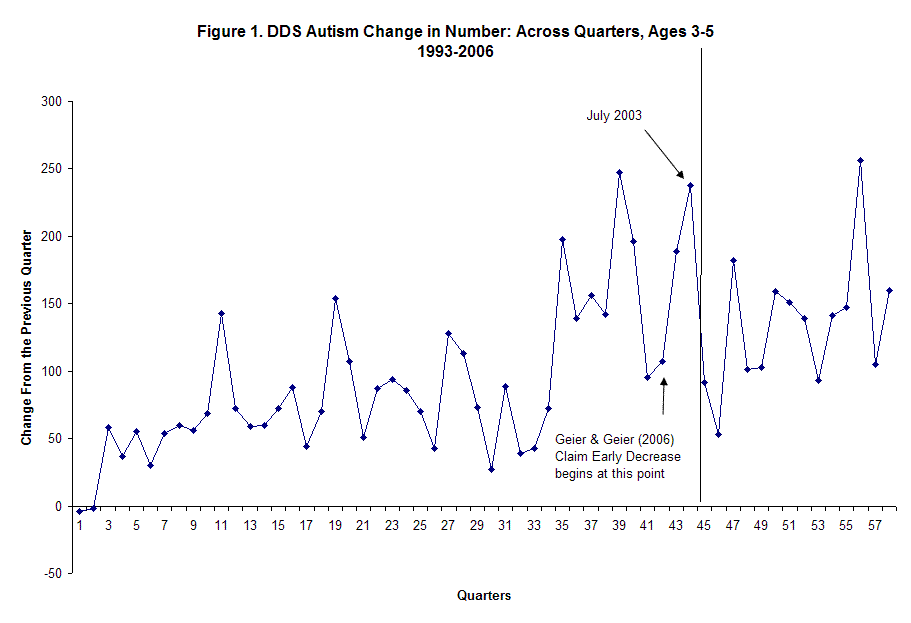
Another example of the epidemiology not only not working for Kirby but being actively manipulated is this:
Have a close look at that graph. Remember in the previous slide Kirby said that the biggest increase in thiomersal was between 1988 and 1992. Take a close look at the dates in _this_ slide. They start in 1993. That’s pretty misleading Mr Kirby. Tut-tut-tut.
Also in this slide I want you to notice that according to this data that Kirby is using, the numbers are continuing to climb in 2001, 2002 and 2003. However, we know from a recently discovered CDC set of meeting minutes that according to a survey, in September 2001, only 5.6%1 of _all vaccines_ contained thiomersal. By Feb 2002, only 1.9% of _all vaccines_ contained thiomersal.
So apparently, Mr Kirby is happy to use data from two sources that shows an increasing amount of autism. CDDS and IDEA data. Both show climbing autism against a backdrop of miniscule amounts of mercury in the general population.
Danger, Will Robinson. Does not compute.
(More Californication to come soon….stay tuned…)


 Now that means that, just like my good friends the Geier’s, I have _used VAERS to prove something _ – that 92% of people who have autism have no gastric issues at all! Now, where’s my money?


 Left Brain Right Brain

Recent Comments