Archive | April, 2015

Press Release: New Research Finds No Evidence That Thimerosal-Containing Vaccines Affect Neurodevelopment and Behavior in Infant Primates

26 Apr

Below is a press release from the Johnson Center (formerly Thoughtful House). It is about a recent follow-up study they performed (discussed here). I’ll give the press release below with no further comment except to highlight this statement by the lead researcher: “Despite these limitations, the data in this primate study overwhelmingly provides support for the safety of pediatric vaccines.

New Research Finds No Evidence That Thimerosal-Containing Vaccines Affect Neurodevelopment and Behavior in Infant Primates

(Austin, Texas) – February 18, 2015 – A research study published today in Environmental Health Perspectivesreported that vaccination of infant macaques with thimerosal-containing vaccines did not negatively impact neurodevelopment, cognition, or behavior. In this study animals received several pediatric vaccines containing thimerosal (a mercury-based preservative) in a schedule similar to that given to infants in the 1990s. Other animals received just the measles-mumps-rubella (MMR) vaccine, which does not contain thimerosal, or an expanded vaccine schedule similar to that recommended for US infants today. Control animals received a saline injection. Regardless of vaccination status, all animals developed normally.

“This comprehensive study of infant primate development, including analyses of learning, cognition, and social development, indicated that vaccinated primates were not negatively affected by thimerosal or the MMR vaccine; the same was true for animals receiving an expanded vaccine schedule” explained Dr. Laura Hewitson of The Johnson Center for Child Health and Development, the principle investigator of the study.

Hewitson worked with a team of researchers at the Center on Human Development and Disability Infant Primate Research Laboratory and the Washington National Primate Research Center (WaNPRC) at the University of Washington, Seattle WA. According to Hewitson, the study was designed to compare the safety of different vaccination schedules, including the schedule from the 1990s, when thimerosal was still used as a preservative in multi-dose vaccine preparations. Although in 1999 the FDA and the American Academy of Pediatrics recommended that thimerosal be removed from vaccines in the US, it is still used as a preservative in multi-dose flu shots, which are recommended for pregnant women and children 6 months of age and older.

“This is the first time the safety of the entire pediatric vaccine schedule has been investigated in a relevant animal model,” said Dr. Judy Van de Water from the UC-Davis MIND Institute, who was not involved in this study.

Hewitson also noted, “As with any animal study, assessments were implemented under controlled laboratory conditions. We did not test all of the interacting variables that could contribute to an adverse outcome, such as birth weight, gestational age, genetic vulnerability, or in utero and post-natal chemical exposures. The interaction between multiple environmental exposures or genetic factors that may impact vaccine response, which is an important aspect of the vaccine debate, was not addressed in this study. Despite these limitations, the data in this primate study overwhelmingly provides support for the safety of pediatric vaccines.”

Citation

Examination of the Safety of Pediatric Vaccine Schedules in a Non-Human Primate Model: Assessments of Neurodevelopment, Learning, and Social Behavior. Britni Curtis, Noelle Liberato, Megan Rulien, Kelly Morrisroe, Caroline Kenney, Vernon Yutuc, Clayton Ferrier, C. Nathan Marti, Dorothy Mandell, Thomas M. Burbacher, Gene P. Sackett and Laura Hewitson. Environmental Health Perspectives, Feb 18, 2015; doi:10.1289/ehp.1408257.
Once the embargo lifts, this article can be downloaded for free at http://ehp.niehs.nih.gov/1408257.

This study was supported by The Ted Lindsay Foundation, SafeMinds, National Autism Association, the Vernick family, and the Johnson family. This work was also supported by WaNPRC Core Grant RR00166 and CHDD Core Grant HD02274.

About The Johnson Center

The mission of The Johnson Center for Child Health and Development is to advance the understanding of childhood development through clinical care, research, and education.


By Matt Carey

Another large study shows no link between autism and the MMR vaccine (or, a comment on “Autism Occurrence by MMR Vaccine Status Among US Children With Older Siblings With and Without Autism”

22 Apr

Autism is not associated with the MMR vaccine. The MMR vaccine does not increase autism risk. To put it in plain language: the MMR vaccine does not cause autism.

Just in case the message gets lost in this discussion, I figured I’d put it plainly at the start.

A study out today compares autism rates and the use of the MMR vaccine. In specific, the researchers looked at children with an older sibling. In this way they could look at kids in a high risk group, those who had an older sibling who is autistic. The authors also looked at kids who had older siblings who are not autistic. In the end the authors found “receipt of the MMR vaccine was not associated with increased risk of ASD, regardless of whether older siblings had ASD”.

To put it simply, kids who got the MMR vaccine were not more likely to be autistic. It doesn’t matter if their older siblings were autistic or not. So, “high risk” or not, the MMR vaccine doesn’t increase autism risk.

Another way to say it, parents who skipped the MMR vaccine did nothing to prevent autism in their younger kids. Nothing. They did leave their younger kids vulnerable to measles infection.

Here’s the abstract.

Autism Occurrence by MMR Vaccine Status Among US Children With Older Siblings With and Without Autism.

IMPORTANCE:
Despite research showing no link between the measles-mumps-rubella (MMR) vaccine and autism spectrum disorders (ASD), beliefs that the vaccine causes autism persist, leading to lower vaccination levels. Parents who already have a child with ASD may be especially wary of vaccinations.

OBJECTIVE:
To report ASD occurrence by MMR vaccine status in a large sample of US children who have older siblings with and without ASD.

DESIGN, SETTING, AND PARTICIPANTS:
A retrospective cohort study using an administrative claims database associated with a large commercial health plan. Participants included children continuously enrolled in the health plan from birth to at least 5 years of age during 2001-2012 who also had an older sibling continuously enrolled for at least 6 months between 1997 and 2012.

EXPOSURES:
MMR vaccine receipt (0, 1, 2 doses) between birth and 5 years of age.

MAIN OUTCOMES AND MEASURES:
ASD status defined as 2 claims with a diagnosis code in any position for autistic disorder or other specified pervasive developmental disorder (PDD) including Asperger syndrome, or unspecified PDD (International Classification of Diseases, Ninth Revision, Clinical Modification 299.0x, 299.8x, 299.9x).

RESULTS:
Of 95 727 children with older siblings, 994 (1.04%) were diagnosed with ASD and 1929 (2.01%) had an older sibling with ASD. Of those with older siblings with ASD, 134 (6.9%) had ASD, vs 860 (0.9%) children with unaffected siblings (P < .001). MMR vaccination rates (≥1 dose) were 84% (n = 78 564) at age 2 years and 92% (n = 86 063) at age 5 years for children with unaffected older siblings, vs 73% (n = 1409) at age 2 years and 86% (n = 1660) at age 5 years for children with affected siblings. MMR vaccine receipt was not associated with an increased risk of ASD at any age. For children with older siblings with ASD, at age 2, the adjusted relative risk (RR) of ASD for 1 dose of MMR vaccine vs no vaccine was 0.76 (95% CI, 0.49-1.18; P = .22), and at age 5, the RR of ASD for 2 doses compared with no vaccine was 0.56 (95% CI, 0.31-1.01; P = .052). For children whose older siblings did not have ASD, at age 2, the adjusted RR of ASD for 1 dose was 0.91 (95% CI, 0.67-1.20; P = .50) and at age 5, the RR of ASD for 2 doses was 1.12 (95% CI, 0.78-1.59; P = .55).

CONCLUSIONS AND RELEVANCE:
In this large sample of privately insured children with older siblings, receipt of the MMR vaccine was not associated with increased risk of ASD, regardless of whether older siblings had ASD. These findings indicate no harmful association between MMR vaccine receipt and ASD even among children already at higher risk for ASD.


By Matt Carey

Robert Kennedy, why can’t you actually apologize? My kid’s brain is not gone.

16 Apr

Robert Kennedy is here in my home state, making disparaging comments about my kid. Not specifically, you see. His comments were about those whom he wrongly considers to be vaccine injured, but that includes autistics and, as a part of that, my kid.

He is quoted by the Sacramento Bee as stating:

“They get the shot, that night they have a fever of a hundred and three, they go to sleep, and three months later their brain is gone,” Kennedy said. “This is a holocaust, what this is doing to our country.”

Really? Their brain is gone?!?

Because, you know, autistics don’t have brains. They’re gone.

How insulting and ignorant can this guy be? Well, before you answer that realize that: he doubled down on his mistake. He apologized, but just for using the term “holocaust”. Stating that kids

“I want to apologize to all whom I offended by my use of the word to describe the autism epidemic,” Kennedy said in a statement. “I employed the term during an impromptu speech as I struggled to find an expression to convey the catastrophic tragedy of autism which has now destroyed the lives of over 20 million children and shattered their families.”

Mr. Kennedy leave my community alone. We are not your tool to attack vaccines, Mr. Kennedy. Your ignorance and stigmatizing comments are doing damage to my kid and autistics of all ages.

Here’s the thing: the autism as a vaccine epidemic idea is the most damaging idea since the refrigerator mother theory. It fuels an industry of charlatans who use the one two punch: you caused your kid’s autism, now let me sell you the cure. And it fuels stigmatizing language: telling an entire group of people that “their brains are gone” is so wrong, so very wrong, so damaging that I can’t believe you let that stand.

Sadly, I can believe that you let it stand. Most other people I would suspect would be quickly apologizing.

Mr. Kennedy, you have been given every gift imaginable. And I mean gift: you did nothing to earn these. You are a wealthy white male in the United States, with a famous name to boot. Again, none of this earned. I bring this up because as the parent of a disabled kid I am so saddened to see gifts wasted. Thrown away, no less. You could be using your brain to do so much more, and yet you remain fixated on vaccines and you use kids like mine in your attacks.

You are not done apologizing. Not by a long shot.


By Matt Carey

No, Dr. “Bob” Sears, you don’t represent the autistic children of California

15 Apr

I’ve been told that testifying before the California Legislature today, Robert “Dr. Bob” Sears, stated either exactly or words to the effect of, “On behalf of 79,000 children with autism in California schools I strongly oppose this bill”.

No Bob, you don’t speak on behalf of the autistics in California, be they students or adults. You don’t. Never have and never will. You are merely a second rate (to put it nicely) pediatrician who puts children like mine at risk by increasing the chances of outbreaks of infectious diseases. OK, not merely, you also promote faux medicine claiming to treat autism.

You know what keeps me up at night, Bob? The fear of my kid going through a state of constant seizures. You know what can cause that? Infections. The sort that you and I just brush off can cause that. I have no idea what a major disease like measles will do, but it won’t be pretty. There’s only one way for me to find out and that’s an outbreak in California. And, yep, not everyone mounts a response to the measles vaccine. Guess how I will find out for sure if my kid is one for whom the vaccine doesn’t take? That’s right, by an outbreak.

And the same goes for multiple other vaccine preventable diseases.

Your patient imported measles years back, because you encourage parents to avoid vaccinations. You can frame it however you want, about how you are giving parents “choice”, but the truth is you just give out bad advice. It’s one thing for the average internet troll to give out bad advice, but you are supposed to be a physician.

On that topic, I live in California, have family not far from your practice and could, if I chose to, visit your office for consultation and treatment. I never will. Not just is your stance on vaccines dangerous, but your approach to autism is as well. You are just another “defeat autism now” doctor who packages other people’s ideas into a book you can sell. Writing a book and attending conventions like AutismOne where others like you sell their faux medicine doesn’t give you the right to speak for my kid. Or any autistic kid in California.

You speak for yourself–a man who has left reason behind. Don’t claim to speak for my kid. Ever.


By Matt Carey

“light it up blue” isn’t autism awareness, it’s advertising for Autism Speaks

2 Apr

Tomorrow is Autism Awareness Day, by some calendars at least.  The United Nations, for example made a resolution in 2007 to designate April 2nd as “World Autism Awareness Day”.

Resolution adopted by the General Assembly on 18 December 2007 [on the report of the Third Committee (A/62/435)] 62/139.

World Autism Awareness Day The General Assembly,

Recalling the 2005 World Summit Outcome and the United Nations Millennium Declaration, as well as the outcomes of the major United Nations conferences and summits in the economic, social and related fields,

Recalling also the Convention on the Rights of the Child and the Convention on the Rights of Persons with Disabilities, according to which children with disabilities should enjoy a full and decent life, in conditions which ensure dignity, promote self-reliance and facilitate the child’s active participation in the community, as well as the full enjoyment of all human rights and fundamental freedoms on an equal basis with other children,

Affirming that ensuring and promoting the full realization of all human rights and fundamental freedoms for all persons with disabilities is critical to achieving internationally agreed development goals, Aware that autism is a lifelong developmental disability that manifests itself during the first three years of life and results from a neurological disorder that affects the functioning of the brain, mostly affecting children in many countries irrespective of gender, race or socio-economic status, and characterized by impairments in social interaction, problems with verbal and non-verbal communication and restricted, repetitive behaviour, interests and activities,

Deeply concerned by the prevalence and high rate of autism in children in all regions of the world and the consequent development challenges to long-term health care, education, training and intervention programmes undertaken by Governments, non-governmental organizations and the private sector, as well as its tremendous impact on children, their families, communities and societies,

Recalling that early diagnosis and appropriate research and interventions are vital to the growth and development of the individual,

1. Decides to designate 2 April as World Autism Awareness Day, to be observed every year beginning in 2008;

2. Invites all Member States, relevant organizations of the United Nations system and other international organizations, as well as civil society, including non-governmental organizations and the private sector, to observe World Autism Awareness Day in an appropriate manner, in order to raise public awareness of autism;

3. Encourages Member States to take measures to raise awareness throughout society, including at the family level, regarding children with autism;

4. Requests the Secretary-General to bring the present resolution to the attention of all Member States and United Nations organizations.

76th plenary meeting 18 December 2007

While I’m sure that Autism Speaks lobbying had much to do with that resolution, it’s an awareness event. No where do you see any mention of Autism Speaks nor statements that we should “light it up blue”. Yet over the years, Autism Speaks has made autism awareness into autism speaks awareness. And no where is that more obvious than on April 2nd with their “light it up blue” event.

Is blue the color of autism? No. It’s the color of Autism Speaks. But Autism Speaks is out there asking people to shine blue lights for autism awareness. A whole section of their shop (yes, they have an online shop) is devoted to “light it up blue” merchandise. All complete with the Autism Speaks logo.

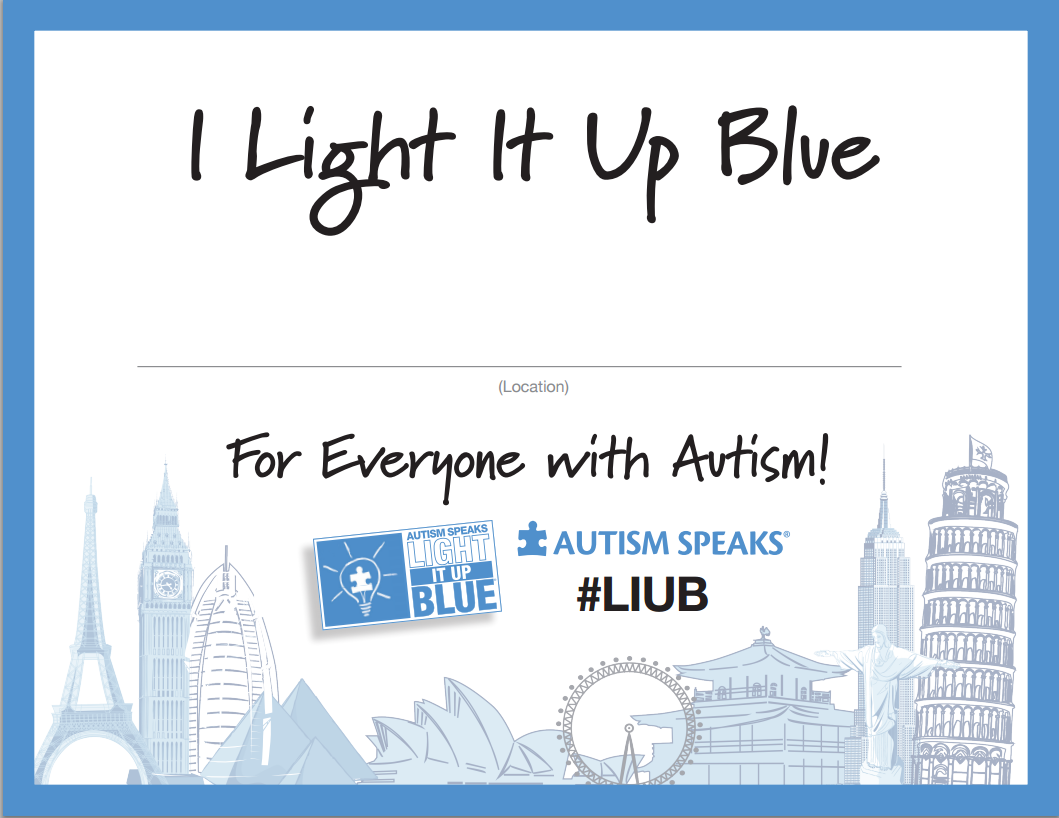
Here’s the text from the Autism Speaks web page on how to “light it up blue”. Each section brings you back to Autism Speaks. Shine a blue light..and project the Autism Speaks logo. Wear blue, including autism speaks pins or accessories. Blue=Autism speaks, basically.

How to LIUB

In honor of people with autism worldwide, iconic landmarks, hotels, sporting venues, concert halls, museums, schools, universities, bridges, retail stores, and thousands of homes will light blue beginning on April 2!

Light Homes, Businesses, Schools, and Landmarks Blue

Change outdoor or indoor white bulbs to blue bulbs.

Tint windows with blue gel sheets

Cover existing fixtures with blue gel filters

Project the Autism Speaks puzzle piece or Light It Up Blue logo on walls or buildings

Wear Blue

Ask family, friends, coworkers, and staff to wear blue (ties, scarfs, shirts, etc.)

Supply Autism Speaks lapel pins, bracelets, or other blue accessories to wear during the month of April.

Post Blue

Personalize your LIUB Selfie Sign to tell us where you Light It Up Blue

Post your photos on Facebook, Twitter, Google+, Instagram, or Flickr with the hashtag #LIUB to be a part of the global autism awareness movement!

Turn your website blue with our Site It Up Blue kit or add the Light It Up Blue logo with a link to autismspeaks.org/liub

Turn your Facebook or Twitter profile picture blue

Tweet autism facts with the hashtag #LIUB

Raise Awareness with Blue

Distribute information about autism, World Autism Awareness Day, and Light It Up Blue in your establishment, neighborhood, or company.

Invite a local Autism Speaks representative to speak to your staff, school, or town about autism and the Light It Up Blue campaign.

Reach out to local media to let the community know about your great work for the autism community and your support of autism speaks!

Donate

Click here to donate!

Text AUTISM to 25383 to give $10*

Host your own fundraising event

Use this form to mail funds to Autism Speaks

Hey, you can take a “light it up blue” selfie. Complete with Autism Speaks logo.

yeah blue for AS

Autism Speaks is corporate autism. They do some things I appreciate and many things I really, really (really) don’t. For example, perpetuating the vaccines-cause-autism idea, an idea which may be second only to the refrigerator mother idea in causing harm to our community. Just in the past couple weeks Autism Speaks had to put out a new message on the idea, because the science based and helpful message by their Chief Science Officer conflicted with the non-science educated founder’s beliefs. Autism Speaks doesn’t have autistic voices in important positions within the organization, an amazing position given the sizable self-advocate population they claim to serve. Autism Speaks has a history of perpetuating stigmatizing messages (search for “I am autism” if you are unaware of this). Autism Speaks has funded quality research over the years and I appreciate that. But every time I start thinking Autism Speaks is starting down a good path they do something that reminds me: they are not my family’s autism organization. They don’t represent my values. They don’t represent my family.

I won’t be “lighting it up blue” tomorrow. I won’t be encouraging people to “light it up blue”. I hope people will be more aware of the needs of people like my kid. I hope more that they will act. I will follow up with another post, but I’ll say it here now: remember the phrase “think globally, act locally”? Feel like donating to an autism charity? I bet you have an autism school in your area and autism schools need donations. I bet there are adult programs in your area that could use some support. That’s my suggestion for April 2nd.


By Matt Carey