Archive | November, 2018

Why autism at 2.5% isn’t surprising.

29 Nov

Let’s get one thing out right away–autism prevalence studies undercount. Not all autistics are diagnosed. That’s just a fact. Consider the recent CDC study. They look at school and medical records. In many cases, they find children are autistic based on their records–but the schools and doctors hadn’t diagnosed those children.

Combining data from all 11 sites, 81% of boys had a previous ASD classification on record, compared with 75% of girls (OR = 1.4; p<0.01).

Yeah, more than 20% of the kids counted in their prevalence had no diagnosis. They and their families didn’t know.

And, if there isn’t enough in the records to show a kid is autistic? That kid gets uncounted altogether.

So, when people look at the CDC prevalence estimates from over the years and cry “epidemic”, well, there’s a reason why those people usually have some causation theory that they believe in. The irony is that they are usually wrong that their theory needs an epidemic to support it. But, heavily biased people are not usually the best sources of reliable analyses.

What would be a better method of counting how many autistics are in a population? Sounds obvious–test all the kids in a given population. Equally obvious–this is a much more expensive and difficult task. One such study was published in 2011. Yes, 7 years ago. In Prevalence of autism spectrum disorders in a total population sample, the autism prevalence in Korea was found to be 2.63%. A study performed in South Carolina and reported at IMFAR last year found a prevalence of 3.62%.

This all said, we had another autism prevalence come out this week–The Prevalence of Parent-Reported Autism Spectrum Disorder Among US Children. This study found a prevalence of 2.5%.

Now here’s a nice thing about this recent study–OK, two nice things. First, they don’t just look at kids of one age. Second, you can obtain the data. Which I did. Let’s look at the autism prevalence broken down by birth year.
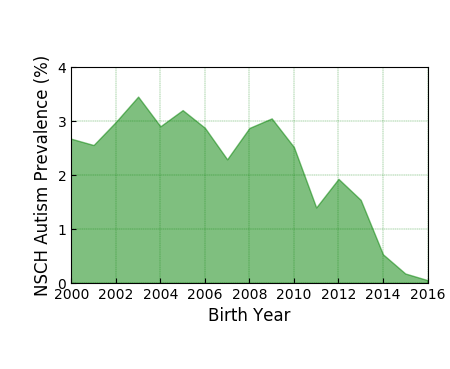
Do you see autism prevalence increasing with birth year? I don’t. I see some scatter, but in general the autism prevalence is about 2.5% from birth year 2000 to 2010. For what it’s worth–the scatter is due to the small numbers of kids in each year making the value uncertain. It’s statistical noise.

If you are wondering about how the autism prevalence drops off above birth year 2010, keep this in mind: kids aren’t diagnosed at birth. In the CDC study, 1/2 of the kids didn’t get diagnosed until after 52 months (4 years 4 months) of age. For this type of reason, the more recent study didn’t count kids under 3 years of age.

People are very fond of graphing autism prevalence data from various years and claiming these are accurate, full counts of autism prevalence (they aren’t) and, from that, claiming an epidemic. Here are the CDC data:
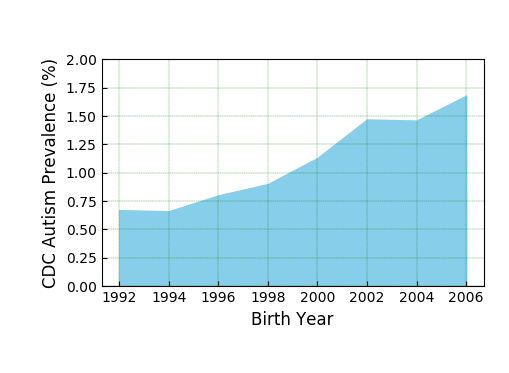
The numbers go up. Steadily up. I’d have to be a total denialist to not see that as evidence of an epidemic, right?

Consider this–the CDC autism prevalence for birth year 2000 is 1.1%. The study just out gives an autism prevalence more than double that (2.9%). For the same birth year. Both are good studies, for what they are. Both are limited. But, for one thing, the CDC study was performed in 2008. 10 years ago. Since then a lot has changed. For one thing, the kids got older and had more chances to get diagnosed. They didn’t just suddenly become autistic in the past 10 years.

So, yeah, we have an autism prevalence estimate of 2.5%. I’m not surprised and I’m not taking this as evidence of an epidemic.

The unfortunate thing in this discussion is that with all the work in this study, all the potential for advocacy, the only number that usually gets discussed is the overall prevalence. Watch the video abstract (which I can’t get to embed). One of the authors goes into a lot of detail about the other findings. Findings I hope to discuss soon.

//players.brightcove.net/1327978102001/rkA3rSifl_default/index.html?videoId=5839990273001

By Matt Carey

VAXXED pulled in over $1.3M in donations, and most of it went to Wakefield and Tommey’s company

19 Nov

A few years ago Andrew Wakefield (one of Time Magazine’s Great Science Frauds) headed a team promoting a faux documentary called “Vaxxed”. I wrote about this film a great deal at the time, but suffice it to say it exemplified much of what is wrong with the way the anti-vaccine community uses and abuses the autism community.

If memory serves, VAXXED concluded with a long list of sponsors. So they apparently had a fair amount of money to work with to produce the film. The film was a product of the Autism Media Channel, which is a limited liability corporation (LLC) owned by Polly Tommey and Andrew Wakefield, based on tax records. At the same time, Vaxxed was associated with a charity: AMC Foundation. Said foundation is run by Andrew Wakefield with Polly Tommey and Brian Burrowes also listed as directors (at least on past tax forms).

Vaxxed came out in 2016, and nonprofit tax forms for 2016 are now public. Here are the tax forms for 2015 and 2016:

Here is the 2015 tax form.

And here is the 2016 (more interesting) tax form.

There are some very interesting details, but let’s focus on a few. Starting with in 2016 AMC Foundation took in $1,325,098 in contributions and grants. $1.3M. (click to enlarge)

$1.3M. Where did it go? Well, about $207K went to “other expenses”. Of that $50K was travel (they had a bus touring around promoting the movie, but they also had a gofundme campaign to pay for the bus if I recall correctly). Another ~$80k into “other” which doesn’t seem to be itemized. Click to enlarge.

And, then there’s the $1M that was given to the business arm of the Autism Media Channel. Click to enlarge.

As noted above, the Autism Media Channel LLC is owned by Andrew Wakefield and Polly Tommey. So that $1M is roughly $500,000.00 each. Of course, the business has to pay other expenses. For example, one assumes that Del Bigtree was not riding along the tour for free. Also, we don’t know how much of the original expenses for producing VAXXED may have needed to be paid off. Of course, had Ms. Tommey and Mr. Wakefield chosen to pay themselves through the charity arm of VAXXED, we would know the amount. That’s called transparency. Given how large this sum is, transparency would seem to this observer to be a necessity. Also, given how much the VAXXED team complains about lack of transparency, this action strikes me as completely hypocritical. click to enlarge.

Perhaps keener eyes than mine can find where any of the money went to, say, help any of the families who Wakefield and Tommey were so eager to include in videos. Or to perform research on autism and/or vaccines. Or anything that, well, would seem charitable. I guess some would think supporting the next film–by the profit generating business–is a charitable act. By shifting the money to their LLC business, we can’t see how much was paid directly to Mr. Wakefield and Ms. Tommey. Which, in itself, is a practice that bothers me. A prime reason to donate to a charity (rather than, say, offer support for a film directly) is to gain transparency. Note that in 2015, the charity did list salary for Ms. Tommey as well as expense for “FILM PRODUCER. PROGRAM EXPENSES”, which one might reasonably consider as a payment to Del Bigrtree (the producer of Vaxxed). So they apparently chose to stop listing salary/payments in 2016.

Recall that in the past Mr. Wakefield was paid $270K/year at Thoughtful House and, after that job ended, tax records for his charities set his salary at the same annual rate.

I profess to be no expert on taxes or the structure of charitable institutions. In my opinion this transfer of funds is at the very least a questionable practice. Money was collected through a charity–giving donors a tax advantages–and mostly diverted to a business run by the same people as heading the charity. Aside from the fact that I would never willingly let Andrew Wakefield or Polly Tommey get a dime of my money, I personally would not be pleased if money I was donating was handled in this way. But Mr. Wakefield’s supporters have been looking the other way and accepting his excuses for over 20 years. I doubt this will bother many of them at all. If any.


By Matt Carey

Proud of You

16 Nov

I had the privilege of presenting a second piece on KQED Radio’s Perspectives. The piece, Proud of You, aired earlier this week. The audio is on KQED’s site.

When we were expecting our son a doctor told us he would be very disabled. I had feared hearing that and yet I had never prepared myself. I didn’t even know what questions to ask. After many sleepless nights the question came to me. I called a friend of mine whose daughter is disabled and asked simply, “Is she happy?” Yes, he told me, she is generally happy.

I didn’t know whether my son would be able to be happy. In our society we often equate disability with unhappiness.

A few days later we learned this was a misdiagnosis.

When my son was two we realized he was disabled, for different reasons. There were suddenly far too many things to do than we could manage. But I never thought, “My son and I should set an example.”

I did want to make sure my son got out into the world. For him. I knew it would be very easy to retreat to our home. So we go into the community as often as we can.

People notice us. Once, a man approached us. He was very upset as he was trying to come to terms with his mother’s dementia. He saw a parallel between his mother and my son. And he noticed that my son and I very much enjoy our time together, even though we are very different.

My mother had recently passed away after years of dementia. I told my neighbor what I had learned from my son. This person in front of you is still a valid person. My son is very different from other children. My mother was different than she was when we were younger. But I learned to enjoy the time I have with the people in front of me rather than comparing them to some “normal” person.

I told my son, “I’m talking about you because I’m proud of you.”

People notice my son and me. Sometimes they see us struggle. Struggle hard. Often they see us enjoy our time together.

I don’t mind that people notice us. When they do, I remember when my friend helped me, when my son taught me to accept my mother. And I hope that our struggles and our joys set an example for others.

With a Perspective, this is Matt Carey.