Archive by Author

Arthur Allen: The Fantastic Laboratory of Dr. Weigl: How Two Brave Scientists Battled Typhus and Sabotaged the Nazis

4 Aug

This isn’t about autism, but it is about a book by an author known to the autism communities: Arthur Allen. Mr. Allen wrote a number of articles on autism, the vaccine debate and treatements (many of which can be found on Slate). His book Vaccine: The Controversial Story of Medicine’s Greatest Lifesaver shows his excellent ability at telling a story.

So when I was driving home and heard Mr. Allen interviewed on Fresh Air I had to listen. At first because it was Arthur Allen. Then because of the story. The segment was called

How Scientists Created A Typhus Vaccine In A ‘Fantastic Laboratory’: Arthur Allen’s new book The Fantastic Laboratory of Dr. Weigl describes how a WWII scientist in Poland smuggled the typhus vaccine to Jews — while his team made a weakened version for the Nazis.

It’s well worth a listen. How Scientists Created A Typhus Vaccine In A ‘Fantastic Laboratory’ tells of his new book, The Fantastic Laboratory of Dr. Weigl: How Two Brave Scientists Battled Typhus and Sabotaged the Nazis. I can’t do the story anywhere near the justice that Mr. Allen gives in his interview, but in a sentence the story is how typhus is transmitted, and how scientists in occupied Poland (now Ukraine) were forced by the Nazis to produce a vaccine and also managed to supply the vaccine to people in the ghettos of Poland and the camp at Buchenwald.

I’ve got the book on order and I hope to read it on an upcoming trip (I rarely get the time to read entire books, but this is one I’m making time for). I hope to come back with a review. In the meantime, the Wall Street Journal has a review up:

Book Review: ‘The Fantastic Laboratory of Dr. Weigl’ by Arthur Allen
Two scientists who worked to beat typhus and sabotage the Nazis.

book%20jacket1405102630[1]


By Matt Carey
yes, I realize this has very little to nothing to do with autism.

Why the “Autism Policy Reform Coalition” was wrong

1 Aug

The Autism CARES Act has passed the Senate. Assuming it is signed by President Obama it will soon become law. This extends and expands the framework set up previously under Pub. Law No. 109-416. The only vocal opposition to this bill that I saw came from within the autism communities. (ASAN was neutral, I believe). In specific, a group of small organizations with a focus on vaccines as causing autism formed the Autism Policy Reform Coalition. Autism CARES had a lot of momentum and I think even a good alternative bill would have faced difficulty replacing Autism CARES. But the proposal by the Coalition was not good.

Let’s start with the current structure, as set out by Pub. Law No. 109-416. The government is advised on the research priorities–and other topics–by the Interagency Autism Coordinating Committee (IACC). The IACC has members representing the various federal agencies which fund autism research, representatives from private organizations funding autism research, researchers, autistics and family members of autistics. It does this through drafting and updating a Strategic Plan and an annual report to Congress on autism research advances.

It is important to keep in mind that the IACC policy as well as research mandates. Examples are the IACC Statement Regarding Scientific, Practice and Policy Implications of Changes in the Diagnostic Criteria for Autism Spectrum Disorder and the IACC Letter to Secretary Sebelius on Health Coverage. So it can advise on policy as well as research. There’s just a more clear structure to what is expected in terms of research advice (the Strategic Plan is required. Policy advice is not).

In order to make the current system work there is an Office of Autism Research Coordination (OARC). These are the dedicated people who do the hard work. For example, they plan the meetings, make them work (which takes a lot of people), put together the reports, and more. OARC are a lot of hard working people doing a thankless job, without whom this process would fall apart.

That’s where we are today (at least from my point of view). Autism CARES adds an additional duty–someone in Health and Human Services will be charged with being the point person on autism. Plus some specific projects (like a report on adults and transitioning youth).

The Secretary of Health and Human Services shall designate an existing official within the Department of Health and Human Services to oversee, in consultation with the Secretaries of Defense and Education, national autism spectrum disorder research, services, and support activities

This official will “take into account” the Strategic Plan and make sure that research is not unnecessarily duplicative.

All these details sound like a lot but it’s fairly straightforward–there is the IACC advising the government, with support from OARC and now a point person in HHS overseeing the implementation of the government’s strategy. It’s simple, and it puts stakeholders (autistics, family members and researchers) directly in the stream drafting the Strategic Plan.

Some people suggest that no one listens to what the IACC has to say. To those people, I say, take a look at who the federal members are. That’s a lot of high level, decision making people who are involved with drafting the Strategic Plan and who listen to the public members every meeting. Again, the process puts stakeholders right in the mix with the decision makers. Also, most of the research being performed falls into the project areas the IACC set out in the Strategic Plan. Does the IACC have control? No. Influence? Yes.

Now consider the plan that was offered by the Autism Policy Reform Coalition. Who knows if anyone in the legislature seriously considered this proposal as a viable option to Autism CARES. Let’s start looking at why I, for one, didn’t see this as a viable option. In place of the IACC, they create two offices. The Office of Autism Spectrum Disorders Research and the Office of National Autism Policy Coordination. OK, see what they did there? They split the research and policy parts into two offices. Each will create separate Strategic Plans, each in their own area. Each Office will have need support staffs, like the IACC has OARC. So now you have four entities. Where are stakeholders in this? Well each new Office gets its own “advisory panel”. So you have six entities, assuming that the advisory panels share the support staff of the Offices they are attached to. If not, then you have eight entities.

Getting confusing?

More than just creating a lot of jobs (coming out of the autism budget), while these proposed stakeholder advisory panels have voting power in drafting the Plans put out by each office, these advisory panels are one step removed from the planning process. They are separate

Why would someone propose this? I can’t say. I can say that in this proposal the advisory groups would be majority or entirely stakeholders. So, within their own advisory panels, stakeholders would have more power to make statements without having to convince non-stakeholders to vote along.

Much as I write about autism politics, I’m no fan of politics. I would never trade the opportunity to work directly with the decision makers for the chance to make statements.

Oh, yeah, and about those stakeholders. Here’s one paragraph discussing an advisory panel:

An Advisory Panel of qualified parents or other relatives of persons with autism shall be established, modeled on the integration panel for this purpose existing within the Congressionally Directed Medical Research Program (CDMRP). As with the CDMRP panel, the integration panel to the OASDR shall have voting rights with respect to the drafting of the annual strategic plan for autism research, and with respect to grant requests presented to the OASDR for the award of autism research funds.

If your eyes glazed over with the alphabet soup, let me draw your attention to the role of autistics in the advisory panel. Or, to be more accurate, the fact that there isn’t a role for autistic adults. We are back to “the autism community is comprised of parents” philosophy.

The fairly minimal costs for the administrative overhead for this Office should be found in offsets from the existing CAA funding by redirecting non-priority dollars authorized to the NIH and HRSA under the prior versions of the CAA

“Minimal costs” and a new government entity are not terms I would put in the same sentence. More important to me, what are “non-priority dollars”? Not spelled out, but no priority is given in their document to, say, improving the lives of autistic adults. Yes, there would be money to move around since priorities would shift.

Which begs the question, what do they put as a priority?

The statute should redirect HRSA resources on autism towards research designed to create a medical model for autism management, a special patient population standard of care.

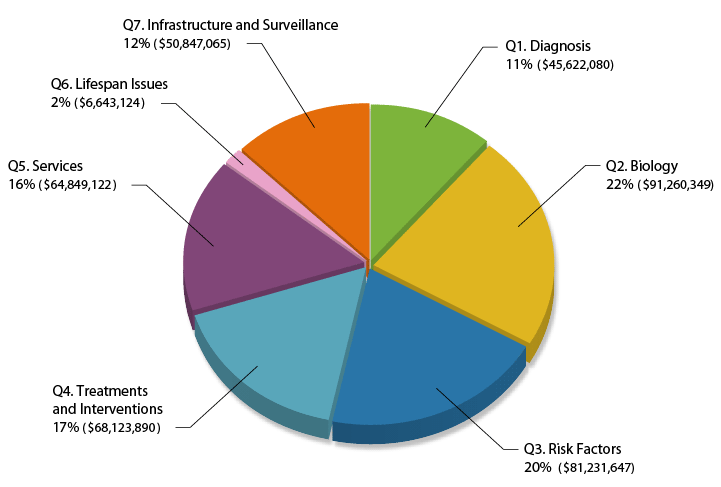
In my own opinion, a large fraction of research effort is already directed towards medical management. If we look at the autism research portfolio (here data from 2010):

2010 ASD Research Funding by IACC Strategic Plan Question – All Funders
(Total ASD funding = $408,577,276)

figure3_2010

You might say, “treatments and interventions, that’s only 17%?”. Yeah, but you gotta include biology, and that’s another 22%. Without an understanding of the biology of autism, you will never get to effective therapies. Well, maybe in some sort of Edisonian approach. However that not only takes a long time, but it’s pretty obvious people aren’t light bulbs. Edison burned out a lot of light bulbs in his search to find a good filament. Groping around blindly for treatments can lead to disastrous results in humans. Perhaps the ARPC may feel they already know the biology of autism (vaccine injury, heavy metal poisoning, oxidative stress, neuroinflammation and more). That hasn’t always worked out so well.

At present the majority of federal autism research funds go to NIH. About 80% per an article in Congressional Quarterly that just came out. The Coalition’s proposal focuses primarily on NIH. Too much in my opinion. While one could say that might be justified given their large stake, in my opinion their proposal doesn’t do a good job of coordinating with the other federal funding agencies. And there little to no coordination with private funders. Private funders account for a large amount of autism research dollars. Simons Foundation, Autism Speaks, Autism Science Foundation and more private organizations contribute a great deal to autism research. In 2010, the Simons Foundation alone was the second largest funding agency after NIH. Yes, a larger contribution than any other federal agency than the NIH.

The Coalition further proposed assigning the funds for the NIH to their proposed Office of Autism Spectrum Disorders Research. It sounds like this would give more power to the advisory groups, but without some framework whereby this Office manages the funds, it’s just bookkeeping.

The Coalition presented themselves as wanting to delay Autism CARES to make some small but helpful changes. They were neither small nor helpful.

I had hoped to write something before Autism CARES passed. While it’s pretty much academic now (and likely was even before Autism CARES passed as I don’t think the Coalition had much traction), it’s worth reviewing their proposal.


By Matt Carey

note: I serve as a public member to the IACC but all comments here and elsewhere are my own.

Autism CARES Act passes the Senate

1 Aug

The Autism Collaboration, Accountability, Research, Education, and Support Act of 2014 (Autism CARES Act) has passed the Senate, per TheHill.com. Autism CARES now moves on to the desk of President Obama.

Autism CARES continues the government’s commitment to support autism research, authorzing $260 million a year. It further continues the structure whereby coordination of research efforts by government and private organizations includes stakeholder input through the Interagency Autism Coordinating Committee.


By Matt Carey

note: I serve as a public member to the IACC but my comments are my own.

Tax form for American Citizens for Health Choice

1 Aug

With the recent article on the financial documents for the Canary Party, it’s worth noting that the same team behind the Canary Party has a charity “American Citizens For Health Choice”. They have a site, HealthChoice.org. A while back I discussed them in the comments for a Canary Party article. As a charity they file tax forms (form 990) which are made public. Here’s their 2012 form. They had $74,000 in revenue and $60,638 in expenses.

So, don’t think that just because money isn’t going to the Canary Party that this team is backing off.

Of their revenue, $4,440 is listed as “public support” which suggests to this observer that the remaining was fronted by their officers. Ms. Larson and Mr. Blaxill contributed large sums to their Canary Party project (and to politicians) in the past.

As with the Canary Party, travel is a large chunk of expenses. Not as much detail as with the Canary Party, but they spent about $12k on travel and another $17k on expo/trade shows.


By Matt Carey

More Canary Party financial documents

1 Aug

The Canary Party is a tiny organization focused on promoting the idea that vaccines cause autism. They have branched out some with GMOs and “health freedom”, but their core seems to be the failed idea that vaccines cause autism. I’ve previously posted some of their financial documents (here and here)

Here are finance disclosure forms for
2011
2012
2013
2014

They took in
$72,018.66 in 2011
$48,748.95 in 2012
$17,425.00 in 2013
$6,275.00 reported as of June 2014

they had about $3,100 on hand as of June 2014. Where before they had some large donors and a number of small donors, so far this year all donations have been from Canary Party officer Jennifer Larson.

In previous years, they had thousands of dollars in expenses for stays at the Hyatt/Ritz and Hyatt/Four Seasons, this year they have two modest travel expenses totaling under $1000.

No parties gatherings are listed this year like their $11,000 convention in 2012.

They’ve become less transparent in their expenses. In 2013 they list $4,500 as “Dues and Membership Fees: Software” and $2,250 one month and $2050 another in “Other Services: Outside Services”. Some or all of that could be payments to blogger Ginger Taylor, who in 2011 and 2012 was paid $4,500 a month for parts of the year as “media consultant” and “Public Relations/Fundraising Service”. Hard to say, it’s not transparent.

It looks like this effort may keep moving along, self funded at a low level, for the foreseeable future. But as a major, grass-routes organization it seems to be failing.


By Matt Carey

Are congressmen Justin Amash and Rick Nolan being courted by the vaccine/autism community?

30 Jul

The groups promoting the idea that vaccines have caused an epidemic of autism have always been politically active. There’s been a resurgence in recent years, with the Canary Party and lobbying and donations and lobbying asking for congressional hearings on autism. When I got an email today from Generation Rescue (an organization promoting the idea that vaccinesasking me to donate to Congressman Bill Posey, I thought I’d take a new look at opensecrets.org and see what donations have been made lately.

Canary Party officer Jennifer Larson donates from her company (Vibrant Technologies). Another Canary Party officer is Mark Blaxill. Searching OpenSecrets for their names I find that they are (a) not donating to Darryl Issa (whom I’ll discuss below), (b) donating to Bill Posey and (c) have started donating to Justin Amash and Rick Nolan. Here are screen shots (click and click to enlarge):

larson

blaxill

And I haven’t checked to see who else is donating to these members of Congress.

Jennifer Larson recently donated $40,000 to Congressman Darryl Issa. Congressman Issa chairs the House Committee on Oversight & Government Reform. This same committee held hearings on autism, sadly wasting a lot of time on the Canary Party’s failed vaccine message. One of those hearings included Larson’s colleague at the Canary Party (Mark Blaxill) presenting testimony. Interestingly, Congressman Issa did not attend the second hearing by his own committee last year. And now the money is moving to other politicians.

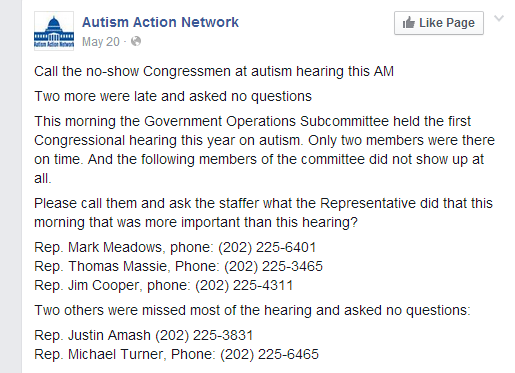
Congressman Amash sits on the Committee for Government Oversight & Reform (the same one that held the hearings). But he was criticized by one of the vaccine/autism groups for arriving late and not asking questions in the recent hearing.

amash1

Rick Nolan is a member of the Congressional Autism Caucus.

Ms. Larson also has a $2,000 donation to congressional hopeful Tom Emmer (May 13, 2014).

Interestingly, Gary Kompothecras does not seem to be supporting Bill Posey this election. He has in the past (and here) and lives in the same state as Congressman Posey. Whether the lack of donations this election cycle represent some of the friction within the autism/vaccine community is unclear.

Donating to politicians is of course appropriate and legal. As is following money from special interest groups.

I hope these politicians do their own research. The vaccine/autism idea has caused a great deal of harm to the autism communities and to public health.


By Matt Carey

The Age of Autism wants people to donate to Congressman Bill Posey…because “money=influence”

30 Jul

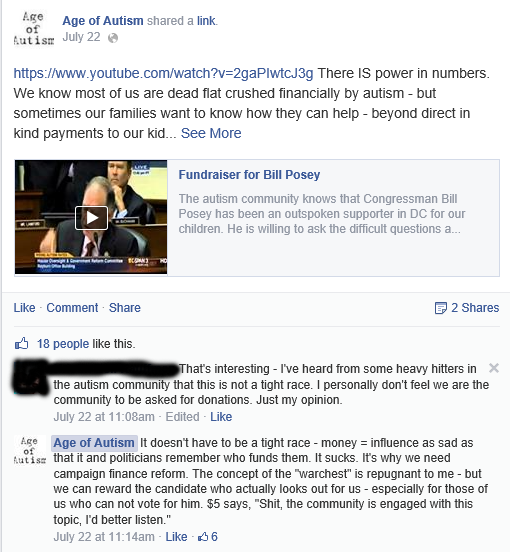
Here’s a screenshot from the Age of Autism Facebook page:

AoAInfluenceBuying

click to enlarge.

I was going to make some comments, but it says a lot just on it’s own.


By Matt Carey

No, autism in Scandinavia isn’t rare and “high functioning”

30 Jul

There’s a belief I’ve seen recently online claiming that studies from Scandinavia don’t relate to the U.S. because autism is rare there (3 in 10,000) and that autism in Scandinavia is primarily “high functioning”, Asperger syndrome or the like. I won’t link to the discussions as I’ve tried to avoid using the blog to continue discussions found online elsewhere.

I don’t know where this myth originated. But here’s a recent study from Sweden and this result (1.15% autism prevalence, intellectual disability in 42.6%)

The 2007 year prevalence of ASD in all children and young people was 11.5 per 1,000 (95% confidence interval 11.2–11.8), with a co-morbid intellectual disability recorded in 42.6% (41.0–44.2) of cases. We found 96.0% (92.0–98.4) of reviewed case-notes being consistent with a diagnosis of ASD, and confirmed ASD in 85.2% (66.2–95.8) of affected twins.

Yep. Prevalence comparable to the US and with a similar level of intellectual disability.

While we are at it–the prevalence is also pretty much flat for ages 9-18 (kids born from 1989 to 1998) as well.

plos_sweden_figure_1_top[1]

As noted before, thimerosal exposure from infant vaccines was low in Sweden before the 1990’s and was reduced to zero in the early 1990’s. So, for few people still clinging to the “thimerosal epidemic” idea, here’s another nail to add to that coffin.

Another recent study shows prevalence in Scandinavian countries to be between .5 and 1 per 1,000.


By Matt Carey

Call your senators, ask to bring the Autism CARES ACT to the floor

29 Jul

The bill which authorizes funding for the US federal government’s autism research effort expires this September. The re authorization bill is called the Autism CARES Act (Autism Collaboration, Accountability, Research, Education, and Support Act of 2014). The U.S. House of Representatives passed the bill and it passed the Senate HELP Committee. If it passes the Senate and gets signed by the President (pretty likely) it’s a law.

It is now waiting to be brought to the floor of the Senate for a vote.

The last time the research authorization bill was passed (the Combating Autism Reauthorization Act), the reauthorization happened at the last minute: September 30th. A new Committee to advise and plan autism research didn’t start work until the next July. This IACC met for the last time a few weeks ago, so if events go as before it will be a full year without stakeholder input on autism research. If Autism CARES passes soon, the government can start working on a new committee earlier and the delay will hopefully be shorter.

The Senate will go on recess at the end of the week (by law they have the month of August off). So now would be a good time to remind them to bring this to the floor and get it moving.

Autism Speaks has set up a handy web app to help you do this: http://bit.ly/SensCall. Click it, input a little information and it calls you back and sets up the call for you to your senators’ offices.

FaxZero lets you send 5 faxes a day from the web and they have a handy web interface to help guide you to your own (or any other senator). That is http://faxzero.com/fax_senate.php

Want to fax everyone in the senate in one fell swoop? For about $10, http://www.faxyouropinion.com/senators will send the same message to each senator. Don’t worry, they change the “Dear….” line for you.

Want to send those 5 free faxes from FaxZero and wonder who might be someone worth faxing? Well, there’s a set of groups who have been trying to block Autism CARES. These groups set up a list of targeted senators (all these groups are in the “vaccines cause autism” persuasion, 3 directly associated with Andrew Wakefield…yeah, sit back, do nothing and Andrew Wakefield will help shape U.S. autism policy for you. Now that’s a cheery thought!)

Here’s their list.  (Their staffs are very nice.  One Senator goes straight to voicemail, though).

Senator Rand Paul in Kentucky

Senator Ted Cruz in Texas

Senator Mike Lee in Utah

Senator Tom Coburn in Oklahoma

Senator Roy Blunt in Missouri

Senator Ron Johnson in Wisconsin

Senator Jim Risch in Idaho

Calls only take a minute. You can just call and say, “I’m autistic and I want Autism CARES brought to the floor. Please support it” or “I’m the parent of an autistic kid and I want Autism CARES brought to the floor. Please support it”. Or you can say “Please kill the Autism CARES Act”. It’s your Senate. Use it.


By Matt Carey

Note: I serve as a public member to the present IACC, the committee which is authorized by the Combating Autism Act. My comments here and elsewhere are always my own.

Locking autistics in a filthy basement room can never be called “the least bad solution”

28 Jul

The Washington Post has a series of articles about a pair of twin autistic adults who were found locked in a basement room. Here are the first two:

Rockville, Md., couple charged with abusing twin 22-year-old autistic sons

and

Rockville autistic twins who were locked in room are moved

From that second article:

The autistic twins who spent nights locked inside a urine-stained room in their parents’ basement have been safely placed in another home under the oversight of social workers, Montgomery County authorities said Tuesday.

The young men, 22 years old, also have undergone medical checkups, which didn’t find signs of further abuse, police said.

Their parents — John and Janice Land — have each been charged with two counts of abuse of vulnerable adults and two counts of false imprisonment. It appears that the authorities’ case against them rests on the conditions that left the two men inside a filthy, dark room with only an old comforter to sleep on. Neither man can communicate verbally. The doors to the room were bolted from the outside, and the basement also was blocked in places by plywood, according to police accounts and fire inspection reports.

“This case is unacceptable,” said Laurie Reyes, a Montgomery police officier who works with autism families. “There are other measures that can be put in place.”

She said that the conditions for the twins were the worst she had ever heard of in the county.

“the worst she had ever heard of in the county”

Not “just” locked in the basement. Squalor. Filth. According to a later article, the house has been condemned.

This inspired the Post and writer Dan Morse to write another article: Coping with adult children’s autism, parents may face ‘least bad’ decisions

Mr. Morse, I appreciate what you are trying to do. We absolutely need better supports for our autistic adults. But framing this story around the actions of these parents is bad. Really bad. I am at a loss for words in describing just how bad.

I’ll pull one sentence out.

But John Land’s father — John Land III — has said the criminal allegations are overstated given the challenge the twins presented.

If you are going to write that, what about a loud rebuttal? How does being disabled make it non criminal to hold these twins in a squalid prison cell? I frankly think the criminal charges are understated, much as this rebuke is extremely understated.

This sort of abuse can never be the “least bad” choice. Not even close.

Please, find a way to write about the challenges faced–from the perspective of the autistics. Find a way to write about autistics as equals, humans who deserve support because we, the non disabled, should live up to our responsibility.

By Matt Carey