Archive by Author

An account from a survivor of the Judge Rotenberg Center

15 Feb

Recently I wrote about a letter from a survivor of the Judge Rotenberg Center (JRC). At the time I did not know if I needed permission to publish the letter in full so I linked to the post I found it at, from Autistic Hoya: Judge Rotenberg Center Survivor’s Letter. I’ve since contacted Nancy Weiss and confirmed that the author gave permission for people to post. Below is that letter. It is very difficult to read and could be a trigger.

—————————

The following letter was sent to Nancy Weiss, Director of the National Leadership Consortium on Developmental Disabilities at the University of Delaware on January 11, 2013. Ms. Weiss assured the author that she would protect the writer’s anonymity. Ms. Weiss can pass messages to the author. Ms Weiss can be contacted as below:
Home Office: 443-318-4879
Cell: 410-241-7257
email: nancy-weiss@comcast.net

Dear Ms. Weiss

Hello my name is xxx. I was told you are someone I can talk to in confidence and be safe. I would like to share with you my letter that I wrote to the FDA about life inside JRC and on the GEDs. It was torture being there. And I suffered so much. I am still tormented. Here is my letter of testimony:

My name is xxx and I attended the Judge Rotenberg Center. I am writing to ask you to please reconsider your approval of the GED for use on ANY human being. I was placed on the GED about 2 months after arriving. I started out on the GED-1, and during my last few years I was placed on the GED-4. There are so many of us that were tortured with these devices, this “treatment”. I believe the reason why more ex-students haven’t spoken out is because they are either non-verbal, afraid, or believe that no one cares about us or it will not make a difference. Parents and families that speak and rally in favor of the GED, are not the ones who have to experience it, the pain and anxiety, day after day for years on end.

The GED IS harmful. Even the GED-1. I was burned many times, and I still have scars on my stomach from being repeatedly shocked there, by the FDA approved GED-1. The electrodes had actually burned into my skin. I experienced long term loss of sensation and numbness in my lower left leg, after getting a shock there. I felt searing pain all the way down to the bottom of my foot, and was left with no feeling in my skin from the knee down for about a year. Again, this was with the GED-1. After complaining to JRC nursing about my leg, they told me to tell the Neurologist about it during a follow up visit for a suspected seizure. He asked the staff what that device was on my leg, and they explained to him it was an electrode. After their explanation, the Neurologist said, “Well, I don’t know what that thing is, but it needs to come off.” JRC left the device off my leg for about a year, then decided on their own, without sending me back to a Neurologist, it was ok to put it back. I have seen students with torso electrodes accidentally placed on their spine area, get a shock there and be violently bent backwards.

Also, I would like you to know that the devices have a tendency to malfunction and go off all by themselves. JRC refers to this as a “misapplication”. It happened to me and other students so many times I cannot count. Sometimes the GED’s will just start to go off and shock you by themselves. Other times the staff shock one student but the remote can also set off someone else’s device at the same time. I have also gotten accidentally shocked from staff mixing up my device with another student’s device, shocking me instead. Then there are the times when staff intentionally misuse the GED. I have had a staff who became angry with me and started pushing more than one remote at a time, shocking me several places on my body at once. I have had staff intentionally give me shocks for things I didn’t do in places like the bus where there was no camera to prove it. I have had numerous staff over my years there threaten me with a GED, antagonize me to try and get me to have a behavior they can then shock me for, merely for the sport of it. Staff can and DO use the GED to scare non-verbal students into doing what they want them to by pretending they are about to shock them. Some even laugh when they do this.

Many of the things I and others get shocked for at JRC were very small things. They would often shock us for things simply because staff found them annoying and they would keep writing therapy notes until our psychologist added it to our program. I got shocked for tic like body movements, for which I have no control over, and which don’t hurt me or anybody else. I would be shocked for waving my hand in front of my face for more than 5 seconds, for closing my ears with my fingers, which I do when things get too loud, because I cannot tolerate too much noise. I would be shocked for wrapping my foot around the leg of my chair, for tensing up my body or my fingers, and the list goes on and on. There was a period of time where I and many of the other students were getting shocked for having 5 verbal behaviors in an hour. A verbal behavior is a minor behavior like talking to yourself, noises (such as clearing your throat), or talking without permission. Every hour would start a new block. And if you were pinpointed more than 4 times in that hour, on the 5th you would get a shock, and then for EVERY minor verbal behavior after that you would be shocked. If you talked out a 6th time, shock. If you had to go to the bathroom, and you had to go really bad, but you asked more then once, that would be nagging, which is a verbal behavior. And these were the things we were getting shocked for. My program was this way for a while. Some of my verbal behaviors I got pinpointed for were crying, talking to myself (even quietly), noises, laughing, humming, repeating myself and inappropriate tone of voice (which was based on staff’s opinion of how my voice should sound). Almost every time I spoke or answered a question, I was pinpointed with these behaviors. My reaction was to stop speaking, but they also made part of my program that if I didn’t answer staff in 5 seconds, I would automatically be shocked. I was paralyzed with fear every day. No matter what I did I was doomed. I ask those who read my letter to think to themselves about how often they do some of these things while they are working. Twirl their pens, talk to yourself or think out loud, ask a question to someone nearby, hum a song that’s in your head, laugh at something funny in the room. These are things humans do. And they are not harmful. Yet we were being subjected to terrible pain and fear for doing these simple things. One day, out of the blue, the case managers went through the building and scratched off this punishment from all their students recording sheets. They didn’t say anything to us about it, just made it like it never happened. Although I can’t say for sure, I overheard talk that one of the male students had told his lawyer and family they were shocking him for talking, and that JRC was never supposed to be allowed to do that to us. Whatever the reason, they covered it up fast. And even though they stopped, they still need to be held accountable for all of it. Because it went on for a very long time, and I suffered greatly because of it. People NEED to know these things happened.

There was a time when I was there that I was on the portion program. This is where JRC starves you as a punishment for having a behavior. For example, my first plan was that for every time I had a minor behavior, such as talking to myself, rocking, wiggling my fingers, I would lose a part of my next meal. My meals came to the classroom cut into tiny pieces and divided into portions inside of a little plastic cup. Every time I had one of these little behaviors, I was forced to stand up and throw one cup away. There were many days I would lose most of my meals. And the hungrier I got, the more frantic and restless my body became. This caused me to have more behaviors like tics and rocking, and in turn I would lose more food. My mind clouded and I could no longer concentrate. I would often become so frustrated from this I would end up hurting myself. At the end of the day, at 7pm, I was offered “LOP” (loss of privilege) food. This was made intentionally to be completely unappetizing. It was ice cold, and it was made up of chicken chunks, mash potato, spinach, and then doused with liver powder, then set to sit in the refrigerator for days. The smell alone made me sick. And I never once was able to eat it, no matter how hungry I got.

It was very difficult to sleep at JRC. There are several alarms in the room and over the bed. Every time someone moved in bed it would set a loud alarm off that could be heard throughout the house. Most of us on GED’s had to sleep with the devices on. That means locks and straps that get all tangled around you and make it very hard to lay down in a comfortable way. I was very anxious to close my eyes, always fearing a shock for something I might not have even known I did. My fears came true one day, and I was given a GED-4 shock while I was asleep. It was not explained to me why I got this shock. I was terrified and angry. I was crying. I kept asking why? And they kept telling me “No talking out”. After a few minutes Monitoring called, and told the staff to shock me again for “Loud, repetitive, disruptive talking out.” The next day I asked the supervisor why I had gotten that GED. And she explained that staff had found a small piece of plastic in my self-care box, which contained my shampoo bottles etc, and that they considered this a hidden weapon. I could not believe it. I did not hide anything in my self-care box. I had not done anything wrong. Yet I was shocked for it, and worse off in my sleep. That piece of plastic, of which I was never shown, had probably broken off of one of the plastic containers inside the box. And I was severely punished for this. After this incident I really stopped sleeping. Every time I closed my eyes they would jump open, anticipating that jolt somewhere in my body.

I truly believe that the judges that approve us for the GED have no idea what it really is like. All they have to go on is what JRC claims. The GED does not feel like a “hard pinch” or a “bee sting.” It is a horrible pain that causes your muscles to contract very hard, leaving you sore afterward. I would often have a limp for one or two days after receiving a GED. The devices JRC puts on us are not the same ones they show to the outside world when they let outsiders try the GED. Students wear a different electrode, a long one with 2 metal electrodes that radiate the electricity across a large area.

Besides the physical pain, life with GEDs is a life of constant anxiety. I experienced heart palpitations daily, had a very hard time sleeping and eating, and became rather paranoid, always wondering if I was about to get shocked and constantly alert in all directions. I eventually became very depressed there and contemplated suicide every night. Now, after having been gone almost 4 years, I am still having nightmares and flashbacks during the day, especially when I hear certain noises that remind me of GEDs and JRC.

I want to mention, similar to many other students, I was also tied to the 4-point restraint board and given multiple shocks for a single behavior. And if I screamed out in fear while on the board, I would be shocked for that as well. I was shocked for behaviors I had no control over, such as tensing up and tic-like body movements. We were always having to watch others getting shocked in the room. Hearing others scream, cry, beg to not be shocked. Students would scream “I’m sorry, No, Please!!” all day. I, like other students, would cringe and feel sick and helpless while watching others getting shocked. I was so anxious about getting shocked that I would many times bang my head just to get it over with. The GED often was the cause of my behavior problems. The students that get shocked the most at JRC are non-verbal. So they cannot speak up. I feel that just because we were born different, we are not given the same rights to be protected from tortures like the GED.

We are at the mercy of guardians and judges. When I was brought to court to be approved for the GED, I was not told where we were going or why. I was brought into the courtroom wearing a helmet and restraints on my wrists and ankles. I was not questioned by the judge. All he had to go on was my appearance in those restraints, testimony from JRC officials, and charts of provoked behaviors. These behaviors came from being forced to sit in isolation with a straight upright posture, in the center of a hard restraint board, day after day, week after week, for two months. I received no real help and no socialization. For those two months I was not allowed to sit in a chair, at the classroom or residence. I was to sit on the board. Also, JRC provoked me by not allowing me to shower during those two months. Instead of showers, I was bathed tied to a restraint board, naked, while staff washed me, putting their hands all over me. All in front of cameras, where Monitoring watched, including men. Being tied on a restraint board, naked, with my private areas exposed to the staff in the bathroom and the cameras was the most horrible, vulnerable, frightening experience for me. I would scream out “rape, rape!” And these were recorded as major behaviors for me. When I first arrived at JRC, I was immediately subjected to humiliation and provocation by them forcing me to wear a diaper. I in NO WAY needed or have ever needed a diaper as an adult. I am completely independent in all toilet and hygiene skills. And they knew that. I had NEVER worn a diaper up until that day, except of course when I was a little baby. And that is exactly how they made me feel, like a little baby. I was embarrassed and confused and angry. I took that diaper off constantly. When I would take the diaper off they would mark that down on my chart that they would later show the judge as destructive behavior. I would often get restrained on the 4 point board for taking off the diaper and fighting staff not to make me put it back on. In these ways and more, JRC provoked many behaviors in me that were shown on a chart to the judge. There is no way the judge could know what was provoking my behaviors. JRC told the judges that their program was the only thing that could help me. That theirs is the only last resort treatment.

I was considered a difficult case. I would like you to know that I am doing very well in a new program that is nothing like JRC. I don’t get shocked or put in restraints, and I am given help by staff and doctors that I can talk to. I am not drugged up as JRC claims I would be if I left. JRC made no attempt to understand me. Feelings do not matter to JRC and we were specifically not allowed to express them. I felt like an animal test subject there. My new program does not punish me for my problems, that are the result of having Aspergers Syndrome. I have gotten so much better from getting real help instead of constant punishment and pain.

I ask you to please investigate carefully into the GED. The ones that are actually being used on the students, not the samples JRC provides, as I have experienced them to be extremely manipulative in all things. There are no doctors overseeing us with the GED. Every few years they would drive me to a doctors office near Framingham, Ma, and not tell me why. In his office he would literally walk in, say hi how are you, and before you can answer he has signed their papers and you are shown the door.

I have attached with this email a document I wrote called “The Board” which is about one of JRC’s worst tortures that they used on me and others. I wrote it so that outsiders can feel what we feel, and hopefully to help others understand the agony of GED treatment. I invite you to read it, and I hope it will share a new perspective for you, the perspective of the ones that should matter the most, the human beings on which these devices are being used.

Sincerely,
xxx
————————————————————————————————————

The Board
By: xxx
December 2012

The most sickening, horrifying experience of my life was being shocked on the restraint board. What is the board? It is a large, door sized contraption made out of hard plastic, with locking restraint cuffs on each corner where your wrists and ankles get locked in. Your body becomes stretched spread eagle style, pinned tight, rendering you completely helpless, combined with an overwhelming feeling of vulnerability. It is a torture that you would expect to see in a horror movie. The kind that makes you cringe and scream while you watch. The kind you cant get out of your head even a after it’s over. Only this was happening for real, to me.

They added the restraint board, which for me was 5 shocks over 10 minutes to my program after a few months, which means getting shocked 5 different times, over a period of 10 minutes for having just one single behavior. If you have just one of those behaviors on your sheet, which can be getting out of your seat without permission (even without doing anything violent), tensing your body, anything they decide to put in your program. A behavior is anything you do that JRC considers a problem. Anything from hitting your head, to talking to yourself, saying a swear word, rocking, even screaming from fear and pain of the shocks, is a “behavior”. The staff grab you, put you in restraints, walk or drag you to where the board is kept (usually right in the middle of the classroom with all the other students watching and stepping around you), and thanrestrain you to the board. Arms and legs locked in. Then the terror starts. You have to wait for it. You never know when it’s coming. The staff shocking you usually hides behind a door or desk so you can not see them. JRC lavishes in the element of surprise when shocking us. Then all of a sudden the searing pain and jolt in your arm or leg or stomach, or sometimes even the fingertips or thigh or even bottom of your feet. Whichever part of the body gets shocked, it will travel throughout. If you get shocked in your arm, for example, it is not a “hard pinch” it is a radiating electricity that will travel from your bicep through to your fingertips. Your whole arm jerks against the restraints, causing added pain from your muscles being forced to contract against being tied up. The loud screech of the device goes off with it, and they say, “(name) there is no tensing up”. One down, 4 to go. Your heart races immediately, and you sweat profusely. All you want to do is throw up. That ten minutes feels like hours. You try to prepare yourself for the next shock. I keep saying in my head, 4 more, 4 more. Please just finish please. Trying not to scream in fear because i will be shocked for that as well. It comes again without warning, next time maybe in your stomach, the stabbing pain runs from left to right, right to left, across your belly button area. Your stomach heaves in and you lose your breath. More sweat now. Your heart beats faster now than you can feel possible. I start to hope my heart stops. Anything to let me away from this.3 more. But now it’s even harder, I don’t feel I can take any more of this torture. Besides the pain, it’s the panic and fear in your mind. There were times when I peed on myself. One particular time I was put on the board for hitting my head the night before. They said because the staff did not “follow my program”. They put me on the board. They shocked me repeatedly in the stomach. And when they finally got to 5, I thought “it’s over”. But then they didn’t take me off the board. They gave me a 6th, than 7th, than 8th. They kept going. I was so filled with fear, not knowing what was happening or when they would ever stop. I went away in my head. I started floating. I had no more tears left. When they finally stopped after 10, they sent other staff in to “change my batteries”. When they lifted the electrodes off of my stomach, it was stuck. They had to pull because it had burned into my skin. I still have those scars on my stomach. When they took the devices off of me to test them, I was still strapped to the board. Every time I heard the noise from the test, I cried and panicked. The staff attempted to comfort me, she whispered to me so they wouldn’t hear her, because any kind of comforting is never allowed. I was shocked on the board on many separate occasions. One time for something I never even did.

I lived this. These things happened. These things were done to me and I witnessed them done to many others.
Comment on: Maternal autoantibodies are associated with abnormal brain enlargement in a subgroup of children with autism spectrum disorder

14 Feb

In 2008 a paper opened up a new area of research in autism risk factors: Autism: maternally derived antibodies specific for fetal brain proteins. The researchers at the U.C. Davis MIND Institute found that for a subset of autistic kids, they could find antibodies in the mothers’ sera that reacted to human fetal brain tissue. Other teams have found similar results, and the MIND researchers have continued to explore this topic.

In the present study, the researchers studied 131 ASD kids and 50 non-ASD controls. 10 of the ASD kids were born to mothers with the brain specific autoantibodies detected in their serum. Autism severity, by their measure, was the same for the two ASD groups. The rate of develpmental regression is the same for the two groups, but strikes me as rather high at 40-50% . Previous studies by this team and others indicated a higher rate of regression in the ASD kids in the maternal-autoantibody group.

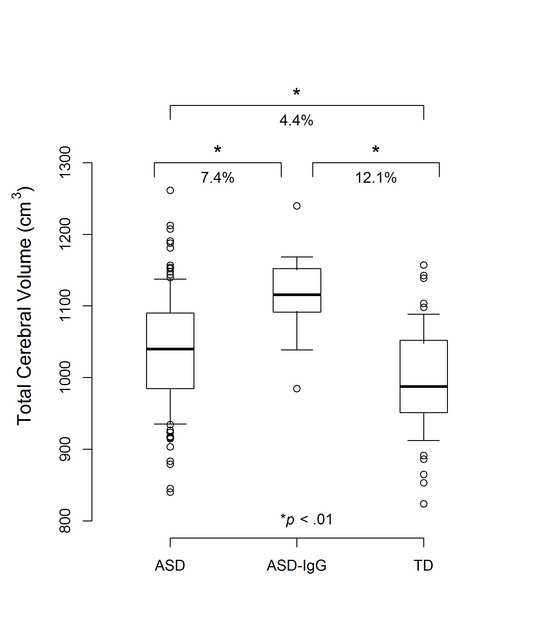
Brain volumes were measured via MRI. Most children were tested during sleep. 10 children (all ASD) were tested under anesthesia. Scans were corrected for instrument distortions before volumes were measured. Brain volumes were higher for the ASD kids than the typical kids, consistent with previous results. However, the kids in the maternal autoantibody group had brain volumes even higher than the rest of the ASD kids. The kids in the maternal autoantibody group had brains 12% larger on average than the non ASD kids, while the rest of the ASD group had about 4.4% larger volumes.

The volume differences were not the same over the entire brain:

Furthermore, the frontal lobe was selectively enlarged in the ASD-IgG children relative to other ASD children, and both gray and white matter were similarly affected.

Previous work by the authors indicate the possibility that the autoantibodies themselves might cause brain differences resulting in autism. Their animal model was rhesus monkeys, whose mothers were injected with the autoantibodies.

The authors note there are a number of open questions:

Obviously, several questions remain: What are the brain antigens recognized by the 37/73 kDa maternal IgG autoantibodies, and what is their role normal neurodevelopment? What induces the production of these antibodies in some women but not in others? What is the mechanism by which these maternal autoantibodies alter brain development? Are there processes that could be implemented to block the deleterious effects of the antibodies? Studies are currently underway to address each of these issues and they will undoubtedly shed more light on the role that maternal
autoantibodies may play in ASD and abnormal brain enlargement in ASD.

Another open question they raise has to do with siblings of the autoantibody ASD kids. In specific, since these autoantibodies can persist in the mother’s serum for many years, it is likely that younger siblings are exposed to them as well. If these children do not develop ASD, what is the reason?

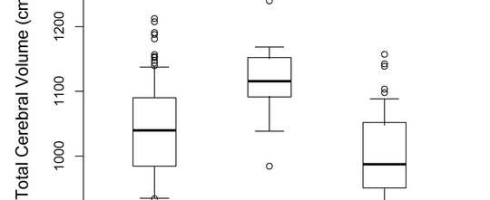
The brain volume differences are shown in summarized in this figure:

Antibodies figure

There is a large spread for the brain volumes for the non-autoantibody ASD kids. While on average they are larger, a number are comparable to the average for non-ASD kids. Also, there is a large overlap between the ASD groups from parents positive for the autoantibodies and without the autoantibodies. The kids in the autoantibody group are almost all at the high end of the distribution for the non-ASD kids.

The main thing this paper adds to the autoantibody story is evidence that this may represent a separate group within the ASD population. The work is being performed on members of the Autism Phenome Project. If this is a separate group, so far the evidence is only in brain volume. The authors note: “There were no differences in age, height, autism severity, or DQ between the two ASD groups. Furthermore, the two groups did not differ in the rate of parent reported history of regression.” So on other physical measures, and on autism-based measures, there are no differences. Obviously it would be valuable to see diffrences in autism-specific measures so we could back track how those measures are related to etiology and brain structure. But it is also interesting that this group does not have differences as it could indicate multiple pathways are not always distinct in the end result in autism development.

Nordahl, C., Braunschweig, D., Iosif, A., Lee, A., Rogers, S., Ashwood, P., Amaral, D., & Van de Water, J. (2013). Maternal autoantibodies are associated with abnormal brain enlargement in a subgroup of children with autism spectrum disorder Brain, Behavior, and Immunity DOI: 10.1016/j.bbi.2013.01.084

ResearchBlogging.org


By Matt Carey

Comment on: Use of Birth Certificates to Examine Maternal Occupational Exposures and Autism Spectrum Disorders in Offspring.

13 Feb

A recent hypothesis-generating study by the epidemiology team at Kaiser in California looks at whether one can use birth certificates as a starting point to identify possible maternal exposures which might increase autism risk. Birth certificates include parental occupation. So, the authors propose, one could categorize occupations by possible exposures and, if there more autistic children are born to parents with various occupation types. The study is: Use of Birth Certificates to Examine Maternal Occupational Exposures and Autism Spectrum Disorders in Offspring.

Here is the abstract:

The continuing rise in the prevalence of autism spectrum disorders has led to heightened interest in the role of nongenetic factors, including exogenous exposures, but little research has been conducted. To explore a possible role in autism etiology, we used data available from our prior studies to examine potential occupational exposures, as these may occur at higher levels than environmental exposures. Parental occupation was obtained from birth certificates for 284 children with autism and 659 controls, born in 1994 in the San Francisco Bay Area. Self-reported occupation and industry were coded into eight exposure/chemical groups based on potential neurotoxicity or reprotoxicity by a board-certified physician in occupational medicine and an industrial hygienist blinded to case-control status. Mothers of autistic children were twice as likely to work in occupations considered exposed (14.4%) as mothers of controls (7.2%) (adjusted odds ratio [AOR] 2.3 [95% confidence interval {CI} 1.3-4.2]). The exposure categories of the greatest frequency among case mothers were exhaust and combustion products (AOR = 12.0 [95% CI 1.4-104.6]) and disinfectants (AOR = 4.0 [95% CI 1.4-12.0]). Paternal occupational exposure was not associated with autism, potentially consistent with a direct in-utero exposure effect. There are several limitations of this hypothesis-generating study, including lack of detail on workplace and job duties, leading to possible misclassification and low proportion exposed. However, this misclassification would not be biased by case-control status and is unlikely to explain the associations we did find, suggesting that further research on exogenous exposures may yield useful etiologic clues

There are a lot of limitations to this study, and the authors make that quite clear. The study is written as a “hypothesis-generating” study. I.e. they can create hypotheses of possible exposures which might increase autism risk. Taken in that context, a limited study which can generate hypotheses, this is a good study. One which takes a fairly inexpensive and straightforward route to narrow the list of possible exposures which increase autism risk.


By Matt Carey

Texas Observer article: Autism Inc.: The Discredited Science, Shady Treatments and Rising Profits Behind Alternative Autism Treatments

12 Feb

The Texas Observer published an article two weeks ago: Autism Inc.: The Discredited Science, Shady Treatments and Rising Profits Behind Alternative Autism Treatments. In the article, author Alex Hannaford discusses the alternative-medicine/vaccine-causation community, the therapies they promote and the lack of evidence behind them. Mr. Hannaford argues that Texas, in particular, is a center for this movement:

To compound the problem, a host of celebrities act as unpaid marketing reps for these unproven treatments, touting a pervasive (but incorrect) belief that autism is caused by childhood vaccines. This misinformation campaign has led, in the last few years, to a decline in the number of children receiving lifesaving inoculations. And Texas has become a center for alternative autism treatment and the anti-vaccine crusade.

Texas, of course, is the home of Andrew Wakefield. Mr. Wakefield, as most will recall, made his name in the autism community promoting the idea that the MMR vaccine was causal not only in some autism cases, but in giving rise to the rise in autism diagnoses observed in the U.S. and the U.K.. Mr. Wakefield’s primary paper has been retracted, his license to practice medicine pulled for unethical practices, he has resigned his position at what was then called “Thoughtful House” and multiple studies have demonstrated the lack of substance in his ideas.

Mr. Hannaford discusses much of this, including extensive quotes from Michael Fitzpatrick, a U.K. autism parent who has been a long-time critic of Andrew Wakefield’s work, James Laidler, whose work with the alternative medicine movement has been documented and, while not calling him out by name, Brian Deer‘s work in the BMJ is also cited. Mr. Hannaford also cites Wakefield supporters Jane Johnson, for whom Thoughtful House is now named (the Johnson Center), filmmaker Robert Rodriguez and, of course, Jenny McCarthy.

I am unconvinced that Texas is a particular hotbed of the alt-med/vaccine-focused autism community. But perhaps this is colored by the fact that my home town is now headquarters for TACA, AutismOne, SafeMinds and more. However, the idea that a great deal of untested and scientifically unsound “therapy” is promoted to the autism parent community is something I do not contest in the least.

Mr. Hannaford concludes his article, citing Dr. Jody Jensen, director of research of the Autism Project at the University of Texas:

“We are not doing anything special,” Jensen said. “What we are doing is providing the resources to allow these kids to be safe and to explore and experience things like every other child. That’s what’s often lacking. It’s about trying to restore some sense for them of what a typical childhood looks like.”

That is what parents of kids with autism disorders want more than anything for their children: a normal childhood. Those children just might have a fighting chance to get it—if they don’t have to undergo therapies and treatment unsupported by any scientific evidence, therapies and treatments that are time-consuming, costly, and benefits only to the people administering them.


By Matt Carey

Via Autistic Hoya: Judge Rotenberg Center Survivor’s Letter

10 Feb

The Judge Rotenberg Center (JRC) is a school for autistic students which incorporates aversives into the program for some of their students. These aversives are electric shocks delivered via remote-control to packs the students wear 24/7.

The JRC has been the focus of a great deal of criticism. To put it mildly. JRC has repeatedly described the shocks in relatively mild terms. Autistic Hoya (whose blog I highly recommend) has an article which includes a letter from a JRC survivor. I do not have permission from the author to copy the letter here, so I will send you to her site. With the warning that this is not an easy letter to read:

Judge Rotenberg Center Survivor’s Letter


By Matt Carey

California’s Legislative Analyst Office report on special education

8 Feb

Recently the California Legislative Analyst’s Office (LAO) released a report on special education in California, Overview of Special Education in California. The report goes over many details of special education, but I will focus on only a few here.

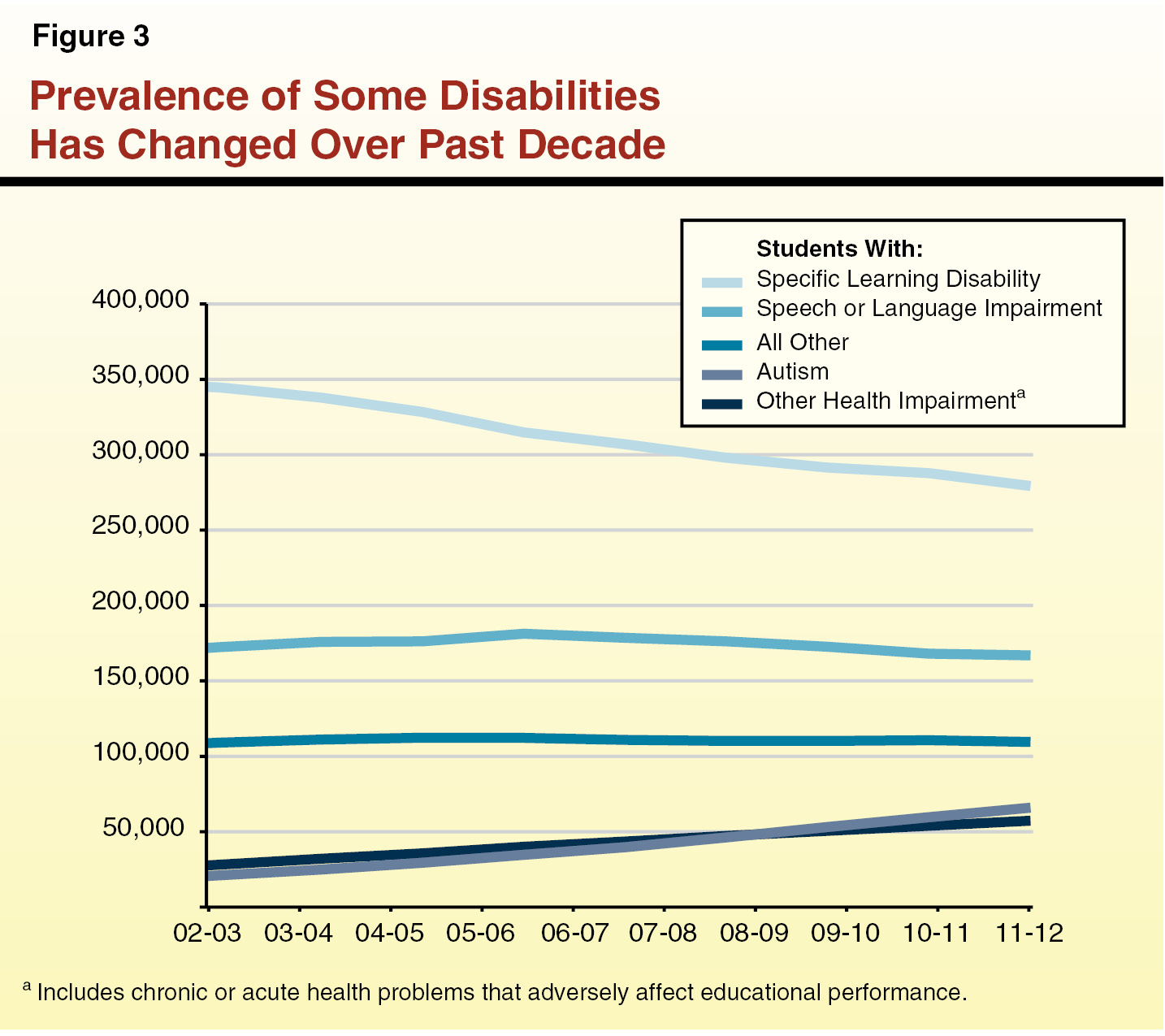
First, the time trend. Yes, the number of students receiving services under the autism label is going up.

LAO Figure 3

Then again, no sign that it is going down after the removal of thimerosal. Also worth noting is the fact that other health impairments as a category is also increasing. Specific Learning Disability is going down. So it’s a bit more complex than just “autism is going up”.

What interests me more is the discussion of costs and finances. On term that often bothers me is the term “encroachment”. As in, “special ed students cost more, and that is an encroachment on the funds for the regular education students”. The LAO report discusses one aspect of that misconception:

(Note: SWD are “students with disabilities”)

Misconceptions About “Encroachment” Some local educational agencies (LEAs) complain that local contributions for special education “encroach” upon their general education programs, sometimes implying that any local dollar spent towards educating a student with disabilities (SWD) imposes unfair expenditure requirements on their general purpose budgets. This argument, however, is a mischaracterization of both federal and state laws. Federal Individuals with Disabilities Education Act (IDEA) and state special education categorical funds never were intended to cover the full costs of educating a SWD—instead the bulk of the “regular” education costs are intended to be covered using local revenue limit and categorical funding, just as for nondisabled students. Moreover, federal IDEA and state special education categorical funds never were intended to fully cover the excess costs of educating a SWD—the special education funding model always has been predicated on a three–way cost–sharing model, including local sources. Despite this basic design of the funding model, LEAs sometimes express frustration that their local share of special education costs is too high. This frustration tends to increase as their local share of special education costs increases, as this leaves them with fewer resources to serve other students.

LAO figure 6

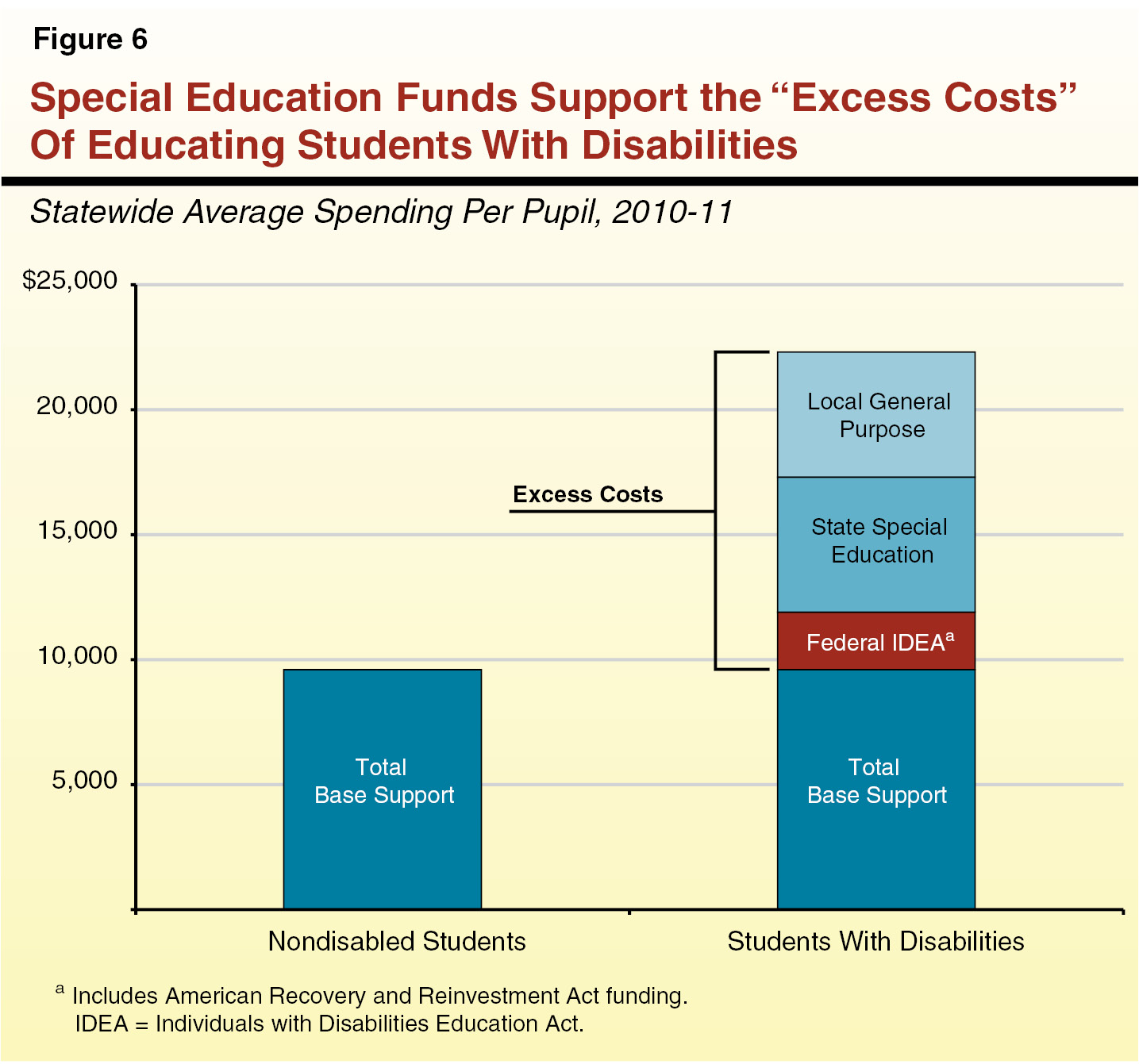
Schools are required to provide free appropriate public education (FAPE) to all students, not just students with disabilities. Some students cost more, some cost less, some cost much more. In California, on average, schools spend $9,600 per non disabled student and, on average, $22,300 per disabled student. Where does that money come from to pay for the disabled student’s costs? Well, $9,600 comes from the money the school would spend anyway. The rest is: $2,300 in federal funds, about $5,400 in state funds, and about $5,000 local funds. So, the “extra” cost for special education students is largely paid by state and federal funds. The Federal government has never paid the full amount they committed for special education. The LAO notes:

LAO figure 8

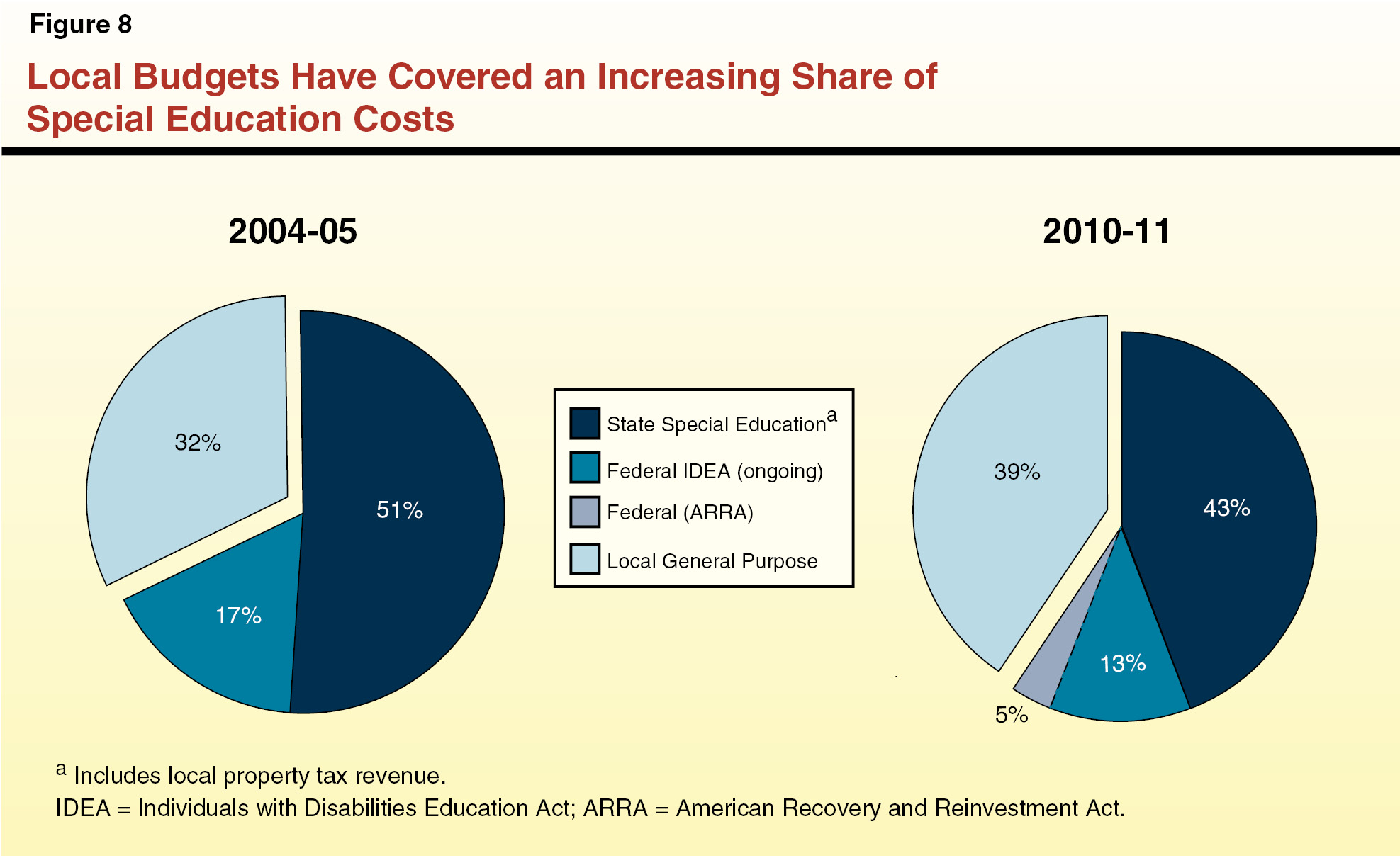
Federal Share Has Never Reached Intended Contribution Level. As shown in Figure 8, federal IDEA funds typically cover less than 20 percent of overall special education expenditures. This is notably lower than the amount the federal government originally committed to provide in support of special education services. The IDEA expresses intent to appropriate funding for each SWD up to 40 percent of the national average expenditure level per K–12 pupil, which would equate to roughly 40 percent of California’s overall special education expenditures. The federal budget, however, has never come close to providing states with this amount. We estimate that California would receive roughly $2 billion more annually if the federal government were to “fully fund” the intended level articulated in the IDEA.

If the Federal Government made good on it’s promise, it would be a great help to education. How’s that for an obvious statement. Somehow this obvious fact hasn’t made an impression on our legislators. That all said–just because the Federal Government isn’t helping as much as they should, that doesn’t mean that cost is an “encroachment” by special ed students.

Now, how does the state decide how much to give to each school district? It isn’t based on “your expenses are $XX, so we will give you a fraction of that.” It isn’t based on, “You have so many special ed students, so we will give you $YY per special ed student.” No, it’s, “your student population is ZZZ, so we give you money based on that number.”

In other words, if a school district has 100% special students, they get the same funding as if they have 0%. If the costs are high or low, they get the same amount from the State and Federal Governments. This isn’t the full story, but it is close:

Two Distribution Models Exist. Across the nation, states generally use one of two approaches to distribute special education funding to the local level. Some use a “cost–based” model, with funding allocations driven by how many SWDs are served or the magnitude of special education costs incurred. In contrast, other states rely primarily on a census–based funding methodology that is not linked to particular SWDs. Under this model, the state allocates special education funds based on the total number of students enrolled, regardless of students’ disability status. This funding model implicitly assumes that SWDs—and associated special education costs—are relatively equally distributed among the general student population and across the state. While the majority of federal special education funds are distributed using a census–based model, the IDEA formula does allocate a small portion (typically around 10 percent) of funds based on counts of economically disadvantaged students, on the assumption that this group contains a greater proportion of SWDs.

A district (or SELPA or LEA) gets paid the same amount whether a student is receiving services for special education or not. Whether a student’s special education services cost a little or a lot. And some districts feel that some or all dollars spent on special education are “encroachment”. We can complain, but in the end we’ve built a system which strongly disincentivises schools from taking a true “cost blind” approach to finding an appropriate education.


By Matt Carey

The Next Vaccine-Autism Newsmaker…5 years later

6 Feb

Years back, much focus in online autism parent community discussions focused on the Omnibus Autism Proceeding (OAP). This was the large “vaccine court” proceeding to explore if people could be compensated for autism as a vaccine injury. Those hearings were held in 2008, and the decisions went against the families.

A year ago I wrote (The Omnibus Autism Proceeding: effectively over), and while, yes, as an “Omnibus” it is effectively over, there is still activity for those who filed claims and were included in the Omnibus Autism Proceeding. Statistics as of today show there were 5,635 claims included in the Omnibus, and 4,564 have been dismissed. 2 claimants have been compensated, with the caveat given that “**HHS has never concluded in any case that autism was caused by vaccination.” This leaves 1,069 cases still pending. A relatively small fraction of the original Omnibus, but a large number nonetheless.

Another way to look at this is the Omnibus proceedings are over, the docket hasn’t been updated for quite some time but there are still individual cases to be decided. Including one case that was rather prominent in the Omnibus: that of A. Krakow. He was intended to be one of the test cases for the thimerosal but was pulled out to pursue another argument: that metabolic dysfunction is involved. David Kirby referred to him as “The Next Vaccine-Autism Newsmaker”, following the supposed game-changer of Hannah Poling.

That was in 2008. As it’s been nearly 5 years, I checked the status of the case. It turns out the first hearing was held in December (a hearing on fact) and a second hearing is set for expert witnesses to testify in April of this year. One way to explore the arguments the family may be taking is to review the experts that are testifying. For example, the family has chosen Richard Deth as an expert. His work has not focused on mitochondria. On the other hand, Yuval Shafir is also listed as an expert and has listed many articles on mitochondria with his report. Richard Frye’s CV was submitted (he also has some work on mitochondria and autism), but I don’t see that an expert report from him has been submitted.

Other experts date from 2008 (from when he was going to be an Omnibus test case) include: Elizabeth A. Mumper, Robert S. Rust, Richard Deth and Sander Greenland.

(edit to add, I see a report in the docket from Marcel Kinsbourne in 2010).

So, is this going ahead as a “mitochondrial autism” case? The “Next Hannah Poling” as David Kirby claimed in Spectrum Magazine? Well, even Hannah Poling wasn’t the game-changer some people predicted. Probably the most we can say is that is 10 years old, with a docket 16 pages long, will finally be heard.

edit to add: For the curious, here is the docket.

By Matt Carey

A correction

5 Feb

Last year, following the autism hearing in the Oversight and Government Reform Committee, I wrote a piece Mr. Wright, is autism an epidemic or not? Why not give real examples of how to make a financial impact? In the article I used an example of how getting more autistics employed could make a real impact financially in our country.

It was pointed out to me that the way I framed it, it read that only a fraction of the autistic population would be able to gain employment. An adult self-advocate pointed out to me that this is not the case, that real employment should be a goal for the entire population. And this self advocate is correct and I regret the way I worded that article.

It is worth noting that a self advocate was informing the parent of a child with multiple disabilities, including intellectual disability, that employment should be a goal for all. There is an important lesson in that apparent role reversal. Self-advocacy does not mean one advocates only for one’s self, nor for only other self advocates. This simple message often gets lost in the stereotyped presentations of self-advocates and parents.

The autism community is broad. No one person will advocate great change. No segment of the population will be very effective on its own. We are going to work together or we are going to fail.


By Matt Carey

IACC to take more active role

4 Feb

The U.S. Interagency Autism Coordinating Committee (IACC) met last week. There were presentations on important subjects but for me the real event happened in the final hour, during the discussion. You can get an idea of that from two Autism Speaks articles: IACC Pledges More Assertive Role in Federal Autism Policy and IACC Tackles Healthcare Disparities and Access to Care.

If one looks at Public Law 109-416 (the law based on the Combating Autism Act)

(b) RESPONSIBILITIES.—In carrying out its duties under this section, the Committee shall—
(1) develop and annually update a summary of advances in autism spectrum disorder research related to causes, prevention, treatment, early screening, diagnosis or rule out, intervention, and access to services and supports for individuals with autism spectrum disorder;
(2) monitor Federal activities with respect to autism spectrum disorder;
(3) make recommendations to the Secretary regarding any appropriate changes to such activities, including recommendations to the Director of NIH with respect to the strategic plan developed under paragraph (5);
(4) make recommendations to the Secretary regarding public participation in decisions relating to autism spectrum disorder;
(5) develop and annually update a strategic plan for the conduct of, and support for, autism spectrum disorder research, including proposed budgetary requirements; and
(6) submit to the Congress such strategic plan and any updates to such plan.

If you look at (2) and (3), they constitute a very broad mandate to “monitor Federal activities with respect to autism spectrum disorder [and] make recommendations to the Secretary regarding any appropriate changes to such activities”

This is an area which the IACC has up until not been the primary focus of the IACC, from what I have observed. The IACC has spent much effort, and rightfully so, on developing and updating the strategic plan for autism research.

The IACC is working on a document to offer advice on how autism should be considered in the implementation of the Affordable Care Act and the insurance exchanges the Act will set up.

The meeting started with Tom Insel (chair of the IACC, director of the NIMH) discussing some recent papers in autism. These include studies on elopement, markers of maternal inflammation as a risk factor for autism, an imaging study showing microglial activation in autistic brains, studies by IACC member David Mandell and more.

A presentation was given about the CDC Minnesota Somali Autism Project. The presentation discussed the methodology (using the same system as the ADDM network) and the difficulties in building the infrastructure from scratch. No information on preliminary results.

Jose Cordero spoke about the prevalence of autism in Puerto Rico. It is one of the highest in the United States at 1.6%. This is especially noteworthy given the relatively low prevalence for autism among the Hispanic communities regularly reported. Another presentation was made on the recent “Optimal Outcomes” study, with much discussion afterwards about what “optimal” outcomes really are. Of note was the fact that the study authors never made the statement that people “grow out of autism”, that was an interpretation added by journalists. Anjali Jain of The Lewin Group and Craig Newschaffer of Drexel University spoke about health outcomes among autistics, showing that there are more health issues among autistics. Alan Guttmacher of the National Institute of Child Health and Human Development spoke about the National Children’s study which is starting and will follow 100,000 children’s health outcomes and track possible environmental risk factors.

Public comments were given both orally and written. Unfortunately, there was no time for discussing the comments, which included statements by Dena Gassner, Amy Lutz, Dawn Loughborough and Jake Crosby.

The meeting was recorded by video. (I’ll try to get the embed code to work) http://videocast.nih.gov/launch.asp?17778


By Matt Carey

note: I serve as a public member to the IACC but all opinions here and elsewhere are my own.

Jenny McCarthy loses gig for health-related fundraiser

3 Feb

I haven’t spent much time discussing Jenny McCarthy in a while. The reason is pretty simple, aside from her annual presentation at the AutismOne parent convention (where she criticizes parents who don’t use alternative medicine), she’s basically dropped out of the public discussion on autism. Years back she stopped expressing her views on vaccines publicly. Gone are the days of shouting “bullshit” at pediatricians on national TV and leading “green our vaccines” demonstrations in Washington DC.

So when I heard that she was going to headline a fundraiser for a cancer charity in Ottawa, I didn’t feel any need to write about it. Sure, it was a bad decision on the charity’s part. Why spend some of their credibility on Ms. McCarthy?

We are talking a cancer charity. Cancer patients often have reduced immune systems due to treatments they receive. They are highly dependent on the rest of us providing protection from serious vaccine-preventable diseases. The efforts of Ms. McCarthy and her organization have, by their own words, reduced vaccine uptake, endangering the very population the charity seeks to serve.

The Ottowa Citizen is reporting that Ms. McCarthy has been replaced for the event. I thank the charity for that. Ms. McCarthy is tweeting that she has a conflict and had to pull out. If this is true, perhaps she could return the “financial settlement” she is reportedly still being paid. In other words, I’m finding it hard to believe her tweet. If she wants to save face, she can save the charity money at the same time.

With luck, this will be the only Jenny McCarthy article here this year. Her time came and passed. We will be feeling the damage of her efforts for years to come. I’m not feeling much sympathy that she has to accept some consenquences.


By Matt Carey