Archive by Author

Autism Science Foundation Partnering with UJA-Federation to Launch Three Surveys Designed to Identify Services and Needs for Adults with Autism

11 Oct

As a follow on to the article Survey of Services Needs for Adults with Autism, here is the press release:


Date Published:
OCTOBER 11, 2012

The New Surveys — Conducted on behalf of UJA-Federation by the Autism Science Foundation and the Interactive Autism Network — Aim to Help Service Providers Expand Programs That Support AllThose Affected by Autism

(OCTOBER 11, 2012—New York, NY) UJA-Federation of New York announced today the launch of a series of surveys designed to determine which types of services for adults with autism are most needed in the New York metropolitan area. The surveys are being administered by the Autism Science Foundation and the Interactive Autism Network (IAN).

The three surveys target individuals with autism ages 18 to 35; parents of individuals with autism ages 18 to 35 who are independent; and parents of individuals with autism ages 18 to 35 who are under their parents’ guardianship. People fitting one of these three groups are invited to participate by registering at the Interactive Autism Network (IAN) and completing the “UJA-Federation Adult with Autism Spectrum Disorder (ASD) Survey.”

“The goal of this project is to identify the drivers of fulfillment and success for autistic adults in the areas of employment, leisure activities, and spirituality,” said Deborah Hilibrand, a member of UJA-Federation of New York’s Autism Task Force. “We will then use this information to help UJA-Federation and other agencies provide these critical activities by providing financial support for projects that deliver these services.”

“We also want to use the data to enhance public awareness about the critical issues facing adults with autism and their families by broadly disseminating the results of this survey,” said Alison Singer, president of the Autism Science Foundation.

The free survey is designed to be completed entirely online. Surveys must be completed by Friday, November 30, 2012. All responses and data collected will be kept anonymous and confidential. Participants in this survey do not have to be Jewish or receive services from UJA-Federation, and people of all faiths are welcome.

Eligibility to participate in the UJA-Federation Adult with ASD Survey includes:

  • Residency in the five boroughs of New York City, Long Island, or Westchester.
  • An adult with ASD who is independent and is not under anyone’s legal guardianship.
  • The parent of an independent adult with ASD (for example, one’s adult son or daughter with ASD is not under legal guardianship and maintains the right to make their own medical and legal decisions).
  • The legally authorized representative of a dependent adult with ASD (for example, you may have legal guardianship or medical power of attorney for the adult with ASD).

“This project is especially exciting because the information collected will not only have an immediate effect on improving services for adults with autism, but it will also advance autism research involving adults — a group that is sorely underrepresented,” said Dr. Paul Law, director of the Interactive Autism Network at Kennedy Krieger Institute. “I believe that community service providers like UJA-Federation of New York are key to ensuring greater involvement of adults with autism in research.”

Additional funding for this project was provided by the Hilibrand Foundation and the FAR Fund. The survey can be found by visiting http://orca.kennedykrieger.org/index.php?sid=86954&newtest=Y&lang=en

###

Contact: Roberta Lee, UJA-Federation, 1.212.836.1800, leer@ujafedny.org


To begin registration and the survey, click on the link below:

http://orca.kennedykrieger.org/index.php?sid=86954&newtest=Y&lang=en


By Matt Carey

Survey of Services Needs for Adults with Autism

11 Oct

There is a great need for more and more accurate information on the needs of autistic adults. Information will allow for better advocacy and changes.

The Autism Science Foundation and the UJA Federation of New York have teamed up with the Interactive Autism Network (IAN) to gather data in a survey.

Now is the chance to be heard. Autistic adults, parents of autistic adults and representatives of autistic adults are encouraged to participate. Details are below in a message from Alison Singer at the Autism Science Foundation.

Now is the chance to be heard.

We need your help!

As many of you know, there is little information about the changing needs of adults with autism spectrum disorders (ASD) to guide those planning programs and services. That is why the UJA Federation of New York and the Autism Science Foundation are asking adults with ASD (and their parents or guardians) to complete a survey addressing what is going well in daily life, and what is a challenge. The results of this survey will inform decision making with regard to which programs should be expanded and which may no longer be of value.

We invite you to take this survey by joining the Interactive Autism Network (IAN) – the world’s largest online autism research project — and then completing the UJA Adult with ASD Survey. As a member of IAN, you’ll be informed about future surveys and studies, with a chance to provide ongoing input regarding the experience of adults with ASD over time. IAN registration and this survey can be completed entirely online and will take approximately 20 minutes.

You are eligible to participate in IAN and the UJA Adult with ASD Survey if you are:

· An adult with ASD who is independent
(that is, you are not under anyone’s legal guardianship)

· The parent of an independent adult with ASD
(that is, your adult son or daughter with ASD is not under legal guardianship and maintains the right to make their own medical and legal decisions)

· The legally authorized representative of a dependent adult with ASD
(For example, you may have legal guardianship or medical power of attorney for the adult with ASD)

If you’d like to read the IAN Research study consent form, including privacy policies, before continuing, click here.

To begin registration and the survey, click on the link below:
http://bit.ly/ORf7d5

If you have any questions, the IAN team is happy to answer them for you. You can contact them at 1-866-348-3440 or ian@kennedykrieger.org.

Your participation is critical, and will inform those planning programs about which resources and services adults with ASD and their families need most. Thank you in advance for your support and please forward this email to any individuals or groups who may be interested in participating.

Sincerely,

Alison Singer
President, Autism Science Foundation

The press release can be found on the Autism Science Foundation’s website.


By Matt Carey

A breach of privacy

10 Oct

Privacy is an important point for all of us. I blogged for a long time under a pseudonym in order to protect my child’s privacy. The subject is important enough to me that when I noticed what I considered to be a breach of privacy by Andrew Wakefield and his “Dr Wakefield Justice Fund”, I wrote to them with the information in order to give them the chance to correct this. To explain: the “Dr. Wakefield Justice Fund” posted documents from Mr. Wakefield’s defamation suit filed against Brian Deer and Fiona Godlee. One of those documents includes the full names and birthdates of seven of the patients seen at the Royal Free Hospital in the 1990’s.

I sent the following email to one of the contact email addresses for the “Dr Wakefield Justice Fund” (info@drwakefieldjusticefund.org).

Hello,

if you aren’t already aware of this, you may want to know that in this document:

[link redacted by me for this article]

You have made public the full names and birth dates of seven patients seen at the Royal Free. Given the complaints levied against Mr. Deer for, as I recall, publishing the first names of the Lancet 12, I thought you might want to take the effort to redact that document.

Matt Carey

I sent this Friday of last week and so far have received no response and no correction has been made. I have not made an effort to find and remember the names of the “Lancet 12” so these names are unfamiliar to me (with the exception of two last names). I did a quick internet search on some of the names and did not find them linked to Mr. Wakefield or MMR in a relatively brief search, so this seems like a true breach of privacy. I’ll note that in the GMC hearings names were occasionally spoken but the court kept to a standard of anonymizing child and parent names in the transcript.

I would encourage the “Dr. Wakefield Justice Fund” to redact that and any other documents which contain such information.


By Matt Carey

Occurrence and Family Impact of Elopement in Children With Autism Spectrum Disorders

9 Oct

In the past few years there has been a great deal of discussion on wandering and autism. Wandering as in elopement, running away, leaving a home or group. With people who are not independent this can obviously be a dangerous situation.

The U.S. Interagency Autism Coordinating Committee (IACC) had much discussion on wandering. The previous IACC had a Subcommittee on Safety and provided HHS Secretary Sebelius with a letter on the subject. One hot topic was whether a medical code should be created to track wandering as there was little hard data on the topic.

One result of this discussion was a study to answer: how prevalent is wandering? Anecdotally we knew the answer was going to be that there is a high prevalence. Now there are numbers to back that up from a study published in the journal Pediatrics.

Here is the abstract:

OBJECTIVES: Anecdotal reports suggest that elopement behavior in children with autism spectrum disorders (ASDs) increases risk of injury or death and places a major burden on families. This study assessed parent-reported elopement occurrence and associated factors among children with ASDs.

METHODS: Information on elopement frequency, associated characteristics, and consequences was collected via an online questionnaire. The study sample included 1218 children with ASD and 1076 of their siblings without ASD. The association among family sociodemographic and child clinical characteristics and time to first elopement was estimated by using a Cox proportional hazards model.

RESULTS: Forty-nine percent (n = 598) of survey respondents reported their child with an ASD had attempted to elope at least once after age 4 years; 26% (n = 316) were missing long enough to cause concern. Of those who went missing, 24% were in danger of drowning and 65% were in danger of traffic injury. Elopement risk was associated with autism severity, increasing, on average, 9% for every 10-point increase in Social Responsiveness Scale T score (relative risk 1.09, 95% confidence interval: 1.02, 1.16). Unaffected siblings had significantly lower rates of elopement across all ages compared with children with ASD.

CONCLUSIONS: Nearly half of children with ASD were reported to engage in elopement behavior, with a substantial number at risk for bodily harm. These results highlight the urgent need to develop interventions to reduce the risk of elopement, to support families coping with this issue, and to train child care professionals, educators, and first responders who are often involved when elopements occur.

Usually with papers like this I try to obtain a copy in advance to review when it is released. last week and this week are too busy for that. The Autism Science Foundation blog has a discussion of the paper in New Study Confirms Autistic Wandering is Widespread. Autism Science Foundation president Alison Singer was one of the forces behind getting this study accomplished, along with Lyn Redwood of SafeMinds and there was support from the National Autism Association and Autism Speaks.

Often on such high profile papers, the full paper is made available to the public. Apparently not in this case.


By Matt Carey

TPGA’s Position on Autism Organizations That Support Autistic People

9 Oct

The Thinking Person’s Guide to Autism has published a five point list of principles they feel organizations that support autistic people must adhere to. This can be found on their site as “TPGA’s Position on Autism Organizations That Support Autistic People“.

I was going to copy them here, but that is basically the full article. I encourage readers to take the time to check out this list and follow the discussion at TPGA.


By Matt Carey

The Nobel Prize in Physiology or Medicine 2012: for the discovery that mature cells can be reprogrammed to become pluripotent

9 Oct

The Nobel committee announced today that “The 2012 Nobel Prize in Physiology or Medicine was awarded jointly to John B. Gurdon and Shinya Yamanaka “for the discovery that mature cells can be reprogrammed to become pluripotent”.” The discoveries are discussed below. The short version is that Gordon and Yamanaka separately discovered that specialized cells can be changed into unspecialized cells.

Yamanaka was able to take mature cells and turn them into stem cells. This has opened up a large area of research including research in Autism.

Here is the press release:

The Nobel Prize recognizes two scientists who discovered that mature, specialised cells can be reprogrammed to become immature cells capable of developing into all tissues of the body. Their findings have revolutionised our understanding of how cells and organisms develop.

John B. Gurdon discovered in 1962 that the specialisation of cells is reversible. In a classic experiment, he replaced the immature cell nucleus in an egg cell of a frog with the nucleus from a mature intestinal cell. This modified egg cell developed into a normal tadpole. The DNA of the mature cell still had all the information needed to develop all cells in the frog.

Shinya Yamanaka discovered more than 40 years later, in 2006, how intact mature cells in mice could be reprogrammed to become immature stem cells. Surprisingly, by introducing only a few genes, he could reprogram mature cells to become pluripotent stem cells, i.e. immature cells that are able to develop into all types of cells in the body.

These groundbreaking discoveries have completely changed our view of the development and cellular specialisation. We now understand that the mature cell does not have to be confined forever to its specialised state. Textbooks have been rewritten and new research fields have been established. By reprogramming human cells, scientists have created new opportunities to study diseases and develop methods for diagnosis and therapy.

Life – a journey towards increasing specialisation
All of us developed from fertilized egg cells. During the first days after conception, the embryo consists of immature cells, each of which is capable of developing into all the cell types that form the adult organism. Such cells are called pluripotent stem cells. With further development of the embryo, these cells give rise to nerve cells, muscle cells, liver cells and all other cell types – each of them specialised to carry out a specific task in the adult body. This journey from immature to specialised cell was previously considered to be unidirectional. It was thought that the cell changes in such a way during maturation that it would no longer be possible for it to return to an immature, pluripotent stage.

Frogs jump backwards in development
John B. Gurdon challenged the dogma that the specialised cell is irreversibly committed to its fate. He hypothesised that its genome might still contain all the information needed to drive its development into all the different cell types of an organism. In 1962, he tested this hypothesis by replacing the cell nucleus of a frog’s egg cell with a nucleus from a mature, specialised cell derived from the intestine of a tadpole. The egg developed into a fully functional, cloned tadpole and subsequent repeats of the experiment yielded adult frogs. The nucleus of the mature cell had not lost its capacity to drive development to a fully functional organism.

Gurdon’s landmark discovery was initially met with scepticism but became accepted when it had been confirmed by other scientists. It initiated intense research and the technique was further developed, leading eventually to the cloning of mammals. Gurdon’s research taught us that the nucleus of a mature, specialized cell can be returned to an immature, pluripotent state. But his experiment involved the removal of cell nuclei with pipettes followed by their introduction into other cells. Would it ever be possible to turn an intact cell back into a pluripotent stem cell?

A roundtrip journey – mature cells return to a stem cell state
Shinya Yamanaka was able to answer this question in a scientific breakthrough more than 40 years after Gurdon´s discovery. His research concerned embryonal stem cells, i.e. pluripotent stem cells that are isolated from the embryo and cultured in the laboratory. Such stem cells were initially isolated from mice by Martin Evans (Nobel Prize 2007) and Yamanaka tried to find the genes that kept them immature. When several of these genes had been identified, he tested whether any of them could reprogram mature cells to become pluripotent stem cells.

Yamanaka and his co-workers introduced these genes, in different combinations, into mature cells from connective tissue, fibroblasts, and examined the results under the microscope. They finally found a combination that worked, and the recipe was surprisingly simple. By introducing four genes together, they could reprogram their fibroblasts into immature stem cells!

The resulting induced pluripotent stem cells (iPS cells) could develop into mature cell types such as fibroblasts, nerve cells and gut cells. The discovery that intact, mature cells could be reprogrammed into pluripotent stem cells was published in 2006 and was immediately considered a major breakthrough.

From surprising discovery to medical use
The discoveries of Gurdon and Yamanaka have shown that specialised cells can turn back the developmental clock under certain circumstances. Although their genome undergoes modifications during development, these modifications are not irreversible. We have obtained a new view of the development of cells and organisms.

Research during recent years has shown that iPS cells can give rise to all the different cell types of the body. These discoveries have also provided new tools for scientists around the world and led to remarkable progress in many areas of medicine. iPS cells can also be prepared from human cells.

For instance, skin cells can be obtained from patients with various diseases, reprogrammed, and examined in the laboratory to determine how they differ from cells of healthy individuals. Such cells constitute invaluable tools for understanding disease mechanisms and so provide new opportunities to develop medical therapies.

Sir John B. Gurdon was born in 1933 in Dippenhall, UK. He received his Doctorate from the University of Oxford in 1960 and was a postdoctoral fellow at California Institute of Technology. He joined Cambridge University, UK, in 1972 and has served as Professor of Cell Biology and Master of Magdalene College. Gurdon is currently at the Gurdon Institute in Cambridge.

Shinya Yamanaka was born in Osaka, Japan in 1962. He obtained his MD in 1987 at Kobe University and trained as an orthopaedic surgeon before switching to basic research. Yamanaka received his PhD at Osaka City University in 1993, after which he worked at the Gladstone Institute in San Francisco and Nara Institute of Science and Technology in Japan. Yamanaka is currently Professor at Kyoto University and also affiliated with the Gladstone Institute.

Key publications:
Gurdon, J.B. (1962). The developmental capacity of nuclei taken from intestinal epithelium cells of feeding tadpoles. Journal of Embryology and Experimental Morphology 10:622-640.

Takahashi, K., Yamanaka, S. (2006). Induction of pluripotent stem cells from mouse embryonic and adult fibroblast cultures by defined factors. Cell 126:663-676.

KQED in San Francisco has a good story and interview on the award in SF Scientist Wins Nobel for Stem Cell Breakthrough. Here’s the beginning of that story:

Shinya Yamanaka, a stem cell researcher at the Gladstone Institutes, which is affiliated with the University of California, San Francisco, has won this year’s Nobel Prize in Physiology or Medicine jointly with English researcher John B. Gurdon.

Here is the video from that story (I can’t get the video from the Nobel site to embed):

One great example of the application of this work is in autism research. A topic of much discussion recently was the work of Ricardo Dolmetsch (who, to be clear, did not share this award) of Stanford who has been taking mature skin cells from autistics, reverted them to pluripotent stem cells and, from these, grown cells of other organs like the brain or the heart. By studying these cells, they are learning about the differences in brains of autistics.

By Matt Carey

Andrew Wakefield tops the “Retraction Epidemic”

5 Oct

We recently discussed a paper in the Proceedings of the National Academy of Sciences: Misconduct accounts for the majority of retracted scientific publications. A reader sent a copy to me and there are a couple of interesting points (OK, there are a number of interesting points, but a couple specific to the autism communities).

First, consider the abstract:

A detailed review of all 2,047 biomedical and life-science research articles indexed by PubMed as retracted on May 3, 2012 revealed that only 21.3%of retractionswere attributable to error. In contrast, 67.4% of retractions were attributable to misconduct, including fraud or suspected fraud (43.4%), duplicate publication (14.2%), and plagiarism (9.8%). Incomplete, uninformative or misleading retraction announcements have led to a previous underestimation of the role of fraud in the ongoing retraction epidemic. The percentage of scientific articles retracted because of fraud has increased ∼10-fold since 1975. Retractions exhibit distinctive temporal and geographic patterns that may reveal underlying causes

Yes, the “retraction epidemic”. My guess is the use of “epidemic” here will rankle one or more of Mr. Wakefield’s supporters.

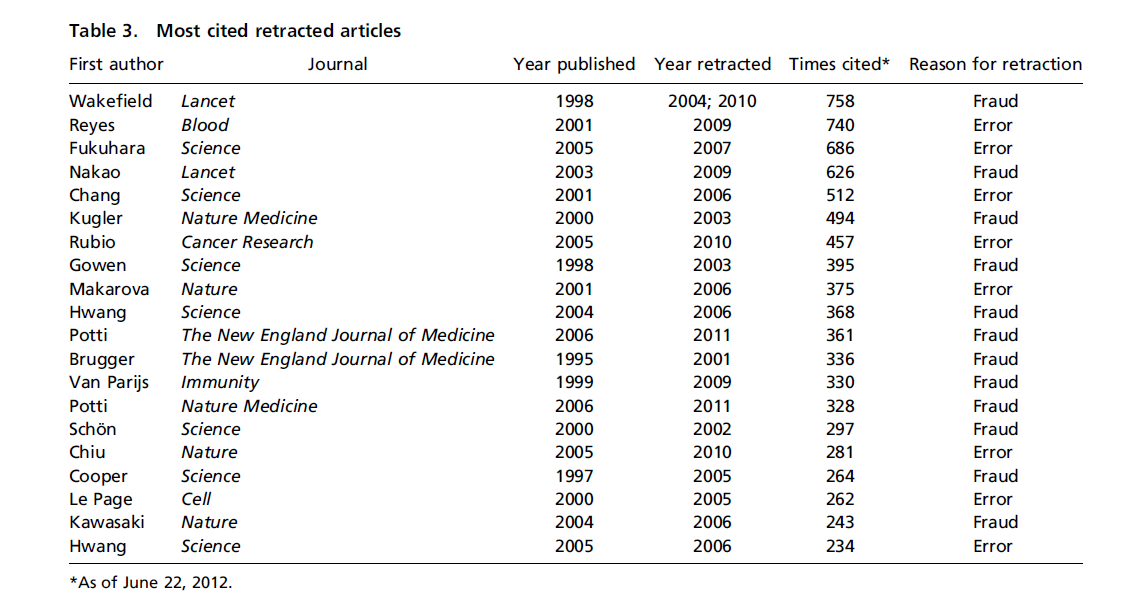
One point that I discussed previously was that Mr. Wakefield’s 1998 Lancet paper tops the list as the most cited retracted paper. The list of top cited retracted papers is shown in this figure (Click to enlarge):

The figure lists the reasons for retraction. The reason for Mr. Wakefield’s paper? Fraud.

As many readers will recall, Mr. Wakefield sued the BMJ and Brian Deer and editor Fiona Godlee for defamation for calling Mr. Wakefield’s paper fraudulent. Which begs the question: how can one call something defamatory when it is a generally accepted fact within the research community?

At present Mr. Wakefield is appealing the decision that stated he doesn’t have the standing to sue in Texas. As always in this case, it isn’t enough to show that his reputation is poor. He has to show that someone other than himself is at fault for his poor reputation. And that is a tough hurdle to cross.


By Matt Carey

Mark and David Geier, holed up in Missouri?

5 Oct

There is really no fun in writing about people whose lack of ethical standards harm disabled children. Seriously, it is painful. I know at least one autism blogger who quit in no small part because it was just too hard to keep writing about these topics.

And here in one week, both Andrew Wakefield and the Geiers (Mark and David) come back up in the news. A recent story in the St. Louis Post Dispatch discusses the Geiers: Controversial autism doctor loses license elsewhere, but can still practice in Missouri, Illinois

Mark Geier is an M.D. and was licensed in multiple states (I’ve lost count of how many and which ones). His home base is Maryland. His license was suspended there and many other states have followed suit. David Geier holds no medical credentials and is charged with practicing medicine without a license in Maryland.

As noted above, most, but not all, states have followed suit with suspending Mark Geier’s license.

The St. Louis Post Dispatch writes (reminding me of which states Mr. Geier has been licensed):

Dr. Mark Geier has opened eight autism treatment clinics called ASD Centers across the country but is only allowed to practice at two of them — in St. Peters and Springfield, Ill.

Missouri and Illinois are among the last states to seek discipline against Geier, whose hormone therapy for children with autism has been called dangerous, abusive and exploitive by various medical boards.

In the last two years, his medical license has been revoked or suspended in California, Florida, Indiana, Kentucky, Maryland, New Jersey, Texas, Virginia and Washington.

Missouri, Illinois and Hawaii have filed complaints against Geier based on other states’ actions, but his license remains active in all three states. A disciplinary hearing in Geier’s case is set for Oct. 19 before the Missouri Board of Registration for the Healing Arts in Jefferson City

The Geier hypothesis is that mercury binds with testosterone in the brain, making it difficult to chelate. They prescribe Lupron to reduce testosterone. The idea would be laughable if it weren’t being used on humans (or any animal for that matter).

Briefly–the Geier’s cited a paper showing that in hot benzene,
(more details in Miscellaneous Mercury Nonsense), mercuric chloride and testosterone can be induced to form chemical complexes.

I had hopes that the Geiers had moved away from this idea, but they stand by it:

David Geier said Wednesday that “many peer-reviewed scientific studies” have been published that support the theory. All of the research articles cited on the ASD Centers’ website are co-authored by Mark or David Geier.

The fact that the Geiers were able to get papers published in third rate journals doesn’t make their ideas true. Or even feasible.

Mr. David Geier did not attend medical school. Neither did I but I will offer him this small bit of medical advice: Among other logical problems with your idea, the human brain is not the same thing as a beaker of hot benzene.

Point two: even if your idea held any merit, Lupron lowers the level of testosterone in the blood, it doesn’t break up these mythical mercury-testosterone complexes.

The Geiers are demonstrating a major problem with the medical license system in the U.S.. It took years to bring the Geiers to hearing. Now that Mark Geier has lost his license in his home state, he has moved to other “safe havens” to continue business? How is this right.

I recall a number of med students and premeds I knew while in college and grad school. The hoops they had to jump through to get their degrees and get licensed and start working seemed enormous. Now we see why: it’s so hard to stop someone from practicing.

Christian Science Monitor: Fraud in scientific research: It happens, and cases are on the rise

4 Oct

The Christian Science Monitor has an article out today: Fraud in scientific research: It happens, and cases are on the rise

Of 2,000 retractions of published scientific papers since 1977, 866 were because of fraud, a new study finds. Another 201 were plagiarized. But it’s hard to know if more scientists are cheating, or if detection is simply better.

Is it a real increase, or just better awareness…

Who is their prime example of science fraud? I’m sure you’ve guessed it: Andrew Wakefield. Ironically, on the day when Mr. Wakefield is giving a faux press conference in a public park, the Monitor uses a photo from Mr. Wakefield’s public park appearance during a past AutismOne convention:

Why use Mr. Wakefield as the example? Many reasons come to mind, but the fact that he is probably the most publicly recognizable that the Monitor could have chosen. Also, the Monitor states:

One of the most high-profile examples involved the issue of childhood immunizations.

That paper, which the PNAS [Proceedings of the National Academy of Sciences] study identifies as the most widely cited retracted work, cited research purported to uncover a link between autism and vaccines given to children. The work was published in 1998 in the British medical journal Lancet. Subsequent studies reportedly indicated that the data were fraudulent. Meanwhile, Britain’s General Medical Council stripped the study’s author, Andrew Wakefield, of his status as a “registered medical practitioner” for misconduct after investigating his research effort.

So Mr. Wakefield has the dubious distinction of having written the most cited retracted work. He’s the best at something.


By Matt Carey

Autism Science Foundation to Develop Brain Tissue Awareness Campaign

3 Oct

One thing I learned at IMFAR last year was that brain tissue is critical to many areas of autism research and that there is very little tissue available for research. OK, that’s two things. This year saw an amazingly sad event where a large number of brain tissue samples were ruined in a freezer failure.

The ASF’s announcement is below and also on their website as Autism Science Foundation to Develop Brain Tissue Donation Awareness Campaign with Support from Simons Foundation

The Autism Science Foundation has received a two-year, $600,000 grant from the Simons Foundation to develop a multi-media campaign designed to increase awareness of the importance of brain tissue donation to further autism research.

“No effort is more important than raising awareness among families and scientists about the need for research on human brain tissue,” said Dr. Gerald Fischbach, Director of the Simons Foundation Autism Research Initiative.

Brain tissue research is critical for developing effective prevention and treatment options for autism but research in this area has lagged because of lack of tissue.

“In every area of medicine,” said Dr. Thomas Insel, Director of the National Institute of Mental Health, “new diagnostics and new treatments have come from studying the affected organ. In autism, we have been challenged by trying to understand a complex neurodevelopmental disorder without having enough brain tissue available for study. In so many ways, our ability to deliver for families with autism depends on the success of this effort.”

ASF President Alison Singer will serve as principal investigator on the project. Prior to founding the Autism Science Foundation, Singer served as Executive Vice President for Communications and Awareness at Autism Speaks, where she developed and co-produced the award-winning “The Odds” autism awareness campaign in conjunction with the Ad Council.


By Matt Carey