Archive by Author

Anti-SLAPP motion moves forward in Wakefield v. BMJ et al.

13 Jul

In January of this year Andrew Wakefield filed a defamation suit against the BMJ (British Medical Journal), Brian Deer (journalist) and Fiona Godlee (editor BMJ). This was followed in March by a response from the BMJ team, including an anti-SLAPP motion to dismiss. (SLAPP = strategic lawsuit against public participation) Discussion of the response can be found on Mr. Deer’s website.

Little has been discussed publicly in the months since the BMJ team’s response. It’s been difficult to judge what is happening in the defamation suit. It appears now that the BMJ team have filed an amended response. My understanding is that this would give Mr. Wakefield 10 days from that filing to respond.

Mr. Deer’s ammended response is 86 pages long, shorter than his 102 page original statement, but still lengthy. I seem to recall Mr. Deer posting a picture of the entire BMJ team submission from March. It was huge. And now another stack of documents have been added to the docket. When I think of all these pages, all I can think of is the cost. The cost to draft. The cost for the BMJ legal team to review. The cost for Mr. Wakefield’s team to digest. Mr. Deer estimates that the 2005 lawsuit Mr. Wakefield brought against Mr. Deer, the Sunday Times and Channel 4 cost upwards of £500,000 to defend (even with Mr. Wakefield abandoning the suit). I shudder to think of the cost of the present litigation and what better purposes that money could be used for.

by Matt Carey

IACC/OARC Autism Spectrum Disorder Research Portfolio Analysis Web Tool

12 Jul

The Office of Autism Research Coordination (OARC) released a web-based tool to explore research projects. One can search or browse. Data are included for both government funded and non-government funding agencies (such as NIH, Autism Speaks, Simons Foundation, Autism Science Foundation, etc.). One can browse by objectives in the IACC’s Strategic Plan (for example, here is a starting point for 2009 projects)

For example, one can search for how many projects used the term “nonverbal” (six in 2009, fifteen in 2010). One can browse by funding group, through Strategic Plan question or other ways. You can download results in pdf or spreadsheet format.

If you are interested in seeing what research is funded, and not funded, this is a good tool.


By Matt Carey

What is the IACC charged to do?

12 Jul

The Interagency Autism Coordinating Committee (IACC) is charged with certain responsibilities under the law. At the same time, the scope of the IACC is actually quite limited and often misunderstood. In my opinion, the word “coordinating” may be a bit of an overstatement as the committee does not control funding nor does it have the power to make policy or to initiate research.

Here are the responsibilities of the IACC, as well as some of the limitations of the IACC, from the IACC Charge Document.

Statutory Responsibilities of the IACC under the Combating Autism Act and
Combating Autism Reauthorization Act

The IACC was established to coordinate all efforts within the Department of Health and Human
Services concerning autism spectrum disorder and is required to:

Develop and annually update a strategic plan for ASD research, and submit the strategic plan
and annual updates to Congress.

Develop and annually update a summary of advances in ASD research.

Monitor federal activities with respect to ASD.

Make recommendations to the HHS Secretary regarding research or public participation in
decisions related to ASD.

Meet at least twice a year (full committee) and conduct meetings in public with time for public
participation (public comment).

The committee may establish subcommittees and convene workshop and conferences.

How has the IACC executed these responsibilities?

The IACC serves as a forum for coordination, communication and collaboration between Federal
agencies, private organizations and community stakeholders.

The IACC developed its first strategic plan in 2009 and updated it in 2010 and 2011 with the goal
of focusing and accelerating research. The plan was developed with public input and a focus on
community needs.

The IACC has issued an annual Summary of Advances in ASD Research document each year –
2007, 2008, 2009, 2010 and 2011.

The IACC issues a Portfolio Analysis Report to analyze Federal and private funding for research
and how funding aligns with priorities identified in the Strategic Plan.

The IACC/OARC are launching a public database to provide information on federal and private
funded research projects.

IACC members and guest speakers provide research and services program updates at each
meeting of the IACC.

The IACC/OARC issues special reports on ASD activities such as the IACC/OARC ASD Research
Publications Analysis.

The IACC has made recommendations to the HHS Secretary in the Strategic Plan and through
advisory letters.

The IACC gathers public input and information on emerging issues in the autism community
through written and oral public comments at meetings of the full IACC, town hall meetings,
workshops and formal requests for public comment; all meetings, including phone meetings, are
open to the public by phone, webcast and/or webinar.

The IACC provides information to the public through its activities (all open to the public), public
website, news updates, listserv and Twitter announcements.

What is the committee not required or authorized to do?

To fund research – the IACC does not have or control a research budget.

To implement research or services programs – programs can only be implemented by
government agencies and private organizations.

To set government policies – the IACC is an advisory body that can raise awareness and make
recommendations for development or adoption of policies, but only government agencies and
private organizations can set policies.

To force government agencies to fund specific research projects or set particular policies.

Many seem to think of the IACC as a funding agency, or an group which sets the research agenda. It is “an advisory body”.

In my opiion, it is an advisory body which people listen to. Most of the research projects proposed in the Strategic Plan have been funded (which is pretty good in these economic times). Researchers I have spoken with have respect for the IACC.

By Matt Carey
(I serve as a public member on the IACC but all opinions expressed here and elsewhere are my own)

Great article at TPGA: Advice to Young Autistics: Stick Around and Become Awesome

8 Jul

The Thinking Person’s Guide to Autism (TPGA) has an article today by Nick Walker: Advice to Young Autistics: Stick Around and Become Awesome. Here’s the introduction:

So you’re a young Autistic person, and maybe you think you’re broken; maybe you think you’re doomed to a life of misery. You’re in pain, maybe depressed, maybe angry. Maybe you’re even considering suicide.

Sorry you’re going through that. I’ve been there myself, and it sucks.

But I survived. And although it took some time and involved some major struggles, I eventually ended up becoming a very happy adult with an awesome life where I spend much of my time doing things that I love — a life full of good friendships, good community, and those simple moments of joy, grace, kindness, and connection that make a life worthwhile. I’m glad I stuck around long enough to get here. The hard parts were worth it.

I hope I have you hooked and you will go to the TPGA site and read the rest.

By Matt Carey

Agenda for July 10 IACC meeting

7 Jul

The agenda for the upcoming IACC meeting has been posted. The schedule is very full. Kathleen Sebelius, secretary of Health and Human Services, Michael Doyle U.S and Christopher Smith, members of Congress, Kareem Dale and Michael Strautmanis, White House staff, are attending.

New reports and a new Web Tool with be announced by OARC (the Office of Autism Research Coordination)

I will be there for my first meeting as a public member of the IACC.

9:00 a.m. Call to Order and Opening Remarks

Thomas Insel, M.D. Director National Institute of Mental Health and Chair, IACC

Welcome Recognition of Former IACC Members Introduction of New IACC Members

10:00 The Honorable Kathleen Sebelius Secretary, U.S. Department of Health and Human Services

10:30 The Honorable Michael Doyle U.S. House of Representatives 14th District of Pennsylvania

10:40 The Honorable Christopher Smith U.S. House of Representatives 4th District of New Jersey

10:50 Kareem Dale, J.D., MBA Associate Director White House Office of Public Engagement & Special Assistant to the President for Disability Policy

11:00 Michael Strautmanis, J.D. Deputy Assistant to the President and Counselor for Strategic Engagement to the Senior Advisor Executive Office of the President

11:10 Alexa Posny, Ph.D. Assistant Secretary of Special Education and Rehabilitative Services U.S. Department of Education

11:20 Francis Collins, M.D., Ph.D. Director National Institutes of Health

11:30 Morning Wrap-Up

Thomas Insel, M.D. Director National Institute of Mental Health, and IACC, Chair

11:45 a.m. Lunch

1:00 p.m. Public Comments

1:30 ASD Science Update

Thomas Insel, M.D. Director, National Institute of Mental Health and Chair, IACC

1:45 Administration for Community Living

Henry Claypool Principal Deputy Administrator, ACL

2:00 Update on Restraint and Seclusion

Larry Wexler, Ed.D. Director, Research to Practice Division Office of Special Education Programs U.S. Department of Education

2:15 Update on the DSM-5 Criteria for Autism Spectrum Disorders

Susan E. Swedo, M.D. Chief Pediatrics & Developmental Neuroscience Branch, NIMH Chair, The SDM-5 Neurodevelopmental Disorders Workgroup, American Psychiatric Association

2:30 Insurance Coverage for Autism Treatments

Stuart Spielman, J.D. Senior Policy Advisor and Counsel, Autism Speaks

Peter Bell, M.B.A. Executive Vice President of Programs and Services, Autism Speaks

2:40 Autism and Epilepsy: Clinical Profile across the Lifespan

Geraldine Dawson, Ph.D. Chief Science Officer, Autism Speaks

2:50 Update on NIH/Autism Speaks/CURE Meeting on Epilepsy and Autism

Deborah Hirtz, M.D. Program Director, Office of Clinical Research National Institute of Neurological Disorders and Stroke

3:00 Break

3:15 IACC Business

Susan A. Daniels, Ph.D. Acting Director, Office of Autism Research Coordination and Executive Secretary, IACC

OARC/IACC Updates – New Document and Web Releases

2011 IACC Summary of Advances 2010 IACC ASD Research Portfolio Analysis Report IACC/OARC Portfolio Analysis Web Tool IACC/OARC ASD Research Publications Analysis

Planning Future Committee Activities

IACC Subcommittees and Workgroups 2012/2013 IACC Strategic Plan Update 2012 IACC Summary of Advances 2011 IACC Portfolio Analysis IACC Workshop

4:30 Public Comments Discussion Period

5:00 Closing Comments and Adjournment

Schedule subject to change. Meeting may end prior to or later than 5:00 p.m. depending on the needs of the committee

By Matt Carey

Mom charged in death of son with autism

7 Jul

A recent news story, Mom charged in death of son with autism, the discusses how an adult autistic was allegedly murdered by his mother:

She was arraigned the same day on charges of second-degree murder and second-degree felony abuse. Court records reviewed by 24 Hour News 8 indicate she starved her son to death.

The Vulnerable Adult Abuse charge stems from, court records show, Jackson’s “Failure to insure that he (the victim) receive proper nutrition , hydration and or medical care.”

“I just found out. I’m really at awe,” said Jackson’s friend Manda Diskin. “I can’t believe they found enough to charge her with murder.”

The mother’s friend goes on to defend the mother :

“These kids have a lot of ailments that people don’t know,” said Diskin. “Without speaking, they can’t always tell you that they’re in pain. Not having a verbal way to tell someone that you’re hurting. That could happen to anyone with a special needs kid.”

I am having a very hard time understanding that statement. Are we to believe that after 25 years the mother could not tell her son was starving to death because he was non verbal?

Bail in this murder case was set at $10,000. As is common in the United States, the mother was a letter to obtain a bond with 10%.

Second degree murder charge and out with only $1000.

I am at a loss for words.

Autism Spectrum Disorder Reclassified: A Second Look at the 1980s Utah/UCLA Autism Epidemiologic Study

3 Jul

In the 1980’S a major epidemiological study was performed by UCLA researchers focused on the population of Utah. This resulted in six publications. One study, the prevalence paper, has now been revisited recently with results indicating that the broadening of autism criteria with the shift from DSM III to DSM IV had a major impact on prevalence. In particular, on the prevalence of individuals with lower IQ’s.

Yes, the the DSM III missed a large number of individuals with low. IQ.

Here is the abstract from the 1990 study:

The UCLA-University of Utah epidemiologic survey of autism: Prevalence

Ritvo ER, Freeman BJ, Pingree C, Mason-Brothers A, Jorde L, Jenson WR, McMahon WM, Petersen PB, Mo

Division of Mental Retardation and Child Psychiatry, University of California School of Medicine, Los Angeles.

The authors conducted an epidemiologic survey in Utah using a four-level ascertainment system, blind current diagnostic assessments, and DSM-III criteria. Of 483 individuals ascertained, 241 were diagnosed as having autism. The best estimate for the prevalence rate was 4 per 10,000 population. Autism was not associated with parental education, occupation, racial origin, or religion. Sixty-six percent of the autistic subjects scored below 70 on standardized IQ tests, and females scored proportionately lower than males. Twenty (9.7%) of 207 families had more than one autistic sibling, which supports the authors’ previous finding that there may be a familial subtype of autism

The recent study is:

Autism Spectrum Disorder Reclassified: A Second Look at the 1980s Utah/UCLA Autism Epidemiologic Study.

Here is the abstract:

Abstract The purpose of the present study was to re-examine diagnostic data from a state-wide autism prevalence study (n = 489) conducted in the 1980s to investigate the impact of broader diagnostic criteria on autism spectrum disorder (ASD) case status. Sixty-four (59 %) of the 108 originally “Diagnosed Not Autistic” met the current ASD case definition. The average IQ estimate in the newly identified group (IQ = 35.58; SD = 23.01) was significantly lower than in the original group (IQ = 56.19 SD = 21.21; t = 5.75; p < .0001). Today’s diagnostic criteria applied to participants ascertained in the 1980s identified more cases of autism with intellectual disability. The current analysis puts this historic work into context and highlights differences in ascertainment between epidemiological studies performed decades ago and those of today.

Emphasis added.

This goes counter to the common perception that the expansion of diagnostic criteria was confined to adding so-called “higher functioning” autistics.

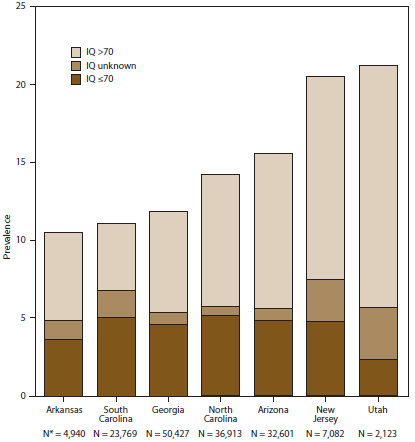
Comparing these results to the recent CDC results show that much of the increase in Utah was due to inclusion of higher IQ individuals. The recent prevalence estimate for Utah was 212/10,000 with most with IQ >70. One has to note that the prevalence estimate from the recent CDC report is roughly 20/10,000, about 5x higher than the UCLA report from 22 years ago. (further note that the CDC data for Utah are based on only 45 autistics so the error bars are very big).

It would be interesting to go through the screening process from the UCLA study to see how well they might have been able to capture individuals without intellectual disability.

This study doesn’t explain a substantial fraction of difference between the 1990 prevalence and the most recent estimate. It does point to a shift in diagnostic standards for low IQ individuals.

How Does Relaxing the Algorithm for Autism Affect DSM-V Prevalence Rates?

28 Jun

There has been much discussion of the impact the DSM 5 will have on who will be diagnosed with autism. Another paper exploring this came out yesterday: How Does Relaxing the Algorithm for Autism Affect DSM-V Prevalence Rates?. The abstract is below:

Although it is still unclear what causes autism spectrum disorders (ASDs), over time researchers and clinicians have become more precise with detecting and diagnosing ASD. Many diagnoses, however, are based on the criteria established within the Diagnostic and Statistical Manual of Mental Disorders (DSM); thus, any change in these diagnostic criteria can have a great effect upon children with ASD and their families. It is predicted that the prevalence of ASD diagnoses will dramatically decrease with the adoption of the proposed DSM-5 criteria in 2013. The aim of this current study was to inspect the changes in prevalence first using a diagnostic criteria set which was modified slightly from the DSM-5 criteria (Modified-1 criteria) and again using a set of criteria which was relaxed even a bit more (Modified-2 criteria). Modified-1 resulted in 33.77 % fewer toddlers being diagnosed with ASD compared to the DSM-IV, while Modified-2 resulted in only a 17.98 % decrease in ASD diagnoses. Children diagnosed with the DSM-5 criteria exhibited the greatest levels of autism symptomatology, but the Mod-1, Mod-2, and DSM-IV groups still demonstrated significant impairments. Implications of these findings are discussed.

Without the full paper it is difficult to compare the modified criteria. Also, from the abstract alone we can’t tell much about the methodology of the application of the DSM 5 and the two modified criteria. Keeping those very large caveats in mind, this study points to a lower rate of autism diagnoses for toddlers under the DSM 5, even with modifications. The study does not appear to address the question of the effect of the DSM 5 on diagnosing adults.

35 Nobel Laureates are all in the pocket of Big Pharma?

27 Jun

Yes. A group of 35 Nobel Laureates has been accused of working with the “vaccine industry”. Those familiar with the online discussions of autism and vaccines will likely be unsurprised that this claim comes from the Age of Autism blog. Given the odd nature of this claim, most will likely be unsruprised that this will take some lenghthy introduction.

The article at the Age of Autism is Write the President of Cameroon to Defend Dr. Luc Montagnier, which opens so many questions. Why do they want to defend Luc Montagnier? Why would one write the president of Cameroon to do so?

Luc Montagnier received the Nobel Prize in medicine in 2008. His research has since moved into some rather questionable territory. For example, he claims that DNA from bacteria can, in highly diluted samples, induce low frequency electromagnetic radiation. This brings us to his connection to the autism communities. He claims that he can detect the electromagnetic radiation from the blood of autistic children, but not from non-autistic children. He claims that this radiation is a sign of pathogentic bacteria, and, further, claims that based on this one might treat autism with long term antibiotic therapy.

Here is part of his summary from when he presented these ideas at AutismOne this year:

There is in the blood of most autistic children — but not in healthy children — DNA sequences that emit, in certain conditions, electromagnetic waves. The analysis by molecular biology techniques allows us to identify these electromagnetic waves as coming from already known bacterial species. This correlation, which is based on more than one hundred children of European origin, naturally does not prove a causal relationship. However, a therapy first started by a group of independent clinicians and now performed in conjunction with laboratory observations reinforces the idea that systemic bacterial infections play a role in the genesis of symptoms of autism.


These are, to put it politely, extraordinary claims. They are without the extraordinary evidence which would support them.

Those with experience following the autism/vaccine discussion will not be surprised that even with these odd claims, the alternative-medical community has embraced Luc Montagnier eagerly. He has a Nobel Prize, after all. And these groups have shown a strong desire to establish some credibility. Most of their proponents are non-medical specialists (think Kerri Rivera whose presentation at AutismOne promoted using a bleach as an oral and enema-based “therapy”) and their medical specialists include people whose reputations are less than stellar (for example, Andrew Wakefield and Mark Geier).

Luc Montagnier ties his theory into the permeable-gut theory of autism.

Our working hypothesis is that immune dysfunction associated with inflammation of the intestinal mucosa leads to the introduction of bacterial components, including neurotoxins,
into the bloodstream, creating oxidative stress as well as microvascularities, especially affecting meningeal vessels and finally specific neuronal damage.


And questions whether risks are worth the benefit for vaccines in the modern world
:

My position on vaccines has not changed over the last 30 years: the principle has proved to be excellent in the past. Smallpox has been eradicated in the world thanks to the use of vaccination, with attenuated vaccinia virus. But some had to pay a horrific price: encephalitis in a certain number of children. Over the years, vaccinations against bacteria and viruses have multiplied, appearing as the most cost-effective way to prevent epidemics. However, side effects are becoming more important and a single death cannot be tolerated any longer. Many parents have observed a temporal association – which does not mean causation – between a vaccination by puncture and the appearance of autism symptoms. This should not be neglected by the medical community and public health decision makers. It is therefore of prime importance to study the risk factors, both environmental and genetic, which could be involved in order to prevent them. Presumably, vaccination, especially vaccination against multiple antigens, could be a trigger of a pre-existing pathological situation in some children. The vaccine denialists are not the courageous individuals who raise the problems of vaccination accidents, but are those people who deny the existence of these tragic accidents. The latter believe in the dogma “vaccines are good”, period. They are forgetting the Hippocratic oath: primum, non nocere. First, do no harm.

He has credentials. He claims to have a potential cause and potential treatment for autism. He supports the gut-brain theory and is openly skeptical about the way vaccines are used. Is there any surprise that the vaccines-cause-autism/alternative-medicine groups support him?

A news article on the Nature website discusses some recent controversy involving Luc Montagnier. In Nobel fight over African HIV centre Declan Butler writes

A fledgling AIDS research centre in Cameroon, already struggling to find a scientific leader, is now facing insurrection from an unlikely quarter: a group of 35 Nobel prizewinners.

The laureates are calling for the centre’s interim scientific director, fellow prizewinner Luc Montagnier, to be removed from the part-time post. Observers say that unless the leadership crisis is resolved quickly and decisively, it could harm the prospects of the Chantal Biya Inter­national Reference Centre (CIRCB) in Yaoundé.

Yes, 35 Nobel Laureates have signed a letter asking an AIDS center in Cameroon to reconsider hiring Luc Montagier in a part time post.

The laureates argue that his embrace of theories that are far from the scientific mainstream, as well as what they claim are anti-vaccination views, risk hurting the CIRCB’s research, health-care programme and reputation. Montagnier has suggested, for example, that water can retain a ‘memory’ of pathogens that are no longer present1; that the DNA sequences of pathogens emit electromagnetic waves that could be used to diagnose disease2, 3; and that stimulating the immune system with antioxidants and nutritional supplements may help people to fight off AIDS4.

1) Montagnier, L., Aïssa, J., Ferris, S., Montagnier, J.-L. & Lavalléee, C. Interdisciplin. Sci. 1, 81–90 (2009).

2) Montagnier, L. et al. Preprint at http://arxiv.org/abs/1012.5166 (2010).

3) Montagnier, L. et al. Interdisciplin. Sci. 1, 245–253 (2009).

4) Butler, D. Nature 468, 743 (2010).

One could argue that it is this last point which is the most important, and the likely strongest motivation for the group of Laureates to write their letter. From reference 4:

Since then, Montagnier has supported non-mainstream theories in AIDS research that have put him at odds with other scientists. Most recently, he has argued that strengthening the immune system with antioxidants and nutritional supplements needs to be considered along with antiretroviral drugs in fighting AIDS, in particular in Africa.

“Montagnier’s embrace of pseudoscientific and fringe agendas over the past few years has been seized on by AIDS denialists and other fringe groups, who make the case that Montagnier now supports their crazy views,” says John Moore, an AIDS virologist at Cornell University in New York. Montagnier says that AIDS denialist groups misrepresent his thinking.

My suspicion is that the group of 35 Nobel Laureates are very concerned that an AIDS treatment center in Africa might take a path towards non-scientifically based treatments.

The Nature news article does mention Luc Montagnier’s connection to the autism communities:

The last straw for Montagnier’s critics seems to have been his appearance in May alongside vaccine sceptics at a conference in Chicago, Illinois, organized by US patient-advocacy groups AutismOne and Generation Rescue. Montagnier’s talk, on his hypothesis that bacterial infections may be one of many causes of autism spectrum disorder, states: “There is in the blood of most autistic children — but not in healthy children — DNA sequences that emit, in certain conditions, electromagnetic waves.”

The same groups who greeted a single Nobel Laureate with such vigor have now 35 other Nobel Laureates who consider this move by Luc Montagnier to be “the last straw” in his actions. That is a rather stunning rebuke.

And, as already alluded to above, a rebuke which has not gone unanswered. The Age of Autism blog is calling for support for Luc Montagnier. Their article, Write the President of Cameroon to Defend Dr. Luc Montagnier, begins:

A recent article in Nature shows that the vaccine industry has been closing ranks against Dr. Luc Montagnier ever since his brilliant lecture at AutismOne last month. In particular, 35 Nobel Laureates, led by one who sells commercial products to the vaccine industry, sent a letter to the President of Cameroon protesting Dr. Montagnier’s leadership position on a national research organization dedicated to HIV research.

Immediately we read that it is the “vaccine industry” closing ranks against Luc Montagnier, and the Nobel Laureates are led by one with a link (however tenuous) to the vaccine industry.

What is more stunning in this article is the fact that they never address the simple question of whether it would be good for the AIDS community in Cameroon to have Luc Montagnier on board at the Center. The letter is entirely focused on arguments that vaccines cause autism.

In conclusion, the evidence to date shows that Dr. Luc Montagnier’s serious consideration to the vaccine-autism connection is as correct as his original discovery of the Human Immunodeficiency Virus. Please do not cave to the coercive and corrupt powers of the vaccine industry, which includes an old rival who previously tried to take credit for Dr. Montagnier’s Nobel Prize-Winning discovery of HIV. We believe that through his work on autism, Dr. Montagnier has further demonstrated a level of scientific rigor and innovation of unparalleled accomplishment that could hold significant promise for patients suffering from AIDS, as it does for patients with autism.

What the autism/vaccine discussion has to do with Cameroon’s decision whether to keep Luc Montagnier on board for an AIDS center is not a part of the letter. This letter has frankly nothing to do with Cameroon’s decision whether to keep Luc Montagnier on board at an AIDS center. It is just a rundown of the rather weak arguments behind the vaccine-autism proposed link, with a liberal dose of “coercive and corrupt” powers language. This may come as a bit of a harsh surprise to the author of the letter, but, this letter will only serve to help convince the President of Cameroon to let Luc Montagnier go.

It is likely that the president of Cameroon will not do much fact checking, but should he chose to, here’s one section that takes no interpretation:

The latest CDC Autism and Developmental Disabilities Monitoring Network report from one US state found a 20% decrease in autism spectrum disorder prevalence in children born in 2000, the first year after a joint statement was made in the United States by the American Academy of Pediatrics and the US Public Health Service calling for thimerosal to be removed as soon as possible. This is the first statistically significant decrease in autism reported in this surveillance system’s decade long-history.

The prevalence estimate went from 1 in 110 to 1 in 88. That’s an increase.

Here is Luc Montagnier’s own response to the letter submitted by the 35 Nobel Laureates: Luc Pr Luc Montagnier HIV – AUTISM – VACCINES: FACTS and HOPES

The need for tissue donations

26 Jun

The recent loss of tissue from one of the tissue banks is a major setback to autism research. Tissue, brain tissue in particular, is an incredibly scarce resource. This loss only highlights the need for tissue and the need for individuals and families to plan ahead on the question of tissue donation.

The Simons Foundation has a discussion of this in: Guest blog: The case for brain donation was written by Autism Science Foundation’s Alison Singer.

She addresses the fact that no one wants to think about being in a position to be a tissue donor, but that advanced planning is critical:

Fortunately, my daughter with autism is alive, happy, energetic (sleepless, in fact) and vivacious. I can’t imagine her any other way. Donating her brain is not something I really want to think about, but as parents of children with autism, we have to. And we have to think about it now, in advance of the period of grief and confusion that follows the loss of a child or other family member.

She refers people to the Autism Tissue Program website. The ATP is run by Autism Speaks.

Autism organizations–Autism Speaks, Autism Science Foundation, Simons Foundation–are all working towards the goal of improving access to tissue samples for research.

ATP has information on donation and registration for donation.

Another place to register isThe Eunice Kennedy Shriver NICHD Brain Tissue Bank. You (either as an autistic or a non-autistic relative) can register there.