The Autism Science Foundation funds research related to autism. They have been named as a “Top-Rated Nonprofit” by Great Nonprofits. Below is the overview from the announcement website.
Mission:
The Autism Science Foundation supports autism research by providing funding and other assistance to scientists and organizations conducting, facilitating, publicizing and disseminating autism research. The organization also provides information about autism to the general public and serves to increase awareness of autism spectrum disorders and the needs of individuals and families affected by autism.
ASF has awarded over one million dollars in funding to scientists doing autism research since our founding in 2009. We also provide travel awards for autism stakeholders to attend the International Meeting for Autism Research each year.
We launched an awareness campaign to encourage brain tissue donation so scientists can investigate the neural underpinnings of autism spectrum disorders.
ASF advocated successfully for a new medical classification code for autistic wandering, which became possible after the ASF-funded wandering study published in the journal Pediatrics.
ASF board members and staff are frequently sought after by major national media (CNN, Wall Street Journal, Washington Post, USA Today, etc) to comment on autism related issues.
Below is a press release about the nomination process for the next Interagency Autism Coordinating Committee (IACC). Note: I served as a public member to the previous IACC but my comments here and elsewhere are my own.
IACC Reauthorized by Autism CARES Act to Continue Through 2019; HHS Seeks Nominations for Public Membership (PDF – 94 KB)
On August 8, 2014, President Obama signed the Autism Collaboration, Accountability, Research, Education and Support (CARES) Act of 2014(PDF – 256 KB) into law, reauthorizing and expanding the provisions of the Combating Autism Act of 2006(PDF – 142 KB). New provisions include an increased focus on services and supports, a report on the needs of transitioning youth and adults, and the creation of an Autism Initiative within the Department of Health and Human Services to ensure accountability and ongoing implementation of autism activities across the Department. The new law also reauthorizes the Interagency Autism Coordinating Committee (IACC) to continue until September 30, 2019.
The IACC is a federal advisory committee composed of federal officials and non-federal public members, including autism self-advocates, family members, representatives of private autism organizations, and other public stakeholders. The committee is charged with:
Providing advice and recommendations to the HHS Secretary regarding issues related to ASD;
Providing a forum for public discussion of issues related to ASD.
As a federal advisory committee, the IACC does not have authority or appropriations to fund research or services activities, nor to implement federal programs. The IACC’s role is to provide advice that can be used by federal agencies to guide them in setting program and funding priorities, and in developing partnerships with private organizations to address issues of importance to the autism community.
Under the Combating Autism Reauthorization Act of 2011 (covering the period from 2011-2014, PDF – 121 KB), the IACC completed several important projects, including issuing: a letter to HHS Secretary Kathleen Sebelius regarding the need to fill critical gaps in health coverage for people on the autism spectrum; a statement from the Committee on the 2012 update in the ASD diagnostic criteria, which emphasized the importance of basing healthcare and service provision decisions on the need of the individual; and an in-depth 2013 IACC Strategic Plan Update that analyzed progress made over a five-year period (2008-2012) toward implementing the recommendations in the IACC Strategic Plan.
Reflecting on the completion of the current IACC members’ terms on September 30, 2014, IACC Chair Dr. Thomas Insel stated, “We deeply appreciate the contributions and accomplishments of the IACC members who served on the Committee from 2012-2014, and we look forward to working with the new committee, starting in 2015, to address the community’s most pressing ASD research and services needs.”
The Autism CARES Act extends the work of the IACC another 5 years to 2019. The Department of Health and Human Services (HHS) is currently seeking nominations of individuals to serve as non-federal public members on the next iteration of the committee. Members of the public are welcome to nominate individuals with personal and/or professional experience with ASD for public membership on the committee. The Office of Autism Research Coordination (OARC) at the National Institutes of Health, which manages the IACC, will assist the Department in collecting public member nominations. Selections and appointments of public members will be made by the Secretary of Health and Human Services.
The IACC is a federal advisory committee that was created by Congress in an effort to accelerate progress in ASD research and services. The IACC provides advice to the U.S. Department of Health and Human Services on activities related to ASD, and works to improve coordination and communication across the Federal government and work in partnership with the autism community. The Committee is composed of officials from many different federal agencies involved in autism research and services, as well as people with ASD, parents, advocates, and other members of the autism community. The documents and recommendations produced by the IACC reflect the views of the Committee as an independent advisory body and the expertise of the members of the Committee, but do not represent the views, official statements, policies or positions of the Federal government. For more information on the IACC, please visit: www.iacc.hhs.gov.
Below is the call for nominations announcement for membership in the next IACC.
Note: I served as a public member to the IACC in the last term, but my comments here and elsewhere are my own.
Interagency Autism Coordinating Committee
2014 Call for Nominations Announcement
Introduction
The Interagency Autism Coordinating Committee (IACC), established in accordance with the Combating Autism Act of 2006 (Public Law 109-416, PDF – 49 KB) and reauthorized by the Autism Collaboration, Accountability, Research, Education and Support Act of 2014 (Public Law 113-157, PDF – 211 KB), is open from October 1, 2014- November 14, 2014 for nominations of individuals to serve as non-federal public members on this committee (see press release). The Secretary of Health and Human Services (Secretary), who will make the final selections and appointments of non-federal public members, has directed the Office of Autism Research Coordination (OARC) to assist the Department in conducting an open and transparent nomination process.
Who Is Eligible?
Nominations of new non-federal public members are encouraged, but current non-federal public members may also be re-nominated to continue to serve. Self-nominations and nominations of other individuals are both permitted. Only one nomination per individual is required. Multiple nominations for the same individual will not increase likelihood of selection. The Secretary may select non-federal public members from the pool of submitted nominations and other sources as needed to meet statutory requirements and to form a balanced committee that represents the diversity within the autism spectrum disorder (ASD) community. Those eligible for nomination include leaders or representatives of major ASD research, advocacy and service organizations, parents or guardians of individuals with ASD, individuals on the autism spectrum, healthcare and service providers, educators, researchers and other individuals with professional or personal experience with ASD. In accordance with White House Office of Management and Budget guidelines (FR Doc. 2014–19140), federally-registered lobbyists are not eligible.
Responsibilities of Appointed Non-Federal Public Members
As specified in the Committee’s authorizing statute (section 399CC of the Public Health Service Act, 42 U.S.C. 280i-2, as amended), the Committee will carry out the following responsibilities: (1) monitor autism spectrum disorder research, and to the extent practicable, services and support activities, across all relevant Federal departments and agencies, including coordination of Federal activities with respect to autism spectrum disorder; (2) develop a summary of advances in autism spectrum disorder research related to causes, prevention, treatment, early screening, diagnosis or ruling out a diagnosis; interventions, including school and community-based interventions, and access to services and supports for individuals with autism spectrum disorder; (3) make recommendations to the Secretary regarding any appropriate changes to such activities, including with respect to the strategic plan; (4) make recommendations to the Secretary regarding public participation in decisions relating to autism spectrum disorder, and the process by which public feedback can be better integrated into such decisions; (5) develop a strategic plan for the conduct of, and support for, autism spectrum disorder research, including, as practicable, for services and supports, for individuals with an autism spectrum disorder and the families of such individuals, which shall include (A) proposed budgetary requirements; and (B) recommendations to ensure that autism spectrum disorder research, and services and support activities to the extent practicable, of the Department of Health and Human Services and of other Federal departments and agencies are not unnecessarily duplicative; and (6) submit to Congress and the President: (A) an annual update on the summary of advances; and (B) an annual update to the strategic plan, including any progress made in achieving the goals outlined in such strategic plan.
Committee Composition
In accordance with the Committee’s authorizing statute, “Not more than 1/2, but not fewer than 1/3, of the total membership of the Committee shall be composed of non-Federal public members appointed by the Secretary.”
All non-Federal public members are appointed as Special Government Employees for their service on the IACC, of which:
At least two such members shall be individuals with a diagnosis of autism spectrum disorder;
At least two such members shall be parents or legal guardians of an individual with an autism spectrum disorder; and
At least two such members shall be representatives of leading research, advocacy, and service organizations for individuals with autism spectrum disorder.
The Department strives to ensure that the membership of HHS Federal advisory committees is fairly balanced in terms of points of view represented and the committee’s function. Every effort is made to ensure that the views of women, all ethnic and racial groups, and people with disabilities are represented on HHS Federal advisory committees and, therefore, the Department encourages nominations of qualified candidates from these groups. The Department also encourages geographic diversity in the composition of the Committee. Appointment to this Committee shall be made without discrimination on the basis of age, race, ethnicity, gender, sexual orientation, disability, and cultural, religious, or socioeconomic status. Requests for reasonable accommodation to enable participation on the Committee should be indicated in the nomination submission.
Member Terms
Non-Federal public members of the Committee “shall serve for a term of 4 years, and may be reappointed for one or more additional 4-year terms… Any member appointed to fill a vacancy for an unexpired term shall be appointed for the remainder of such term. A member [with a valid appointment] may serve after the expiration of the member’s term until a successor has been appointed.”
Meetings and Travel
“The Committee shall meet at the call of the chairperson or upon the request of the Secretary. The Committee shall meet not fewer than 2 times each year.”
In the years 2008-2014, the IACC held an average of 16 meetings, workshops and phone conferences per year, including full committee, subcommittee, working and planning group meetings, and workshops. Travel expenses are provided for non-federal public Committee members to facilitate attendance at in-person meetings.
Submission Instructions and Deadline
Nominations should include a cover letter of no longer than 3 pages describing the candidate’s interest in seeking appointment to the IACC, including relevant personal and professional experience with ASD, as well as contact information and a current curriculum vitae or resume. Up to 2 letters of support are permitted in addition to the nomination, with a page limit of 3 pages per letter. Please do not include other materials unless requested.
Nominations are due by 12:00 midnight Eastern Friday, November 14, 2014 and may be sent to Dr. Susan Daniels, Director, Office of Autism Research Coordination/NIMH/NIH, 6001 Executive Boulevard, Room 6184, Bethesda, Maryland 20892 by standard or express mail, or via e-mail to IACCPublicInquiries@mail.nih.gov.
More information about the IACC is available at www.iacc.hhs.gov.
Andrew Wakefield has tried to make a new career for himself as a film maker. He runs a website producing YouTube and Vimeo videos in which he describes himself as “director”. He also serves as presenter. He has finished his documentary on the murder of Alex Spourdalakis, even though his fundraiser fell well short of its goal (“$9,532USD RAISED OF $200,000 GOAL”).
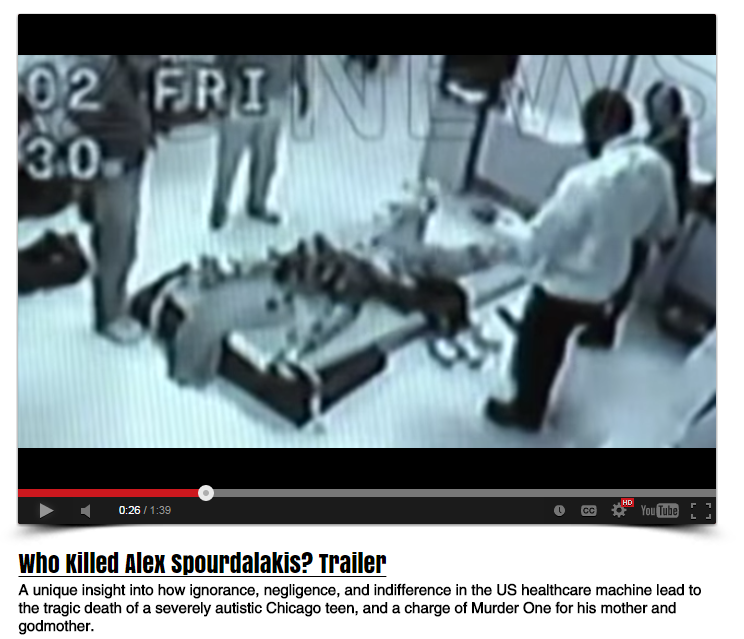
If one follows the link above to the Mr. Wakefield’s Autism Media Channel, one will find a trailer for his “Who Killed Alex Spourdalakis” video. The narration talks about him being treated “in the words of witnesses…like an animal…” and at 26 seconds in one sees this image:
.
An image from that same video is also seen at about 20 seconds into the trailer.
As one who has followed various stories in the autism community I know that video well. I know it is taken from a video that made the news. A video about a completely different autistic.
That video can be found on YouTube. It’s a story of an autistic at the Judge Rotenberg Center. I’m unaware of Mr. Wakefield speaking out on the treatment at JRC, by the way.
Perhaps in the full documentary Mr. Wakefield uses the Judge Rotenberg Video and tells his audience that it is a completely different story than the one he is discussing. But he doesn’t in the trailer. In fact, he cut the frame so that one doesn’t see where the video originated.
First rule of documentary film making–document. Don’t make things up. Don’t pull in film from some other event. The second rule would probably be: the film maker should not be part of the story. Mr. Wakefield applied his “Autism Team” to give their brand of support to the Spourdalakis family. I do question whether Mr. Spourdalakis would be alive today without that interference. Without the false hope. A question one can bet will not be addressed in an unbiased fashion, if at all, in Mr. Wakefield’s documentary.
I’ll note something else odd in that trailer. Immediately after that clip from the JRC video, one hears someone talk about “exorcism needed to be performed” and “he was possessed”. What that is all about is as much your guess as mine. Is this an example of the bad support Mr. Spourdalakis was getting before Mr. Wakefield? The type of support he got from Mr. Wakefield’s “Autism Team”?
Let’s consider another of Mr. Wakefield’s recent videos. In it, Mr. Wakefield presents a little more of the audio Brian Hooker claims are from phone calls he secretly taped with a CDC researcher. Let’s assume this is correct. At about 56 seconds in, Mr. Wakefield shows us a silhouetted figure gesturing while the recording goes on.
Dramatic, isn’t it? Looks like Team Wakefield got someone from the CDC into a room, spilling secrets galore. It’s like a bad spy movie.
Looks to this observer like the man in the silhouette is an actor, not the CDC researcher. Why? Well, the face doesn’t look like the same person. The actor isn’t wearing glasses, the most recent photos of the researcher show him with glasses. The movements of the actor don’t really match the words in the audio. The audio quality is the same as in the phone call, but the actor doesn’t have a phone. Why would he be talking on the phone if he’s in a room? Why not use a recorder in the room? One can go on and on.
Perhaps Mr. Wakefield felt that this was artistic license: he didn’t have that video, so he used an actor in a recreation of events. Except that in real documentaries, one tells the audience when one is doing a recreation.
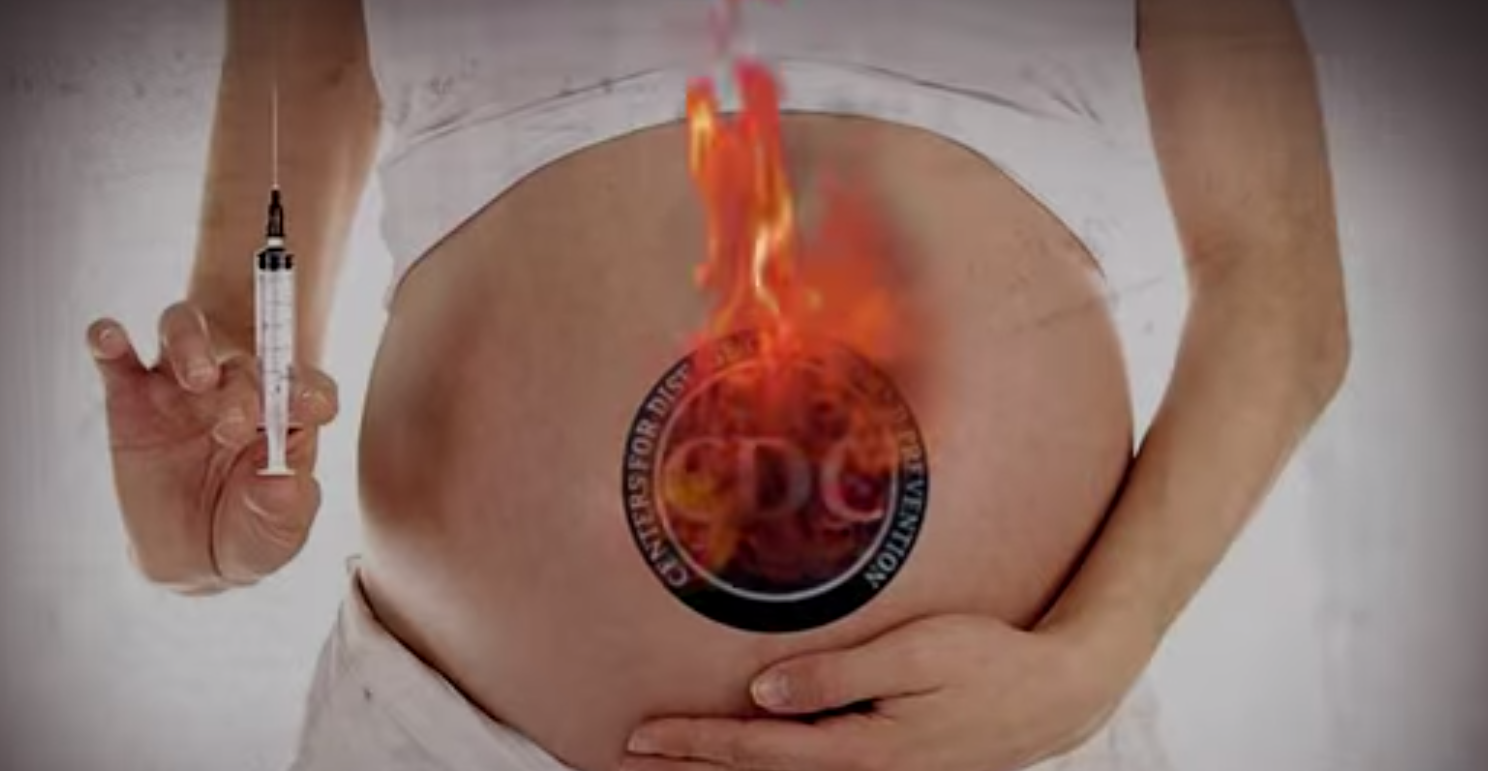
This last bit is from another of Mr. Wakefield’s recent videos. Not really relevant to the question of how does one make a good documentary. Instead this goes to one of the common complaints one hears from Mr. Wakefield’s supporters: whether he or they can be accurately called anti-vaccine. I rarely use the term, by the way. Here’s an image from another of Mr. Wakefield’s recent videos. It’s the picture of a pregnant woman holding a vaccine. The CDC logo is overlayed on her bare stomach and flames are burning from that logo. I cropped the image to remove the text imposed upon it.
How should we classify such an action? Is this an example of the methods of the “pro safe vaccine” community (as they sometimes like to be called)?
Mr. Wakefield’s new career as a film maker is an interesting choice. Frankly, he has a lot to learn.
A few years ago a study came out looking intently at the question of whether thimerosal in vaccines increases autism risk. That study, Prenatal and Infant Exposure to Thimerosal From Vaccines and Immunoglobulins and Risk of Autism, approached the question from many angles, including those suggested by parent advocates who believed (and still believe) that thimerosal was a driving force in the increased prevalence of identified autism in the U.S.. There were so many questions asked and so many results that the paper did not include all of those results. They just wouldn’t fit in a published paper, for one thing. So the authors put out additional reports including those extra tests.
One question they asked was whether the combination of exposure to thimerosal before birth and after birth would increase autism risk. This was an “interaction” model–how do these factors interact to create any possible autism risk. In their report the authors included not only the final result, but the sub-results. The pieces that they combined to calculate the final analysis.
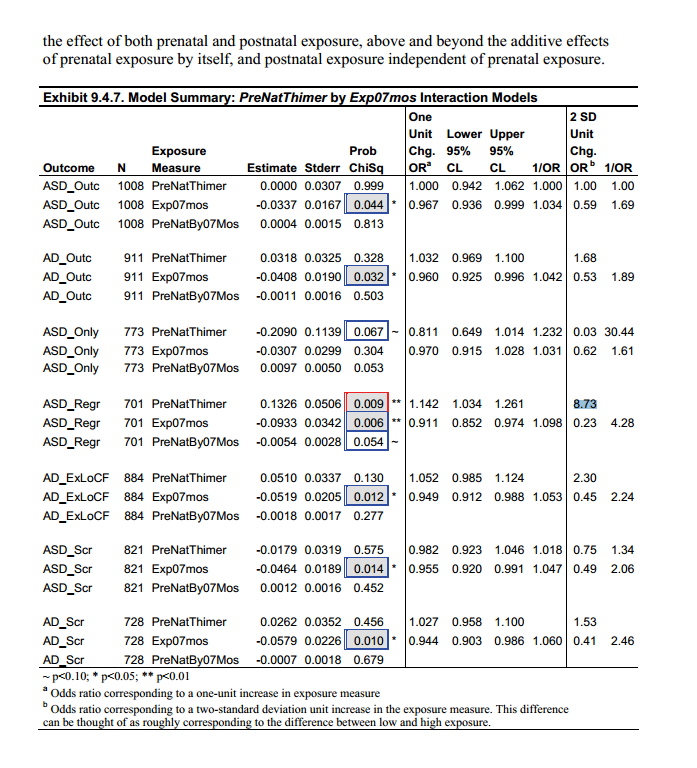
Below is an example of one of those analyses. These are data involved in calculating how pre-natal thimerosal exposure combined with post-natal exposure up to 7 months of age might interact to create autism risk. The authors were kind enough to put boxes around statistically significant results–blue for results which indicate decreased risk and red for increased risk.
Now, let’s say I took the exposure by 7 months point and said, “Hey, look! Thimerosal exposure in the first seven months of life reduces autism risk by a factor of 4.28!” Well, that would be dishonest wouldn’t it? Taking a single sub result in an interaction model isn’t valid.
If I chose a different model from the same report I could quote a 1/OR (inverse odds ratio) of 113.59. A huge “protective” effect. Very dramatic. 113 times lower risk! But just as with the previous example, if I cherry picked this data point my own community would call me out for being dishonest. And they’d be right to do so.
I’m going to repeat that for emphasis because it isn’t obvious but it is very important: taking a single sub result in an interaction model is not valid. These sub results are only valid when incorporated into the full model and calculation performed.
Here’s something else that would be incorrect, and is more obvious: reporting only the results one wants to report. Ignoring the other results–especially the final result. In this case the final result is that the interaction of prenatal exposure and post natal exposure by 7 months does not increase autism risk. If I pulled out the sub result and said, “hey post natal thimerosal is protective” that would be misleading. If I ignored that red box you see with an odds ratio of 8.73, indicating a higher risk with thimerosal, that would be misleading.
Incorrect. Dishonest. Invalid. Take your pick of terms. It’s wrong.
So, what if I told you someone sifted through the report and cherry picked the results in the red boxes and was going around telling people “prenatal exposure to thimerosal increases autism risk by as much as a factor of 8.73. Would that be honest in your opinion?
Remember Brian Hooker?
If you don’t, he’s the guy who decided to publicize his paper with a race-baiting YouTube video claiming that a scientific disagreement among CDC researchers amounts to a new Tuskegee experiment? That scientific disagreement being whether to discuss one preliminary result or leave it out of a paper?
For some time now Mr. Hooker has been giving talks about how the data from the Price study shows an increased risk for autism and regression with thimerosal exposure. He doesn’t show exactly where he got the numbers he reports. But the number he likes to quote, 8.73, pretty much only appears in the figure above. He’s reporting on a sub result in an interaction model, which is not valid. He’s not reporting on the other sub results, nor the final result of the interaction model.
You can see him do this in his recent talk which has been posted to YouTube:
Let’s go into this in more detail, for those who would like to see that. His talk on this study starts at about 32 min in to the video. Mr. Hooker claims that he got the background reports from a “congressional request”. That’s around minute 37 in the talk. Sounds really impressive. Perhaps Mr. Hooker did get them through a congressional request. Which would beg the question of why he didn’t just download them from the web. The reports have been freely available since the Price Study was published. If one reads the Price study, as one would expect Mr. Hooker has done, references 10 and 11 are the reports, complete with url. These are online (here and here). Minor point I know, but it goes to show the amount of spin coming from Mr. Hooker and his team.
A few other points from his discussion of the Price study:
Mr. Hooker calls the Price study “fatally flawed”. He goes into great detail about why he feels this study is not valid. It’s a lot of hand waiving and his arguments are not valid. But it’s also problematical to spend a great deal of time tearing down a study to then rely on it for your own argument.
You see after he goes on and on about how he feels this study is not statistically valid, Mr. Hooker then appears to forget why the study is not, in his view, statistically valid and goes for the least statistically strong part of the study–that involving the smallest sub group.
He calls his discussion of the Price study a “reanalysis”. That’s not the word I use for skimming through publicly available reports and pulling out results that the authors put red boxes around. Again, it’s just spin.
At 36 minutes in you can see Brian Hooker claiming that the refusal rate was too high for the study to be valid (again, somehow that argument magically goes away for his “reanalysis”) and cheering and telling his audience to refuse to participate in CDC studies.
This is not the act of someone who wants to know the truth, of a true advocate, in my opinion. This looks to me like someone showing a strong bias towards the CDC. This advice goes counter to what I and my family need.
As an aside: if you watch Mr. Hooker’s full talk (don’t worry, it isn’t the full 8 hours of the video, just about an hour) you will see that it’s basically three parts. Part 1 is about his MMR paper with lots of references to the “whistleblower” (what whistle was blown again?). Part 2 is the Price study “reanalysis” (since when is reading someone else’s report a “reanalysis”). Part 3 is a discussion of tics with references to the “whistleblower” again.
Notice the pattern–there’s no discussion of the “whistleblower” in the discussion of the Price study. The area that is the most important to Mr. Hooker, thimerosal and autism, and no input from the “whistleblower”? Take a look at the Price study and answer this question: who is the second author on that study? That’s right, the “whistleblower”.
As I recall, Mr. Hooker claims to have been in contact with his “whistleblower” for about 10 months. It strains credulity to think that in that time Mr. Hooker never asked about the Price study. It further strains credulity to think that if Mr. Hooker had anything from the “whistleblower” to attack the Price study, he would hold it back.
Which is to say: I think he got nothing from his “whistleblower” on the Price study.
There’s a lot more wrong with Mr. Hooker’s “reanalysis”. But I’ll bring this back to this:
Yes, I admit it’s a bit obscure to know that you don’t pull a sub result out of an interaction model. It’s not so obscure that Mr. Hooker should be excused for doing it. But reporting the one sub result in the red box and ignoring 8 blue boxes? That’s not obscure. That’s just wrong.
In 2011 the British Medical Journal (BMJ) published a series of articles about Andrew Wakefield and his efforts to promote the idea of the MMR vaccine causing autism. Brian Deer has a list of links on his website: Secrets of the MMR scare. Here are just a few of those links:
Nearly a year after those were published, Andrew Wakefield took issue with his work being declared fraudulent and sued for defamation. Not in the UK, where the laws are very favorable to him. No, instead he chose his home state of Texas. Mr. Wakefield’s original suit was denied on the grounds that he did not have the standing to bring suit against the BMJ in Texas. Mr. Wakefield appealed.And lost.
In the recent appeal the judgment the court stated:
This is an appeal from the judgment signed by the trial court on August 3, 2012. Having reviewed the record and the parties’ arguments, the Court holds that there was no reversible error in the trial court’s judgment. Therefore, the Court affirms the trial court’s judgment. The appellant shall pay all costs relating to this appeal, both in this Court and the court below.
[Edit to add–see the discussion below. It is quite possible that I did not read this correctly]
If I read this correctly, Mr. Wakefield will be paying the costs the BMJ team incurred as well as his own. And, not only in the appeal, but also “in the court below”, which I read to be in the original suit. To put it simply–Mr. Wakefield may be in the position of paying the costs going back to when he first filed his defamation case.
The BMJ team and Mr. Wakefield’s team were four attorneys each. I would expect that Mr. Wakefield’s costs run into many tens of thousands of dollars. I would expect that the BMJ’s costs are likely even higher.
Which brings us to the obvious question: with a gamble of this size, what would this appeal have accomplished had Mr. Wakefield won? Well, for starters the BMJ team’s Anti SLAPP suit would have moved forward. Texas had just enacted Anti-SLAPP legislation at the time Mr. Wakefield filed suit (as an aside, if I recall correctly this is one of the blunders of Mr. Wakefield’s suit–waiting until after the new law was in place to file). SLAPP stands for Strategic lawsuit against public participation. The BMJ suit essentially puts for the idea that Mr. Wakefield’s defamation suit was a cynical attempt to stop the BMJ (and others) from voicing public criticism about Mr. Wakefield’s actions. Mr. Wakefield faced heavy penalties had the Anti-SLAPP suit gone forward and had the BMJ won.
This is the fourth time that Mr. Wakefield has attempted to “gag the media” as Mr. Deer puts it. And now the fourth time Mr. Wakefield has lost. One can never tell for certain, but it seems likely that Mr. Wakefield would have lost the Anti-SLAPP suit.
Let’s say Mr. Wakefield avoided an Anti-SLAPP judgment. He would have been able to bring his defamation case to court on the merits. Not on the merits of his scientific work, but on the question of whether the BMJ team could rightfully call his work fraudulent. A case the BMJ team certainly prepared for before going to press. And prepared to defend in the UK, where the laws are much more favorable to Mr. Wakefield. Which is to say, I suspect the BMJ felt strongly that they had checked all their facts closely and were well defended in any and all statements they made.
From my point of view, this defamation lawsuit was a vanity exercise by Mr. Wakefield. It got his name in the news. It may have slowed criticism of him for years. He got to look like a hero to his own community.
And he threw tens if not hundreds of thousands of dollars down the tubes in the effort. Mr. Wakefield heads the “Strategic Autism Initiative” which has the purported goal of funding autism research. Last I checked the majority of the money collected for the SAI went to salaries. Mr. Wakefield’s being the lion’s share. Be that as it may, Mr. Wakefield had an option a few years ago: fund autism research or fund this lawsuit.
Well, we see his choice. And the result. Sure there may be a further appeal. Take it to the Texas Supreme Court and delay some more. And run up more bills to pay.
Isabelle Stapleton is an autistic teenager. Thankfully we get to say “is” as, you see, her mother tried to kill Isabelle (“Issy” to her friends). The mother took her daughter to a remote area and lit two charcoal grills in her van so that the carbon monoxide would poison them both.
It has been reported that at times Isabelle has been violent. Keep in mind most of those reports seem to source back to the mother, the mother who tried to kill her. I’m not trying to downplay Isabelle’s struggles. Some in our community have very great needs.
“Dr. Phil” has interviewed Isabllele’s mother. People Magazine has a story up on it. Whenever these stories go online I cringe. Rarely are they handled well. And I cringe even more at the comments I know will be there.
One can just bet that many comments will take the form, “no one should kill her child…..but…..”
There is no “but” in this. No one should commit murder. No parent should kill her child. Full stop. Period. “But” does not apply.
Variants of this are “don’t judge her” and “until you walk in her shoes”.
“Judge” means to form an opinion.
For those who write that: the mother tried to kill her daughter. I will form an opinion about this–this is wrong. I don’t have to “walk in her shoes” to say that. Why won’t you form an opinion? Why does her daughter’s disability have anything to do with forming this opinion?
Just in case you are wondering: I did purposely write this without mentioning the mother’s name. The mother is not the story. When autistics have been murdered in the past there have been news stories that never mention the name of the victim.
—
By Matt Carey
Shannon Rosa is the incredible parent of incredible kids, one of whom is autistic. I could say this from what I’ve read because Ms. Rosa is an excellent writer, but I have also met her and Leo in real life. Ms. Rosa writes at BlogHer as well as The Thinking Person’s Guide to Autism and Squidalicious.
A recent BlogHer article she wrote covers a very important topic: how when a disabled person is murdered the conversation usually focuses on the murderer, not the victim
Michigan parent Kelli Stapleton recently pled guilty to poisoning her autistic teen daughter Issy. According to police reports, Kelly lured Issy into a van, “drugged her, lit the grills and left the van to get more charcoal while her sleeping daughter breathed in poisonous carbon monoxide fumes.” Kelli and Issy both survived the attempted murder-suicide. Issy emerged from a coma and seems to be doing well; Kelli is in jail, and is scheduled to be sentenced on October 6th.
The question of vaccine safety comes up a lot in the online autism parent community. The PBS program Nova is taking a look at vaccines and vaccine safety in a show “Calling the Shots”. As they point out, it is OK to question vaccine safety, but that is just the start of the conversation. The program airs tomorrow (September 10) at 9pm.
Todd W. over at Harpocrates Speaks has put together a FAQ like guide on the questions that come up with regards to recent research by Brian Hooker and the allegations Mr. Hooker has made about the CDC. That article is an excellent resource for people looking for some answers on this story. The article starts:
The anti-vaccine community has been in a tizzy lately over a supposed “CDC whistleblower”, Dr. William W. Thompson, who, according to them, revealed fraud at the United States Centers for Disease Control and Prevention (CDC). To bolster their claim, they point to a new study from one of their own, Brian S. Hooker, that purports to show evidence of an increased risk of autism among African American boys who receive their first MMR vaccine late. However, the claims appear to be hollow and unfounded, and so they have chosen to rely on emotional arguments that may sound convincing to those who are not familiar with the issues and people involved. In a truly egregious fashion, they have erroneously and cynically compared this whole thing to the Tuskegee syphilis study, and equated the CDC with Adolf Hitler, Josef Stalin and Pol Pot, combined.
With that in mind, here is a brief FAQ for parents, news media and others to help them understand what the claims are and what the evidence actually says. The questions below have been raised or implied by anti-vaccine activists. Hopefully, this will prevent inaccurate reporting and help parents feel reassured about the MMR vaccine.
Let’s start with an uncomfortable fact. States have a financial incentive to underserve disabled students. Special education is expensive, and every support costs money. The Department of Education exists, in part, as a federal watchdog to ensure that states live up to their obligations under the law. And these are kids who will never pay […]
When I was young, people like my kid were institutionalized. Access to community, either in their residence or their daily activities, was limited. Which is a nice way of saying, a lot of people never saw the outside of an institution. I don’t want to go back. I don’t want to think that after I […]
NIH autism research funding has collapsed since Mr. Kennedy became HHS Secretary. I wrote about this in my open letter to the IACC. Then I got curious: are the cuts limited to autism, or is this happening across NIH? The answer: it’s everywhere, and it’s worse than I expected. Below is a graph I made […]
Secretary Kennedy has cut back on autism research, and you can act. You should act. You must act. Here are data from NIH Reporter on new NIH autism grants by fiscal year. I pro-rated the results from 2026, since the fiscal year ends in September. This graph shows only those grants which are new in each fiscal […]
Yes, this is a different topic than typical for this blog. But, let’s consider a simple and obvious lie by our president: the As is typical for this president, this project involves multiple lies. Here are but two. First, the White House would not be changed itself. Just added to. As noted in a recent […]
Recent Comments