Archive | Matt Carey RSS feed for this section

Action Alert: Call today to support The Convention on the Rights of Persons with Disabilities!

27 Nov

The action alert below is from The Arc:

Action Alert: Call today to support The Convention on the Rights of Persons with Disabilities!
Take Action!

The United Nations Convention on the Rights of Persons with Disabilities (CRPD) is being brought to the U.S. Senate floor this week. We are nearing a vote, as Senate Majority Leader Harry Reid (D-NV) indicated he will bring the treaty up to begin debate during Executive Session within the next few days.  The Arc has been working with numerous other disability advocacy groups to garner support for ratifying the treaty, which will promote, protect, and ensure the full and equal enjoyment of all human rights and fundamental freedoms by all persons with disabilities.  This vote is the culmination of months of advocacy work by advocates like you and we need your help to ensure ratification.

It is important for you to contact your Senators today and let them know that you support CRPD. We need every U.S. Senator to be contacted and to know that the disability community is leading the charge for U.S. ratification of this international disability treaty. Our voice matters.

Get your friends, family, and work colleagues to make calls and use social media today to show support! Click on the “take action” link at the top of the page to get started.

You can find phone and email contact information for your Senators here, and Twitter IDs for your Senators here (Tweet using #CRPD #UNCRPD).

Tell your Senators:

I am a person with a disability (I am a family member/friend/supporter of a person with a disability) and I want to see the Senator vote in support of the CRPD this year!

The CRPD will not cost the Federal Government any additional funds.

The CRPD has been reviewed by both Republican and Democratic Attorneys General and by past Counsel to Presidents.  They confirm that it does not threaten the sovereignty of the U.S. nor does it require any new legislation to comply with the treaty. 

This treaty is good for American business and for the world.  It will allow us to bring our knowledge of making a society accessible to the whole world.

MOST IMPORTANTLY – This treaty is very important to the U.S. disability community! Following U.S. ratification of the treaty, U.S. leadership will help raise accessibility around the world, directly helping Americans with disabilities who live, work, or travel abroad.  

Sample Tweet : @(SenatorID) Vote to support the #CRPD #UNCRPD!  This is a #disability issue and we say vote YES!

Sample Twitpic: https://twitter.com/USICD/status/259376999901044736/photo/1


By Matt Carey

Congressional hearing to include Autistic witnesses

27 Nov

This Thursday, Nov. 29, the U.S. House of Representatives Committee on Oversight and Government Reform will hold a hearing “1 in 88 Children: A Look Into the Federal Response to Rising Rates of Autism“. The original witness list (at least as far as I have heard, it is not on the Committee’s website) did not include autistic witnesses. It appears that has changed. Here is an announcement from the Autistic Self Advocacy Network (ASAN):

On November 29th, the House Committee on Oversight and Government Reform will be holding a hearing on autism. Invited witnesses include people from government agencies, parent autism advocacy organizations, AND Autistic self-advocacy organizations. We are pleased to report that the House Committee on Oversight and Government Reform staff have just reached out to us to invite Autistic representation to this Thursday’s hearing.

Thanks to all of you for making your voices heard and to the House Committee for hearing the message Nothing About Us, Without Us! Whether you faxed letters of support for Autistic representation at the upcoming hearing or signed our petition, your voice has been heard. Now Autistic voices will be heard as well. ASAN President Ari Ne’eman has been invited as one of not one but TWO Autistic witnesses scheduled to testify at the hearing.

The journey doesn’t end there. Come join us in showing support to Autistic people speaking! We’ll be gathering together at the Rayburn House Office, Room 2154 on the day of the hearing. The hearing itself will begin at 2 PM, but as we anticipate a packed room ASAN will begin gathering besides the door to the hearing at 11 AM. RSVP via our Facebook event page.

You made this happen!

Regards,

The Autistic Self Advocacy Network

It will be an uphill battle to get anything accomplished at this hearing, in my opinion. It’s a lame duck congress and a relatively short hearing. But the precedent has been set that autistics will be present. The precedent was set years ago that parents will be present.


By Matt Carey

Aging with intellectual disability

26 Nov

Care for the developmentally disabled has improved over recent generations and life and expectancy has increased. As a result, issues surrounding old age need more attention. Two studies out recently open the dialogue in two areas: hospice care and retirement options.

Advanced age and end of life concerns present areas often not focused upon by parent advocates with developmentally disabled children. There are many issues which are more immediate and time and energy are limited. But few parents will be present to advocate for their own children at end of life. These are prime examples of where listening to adults with DD and helping them advocate for changes will pay off in a better life for our kids.

Here are the abstracts:

Unique and universal barriers: hospice care for aging adults with intellectual disability.

Friedman SL, Helm DT, Woodman AC.
Abstract

Abstract As life expectancy of people with intellectual disability (ID) has increased, there has been a concurrent increase in age-related illnesses and conditions similar to that of the general population. These circumstances result in people with ID dying from typical life-ending conditions, and thus, they require similar end-of-life services such as palliative and hospice care. Although there are notable barriers to hospice for all, people with ID face additional challenges in accessing the benefits of these services. This article presents a review of the literature on these issues, underscoring the multiple challenges and the importance of a more collaborative approach between hospice and palliative care workers with people with ID, their families, and other important stakeholders.

PMID: 23167489 [PubMed – in process]

8. Am J Intellect Dev Disabil. 2012 Nov;117(6):497-508. doi: 10.1352/1944-7558-117-6.497.

Active aging for individuals with intellectual disability: meaningful community participation through employment, retirement, service, and volunteerism.

Fesko SL, Hall AC, Quinlan J, Jockell C.
Abstract

Abstract As individuals with intellectual and developmental disabilities become more engaged in community employment, it will be critical to consider how their employment experience changes as they age. Similar to other seniors, individuals will need to consider whether they want to maintain their employment, reduce their work commitment, or retire completely. If they do choose to retire, what activities will they choose to engage in, and what service or supports might be necessary? This article considers the issues faced by all aging workers in regard to retirement planning and active aging as well as specific strategies for individuals with intellectual and developmental disabilities to remain active and engaged. Recommendations for service options, policy consideration, and future research are also discussed.

PMID: 23167488 [PubMed – in process]
9. Am J Intellect Dev Disabil. 2012 Nov;117(6):455-63. doi: 10.1352/1944-7558-117.6.455

A rare opportunity: a congressional autism hearing

23 Nov

A hearing is scheduled for next week by the a committee of the U.S. House of representatives: the Committee on Oversight & Government Refiorm. The Committee’s hearing is entitled:

1 in 88 Children: A Look Into the Federal Response to Rising Rates of Autism

This gives a rare opportunity to contact a member of congress when autism is on the agenda. There are many ways to do so. Consider taking the time to let people known what you think is important.

The Committee has a webpage and the Minority party (currently the Democrats) maintain a separate page. Neither site has an electronic method for feedback that I can see.

However, feedback is possible via phone and fax: Phone: (202) 225-5074 Fax: (202) 225-3974.

I have set up a webpage where you can fax the committee.

Comments can be left on the committee main  Facebook page
Minority party (Democrats) Facebook page

The committee webpage lists @darellissa (the chairman) as their Twitter handle.

In addition, the Autistic Self Advocacy Network has a Facebook event and will be gathering a group to attend the hearing.

At A Diary of a Mom, it has been suggested that one cont acre the Chair, Darrell Issa directly through his website.

The committee members are listed here and one should feel free to contact them, especially if you are in their district.

If you are able to attend, the hearing is Nov. 29 2:00 pm in 2154 Rayburn House Office Building.

To be clear, this is a committee hearing from a lame duck congress. No legislation is being considered at present. There will be some science, much politics and, I expect, more than a little theater (although I admit where politics ends and theater begins is not well defined).

Word is that the hearing will include government and non government members in two panels.

Alan Guttmacher, NIH NICHD
Coleen Boyle, CDC

And
Bob Wright, Autism Speaks
Scott Badesch, Autism Society
Mark Blaxill, Safe Minds
Rebecca Landa, Center for Autism and Related Disorders Kennedy Krieger Institute

Autism Hearing? Let yourself be heard

21 Nov

It has been reported that a hearing of the Committee On Oversight & Government Reform will held on autism on November 29th:

The panel, chaired by Rep. Darrell Issa (D-Calif.), has invited witnesses from the National Institutes of Health and the Centers for Disease Control and Prevention, as well as Autism Speaks and other advocacy groups.

Autism Speaks appears to be confirming this meeting is being set up.

There hasn’t been such a hearing in many years (think a decade). The previous hearings were held by Congressman Dan Burton, who was a major proponent of the idea that vaccines were causing an epidemic of autism. Congressman Burton is retiring, and the focus of the meeting is likely not going to be as strongly vaccine oriented in the past, but that will likely be a discussion point. From what I’ve been able to gather, so far the meeting will include no Autistic representatives nor Autistic-run organizations.

Should the meeting happen (it isn’t on the calendar for the Committee yet), wouldn’t you like the opportunity to have your views heard? One can fax the Committee, but they are not under an obligation to include public comments. I say this not to dissuade you from sending a comment, but, instead, to encourage you to ask strongly that your comments be included.

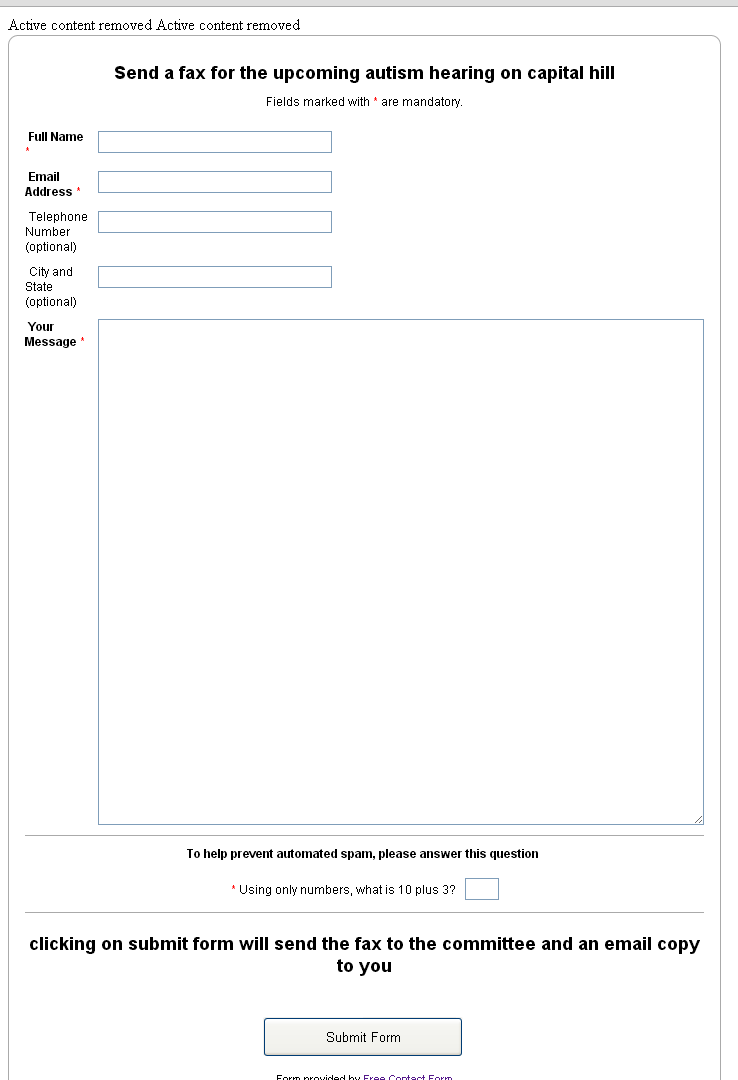
I have set up a website which will allow you to easily send a fax to the committee. Follow this link and you will have a form which you can fill out and send your message. The form is very basic (here is a screenshot). The message you send will be emailed to you and emailed to a fax server which will send it to the committee’s fax number. (alternatively, you can fax them directly at (202) 225-3974).

In my opinion, U.S. Autism policy affects communities the whole world over. As such, I would encourage international readers of Left Brain/Right Brain to submit comments as well. Consider making it clear that you are from outside the U.S..

Privacy issues: the site sends two emails. One to the email address you give and the other to a server which will send the faxes. I have access to the logs on that server and, for some time, I can read the faxes sent. But I don’t.

You are free to chose your talking points. Here are some of mine:

1) We need focus on improving the quality of life of Autistics
2) While not all Autistics can self-advocate, if we are going to have autism organizations represented, we need to have Autistic-run organizations represented.
3) Autism is a very broad spectrum, all with challenges of some sort. The government’s response needs to be broad (read-larger than it is now) in order to encompass all the needs of these communities.
4) The vaccine-epidemic hypothesis has been very damaging to the autism communities. Please don’t allow this meeting to be a way around the science in order to keep that idea alive.
5) There are faux therapies in common use for autism. Many are harmless. Some are dangerous and based on incredibly poor science. We need to get accurate information out about these practices.

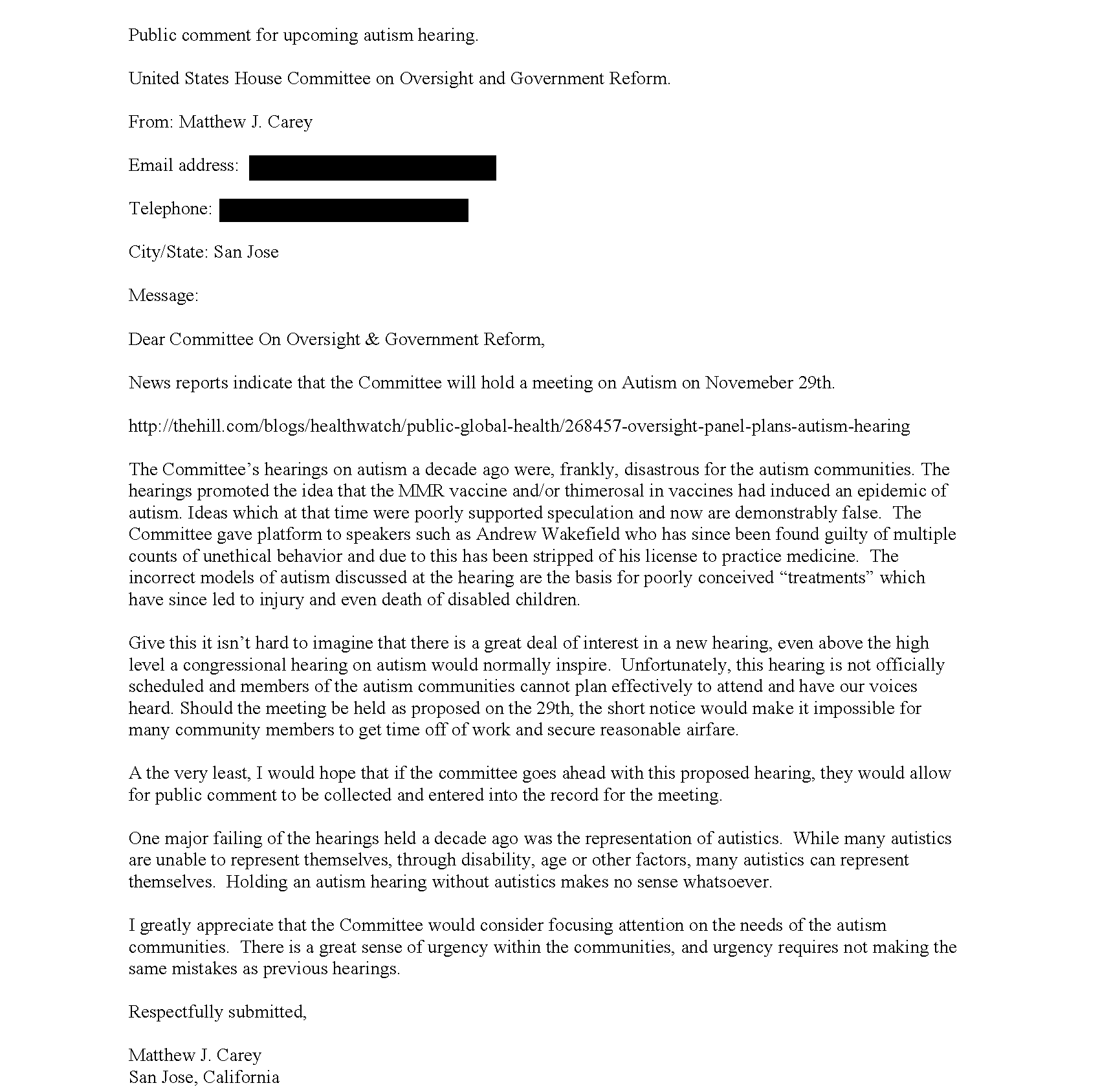
The fax is very basic. Here is a copy of one I sent earlier this week. I redacted my phone number and email address, but those will be included in the fax you send (note that those are voluntary fields. In other words, you can leave the phone number and city/state boxes blank).

Again, take a moment or take longer and put together a comment for the Committee. Follow this link and fill out the form and send a fax.

There can’t be a genetic epidemic?

20 Nov

It’s a phrase that is heard a great deal in online discussions about autism: there are no genetic epidemics. Genes don’t change quickly enough for a genetic condition to see an increased prevalence over a single generation, right? Well, yes and no.

Consider Down Syndrome. A condition almost everyone would agree is genetic. Per the NIH website: Down syndrome is a genetic condition in which a person has 47 chromosomes instead of the usual 46. Most Down Syndrome children are born to non-Down Syndrome parents. I.e. the genetic condition is not inherited. DS risk increases significantly with the age of the mother. Here is a graph showing estimated DS risk as a function of maternal age (source):

Down Syndrome genetic testing is well established, allowing for prenatal testing and parental choice to terminate pregnancies. An estimated 2/3 of Down Syndrome pregnancies are terminated.

Thus there are at least two social factors which impact Down Syndrome incidence: maternal age and parental choice. Average maternal age is going up, and there are indications that termination rates are going down. These social factors and possibly other factors have led to–a genetic epidemic. Down Syndrome prevalence has been steadily climbing for years:

Per the article in Pediatrics, Prevalence of Down Syndrome Among Children and Adolescents in 10 Regions of the United States:

From 1979 through 2003, the prevalence of DS at birth increased by 31.1%, from 9.0 to 11.8 per 10000 live births in 10 US regions. In 2002, the prevalence among children and adolescents (0–19 years old) was 10.3 per 10000. The prevalence of DS among children in a given age group consistently increased over time but decreased with age within a given birth cohort. The pooled prevalence of DS among children and adolescents was lower among non-Hispanic black individuals and other racial/ethnic groups compared with non-Hispanic white individuals; it was also lower among females than males.

What does this mean for autism? At present there is no commonly used test for autism, but there are strong indications that parental age (both maternal and paternal) increase autism risk. Peter Bearman at Columbia calculated that about 11% of the increase in the administrative autism prevalence in California was due to increased parental age. Groups that promote autism as vaccine injury have been antagonistic towards the idea that parental age, especially paternal age, increases autism risk. The reasons are fairly obvious: they indicate that the idea of “there can be no genetic epidemic” is, at best, a much more complicated statement than they would have us believe.


By Matt Carey

Genetic tests for autism debut amid concerns about validity

20 Nov

One of the best, if not the best, blogs on autism science is that run by the Simons Foundation: SFARI.org. One of my favorite science writers is Virginia Hughes, who has written well on autism over many years. So, you can imagine I was pleased to see a recent article was hosted on SFARI and written by Ms. Hughes. But this one touches on a very serious topic: genetic testing. The article (Genetic tests for autism debut amid concerns about validity) is well done, but incomplete. One obvious concern about genetic testing is whether it would be used for prenatal screening.

The tests, as the title of the article suggest, are not completely accurate. Frankly I’m a bit surprised that teams are offering these as a product given the current accuracy attainable. That said, they are being offered. And this ushers in an era that is, to me, frightening. An era when parents might use a test, accurate or not, to terminate a pregnancy based on the possibility of having an autistic child.


By Matt Carey

Oversight panel plans autism hearing

17 Nov

The Hill dot com is reporting that the U.S. House Committee on Oversight and Government Reform will hold a hearing on autism on November 29. This meeting is not yet on the Committee’s calendar and when I called them earlier in the week the meeting itself was not firm (they expected it to happen but it wasn’t certain).

In Oversight panel plans autism hearing Sam Baker writes:

The House Oversight and Government Reform Committee is planning a hearing later this month on rising autism rates and the federal government’s response.

The panel, chaired by Rep. Darrell Issa (D-Calif.), has invited witnesses from the National Institutes of Health and the Centers for Disease Control and Prevention, as well as Autism Speaks and other advocacy groups.

Autism rates are rising quickly. One in 88 children has been diagnosed with autism spectrum disorder (ASD) by age 8, the CDC reported in March, a dramatic increase from its previous estimates.

The Oversight Committee’s witness invitations say the Nov. 29 hearing “will address the federal response to the recent rise in ASD diagnoses, as well as the allocation of government resources for ASD. It will also review research and treatment options for those diagnosed with ASDs.”

The Committee held meetings 10 years ago which caused major harm to the autism communities. A platform was given for Andrew Wakefield (granted, his work was only questionable then but his ethical breaches were unknown) and the now disproved notion that the rise in the number of people diagnosed with autism was due to mercury in vaccines.

Much has happened in the past decade, but there’s a long way to go yet. The US government has a large effort on autism research, but more is needed. More effort on understanding the needs of adults, the broad spectrum of adults, for one thing. So many topics could use attention. The hearings of a decade ago helped to steer focus into unproductive areas. Let’s hope that doesn’t happen again. I’d like to do more than hope on that.


By Matt Carey

Note: this was edited after publishing to add the signature and correct a misspelled word (overnight instead of oversight)

Youth with autism gravitate toward STEM majors in college — if they get there

16 Nov

Recent research has shown that there is a lack of support for the transition from school to adulthood for autistics in the U.S.. That research came from one of the researchers I admire most: Prof. Paul Shattuck of Washington University in St. Louis. Prof. Shattuck’s team has a new paper out with : Science, Technology, Engineering, and Mathematics (STEM) Participation Among College Students with an Autism Spectrum Disorder.

Here is the abstract:

Little research has examined the popular belief that individuals with an autism spectrum disorder (ASD) are more likely than the general population to gravitate toward science, technology, engineering, and mathematics (STEM) fields. This study analyzed data from the National Longitudinal Transition Study-2, a nationally representative sample of students with an ASD in special education. Findings suggest that students with an ASD had the highest STEM participation rates although their college enrollment rate was the third lowest among 11 disability categories and students in the general population. Disproportionate postsecondary enrollment and STEM participation by gender, family income, and mental functioning skills were found for young adults with an ASD. Educational policy implications are discussed.

The press release can be found at Youth with autism gravitate toward STEM majors in college — if they get there, but here are a few quotes:

It’s a popularly held belief that individuals with an autism spectrum disorder (ASD) gravitate toward STEM majors in college (science, technology, engineering and mathematics).

A new study, co-authored by Paul Shattuck, PhD, assistant professor at the Brown School at Washington University in St. Louis, confirms that view yet finds that young adults with an ASD also have one of the lowest overall college enrollment rates.

and,

The study found that 34.3 percent of students with an ASD gravitated toward STEM majors. That’s not only higher than their peers in all 10 other disability categories, but also higher than the 22.8 percent of students in the general population who declared a STEM major in college. Science (12.1 percent) and computer science (16.2 percent) were the fields most likely to be chosen by students with an ASD.

Prof. Shattuck put the need for attention to the needs of autistic adults much better than I:

“More and more children are being identified as having autism,” Shattuck says, “children who grow up to be adults. With the majority of a typical lifespan spent in adulthood, that phase of life is the one we know least about when it comes to autism spectrum disorders.

“This study is the latest addition to a growing body of evidence we are building here at the Brown School about the needs, strengths and challenges facing this vulnerable population,” Shattuck says.

While for many of us parents, college is not really in the likely future for our autistic children. The basic theme is still the same: “With the majority of a typical lifespan spent in adulthood, that phase of life is the one we know least about when it comes to autism spectrum disorders”


By Matt Carey

Clinical features of suicide attempts in adults with autism spectrum disorders

16 Nov

For those who don’t read Left Brain/Right Brain regularly, know that I am constantly bothered by the lack of attention to understanding the needs of autistic adults that I see in much of the ongoing research and in many parent-advocacy groups. My child is still somewhat young, but I realize that real understanding comes with time. Not only will attention to autistic adults provide benefit for those already of age, but it will set the stage for a better life for the autistic children of today.

When I see an study titled “Clinical features of suicide attempts in adults with autism spectrum disorders”, I am taken aback by just how serious this question is. The study out of Japan is preliminary but they found 7.3% of patients seen for attempted suicide are autistic. Take whatever prevalence for autism among adults you think is appropriate. I suspect the autism prevalence in adults is closer to 1%, but that’s still a 7x higher rate of attempted suicide. Much of the resistance to focusing attention on the needs of adults comes from groups promoting the idea of a vaccine-induced autism epidemic. If you believe the autism prevalence in adults is something like 1 in 10,000 (0.01%), this is would mean that autistic adults are attempting suicide in Japan at a rate of 700 times greater than the general population.

Our results indicate that ASDs should always be a consideration when dealing with suicide attempts in adults, in particular, in cases of males. Individuals with ASDs attempted suicide using serious methods, and, therefore, they may have a tendency to complete it at a first attempt. This was only a preliminary study. Thus, the clinical features of individuals with ASDs who attempt suicide must be clarified. In addition, interventions focusing on preventing suicide attempts in individuals with ASDs are required.

Yes, autistics are not only attempting suicide more often, they are using more serious methods. Like cutting/stabbing one’s self. Like jumping from heights or carbon monoxide intoxication.

The autistics in this study had the same (or a little higher) education level as the non-autistics who were attempting suicide. While psychiatric history was high (about 50%) it was lower in the autistic group than the non-autistics.

There are more comparisons made and which could be discussed but, for now, I’ll bring this back to: autistics in this study are attempting suicide more often and with more serious methods than non-autistics. If that doesn’t make people consider the importance of understanding the unique needs of autistic adults, I don’t know what will.

Here is the abstract:
Clinical features of suicide attempts in adults with autism spectrum disorders

OBJECTIVE:
The objective of this study was to investigate the frequency and clinical features of suicide attempts in adults with autism spectrum disorders (ASDs).

METHODS:
We enrolled 587 consecutive patients aged 18 or over who attempted suicide and were hospitalized for inpatient treatment. Psychiatric diagnoses, suicide attempt frequency and clinical features were compared between ASD and non-ASD patients.

RESULTS:
Forty-three (7.3%) of the 587 subjects who attempted suicide had ASDs. The incidence of patients with mood disorders was significantly lower (Fisher’s Exact Test, P=.043) and that of those with an adjustment disorder was significantly higher (Fisher’s Exact Test, P<.001) in the ASD group than in the non-ASD group. The average length of stay at both the hospital and intensive care unit in the ASD group was longer than that in the non-ASD group (z=-2.031, P=.042; z=-2.322, P=.020, respectively).

CONCLUSIONS:
ASDs should always be a consideration when dealing with suicide attempts in adults at the emergency room.


By Matt Carey