Archive | Authors RSS feed for this section

comment on: “Recovery” from the diagnosis of autism – and then?

1 May

Before commenting on the paper, there are a few general comments on the idea of recovery that need to be addressed. The fact that some people are diagnosed as autistic and later are found not to be autistic is not a new idea. Here’s a study from 1975 where 75% (of an admittedly very specialized) subgroup were diagnosed as autistic and later found to have “…social responses appropriate to their level of function; those who did not generally were over 3 years of age at the time of their first examination or had initial DQs of 35 or less”. I.e. they were no longer considered autistic. The idea that losing a diagnosis would be labelled “recovery” does seem to be a new idea. “Recovery” implies that one was originally not autistic, became autistic and was later “recovered” to the original state. Whatever one’s stance on whether that accurately describes autistic regression, it doesn’t describe at least most of autism.

Given this, I find the use of the term “recovery” by academics to be problematic at best. My personal feeling is that the authors of the study below shouldn’t have used the term. But it’s worth noting that this, like many topics in autism, is a minefield (no safe place to stand). When a team discussed kids as having an “optimal outcome” from autism, they too came under a great deal of criticism.

All this said, a new study came out discussing kids who were diagnosed as autistic (age 4 or younger) and two years later did not meet the criteria for a diagnosis. This group was followed up later (about age 10) and were found to have significant challenges. In fact, some had declined in Vineland test scores.

And, a “substantial minority” were once again autistic, according to the parents.

So, “recovery” may not be all that it’s cracked up to be. But is there more valuable lessons that we can learn from this? Well the researchers point out that these kids would have and still could benefit from significant support. Clearly, an autism diagnosis is the be-all and end-all of what should determine a child or adult’s need for support.

Here is the abstract:

Background: The aim of this study was to follow up the 17 children, from a total group of 208 children with autism spectrum disorder (ASD), who “recovered from autism”. They had been clinically diagnosed with ASD at or under the age of 4 years. For 2 years thereafter they received intervention based on applied behavior analysis. These 17 children were all of average or borderline intellectual functioning. On the 2-year follow-up assessment, they no longer met criteria for ASD.
Methods: At about 10 years of age they were targeted for a new follow-up. Parents were given a semistructured interview regarding the child’s daily functioning, school situation, and need of support, and were interviewed using the Vineland Adaptive Behavior Scales (VABS) and the Autism – Tics, Attention-deficit/hyperactivity disorder (AD/HD), and other Comorbidities (A-TAC) telephone interview.

Results: The vast majority of the children had moderate-to-severe problems with attention/activity regulation, speech and language, behavior, and/or social interaction. A majority of the children had declined in their VABS scores. Most of the 14 children whose parents were A-TAC-interviewed had problems within many behavioral A-TAC domains, and four (29%) had symptom levels corresponding to a clinical diagnosis of ASD, AD/HD, or both. Another seven children (50%) had pronounced subthreshold indicators of ASD, AD/HD, or both.

Conclusion: Children diagnosed at 2–4 years of age as suffering from ASD and who, after appropriate intervention for 2 years, no longer met diagnostic criteria for the disorder, clearly needed to be followed up longer. About 3–4 years later, they still had major problems diagnosable under the umbrella term of ESSENCE (Early Symptomatic Syndromes Eliciting Neurodevelopmental Clinical Examinations). They continued to be in need of support, educationally, from a neurodevelopmental and a medical point of view. According to parent interview data, a substantial minority of these children again met diagnostic criteria for ASD.

Keywords: autism spectrum disorder, autistic traits, AD/HD, A-TAC, Vineland, cure

Here is a video presentation that was published along with the paper


By Matt Carey

Press Release: New Research Finds No Evidence That Thimerosal-Containing Vaccines Affect Neurodevelopment and Behavior in Infant Primates

26 Apr

Below is a press release from the Johnson Center (formerly Thoughtful House). It is about a recent follow-up study they performed (discussed here). I’ll give the press release below with no further comment except to highlight this statement by the lead researcher: “Despite these limitations, the data in this primate study overwhelmingly provides support for the safety of pediatric vaccines.

New Research Finds No Evidence That Thimerosal-Containing Vaccines Affect Neurodevelopment and Behavior in Infant Primates

(Austin, Texas) – February 18, 2015 – A research study published today in Environmental Health Perspectivesreported that vaccination of infant macaques with thimerosal-containing vaccines did not negatively impact neurodevelopment, cognition, or behavior. In this study animals received several pediatric vaccines containing thimerosal (a mercury-based preservative) in a schedule similar to that given to infants in the 1990s. Other animals received just the measles-mumps-rubella (MMR) vaccine, which does not contain thimerosal, or an expanded vaccine schedule similar to that recommended for US infants today. Control animals received a saline injection. Regardless of vaccination status, all animals developed normally.

“This comprehensive study of infant primate development, including analyses of learning, cognition, and social development, indicated that vaccinated primates were not negatively affected by thimerosal or the MMR vaccine; the same was true for animals receiving an expanded vaccine schedule” explained Dr. Laura Hewitson of The Johnson Center for Child Health and Development, the principle investigator of the study.

Hewitson worked with a team of researchers at the Center on Human Development and Disability Infant Primate Research Laboratory and the Washington National Primate Research Center (WaNPRC) at the University of Washington, Seattle WA. According to Hewitson, the study was designed to compare the safety of different vaccination schedules, including the schedule from the 1990s, when thimerosal was still used as a preservative in multi-dose vaccine preparations. Although in 1999 the FDA and the American Academy of Pediatrics recommended that thimerosal be removed from vaccines in the US, it is still used as a preservative in multi-dose flu shots, which are recommended for pregnant women and children 6 months of age and older.

“This is the first time the safety of the entire pediatric vaccine schedule has been investigated in a relevant animal model,” said Dr. Judy Van de Water from the UC-Davis MIND Institute, who was not involved in this study.

Hewitson also noted, “As with any animal study, assessments were implemented under controlled laboratory conditions. We did not test all of the interacting variables that could contribute to an adverse outcome, such as birth weight, gestational age, genetic vulnerability, or in utero and post-natal chemical exposures. The interaction between multiple environmental exposures or genetic factors that may impact vaccine response, which is an important aspect of the vaccine debate, was not addressed in this study. Despite these limitations, the data in this primate study overwhelmingly provides support for the safety of pediatric vaccines.”

Citation

Examination of the Safety of Pediatric Vaccine Schedules in a Non-Human Primate Model: Assessments of Neurodevelopment, Learning, and Social Behavior. Britni Curtis, Noelle Liberato, Megan Rulien, Kelly Morrisroe, Caroline Kenney, Vernon Yutuc, Clayton Ferrier, C. Nathan Marti, Dorothy Mandell, Thomas M. Burbacher, Gene P. Sackett and Laura Hewitson. Environmental Health Perspectives, Feb 18, 2015; doi:10.1289/ehp.1408257.
Once the embargo lifts, this article can be downloaded for free at http://ehp.niehs.nih.gov/1408257.

This study was supported by The Ted Lindsay Foundation, SafeMinds, National Autism Association, the Vernick family, and the Johnson family. This work was also supported by WaNPRC Core Grant RR00166 and CHDD Core Grant HD02274.

About The Johnson Center

The mission of The Johnson Center for Child Health and Development is to advance the understanding of childhood development through clinical care, research, and education.


By Matt Carey

Another large study shows no link between autism and the MMR vaccine (or, a comment on “Autism Occurrence by MMR Vaccine Status Among US Children With Older Siblings With and Without Autism”

22 Apr

Autism is not associated with the MMR vaccine. The MMR vaccine does not increase autism risk. To put it in plain language: the MMR vaccine does not cause autism.

Just in case the message gets lost in this discussion, I figured I’d put it plainly at the start.

A study out today compares autism rates and the use of the MMR vaccine. In specific, the researchers looked at children with an older sibling. In this way they could look at kids in a high risk group, those who had an older sibling who is autistic. The authors also looked at kids who had older siblings who are not autistic. In the end the authors found “receipt of the MMR vaccine was not associated with increased risk of ASD, regardless of whether older siblings had ASD”.

To put it simply, kids who got the MMR vaccine were not more likely to be autistic. It doesn’t matter if their older siblings were autistic or not. So, “high risk” or not, the MMR vaccine doesn’t increase autism risk.

Another way to say it, parents who skipped the MMR vaccine did nothing to prevent autism in their younger kids. Nothing. They did leave their younger kids vulnerable to measles infection.

Here’s the abstract.

Autism Occurrence by MMR Vaccine Status Among US Children With Older Siblings With and Without Autism.

IMPORTANCE:
Despite research showing no link between the measles-mumps-rubella (MMR) vaccine and autism spectrum disorders (ASD), beliefs that the vaccine causes autism persist, leading to lower vaccination levels. Parents who already have a child with ASD may be especially wary of vaccinations.

OBJECTIVE:
To report ASD occurrence by MMR vaccine status in a large sample of US children who have older siblings with and without ASD.

DESIGN, SETTING, AND PARTICIPANTS:
A retrospective cohort study using an administrative claims database associated with a large commercial health plan. Participants included children continuously enrolled in the health plan from birth to at least 5 years of age during 2001-2012 who also had an older sibling continuously enrolled for at least 6 months between 1997 and 2012.

EXPOSURES:
MMR vaccine receipt (0, 1, 2 doses) between birth and 5 years of age.

MAIN OUTCOMES AND MEASURES:
ASD status defined as 2 claims with a diagnosis code in any position for autistic disorder or other specified pervasive developmental disorder (PDD) including Asperger syndrome, or unspecified PDD (International Classification of Diseases, Ninth Revision, Clinical Modification 299.0x, 299.8x, 299.9x).

RESULTS:
Of 95 727 children with older siblings, 994 (1.04%) were diagnosed with ASD and 1929 (2.01%) had an older sibling with ASD. Of those with older siblings with ASD, 134 (6.9%) had ASD, vs 860 (0.9%) children with unaffected siblings (P < .001). MMR vaccination rates (≥1 dose) were 84% (n = 78 564) at age 2 years and 92% (n = 86 063) at age 5 years for children with unaffected older siblings, vs 73% (n = 1409) at age 2 years and 86% (n = 1660) at age 5 years for children with affected siblings. MMR vaccine receipt was not associated with an increased risk of ASD at any age. For children with older siblings with ASD, at age 2, the adjusted relative risk (RR) of ASD for 1 dose of MMR vaccine vs no vaccine was 0.76 (95% CI, 0.49-1.18; P = .22), and at age 5, the RR of ASD for 2 doses compared with no vaccine was 0.56 (95% CI, 0.31-1.01; P = .052). For children whose older siblings did not have ASD, at age 2, the adjusted RR of ASD for 1 dose was 0.91 (95% CI, 0.67-1.20; P = .50) and at age 5, the RR of ASD for 2 doses was 1.12 (95% CI, 0.78-1.59; P = .55).

CONCLUSIONS AND RELEVANCE:
In this large sample of privately insured children with older siblings, receipt of the MMR vaccine was not associated with increased risk of ASD, regardless of whether older siblings had ASD. These findings indicate no harmful association between MMR vaccine receipt and ASD even among children already at higher risk for ASD.


By Matt Carey

Robert Kennedy, why can’t you actually apologize? My kid’s brain is not gone.

16 Apr

Robert Kennedy is here in my home state, making disparaging comments about my kid. Not specifically, you see. His comments were about those whom he wrongly considers to be vaccine injured, but that includes autistics and, as a part of that, my kid.

He is quoted by the Sacramento Bee as stating:

“They get the shot, that night they have a fever of a hundred and three, they go to sleep, and three months later their brain is gone,” Kennedy said. “This is a holocaust, what this is doing to our country.”

Really? Their brain is gone?!?

Because, you know, autistics don’t have brains. They’re gone.

How insulting and ignorant can this guy be? Well, before you answer that realize that: he doubled down on his mistake. He apologized, but just for using the term “holocaust”. Stating that kids

“I want to apologize to all whom I offended by my use of the word to describe the autism epidemic,” Kennedy said in a statement. “I employed the term during an impromptu speech as I struggled to find an expression to convey the catastrophic tragedy of autism which has now destroyed the lives of over 20 million children and shattered their families.”

Mr. Kennedy leave my community alone. We are not your tool to attack vaccines, Mr. Kennedy. Your ignorance and stigmatizing comments are doing damage to my kid and autistics of all ages.

Here’s the thing: the autism as a vaccine epidemic idea is the most damaging idea since the refrigerator mother theory. It fuels an industry of charlatans who use the one two punch: you caused your kid’s autism, now let me sell you the cure. And it fuels stigmatizing language: telling an entire group of people that “their brains are gone” is so wrong, so very wrong, so damaging that I can’t believe you let that stand.

Sadly, I can believe that you let it stand. Most other people I would suspect would be quickly apologizing.

Mr. Kennedy, you have been given every gift imaginable. And I mean gift: you did nothing to earn these. You are a wealthy white male in the United States, with a famous name to boot. Again, none of this earned. I bring this up because as the parent of a disabled kid I am so saddened to see gifts wasted. Thrown away, no less. You could be using your brain to do so much more, and yet you remain fixated on vaccines and you use kids like mine in your attacks.

You are not done apologizing. Not by a long shot.


By Matt Carey

“light it up blue” isn’t autism awareness, it’s advertising for Autism Speaks

2 Apr

Tomorrow is Autism Awareness Day, by some calendars at least.  The United Nations, for example made a resolution in 2007 to designate April 2nd as “World Autism Awareness Day”.

Resolution adopted by the General Assembly on 18 December 2007 [on the report of the Third Committee (A/62/435)] 62/139.

World Autism Awareness Day The General Assembly,

Recalling the 2005 World Summit Outcome and the United Nations Millennium Declaration, as well as the outcomes of the major United Nations conferences and summits in the economic, social and related fields,

Recalling also the Convention on the Rights of the Child and the Convention on the Rights of Persons with Disabilities, according to which children with disabilities should enjoy a full and decent life, in conditions which ensure dignity, promote self-reliance and facilitate the child’s active participation in the community, as well as the full enjoyment of all human rights and fundamental freedoms on an equal basis with other children,

Affirming that ensuring and promoting the full realization of all human rights and fundamental freedoms for all persons with disabilities is critical to achieving internationally agreed development goals, Aware that autism is a lifelong developmental disability that manifests itself during the first three years of life and results from a neurological disorder that affects the functioning of the brain, mostly affecting children in many countries irrespective of gender, race or socio-economic status, and characterized by impairments in social interaction, problems with verbal and non-verbal communication and restricted, repetitive behaviour, interests and activities,

Deeply concerned by the prevalence and high rate of autism in children in all regions of the world and the consequent development challenges to long-term health care, education, training and intervention programmes undertaken by Governments, non-governmental organizations and the private sector, as well as its tremendous impact on children, their families, communities and societies,

Recalling that early diagnosis and appropriate research and interventions are vital to the growth and development of the individual,

1. Decides to designate 2 April as World Autism Awareness Day, to be observed every year beginning in 2008;

2. Invites all Member States, relevant organizations of the United Nations system and other international organizations, as well as civil society, including non-governmental organizations and the private sector, to observe World Autism Awareness Day in an appropriate manner, in order to raise public awareness of autism;

3. Encourages Member States to take measures to raise awareness throughout society, including at the family level, regarding children with autism;

4. Requests the Secretary-General to bring the present resolution to the attention of all Member States and United Nations organizations.

76th plenary meeting 18 December 2007

While I’m sure that Autism Speaks lobbying had much to do with that resolution, it’s an awareness event. No where do you see any mention of Autism Speaks nor statements that we should “light it up blue”. Yet over the years, Autism Speaks has made autism awareness into autism speaks awareness. And no where is that more obvious than on April 2nd with their “light it up blue” event.

Is blue the color of autism? No. It’s the color of Autism Speaks. But Autism Speaks is out there asking people to shine blue lights for autism awareness. A whole section of their shop (yes, they have an online shop) is devoted to “light it up blue” merchandise. All complete with the Autism Speaks logo.

Here’s the text from the Autism Speaks web page on how to “light it up blue”. Each section brings you back to Autism Speaks. Shine a blue light..and project the Autism Speaks logo. Wear blue, including autism speaks pins or accessories. Blue=Autism speaks, basically.

How to LIUB

In honor of people with autism worldwide, iconic landmarks, hotels, sporting venues, concert halls, museums, schools, universities, bridges, retail stores, and thousands of homes will light blue beginning on April 2!

Light Homes, Businesses, Schools, and Landmarks Blue

Change outdoor or indoor white bulbs to blue bulbs.

Tint windows with blue gel sheets

Cover existing fixtures with blue gel filters

Project the Autism Speaks puzzle piece or Light It Up Blue logo on walls or buildings

Wear Blue

Ask family, friends, coworkers, and staff to wear blue (ties, scarfs, shirts, etc.)

Supply Autism Speaks lapel pins, bracelets, or other blue accessories to wear during the month of April.

Post Blue

Personalize your LIUB Selfie Sign to tell us where you Light It Up Blue

Post your photos on Facebook, Twitter, Google+, Instagram, or Flickr with the hashtag #LIUB to be a part of the global autism awareness movement!

Turn your website blue with our Site It Up Blue kit or add the Light It Up Blue logo with a link to autismspeaks.org/liub

Turn your Facebook or Twitter profile picture blue

Tweet autism facts with the hashtag #LIUB

Raise Awareness with Blue

Distribute information about autism, World Autism Awareness Day, and Light It Up Blue in your establishment, neighborhood, or company.

Invite a local Autism Speaks representative to speak to your staff, school, or town about autism and the Light It Up Blue campaign.

Reach out to local media to let the community know about your great work for the autism community and your support of autism speaks!

Donate

Click here to donate!

Text AUTISM to 25383 to give $10*

Host your own fundraising event

Use this form to mail funds to Autism Speaks

Hey, you can take a “light it up blue” selfie. Complete with Autism Speaks logo.

yeah blue for AS

Autism Speaks is corporate autism. They do some things I appreciate and many things I really, really (really) don’t. For example, perpetuating the vaccines-cause-autism idea, an idea which may be second only to the refrigerator mother idea in causing harm to our community. Just in the past couple weeks Autism Speaks had to put out a new message on the idea, because the science based and helpful message by their Chief Science Officer conflicted with the non-science educated founder’s beliefs. Autism Speaks doesn’t have autistic voices in important positions within the organization, an amazing position given the sizable self-advocate population they claim to serve. Autism Speaks has a history of perpetuating stigmatizing messages (search for “I am autism” if you are unaware of this). Autism Speaks has funded quality research over the years and I appreciate that. But every time I start thinking Autism Speaks is starting down a good path they do something that reminds me: they are not my family’s autism organization. They don’t represent my values. They don’t represent my family.

I won’t be “lighting it up blue” tomorrow. I won’t be encouraging people to “light it up blue”. I hope people will be more aware of the needs of people like my kid. I hope more that they will act. I will follow up with another post, but I’ll say it here now: remember the phrase “think globally, act locally”? Feel like donating to an autism charity? I bet you have an autism school in your area and autism schools need donations. I bet there are adult programs in your area that could use some support. That’s my suggestion for April 2nd.


By Matt Carey

Autism Speaks:  The results of this research are clear: Vaccines do not cause autism…but doesn’t let that statement stand alone.

26 Mar

Autism Speaks has come out with some very strong statements about autism and vaccines.  And the back peddled. 

First, here is a statement by Robert Ring, Chief Science Officer:

Over the last two decades, extensive research has asked whether there is any link between childhood vaccinations and autism.  The results of this research are clear: Vaccines do not cause autism.  We urge that all children be fully vaccinated.

Rob Ring
Chief Science Officer, Autism Speaks

 
In the past Autism Speaks had been sympathetic towards the idea that vaccines cause autism.  More than sympathetic, some would say.  Such a clear statement as above would have been unthinkable from Autism Speaks only a few years ago.
I wish they had made these statements earlier, but I am glad they are making these statements now.  The vaccine hypothesis has been the most damaging idea in autism since the refrigerator mother theory.  With Autism Speaks position as a well known autism organization, perhaps even fewer families will get caught in the vaccines-cause-autism trap in the future.Here’s the way the Autism Speaks vaccines and autism page looked just last year.  It includes many problematic statements and concludes: “A list of publications that used VAERS information to study associations with autism can be found here“.  “Here” is a link to pubmed with the search terms “vaers” and “autism”.  No surprise, it’s a list that is padded out by works by Mark and David Geier.  The Geiers have been performing poor research for years and have been discussed here at Left Brain/Right Brain many times.


The above statement by Mr. Ring was picked up by the press in February as it was so clear.
Next, Bob Wright, co-founder of Autism Speaks:
 

Over the last two decades extensive research has asked whether there is any link between childhood vaccines and autism. Scientific research has not directly connected autism to vaccines. Vaccines are very important. Parents must make the decision whether to vaccinate their children. Efforts must be continually  made to educate parents about vaccine safety. If parents decide not to vaccinate they must be aware of the consequences in their community and their local schools.

Bob Wright
Co-founder, Autism Speaks

It’s a fairly stilted paragraph in my read.  It comes across as though Mr. Wright is trying to appear to ride the fence while at the same time pulling back dramatically from the clear statement by Mr. Ring.  Scientific research has not directly connected autism to vaccines?

Even with that, I can’t imagine that admitting that vaccines are “important” will go over well in some circles.  Close circles.  Even “important” is to positive a word for some.  But, seriously, here we have an invention that has saved more lives that possibly any other in medical history and we get “important”?

Yes, Mr. Wright, efforts must be made to educate parents about vaccine safety.  That’s what your chief science officer did.  Sadly, you can’t let Autism Speaks be a science led organization.

By Matt Carey

Note: I accidentally published an early draft of this article yesterday.

Will a new IACC be seated soon?

22 Mar

The United States has a committee enacted by law called the Interagency Autism Coordinating Committee or IACC. The IACC describes itself on its web page as:

The Interagency Autism Coordinating Committee (IACC) is a Federal advisory committee that coordinates all efforts within the Department of Health and Human Services (HHS) concerning autism spectrum disorder (ASD). Through its inclusion of both Federal and public members, the IACC helps to ensure that a wide range of ideas and perspectives are represented and discussed in a public forum.

The IACC mission is to:

Provide advice to the Secretary of Health and Human Services regarding Federal activities related to autism spectrum disorder.

Facilitate the exchange of information on and coordination of ASD activities among the member agencies and organizations.

Increase public understanding of the member agencies’ activities, programs, policies, and research by providing a public forum for discussions related to ASD research and services.
IACC meetings are open to the public and include presentations and discussions on a variety of topics, including activities and projects of the IACC, recent advances in science and autism policy issues. A portion of each meeting is reserved for public comment. A summary of each meeting is posted on the meetings & events page.

The thing is, the IACC hasn’t had a meeting since last September, and that wasn’t even a full committee meeting. They haven’t met because the committee was dissolved since the law that created that generation of the IACC ended. A new law was passed and enacted before the previous law hit its sunset date, and so the activities of the IACC will continue through 2019. A nomination process was opened to reconstitute the committee last fall.

Consider the events surrounding the formation of the recently ended IACC (the third committee if you are keeping count). We (I was a member) were formed at the end of March 2012 after a hiatus following the sunset of the 2nd committee in September of 2011. While the press release is dated the end of March, my recollection is that the announcement came April 1st.

So, here we are, nearing the end of March following the sunset of the previous committee in September of last year.

Nothing says that they have to follow the same pattern, but it would be reasonable to expect a new committee to be announced soon. As in April 1st, the start of Autism Acceptance Month (aka Autism Awareness Month). Expect a lot of press releases around April 1 and 2 (World Autism Awareness Day) for various autism related activities, mostly centering around the “awareness” month.

This said, I suspect the speculation will soon turn to who will be on the new (4th) Committee. It’s very safe and very appropriate to say that organizations which fund a lot of research will have representation on the Committee. Thus, someone from Simons Foundation (the largest private funder of autism related research), Autism Speaks and Autism Science Foundation. Someone forwarded me a link stating that the representative from SafeMinds was not seeking reappointment, but that doesn’t mean another member of SafeMinds couldn’t be appointed.

While the Autism Society of America doesn’t fund much research, they are a large member organization and someone from ASA has been on the IACC for at least the past two incarnations.

The Autistic Self Advocacy Network, ASAN, had a member on each of the last two committees. My understanding is that the ASAN representative to the last committee (Scott Robertson) landed a position in government which posed a conflict and he had to resign the last IACC. He was not replaced with a self advocate, ASAN member or not. So, I would not be surprised if there is not an ASAN member on the next committee. I also wouldn’t be surprised if an ASAN member is on the next committee. (How’s that for hedging my bets)

The law which calls for the IACC requires self-advocate representation. Scott Robertson, Noah Britton and John Elder Robison were on the previous committee and all were excellent. Noah did a great deal of work in writing subsections of the IACC strategic plan. John is likely the most vocal of any member on the Committee (aside from Tom Insel, the chair) and is pretty much willing to take on any topic, and able to speak to it well.

It was recently pointed out to me that the self-advocates so far have all been Caucasian males. While I appreciate the contributions of John, Scott and Noah, I would greatly appreciate seeing more diversity in this area.

I won’t go through all the rest of the public members, but I will bring up a few. David Mandell is a researcher I’ve had a great deal of respect for since pretty much I started reading autism research. He has a great deal of expertise on services, which is an area that will be of heightened importance for the next Committee. In the area of services, Paul Shattuck would be an excellent new addition. Both Paul and David ask questions few others ask–focusing attention on populations that just don’t get the attention that they should. Either or both would be an asset to the next Committee.

Geri Dawson was on the previous IACC, starting as a member of Autism Speaks. She is incredibly knowledgeable about autism research, especially what is current (and in the pipeline).

One person I would like to see return is Sally Burton-Hoyle. I wrote about a presentation she gave to the IACC last year. If you watch her presentation (it’s on the teen transition and supporting autistics in college, something she knows a great deal about as that’s her job) you will see that she’s also quite on target as someone to contribute for the new services focus of the IACC. She also represents a constituency we don’t speak to enough: adults who are not self-advocates. She had an adult autistic brother. Sally Burton-Hoyle and Alison Singer were the two people I am aware of who represented non self-advocate adults (Alison has an autistic brother).

I felt strongly that the IACC should not have been disbanded but continued with additional members added to meet the new mandates (and, also, allowing for those members who wanted to be done to be replaced). The new law was in effect in time to allow for the committee to continue. The House Report (from the Energy and Commerce Committee) stated:

The Committee appreciates the diverse makeup of IACC, and would like the panel to continue to represent the diversity within the autism community and remain a place where all viewpoints can be heard. Current members include parents and legal guardians, individuals with an autism diagnosis, advocacy organizations, and medical researchers. The Committee believes that these groups should continue to be represented. After previous reauthorizations of the Combating Autism Act, IACC has been dissolved and reconstituted. The Committee believes that this is unproductive and disruptive, and would like IACC to remain active, as the changes in this bill are instituted to ensure continuity.

But that’s in a report, not the law. While I agree with the Report, it might have helped if Congress had included this language in the bill. This language together with appropriations sufficient to staff the Office of Autism Research Coordination to a level that they can support the IACC and the other duties OARC has.

There’s a lot to do for the next Committee. There is a mandate to produce a services plan. The Stategic Plan for Autism Research needs to be updated. Besides the lost time in dissolving and reconstituting the IACC, the previous Committee was experienced and could have started work immediately.

Again, I’m expecting the next Committee to be announced in about a week and a half (April 1 or 2). I had hope it wouldn’t take this long, and I have even more hope that it won’t take longer than that. There’s a lot to be done.


By Matt Carey

Hey Jimmy Kimmel, thanks from your autism community!

3 Mar

Jimmy Kimmel, member of the autism community (he has an autistic family member) took on the anti-vaccine movement in a segment of his show:

He starts out with a monologue and then gives a PSA. The PSA is well worth watching. All the way through.

As you can imagine, this did not go over well with some people. He got a lot of hatred flung at him and claims that he is attacking the autism community. It’s the “use my kid as a human shield” defense.

And Mr Kimmel (member of the autism communities) stood his ground, with humor:

We need more people standing up against those who scare people about vaccines. And by “we” I mean the autism community and the developmental disability community. Our community is the most at risk for injury or death from infectious diseases. Diseases that injure or kill do so more to our communities (Why vaccination uptake matters to the autism community).


By Matt Carey

Is Andrew Wakefield’s Strategic Autism Initiative failing?

3 Mar

When Andrew Wakefield left Thoughtful House he set up a charity, the Strategic Autism Initiative.  Interestingly even now, years after it was founded, it appears to have no website or Facebook page.  What it does have is tax forms because every charity must make those public.   Last year when I looked these tax forms, a few points became apparent.  Most of the money the SAI had taken in (58%) had gone to salaries, with the lion’s share of that going to Mr. Wakefield himself.  In 2012 more money was spent on salaries that was taken in.  SAI appears to have two employees, Andrew Wakefield and Terri Arranga.  Here are the contributions to the SAI, Mr. Wakefield’s salary and Ms. Arranga’s salary for the years 2010, 2011, 2012.

SAI contributions and salaries

And here are the tax forms:

Strategic Autism Initiative 2010 tax form
Strategic Autism Initiative 2011 tax form
Strategic Autism Initiative 2012 tax form

It is worth noting that the SAI was formed towards the end of 2010, hence the low salaries for that year.

Donations were down dramatically from 2011 to 2012 leaving one to wonder: what would 2013 bring?  Did the downward trend continue? Well, here’s the 2013 tax form:

Strategic Autism Initiative 2013 tax form.

Gross receipts: $50,498, down from $113,501 for tax year 2012.  A drop of over 50%.  The SAI ran a deficit of $97,514, nearly twice what they took in.  Mr. Wakefield took no salary, Teri Arranga only $5,000.  The SAI only had $21,396 in assets at the end of the year.

In short: the SAI appears to be failing. OK, in terms of benefit to the autism communities, the SAI has continually failed.

SAI 2013 form 990

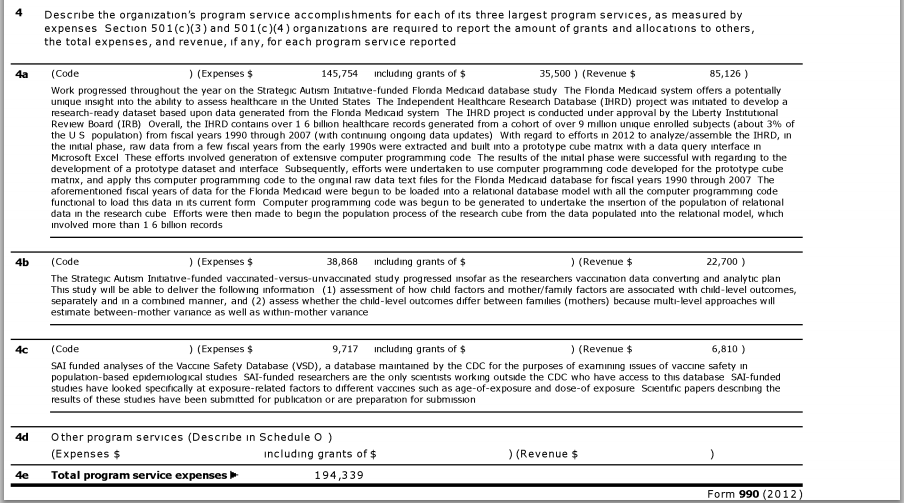
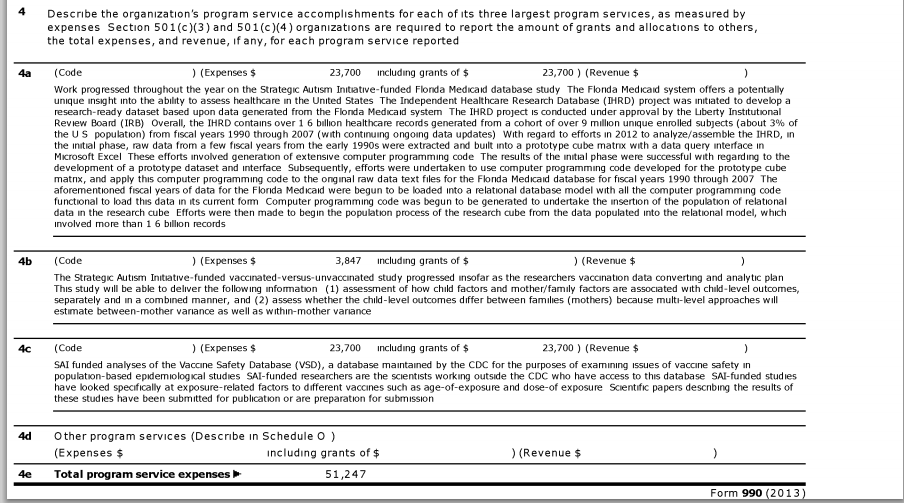
Below are the “program service accomplishments” for the SAI in 2012 and 2013.  Program services are the heart of what a charity is doing.  Well, a standard charity.  That said, ignore the money amounts listed and tell me if you can see any difference in the text.  It looks to me like they copy and pasted the accomplishments from 2012 into 2013.  If I wrote the same accomplishments one year to the next, my management would likely let me go for accomplishing nothing in a year.

SAI 2012 program services SAI 2013 program services

This tax form–the most recent one available–is from 2013.  We will have to wait for the 2014 form but if this trend continued, the SAI is either failing or has failed as an organization.

By Matt Carey

Was autism ever a first advocacy priority for those promoting the idea that vaccines cause autism?

2 Mar

Years back the evidence was rolling in debunking the hypotheses that the MMR and/or thimerosal in vaccines causes autism. At that time I naively wrote some colleagues in online writer’s community about how perhaps the groups that had been advocating about autism being a vaccine-induced epidemic would now become actual autism advocacy groups. They were at a fork in the road: become autism organizations or focus solely on vaccines. But acting like they were doing both was no longer going to work. One writer responded in a way that has stuck with me as he has been shown to be dead on right. Dr. David Gorski (who writes at Science Based Medicine among other places) was the colleague and I he said essentially: it has always been about the vaccines for them and it always will.

Years later it’s obvious: Dr. Gorski was correct. I was wrong. And we are seeing good examples of that now in this measles outbreak as groups like Safeminds and, of course, the Age of Autism blog chime in with articles downplaying the dangers of measles. A prime example recently came on AoA from Mark Blaxill. Mr. Blaxill is largely responsible for the thimerosal scare of the past decade. He wrote a paper (published in the non peer reviewed Medical Hypotheses) Thimerosal and autism? A plausible hypothesis that should not be dismissed. It was junk when it was published, it’s junk now.

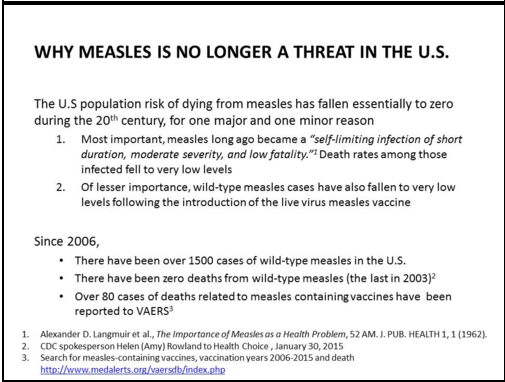
His recent article on AoA is “Measles Hysteria — The Truth About a Non-Epidemic in Eight Simple Slides”. It’s junk and one could spend an article debunking each point. But Let’s take a more focused look. He has a slide “Why Measles is No Longer a Threat in the U.S.” (click to enlarge)

M Blaxill misinfo 1

So, it was supposedly 1500 infections ago that someone in the U.S. died of measles. Only 1 in 1500 or so and so it’s not a big deal. Mr. Blaxill even called (or got someone from his organization to call) the CDC for a statement. Who knows what was asked, what was said. Maybe the CDC spokesperson made a mistake. You see, Dr. Vincent Iannelli at Pediatrics.About.Com actually tabulated measles deaths in the U.S. in recent years. Even with a low infection rate, people die of measles and have died in the U.S.. After presenting the data for each year he summarizes:

So that’s 10 measles deaths since 2000 and at least 7 measles deaths since 2005.

Why do people say that there have been no measles deaths in the United States in the past 10 years? Whether they are misinformed or intentionally trying to misinform people, they are wrong.

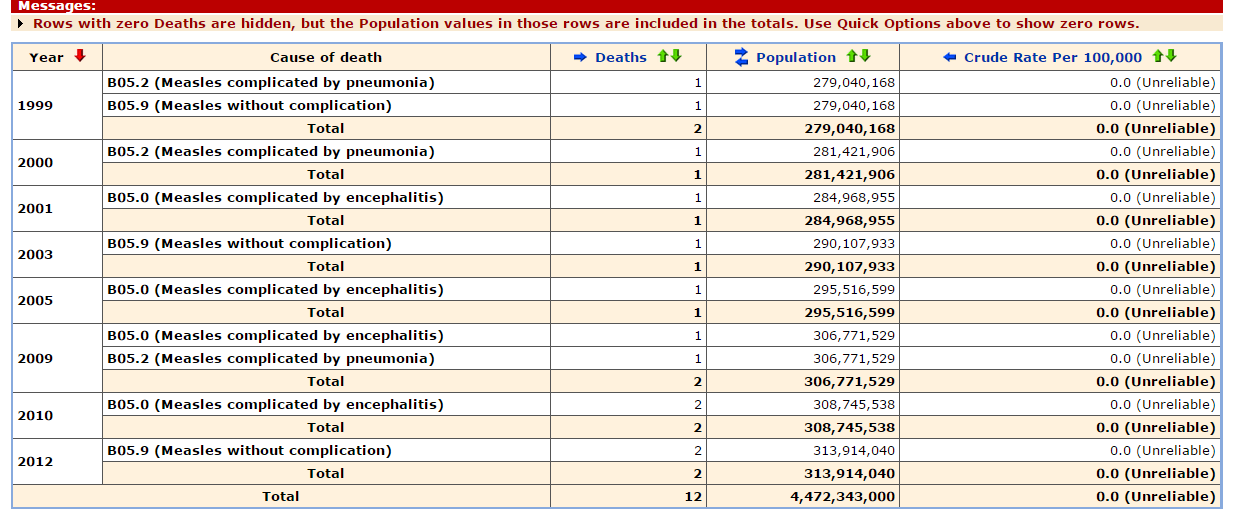
One can confirm this on the CDC Wonder website. Here’s a screenshot.

This isn’t about proving Mark Blaxill wrong on some point. Because in the end it doesn’t matter if it’s one death or ten deaths, it’s too many. But I suspect 1 death or 10 deaths wouldn’t change Mr. Blaxill’s assertion that measles is a minor deasease.

\Those 10 measles deaths Dr. Iannelli mentions are deaths that occur during the infection, usually from complications like pneumonia or encephalitis. But the thing about measles is that it can kill years later. There’s a condition called SSPE, Subacute Sclerosing Panencephalitis. You see, for some people, the measles virus enters the brain and stays there. And slowly kills.

From Dr. Iannelli:

About 6 to 8 years after having measles, children with SSPE develop progressive neurological symptoms, including memory loss, behavior changes, uncontrollable movements, and even seizures. As symptoms progress, they may become blind, develop stiff muscles, become unable to walk, and eventually deteriorate to a persistent vegetative state.

Children with SSPE usually die within 1 to 3 years of first developing symptoms

and

That’s 32 SSPE deaths since 2000 and at least 19 SSPE deaths since 2005. Why so many? Many of them can likely be attributed to the large number of cases associated with measles outbreaks from 1989 to 1991.

There is no cure for measles infection. There is no cure for SSPE. One can read more about SSPE at the link given above or at a recent article at Science Based Medicine: SSPE: A Deadly and Not-That-Rare Complication of Measles.

Mr. Blaxill includes a quote from someone in the 1963 who stated that measles is of “moderate severity” or “low fatality”. Perhaps to someone who lived through the early 20th century when measles was even more deadly, this might seem so. Perhaps. But not now. And how can someone ever use the phrase “self limiting” about a disease that can lead to SSPE? SSPE is only “self limiting” in the death of the patient.

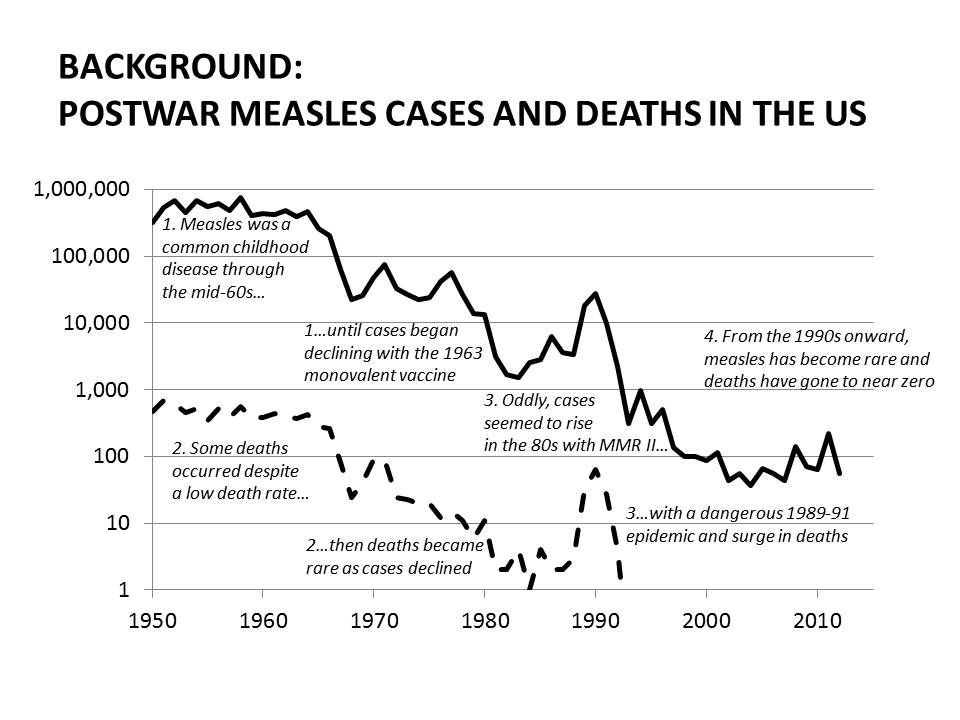
Another of Mr. Blaxill’s slides shows the decline in measles infections and deaths following the introduction of the vaccine. Mr. Blaxill annotated this with his own observations (click to enlarge):

M Blaxill misinfo 2

Here’s the thing that pops out of that graph: the death rate has remained constant at about 1 in 1,000 since at least 1950. Take a look at any datapoint in the deaths and go up a factor of 1,000 and there’s the infection rate. And that doesn’t account for SSPE deaths years later.

Over the years I’ve found that Mr. Blaxill often takes an unreasonable and unfounded stance on issues. But since when is a death rate of 1 in 1,000 low enough to state “Why Measles is No Longer a Threat in the U.S.”?

For comparison, Mr. Blaxill informs us that there have been 80 deaths attributed to measles containing vaccines reported to VAERS (the Vaccine Adverse Event Reporting System) in the past 10 years. He ignores, as most people do who use VAERS in this manner, to include the disclaimer one must acknowledge in order to access VAERS data, which concludes that VAERS data do not imply causality. But let’s for the moment assume that every report to VAERS is causal. 80 deaths. There are about 4 million babies born in the U.S. each year. About 90% get the MMR vaccine. Twice. Over 10 years. That’s nearly 80 million doses of MMR vaccine administered. So, even if we take each report to VAERS as causal, that would be 1 death in 1 million doses. 1 death in 500,000 infants. This is a huge over estimate given the assumptions, but let’s do the difficult: compare these numbers. To Mr. Blaxill 1 in 500,000 is too many, but 1 in 1,500 is “low fatality”.

Even using the Mr. Blaxill’s flawed assumptions, his logic doesn’t make any sense.

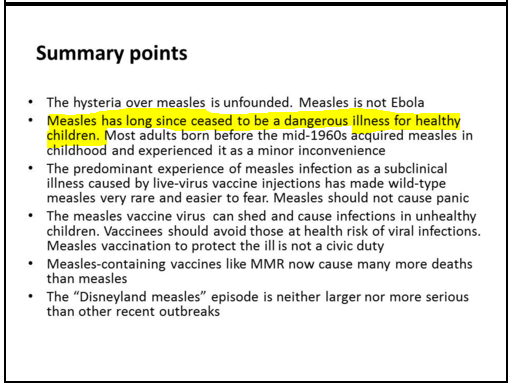
Let’s take a look at Mr. Blaxill’s concluding slide so I can bring this back to how it shows that he has abandoned not just logic but also the autism community. I’ve highlighted one sentence that is particularly important. (click to enlarge):
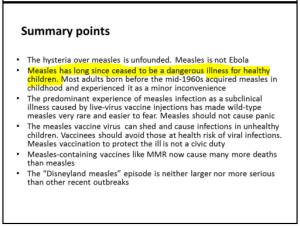
M Blaxill misinfo 3

Measles has ceased to be a dangerous illness? Seriously? First, the idea that we can accept 1 out of 1000 people dying due to measles is just astonishingly bad advocacy. For that point alone we in the autism community need to distance ourselves from Mr. Blaxill and people like him. These irresponsible actions are not the actions of the autism community.

That said, let’s consider this key phrase: “in healthy children”. If you will, try to recall back in the day when Mr. Blaxill presented himself as an autism advocate. Actually, we don’t even have to go back that far, only recently he was telling a congressional hearing:

In New Jersey, 1 in 29 boys born in 2000 were diagnosed autistic.

What’s going on? Why are so many American children sick?

The message he had for many years was that autistic children are sick. Not healthy. His former organization (Safeminds) would be quick to point out a number of conditions that are more common in autistics than in the general population. Since even by his own definition autistics are not “healthy”, why should we let measles return in force to the U.S.? Of course it is Mr. Blaxill’s failed hypothesis that vaccines are making children “sick”. But let’s consider this very real point: the developmentally disabled are more likely to become sickened by infectious diseases and they are more likely to die (Why vaccination uptake matters to the autism community).

And that’s ignoring the fact that a large fraction of autistics are also epileptic. And a huge trigger for seizures is infectious disease and the prolonged fever that comes with it. Perhaps Mr. Blaxill is unaware of the term status epilepticus, the situation where someone gets into a state of constant seizures. And, yes, this can be brought on by infection.

Or perhaps Mr. Blaxill has forgotten the emphasis his community placed on mitochondrial disease and autism just a few short years ago.

From a U.C. San Diego Metabolic Deseaese Center website, the paragraph: What is Mitochondrial Disease?

If a child is stricken with a catastrophic disease affecting three or more organ systems, or if a child has been afflicted with a relapsing disease that affects two or more organ systems and leads to slow but measurable deterioration, he or she may have a mitochondrial disease. At times, mitochondrial diseases can cause isolated symptoms. These may include unexplained seizures, low blood counts, dystonia (abnormal muscle tone or spasms), blindness, deafness, dementia, ataxia (stumbling or tremors), cerebral palsy, heart failure, or progressive muscle weakness. More often, however, several organ systems are affected in sequence, one faltering or failing after another. Good periods are frequently punctuated by abrupt deteriorations that are caused by simple infections. For children with mitochondrial disease these infections can be life threatening, and leave them with deficits that cannot be recovered.

Emphasis added. Some fraction of our population does have mitochondrial disease. Allowing diseases like measles back would put this community (as well as those with mitochondrial disease without autism) at huge risk.

I’d like to say that Mr. Blaxill, like many in the “autism is a vaccine-induced epidemic” camp, has lost his way. A very valid question is whether Mr. Blaxill and his colleagues were ever on the path of autism advocacy. Was it always, as Dr. Gorski opined, about the vaccines?

While I’ve entitled this article “Was autism ever a first advocacy priority for those promoting the idea that vaccines cause autism?”, in the end motivations are secondary. Mr. Blaxill’s actions are and have been irresponsible. They are an example of the actions of a group of faux autism advocates that have a history of irresponsible actions. Not just to public health but to the autism communities.


By Matt Carey