Archive | Autism Epidemic RSS feed for this section

Guest Blogger on CDDS

31 Jan

Manipulating CDDS - guest blogger Dr Nick Riviera

Hi Everybody!

Wow! OK, so here I am again – I’m Dr. Nick Riviera, and I will perform any major operation for just 129.95!

So today I’m supposed to tell you about CDDS data and how, just like VAERS, you can use it to say anything really. And hey – if there’s any Autism Omnibus lawyers reading – You don’t have to make up stories here. Save that for court.

Now there’s this guy called David Kirby who once said that CDDS was the gold standard of autism epidemiology (long word friends – just means numbers) but it seems that now, after the numbers started to disagree with his hypothesis (long word friends – it just means any old thing you want to make up) that they’re suddenly not so important. That makes perfect sense to Dr Nick friends – who wants to be caught right? In fact, Mr Kirby – did you go to Hollywood Upstairs Medical College too?

So, I wanna show you some more number examinations from CDDS – see what you think of them friends.

OK, so, the autism epidemic is thought to be demonstrated by the ever-increasing number of entries to the 3 – 5 age group (side note: the sci-guys only had 1.9% of mercury containing vaccines available by Feb 2002 and the 3 – 5 year olds are still increasing….even Dr. Nick can make the obvious conclusion from _that_ fact friends).

Those people who think that there _isn’t_ an epidemic say that the increase is just due to diagnosis catching up to the actual rate.

Those who say there _is_ an epidemic (man this is tiring) say, if that’s true where are all the older autistics? Some say there can’t be any autistic people over 75 as Eli Lilly invented autism in 1931.

Dr. Nick presents his first graph – ta da (click for bigger version)!

CDDS numbers for 62 - 99 year olds

This is 62 – 99 year old autistic people in CDDS from 1992 – 2005. First thing that seems pretty clear, even to Dr Nick, is that having a reporting category that goes up to 99 years old takes care of the claim that autism was invented by Eli Lilly in 1931.

But _man_ look at that graph – look at that rate climb! Just for your information friends, what you’re looking at there in the 62 – 99 category is a 16 times increase. Woah.

OK! Next graph friends – (click for bigger again, you get the drill right?)

CDDS numbers for 52 - 61 year olds

So this one shows 52 – 61 year olds in CDDS. Another pretty impressive climb there friends! This one shows a 15 times increase. Phew!

So what about the 3 – 5 year old category? They key category? Well this is where Dr Nick gets a bit confused friends. Here’s the graphs (clicky!!)

CDDS numbers for 03 - 05 year olds

So this one shows a climb too but – I dunno – what about the rate of increase? Well, unlike the 62 – 99 year olds which showed a 16 times increase (the biggest of all categories) and unlike the 52 – 61 year olds which showed a 15 times increase, the 3 – 5 year olds showed a 12 times increase.

So from what Dr Nick can _tell_ – it would seem that the age category that’s made the biggest gains since 1992 would be the 62 – 99 year old group.

Damn, Dr Nick just had a delivery of sun cream to put into medicinal looking bottles as well.

David Kirby/Arthur Allen Debate Part III

24 Jan

“It’s understood that Hollywood sells Californication”
~ Red Hot Chilli Peppers

In this section I want to look at Kirby’s presentation regarding what he terms as the first of seven skeptical rebuttals to the autism/thiomersal hypothesis. He says that skeptics say:

Hmm. Not really. I think most people are agreed that autism is a ‘mix’ of genes and environment. However, this is a popular and recurring strawman from the anti-thiomersal hypothesisers – that thiomersal and environment are interchangeable. They’re not. Maybe ice cream is the environmental trigger for autism. What science _is_ pretty sure about however, is that thiomersal (i.e. one _possible_ environmental ‘trigger’) is _not_ in the frame. So straight away we can see the Kirby is proceeding from a misleading position. If his argument is so strong, why does he feel the need to do this I wonder?

However, the point Kirby is (misleadingly) making is to try and push the idea of there having been an epidemic. Lets see how he does this.

(A lot of the next section has been amply covered by Mike – I won’t repeat his work)

NB: The years Kirby refers to here are between 1988 – 1992.

Guess what else happened around that time?

In 1987, one year before the time period Kirby is talking about, the DSM (III-R) was published. This was a revision to the previously published (1980) DSM (III). Here’s what the DSM (III) criteria was for what it called ‘Diagnostic criteria for Infantile Autism’- this is in full by the way:

A. Onset before 30 months of age

B. Pervasive lack of responsiveness to other people (autism)

C. Gross deficits in language development

D. If speech is present, peculiar speech patterns such as immediate and delayed echolalia, metaphorical language, pronominal reversal.

E. Bizarre responses to various aspects of the environment, e.g., resistance to change, peculiar interest in or attachments to animate or inanimate objects.

F. Absence of delusions, hallucinations, loosening of associations, and incoherence as in Schizophrenia.

So that is the sole and only reference for autism in 1980. Next up, this is the 1987 revision – DSM (III-R):

Diagnostic Criteria for Autistic Disorder

At least eight of the following sixteen items are present, these to include at least two items from A, one from B, and one from C.

A. Qualitative impairment in reciprocal social interaction (the examples within parentheses are arranged so that those first listed are more likely to apply to younger or more disabled, and the later ones, to older or less disabled) as manifested by the following:

1.Marked lack of awareness of the existence or feelings of others (for example, treats a person as if that person were a piece of furniture; does not notice another person’s distress; apparently has no concept of the need of others for privacy);

2. No or abnormal seeking of comfort at times of distress (for example, does not come for comfort even when ill, hurt, or tired; seeks comfort in a stereotyped way, for example, says “cheese, cheese, cheese” whenever hurt);

3. No or impaired imitation (for example, does not wave bye-bye; does not copy parent’s domestic activities; mechanical imitation of others’ actions out of context);

4. No or abnormal social play (for example, does not actively participate in simple games; refers solitary play activities; involves other children in play only as mechanical aids); and

5. Gross impairment in ability to make peer friendships (for example, no interest in making peer friendships despite interest in making fiends, demonstrates lack of understanding of conventions of social interaction, for example, reads phone book to uninterested peer.

B. Qualitative impairment in verbal and nonverbal communication and in imaginative activity, (the numbered items are arranged so that those first listed are more likely to apply to younger or more disabled, and the later ones, to older or less disabled) as manifested by the following:

1. No mode of communication, such as: communicative babbling, facial expression, gesture, mime, or spoken language;

2. Markedly abnormal nonverbal communication, as in the use of eye-to-eye gaze, facial expression, body posture, or gestures to initiate or modulate social interaction (for example, does not anticipate being held, stiffens when held, does not look at the person or smile when making a social approach, does not greet parents or visitors, has a fixed stare in social situations);

3. Absence of imaginative activity, such as play-acting of adult roles, fantasy character or animals; lack of interest in stories about imaginary events;

4. Marked abnormalities in the production of speech, including volume, pitch, stress, rate, rhythm, and intonation (for example, monotonous tone, question-like melody, or high pitch);

5. Marked abnormalities in the form or content of speech, including stereotyped and repetitive use of speech (for example, immediate echolalia or mechanical repetition of a television commercial); use of “you” when “I” is meant (for example, using “You want cookie?” to mean “I want a cookie”); idiosyncratic use of words or phrases (for example, “Go on green riding” to mean “I want to go on the swing”); or frequent irrelevant remarks (for example, starts talking about train schedules during a conversation about ports); and

6. Marked impairment in the ability to initiate or sustain a conversation with others, despite adequate speech (for example, indulging in lengthy monologues on one subject regardless of interjections from others);

C. Markedly restricted repertoire of activities and interests as manifested by the following:

1. Stereotyped body movements (for example, hand flicking or twisting, spinning, head-banging, complex whole-body movements);

2. Persistent preoccupation with parts of objects (for example, sniffing or smelling objects, repetitive feeling of texture of materials, spinning wheels of toy cars) or attachment to unusual objects (for example, insists on carrying around a piece of string);

3. Marked distress over changes in trivial aspects of environment (for example, when a vase is moved from usual position);

4. Unreasonable insistence on following routines in precise detail (for example, insisting that exactly the same route always be followed when shopping);

5. Markedly restricted range of interests and a preoccupation with one narrow interest, e.g., interested only in lining up objects, in amassing facts about meteorology, or in pretending to be a fantasy character.

D. Onset during infancy or early childhood

Specify if childhood onset (after 36 months of age)

Slight difference huh? Of key importance – in 1980 we only had ‘infantile autism’. In 1987, we had ‘autistic disorder’.

The DSM (III-R) is a quantum leap in diagnostic precision (far from perfect of course and as we all know the DSM (IV) came along in 1994 and the DSM (IV-R) came along in 2000) but surely it is blindingly obvious what a massively more accurate and precise set of criteria must mean – better recognition. More diagnosis.

Now Kirby says that this increase ties in to the ‘spike in mercury in vaccines’ over the same time period. Could be. But lets _also_ not forget that – as Kirby says in this debate – you need clinical science to support a clinical idea such as thiomersal causing autism.

Nine years now and there is _not one_ paper that even suggests that the symptoms of autism can be attributed to thiomersal (or MMR, or both together come to that). Nine years. In terms of science this hypothesis has four papers that might be considered of publishable quality. One shows that if you take a strain of mice known for aggressiveness and severely overdose them with thiomersal then they get more aggressive. Another shows that if you take a control group high in mercury levels and compare them with new born babies then the babies will look like poor excretors of mercury. The third shows that ethyl mercury and methyl mercury cannot be used to represent each other. The last one shows that thimerosal might cause methionine synthase dysfunction (MSD) – a condition that bears no resemblance to autism.

So here we are with the thiomersal hypothesis resting squarely and solely on epidemiology. Once upon a time, Kirby said CDDS epidemiology was ‘the gold standard’ – now he says its not enough. However, make no mistake. Epidemiology is all this hypothesis has.

So what is the state of this epidemiology? Is it of good quality? Well, no. As Mike has shown (see link above) Kirby’s presentation numbers are awful. As I have shown, his opinion of CDDS fluctuates depending on whether the numbers work for him or not and as Jospeh has shown, his new source is equally as badly reported on as his initial take on CDDS was.

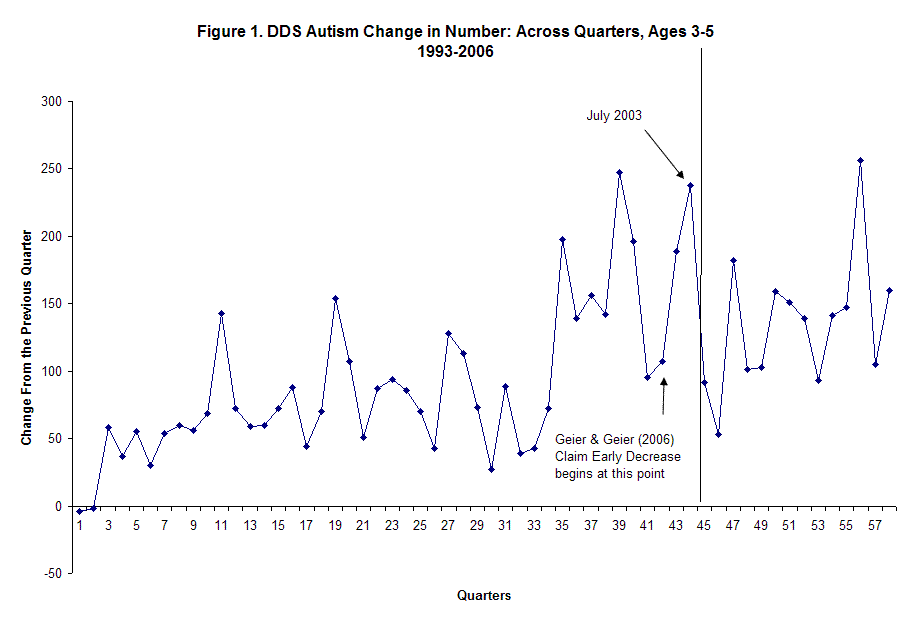
Another example of the epidemiology not only not working for Kirby but being actively manipulated is this:

Have a close look at that graph. Remember in the previous slide Kirby said that the biggest increase in thiomersal was between 1988 and 1992. Take a close look at the dates in _this_ slide. They start in 1993. That’s pretty misleading Mr Kirby. Tut-tut-tut.

Also in this slide I want you to notice that according to this data that Kirby is using, the numbers are continuing to climb in 2001, 2002 and 2003. However, we know from a recently discovered CDC set of meeting minutes that according to a survey, in September 2001, only 5.6%1 of _all vaccines_ contained thiomersal. By Feb 2002, only 1.9% of _all vaccines_ contained thiomersal.

So apparently, Mr Kirby is happy to use data from two sources that shows an increasing amount of autism. CDDS and IDEA data. Both show climbing autism against a backdrop of miniscule amounts of mercury in the general population.

Danger, Will Robinson. Does not compute.

(More Californication to come soon….stay tuned…)

Kevin Barry and dumbing down science

20 Jan

Kevin Barry’s Ethics

Kevin Barry used to be deputy (or something) to Brad Handley’s Sherriff at Generation Rescue. He announced to the EoH Yahoo Group on 21st Nov 2006 that:

As of December 1st, I begin work as a consultant to Autism Speaks. In order to avoid any conflict of interest, I am resigning as President of Generation Rescue.

What a decent guy – wanting to avoid any conflict of interest.

End of story? Of course not. Never is with these goons.

Yesterday, it was noted that one Heidi Roger had made a post to the EoH group exhorting members to flood the Autism Speaks website who had asked for opinions on ‘Unstrange Minds‘ (which you may recall is skeptical regarding a vaccine initiated epidemic).

Except, Heidi had forgotten to strip out the message she had got from the person who had sent her this news. Good old conflict-of-interest avoider, Kevin Barry:

Hi Heidi, Confidential. I am not allowed to comment on the Boards. Would you post this to the EOH board as if you can upon it yourself? It is a page where people can comment on the epidemic “debate”. It would not hurt if Autism Speaks heard more feedback from EOH parents. Thanks, Kevin

Oops (screenshot attached).

So, here we have the moral and ethical finery of Generation Rescue and militia members on show. It seems that Barry is keen only not to get caught. I hope he gets fired. He should be.

Dumbing Down Science

Some fascinating legal developments in the Omnibus Autism Proceedings (OAP). Firstly a quick recap:

A bunch of people decided thiomersal caused their kids autism and decided to sue various people. By doing this, they stepped out of the opportunity to go down the Vaccine Program route which would allow them to contest their beliefs in a very much less stringent legal environment. However, the vaccine makers would suffer no liability and the plaintiffs would gain only a set amount (I think US$100,000) should they win their case.

They eschewed this process and decided they wanted to go down the full, legal shenanigans route. I’ve read invective from various blowhards who talk about taking the vaccine makers to account publicly and making sure that they are vindicated in a proper court of law (and of course the unspoken promise of megabucks).

OK, so fast forward a couple of years and we come to the RhoGAM/autism/thiomersal case in which the vaccine causation hypothesis was utterly demolished under the (totally appropriate) legal principle of Daubert. The take home quote from that case was:

This Court must find more than the “hypothesis and speculation,” engaged in [by Dr. Geier] in this instance….

The science was so bad, the case never even made it to trial. It was dismissed as a total waste of time.

Now you can bet the legal team for the OAP petitioners (numbering some 4,700 claims by now) were watching this closely and on Jan 9th this year, a new document was submitted which detailed how the Petitioners thought the trial should be conducted.

First of all, they want to use a ‘test case’ i.e. a handpicked petitioner from the 4,700 who would:

…serve as a representative case for a significant number of children who claim that a combination of thimerosal exposure and the MMR vaccine caused injury.

and then followed by cases solely addressing thiomersal and cases solely addressing MMR.

Okaaay. Also in this document was a reminder in this document that:

they needed ‘more time for the science to crystallize.’

Heh – you can say that again. Has the ‘crystallisation’ occurred? Maybe the overall intent of this document will tell us.

On page six of the document I have linked to above, the petitioners start to argue that the same legal rules that govern the Vaccine Program (described above) should be used to ‘judge’ the OAP proceedings. They repeat the arguments that led to the setting up of the Vaccine Program originally touching on how vaccines were a national health priority and that supply should not be endangered. The purpose of this legislation therefore was to try and limit the number of civil cases against vaccine manufacturers so that the health of the nations children was never compromised (see pages 6 – 7) .

In order to do this, it was accepted that the burden of proof would be substantially less. It was also noted that from time to time, people who’s kids weren’t actually damaged by vaccines would be awarded compensation. As the petitioners define the statute it reads:

As enacted the vaccinate act has a unique evidentiary standard, a unique standard, one that facilitates resolution of cases in the Vaccine Program and discourages the diversion of cases to the civil arena. It does not require a petitioner to prove his or her case with scientific certainty. It does not require ‘truth’. It does not require a petitioner to show ’cause in fact’

So why is all this lead up to the vaccine program necessary? Because the petitioners – who eschewed their option to go down the vaccine program option if you recall – now want their cases to be tried under these same ‘relaxed’ standards. They want their _civil legal cases_ to be tried under conditions that do not require the truth.

Wow. Just wow. The bare faced, cowardly effrontery of it defies belief.

Let us recall that at the start of these proceedings, plaintiffs stated they required time for their science to crystallize. Now they want to their omnibus case to be tried under a standard that doesn’t require scientific certainty or indeed, truth. That tells its own story about how good the state of the ‘science’ is underpinning the OAP case.

But what really galls me is that here are these people who had their opportunity to go down the route of the vaccine program and follow the same set of rules as described above and refused. They wanted to make a big song and dance about it and parade their science. Now that its apparent that their science is crap, they want their cases to be tried under the same legalities as the vaccine program cases are. Talk about wanting your cake and eating it.

If it was up to me, I’d tell them to go away and accept the consequences of their actions.

UPDATE: Please scroll down and read Anne’s comments on the _actual_ status of the OAP. It seems a whole lot of people who are part of the Omnibus are badly mistaken as to the nature of it and I’ve duplicated their misunderstanding.

Stat-tastic!

12 Jan

if the total number of 3-5 year olds in the California DDS system has not declined by 2007, that would deal a severe blow to the autism-thimerosal hypothesis…..total cases among 3-5 year olds, not changes in the rate of increase is the right measure.

David Kirby, Nov 2005.

Time’s up Mr Kirby. The last quarter numbers for 2006 are now in.

Jonathon even took the trouble to highlight on his graph where the Geier’s made asses of themselves declaring an early decrease in their 2006 paper. As can be seen from Jon’s graph (and even more clearly on Dad of Cameron’s) – _the numbers are still going up_.

A severe blow to the autism-thimerosal hypothesis has been dealt.

Jospeph tells us what to expect in the coming months in the way of excuses from Kirby. Something I also discussed in April 2006. In short, the militia will argue that there’s still TCV’s sitting around waiting to be used up (rubbish, but even if true, would be a very, very minimal amount, click the link to my previous post to see Sallie Bernard of SafeMinds struggling to locate TCV’s in June 2001), they will also argue that the flu shot supports the ‘epidemic’ (again, rubbish. Are we really comparing mandatory TCV administration culminating in 187 ug Hg with optional flu vaccines, administered in one season of the year, culminating in 25 ug Hg?). They will also argue that RhoGAM was a contributing factor (but as we all kow, that one’s got no legs.). They may also try and argue that some other vaccine/environmental ‘thing’ comes into play. This takes us right back to square one and is a virtual admission that thiomersal doesn’t do a goddamn thing except act as a preservative.

In fact, that process is already under way from the Big Cheese himself. In a post on Jan 9th 2007 to his munchkins on the EoH yahoo group, Kirby said:

I believe this puzzle will be solved by looking at TOTAL “environmental” toxic burden from ALL sources, including other chemicals, and, of course, thimerosal in vaccines,

Oh, of _course_ ;o)

This prompted a bit of controversy: H Coleman replied:

Please stop it- you’re all giving me a headache.

And Robert Krakow replied:

I disagree somewhat with the emphasis of your message. I don’t know anyone who focuses on the vaccine issue who believes that other environmental exposure is unimportant. To suggest so underestimates the intelligence of most of the members of this list.

‘Most’ obviously not including John Best, Rescue Angel, who said on that same group:

I view any talk of mercury in the air as a problem as utter nonsense. It’s just propaganda to deflect blame from pharma and I don’t buy one word of it.

See Robert? There’s more than a few idiots who need things spelled out to them on EoH.

Anyway, the impact of Kirby’s statement has not been lost amongst the rank and file militia members. They know he’s trying to move on. Memo to Mr Kirby: it would be quicker and more painless to just fess up: _A severe blow to the autism-thimerosal hypothesis has been dealt._

David Kirby – what have you done?

20 Dec

I want to follow up somewhat on Joseph’s techncial takedown of David Kirby’s recent act of intellectual suicide. On the Huffington Post he wrote a bewildering post called ‘Bad News for Mercury Defenders‘ which discussed how Dan Olmsted’s recent sleuth-like skills led him to talking about a report that undermined studies conducted using VSD data.

Let us begin:

Next June, when the Vaccine Trial of the Century gets underway in Federal Claims Court, government lawyers will defend the direct injection of toxic mercury into infant children by repeating the well-worn mantra that “five large population studies” in Europe and the US have completely exonerated the vaccine preservative thimerosal as a possible cause of autism.

My, my – vaccine trial of the century eh? I’ll have to remember that one when the verdict comes back. This is crap. No lawyer will have to defend the direct injection of mercury into infant children. What they will have to do is counter the accusation that thiomersal in vaccines caused autism. Kirby (as usual) presents a highly distorted view to his adoring fans. The truth is that as in all legal cases, the burden of proof lies on those making the accusation. The accusation is not that mercury is dangerous. the accusation is that it caused autism.

Again:

The VSD study is constantly held up by public health officials as EXHIBIT A in the defense of injecting mercury into little kids.

No, its not. If its held up as anything, its held up as a study that refutes the link between thiomersal in vaccines and autism. Seriously – isn’t this man a journalist? What’s difficult to grasp about this concept?

Kirby goes on to diss the remaining studies and surmises this section of his blog thusly:

With so many holes shot through their “five large studies” defense, the government lawyers will be left to argue that autism is purely genetic, that there is no environmental component, and that the rates of illness have not “really” gone up. We are simply better at recognizing and diagnosing the disorder, that’s all.

Well, if that is the case, the mercury-defense lawyers should have no problem proving it. All they need do is produce irrefutable evidence that 1-in-166 American adults of ALL ages (and 1-in-104 men) fall somewhere within the autism spectrum disorder, at the same rate as kids. But they can’t, and they won’t.

I can only surmise that Kirby is a big fan of the Wizard of Oz and had strawmen on his mind whilst writing this. Yet _again_ he fails to grasp the fact that what this trial is about is simply if thiomersal caused autism. All the vaccine makers have to do is refute the ‘science’ from the other side. And lets be honest, after the RhoGAM smackdown that’s going to be about as difficult as falling off a log. It’ll be surprising if any of the ‘scientific’ evidence ever gets past a Daubert hearing as it failed to do in the RhoGAM case.

And whilst we’re at it, no one has said anything about arguing autism is purely genetic. Why in Gods name would _that_ be required? Autism may well have an environmental component – I know I think it does – but unless Kirby is trying to say that the word ‘environment’ is interchangable with the word ‘vaccine’ then this is also just…meaningless.

And lets get back to the clinical science for a moment:

Instead, one must also consider biological studies (animal, clinical, test tube) when assessing causation. And that’s where the plaintiffs will come to court armed with reams of published evidence – produced at Harvard, Columbia, Davis, etc., and printed in prestigious journals – to suggest a highly plausible biological mechanism that would link a known neurotoxin with a neuro-developmental disorder

Has no one broken the news of the thiomersal/RHOGam/autism case to Kirby? _All_ the ‘science’ that Kirby is talking about here was brought to that trial (follow the link and you can download the entire Daubert findings and read the studies presented for yourself) and was cumulatively dismissed. Here’s what the presiding Judge stated:

However, upon being subjected to extensive cross examination, much of Dr. Geier’s analysis, based upon his collective review of a motley assortment of diverse literature, proved, in the Court’s view, to be overstated……[Dr. Geier] could not point to a single study that conclusively determined that any amount of mercury could cause the specific neurological disorder of autism.

So, that’s exactly what effect eliminating VSD based studies will have on the respondents case. None whatsoever.

But what about the plaintiffs? They have to prove beyond reasonable doubt that thiomersal in vaccines caused autism. And as Kirby helpfully points out:

….They wanted to know if the US database, the Vaccine Safety Datalink (VSD), could be used to compare autism rates in kids before, during, and after the gradual removal of thimerosal, which began in roughly 2000.

Unfortunately, the answer was a resounding “not really.” A laundry list of “weaknesses” and “limitations” associated with the database would render such a comparative analysis “uninformative and potentially misleading,” the panel said, (though it did suggest some excellent ways to re-approach the data going into the future).

Some weaknesses had to do with changes in medical practices over time. But many of the limitations sprang directly from the poorly designed VSD study itself….

So what studies could be killed off by this examination. Well, there are two actually. The first one is Verstraeten et al (2000) which is the one we’ve been discussing so far and Kirby’s been bashing. The other one is Geier and Geier (2005) which they plagiarised from Verstraeten et al (2000). Oops.

Why does the nuking of Geier matter whilst the nuking of Verstraeten does not? Burden of proof, which lies with the prosecution. The Geier paper will be used to help _establish_ causation which is vital, not prove it didn’t happen, which is not called for. The Geier paper (which was crap anyway, lets face it) has now been neatly and effectively taken out by Olmsted and Kirby. Don’t Americans refer to that as friendly fire? By removing Geier 2005 from the playing field, the prosecution are now left with clinical science which has already failed one Daubert hearing (I believe the legal term is ‘setting a precedent’) and any epidemiological data they can scrape together from VAERS and CDDS.

As far as VAERS go, I’d like to remind people of my own experimentation with VAERS. And as far as CDDS data goes, lets remind ourselves one more time what Kirby has said about CDDS data:

“if the total number of 3-5 year olds in the California DDS system has not declined by 2007, that would deal a severe blow to the autism-thimerosal hypothesis.”….total cases among 3-5 year olds, not changes in the rate of increase is the right measure.

And here, helpfully provided by Dad of Cameron are the ever-growing numbers in that cohort.

There’s also the small matter of The Simpsonwood Conspiracy. To quote Joseph:

….it completely undermines the foundations of the Simpsonwood conspiracy theory. You see, Verstraeten et al. were supposed to have found significant associations between thimerosal and neurodevelopmental outcomes beyond those that were reported in 2003. But now Kirby is endorsing a NIH report which says that ecological studies on the VSD database, specifically those done by Verstraeten et al., are likely flawed.

In other words, without the VSD data being good, the Simpsonwood Conspiracy is a non-starter.

Amazing.

Unstrange Minds

17 Dec

Unstrange Minds is a book from George Washington University Professor of Anthropology – and Dad to Isabel, his autistic daughter, Roy Richard Grinker about autism, its history as a diagnosis and how it exists as a cultural phenomenon in other (non-Westernised) countries.

Epidemic

The first thing that Unstrange Minds does is quietly and comprehensively dismantle the idea of there having been an autism epidemic in the sense of that concept relating to a sudden, massive increase.

The shift in how we view autism….is part of a broader set of shifts taking place in society.
Page 4

Grinker goes on to take the reader through the often fascinating history of autism as a diagnostic label (Kanner is pronounced ‘connor’ – who knew??) to illustrate his theory of the apparent rise in autism prevalence being intrinsically linked to these cultural changes such as the growth in child psychology as an area of practice, the decline of psychoanalysis, the rise of advocacy organisations, greater public awareness to educational needs and change in pubic policies:

Doctors now have a more heightened awareness of autism and are diagnosing it with more frequency, and public schools….which first started using the category of autism during the 1991 – 1992 school year are reporting it more often….Epidemiologists are also counting it better.
Page 4

Grinker then goes on to make a similar point to the one that Paul Shattuck was making earlier this year:

Still, these rates may not be proof of an epidemic. Why? Because the old rates were either inaccurate….or based on different definitions of autism than the ones we use now.
Page 4 – 5

The point about different definitions of autism contributing to the ‘rise’ in autism prevalence is frequently dismissed by the mercury militia et al but Grinker has collated the ever changing face of the DSM on the books accompanying website and it graphically demonstrates his point.

Autism Abroad

Unstrange Minds is one of the first academically rigorous books (that I know of) that takes a look at how autism is perceived outside the Western experience. Grinker looks in depth at Korea and India. The picture is not always pretty but it does provide a striking example of how the old adage about ‘out of sight, out of mind’ can contribute to a cultural perception that autism is something unmissable. Those who believe in an epidemic of autism often state that it is ‘impossible’ to miss people with autism. They should consider Grinker’s experience in Korea:

When [Milal School] was being built in the mid-1990s, some of the wealthy residents of this quiet neighborhood south of the Kangnam River in Seoul picketed the site, cut the school’s phone lines, physically assaulted school administrators, and filed a lawsuit to halt construction, because they believed that the presence in the neighborhood of children with disabilities would lower property values. The school opened in 1997, but only with a compromise. It was required to alter its architecture so that the children were completely hidden from public view. Some of the protestors were brutally honest. They said they didn’t want their children to see or meet a child with autism.

If we believe this type of situation and deliberate obfuscation of autism has never occurred in the West than we are kidding ourselves. The situation in Korea now, is how we were in the West once upon a time. This theme is explored thoroughly by Grinker. Remove the places names and this could be London of the 1970’s or New York of the 80’s:

In Seoul, a city of eleven million people, the story is different. There is invisibility in numbers. Posed to an adult, the question ‘Do you know any children who don’t speak well?’ usually goes unanswered, partly because people are reluctant to talk about such things for fear of shaming the child’s family. Equally, people with autism are sometimes hidden away, often go untreated and are seldom integrated into community life.
Page 233

Grinker offers an anecdote from his own life with his autistic daughter Isabel that shows how this wish to exclude difference still turns up in Western culture, even today. A camp director phoned the Grinkers with news that Isabel had ‘took her clothes off in the classroom and the mother of another girl is demanding your daughter be removed from the class’. The camp director had not spoken to the teacher and after he had it transpired that Isabel had merely taken her arms out of her sleeves and put them under her shirt because the air conditioning was on high. It was clear that the whole situation had been contrived by the parent of the other child and indeed, when the camp refused to place Isabel in another class, this same mother withdrew her child (pages 273 – 274).

Autism At Home

The sections of the book directly concerning Isabel are my favourite. My role as dad to an autistic girl makes me appreciate the anecdotes and clear stories of love that other dads of autistic girls convey. The Grinkers don’t shy away from the bad side as well as the good side and detail the battles with American educational authorities that echoed our own battles with our LEA (an ongoing battle even today) to even be recognised as needing such services.

Grinker’s anecdotes about his family (like me, his home life is female oriented with a wife and two daughters) are too poignant and contextual to share and quote well but believe me, they are the lifeblood of the book, making the academic discussion real to parents and people who are autistic.

The author Ron Suskind called Unstrange Minds:

…this big-hearted, uplifting, fiercely rigorous book-a genuine gift to readers who believe in the power of truth.

which is exactly right. It is firmly committed to the truth. It is committed to a rigorous examination of how and why we came to think of autism as having ‘an epidemic’ and explaining how cultural beliefs led us to this stance. It is however also brave, kind, hopeful and above all real. Not a dusty anthropological tome in any way, Unstrange Minds is written in engaging style by a writer who clearly finds his subject fascinating and who has a deep cultural as well as deep personal knowledge of how autism exists as a type of existence as well as a diagnostic label.

Its available on pre-order from Amazon.com only. Don’t let that stop you. Pre-order it from the US no matter where you live. The extra air-mail fare is well worth it. I read the whole thing in two weeks worth of train journeys to and from work and very nearly missed my stop more than once due to being utterly absorbed. Buy it. Read it. Enjoy it.

RFK Jr – Hold yourself to account

8 Dec

Last year, RFK Jr published his shlock piece Deadly Immunity.

Its been taken apart more times than a Lego castle (a good list exists on Skeptico’s site) and was so bad that it contained more than five factual corrections, posted after initial publication.

One of the more amusing bits of idiocy that Kennedy spouted was that:

Even more alarming, the government continues to ship vaccines preserved with thimerosal to developing countries – some of which are now experiencing a sudden explosion in autism rates. In China, where the disease was virtually unknown prior to the introduction of thimerosal by U.S. drug manufacturers in 1999, news reports indicate that there are now more than 1.8 million autistics.

This prompted a flurry of comments from the more credulous element on my blog:

John Best:

Maybe the genetic stuff you found has to do with susceptibility to mercury. I heard from a couple of people in China but it was a long time ago. I didn’t hear back from their government.

We’ll get better information on China someday and they’ll be jumping all over us when they figure out we poisoned them with thimerosal. Maybe that’ll start WWIII.

Sue M (attempting levity):

This is Julie Gerberding. I really need Anders Hviid to make a trip to China ASAP. We really could use some help over there. Yes, the sooner the better. Denial it ain’t just a river in Africa…

(and quoting David Kirby from EoH):

Autism has rarely been reported outside of industrialized countries, at least until recent years. A good example is China, where companies such as Merck and Glaxo-SmithKline have begun an aggressive pediatric marketing campaign, selling millions of dollars in vaccines to the Communist Government” – David Kirby

What do you want to do, start injecting children all over again with the large quantities of thimerosal that we have seen in the past? Oh, wait, we’re actually doing experiments like that overseas. I guess we can just wait and see how those turn out. Not so good, so far as seen by the rates of autism in China.

Erik Nanstiel:

The World Health Organization is distributing vaccines with the full amount of thimerosal all around the world. For the first time ever, China is seeing fast-growing numbers of autistics…

See what’s happening in China, Africa and the Middle east? Their autism numbers are growing at an alarming rate…but only since the WHO began distributing thimerosal-laced vaccines in those countries.

So here’s all these people lapping up every word RFK Jr rehashed from David Kirby….oh if only someone had thought to ask the Chinese. Luckily, they came to us:

There are an estimated five million autistic residents in China, including some 650,000 with serious symptoms, said Jiao Min, doctor with the Zhengzhou Children’s Hospital. Nearly 800,000 are below 14 years old.

Now, wait, wait just a minute….if I take 14 away from 2006, does that come to 1999? Hmmm – no. How very odd.

And – hang on here – apparently 800,000 from a population of 5,000,000 are under 14. That leaves 4,200,000 who are over fourteen.

Listening to grandstanding politicians and bad journo’s can be very bad for your credibility.

What the future holds

23 Nov

A recent MSNBC piece on autism entitled ‘growing up with autism’ was a well written, well researched and responsibly written article. It highlighted a worry that all parents of autistic kids have – the future. What happens when our kids become adults?

“Once they lose the education entitlement and become adults, it’s like they fall off the face of the earth” as far as government services are concerned, says Lee Grossman, president and CEO of the Autism Society of America…

The same is true over here in the UK as well.

The much discussed Combating Autism Act was to allocate US$1Billion to research and:

Grossman’s early wish for the Combating Autism Act was that it would address the dire needs of autistic adults, and he drafted 30 pages of service-related issues. But that part was never introduced because a consortium of activists working on the bill concluded, for the sake of political expediency, that the bill shouldn’t try to take on too much…

A ‘consortium of activists eh?’ – lets not beat around the bush here. This consortium was the mercury militia – A-CHAMP, the NAA, SafeMinds, Autism Speaks, Generation Rescue etc. They wanted the money to go on research searching in vain for a link between thiomersal/MMR and autism. It didn’t quite work out that way, but its painfully obvious that they did manage to scupper the dire need of helping autistic adults.

However, advocacy groups vow that the moment the bill passes, government funding for adult services will become their next priority

Yeah, right. I’ll believe that when I see it.

There’s a whole bunch of people here who need to wake up to reality. Autistic adults have been in existence for any number of decades. My great aunt and great uncle, both born before 1920 were amongst them. The Autism Hub has some of them. They had no services beyond institutionalisation. Autistic adults currently have little to no services. This is not a new scenario and it behooves this ‘consortium of activists’ to put aside their short-sighted, unscientific agenda and step up to plan for the future. A mad dash for a non-existent cure helps no one except the quacks who’s pockets are lined.

So what could help? Well, Lee Grossman’s 30 page document would’ve been a start. The other thing of course is challenging perceptions.

Many families are sustained knowing that, by raising awareness of autism, they have already given their children the gift of a meaningful identity. “If this was 10 years ago, my daughter’s classmates might say she’s the one who talks to herself all the time and flaps her hands,” says Roy Richard Grinker, an anthropologist at George Washington University and father of Isabel, 15. “But if you ask these kids in 2006 about Isabel, they say she’s the one who plays the cello and who’s smart about animals.”

The more peers of the same age group understand about autism, the more likely they are to be kind, caring and integrate them into community life.”

We need to start taking a long term view. This won’t be pleasant for some sections of the community to accept but we must stop looking at autism that something that affects children primarily. We must stop the headlong rush into dangerous, unproven ‘treatments’ that do nothing for autism and start looking at realistic ways we can move society and autistic people closer towards each other. We must start demanding more responsibility of those who elect to paint themselves as authorities on autism and then proceed to dehumanise autistic people with words like ‘poisoned’ and ‘epidemic’ and ‘train wrecks’. We must start to look skeptically at autism organisations who are actually single-issue groups promoting quackery.

We must start to listen to autistic people – adults – about service provision, about the future of autism advocacy. The one certainty in life is that children become adults. To ignore this issue is tantamount to burying one’s head in the sand.

From autism epidemic to silent pandemic

12 Nov

Developmental neurotoxicity of industrial chemicals (320kb).

CBS news (amongst plenty of others) recently reported on a new study published in The Lancet

Exposure to industrial chemicals may be responsible for a “silent pandemic” of brain development disorders affecting millions of children worldwide, and not enough is being done to identify the risks.

In an essay published online in the journal The Lancet, the researchers identified 202 potentially harmful industrial chemicals that may be contributing to dramatic increases in autism, attention deficit hyperactivity disorder (ADHD), and other brain disorders among children.

Roughly half of the chemicals are in common use, but very few have been tested to determine their impact on brain development.

Right. So ‘very few’ of the chemicals’ have been tested to determine their impact on brain development but they are being touted as the cause of a ‘silent pandemic’? How does that work exactly?

Don’t get me wrong – these things should be looked at to determine their safety but really, this is an example of hysterical journalism. Lets take a look at what the paper itself actually says.

This is from the abstract:

Neurodevelopmental disorders such as autism, attention deficit disorder, mental retardation, and cerebral palsy….causes are mostly unknown.

And what about this ‘silent pandemic’? Well, firstly, lets make sure we’re on the same page. This essay ups the ante from ‘epidemic’ to ‘pandemic’ meaning that the ‘epidemic’ is on a large international scale. OK, so –

The underlying idea is that there is a dose-dependent continuum of toxic effects, in which clinically obvious effects have subclinical counterparts. A pandemic of subclinical neurotoxicity is therefore likely to be silent—ie, not apparent from standard health statistics.

The authors draw comparisons between this and the pioneering work which identified the issues of Lead toxicity in kids. However, they fail to note that these studies had actual data to back up their hypothesis. This is in direct contrast to this essay which has no such data. In fact, in relation to the idea of an ‘epidemic’ of autism, the authors admit that:

Some experts have reported that the prevalence of certain neurodevelopmental disorders—autism and attention deficit and hyperactivity disorder, in particular—might be increasing, but there are few data to sustain that position.

So, its clear that this ‘silent pandemic’, far from being a threat is totally hypothetical. Much as the authors might like to think it has happened, it is not apparent from any data that it has. The authors of this paper certainly failed to present _any_ supporting data.

Indeed, they even (inadvertently?) seem to exonerate thiomersal as a causative agent from their own investigation:

Substantial reductions have already been achieved in mercury use and release from hospitals and incinerators. A related substance, > ethylmercury, has been widely used as a preservative in vaccines, but neurotoxic risk has not been documented.

Very true.

Altogether this is an odd paper, which claims to support the idea that chemicals might play a role in causing neurodevelopmental disorders but fails to provide any evidence for that stance whatsoever.

If I was a more cynical person, I’d say somebody was trying to add to the ‘scientific’ knowledge being accumulated for the Autism Omnibus hearings next year as well as place the idea of poisoning in the public conciousness as well.

There’s a ‘Conflict of Interest’ statement on page 10:

P Grandjean has testified on behalf of the Natural Resources Defense Council in a court case in regard to mercury pollution from a chemical plant in Maine, USA. PJ Landrigan has testified on behalf of the State of Rhode Island, USA, in a lawsuit against the manufacturers of lead-based paint.

Very laudable. However, it fails to mention something else Grandjean is involved with. He’s an expert witness in the Autism Omnibus proceedings. That puts a slightly different slant on this weird essay.

46th Skeptics’ Circle – On a mission from God

26 Oct

Its always the same. I volunteer to do something because its a worthy cause or I really like the thing in question – or both – and then I put it off and put it off and end up scrabbling about at the last minute to sort it out.

So, when I volunteered to host this Skeptics Circle three months in advance I knew that this time I wouldn’t need to put it off again and again as this time I had plenty of time to get organised.

Unfortunately, the bit of my brain that reassures me there’s plenty of time is broken and thats why with less than 30 minutes to go I’m scrabbling about getting the bloody thing organised. Getting a spectacular venue at such short notice is tricky. I do have a few contacts though. Which was good. Skeptics’ would be arriving in about 20minutes time demanding in their evidenced-based ways to be plushly seated and fed.

“Hi, Colnel Jack O’Neil please….look I know it exists….oh for…look, just tell him that Kev rang…yeah, I want to use the conference room for a meeting. What? Promoted? Well…OK…is Daniel Jackson there? Smart arse…not as funny as he thinks. No? Shit. OK…what? Teal’c? Big guy, funny looking. Big on hats. Oh forget it.”

Next try.

“Satan? No? Whoops, sorry Gabriel…wrong fast dial number…hahahaha!”

Try again. Press right key this time.

“Lord of Darkness? Heeeeyyy…how’s it going big guy? Yeah, aside from hot…..oh really? Well if it says a thousand years and you signed it I don’t see how you can moan about it feller. Hey, I’m just saying! Look, shut up a minute – you know that favour you owe me?…..Yes you bloody do!….no *you* look – if it wasn’t for me that Bryan Adams record would still be No.1….look, look, stop it….all I want is the big conference room….what? No the one on the Ninth Circle…..whaddya mean ‘booked’? By who? Oh yeah? Well, you tell Tom Cruise from me that….that….hello? Hello? Bugger!”

This was getting slightly annoying.

“Hey Doc! It’s Kev….Leitch. Kev leitch. Kevin Leitch. I was your assistant just before Billy Pip…uh, I mean Rose. Well, thanks! Nice to know I made an impression! How come you don’t remember me? I was the guy who broke the uppy-downy thing in the Tardis engine room. Yeah…ever get it fixed? Well, thats good…uh…listen, I know I kind of wrecked your only viable mode of transport but I was hoping for a favour…? Just one room for a few hours for me and a few pals….what? No no no, nothing like that….well maybe some beer….whaddya mean ‘how big’? It’s a bloody Tardis! Small outside, massive inside…..look, just for an hour and no beer…well thanks for nothing! I always preferred The Master anyway!”

Dammit.

“Hi…Is that The Others? It is? Cool. Can you just kill Charlie? Yeah, the guy from the Lord of the Rings. Yeah, thats it. Bye”

OK, so I get a little sidetracked sometimes. Back to it…and there was only one thing for it…

“Gabriel? Gabe! Hi! yeah, sorry about before….yeah I spoke to him….he’s fine – well, hot – y’know how it is…..no, no, I guess you don’t…erm…listen I need a favour. No from you, not the big guy. No, no, I’ve got nothing against him….yeah, the beard’s a bit much…look, look, listen – I need a conference room. No, no catering Gabe. I haven’t got the touch the big guy has – two loaves and a couple of fish don’t go very bloody far for me. I dunno….Burger King maybe. Oh for…yes, yes, there’s only one King…Jes- I mean, Chri- I mean for goodness sake, he’s really touchy for an all powerful being isn’t he? Ok, no bloody Burger King….I can? Nice one Gabe! Just a couple of hours. Eh?….for the Skeptics Circle…..hello? Hello? Gabe!? Damnation!”

Re-dial.

“Gabe? Don’t put the phone down! Whats wrong with the septic circle? Hmmm? No, no, *septic* circle. What? ‘Skeptic’? Ha! No way – those guys are losers. No, this is the Septic Circle. We discuss, uh, Septic tanks and the latest news regarding all things, er, septic…wounds…umm. Treatment? Oh, umm, laying on of hands mostly…..No – wait! Prayer, I mean! So – can I have the big conference room? Cheers Gabe you always were my favourite!”

Bloody hell. A skeptics circle in heaven. For a minute I thought the paradox might make my head implode or some such thing but then I remembered to just believe in the power of dreams or whatever and everything was fine.

Next problem – how do you get yourself and several skeptical people into Heaven?

Luckily, we have Google these days so I searched for it.

According to this guy what you needed was:

If you ask most people this question, they will say something like, “If you do more good things than bad things, God will probably let you into heaven.” The above thinking will reserve your place in hell. You need FAITH IN THE BLOOD OF JESUS.

Hell was no good – Tom Cruise had booked the only conference room big enough, the short-arse git. So all I needed was to persuade a bunch of Skeptics to have faith in the blood of Jesus. Should be pretty straightforward.

This was getting silly.

Then I remembered that ‘clapping’ song:

Three, six, nine, The goose drank wine, The monkey chewed tobacco on the street car line. The line broke, the monkey got choked And they all went to heaven in a little row boat.

Frankly, I was dubious. What the hell is a ‘street car line’? And ‘choking a monkey’ sounded suspiciously like something my Grandmother told me would make me go blind. I thought it best to stick to the blood of Jesus thing. A _little_ row boat would never hold *all* the skeptics anyway.

Decision made, I was calm and sanguine when the doorbell rang. I could see the shape of a phalanx of Skeptics through the net curtains and hear the sardonic patter of sarcasm as it echoed down the cul-de-sac I lived in. Game on.

“Welcome all,” I gushed, “come in, take a seat, just a few short words from me and we’ll be off to our scheduled meeting point.”

The phalanx trooped in – I spotted a few familiar faces (Diva, Skeptico, DoC and the sharpshooter eyes of Orac met mine for a minute) and a few people I didn’t know who offered a polite introduction as they came in…Dr Charles, Runolfr, Paul….skeptics’ so hardened and long serving that a permanent air of critical irony came off them like a deeply sarcastic mist.

“OK, everyone in? Good. So, a bit of a change of pace this time….I’ve arranged for us to meet in Heaven.”

Silence. And then Orac asked: “You want us to hold a Skeptics’ Circle in a place that – lets be honest – doesn’t exactly lend itself to critical thinking.”

I nodded. “And to get there, according to some guy on a website, all we need to do is all believe in the blood of Jesus.”

“Seriously?” Said a Skeptic near the back.

I nodded again. “Easy, right?”

Someone laughed nervously (and yet logically). Orac closed his eyes and rubbed his brow. “OK, what do we need to do?”

With a confidence I really didn’t feel, I explained that if each of us expressed our carefully examined and well researched opinion that there was such a thing as the blood of Jesus then we would all be instantly transported to the opulence of the conference room in Heaven I booked with Gabriel awhile before.

“Seriously?” Said all the Skeptics.

“Well, yeah….”

Orac muttered a fairly appalling word and then said, “Right, OK, lets give it a go.” He cleared his throat nervously. “All together…..”

It was one of the greatest moments of my life. Persuading a bunch of Skeptics’ to affirm their belief in the blood of Jesus in order to attend a conference in Heaven. Admittedly, they didn’t look very happy about it, but it worked. Skeptics’ in Heaven. Marvellous.

Once the assembled Skeptics’ had recovered from the shock of being in a place they didn’t believe existed (I explained that Chaos Theory would probably throw up a new type of science at some unspecified point in time called Paradox Theory in which events like this would be commonplace) we settled down to business.

Dr Charles stood up (after he’d finished poking the table with unbelieving pencil prods to establish it was really there) and told the assembled Skeptics’ about the evils of chain letters and how one chain letter in particular had affected his practice in terms of some of his patients feeling the chain letter in question was an excellent diagnostic tool for ovarian cancer. We were off to a good start.

Next, Lord Runolfr told the assembled ranks of Skeptics about how Reiki was not actually ‘spiritually guided life force energy’ at all – an announcement that caused a rumble of appreciation to echo around the room. As an encore, Lord Runolfr explained to everyone just how bad science was abused in Hollywood.

The brilliance of a thousand tiara’s announced the proclamations of Autism Diva. She explained to the assembled ranks that for some institutions, ‘distinguished’ seemed to be a relative term, including people who think Gaia is suffering and that’s why we have autism, or that autism is actually demonic possession.

“I actaully wouldn’t use the word ‘demon’ around here if I were you”, I muttered to Diva as she sat down but she simply threw a spare tiara at me.

Dad of Cameron rose and told the assembled skeptics that despite the assembled scientific might of RFK Jr, jouranlist David Kirby and various other liggers – the mercury-in-vaccines-causes-autism hypothesis was still dead as the rate of autism was still rising even after a few years of mercury-free vaccines.

As DoC sat back down, I remembered who was next up. I rose quickly.

“Um, next up is…uh….Hell’s Handmaiden….” I said, ducking in anticipation of a thunderbolt from our host…..nothing….cool.

The Maiden stood and expounded thoroughly on the formula used by the more credulous examples of creationists to be found littering the web. Was it me or was the sky of Heaven darkening outside?….oh dear….how embarrassing it would be if a bunch of creationist-rejecting skeptics were smitten by a thunderbolt from God.

Luckily, Dr David decided to inject a bit of class into proceedings and started to recite a bit of poetry called I.D. On the Stand. Hmmm….maybe Heaven really hadn’t been the best venue for a Skeptics Circle after all….I shifted uncomfortably as Dr David recited:

…Creationism in the schools had died a legal death…And now as Rothschild rose, Gishville IDers held their breath.

I struggled to recall exactly what God had done to non-believers in the Old Testament. I couldn’t remember but it probably involved boiling oil and pointy sticks and squidgy parts of peoples anatomies. Note to self: next time, if you _must_ do this in a religious setting, try Bhuddist Nirvana. They’re a lot less wrathful and vengeful.

I popped a couple of Rennie’s and munched fretfully as Stuart Coleman stood and asked the assembled skeptics if religion benefited society – and just to really get my stomach acid rising, Stuart went on to comment on the need to create ‘ghosts’ from random shapes.

My indigestion eased somewhat as Archy recounted his look at some incredibly lazy science reporting centered around yet another Atlantis theory. Damn you and your poor attempts at fiction Plato! But at least we were moving away from subject matter likely to cause annoyance in our all-knowing host.

Skeptico stood and pointed out the tired old repetitious fallacies that ID proponents wheel out at the vaguest hint of patterns in nature. Veering close to holy criticism I grant you, but Skeptico took pity on my nerves with lots of fascinating references to the SETI project. He then when on to make the Circle laugh by recounting the time a few days ago when we were all bathed in an ultraviolet pulse beam from higher dimensions. An event so earth-shaking that had Skeptico not told me about it, I don’t think I would ever had known it had happened. Certainly the ‘jump-start in manifesting the things we would like to cocreate in our own lives’ must’ve passed me by.

Next up, the guys from Humbug Online told everyone about some of the best Shonky stuff around including bio-available Oxygen and the Magnetic Laundry System, thus establishing that Aussie punters are just as credulous as Yanks and Poms.

Interverbal rose and clearly and concisely decimated the arguments of some ‘autism epidemic’ apologists by expanding on DoC’s earlier points to show that no matter how one attempted to twist the stats, the CDDS is never going to be a good source of data for autism prevalence.

Orac slapped the table to show his appreciation of Interverbal’s clinical smackdown and then went on to tell the assembled skeptics just exactly what the problem with Deepak Chopra was, coining the marvellous phrase ‘Choprawoo’ into the bargain.

Once the Skeptics had all finished giggling at the phrase ‘Choprawoo’ (personally I doubted I’d ever get tired of it), Seth from a Whiskey Before Breakfast staggered unsteadily to his feet and slurred his way through not one, but two pieces on why magical thinking was bad for people and how magical thinking did not equate to skeptical thinking.

And talking of magical thinking, EoR from The Second Sight told everybody that nothing – quite literally _nothing_ – worked like Homeopathy.

Martin from Salto Sobrius rose next and explained how puzzled he was when people said they weren’t religious but were spiritual and how it seemed to him that the word meant nothing and anything….verging on dangerous ground again – didn’t these skeptics know I had high blood pressure? Luckily my chelationist was waiting for me in his custom 15 door limo-cum-consulting rooms-cum-hyperbaric chamber after the Circle meet up was finished so I knew I’d be all right.

P cleared his throat and proceeded to remind the assembled skeptics about the Strawman fallacy and what a first class example of one he’d come across recently whilst attempting to debate a Christian. ‘Thanks, P’ I thought to myself as I popped another brace of Rennie’s.

Bronze Dog also decided to my indigestion by talking about the appeal to ridicule gambit and, much to my horror, directly addressed the idea of ‘God’ as doggerel…..a definite rumble of celestial thunder sounded outside the door and the room briefly shook. This was going pear shaped. Fast. I needed a safe pair of hands…

Tara stood and told the circle about The failure of alternative medicine – a subject I was profoundly interested in _and_ relieved to be talking about.

Tara indicated she’d finished.

I stood up. “That’s it – everyone’s presented. I’ll close by saying that

a) The Next Circle is at Polite Company on November 9th

b) By way of a party favour, I have this modest bit of fun for you all and

c) I have no idea how to get out of Heaven.”