Archive | Epidemiology RSS feed for this section

Autism spectrum disorders in Hispanics and non-Hispanics

5 Sep

Most autism research has focused on America and Europe. Not all, but most. Within the U.S. there remain populations who are under identified and under served. Racial and ethnic minorities are examples of such populations.

Within California, where the CHARGE Study is ongoing, Hispanics are qunder represented in administrative counts (e.g. Special Education).

This is an area that has struck me as a topic that needs attention. That needs change. Which is why I was both pleased to see and unsurprised by a press release last week from U.C. Davis’ MIND Institute:

DIAGNOSIS OFTEN MISSED FOR HISPANIC CHILDREN WITH DEVELOPMENTAL DELAY, AUTISM Broader outreach on developmental milestones needed

Yes, many Hispanic children do go undiagnosed, even today. And, yes, we as a people should be doing more to remedy that.

Robin Hansen of MIND is quoted as saying:

“That so many children are slipping through the cracks is disheartening,” Hansen said. “The differences between developmental disabilities can be subtle but important and involve distinct treatment pathways. We need to make sure that all children are getting routine developmental screening, early diagnosis and intervention so they can achieve their fullest potential.”

Interestingly the primary focus of the abstract for the study is not the underdiagnosis aspect but the result that for bilingual families, the autistic children score lower on the Mullen Scales of Early Learning.

Robin Hansen again:

“Our results emphasize the importance of considering cultural and other family factors such as multiple language exposure that can affect development when interpreting clinical tests, even when they are conducted in the child’s preferred language,” said Robin Hansen, chief of developmental-behavioral pediatrics at UC Davis, director of clinical programs with the MIND Institute and a study co-author.

The abstract:

Autism spectrum disorders in Hispanics and non-Hispanics

Objectives To compare differences in autism between Hispanic and non-Hispanics. We also examined the relationship between multiple language exposure and language function and scores of children.

Methods The Childhood Autism Risks from Genetics and the Environment (CHARGE) study is an ongoing population-based case-control study with children sampled (n=1061) from three strata: those with autism (AU) or autism spectrum disorder (ASD); developmental delay (DD); or the general population (GP).

Results Non-Hispanic cases demonstrated higher cognitive composite scores for the Mullen Scales of Early Learning (MSEL). There were significant associations between multiple language exposure and MSEL subscales for receptive language and expressive language, in both cases (AU/ASD) and TD controls, but not DD controls. Results of multivariate regression analyses suggest several predictors to be associated with lower Mullen expressive language scores including: diagnosis of ASD/AU, speaking to the child in a second language 25-50% of the time and Hispanic ethnicity; while maternal college education was associated with higher scores.

Conclusion Overall, the CHARGE Hispanic group displayed more similarities than differences compared to non-Hispanics in terms of autistic phenotypes and maladaptive & adaptive scores for cases. The relationship between multiple language use and cognitive scores warrants a closer look.


By Matt Carey

Children with neurologic disorders at high risk of death from flu

29 Aug

Sometimes I get taken to task for spending too much time discussing vaccines. The thimersal and MMR hypotheses failed. Why keep discussing vaccines on what is primarily an autism focus site?

Well, for one thing, public health does involve us all. Just in general.
But there really is another level. Many autistics are more medically fragile than the average.

People die from influenza. Even in the relatively clean United States with its modern health care. People die. Amongst those are a disproportionate number of children with neurological disorders.

Below is a CDC press release on deaths from flu. Here for emphasis:

Of the 336 children (defined as people younger than 18 years) with information available on underlying medical conditions who were reported to have died from 2009 H1N1 flu-associated causes, 227 had one or more underlying health conditions. One hundred forty-six children (64 percent) had a neurologic disorder such as cerebral palsy, intellectual disability, or epilepsy. Of the children with neurologic disorders for whom information on vaccination status was available, only 21 (23 percent) had received the seasonal influenza vaccine and 2 (3 percent) were fully vaccinated for 2009 H1N1.

People and groups that spread misinformation about vaccines put everyone at risk and people with neurological conditions even more so.

They put my kid at risk. As is often discussed, some people don’t get immunity from vaccines. The only way I’ll know if my kid isn’t protected will be when an outbreak occurs.

I love the nurses in our local pediatric ward. But they dont want to see us again and I don’t want to see them again unless it is at a local Starbucks (in which case I pick up their tab. )

Children with neurologic disorders at high risk of death from flu
Health care and advocacy groups join to protect children most vulnerable to influenza

A disproportionately high number of children with neurologic disorders died from influenza-related complications during the 2009 H1N1 pandemic, according to a study by scientists with the Centers for Disease Control and Prevention. The report in the journal Pediatrics underscores the importance of influenza vaccination to protect children with neurologic disorders. CDC is joining with the American Academy of Pediatrics, Families Fighting Flu and Family Voices to spread the message about the importance of influenza vaccination and treatment in these children.

The Pediatrics study looked at influenza-related deaths in children during the 2009 H1N1 pandemic based on data submitted to CDC from state and local health departments. The number of pediatric deaths associated with 2009 H1N1 virus infection reported to CDC during the pandemic was more than five times the median number of pediatric deaths that were reported in the five flu seasons prior to the pandemic. Sixty-eight percent of those deaths occurred in children with underlying medical conditions that increase the risk of serious flu complications.

Of the 336 children (defined as people younger than 18 years) with information available on underlying medical conditions who were reported to have died from 2009 H1N1 flu-associated causes, 227 had one or more underlying health conditions. One hundred forty-six children (64 percent) had a neurologic disorder such as cerebral palsy, intellectual disability, or epilepsy. Of the children with neurologic disorders for whom information on vaccination status was available, only 21 (23 percent) had received the seasonal influenza vaccine and 2 (3 percent) were fully vaccinated for 2009 H1N1.

“We’ve known for some time that certain neurologic conditions can put children at high risk for serious complications from influenza,” said Dr. Lyn Finelli, chief of the surveillance and outbreak response team in CDC’s Influenza Division. “However, the high percentage of pediatric deaths associated with neurologic disorders that occurred during the 2009 H1N1 pandemic was a somber reminder of the harm that flu can cause to children with neurologic and neurodevelopmental disorders.”

“Flu is particularly dangerous for people who may have trouble with muscle function, lung function or difficulty coughing, swallowing or clearing fluids from their airways,” said study coauthor and pediatrician Dr. Georgina Peacock. “These problems are sometimes experienced by children with neurologic disorders,” said Peacock, of CDC’s National Center on Birth Defects and Developmental Disabilities.

The most commonly reported complications for children with neurologic disorders in this study were influenza-associated pneumonia and acute respiratory distress syndrome (ARDS). Seventy-five percent of children with a neurologic condition who died from 2009 H1N1 influenza-related infection also had an additional high risk condition that increased their risk for influenza complications, such as a pulmonary disorder, metabolic disorder, heart disease or a chromosomal abnormality.

CDC is partnering with the American Academy of Pediatrics and influenza advocacy groups to help promote awareness about the importance of influenza prevention and treatment in these high risk children. Since the H1N1 pandemic, children with neurologic conditions continue to represent a disproportionate number of influenza-associated pediatric deaths. CDC, the American Academy of Pediatrics (AAP), Family Voices, and Families Fighting Flu recognize the need to communicate with care takers about the potential for severe outcomes in these children if they are infected with flu.

“Partnering with the American Academy of Pediatrics, influenza advocacy groups and family led-organizations CAN help prevent influenza in children at highest risk,” said CDC Director Dr. Thomas R. Frieden.

The partnering organizations are working to coordinate communication activities with their constituents, which include parents and caregivers, primary care clinicians, developmental pediatricians and neurologists in hopes to increase awareness about flu prevention and treatment in children with neurologic disorders.

“The American Academy of Pediatrics, Families Fighting Flu and Family Voices were all natural partners when we thought about how to reach as many key people as possible with this message,” Dr. Peacock adds. “The collaboration and energy around this effort has been fabulous.”

“Our network of physicians is committed to influenza prevention in all children, and especially in reducing complications in those children at higher risk for experiencing severe outcomes as a result of influenza-like illness,” says Robert W. Block, M.D., president of the AAP. “This coalition can more broadly engage the entire community of child caregivers to express how serious flu can be for these children. These efforts emphasize why the medical home is so important for children and youth with special health care needs.”

Family Voices is a national family-led organization supporting families and their children with special health care needs. Ruth Walden, a parent of a child with special needs and president of the Family Voices Board of Directors, says, “It’s frightening to think that flu can potentially lead to so many complications or even death. We’re pleased to see organizations working together to educate families and providers about the importance of prevention.”

Families Fighting Flu, an advocacy group dedicated to preventing influenza, has a long history of reaching out to families who’ve lost loved ones to flu. “Throughout the years we’ve seen firsthand how flu can affect these kids and their families’ lives. We understand that prevention is absolutely critical,” explains Laura Scott, executive director of Families Fighting Flu. “Working with other groups only expands our mission of keeping kids safe throughout the flu season.”

CDC recommends that everyone aged 6 months and older get an annual influenza vaccination, including people who are at high risk of developing serious complications. Flu vaccine is the best prevention method available. Antiviral drugs, which can treat flu illness, are a second line of defense against flu.

To learn more about influenza, visit http://www.cdc.gov/flu.


By Matt Carey

Autism Spectrum Disorders in the Stockholm Youth Cohort: Design, Prevalence and Validity

28 Aug

A recent study from Sweden presents another autism prevalence estimate. Autism Spectrum Disorders in the Stockholm Youth Cohort: Design, Prevalence and Validity is available online free. My analysis is on the Autism Science Foundation blog as Autism Spectrum Disorders in the Stockholm Youth Cohort: Design, Prevalence and Validity

I will point out that the methodology differs from the American prevalence estimates from the CDC. In particular, where the CDC looks at children of a given age (8 years old) in a given year, the Stockholm Youth Cohort study considers a cross section of autistics, ages 4 to 23. The prevalence, especially for autistic disorder, is relatively flat for autistics born in the 1990s, a time when there was supposedly an increase of 100’s of percent in autism prevalence. In other words, the study doesn’t support the idea of an epidemic.


By Matt Carey

Comparing Symptoms of Autism Spectrum Disorders in a Developmentally Disabled Adult Population Using the Current DSM-IV-TR Diagnostic Criteria and the Proposed DSM-5 Diagnostic Criteria

8 Aug

The proposed change in diagnostic criteria for autism (from DSM IV to DSM 5) has been a topic of much discussion. To put it mildly. Little, if any, data has been available on how this change may affect the adult population.

A recent study seeks to address that void:

Comparing Symptoms of Autism Spectrum Disorders in a Developmentally Disabled Adult Population Using the Current DSM-IV-TR Diagnostic Criteria and the Proposed DSM-5 Diagnostic Criteria

Reseaerchers studied autistic adults with intellectual disability. They found that 36%  of their study population would lose their diagnosis under DSM 5.

The American Psychiatric Association is making changes in the autism spectrum disorder (ASD) criteria for the Diagnostic and Statistical Manual of Mental Disorders, Fifth Edition (DSM-5). In order to examine potential effects of the changing of the criteria, 330 adults with intellectual disability (ID) from two developmental centers were examined. However, due to the fact that the DSM-IV-TR/ICD-10 Checklist does not contain one of the restricted behavior items listed in the current proposed DSM-5 criteria, 41 participants were eliminated from the study. An additional 62 individuals were randomly removed from the study so that no one group was 1.5 times larger than any other group. This left a total of 227 individuals. These individuals were divided into three groups: those who met criteria for an ASD according to only DSM-IV-TR criteria, those who met criteria according to the proposed DSM-5 criteria, and controls with ID not meeting ASD criteria according to either diagnostic system. After statistical analysis, individuals in the DSM-5 group evinced significantly greater overall ASD core symptoms than those in the DSM-IV-TR group or controls. In addition, those in the DSM-IV-TR group exhibited significantly greater overall ASD core symptoms than those in the control group. Furthermore, we found that the percentage of adults diagnosed with ASD declined by 36.53% when using DSM-5 as compared to DSM-IV-TR criteria. Implications of these findings are discussed.


by Matt Carey

What projects are being funded in autism research? Part 2: Expanded Surveillance

3 Aug

At the IACC meeting OARC released it’s new IACC/OARC Autism Spectrum Disorder Research Portfolio Analysis Web Tool. There are many ways to explore what research is being performed. Since the CDC autism prevalence estimates get a lot of attention, it seemed valuable to see what is in the pipeline with them. The CDC estimates are made through ADDM, the Autism and Developmental Disabilities Monitoring Network, which is largely sites in various states working with the CDC, not the CDC itself.

One can search for ADDM for 2009 and 2010 projects.

In 2009 there were projects ongoing in Alabama, Arizona, Arkansas, Colorado, Florida, Maryland, Missouri, New Jersey, North Carolina, Pennsylvania, South Carolina, Utah and Wisconsin, as well as the Metropolitan Atlanta Developmental Disabilities Surveillance Program/Autism and Developmental Disabilities Monitoring (ADDM) network – Georgia.

13 states plus the Metro Atlanta study.

The latest prevalence estimate report from the CDC included 14 sites: Alabama, Arizona, Arkansas, Colorado, Florida, Maryland, Missouri, New Jersey, North Carolina, Pennsylvania, South Carolina, Utah, West Virginia, and Wisconsin. West Virginia appears to no longer be a part of the study.

In 2010 there were projects ongoing in 11 states plus the metro Atlanta site. Florida and Pennsylvania are no longer funded.

Now, here’s where it get’s interesting. At least to this reader. There are “expanded” projects in 2010:

Through surveillance of ASD among 4-year-old children, CDC can better understand the population characteristics of young children affected by ASDs and better inform early identification efforts.

Arizona, Missouri, New Jersey, South Carolina, Utah and Wisconsin are starting to count 4 year-olds as well as 8 year olds. This will be a good thing. As they say, this will inform early-intervention efforts. This will also benchmark 4 year olds, then (I assume) 4 years later find out what that same cohort looks like.

The CDC autism prevalence estimate reports find a large number of autistic students unidentified even at age 8. They are identified through the records review of the ADDM. This and other studies raise the question of what factors are involved with delays in autism diagnosis. A study is ongoing to answer just that question: Understanding the delay in the diagnosis of autism. The study has already resulted in numerous publications.

The Strategic Plan calls for even more expansion of the ADDM:

Expand the number of ADDM sites in order to conduct ASD surveillance in children and adults; conduct complementary direct screening to inform completeness of ongoing surveillance; and expand efforts to include autism subtypes by 2015.

Expanding to include adults is a good idea, but extremely tough. The current method uses educational and medical records of students. Obviously educational records will not be available for adults. This will make it difficult to make comparisons between adults and children in the same state. Most likely, the estimate will be lower than the actual autism prevalence in adults.

There is a study by the Mayo Clinic on adult autism prevalence and at least one more I am aware of.

Surveillance efforts are expanding into better identification of young children outside of ADDM. Two studies, the California Monitoring of Early Childhood Autism (CA-MECA) and the First Words Project: Implementing Surveillance to Determine the Prevalence of ASD project in Florida. Both are looking at young children (<4 years old) or infants (as young as 18 months). Both studies have been ongoing since 2006.

Studies are ongoing outside the U.S.. Including an Autism Speaks funded study in Kwa Zulu Natal (South Africa). KwaZulu-Natal (KZN) Autism Study will “…test how best to identify and assess children with ASD in the Zulu language and culture, explore the prevalence of autism in South Africa, and further explore the hypothesized relationship between autism and HIV infection.” The Korea Autism Study (also funded by Autism Speaks), which last year announced a prevalence of 2.62% using a whole-population screen, is ongoing.

Surveillance projects will generate questions, and that has definitely happened with autism surveillance work. Questions of why the estimated prevalences are increasing and why some groups are identified later than others are a couple of the big ones. Based on this quick look through the ongoing projects, there appear to be a number of projects in the pipeline which will probably shed some light on existing questions as well as spark new ones.


by Matt Carey

Is Infertility Associated with Childhood Autism?

17 Jul

Some of the more prolific teams of autism epidemiologists are based in California. The people at Kaiser Permanente, the MIND Institute and the California Department of Public Health must account for a sizable fraction of research papers published. On thing I appreciate about these groups is that they don’t just publish the “hits”, they also “misses” (hypotheses which did not show an increased risk).

Such is the case with at least part of the recent study, Is Infertility Associated with Childhood Autism? The authors found no evidence of increased risk for ASD with infertility. They do find a possible risk “associated with infertility history and with infertility evaluations and treatment around the time of index pregnancy conception”

Here is the abstract:

Concerns persist about a possible link between infertility and risk of autism spectrum disorders (ASD). Interpretation of existing studies is limited by racial/ethnic homogeneity of study populations and other factors. Using a case-control design, we evaluated infertility history and treatment documented in medical records of members of Kaiser Permanente Northern California. Among singletons (349 cases, 1,847 controls), we found no evidence to support an increase in risk of ASD associated with infertility. Among multiple births (21 cases, 54 controls), we found an increased risk associated with infertility history and with infertility evaluations and treatment around the time of index pregnancy conception; however, small sample size and lack of detailed data on treatments preclude firm interpretation of results for multiple births.

–by Matt Carey

Autism Spectrum Disorder Reclassified: A Second Look at the 1980s Utah/UCLA Autism Epidemiologic Study

3 Jul

In the 1980’S a major epidemiological study was performed by UCLA researchers focused on the population of Utah. This resulted in six publications. One study, the prevalence paper, has now been revisited recently with results indicating that the broadening of autism criteria with the shift from DSM III to DSM IV had a major impact on prevalence. In particular, on the prevalence of individuals with lower IQ’s.

Yes, the the DSM III missed a large number of individuals with low. IQ.

Here is the abstract from the 1990 study:

The UCLA-University of Utah epidemiologic survey of autism: Prevalence

Ritvo ER, Freeman BJ, Pingree C, Mason-Brothers A, Jorde L, Jenson WR, McMahon WM, Petersen PB, Mo

Division of Mental Retardation and Child Psychiatry, University of California School of Medicine, Los Angeles.

The authors conducted an epidemiologic survey in Utah using a four-level ascertainment system, blind current diagnostic assessments, and DSM-III criteria. Of 483 individuals ascertained, 241 were diagnosed as having autism. The best estimate for the prevalence rate was 4 per 10,000 population. Autism was not associated with parental education, occupation, racial origin, or religion. Sixty-six percent of the autistic subjects scored below 70 on standardized IQ tests, and females scored proportionately lower than males. Twenty (9.7%) of 207 families had more than one autistic sibling, which supports the authors’ previous finding that there may be a familial subtype of autism

The recent study is:

Autism Spectrum Disorder Reclassified: A Second Look at the 1980s Utah/UCLA Autism Epidemiologic Study.

Here is the abstract:

Abstract The purpose of the present study was to re-examine diagnostic data from a state-wide autism prevalence study (n = 489) conducted in the 1980s to investigate the impact of broader diagnostic criteria on autism spectrum disorder (ASD) case status. Sixty-four (59 %) of the 108 originally “Diagnosed Not Autistic” met the current ASD case definition. The average IQ estimate in the newly identified group (IQ = 35.58; SD = 23.01) was significantly lower than in the original group (IQ = 56.19 SD = 21.21; t = 5.75; p < .0001). Today’s diagnostic criteria applied to participants ascertained in the 1980s identified more cases of autism with intellectual disability. The current analysis puts this historic work into context and highlights differences in ascertainment between epidemiological studies performed decades ago and those of today.

Emphasis added.

This goes counter to the common perception that the expansion of diagnostic criteria was confined to adding so-called “higher functioning” autistics.

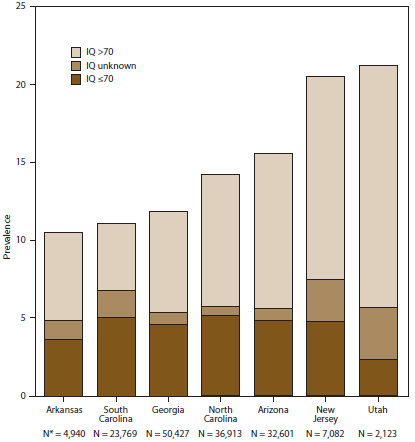
Comparing these results to the recent CDC results show that much of the increase in Utah was due to inclusion of higher IQ individuals. The recent prevalence estimate for Utah was 212/10,000 with most with IQ >70. One has to note that the prevalence estimate from the recent CDC report is roughly 20/10,000, about 5x higher than the UCLA report from 22 years ago. (further note that the CDC data for Utah are based on only 45 autistics so the error bars are very big).

It would be interesting to go through the screening process from the UCLA study to see how well they might have been able to capture individuals without intellectual disability.

This study doesn’t explain a substantial fraction of difference between the 1990 prevalence and the most recent estimate. It does point to a shift in diagnostic standards for low IQ individuals.

UA research looks at detecting autism in rural areas

11 Jun

Most online discussion of autism prevalence focuses in a single number: the average. For example, the recent CDC estimate boils down to “1 in 88” most of the time.

There is a lot going on behind the average, though. For example there is a great deal of variation in prevalence state to state, between racial/ethnic groups and between rural and urban populations. These differences in prevalence point to the conclusion that we still are not identifying all autistic students (much less all autistic adults).

This is why there are a number of efforts to identify and bring services to under represented populations.

Alabama is one of the states that is included in the CDC prevalence estimates. Alabama is the state with the lowest prevalence estimate.

Which is why it is a good thing that the University of Alabama is working on identifying autistics in rural Alabama. This is discussed in UA research looks at detecting autism in rural areas

Here is an excerpt:

Current knowledge about autism spectrum disorders (ASD) allows doctors to identify patients with autism as early as 18 to 24 months old, but in places like rural West Alabama those diagnoses might not take place until children are 5 or 6.

Dr. Dan Albertson and his colleagues at the University of Alabama are in the midst of a study that they hope will shorten the amount of time it takes to recognize cases of autism at the rural Carrollton Primary Care Clinic in Pickens County.

In the study, children who show signs of autism at the Carrollton clinic will be asked to participate in a follow-up play session that is videotaped.

The videos are then sent to the Autism Spectrum Disorder Clinic in Tuscaloosa for further analysis, and doctors at the Carrollton clinic are then given feedback on any red flags for the disorder.

This study will help address the big question of how to efficiently screen a lot more kids for autism than we currently do.

The state with the highest autism prevalence estimate in the recent CDC report was New Jersey. Recently results were reported from a program to use staff in schools, specifically preschools, to help screen for autism in New Jersey. That study was headed by Dr. Yvette Janvier, former member of the Interagency Autism Coordinating Committee.

Study Finds Early Childhood Educators Can Effectively Screen Students For Autism In Underserved Communities

17 May

Studies presented at IMFAR this year addresses the problem of how to effectively screen children for autism in underserved communities. Many studies have shown that the rates of identified autism are lower in racial and ethnic minorities and those with lower socio-economic status. For example, CDC autism prevalence estimates routinely show lower estimated prevalence for Hispanic or African American students. This suggests the possibility that a large fraction of the autism population remains unidentified and under served.

The study authors propose using teachers to actively participate in the community screening efforts. From Study Finds Early Childhood Educators Can Effectively Screen Students For Autism In Underserved Communities

In a study with national implications, researchers at Children’s Specialized Hospital found that in underserved communities using teachers to screen for autism in preschools and day care centers is more effective than the current system that relies solely on parents and pediatricians to identify the disorder.

Two studies from this group presented at IMFAR are: Parent-Teacher Agreement on An Autism Screener in An Underserved Preschool Population and Feasibility of Autism Screening in Underserved Populations.

From the news story:

“We found that unless we go out into underserved communities we are going to be missing many children who have autism,” said lead researcher Dr. Yvette Janvier, developmental/behavioral pediatrician and medical director – Toms River, Children’s Specialized Hospital. “This is the first study to look at using teachers in preschools and day care centers to screen for autism.”

The idea is so simple. Probably not surprising to many of us. From my own experience, I recall early intervention therapists telling us that they couldn’t tell parents about suspicions of autism for the children. They weren’t just not being engaged in the screening process, they were being told to keep quiet.

If the name of Dr. Yvette Janvier sounds familiar, she was a member of the previous Interagency Autism Coordinating Committee (IACC).

Prevalence of autistic spectrum disorders in Tripoli, Libya: the need for more research and planned services.

15 May

Autism prevalence studies are being performed in more and more locations around the globe. It’s somewhat amazing how little is known about autism prevalence outside of Europe and the U.S.. There are data from Japan and data has been coming in from Australia and elsewhere. There is very little data from Africa. Prevalence of autistic spectrum disorders in Tripoli, Libya: the need for more research and planned services.

Data on autism are lacking for Libya. We conducted a hospital-based study in the Neurodevelopment Clinic of AI-Khadra Hospital in Tripoli to estimate the prevalence of autistic spectrum disorders in children attending the clinic. All children referred to the clinic between 2005 and 2009 with a diagnosis of speech and language disorders or behavioural difficulties were assessed. There were 38 508 children in total seen during 2005-09,180 of whom had a history of delayed speech and language and/or behavioural difficulties. Of the 180, 128 children were diagnosed with autistic spectrum disorder: 99 had classical autism, giving the prevalence of about 4 in 1000. The male:female ratio for autistic spectrum disorders was 4:1 and for autism was 4.5:1. The most common age at presentation was 2-5 years (58%) and 56% presented 6-18 months after the onset of symptoms. Physicians should consider autism in the differential diagnosis of any child presenting with a speech and language disorder and/or behavioural difficulties.

The study population is biased, being taken from children referred to a hospital. On top of that, they limit themselves to children with a history of speech and language delay and/or behavior difficulties. A lot of kids could fall through the net on this, but it is still great to see the effort being made to get information on autism prevalence in Libya.

For those who may wonder, 128 out of 38,508 is a prevalence of 0.33%, or about 1 in 300.

On the topic of autism in Africa, there is a recent paper by Richard Grinker (author of Unstrange Minds), “Communities” in Community Engagement: Lessons Learned From Autism Research in South Korea and South Africa, which I hope to review soon.