Archive by Author

Huffington Post uses erroneous data to promote autism epidemic

26 Aug

correction:

As noted in the comments below, Mr. Kirby appears to be basing argument suggesting that the Hepatitis B vaccine could have caused autism on ADDM data, not on the NSCH dataset, as I assumed.

A recent blog post on the Huffington Post contains serious errors and should be edited or pulled.  At the very least a public acknowledgment of the error must be made.

Using data from the recently published 2007 National Survey of Children’s Health to estimate autism prevalence, a Huffington Post blogger (David Kirby) attempted to draw a connection between the Hepatitis B vaccine and an “explosion” of autism . Here is what he wrote:

If there is an environmental component to autism, hopefully scientists will want to know which exposures might have increased between, say, 1992 and 1996.

One possible answer is the Hepatitis B vaccine, (which also contained 25 micrograms of mercury containing thimerosal).

Introduced in 1991, it was the first vaccine ever given on a population basis to newborn babies (within the first three hours after delivery) in human history.

But according to the CDC’s National Immunization Survey (which also includes parental telephone interviews), only 8% of infant children received the Hep B vaccine in 1992, when that birth cohort showed an ASD rate of 60-per-10,000.

By 1994, the number of children receiving Hep B vaccine had reached just 27% — and the cohort showed an ASD rate of 66-per-10,000.

But the Hep B coverage rate had risen to 82% by 1996, when that cohort’s ASD rate exploded to around 100-per-10,000.

Correlation, obviously, does not equal causation. And no one is suggesting that Hepatitis B vaccine is the singular “cause” of autism. But the uptake rate of that particular immunization is at least one environmental factor that did demonstrably change during the period in question.

Emphasis is mine. I emphasized the data which  are the data that are incorrect.

The analysis is simple. Here are the actual results compared to what Mr. Kirby misreported:

1992 “birth cohort*”:
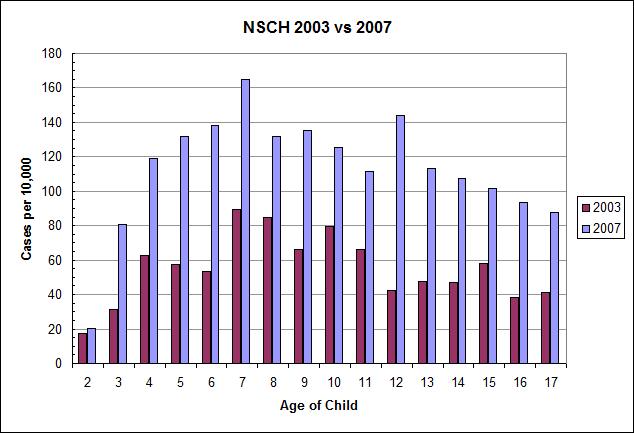
102 per 10,000 (not 60 per 10,000 as on HuffPo)

1994 “birth cohort*”:
113 per 10,000 (not 66 per 10,000 as on HuffPo)

1996 “birth cohort*”:
111 per 10,000 (close to the “around” 100 per 10,000 quoted).

Or, to put it very simply: Mr. Kirby’s statement that there was an “explosion” in the autism rates is incorrect. The evidence that the introduction of the Hepatitis B vaccine is somehow related to the increase in autism rates is false.

That entire statement isn’t even a misinterpretation–it is just simply, demonstrably, false.

Unfortunately, this isn’t Mr. Kirby’s first clear and serious error. He has a history of mistakes. Unfortunately, he doesn’t have a history of correcting his mistakes. Consider these examples:

In June 2008, epiwonk publish a blog post “David Kirby: HuffPost Report on CDC’s Vaccine Safety Datalink Uninformative and Completely Misleading“, demonstrating clear errors in Mr. Kirby’s post “CDC: Vaccine Study Design “Uninformative and Potentially Misleading“”.

The errors were serious enough that Mr. Kirby rewrote his blog post as CDC: Vaccine Study Used Flawed Methods. This included the following introduction:

NOTE: My original post on this topic mischaracterized the 2003 CDC vaccine investigation as an “Ecological Study,” which it was not. I am reposting this piece to reflect that information accurately, but also to point out that many of the weaknesses identified in the CDC’s data and methods apply to the published 2003 “retrospective cohort” study, as much as they do to any future “ecological” ones. I regret and apologize for the error.

Mr. Kirby “regrets” and “apologizes” for the error. Yet his original, erroneous blog post is still on the Huffington Post website. He never took it down. He didn’t even add an apology or correction note to the piece. Anyone following a link to it would have no idea that even the author acknowledges the serious flaws in that piece.

It is also worth noting that the “corrected” version of Mr. Kirby’s blog post was also in error. Again, as noted by epiwonk, this time in his piece “David Kirby HuffPost, Take 2: My Original Story was Flawed, So Here’s A Second (”Corrected”) Story That’s Still Flawed, But I Hope I Can Snow You Under Again This Time…

Mr. Kirby compounded this error when he recreated it in his first “congressional briefing”, September 2008. Mr. Kirby misquoted a report by the National Institute of Enviornmental Health Sciences, and he was caught by a knowledgeable staffer.

Again, Mr. Kirbty has failed to correct his error.  He posted his power point presentation to his website, but without any acknowledgment of the error on page 6.  In the transcript for this talk, he only states, “NOTE: This statement omits important details of the CDC response” and sends you to other sites “For a more detailed explanation”. The “transcript” makes no reference to the exchange between Mr. Kirby and the congressional staffer, nor does it acknowledge that the omission was critical to the point being made. The transcript is noted as being a “Rush transcription by Nancy Hokkanen”. Being in a rush is not an excuse to leave important flaws unexplained.

Math errors are also not new to Mr. Kirby. In May 2008, Mr. Kirby wrote a piece analyzing data from Scotland. In doing so, Mr. Kirby misread a graph resulting in a factor of 10 error in a key piece of information (he misread a bar graph . After his error was blogged, Mr. Kirby corrected his Huffington Post piece. What he didn’t do, and he should have, was to note in the blog piece that he made the error and corrected it.

Mr. Kirby placed his Scotland data post in two sites: Huffington Post and the Age of Autism blog. In yet another odd move by Mr. Kirby, he left the original version of his post, complete with the factor of 10 error, on the Age of Autism blog (it still has 34,000 instead of 3,400). As noted above, Mr. Kirby obviously knows about the error, since he corrected it on the Huffington Post.

Since he clearly knew that his post on the Age of Autism blog had a big error, why didn’t he make a correction (with acknowledgment of the error) there?

Mr. Kirby had a bit of a problem with understanding the difference between Change.Org Change.Gov (the Obama transition team’s website) and Change.Org (a website that hosts blogs on important topics, including autism) (also noted here and here) He made a clear correction on the Huffington Post. However, his post on the Age of Autism blog just disappeared without a comment.

But let’s get back to the present. Mr. Kirby has blogged erroneous data and used this to show a false correlation between the Hepatitis B vaccine introduction and the rise in autism rates.

In case anyone is thinking, “are you sure you checked your own numbers, Sullivan?” The answer is yes. I double checked. I asked a frequent commenter on this blog, Dawn, to check my numbers. Another commenter independently collected and graphed the NCSH data as well. No evidence for an “explosion” of autism rates. Take a look at the graph. Mr. Kirby claimed that the 2007 survey data showed autism rates of about 60/10,000 for kids aged 13 and 15. There are no rates below 80 per 10,000 for the kids in those age ranges in that dataset.

So here we have a man with a history of errors, and with a history of failing to adequately correct his errors. He now has a new, big, obvious error. This error is likely the most serious of those listed here, in my opinion. Mr. Kirby has convinced people that the Hepatitis B vaccine could be causing autism. That was a serious accusation, and it was wrong. The question before us now is this: what will Mr. Kirby do now that he knows he made a mistake?

I’m very curious about that, so I’ve emailed Mr. Kirby and one of the editors at the Huffington Post with this information. I’ll let you all know what I hear back.

*note: the NSCH data are not given as “birth cohorts”. Instead, they are given by age. The survey was performed in 2007 and 2008. So, the 15 year old age group is roughly the “1992 birth cohort”. Likewise, 13 year olds are the 1994 “cohort” and 11 year olds are the 1996 “cohort”.

EDIT: Note that I too have a problem with keeping Change.Org and Change.Gov separate. This correction was made after the post was published.

Unscientific Americans

25 Aug

In Saturday’s Los Angeles Times, Lori Kozlowski talked to Chris Mooney in an article headed ‘Bringing science back into America’s sphere.’ The piece is about a book that Chris has co-authored with Sheril Kirshenbaum “Unscientific America: How Scientific Illiteracy Threatens Our Future.” It provoked such a lot of comments that they set up a blog so everyone could have their say.

Needless to say, as one of the book’s targets is the vaccine/autism camp and Chris mentions Age of Autism, that nest of anti-vaxers has dominated the comments with an orchestrated campaign. Here is my own attempt to stem the tide.

Those who have argued for a link between vaccines and autism adopt two contradictory positions. On the one hand we have those who point to the epidemiological studies as evidence of an autism epidemic whose growth is supposed to coincide with changes in the United States schedule for early childhood vaccinations. But when population studies fail to find a connection between vaccines and autism we get a different argument. Apparently there is a subset of genetically susceptible children that is too small to show up in population studies of vaccine safety. We have yet to hear a convincing explanation for this alleged genetic susceptibility to vaccine induced autism. But the parents who subscribe to this view are all convinced that, whatever it is, their child must have it.

It is difficult to see how this latter group could be persuaded to abandon their belief that that in their individual cases correlation does indeed equal causation. But I am at a loss to understand why they are willing to make common cause with the autism epidemicists, who are clearly and demonstrably wrong.

Regarding prevalence we have a very good idea why prevalence used to be 4 in 10000 and is now approaching 100 in 10000. In 1966 Victor Lotter carried out one of the earliest epidemiological studies in the county of Middlesex in the UK. He used a very narrow definition of autism in which only children who actively avoided human contact and engaged in elaborate repetitive behaviour qualified for diagnosis. When his students Lorna Wing and Judith Gould repeated the study in 1979 they found a similar rate of between 4 and 5 in 10000. However they also discovered a larger group who also engaged in repetitive behaviour but did not avoid human contact. However they did show difficulties in social communication and interaction. Wing and Gould defined ther problems within the triad of impairments, which also explained the aloof behaviour of the more typical Kanner type autistics. The newly identified members of the autistic spectrum numbered around 15 in 10000. Thus a simple broadening of the criteria lifted the numbers from 4 to 20 in 10000.

Lotter, Wing and Gould had all studied children excluded from mainstream education. In 1993 Stephan Ehlers and Christopher Gillberg went looking for children with the triad of impairments in mainstream education in the Swedish city of Gothenburg. They found a rate of 71 in 10000 for children with an IQ greater than 70. The children who were identified were known by their teachers to be having social and/or educational problems but the nature of their difficulties had not been recognised prior to the study.

So, as early as 1994, on the basis of epidemiological studies by Wing and Gould (1979) and Ehlers and Gillberg (1993) it was apparent that autism in all its manifestations including the classic Kanner type and the Asperger type affected at least 91 in 10000. The National Autistic Society in the UK issued a fact sheet to that effect. The modern version is available on our website.

In 15 years the figure for all autistic spectrum disorders in the UK has moved from 91 in 10000 to 116 in 10000 (Baird et al 2006). Thus it has remained flat at around 1 per cent for the whole period of the so-called autism epidemic. And that 1 percent represents the whole spectrum with perhaps a fifth to a quarter consisting of people with recognizable learning difficulties that are moderate or severe. The rest are more able.

I see no reason to doubt that the CDC estimate of 1 in 150 and the figures from recent studies that more closely approach the overall prevalence figures from the UK contain within them similar proportions of more and less able individuals. It is a shame that it has taken health and education services on both sides of the Atlantic so long to catch up with the true prevalence of autism amongst our children and begin to tailor services to meet their needs.

That still leaves those more able adults, often living a life less ordinary without the benefit of diagnosis and support, but still experiencing difficulties in their daily lives. The recent I Exist campaign by the National Autistic Society in the UK has influenced our government to take adult issues seriously

Comments are still open. Please visit and counter the collective lunacy of the anti-vaxers.

Physician’s Warranty of Vaccine Safety

25 Aug

There is an amazing document to be found on the internet: the “Physicians Warranty of Vaccine Safety”.

My take on this? It isn’t a real method of communicating one’s possible concerns about vaccines with one’s doctor. Instead, it is appears to be intended to sway parents away from vaccinating their children. They read this and go “Oh No!” and probably never even show it to their pediatricians.

The document is long and asks doctors to provide huge amounts of information supporting the idea that vaccines are safe and effective. Again, my view is that the document is more about getting parents to question vaccines.

The “Warranty” includes a scary list of vaccine “fillers” including the ever not-present “antifreeze”. It brings up the SV40 scare, including the nonsensical statement, “I hereby warrant that the vaccines I employ in my practice do not contain SV 40 or any other live viruses.” I guess whoever wrote the “Physician’s Warranty of Vaccine Safety” never heard of he MMR vaccine, with its live viruses and all. How can a physician warrant that MMR doesn’t include “live viruses”?

In the end the objective of this document appears to be: give this to your doctor and when he/she refuses to sign it, take that as proof that vaccines are not safe.

To insure that this happens, the Physicians Warranty of Vaccine Safety includes a killer clause:

Regardless of the legal entity under which I normally practice medicine, I am issuing this statement in both my business and individual capacities and hereby waive any statutory, Common Law, Constitutional, UCC, international treaty, and any other legal immunities from liability lawsuits in the instant case. I issue this document of my own free will after consultation with competent legal counsel whose name is __________________________________________, an attorney admitted to the Bar in the State of ___________________________.
________________________(Name of Attending Physician)
________________________ L.S. (Signature of Attending Physician)

Yep. The doctor is supposed to waive all legal protection from liability. He/she is supposed to put his/her business and personal assets behind this.

Make a document that says, “I want a glass of water…oh, by the way, please waive all your legal rights before doing so”. See if your doctor will sign it.

I’ve toyed with creating a “Physicians Warranty of Autistic Child Safety”. It would require the physician to provide all the evidence that the alternative medical therapies have been tested and proven to be beneficial and safe.

Oh, yeah, the physician would have to waive his/her immunities from liability lawsuits.

I considered asking a number of the prominent alternative medical practitioners if they would consider taking my kid on as a patient, then asking them to sign the “Physicians Warranty of Autistic Child Safety”.

But why when I already know the answer will be no?

I guess it says something about the vaccine-rejectionists that they have to resort to such cheesy measures as the “Physicians Warranty of Vaccine Safety”.

Parents’ Interest in Predictive Genetic Testing for Their Children When a Disease Has No Treatment

25 Aug

If you are a parent, would you have asked for a genetic test for autism on your child before his/her diagnosis?

Consider an article in today’s issue of the journal Pediatrics, “Parents’ Interest in Predictive Genetic Testing for Their Children When a Disease Has No Treatment”.

This is not about autism specifically, but about an unnamed “disease”. The researchers posed two “vignettes” and asked the parent to respond to them.

Before people heap criticism over bringing up a paper with the word “Diseases” in the title (and throughout the paper) in relation to a discussion of autism: I am not saying autism is a disease.

Here are the two vignettes:

Vignette 1: Disease With Severe Symptoms and Uncertain Time of Onset
Imagine that a genetic test exists that can identify people at increased risk for developing a certain disease for which there is currently no treatment. Disease symptoms are severe and sometimes lead to early death. People may develop symptoms either as an adult or as a child, and it is not possible to predict how old a person will be when he or she develops symptoms.
Would you want to have your child get this genetic test? Please answer for your youngest child.

And

Vignette 2: Disease With Uncertain Symptoms and Uncertain Time of Onset
Imagine that a genetic test exists that can identify people at increased risk for developing a certain disease for which there is currently no treatment. Some people with this disease will develop severe symptoms, whereas others will develop only mild symptoms. It is not possible to predict how severe the symptoms will be or at what age they will develop.
Would you want to have your child get this genetic test? Please answer for your youngest child.

I would argue that the public’s perception of autism (especially with regression) would fit into Vignette 2. I would further argue that if “disease” were replaced with “developmental disability”, it would have been an even more relevant to the public’s perception of autism.

The results surprised me. There was little if any difference in the responses to vignette 1 and vignette 2. Somehow, I figured more people would want the test for conditions that were always severe and could result in death (vignette 1).

For both vignettes, the responses were fairly evenly split into 3: “probably/definitely”, “unsure” and “probably not/definitely not”.

In other words, about 1/3 of parents say they would want a genetic test and about 1/3 say they would not, with the remainder unsure.

It would be very interesting to formulate “vignettes” that are targeted to developmental delays in general and autism in specific.

What if instead of “diseases” they asked about “developmental delays”? What if instead of “no treatment” they said, “no cure, but some therapies (e.g. speech and occupational) could be beneficial”? What would the responses be like?

The main reason this paper caught my eye is the fact that the study begs the question: if the genetic test can be performed on child, why not prenatally? What would be the difference in the responses from the parents if they were asked about prenatal testing?

Or, to put it very specifically, what if parents were told to consider a genetic test for autism?

How would the responses vary depending on the parents’ perception of autism?

Pittsburgh parents suing over alleged teacher abuse caught on video

24 Aug

The Pittsburgh station WXPI has a story, “YouTube Video Shows Teacher Slapping Autistic Boy“.

This is one of every parent’s worst nightmares–abuse behind closed doors in school. Without the video, this incident may never have come to light.

WXPI has their story video on their page, and the YouTube video is here. Sorry, I just can’t bring myself to embed it right now.

From the WXPI story:

Lori Davis is the teacher accused of hitting the boy. In the video, Davis can be heard shouting, “Stop moving your chair back. Move it, and you stay up there. I’ve had it with you.”

The criminal complaint against Davis alleges, “During the March 14, 2008 special education session, without warning or provocation, the defendant suddenly and violently struck (the victim) on the left side of the head.”

She is no longer employed by the district.

This teacher was immediately removed from the classroom and she is no longer employed with the district. We take these types of things very seriously. This is the only incident we were made aware of involving this teacher. When we found out, we immediately took action. She was removed from the classroom in June 2008.

Again, the idea of teacher or aide abuse is just a nightmare. Let’s face it, many autistic kids who can’t self-advocate or won’t be believed if they try.

Autism Speaks softens message on vaccines?

24 Aug

That is the message of a recent article by Mark Roth, Autism group softens stance on vaccines .

Autism Speaks, the nation’s largest autism advocacy group, recently made its clearest public statement yet that minimizes the link between vaccines and autism.

Mr. Roth discussed a recent statement from the Autism Speaks website by Dr. Gerri Dawson, Autism Speaks’ chief science officer. He quoted Dr. Dawson as stating:

“So … given what the scientific literature tells us today,” she says, “there is no evidence that thimerosal or the MMR vaccine cause autism” and “evidence does not support the theory that vaccines are causing an autism epidemic.”

It has been, well, interesting watching the reaction to Autism Speaks in the past few years. As recently as two years ago, the vaccines-cause-autism organizations were highly critical of Autism Speaks for ignoring the vaccine question. In fact, it seems like just this year that Autism Speaks “outed” itself as supporting the vaccines-cause-autism idea. This occurred when Alison Singer was forced to resign from Autism Speaks since she wouldn’t vote for vaccine-causation research in the IACC.

From my perspective, this “softened” stance by Autism Speaks is still a stronger message than they were sending a year ago.

This all begs the question: why did Autism Speaks soften their message?

I can speculate (and that is all this is, speculation). First, the vaccine question is highly charged. My guess is that Autism Speaks put off making a definite statement as long as possible. When Alison Singer resigned over her vote in the IACC (voting to remove vaccine research from the funded projects), Autism Speaks was forced to make their views public.

The departure of two key people, Alison Singer and Eric London over the vaccine question was not good publicity for Autism Speaks. Much more, the creation of the Autism Science Foundation gives potential donors a second viable option for an autism research charity that doesn’t fund vaccine-causation research (the first being the Simons Foundation).

What is odd about Dr. Dawson’s comments is this: If there is no evidence that thimerosal causes autism, why does Autism Speaks fund thimerosal research? Here are grants from 2008:

Differential Effects of Thimerosal on Cell Division and Apoptosis in Normal vs Autism Spectrum Disorder Cell Lines ($60,000 for one year)

and

Vulnerability phenotypes and susceptibility to environmental toxicants: from organism to mechanism ($330,000 over 3 years)

Specifically, thimerosal and other vaccine adjuvants will be studied.

(sidenote: Thimerosal isn’t an “adjuvant”)

and

Analysis of developmental interactions between Reelin haploinsufficiency, male sex, and mercury exposure ($324,340 over 3 years)

and

Etiology of Autism Risk Involving MET Gene and the Environment ($659,100 over 3 years)

The next line of experiments will examine the relationship in an even larger sample, and assess the functional effect of the MET gene polymorphism on immune cell activity, and to further examine the impact of environmental toxins (including ethyl mercury) on the gene expression-dependent function of maternal immune cells.

Is Autism Speaks softening their “message” or softening their “stance” on whether vaccines and/or mercury cause autism?

Massachusetts General Hospital to add program on autistic adults

23 Aug

Massachusetts General Hospital (MGH) has received a $29 million grant to expand its pediatric autism program to a program that also gives comprehensive care to adults.

From the Boston Globe:

The hospital plans to announce Tuesday that it will receive $29 million, the fourth- largest gift in its history, from Nancy Lurie Marks and her family foundation in Wellesley, in part to add a major adult component to its pediatric autism program. The money will also allow the hospital to expand its services for children with autism, who now wait up to a year for an appointment, conduct extensive research, advocate for patients, and train physicians.

The Nancy Lurie Marks foundation describes itself as:

The primary mission of the Nancy Lurie Marks (NLM) Family Foundation is to help people with autism lead fulfilling and rewarding lives. The Foundation is committed to understanding autism from a scientific perspective, increasing opportunities and services available to the autism community and educating the public about autism.

The foundation was established in 1977.

This is a great step forward. As the story notes, autistics often stay with their pediatricians well into adulthood for lack of better options.

The Boston Globe quoted Peter Bell of Autism Speaks:

Bell said that while he knows of two autism clinics in the United States that treat adults, nothing “comes close to the kind of plan Mass. General is looking at. This is tremendously exciting, and I hope others will follow.’’

I agree. This is tremendously exciting and I hope others will follow.

Autism “is treated as a childhood disorder but it’s lifelong,’’ said Clarence Schutt, director of the Wellesley foundation, which is a leading funder of autism research and whose grant to Mass. General is its largest ever.

Autistic Somali man denied return to Canada

21 Aug

If true, this is a travesty of justice.

According to a recent story in CBC news, a naturalized Canadian citizen has been stuck in Nairobi for three years. The man, Abdihakim Mohammed, is 25 years old, and autistic.

Here’s the story, in brief: Mr. Mohammed was born in Somalia and emigrated to Canada with his mother in 1990, at about age 6. He is a Canadian citizen. A psychiatrist recommended that he travel back to Somalia with his mother, with the idea that this might improve his communication and social skills.

His mother returned to Canada first, leaving Mr. Mohammed in Somalia. Fearing that he might lose his passport, she kept it in her possession. Officials in Canada took the passport on the grounds that it was in the possession of someone not the owner.

When Mr. Mohammed’s grandmother took him to Nairobi to try to send him back home, he was denied travel. His citizenship card was not enough to convince officials that he is who he claims to be. That was in 2006. He has been unable to leave Nairobi since.

In a classic catch-22, his mother can apply for a passport on his behalf if she can get a court order granting her guardianship. But, in order to do that, Mr. Mohammed must be present in Canada. So, she can bring him home to Canada if she can bring him before a court in Canada first.

Mr. Mohammed has offered to undergo DNA testing to prove his identity.

Note: I wrote a similar post a few days ago, but I managed to overwrite it with a different post. If you have a sense of deja vu, that is why.

IACC comment time: No more procrastinating!

21 Aug

If you are like me you have put off submitting comments to the IACC.

If you are like me you need a reminder.

If you are like me you are in danger of missing the deadline.

Any thoughts about autism research? Let them know. Let them know if you think they are doing a good job or a bad job. Let them know if you think they should put more or less effort into any area.

Let them know here.

You don’t have to answer all the questions. You don’t even really have to stick to their format (if you hit “continue a few times, you get to an they even have an “other information” question).

I was going to try to write this without referencing groups that have opinions I disagree with. However, here is a comment from the Age of Autism blog on the IACC:

Answering their questions made me ill. The idea that their research intiatives include “where do I turn for help” and “what does the future hold”. What a ridiculous drain and distraction from important things such as treatment and prevention.

“What the future holds” is the category for adults with autism. Only 5% of research funding goes towards such research.

Even if the research funding wasn’t that small:

If you feel, like I do, that research into areas such as services for autistic adolescents and adults are important. If you feel that there is room for anything beyond just “treatment and prevention”. If you don’t want your opinion dismissed as “..a ridiculous drain and distraction from important things…”, the time to be heard is now.


It only takes a minute.

Read this article in O magazine

21 Aug

You read that right, I am sending people to read an article in Oprah Winfrey’s “O” magazine.

I’ve been waiting for the article, An Inconvenient Youth: Raising Children with Autism to appear online since reading some discussion about it on the net.

I am happily surprised that Oprah’s magazine would have such an article, given her support for a certain celebrity autism “advocate”.

That out of the way, the story is really worth the time to read it. It isn’t perfect, but, hey nothing (and that includes my pieces) is.

Here are some quotes:

Accepting the “A word” requires a learning curve. “You graduate to it,” says Erin. “Because this is about: Let’s call it what it is, let’s deal with it together.”

and,

And that leads to a bigger issue—one that really burns this group: the implication that accepting your child’s autism is not okay….The simple fact is that not all autistic kids can “recover.” “We need to reexamine what it means to be a successful adult,” says Erin. “To me, now, a successful adult is a functional adult.

and

At this point, however, society still has a long way to go in terms of tolerating people who behave in unfamiliar ways.

Lisa Jo Rudy at autism.about.com has already blogged this. I am very interested in hearing other people’s opinions.