Archive by Author

Clinical features of suicide attempts in adults with autism spectrum disorders

16 Nov

For those who don’t read Left Brain/Right Brain regularly, know that I am constantly bothered by the lack of attention to understanding the needs of autistic adults that I see in much of the ongoing research and in many parent-advocacy groups. My child is still somewhat young, but I realize that real understanding comes with time. Not only will attention to autistic adults provide benefit for those already of age, but it will set the stage for a better life for the autistic children of today.

When I see an study titled “Clinical features of suicide attempts in adults with autism spectrum disorders”, I am taken aback by just how serious this question is. The study out of Japan is preliminary but they found 7.3% of patients seen for attempted suicide are autistic. Take whatever prevalence for autism among adults you think is appropriate. I suspect the autism prevalence in adults is closer to 1%, but that’s still a 7x higher rate of attempted suicide. Much of the resistance to focusing attention on the needs of adults comes from groups promoting the idea of a vaccine-induced autism epidemic. If you believe the autism prevalence in adults is something like 1 in 10,000 (0.01%), this is would mean that autistic adults are attempting suicide in Japan at a rate of 700 times greater than the general population.

Our results indicate that ASDs should always be a consideration when dealing with suicide attempts in adults, in particular, in cases of males. Individuals with ASDs attempted suicide using serious methods, and, therefore, they may have a tendency to complete it at a first attempt. This was only a preliminary study. Thus, the clinical features of individuals with ASDs who attempt suicide must be clarified. In addition, interventions focusing on preventing suicide attempts in individuals with ASDs are required.

Yes, autistics are not only attempting suicide more often, they are using more serious methods. Like cutting/stabbing one’s self. Like jumping from heights or carbon monoxide intoxication.

The autistics in this study had the same (or a little higher) education level as the non-autistics who were attempting suicide. While psychiatric history was high (about 50%) it was lower in the autistic group than the non-autistics.

There are more comparisons made and which could be discussed but, for now, I’ll bring this back to: autistics in this study are attempting suicide more often and with more serious methods than non-autistics. If that doesn’t make people consider the importance of understanding the unique needs of autistic adults, I don’t know what will.

Here is the abstract:
Clinical features of suicide attempts in adults with autism spectrum disorders

OBJECTIVE:
The objective of this study was to investigate the frequency and clinical features of suicide attempts in adults with autism spectrum disorders (ASDs).

METHODS:
We enrolled 587 consecutive patients aged 18 or over who attempted suicide and were hospitalized for inpatient treatment. Psychiatric diagnoses, suicide attempt frequency and clinical features were compared between ASD and non-ASD patients.

RESULTS:
Forty-three (7.3%) of the 587 subjects who attempted suicide had ASDs. The incidence of patients with mood disorders was significantly lower (Fisher’s Exact Test, P=.043) and that of those with an adjustment disorder was significantly higher (Fisher’s Exact Test, P<.001) in the ASD group than in the non-ASD group. The average length of stay at both the hospital and intensive care unit in the ASD group was longer than that in the non-ASD group (z=-2.031, P=.042; z=-2.322, P=.020, respectively).

CONCLUSIONS:
ASDs should always be a consideration when dealing with suicide attempts in adults at the emergency room.


By Matt Carey

Prof. Walker Smith’s memories perhaps not so enduring

12 Nov

Prof. John Walker-Smith was a pediatric gastronterologist  (now retired) who worked with Andrew Wakefield on the research that formed the basis for the now retracted 1998 article in The Lancet that sparked the public fear over a possible link between the MMR vaccine and autism. Multiple studies since have demonstrated that the MMR does not increase autism risk and even Prof. Walker-Smith has stated through his attorney that the Wakefield autism/MMR hypothesis is without merit.

Prof. Walker-Smith was found guilty of misconduct and stripped of his medical license by the General Medical Council (GMC), but that ruling was quashed on appeal. In the appeal decision the judge ruled:

It had to decide what Professor Walker-Smith thought he was doing: if he believed he was undertaking research in the guise of clinical investigation and treatment, he deserved the finding that he had been guilty of serious professional misconduct and the sanction of erasure; if not, he did not, unless, perhaps, his actions fell outside the spectrum of that which would have been considered reasonable medical practice by an academic clinician.

Prof. Walker-Smith and Andrew Wakefield took the position that the work they performed was not research driven, but was clinically indicated tests on children later collected as a case series. That the study for which they received ethical approval was not performed. So there was no problem in that children were seen before the approval was granted.

Prof. Walker-Smith wrote an autobiography (Enduring Memories). Two autobiographies, really. One in 2003 (before Brian Deer exposed the ethical lapses involved in the Royal Free Hospital’s research program) and another in 2012 (after the GMC hearings).

Mr. Deer has contrasted some excerpts from the two versions. Here is a snippet fro the 2002 edition:

The centre piece of the research however would be first a study to see if there was significant bowel inflammation in these children which could be treated. A secondary but important question would be whether measles virus, especially the vaccine virus strain, was present in any inflamed tissue which might be found. ”

The inflammation study-the Lancet work-was the center piece of the research with the measles virus work as a secondary project. The first measles virus effort was unpublished.

According to Prof. Walker-Smith in 2003, ethical approval was obtained and a pilot study went ahead:

My own role in all this was permissive as Andy Wakefield was the research leader, the conductor of the orchestra, a classical role in research for a gastroenterologist. A team was assembled, an ethical committee application was obtained and a pilot study went ahead.

The 2012 version differs notably from the above. The center piece is no longer the inflammation study, but the measles virus study and the work was not part of an ethics board approved study, but as a byproduct of routine investigation:

The centre piece of the research per se would be to determine whether measles virus, especially the vaccine virus strain, was resent in any inflamed tissue which might be found in these children and to investigate a pathogenetic hypothesis. This research could only be contemplated as a by-product of routine investigation.

Where the ethical approval statement from 2003 says a study went ahead, in 2012 the statement indicates that the project “was not implemented”.

A team was assembled, an ethical committee application was developed to investigate an hypothesis and was submitted by Andy Wakefield but based upon our clinically indicated diagnostic approach. The Ethical Committee approved the application but in the event the study was not implemented.

More modest studies based upon ethically approved research biopsies went ahead

The 2003 version is basically consistent with the GMC charges and the story unearthed by Brian Deer. The 2012 version is consistent with the failed defense Prof. Walker-Smith and Andrew Wakefield gave to the GMC. The decision against Prof. Walker-Smith was quashed.

For many reasons the argument that the quash of the GMC decision somehow exonerated Andrew Wakefield was not convincing from the start. From where I sit, it is even less so in light of a 2003 account clearly setting out the work as a research project.

Complementary and alternative medicine use in a large pediatric autism sample

9 Nov

The journal Pediatrics has a large number of autism related articles in a recent supplement. One of these covers a topic discussed a great deal by parent groups online: alternative medical approaches to the treatment of autism. In Complementary and alternative medicine use in a large pediatric autism sample, James Perrin (this one of his five articles in the Supplement; Dr. Perrin is the president elect of the American Academy of Pediatrics) and his coauthors use the Autism Treatment Network (ATN) to review parent report of use of complementary and alternative medicine (CAM) in regards to autism.

The authors find that while CAM is used by a significant minority of parents, it is a minority: 28% (896 out of 3173). Special diets are the most common (548 respondents, 17%). Various methodologies are listed below:

Characteristic N
Any CAM 896
Special diets 548
Gluten-free diet 249
Casein-free diet 289
No processed sugars 69
No sugars or salicylates 28
Feingold diet 14
Other specified special diet 293
Other CAM 643
Other vitamin supplements 413
Probiotics 274
Essential fatty acids 171
Digestive enzymes 116
Higher dosing vitamin B6 and magnesium 99
Chiropractic 77
Amino acids 59
Antifungals 58
Glutathione 33
Chelation 19
Hyperbaric oxygen 12
Acupuncture 10
Sulfation 7
Other specified CAM 173

Some of the most talked about methodologies are rarely used. Chelation, for example, had only 19 respondents or 0.6%. Hyperbaric oxygen, 0.4%. Previously, chelation had been reported as being used by about 7% of families. If these studies are comparable, this would indicate that chelation has dropped from low to very low in use by parents.

CAM usage is higher among the wealthy, whites, those with children with autism vs PDD NOS or Asperger syndrome, and higher among those whose children have gastrointestinal complaints and/or seizures. The authors note:

As with other CAM use, it will help to determine more about the potential synergistic effects of CAM with medical treatments as well as ways that CAM use may interfere with improvement in medical conditions.

The full article is available free online including a discussion of limitations of the study. The abstract is copied below:

BACKGROUND AND OBJECTIVE Children and adolescents with autism spectrum disorder (ASD) often use complementary and alternative medicine (CAM), usually along with other medical care. This study aimed to determine associations of ASD diagnostic category, co-existing conditions, and use of medications with use of CAM.

METHODS We used the Autism Speaks Autism Treatment Network patient registry, which collects information on CAM use, medical conditions, and psychotropic medication at enrollment. CAM was categorized as special diets versus “other” CAM; ASD was defined as autism, pervasive developmental disorder (PDD), or Asperger’s. Gastrointestinal symptoms, seizure disorders, sleep problems, and medication use were determined from parent report. Child Behavior Checklist (CBCL) scores were used to measure behavioral symptoms. Logistic regression was used to determine associations of diagnostic category, other medical conditions, and medication use with CAM treatments, controlling for demographic characteristics.

RESULTS Of 3413 subjects in the registry as of April 2011, 3173 had complete data on CAM use: 896 (28%) reported any use; 548 (17%), special diets; and 643 (20%), other CAM. Higher rates of CAM use were associated with gastrointestinal symptoms (odds ratio [OR] = 1.88), seizures (OR = 1.58), and CBCL total score >70 (OR = 1.29). Children with PDD (OR = 0.62), Asperger’s (OR = 0.66), or using medications (0.69) had lower rates.

CONCLUSIONS Children with ASD use more CAM when they have co-existing gastrointestinal symptoms, seizure disorders, and behavior problems. This study suggests the importance of asking about CAM use in children with ASD, especially those with complex symptoms.

Topsham parents seek permission to record nonverbal son’s school day

7 Nov

A story out of Maine (USA) brings up an important discussion about what are the rights of a disabled student to have his/her day communicated completely to his/her parents. If an individual (student in this case, but one can easily generalize to adults in a non-school setting) are unable to effectively communicate what happens to them during the day, what do those who advocate with/for those individuals have as a means to fully learn about what happens?

It’s a cumbersome point, I know, but consider this news story: Topsham parents seek permission to record nonverbal son’s school day

The parents want to make an audio recording of the student’s day. The student is non-verbal and, apparently, unable to otherwise effectively communicate the events of the day. A non-disabled student can report back to family, “I’ve been bullied” or “I was placed alone in a room for an hour”.

The parents of a 13-year-old Mt. Ararat Middle School student who has autism and intellectual disabilities are challenging the school district’s decision to block them from sending their son to school with an audio recording device.

The school district is fighting the parents’ proposal, saying it’s not conducive to providing educational services and poses a threat to the privacy of other students and school staff.

At what point are the nonverbal student’s rights so infringed that the school must make an accommodation?

Recall a recent story where a parent sent an audio recorder with his son. (I’ll add the link soon). He found that his son was being ignored and worse by staff.

(Trigger alert): A story out of Bakersfield, California, makes the point of the need for information about a disabled student’s day. This one isn’t specific to autism or non-verbal ability, but does involve a 16 year old

Parents of alleged assault victim take KHSD to court

The girl was a 16-year-old 10th-grader at the time of the alleged Oct. 15, 2009, incident but had the intellectual capacity of a 4-year-old, according to a civil complaint filed in September 2010.

The girl was attacked at about 11 a.m., and afterward the school allowed her to finish out her regular school day and even attend an after-school program, not telling her parents what had happened to her until more than five hours later, according to the complaint.

The girl was assaulted in a bathroom adjacent to a special education classroom where a teacher’s aide walked in on them after he heard screaming, according to the lawsuit. Both children were naked from the waist down and the then-15-year-old boy was clutching the girl’s hips from behind, according to the lawsuit

The school officials put off telling the parents. Would that have even been possible with a non-disabled student? The school would have known this would be reported back (or that the student would have called the parents immediately).

The story goes on:

The lawsuit contends that the school should have more closely supervised the boy, “a troubled special education student having had prior difficulties and/or complaints concerning similar conduct with others.”

It isn’t the parents who have the rights to know what goes on (or at least that is not the only point here). The students have a right that their guardians know what happens to them. If the student is unable to effectively communicate what happens, his/her rights are not the same as those of everyone else in the school. Somehow that has to be remedied.

Immunization uptake in younger siblings of children with autism spectrum disorder (part 2)

7 Nov

Recently I wrote about a study, Immunization uptake in younger siblings of children with autism spectrum disorder, in which it appeared they had a comparison of immunized vs. non-immunized. I contacted the authors for clarification and found that “non immunized” meant the lack of the two combination vaccines. They did not specifically ask for or collect full immunization data on all children in the study.


By Matt Carey

Tell NCD About Your Voting Experience

7 Nov

This from the Autistic Self Advocacy Network (ASAN): Tell NCD About Your Voting Experience. Today is election day in the U.S. and the National Council on Disability (NCD) is collecting input on the experiences of disabled voters.

Here is the announcement:

Have you cast your vote in the current election?

The National Council on Disability, in collaboration with the National Disability Rights Network and EIN SOF Communications, is collecting information about the voting experiences of people with disabilities. In early 2013, they will release a report based on their findings.

Although it violates state and federal laws, many polling places across the country are inaccessible to people with disabilities. According to a Government Accounting Office report found in 2008, only 27% of polling places were fully accessible. This means that many disabled people are denied their fundamental right to vote in federal, state, and local elections.

To help the NCD determine how people with disabilities are faring in this election, fill out their brief questionnare about your own voting experience.

For more information, or to download an alternative hard copy of the questionnaire, visit the National Council on Disability website.


By Matt Carey

Autistics Speaking Day

6 Nov

I missed it. Autistic Speaking Day. Autistics Speaking Day grew out of a response to a poorly conceived awareness/fundraising event from Autism Speaks: Communication Shutdown (the link seems to be no longer valid).

Here’s part of what Corina Becker wrote last year about Autistics Speaking Day:

At the end of my last post, I stated that on November 1st, Autistic people should speak up and be heard. That in the absence of NT voices, Autistics should reclaim the Autism community by communicating in our own ways on our life experiences.

A series of blog posts are collected at http://autisticsspeakingday.blogspot.ca/

Yes, clearly, not all autistics participate by speaking or writing as many are non-verbal, non-conversational or have intellectual disability.


By Matt Carey

Presidential Election tomorrow

6 Nov

The U.S. is holding their Presidential election tomorrow (Nov.6). Four years ago I wrote about the election as it approached. Both major candidates made a few comments that were, well, ill informed. Barack Obama held forth a promise to make life better for the disability community. He had the clearest disability plan, including fully funding IDEA (special education) and naming an “Autism Czar”. These did not come to pass. Some extra money was set aside for special education as a one time event during the economic stimulus budget, but special education remains underfunded. No one person is in place to oversee autism research and policy, but there is a renewed commitment to keep funding research.

All in all, not where I hoped we would be four years ago.

And, yet, I have even less hope for the future with Mr. Romney.

I hope all is well for Americans who wish to vote. The east coast is still recovering. Whoever you support, make your voice heard.


By Matt Carey

With thanks to OARC

5 Nov

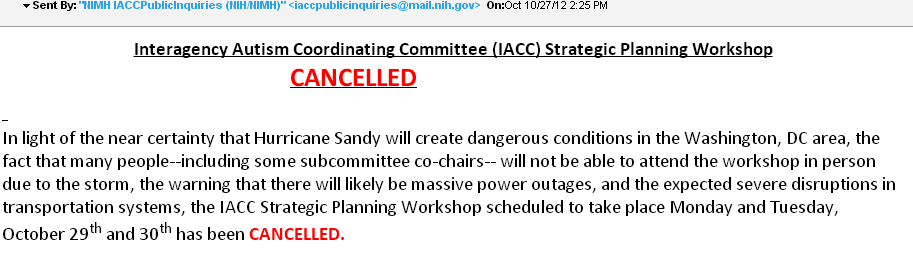
Last week there was supposed to be a 2 day workshop of the the U.S. Interagency Autism Coordinating Committee (IACC) to update the Strategic Plan. The workshop was to be held in Washington DC. The meeting was cancelled due to Hurricane Sandy.

Behind the scenes, making things work for the IACC is OARC: the Office of Autism Research Coordination. The people of OARC do a lot, including managing the meetings. No small task for this workshop. There are about 30 IACC members and about 20 experts were brought in to consult on the Plan update. These meetings are a lot of work and OARC staff were preparing long in advance and still, I am sure, were going to be working through the weekend before the workshop. And that without hurricane Sandy. With Sandy bearing down, they had to put together contigency plans. What if some people don’t make it in time? What if people can’t come? What if power goes out? Lots of contingencies which I am sure made this whole process very complicated. I was working with them to make sure I could get in and out of DC for the meeting. Or, at least I hoped to. Airports ended up shut down. Luckily OARC saw that it was going to be unworkable and cancelled the meeting the Saturday before.

Here’s a screen shot from my email on Saturday(Click to enlarge):

The people of the Office of Autism Research Coordination (OARC) were working very hard to put this workshop together. Working hard on contingency plans. Working on the weekend. All this while a hurricane was bearing down on their homes. Thank you, OARC staff. I appreciate the dedication and the hard work.


By Matt Carey

Note: I serve as a public member to the IACC but my comments here and elsewhere are my own.

Controversial autism doctor Mark Geier loses licenses in Missouri, Illinois

4 Nov

Mark Geier has been discussed a great deal here on Left Brain/Right Brain. Including very recently on the topic of this article. Much of that discussion has recently centered on his belief that not only is autism caused by mercury, but that mercury somehow is bound to testosterone and that by reducing the amount of testosterone in the body one can reduce the amount of mercury and, thus in his flawed model, treat autism. Mr. Geier’s clinical practice was found to have been flawed as well and he lost his license to practice medicine in his home state of Maryland. He was licensed in multiple other states as well, including Missouri and Illinois. With the loss of his license in Maryland, other states have followed in license actions.

The St. Louis Post Dispatch reports: ” Controversial autism doctor Mark Geier loses licenses in Missouri, Illinois”.

Todd W. Of Harpocrates Speaks writes about this in “Mark Geier on his Last Leg” where he notes that Mark Geier is still licensed in Hawai’i only.

Todd W. keeps a map of states where Mark Geier has lost his license.


By Matt Carey