Archive | Authors RSS feed for this section

Embryo screening to reduce autism risk: it’s not in the future. It’s now

28 Dec

A news article on screening of embryos came out last week and it was picked up under various titles by various news outlets.

From Australia and New Zealand

Why IVF parents are choosing girls over boys, which google news also listed under Parents call for embryo screening to cut risks.

IVF parents choosing girls over boys

And a different take

Parents Worldwide Prefer Girls To Boys: Will India And China Learn?

From India

Why girls are preferred over boys by IVF parents

Here’s a quote from one of the stories:

Figures from one of Sydney’s top IVF clinics show about one in 20 parents seeking embryo screening are looking to have a female baby to reduce their risk of autism.

Australia does not allow for gender selection of embryos. One can’t tell the IVF team to pick male or female embryos. But one can ask for genetic screening.

University of Sydney senior lecturer in bioethics Chris Jordens said autism had a strong genetic basis, so it was within the guidelines.

And the trend towards genetic screening is strong and building in the US.

At a recent conference in Chicago, he saw a number of United States IVF providers offering parents without the conditions tests for between 180 and 600 common gene mutations, such as the BRCA ”breast cancer” genes.

Gender selection to reduce autism risk is about the most basic, the most crude, genetic screening one could imagine. But it’s real and it’s happening.

The concept of autism prevention through genetic screening, either in IVF or in selective abortions, has been a major ethical question with the push for genetics research in autism in the past decade.

The first step in guiding our societies towards an ethical approach to genetic testing is to present autism accurately. This is one reason why I and others speak out when groups such as Autism Speaks or some parent “advocates” present autism with phrases such as as “These families are not living” or “Life is lived…in despair”. Is life harder, more challenging for my kid? Absolutely. But what message are we sending to prospective parents when we tell them that their lives will be lived in despair or they will no longer be living if they have an autistic child? We are telling them to do whatever they can to avoid having an autistic child. We are telling them to pick and chose their embryos. We are telling them to selectively abort. We are telling the autistics of today that the perfect world (in the view of the majority) is one without them.

My kid and other autistics, children and adults, deserve life. They deserve the right to pursue happiness. Disabled does not equate to despair.

This is why, Autism Speaks, when you portray my kid as less, my life as not lived, I and others will speak out. Autism Speaks, it’s time you started listening.

By Matt Carey

Details about the potentially “recovered” autistic kids in the National Survey of Children’s Health

27 Dec

I recently wrote about data from the National Surevey of Children’s Health. In specific, I explored the question of just how many of those kids were identified as autistic at some time in the past and are currently not identified as autistic. Keep in mind the limitations of the NSCH, inlcuding (1) it’s a survey not a direct examination of kids, (2) similar to (1), this is all parent-reported data, (3) these are raw data, not corrected for any socio-economic factors.

I posed the question Are 20-30% of autistic children recovering? as this is how I’ve heard the results of the survey framed. Kid was once identified as possibly autistic/kid is not currently identified as autistic/therefore kid recovered from autism. While 17% of the kids in the survey “lost” their autism label, the parents report that most of these kids were never autistic to begin with.

In other words, the fraction of kids who might have recovered from autism is small. Much smaller than many people have been thinking after the 2007 NSCH data were released. Back then, David Kirby discussed the new prevalence numbers in his usual manner. For those who are not familiar with his “usual manner”, David Kirby was famous for “just asking questions” which lead the reader to believe that vaccines cause autism. He retains plausible deniability (I never said that vaccines cause autism, I just posed the question. Over and over. With cherry picked data to support the conclusion)

Back then Mr. Kirby wrote:

Among boys, for every 260-per-10,000 male children originally identified as having an ASD, 90 of them (34.6%) reportedly do not have the diagnosis now.

and

The percentage of girls who apparently lost their original label was 44.5%.

Followed later by:

Another item that will surely spark fiery debate is the reason why so many children previously indentified with ASD are currently not holding that diagnosis.

There are three main possible explanations:

1) Many children never had an ASD to begin with, and were simply “mislabled.”

2) Some children naturally “recovered” from ASD on their own without treatment, (though Lee Grossman and many others told me they have never seen this happen).

3) Interventions including behavioral therapy, dietary changes and biomedical treatments actually work, and it is possible to “recover” a child from the grips of ASD

Well, there’s never been a “fiery debate”. But he did implant the question in the minds of people and it has stuck. I’ve heard people claim a high “recovery” rate. We can now answer some of Mr. Kirby’s questions. We now know that, yes, many of these children never had an ASD to begin with. Some children went from having an autism label to not and the parents did not attribute the change to treatment. A small fraction (about 3%) of parents attribute the “loss” of the autism label to treatment, but we don’t know what treatments they credit. (Note how Mr. Kirby lumps dietary changes and biomed together with ABA, lending alternative medicine some credibility by association).

So, what about those kids whose parents reported some treatment(s) resulted in a change from actually autistic in the past to not autistic now. What can we say about those kids? Do they have any other challenges or diagnoses? What we can say is that a large fraction still have some diagnosis or parental concern.

Let’s go through some of the questions in the survey:

Recall that 2041 parents answered yes to Has a doctor or other health care provider ever told you that [S.C.] had Autism, Asperger’s Disorder, pervasive developmental disorder, or other autism spectrum disorder? (question K2Q35A)

Some of these kids were reported by parents to no longer have an autism label. And some of those parents attributed the change to treatment. How many one might ask? 69 answered yes to question K2Q3F_1: I am going to read a list of reasons why [S.C.] may no longer have autism or autism spectrum disorder. For each reason, please tell me if it applies to [S.C.]. Treatment helped the condition go away.

69/2041=3.4%.

So we are dealing with small numbers here, but there are more data to explore in the survey. In specific, parents were asked questions about diagnoses other than autism.

Here are a few examples of the conditions those 69 kids still have:

23 parents answered yes to “Does [S.C.] currently have speech or other language problems”. For reference, 23/69=33%

18 parents answered yes to “Does [S.C.] currently have a learning disability?”. 18/69 is 26%.

6 parents answered yes to “Does [S.C.] currently have intellectual disability or mental retardation?”

18 parents answered yes to “Does [S.C.] currently have ADD or ADHD?”

12 parents answered yes to “Does [S.C.] currently have anxiety problems?”

10 parents answered yes to “Does [S.C.] currently have behavioral or conduct problems?”

5 parents answered yes to “Does [S.C.] currently have epilepsy or seizure disorder?”

25 parents answered yes to “During the past 12 months, has [S.C.] received any treatment or counseling from a mental health professional?”

Note that parents can answer yes to more than one question, so the total adds up to more than 69.

Kids go from having an autism label to not having an autism label. The fraction seems small, but it’s there. But not having an autism label is not the same thing at all as not having any label or challenges.

I don’t write this to throw cold water on those excited by autism recovery. But I do think we need to quote numbers that are as accurate as we can. The National Survey of Children’s Health points to any autism recovery being a small fraction of the autistic population (3% or less) and, of those, other diagnoses, disabilities and challenges are often present.


By Matt Carey

Is SSRI use during pregnancy an autism risk factor?

23 Dec

A few recent studies have suggested that using SSRI’s during pregnancy might increase the risk of a child later being diagnosed autistic. SSRI’s are commonly used to treat depression.

Earlier this year a team from Bristol studied the question and concluded:

In utero exposure to both SSRIs and non-selective monoamine reuptake inhibitors (tricyclic antidepressants) was associated with an increased risk of autism spectrum disorders, particularly without intellectual disability. Whether this association is causal or reflects the risk of autism with severe depression during pregnancy requires further research. However, assuming causality, antidepressant use during pregnancy is unlikely to have contributed significantly towards the dramatic increase in observed prevalence of autism spectrum disorders as it explained less than 1% of cases.

In other words, mothers taking SSRI’s may have more autistic children (50% increased risk) but that could be due to the underlying condition (depression) rather than the SSRI use.

A previous study pointed to an exposure risk from SSRI’s:

Although the number of children exposed prenatally to selective serotonin reuptake inhibitors in this population was low, results suggest that exposure, especially during the first trimester, may modestly increase the risk of ASD. The potential risk associated with exposure must be balanced with the risk to the mother or fetus of untreated mental health disorders. Further studies are needed to replicate and extend these findings.

This past week another study was published: Use of selective serotonin reuptake inhibitors during pregnancy and risk of autism. This tells a slightly different story: no increased risk for SSRI use during pregnancy, but an increased risk for mothers who used SSRI’s before pregnancy but not during. That would be consistent with the group above who postulated “Whether this association is causal or reflects the risk of autism with severe depression during pregnancy requires further research. ”

A good discussion of this work is found at the Simons Foundation SFARI website: Study challenges link between antidepressants, autism.

I’ve seen people state emphatically based on the earlier work that SSRI’s should be banned for pregnant women. The present study shows how problematic drawing such strong conclusions from these small studies can be. What if the risk is for women who stop SSRI use?

The authors of the present study note that more work is warranted. This is clearly the case as the studies to date are conflicting and use small populations.

Here is the abstract from the present study:

BACKGROUND
Studies have raised concern about an association between the use of selective serotonin reuptake inhibitors (SSRIs) during pregnancy and an increased risk of autism spectrum disorders in the offspring.
METHODS
We conducted a cohort study of all singleton live births in Denmark from 1996 through 2005 (626,875 births), with follow-up through 2009. Using Danish population registries, we linked information on maternal use of SSRIs before and during pregnancy, autism spectrum disorders diagnosed in the offspring, and a range of potential confounders. We used a survival analysis of the time to diagnosis in the offspring with Poisson regression to estimate rate ratios of autism spectrum disorders according to maternal use of SSRIs.
RESULTS
During 5,057,282 person-years of follow-up, we identified 3892 cases of autism spectrum disorder (incidence rate, 77.0 per 100,000 person-years). A total of 52 cases during 42,400 person-years of follow-up involved offspring of women who were exposed to SSRIs during their pregnancy (incidence rate, 122.6 per 100,000 person-years). As compared with no use of SSRIs both before and during pregnancy, use during pregnancy was not associated with a significantly increased risk of autism spectrum disorders (fully adjusted rate ratio, 1.20; 95% confidence interval [CI], 0.90 to 1.61). Among women who received SSRIs before pregnancy but not during pregnancy, the corresponding fully adjusted rate ratio was 1.46 (95% CI, 1.17 to 1.81).
CONCLUSIONS
We did not detect a significant association between maternal use of SSRIs during pregnancy and autism spectrum disorder in the offspring. On the basis of the upper boundary of the confidence interval, our study could not rule out a relative risk up to 1.61, and therefore the association warrants further study. (Funded by the Danish Health and Medicines Authority.)


By Matt Carey

Are 20-30% of autistic children recovering?

22 Dec

Some children are identified as autistic and later found to be non autistic. How much does this represent “recovery” from autism and how much does this represent something else? The question became very big after the 2007 National Survey of Children’s Health NSCH) results were published. The survey asked parents if they had ever been told by a health care provider that their child was autistic. (Note that this is different from confirming that a child actually had a diagnosis). They then asked if the child is still autistic and about 40% said, no, I was told my kid was autistic before but he/she is not autistic now.

This raised a lot of questions. Are these kids “recovering” from autism? Were they autistic to begin with? These and more questions just couldn’t be answered in by the data collected.

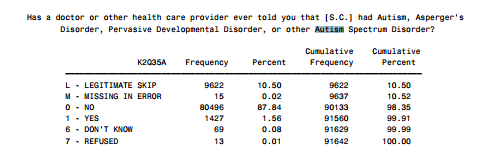
Consider the 2007 dataset.Here is a list of raw data from the 2007 NSCH. 1427 parents, or 1.56% of parents answered yes to “Has a doctor or other health care provider ever told you that [S.C.] had Autism, Asperger’s Disorder, Pervasive Developmental Disorder, or other Autism Spectrum Disorder? ” [S.C] is the code for the child being discussed (selected child or something to that effect). (as with all figures in this article, click to enlarge).
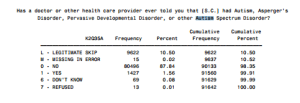
NSCH 2007 ever told

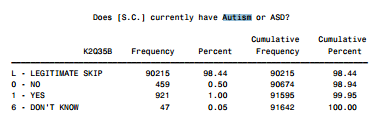
Again, 1427 parents who said that some medical professional had stated the child was autistic in the past. Of these 459 answered no to “Does [S.C.] currently have Autism or ASD?”

NSCH 2007 still autistic

What’s going on there? Again, are these kids recovering? It’s a question certainly worth looking in to. The researchers felt it needed more attention and in the 2011/12 survey, discussed below, the researchers did ask more questions about autism and this subgroup.

The 2011-12 NCSH was published this past year (March of 2013). Once again they asked autism-related questions. The prevalence estimate from this survey was about 2% (1 in 50). In all, 2.13% answered yes to “Has a doctor or other health care provider ever told you that [S.C.] had autism, Asperger’s disorder, pervasive developmental disorder, or other autism spectrum disorder? ” [S.C] is the code for the child being discussed (selected child or something to that effect).

NSCH ever told

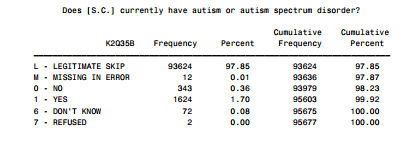
They then asked, “Does [S.C.] currently have autism or autism spectrum disorder?” and 0.36% said no. I.e. out of the 2.13%, 1.7% said that, yes, they report that their child is autistic. After controlling for some factors, an estimated prevalence of 1 in 50 (2%) was reported.

NSCH still autistic

So, what about the 343 kids who were previously identified as autistic but who aren’t now. 343 kids are about 17% of all those ever identified as autistic. But in 2007, about 33% of parents answered “no” to “Does [S.C.] currently have autism or autism spectrum disorder?” I.e. the fraction of these potentially recovered kids went down by 1/2. In 4 years. If those kids are a measure of autism recovery, something dramatic is happening. As in, autism recovery rates are dropping fast.

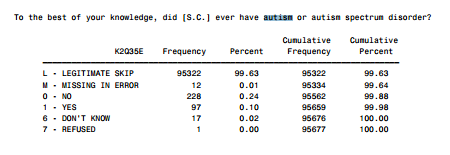
Luckily we can test whether these kids do represent autism recovery. The authors of the NSCH added new questions to the 2011-12 survey. First they asked the obvious and important question “To the best of your knowledge, did [S.C.] ever have autism or autism spectrum disorder? ” 228 parents, 0.24% of the total population surveyed, said “no”. Only 97 said “yes”.
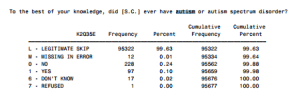
NSCH ever had.

That’s a lot of numbers, so let’s recap. In the 2011/12 survey:

95,677 parents were surveyed
2,041 answered that at some time they were told their child was autistic
343 of those said their child is not currently autistic
228 of those said that their child never was autistic.

Most of the kids who “lost” their autism label were never autistic to begin with.

Of the total kids in the “ever identified autistic” group, 97/2041 or about 5% said that they believed their child was autistic at one time in the past but was not in the present. Not 20%, not 30% as some have suggested. 5%. Still worth investigating, but not the high numbers I sometimes hear people quote.

The survey authors asked two follow up questions to the parents who reported that their child is not currently autistic but was in the past “Treatment helped the condition go away” and “The condition seemed to go away on its own”. For those looking for support that some therapy or combination of therapies is recovering kids: 69 parents out of 2043 reported that their kid lost the autism label and that treatment was the primary factor in the loss.

69/2043: we are talking about roughly 3%.
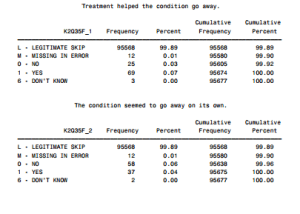
NSCH follow up

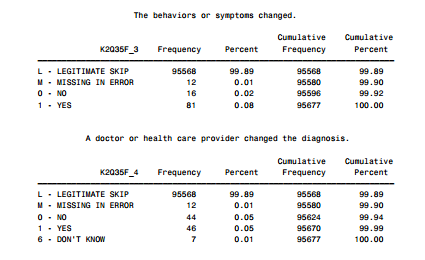
They also asked parents to comment on whether “The behaviors or symptoms changed” or “A doctor or health care provider changed the diagnosis”.
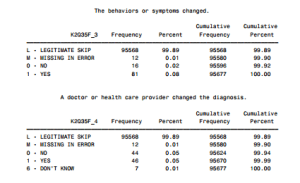
NSCH more questions

There are a few other questions on autism. For example, “With more information, the diagnosis was changed” (158 parents said yes). And “A doctor or health care provider changed the diagnosis” (46 parents said yes).

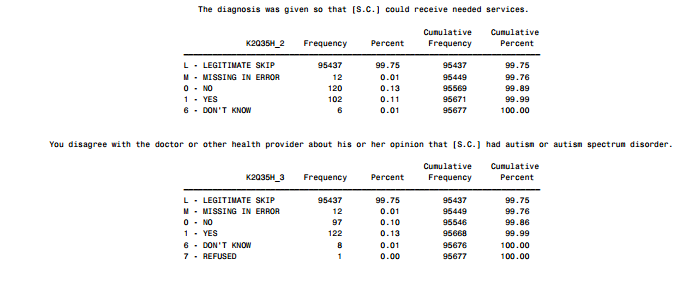
The last two autism questions are very important: “The diagnosis was given so that [S.C.] could receive needed services” and “You disagree with the doctor or other health provider about his or her opinion that [S.C.] had autism or autism spectrum disorder”. Out of the 343 children who “lost” their diagnoses, 102 (30%) parents say the diagnosis was given to obtain services. 122 (36%) of parents say they disagree with the original diagnosis.

The parents report that these kids were never autistic.

NSCH last autism questions

To summarize–Yes, a significant fraction of the children in this survey reported as once holding an autism label are not currently autistic. About 17%, to put a number on it. And, of that 17%, many have social factors involved in their “loss” of an autism diagnosis: incorrect diagnoses, the search for services, etc.. About 5% of autistic kids are reported by their parents as once really being autistic but not presently autistic. Are these kids a subgroup of actual recovery? It’s hard to tell.

One can drill down further into the data and get more insight about this group, but that will wait for another article.

The bottom line is simple, though. The National Survey of Children’s Health does not support the idea that 20-40% of autistic children are recovering. Maybe a few percent are, and with small numbers that will make studying this subgroup very difficult.


By Matt Carey

note: numerous edits were made for readability, but no substantial changes to the basic information was made.

My response to Mrs. Wright of Autism Speaks

20 Dec

As I recently wrote, Autism Speaks has once again shown it’s lack of respect for autistics and their parents with an opinion piece by Mrs. Suzanne Wright, co-founder of Autism Speaks.

I left the message below in response to Mrs. Wright’s piece.

I can not resign any position with Autism Speaks, as John Robison has done. I have been a member of one autism organization–a group which later became the local chapter for Autism Speaks. I resigned that group when they showed that they would waste their efforts lobbying against legislation that had nothing to do with autism. I’m glad I quit then.

One thing autism has taught me is that so many things we take for granted are gifts. It is a gift to have average or above intelligence. We don’t earn intelligence. It is our responsibility to use our gifts well.

Mrs. Wright, you aren’t using your gifts. After years with the autism community, you continue to speak for us as without understanding us. You aren’t using your gifts. My kid will never have the ability to understand the world like you can. Your gifts are squandered and that is a terrible shame.

I am doing more than “existing”. I am living. Is it harder with a disabled kid? Sure. It’s harder for him.

Use your gifts. Much more–use the gifts of those working for you. Learn how to frame the situation as being difficult, for that is what it is. But not as a life without hope. A life of despair.

I live. I love. I have joy. My son lives. Loves. Has joy. I have not lost touch with him. He has not lost touch with me.

It will be harder for him to enjoy life if the world sees him as less than a full person. It will be harder for him if we don’t put his needs first rather than mine. Please learn to put first the needs of the people we represent and advocate for.

If we in the autism community can’t put forth this message, how can we expect the rest of the world to do so?

Before we can craft a national plan we in the autism community must have a plan of our own. It must start with respect. Respect for autistics. Respect for families. And you are not showing that.

I saw the response Autism Speaks put forth in your home town newspaper in Florida. Please stop dodging this important question by framing it as “high functioning” adults vs. parents of “low functioning” children. Many of us who are parents of children with great challenges disagree with your stances. We’ve been telling you this for years. It’s time to listen.


By Matt Carey

Autism Speaks: it’s time to listen

18 Dec

I’ve always found the Autism Speaks motto ironic: “Autism Speaks. It’s time to listen.” Change he period to a colon and you get “Autism Speaks: it’s time to listen”. And, please, could you start listening, Autism Speaks?

Autism Speaks got off to a rocky start. Although they claimed an ” overwhelming positive response from the autism community”, the rollout of the organization was met with much criticism. Autism Speaks co-founder Suzanne Wright adhered to the “missing child” model of autism with phrases like: “It is as if he’d been kidnapped, or somehow had his mind and spirit locked in a dark hole deep within him”. She also had the parent-centric model of the autism community with phrases like “Such an effort must be driven by those with most at stake: the parents of autistic children.”

Shortly after their launch, Autism Speaks released a short film, Autism Every Day. While Autism Speaks told themselves and the world that the response was positive, in reality there was a great deal of negative reaction. (e.g. here, here, here, here, and more.)

It took years, but eventually Autism Speaks listened. The video disappeared from their website and YouTube channel.

Another video debacle came in the form of “I am autism” which depicted autism as a sinister monster stealing babies and ruining parent’s lives. Here’s the transcript in case you think I’m exaggerating. The video is now also removed.

Every now an then, I feel hope for Autism Speaks. There are some really excellent people at AS. AS took on the phrase “different, not less“. Sometimes a blog post comes by that I particularly like. And a lot of their research portfolio is quite good.

Then you get announcements like this one: Autism Speaks to Washington – A Call for Action. And we see that we are back to 2006. We are back to “I am autism” but this time it’s phrased “This is Autism”.

As a result of that opinion piece, John Elder Robison quit. He was one of the few (if not the only) autistics working in a high profile position with Autism Speaks. Here’s a section from his article, I resign my roles at Autism Speaks:

For the past four years I have worked very hard to defend Autism Speak after a series of public relations missteps; beginning with the I Am Autism video. The most recent “Autism Speaks Point of View” http://www.autismspeaks.org/news/news-item/autism-speaks-washington-call-action shows me that my words and efforts have had no real impact on the beliefs of the actual leadership of the organization.

I have tried to help Autism Speaks staffers understand how destructive its messages have been to the psyches of autistic people. We do not like hearing that we are defective or diseased. We do not like hearing that we are part of an epidemic. We are not problems for our parents or society, or genes to be eliminated. We are people.

We do have problems, and we need help. Some of us need counseling or training, while others have significant medical challenges. We also need acceptance, and support. There is a great diversity in our community, which means we have a very broad range of needs. Unfortunately, the majority of the research Autism Speaks has funded to date does not meet those needs, and the community services are too small a percentage of total budget to be truly meaningful. We have delivered very little value to autistic people, for the many millions raised.

A newspaper in Palm Beach, Florida (where the Wrights have a home) published the article: Autism Speaks post rattles some readers One board member resigns, saying he can’t stand by co-founder Suzanne Wright’s views. While they couldn’t get a comment from Mrs. Wright, they did get some statements from Autism Speaks itself.

Autism Speaks took the old cop out. Whenever there’s a discussion of whether a depiction of autism is demeaning, one can count on hearing the argument that the discussion is between parents of “severely” autistic kids and “high functioning” adults.

Michael Rosen, executive vice president of strategic communications at Autism Speaks, said Robison was the only one who resigned over the post. He said the organization understands that higher-functioning people with autism may have a different point of view about the issue.

“The people who are not sick, not unhappy, and are totally fulfilled and happy with their differences, we totally support them as well,” Rosen said. “We’re not looking to change anybody, we’re looking to support and get services for everyone who needs them.

“What that column had was a lot of empathy for those who are struggling the most. But for those who just need support and services, we work for them as well.”

Eight years ago Autism Speaks could pretend to be ignorant of the fact that much, a great deal in fact, of the criticism they get is from parents like me. Parents of children. Children who are “struggling the most”.

Then there’s the old “they see autism as a good thing” bit:

He said some people with autism feel it’s “a good thing” that just makes them “neurologically different. It’s a matter of diversity, and diversity is a good thing. We understand that and get that. They’re proud of their diversity and we salute them.”

Unless John Robison was VERY different at Autism Speaks meetings than the John Robison I’ve seen at IACC meetings, Mr. Rosen had no business saying what he did. Perhaps he could have read Mr. Robison’s resignation article:

I celebrate the gifts autism brings us, and I have discussed at length the emerging realization that autism – as a neurological difference – confers both gift and disability on everyone it touches. It’s the fire the moves humanity forward, while simultaneously being a fire that can burn us individuals as we try to make our way.

Many autistic people are aware of this dichotomy. Some of us feel “totally disabled” and others feel “totally gifted.” Most of us – I’d venture to say – feel both ways, at different times, depending on what we’re doing at that particular moment.

It’s so much easier to build the straw man that criticism comes from those who are “totally fulfilled and happy” than to face the criticism head on.

Doing a quick google search, I found these criticisms of Mrs. Wrights op-ed:

A Reporter’s Guide to the Autism Speaks Debacle
by Lucy Berrington, autistic adult

AWN SQUARES OFF WITH AUTISM SPEAKS OVER NATIONAL AUTISM PLAN
by the Autism Women’s Network

A Poem For Suzanne Wright. A Call To Action; A Call To Be. November 15, 2013
By Cheairs Graves, mother of an autistic child.

no more – a letter to suzanne wright
by Jess, mother of an autistic child.

The Price We Pay for Autism Speaks
by Heather Clark, mother to two autistic children

Why Autism Speaks Doesn’t Speak for Me
by Emily Willingham, mother of an autistic child.

And there’s more. I did run into a couple articles supporting Mrs. Wright too. But this isn’t about who has more articles, it’s about the fact that Autism Speaks chose to frame the discussion in a very simplistic and, frankly, insulting way. They dismiss the criticism and ignore the fact that much of it comes from parents. The people Autism Speaks claims to represent in this discussion.

Autism Speaks: it’s time to understand.


By Matt Carey

Meeting of the Interagency Autism Coordinating Committee January 14, 2014

17 Dec

Below is the announcement emailed by OARC (the Office of Autism Research Coordination) announcing the next Interagency Autism Coordinating Committee meeting. The meeting will be held on January 14th. Deadline for submission of comments is January 7th.

Note: I serve as a public member to the IACC but my comments here and everywhere are my own.

Meeting of the Interagency Autism Coordinating Committee
Please join us for an IACC Full Committee meeting that will take place on Tuesday, January 14, 2014 from 8:30 a.m. to 5:00 p.m. ET at the National Institutes of Health, 31 Center Drive, Building 31, C Wing, 6th Floor, Conference Room 6, Bethesda, MD 20892.  Onsite registration will begin at 8:00a.m.

Agenda: The committee will discuss and finalize the 2013 IACC Strategic Plan Update and discuss committee business, agency updates and issues related to autism spectrum disorder (ASD) research and services activities.

Meeting location: National Institutes of Health

31 Center Drive

Building 31, C Wing, 6th Floor, Conference Room 6

Bethesda, MD 20892

Nearest Metro stop:

Medical Center – Red Line

In the interest of security, NIH has instituted stringent procedures for entrance onto the NIH campus.  All visitor vehicles, including taxicabs, hotel, and airport shuttles will be inspected before being allowed on campus. Visitors will be asked to show one form of identification (for example, a government-issued photo ID, driver’s license, or passport) and to state the purpose of their visit.

Pre-Registration:

The meeting will be open to the public and pre-registration is recommended. Seating will be limited to the room capacity and seats will be on a first come, first served basis, with expedited check-in for those who are pre-registered. Please visit the IACC website for access and information about registering.

Public Comment – Deadlines:

Notification of intent to present oral comments: Tuesday, January 7th by 5:00p.m. ET

Submission of written/electronic statement for oral comments: Wednesday, January 8th by 5:00p.m. ET

Submission of written comments: Wednesday, January 8th by 5:00p.m. ET

Remote Access:

The meeting will be remotely accessible by videocast  (http://videocast.nih.gov/) and conference call. Members of the public who participate using the conference call phone number will only be able to listen to the meeting.

Conference Call Access
USA/Canada Phone Number: 888-769-9402
Access code: 4632869

Individuals who participate using this service and who need special assistance, such as captioning of the conference call or other reasonable accommodations, should submit a request to the contact person listed above at least five days prior to the meeting. If you experience any technical problems with the conference call, please e-mail at helpdeskiacc@gmail.com or call the IACC Technical Support Help Line at 415-652-8023.

Please visit the IACC Events page for the latest information about the meeting, including registration, remote access information, the agenda, materials and information about prior IACC events.

Contact Person for this meeting is:

Ms. Lina Perez
Office of Autism Research Coordination
National Institute of Mental Health, NIH
6001 Executive Boulevard, NSC
Room 6182A
Rockville, MD 20852
Phone: 301-443-6040
E-mail: IACCpublicinquiries@mail.nih.gov

The hearing that wasn’t

21 Nov

There’s been a lot of internet chatter for the past few months about a hearing by the U.S. House of Representatives’ Committee on Oversight and Government Reform. The hearing, if we are to believe the internet chatter, was promised by the committee chair, Darrell Issa but has been cancelled, postponed, or by some other name has gone from a hope to nothing. By what is surely pure coincidence, a prominent member of one of the groups calling for and talking about the hearing was one of Representative Issa’s largest political donors this year. Perhaps it was due to the Committee’s busy schedule, investigating hot topics like “Reviewing Alternatives to Amtrak’s Annual Losses in Food and Beverage Service

Oversight has held a number of hearings in the past on autism and vaccines. Most were in the old days, when Congressman Burton was pushing his agenda hard (but not his witnesses–he let Andrew Wakefield pass on a misleading response to a question of how his research was funded). Last year Congressman Issa (again after donations) held a hearing on the government’s response to the rise in autism prevalence. Congressman Issa then proceeded to not support autism or vaccine related legislation. Not that I’m cynical, mind you, but I don’t see the value behind all the work and donations to get a few YouTube videos of members of congress talking about a topic they aren’t going to really throw their support behind. Then again, I don’t see the point in trying to make a political movement out of a failed hypothesis (or two or three) and a shrinking base of support.

The autism communities could use the support of congress. We could use some legislation. If I may say so, I think we need support to re-authorize the Combatting Autism Act, which sunsets next year. We need support for the disability communities, like services. Do the parents (and the support for this hearing was from a subset of the autism parent community) involved with the hearing feel that, say, the schools have the money and tools they need? Do they feel that there’s adequate support for autistic adults? Probably not. But they throw their passion, their time and their money behind hearings which wouldn’t even result in a diffrence for their own focus on vaccines.

Congress has better things to do. Like gridlock. We parents have better things to do, like making congress stop gridlock long enough to make a difference in our kids’ lives.


Matt Carey

Age of Autism expresses concern over “acting in the best interests of the child”

27 Oct

A while back I stopped reading the blog “age of autism”. It’s repetitive, degrades people with disabilities and, in general, is applying 99% of their effort to counterproductive aims. My google news searches for “autism” are “autism -“ageofautism.com””. But, once in a while, something sneaks through. Such is the case today.

Consider the United Nations Convention on the Rights of Persons with Disabilities (CRPD). It’s an international agreement, up for ratification in the U.S.. From the U.N.’s FAQ on the Convention:

What are the principles of the Convention?

Article 3 sets out the General Principles that apply to the enjoyment of the rights of persons with disabilities. These are:

• Respect for inherent dignity, individual autonomy, including the freedom to make one’s own choices and independence of persons
• Non-discrimination
• Full and effective participation and inclusion in society
• Respect for difference and acceptance of persons with disabilities as part of human diversity and humanity
• Equality of opportunity
• Accessibility
• Equality between men and women
• Respect for the evolving capacities of children with disabilities and respect for the right of children with disabilities to preserve their identities.

Most countries have ratified the Convention. Here is an analysis by the U.S. National Council on Disability.

Why is AoA concerned? “The fundamental concern with this document is its adoption of the “best interests of the child” standard.”

Yes. Let’s shoot down an international agreement that gives people with disabilities accessibility, opportunity, equality, inclusion and the rest. Because we wouldn’t want to act in the best interests of children.

Many states in the U.S. already use the “best interests of the child” standard in many aspects. In fact,

All States, the District of Columbia, American Samoa, Guam, the Northern Mariana Islands, Puerto Rico, and the U.S. Virgin Islands have statutes requiring that the child’s best interests be considered whenever specified types of decisions are made regarding a child’s custody, placement, or other critical life issues.

Why would AoA be afraid of putting the child’s best interests as paramount?

As you know Michael Bloomberg is now pushing for universal vaccinations for all preschoolers. This requirement will be mandated nationally with ratification of the UN CRPD and, ultimately with the ratification of the UN CRC.

Yes. Fear vaccines. Fear the government. The author of the AoA article makes huge leaps of logic (nothing new for AoA, I know) to claim that if we ratify the Convention on the Rights of Persons with Disabilities, children will be vaccinated.

The woman who wrote this article may not even have a direct connection to the autism community or the disability community. She’s using the fear government+vaccine angle to try to get support for her cause at AoA. Here are her reasons for disliking the Convention. The CRPD would somehow give rights to homosexuals. Can’t have that here in America, can we? Well, except for here in California where we once again have marriage equality…or many other places in the U.S….

If we believe her, the U.N. will tell the U.S. how to spend it’s money, including making us help poorer countries (oh, no, let’s not help poor countries). It isn’t going to happen, but let’s fear it.

Also,

According to Article 23, the disabled have a right to make reproductive health and family planning decisions and a right to be educated about those decisions and given the means to carry out those decisions.

Can’t give those rights to the disabled, can we?

Many countries have ratified the CRPD. Years ago. Does she give examples of other countries, say England, France, Inda, China, where her predictions have come true? No. They are just fear mongering.

The ironic tagline for the AoA piece? “Ignore your rights and they will go away”. So when we as a nation see abuses in another country, abuses of the rights of the disabled, we can complain. And wait for the response, “but you won’t even ratify the CRPD”. Yes, let’s not ratify an agreement on rights for people with disabilities. Let’s not affirm that our own citizens have rights irrespective of disability. AoA is supposedly a community of parents of autistic kids. Let’s not protect the rights of those children. Fear of a parent losing his/her rights to not vaccinate (which is only that, fear, not a real prediction of what might actually happen) should stand in the way.

And, let’s not forget the unspoken fear. That parents might lose their rights to try anything and everything as a “therapy”. It’s a parent’s right, after all, to give a disabled child bleach containing enemas. Or make the kid drink a bleach solution. Or to ingest a drug which shuts down sex hormone production during puberty. Or be subjected to chelation without being appropriately diagnosed with heavy metal poisoning. Subjected to chelation often for years, when a standard course of chelation is very limited in time. Or to take one’s child to another country for infusions of what may or may not be stem cells, without any good science to back up the practice. Or to use an industrial chelator, designed for treating mining waste, untested for safety on humans, as a “supplement”.

Let’s not consider what is “best for the child”. No, parent rights are at stake.

When were we parents given the right to do things which are not in the best interests of our children? And, if we had that right, why would we put protecting that right in front of a chance to improve the rights of the disabled?

I gave up on reading AoA. Good idea that.


By Matt Carey

Geiers lose case against PSC

20 Oct

The attorneys for the families in the Omnibus Autism Proceeding (OAP, the class-action type hearings held in the “vaccine court”) were grouped into the “Petitioner’s Steering Committee” (PSC). The PSC hired experts to help their case. Mark and David Geier did not serve as experts on the OAP but felt that they deserved compensation. $600,000 in compensation. Nearly 10% of the total costs for the OAP.

Thanks to Left Brain/Right Brain commenter Anne, we now know the Geiers lost this suit.

The Geiers presented eight counts, and failed to make them stick

Count I — Breach of Contract;
Count II — Joint Venturer Liability for Breach of Contract;
Count III — Ratification;
Count IV — Implied Contract;
Count V — Unjust Enrichment;
Count VI — Joint and Several Liability for Professional Negligence (Malpractice);
Count VII — Civil Conspiracy for Fraud; and
Count VIII — Breach of Implied Warranty.

Here are some excerpts from the decision:

In sum, the Geiers have failed to present a factual basis for the Court’s exercise of specific personal jurisdiction over the Law Firms

Even if the Court has personal jurisdiction over the Law Firms due to their continuous and systematic contacts with the District of Columbia, it is necessary to dismiss the Complaint for failure to state a claim.

The Geiers’ malpractice claim is based on the disingenuous assertion that the agreement to assist the Geiers in petitioning the Vaccine Court for fee payment created an attorney-client relationship between the Geiers and the Law Firms. This allegation is not “plausible on its face.”

The Geiers’ civil conspiracy allegations are threadbare accusations that fail to state a claim, see Iqbal, 556 U.S. at 678, let alone meet the heightened pleading standard required by Rule 9(b).

One does wonder where the future lies for the Geiers. Mark Geier (the father and doctor of the team) is 65 and could retire. David Geier (the son who holds a B.A.) is a bit young for retirement. Mark Geier’s medical licenses have been suspended. The Special Masters in the vaccine court have made it clear that neither Geier is qualified to act as an expert or a consultant. And, now, the Geiers have burned bridges with many of the attorneys in the vaccine court. I’ve heard that the Geier address in Florida is registered as a mail order pharmacy.


By Matt Carey