Archive | Authors RSS feed for this section

Mayer Eisenstein files for bankruptcy…again

22 Jan

Mayer Eisenstein is a go-to person in the vaccines-cause-autism community. He heads a large practice in the Chicago area and claims that his unvaccinated children do not have autism. He also was or is a part of the “Lupron Franchise”—a group of practitioners who took on the Geier idea that shutting down sex hormone production in autistics could be a treatment. It was a profoundly bad idea.

Mayer Eisenstein was the subject of an article in the Chicago Tribune: Autism doctor: Troubling record trails doctor treating autism. From that article:

Yet his suburban Chicago practice, currently known as Homefirst, garnered an alarming record: It was on the losing side of one of the largest U.S. jury verdicts — $30 million — ever awarded to the family of a newborn in a wrongful-death suit.

In court records dating back three decades, the families of dead and brain-damaged children repeatedly alleged that doctors who work for Eisenstein made harmful mistakes — sometimes the same error more than once. His practice also has been dogged by accusations in court records that its offshore malpractice policy was phony.

After the $30M verdict, Mayer Eisenstein filed bankruptcy. Which was not permitted. Again from the article above:

With bankruptcy off the table, a Cook County judge acknowledged the practice’s claim of insolvency, consolidated the $30 million verdict, five remaining malpractice cases and two civil fraud cases and ordered mediation.

Last July, the judge approved a $1.275 million settlement that Homefirst must divide among six families over seven years. Eisenstein’s practice made the first $100,000 payment last September, four months before he opened the autism clinic.

It appears that the $1.275M settlement noted above is the topic of a battle ongoing in the current bankruptcy filing by Dr. Eisenstein. Per the complaint:

The aggregate Settlement Amount of $1,275,000 represents a small fraction of the total of claims by the Personal Injury Plaintiffs, some of which had reached verdict and judgment.

In other words, it appears Mayer Eisenstein wasn’t allowed to avoid payment by filing bankruptcy, but he did reduce the payments dramatically. The settlement also included a payment schedule. The families claim that four annual payments for a total of $430,000 were made, then the payments stopped after 2011. They claimed (as of August 2013):

Installments to Be Paid on or Before: Amount

September 22, 2012 (not paid when due). . . . . . . . . . . . $ 140,000.00

September 22, 2013 (not yet due). . . . . . . . . . . . . . . . . . $ 150,000.00

September 22, 2014 (not yet due). . . . . . . . . . . . . . . . . . $ 160,000.00

September 22, 2015 (not yet due). . . . . . . . . . . . . . . . . . $ 395,000.00

Total due and unpaid and to become due $ 845,000.00

Per the docket, the case was scheduled to go to hearing last month.

In short, it appears that a multiple families were injured by Mayer Eisenstein and/or member of his practice. They sought and were granted damages, only to have Dr. Eisenstein negotiate those down in a 2004 bankruptcy filing. Dr. Eisenstein made some payments, but then stopped. And he now appears to be trying to avoid further payments as part of his new bankruptcy filing, which the families are fighting. Again.

Why, one might ask, didn’t the families get some secutity pledged to cover the settlement should Dr. Eisenstien stop payments? Seems a reasonable thing to do. The answer is they did. It appears that the property he pledged as security was not under Mayer Eisenstien’s control. In other words, when the families sought to get the property in lieu of the payments, they found that Dr. Eisenstein (who holds a law degree in addition to his medical credentials) couldn’t directly hand it over.

The records of the Office of the Recorder of Deeds of Cook County, Illinois disclose the following transactions for the property at 1101 Dodge, Evanston, Illinois, PIN 10-24-

208-032-0000:

(a) Karen Eisenstein (Mayer Eisenstein, M.D.’s spouse) took title by a deed recorded on April 29, 2002 as document number 0020384408.

(b) Karen Eisenstein transferred title to North Star Trust Co. Tr. # 36189 by a deed in trust recorded on June 11, 2003 as document number 0316239026.

25. Paragraph 6 of the Circuit Court order of July 12, 2008 further provides:

“6. Plaintiffs are to have secured creditor status in the event of an applicable bankruptcy filing.”

So, it would appear that Mayer Eisenstein pledged a property as security for the settlement—a property which he had transferred to his wife in 2002 and which she had transferred to a trust company, in 2003. In other words, to this layman, it appears that at the time he put the property up, it was effectively shielded from actually being used as security.

Another question that one would reasonably ask is why weren’t these claims paid by malpractice insurance? That gets very convoluted, but the original settlement agreement included the statment

“I. Defendants in this matter affirm that they do not have any liability insurance coverage for any of the claims of the remaining plaintiffs.”


Defendants would be Mayer Eisenstein and his practice. And here is where it gets convoluted. The current complaint states

45. At one of the meetings pursuant to Section 341 of the Bankruptcy Code, Mayer Eisenstein, M.D. stated that from time to time he has malpractice insurance to allow him to be on staff at an area hospital.

46. At that same meeting, Mayer Eisenstein, M.D. stated that he did not submit any of the claims to that malpractice insurance carrier, because, as he claimed, if he had the insurance would have been cancelled, and he could no longer use the hospital

47. If Mayer Eisenstein, M.D. had medical malpractice insurance coverage in place at a time when the claims or one or more of the Personal Injury Plaintiffs cases arose, then the
statement was false.

Maybe he didn’t have insurance. Maybe he did and didn’t submit the claims.

Let’s take a look back at the Chicago Tribune article. In addition to discussing the Lupron clinic Dr. Eisenstein set up, it also discusses his history with insurance:

He also dabbled in group health plan sales to Illinois families but tangled with state insurance regulators in the mid- to late 1990s. Regulators warned consumers in a newsletter that Eisenstein “continued to illegally market” the Homefirst Health Plan, based in the British Virgin Islands, even after they told him the plan was ineligible. Despite this, he continued selling the plan, records show, and they ordered him to “cease and desist.”

In an interview, Eisenstein said he was offering a “fraternal health plan,” not traditional health insurance, so he said he didn’t have to listen to regulators. He no longer sells health plans.

And, later:

After Nathan Howey’s death, Weiss Hospital sued Homefirst, Rosi and Eisenstein for fraud, alleging they misrepresented their Caribbean-based malpractice policy. Eisenstein testified that he was in St. Kitts helping one of his daughters, a veterinary student there, buy a condo when the lawyer who helped arrange the sale told Eisenstein he also sold malpractice insurance.
“I was tickled pink to get insurance,” he said under oath.

A Cook County judge called it an “improperly underwritten insurance plan.” Eisenstein, who says the policy is legitimate, agreed to pay Weiss $50,000 after mediation.

Yes, “tickled pink” to get insurance. From a Caribbean island real estate/insurance salesman.

For those interested, here are some of the documents from the case discussed above.

Case 13-01050, lawsuit

Exhibit A

Exhibit B


By Matt Carey

Jenny’s McCarthy’s vaccine narrative called into question

16 Jan

Jenny McCarthy is the face of vaccine rejectionism in America. The story she tells of how her son, Evan, became autistic after his MMR shot is arguably the origin myth for the anti-vaccine movement, and the legions of  “Warrior Mothers” who follow her. Now, a competing narrative from someone else close to Evan calls the myth into question.

“I have such tremendous guilt for not speaking up when I knew something wasn’t right,” says Joyce Bulifant, Evan’s paternal grandmother. “But I was afraid of Jenny, and didn’t want to be the interfering mother-in-law. I was more concerned about me than taking care of Evan.” She agreed to speak with AutismNewsBeat.

McCarthy’s many critics have pointed to her numerous contradictions. She told Oprah Winfrey, for example, and there is “no doubt in my mind” that the MMR vaccine caused her son Evan’s autism. But she has also written that Evan showed signs of delay by six months – one year before the shot.

“I don’t think she’s very fond of me, but I love her because she is Evan’s mother. It makes me sad that we don’t have a true relationship,” says Bulifant. “That makes me very sad.”

The elf on the shelf

Bulifant is no stranger to Hollywood. The Virginia native has been acting for more than 50 years, and is well known for playing Murray Slaughter’s wife, Marie, on the Mary Tyler Moore Show. She was also a regular on The Match Game, and appeared in Airplane! (1980). She lives in Palm Springs with her fourth husband, actor and composer Roger Perry. Joyce has 15 grandchildren, and they all call her LaLa. When she speaks of Evan, who was born in May, 2002, it’s easy to imagine he is the favorite.

“Evan was here for Thanksgiving, and he left a note on my fridge that I just can’t take down. It reads ‘Dear LaLa, I hope that you love me so much. Thanks, Evan. I love you to the moon and back.

P.S., the Elf is in the freezer with turkey.”

The elf is a small, felt doll that sits on a shelf.

“He used to be afraid of the Elf on the Shelf, but last year he started moving it around the house, hiding it in different places and making it reappear. He said it had magical powers,” says Bulifant. “I love playing magic with him. He’s so very dear. It’s like he has a sixth sense that I don’t have.”

That sixth sense sparks her sense of wonder. “I am dyslexic and so is my son (Evan’s father, John),” she says. “We do compensate when we don’t have all the typical skills. The compensation part fascinates me. T

o me Evan is magical and wonderful and I love him to death.”

Bulifant’s conversation is sprinkled with sweet and simple stories about the boy she loves.  One time at L.A.’s Getty Museum, she said, Bulifant and Evan were throwing quarters into a fountain to make a wish

“I wish you would always love me,” said Evan.

“I wish you would always love me,” she said.

“LaLa, that’s my wish!”

Bulifant said she was concerned about Evan’s months before his first birthday.

“I remember Christmas, 2002 (age seven months). I was bathing him in the sink, and trying to get him to giggle and respond to me, but he seemed detached. My family was a little concerned but I didn’t say anything to Jenny because I know children develop at different times. But I was concerned.”

And then there was the incident in the park, another example of how difficult it is to see autism in a loved one.

“We took him to the park, and he started running away from us. We called, but he didn’t even turn around. We wondered if his hearing was impaired,” sh

e says. “That didn’t seem right. So I was testing him in the car seat on the way home. ‘Where is your nose? Where are your ears?’ I asked Evan. He didn’t respond, and I wondered what was going on. Then, when we pulled up in the driveway, Evan suddenly pointed

to h

is mouth and said ‘mouth’, and then he pointed to his ears and said ‘ears.’ It was like he was saying ‘Silly gramma, I know where my mouth and my ears are!’”

Joyce has been active in dyslexia education and advocacy for years, and she called on her research contacts for help. “By the time Evan was 18 months old, I was convinced he had autism,” she says.

Bulifant was wary of approaching McCarthy, who had written two books by that time that made it clear she didn’t appreciate parenting advice from others.

“She wrote ‘I don’t want anyone telling me what to do as a mother,’” says Bulifant. “I was trying to be a good mother-in-law and a good grandmother at the same time. I don’t think I even said anything to John. Everything I read pointed to autism.”

One day, while John was off directing in North Carolina, and Bulifant was staying at Jenny’s Los Angeles home, the “Good Grandmother” spoke up, and asked the nanny about Evan’s development. The nanny reacted defensively.

“I want to ask you something. Have you noticed that Evan doesn’t always connect with me?“ asked Bulifant.

“Jenny is a wonderful mother and he always connects with me.”

“He does watch a lot of television, ” said Bulifant, “and I’m wondering if that means he’s not used to interacting.”

“Evan is fine and always interacts with me. “

Bulifant retreated. “I thought maybe I was just me being a silly grandmother.”

She and her husband left the house for a few hours, and when they came back nobody was home.

“I was terrified that something had happened to Evan.” Then John called, and said that Jenny was “very upset “about the conversation with the nanny.

“You just can’t say anything about Evan,” John continued. “She gets very upset.” He said McCarthy would not come back home until Bulifant and her husband left the house.

Which they did.

Back home, Bulifant wrote a letter of apology to McCarthy. “Jenny wrote back saying ‘You shouldn’t have said anything to the nanny. You should have said it to me.’ And she was right, I should have. I was just afraid. I didn’t want to be the interfering mother-in-law.

“It was very wrong, and that is something I have to live with,” says Bulifant.

McCarthy has told a similar story:

Others had noticed something different about Evan, too. “My mother-in-law said, ‘He doesn’t really show affection,’ and I threw her out of the house,” Jenny says. “I went to a play gym, and the woman [there] said, ‘Does your son have a brain problem?’ … [I said], ‘How dare you say something about my child? I love him. He’s perfect. You can’t say that about a child.’ I just had no idea.”

Bulifant says that after being “thrown out of the house,” she and McCarthy have only spoken a few times, and for the last two years have communicated only through occasional texts.

Seizures and celebrity

Evan’s autism, and Bulifant’s collision with McCarthy’s “strong personality” created another issue. It’s what she calls her “moral problem” for not speaking up sooner about McCarthy’s well-publicized anti-vaccine views. “I know enough about Evan that if I spoke up sooner, more kids would be vaccinated, and fewer would have died or gotten very sick. We’ve seen cases of measles in Texas, and whooping cough killed ten children in California. It breaks my heart. That’s the biggest moral issue in my whole life,” she says.

Vaccines are at the center of McCarthy’s shifting narrative. In one version she says “the soul was gone from Evan’s eyes” shortly after the boy’s MMR vaccine. Here is what she told Oprah in September, 2007:

“Right before his MMR shot, I said to the doctor, ‘I have a very bad feeling about this shot. This is the autism shot, isn’t it?’ And he said, ‘No, that is ridiculous. It is a mother’s desperate attempt to blame something,’ and he swore at me, and then the nurse gave [Evan] the shot,” she says. “And I remember going, ‘Oh, God, I hope he’s right.’ And soon thereafter—boom—the soul’s gone from his eyes.”

McCarthy’s narrative also includes two seizure episodes suffered by Evan, leading to an autism diagnosis. In Belly Laughs, she wrote Evan was diagnosed with a febrile seizure at 2 ½, and three weeks later, he suffered seizures which led to a cardiac arrest, and a diagnosis of epilepsy. By this telling, stereotypical autistic behaviors followed.

Bulifant says the first seizure came in the spring of 2004. Oddly, the news triggered in her a sense of relief.

“I knew that seizures are associated with autism, and that Evan would finally get the diagnosis he needed and finally get help. I wasn’t alarmed.”

The second seizure occurred the evening before Easter Sunday, in Bulifant’s home. “I had an Easter basket for Evan,” she says.

“It was the night before Easter. Evan was so tired that he fell into my arms. I laid him on his bed and took off his shoes and when I looked at him I saw his little eyes rolled into the back of his head. I yelled for John to come quickly. We called 911. John held Evan’s hand and said ‘Don’t worry, you are in a safe place.”

Paramedics arrived. “Jenny was a mess. I now know what ‘wringing you hands mean’, because that’s what I was doing.” The EMTs “bagged” the boy because his breathing was shallow, says Bulifant, then took him to the local emergency room. Jenny rode in the ambulance. Anxious hours followed in the waiting room while doctors stabilized Evan and then allowed family to visit.

Evan’s first words were “Look at that air conditioning vent.”

Jenny and John left Palm Springs with Evan and drove straight to Cedars Sinai Hospital in LA, where he was diagnosed with epilepsy. Joyce felt like screaming – “No, it’s autism!” She had had enough.

“I said to John ‘I now insist that you go to UCLA to see a neurologist.’” By McCarthy’s telling, it took the neurologist 20 minutes to arrive at a diagnosis.

A September, 2007 People Magazine article is typical of how McCarthy tells the story:

This was another seizure, she thought, “but this one is different. He’s not convulsing.” Instead, “foam was coming out of his mouth, (and) and after a few minutes, I felt his heart stop,” she said.

When the paramedics arrived, she told them about Evan’s heart. “They looked at me like I was crazy. I don’t know why,” she said. Only, as they discovered for themselves, the child’s heart was no longer beating, so they administered CPR.

“Why, God? Why me … Why? Why? Why?” McCarthy recalled thinking in those desperate moments, but then, she said, an inner voice came over her. “Everything’s going to come out okay.”

Because there was no pediatric hospital near her parents’ home, Evan and McCarthy drove three hours back to Los Angeles, during which time Evan suffered several more seizures.

Dramatic effect

Another unfortunate dimension to McCarthy’s assault on children’s health is her endorsement of unproven, costly, and potentially harmful alternative therapies for autism. She is front and center at the annual AutismOne conference, where speakers have recommended bleach enemas and chemical castration. Her charitable foundation, Generation Rescue, actively promotes  “a wealth of biomedical therapies that treat the underlying issues of autism inside the body.” These include chelation, hyperbaric oxygen, anti-fungals, anti-virals, and cannabis.

When asked what she thinks of the autism cure industry that Jenny has captained, Bulifant demurs. “I think there is value in eating right and exercise for all children,” she says, her voice trailing off.

But what about telling autistic children they are vaccine injured, or that the soul has been sucked from their eyes? Jenny and her angry mob, as she has called her followers, regularly describe their children as train wrecks, zombies, and worse.

“Jenny says things for dramatic effect,” says Bulifant “I don’t understand that type of thinking. Evan is incredible. One of our favorite things to do is to go looking for lizards. He spots them where I can never see them. I ask him ‘How did you even begin to see that?’”

Still, Bulifant doesn’t hesitate to describe McCarthy as “a very good mother, very caring and trying to do the best for Evan,” adding “I don’t know why she says those things.” She describes her son as good father, and regrets how John has been portrayed as distant and uncaring.

“John never spoke up when Jenny said unkind things about him. I asked him why, and he said it would turn into another ‘Hollywood he said – she said’, and that he wanted to be a gentleman about it, and didn’t want to hurt Evan.”

Does she worry that Evan may one day think he lost his soul to autism?

“I hope that Evan never realizes the things have been said about him. I just don’t want him to ever be hurt. I don’t know if he will ever realize what has been said about him. I hope not.”

Bulifant tries to expose her magical grandson to the arts whenever possible. “I took him to see Billy Elliot, and he loved that. His little mind is working all the time. ”But those bonding opportunities have dwindled since McCarthy moved to the Chicago suburb of Geneva last year. Now, Bulifant watches The View to see new pictures of Evan, and to hear the latest stories.

She says Jenny is doing well on The View.

_____________________

Update from Joyce Bulifant:
I understand and have great empathy for parents of autistic children who want to know the reason for their children’s autism. They understandably latch onto anything they can find as a reason. That might be what Jenny did when Dr. Wakefield gave incorrect information about vaccines. I don’t think she did this maliciously. She just needed a reason.
If people know Evan showed signs of autism before his MMR vaccine, parents wouldn’t be afraid to vaccinate their children, thereby saving lives and much suffering.

Jenny McCarthy, autism families are not your shield

7 Jan

Jenny McCarthy just got herself in the news again. She felt harmed by an article on a celebrity news website and threatened them with legal action. Here’s her statement:

Stories circulating online, claiming that I said my son Evan may not have autism after all, are blatantly inaccurate and completely ridiculous. Evan was diagnosed with autism by the Autism Evaluation Clinic at the UCLA Neuropsychiatric Hospital and was confirmed by the State of California (through their Regional Center). The implication that I have changed my position, that my child was not initially diagnosed with autism (and instead may suffer from Landau-Kleffner Syndrome), is both irresponsible and inaccurate. These stories cite a “new” Time Magazine interview with me, which was actually published in 2010, that never contained any such statements by me. Continued misrepresentations, such as these, only serve to open wounds of the many families who are courageously dealing with this disorder. Please know that I am taking every legal measure necessary to set this straight.

Emphasis mine.

As I already noted elsewhere: don’t use my family as your shield.

Your conventions promote absolute nonsense posing as “therapies”. Forcing disabled children to drink bleach solutions or take bleach solution enemas. Shutting down the sex hormone production in disabled children on the mistaken idea that this will help to remove “toxins”. Chelating disabled kids for faux mercury poisoning.

For parents like me who reject your nonsense, you describe us as: “[they] fall into this victim role, and they like it

News stories about you, correct or incorrect, open no wounds for me.

You added that line to paint yourself as a leader of the autism community. You aren’t.

Stand up and distance yourself from your previous stances on vaccines. That would be leadership. Tell your organization and your parent convention that some of these “therapies” are harming children and you won’t promote them. That would be leadership.

Using autism for self promotion, like you are doing here, that’s not leadership.


Matt Carey

Jenny McCarthy setting the record straight…when it suits her

6 Jan

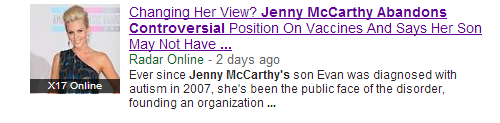
Jenny McCarthy suddenly popped up again in the autism news. Why? Some celebrity website posted an article “Changing Her View? Jenny McCarthy Abandons Controversial Position On Vaccines And Says Her Son May Not Have …”. Note that the link for that story goes to a “404” (page not found). I.e. the story seems to have been pulled.

JennyReturns

The full title seems to have been “Changing Her View? Jenny McCarthy Abandons Controversial Position On Vaccines And Says Her Son May Not Have Autism After All“.

Note, there are two points in that story. The first–that she’s abandoned her controversial position on vaccines. She seems to have dodged that question. The second–that she says her son may not have have autism after all. She made what seems to be a conflicting response to that.

Apparently the original story cited the idea that McCarthy’s son actually had Landau-Kleffner syndrome, not autism. As I recall, that idea was first put forth by Dr. Daniel Ruben in Neurology Today in a letter “Fanning the Vaccine‐Autism Link“. He wrote:

In “After Vaccine-Autism Case Settlement, MDs Urged to Continue Recommending Vaccines” (June 5), Dawn Fallik correctly cites Jenny McCarthy as a celebrity fanning the flames of the vaccine-autism link. McCarthy also makes parents think that autism can be cured with unproven treatments — as she claims is the case with her son — documented in her much publicized book, Louder than Words: A Mother’s Journey in Healing Autism (Dutton 2007).

Unfortunately, what the public does not realize as well as perhaps McCarthy is that her son was most likely misdiagnosed with autism in the first place. His disorder began with seizures and, subsequently, with the seizures treated, he improved. This would be more consistent with Landau-Kleffner syndrome, which often is misdiagnosed as autism.

Daniel B. Rubin, MD, PhD

I can’t recall Jenny McCarthy accepting the idea of Landau-Kleffner, or even commenting on it. So the original story in Radar Online was incorrect and it’s good they corrected their mistake. They posted an new article, “Jenny McCarthy: ‘My Son Does Have Autism’“. He does have autism? Present tense?

Stories circulating online, claiming that I said my son Evan may not have autism after all, are blatantly inaccurate and completely ridiculous. Evan was diagnosed with autism by the Autism Evaluation Clinic at the UCLA Neuropsychiatric Hospital and was confirmed by the State of California (through their Regional Center). The implication that I have changed my position, that my child was not initially diagnosed with autism (and instead may suffer from Landau-Kleffner Syndrome), is both irresponsible and inaccurate. These stories cite a “new” Time Magazine interview with me, which was actually published in 2010, that never contained any such statements by me. Continued misrepresentations, such as these, only serve to open wounds of the many families who are courageously dealing with this disorder. Please know that I am taking every legal measure necessary to set this straight.

Here’s a hint: don’t use “autism families” as a shield. What world do you live in where a story about you, correct or incorrect, “opens the wounds” of people like me?

Let’s pause a moment to acknowledge Jenny McCarthy accusing other people of being “irresponsible and inaccurate”. A statement dripping with irony coming from Jenny McCarthy.

Let’s also notice, we are back to present tense, Evan has autism. If statements that “Evan may not have autism after all” are incorrect, then he has autism now. Present tense.

Why make a big deal out of the tense? Because she’s made statements that her son is no longer autistic. For example, on Larry King Live in 2009:

KING: What is still evident about his autism? In other words, if I spent a day with Evan, what about him would be different about him than any kids.

MCCARTHY: Absolutely nothing. Seizures, that would probably …

CARREY: This is the risk. When he gets a fever we have to worry because there are seizures connected autism, to this disorder.

MCCARTHY: He had a vaccine injury which led to seizures. So we still can’t necessarily say that those are healed, but the autism is [gone].

The transcript had “gob” in place of what I believe was “gone”.

In 2009 autism was past tense. Now it’s present tense. And recall another interview where she says he doesn’t have autism any more.

And let’s address the whole issue of Landau-Kleffner syndrome. The statement by Dr. Ruben was that her child was misdiagnosed, not that he “was not initially diagnosed with autism” as Ms. McCarthy wrote. I don’t know what Radar Online wrote as the story is gone, but it looks like Jenny McCarthy is fighting a bit of a straw man there.

I’ll also note that Jenny McCarthy seems to be taking a page from Andrew Wakefield and the founder of her organization (Generation Rescue) and threatening legal action. It makes news. Why do I figure a phone call, a tweet or some other communication was all that was needed?

But, let’s get back to that original article: Jenny McCarthy Abandons Controversial Position On Vaccines And Says Her Son May Not Have Autism.

Tell me, where in the above statement did she address the vaccine question? Looks to me likes she completely dodged that. Perhaps there’s a statement somewhere else?

So, as far as I can see, she rushed to answer only one part of the original story. The less controversial part.

But that’s Jenny McCarthy.

While she’s storming about, threatening legal action, I wish she would rush to correct the record on other statements she’s made. For example, she hasn’t been exactly clear on how much gap there was between her kid being vaccinated and the onset of his seizure disorder. Her book, as I recall, describes her son experiencing his first seizures at about age 2.5. Which, if he was vaccinated per the schedule, would be about 1 year after his MMR.

But here’s how she told the story:

MCCARTHY: My son died in front of me due to a vaccine injury. And there are many — every week I get a picture of a dead child.

KING: You lost a son?

MCCARTHY: Evan died in front of me for two minutes, cardiac arrest. Every week, I get a picture sent to me of a child that died following a vaccination.

Another time on CNN: “People are also dying from vaccinations. My son died in front of me for two minutes.”

I recall back when McCarthy was popular in autism circles many online discussions recounting how Evan McCarthy died immediately following vaccination. Why hasn’t Jenny McCarthy taken the time to correct that impression?

Back to today, why didn’t she take the opportunity to address her “controversial” ideas on vaccines? I put “controversial” in quotes because they aren’t controversial. They are just incorrect. And irresponsible. I won’t add her other adjective, “ridiculous”, as her statements have caused too much harm to be called “ridiculous”.

Here’s another exchange from a Larry King Live show:

KING: Isn’t the problem here, Jenny, that people sometimes listen with one ear are going to panic. And not vaccine at all?

MCCARTHY: Probably. But guess what? It’s not my fault. The reason why they’re not vaccinating is because the vaccines are not safe. Make a better product and then parents will vaccinate.

Note how she again follows an example of Andrew Wakefield: “it’s not my fault”.

And what about her interview in Time Magazine? Here’s a 2009 interview (the 2010 interview is behind a paywall)

I do believe sadly it’s going to take some diseases coming back to realize that we need to change and develop vaccines that are safe. If the vaccine companies are not listening to us, it’s their f___ing fault that the diseases are coming back. They’re making a product that’s s___. If you give us a safe vaccine, we’ll use it. It shouldn’t be polio versus autism.

She’s not anti-vaccine, she just thinks they are not safe and a “…product that’s s___.”

And it’s not her fault. Never is.

Let’s go back to Larry King Live:

KING: Probably due to you, jenny, and programs like this, the percentage of children getting vaccinations is dropping.

Do you think that’s good?

MCCARTHY: I think it’s only good because it’s the only thing that’s going to shake up the CDC to do something about it. And, you know, it’s a damn shame that we invited them here on this program on World Autism Day to come sit with us so I can ask them questions on behalf of the autism community. And they denied their appearance again, which, of course, they’re going to give their statement.

OK, it’s not her fault that parents aren’t vaccinating their kids, but it is because of her that they aren’t. Pretty fine distinction, one which I don’t agree with.

And, since those statements, we’ve seen rises in vaccine preventable diseases. All not her fault, don’t ya know. It’s “good” and “due to [her]” but not her fault.

Here’s another statement on Larry King. Granted, not by her but by her ex partner Jim Carrey:

KING: Anderson Cooper, “AC 360,” 10:00 Eastern, 7:00 Pacific. Jenny McCarthy’s mate — call him that — Jim Carey, called in. He says, and I’ll like you gentlemen to comment, vaccines are more of a profit engine than a means of prevention. And that’s why there are so many vaccines. Is that true? Jay Gordon.

Yes, vaccines are not a means of protection. I.e. they don’t work.

Vaccines are “s___” and “not a means of protection”.

Jump in any time Jenny and correct some of your statements. Twitter is at your fingertips.

Jenny McCarthy made a lot of irresponsible statements about autism over the years. And about vaccines. But she just dodged the opportunity to clarify her current position. She rode the controversy she made into the news and talkshows. And now that it’s a liability she avoids the controversy.


By Matt Carey

Embryo screening to reduce autism risk: it’s not in the future. It’s now

28 Dec

A news article on screening of embryos came out last week and it was picked up under various titles by various news outlets.

From Australia and New Zealand

Why IVF parents are choosing girls over boys, which google news also listed under Parents call for embryo screening to cut risks.

IVF parents choosing girls over boys

And a different take

Parents Worldwide Prefer Girls To Boys: Will India And China Learn?

From India

Why girls are preferred over boys by IVF parents

Here’s a quote from one of the stories:

Figures from one of Sydney’s top IVF clinics show about one in 20 parents seeking embryo screening are looking to have a female baby to reduce their risk of autism.

Australia does not allow for gender selection of embryos. One can’t tell the IVF team to pick male or female embryos. But one can ask for genetic screening.

University of Sydney senior lecturer in bioethics Chris Jordens said autism had a strong genetic basis, so it was within the guidelines.

And the trend towards genetic screening is strong and building in the US.

At a recent conference in Chicago, he saw a number of United States IVF providers offering parents without the conditions tests for between 180 and 600 common gene mutations, such as the BRCA ”breast cancer” genes.

Gender selection to reduce autism risk is about the most basic, the most crude, genetic screening one could imagine. But it’s real and it’s happening.

The concept of autism prevention through genetic screening, either in IVF or in selective abortions, has been a major ethical question with the push for genetics research in autism in the past decade.

The first step in guiding our societies towards an ethical approach to genetic testing is to present autism accurately. This is one reason why I and others speak out when groups such as Autism Speaks or some parent “advocates” present autism with phrases such as as “These families are not living” or “Life is lived…in despair”. Is life harder, more challenging for my kid? Absolutely. But what message are we sending to prospective parents when we tell them that their lives will be lived in despair or they will no longer be living if they have an autistic child? We are telling them to do whatever they can to avoid having an autistic child. We are telling them to pick and chose their embryos. We are telling them to selectively abort. We are telling the autistics of today that the perfect world (in the view of the majority) is one without them.

My kid and other autistics, children and adults, deserve life. They deserve the right to pursue happiness. Disabled does not equate to despair.

This is why, Autism Speaks, when you portray my kid as less, my life as not lived, I and others will speak out. Autism Speaks, it’s time you started listening.

By Matt Carey

Details about the potentially “recovered” autistic kids in the National Survey of Children’s Health

27 Dec

I recently wrote about data from the National Surevey of Children’s Health. In specific, I explored the question of just how many of those kids were identified as autistic at some time in the past and are currently not identified as autistic. Keep in mind the limitations of the NSCH, inlcuding (1) it’s a survey not a direct examination of kids, (2) similar to (1), this is all parent-reported data, (3) these are raw data, not corrected for any socio-economic factors.

I posed the question Are 20-30% of autistic children recovering? as this is how I’ve heard the results of the survey framed. Kid was once identified as possibly autistic/kid is not currently identified as autistic/therefore kid recovered from autism. While 17% of the kids in the survey “lost” their autism label, the parents report that most of these kids were never autistic to begin with.

In other words, the fraction of kids who might have recovered from autism is small. Much smaller than many people have been thinking after the 2007 NSCH data were released. Back then, David Kirby discussed the new prevalence numbers in his usual manner. For those who are not familiar with his “usual manner”, David Kirby was famous for “just asking questions” which lead the reader to believe that vaccines cause autism. He retains plausible deniability (I never said that vaccines cause autism, I just posed the question. Over and over. With cherry picked data to support the conclusion)

Back then Mr. Kirby wrote:

Among boys, for every 260-per-10,000 male children originally identified as having an ASD, 90 of them (34.6%) reportedly do not have the diagnosis now.

and

The percentage of girls who apparently lost their original label was 44.5%.

Followed later by:

Another item that will surely spark fiery debate is the reason why so many children previously indentified with ASD are currently not holding that diagnosis.

There are three main possible explanations:

1) Many children never had an ASD to begin with, and were simply “mislabled.”

2) Some children naturally “recovered” from ASD on their own without treatment, (though Lee Grossman and many others told me they have never seen this happen).

3) Interventions including behavioral therapy, dietary changes and biomedical treatments actually work, and it is possible to “recover” a child from the grips of ASD

Well, there’s never been a “fiery debate”. But he did implant the question in the minds of people and it has stuck. I’ve heard people claim a high “recovery” rate. We can now answer some of Mr. Kirby’s questions. We now know that, yes, many of these children never had an ASD to begin with. Some children went from having an autism label to not and the parents did not attribute the change to treatment. A small fraction (about 3%) of parents attribute the “loss” of the autism label to treatment, but we don’t know what treatments they credit. (Note how Mr. Kirby lumps dietary changes and biomed together with ABA, lending alternative medicine some credibility by association).

So, what about those kids whose parents reported some treatment(s) resulted in a change from actually autistic in the past to not autistic now. What can we say about those kids? Do they have any other challenges or diagnoses? What we can say is that a large fraction still have some diagnosis or parental concern.

Let’s go through some of the questions in the survey:

Recall that 2041 parents answered yes to Has a doctor or other health care provider ever told you that [S.C.] had Autism, Asperger’s Disorder, pervasive developmental disorder, or other autism spectrum disorder? (question K2Q35A)

Some of these kids were reported by parents to no longer have an autism label. And some of those parents attributed the change to treatment. How many one might ask? 69 answered yes to question K2Q3F_1: I am going to read a list of reasons why [S.C.] may no longer have autism or autism spectrum disorder. For each reason, please tell me if it applies to [S.C.]. Treatment helped the condition go away.

69/2041=3.4%.

So we are dealing with small numbers here, but there are more data to explore in the survey. In specific, parents were asked questions about diagnoses other than autism.

Here are a few examples of the conditions those 69 kids still have:

23 parents answered yes to “Does [S.C.] currently have speech or other language problems”. For reference, 23/69=33%

18 parents answered yes to “Does [S.C.] currently have a learning disability?”. 18/69 is 26%.

6 parents answered yes to “Does [S.C.] currently have intellectual disability or mental retardation?”

18 parents answered yes to “Does [S.C.] currently have ADD or ADHD?”

12 parents answered yes to “Does [S.C.] currently have anxiety problems?”

10 parents answered yes to “Does [S.C.] currently have behavioral or conduct problems?”

5 parents answered yes to “Does [S.C.] currently have epilepsy or seizure disorder?”

25 parents answered yes to “During the past 12 months, has [S.C.] received any treatment or counseling from a mental health professional?”

Note that parents can answer yes to more than one question, so the total adds up to more than 69.

Kids go from having an autism label to not having an autism label. The fraction seems small, but it’s there. But not having an autism label is not the same thing at all as not having any label or challenges.

I don’t write this to throw cold water on those excited by autism recovery. But I do think we need to quote numbers that are as accurate as we can. The National Survey of Children’s Health points to any autism recovery being a small fraction of the autistic population (3% or less) and, of those, other diagnoses, disabilities and challenges are often present.


By Matt Carey

Is SSRI use during pregnancy an autism risk factor?

23 Dec

A few recent studies have suggested that using SSRI’s during pregnancy might increase the risk of a child later being diagnosed autistic. SSRI’s are commonly used to treat depression.

Earlier this year a team from Bristol studied the question and concluded:

In utero exposure to both SSRIs and non-selective monoamine reuptake inhibitors (tricyclic antidepressants) was associated with an increased risk of autism spectrum disorders, particularly without intellectual disability. Whether this association is causal or reflects the risk of autism with severe depression during pregnancy requires further research. However, assuming causality, antidepressant use during pregnancy is unlikely to have contributed significantly towards the dramatic increase in observed prevalence of autism spectrum disorders as it explained less than 1% of cases.

In other words, mothers taking SSRI’s may have more autistic children (50% increased risk) but that could be due to the underlying condition (depression) rather than the SSRI use.

A previous study pointed to an exposure risk from SSRI’s:

Although the number of children exposed prenatally to selective serotonin reuptake inhibitors in this population was low, results suggest that exposure, especially during the first trimester, may modestly increase the risk of ASD. The potential risk associated with exposure must be balanced with the risk to the mother or fetus of untreated mental health disorders. Further studies are needed to replicate and extend these findings.

This past week another study was published: Use of selective serotonin reuptake inhibitors during pregnancy and risk of autism. This tells a slightly different story: no increased risk for SSRI use during pregnancy, but an increased risk for mothers who used SSRI’s before pregnancy but not during. That would be consistent with the group above who postulated “Whether this association is causal or reflects the risk of autism with severe depression during pregnancy requires further research. ”

A good discussion of this work is found at the Simons Foundation SFARI website: Study challenges link between antidepressants, autism.

I’ve seen people state emphatically based on the earlier work that SSRI’s should be banned for pregnant women. The present study shows how problematic drawing such strong conclusions from these small studies can be. What if the risk is for women who stop SSRI use?

The authors of the present study note that more work is warranted. This is clearly the case as the studies to date are conflicting and use small populations.

Here is the abstract from the present study:

BACKGROUND
Studies have raised concern about an association between the use of selective serotonin reuptake inhibitors (SSRIs) during pregnancy and an increased risk of autism spectrum disorders in the offspring.
METHODS
We conducted a cohort study of all singleton live births in Denmark from 1996 through 2005 (626,875 births), with follow-up through 2009. Using Danish population registries, we linked information on maternal use of SSRIs before and during pregnancy, autism spectrum disorders diagnosed in the offspring, and a range of potential confounders. We used a survival analysis of the time to diagnosis in the offspring with Poisson regression to estimate rate ratios of autism spectrum disorders according to maternal use of SSRIs.
RESULTS
During 5,057,282 person-years of follow-up, we identified 3892 cases of autism spectrum disorder (incidence rate, 77.0 per 100,000 person-years). A total of 52 cases during 42,400 person-years of follow-up involved offspring of women who were exposed to SSRIs during their pregnancy (incidence rate, 122.6 per 100,000 person-years). As compared with no use of SSRIs both before and during pregnancy, use during pregnancy was not associated with a significantly increased risk of autism spectrum disorders (fully adjusted rate ratio, 1.20; 95% confidence interval [CI], 0.90 to 1.61). Among women who received SSRIs before pregnancy but not during pregnancy, the corresponding fully adjusted rate ratio was 1.46 (95% CI, 1.17 to 1.81).
CONCLUSIONS
We did not detect a significant association between maternal use of SSRIs during pregnancy and autism spectrum disorder in the offspring. On the basis of the upper boundary of the confidence interval, our study could not rule out a relative risk up to 1.61, and therefore the association warrants further study. (Funded by the Danish Health and Medicines Authority.)


By Matt Carey

Are 20-30% of autistic children recovering?

22 Dec

Some children are identified as autistic and later found to be non autistic. How much does this represent “recovery” from autism and how much does this represent something else? The question became very big after the 2007 National Survey of Children’s Health NSCH) results were published. The survey asked parents if they had ever been told by a health care provider that their child was autistic. (Note that this is different from confirming that a child actually had a diagnosis). They then asked if the child is still autistic and about 40% said, no, I was told my kid was autistic before but he/she is not autistic now.

This raised a lot of questions. Are these kids “recovering” from autism? Were they autistic to begin with? These and more questions just couldn’t be answered in by the data collected.

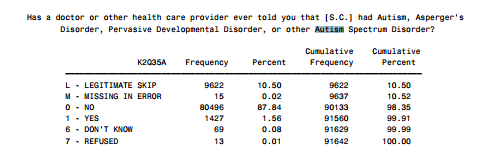
Consider the 2007 dataset.Here is a list of raw data from the 2007 NSCH. 1427 parents, or 1.56% of parents answered yes to “Has a doctor or other health care provider ever told you that [S.C.] had Autism, Asperger’s Disorder, Pervasive Developmental Disorder, or other Autism Spectrum Disorder? ” [S.C] is the code for the child being discussed (selected child or something to that effect). (as with all figures in this article, click to enlarge).

NSCH 2007 ever told

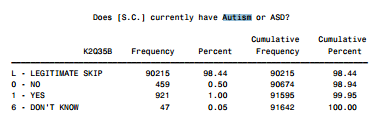
Again, 1427 parents who said that some medical professional had stated the child was autistic in the past. Of these 459 answered no to “Does [S.C.] currently have Autism or ASD?”

NSCH 2007 still autistic

What’s going on there? Again, are these kids recovering? It’s a question certainly worth looking in to. The researchers felt it needed more attention and in the 2011/12 survey, discussed below, the researchers did ask more questions about autism and this subgroup.

The 2011-12 NCSH was published this past year (March of 2013). Once again they asked autism-related questions. The prevalence estimate from this survey was about 2% (1 in 50). In all, 2.13% answered yes to “Has a doctor or other health care provider ever told you that [S.C.] had autism, Asperger’s disorder, pervasive developmental disorder, or other autism spectrum disorder? ” [S.C] is the code for the child being discussed (selected child or something to that effect).

NSCH ever told

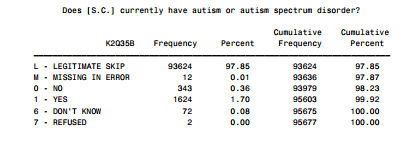
They then asked, “Does [S.C.] currently have autism or autism spectrum disorder?” and 0.36% said no. I.e. out of the 2.13%, 1.7% said that, yes, they report that their child is autistic. After controlling for some factors, an estimated prevalence of 1 in 50 (2%) was reported.

NSCH still autistic

So, what about the 343 kids who were previously identified as autistic but who aren’t now. 343 kids are about 17% of all those ever identified as autistic. But in 2007, about 33% of parents answered “no” to “Does [S.C.] currently have autism or autism spectrum disorder?” I.e. the fraction of these potentially recovered kids went down by 1/2. In 4 years. If those kids are a measure of autism recovery, something dramatic is happening. As in, autism recovery rates are dropping fast.

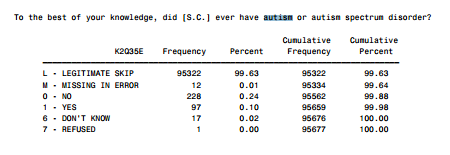
Luckily we can test whether these kids do represent autism recovery. The authors of the NSCH added new questions to the 2011-12 survey. First they asked the obvious and important question “To the best of your knowledge, did [S.C.] ever have autism or autism spectrum disorder? ” 228 parents, 0.24% of the total population surveyed, said “no”. Only 97 said “yes”.

NSCH ever had.

That’s a lot of numbers, so let’s recap. In the 2011/12 survey:

95,677 parents were surveyed
2,041 answered that at some time they were told their child was autistic
343 of those said their child is not currently autistic
228 of those said that their child never was autistic.

Most of the kids who “lost” their autism label were never autistic to begin with.

Of the total kids in the “ever identified autistic” group, 97/2041 or about 5% said that they believed their child was autistic at one time in the past but was not in the present. Not 20%, not 30% as some have suggested. 5%. Still worth investigating, but not the high numbers I sometimes hear people quote.

The survey authors asked two follow up questions to the parents who reported that their child is not currently autistic but was in the past “Treatment helped the condition go away” and “The condition seemed to go away on its own”. For those looking for support that some therapy or combination of therapies is recovering kids: 69 parents out of 2043 reported that their kid lost the autism label and that treatment was the primary factor in the loss.

69/2043: we are talking about roughly 3%.

NSCH follow up

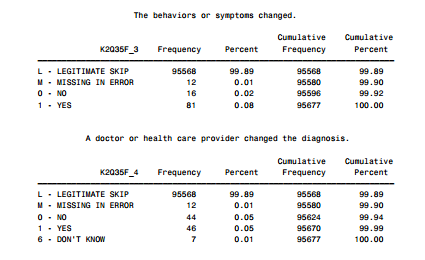
They also asked parents to comment on whether “The behaviors or symptoms changed” or “A doctor or health care provider changed the diagnosis”.

NSCH more questions

There are a few other questions on autism. For example, “With more information, the diagnosis was changed” (158 parents said yes). And “A doctor or health care provider changed the diagnosis” (46 parents said yes).

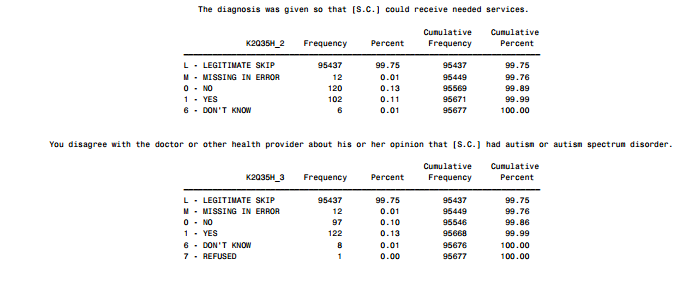
The last two autism questions are very important: “The diagnosis was given so that [S.C.] could receive needed services” and “You disagree with the doctor or other health provider about his or her opinion that [S.C.] had autism or autism spectrum disorder”. Out of the 343 children who “lost” their diagnoses, 102 (30%) parents say the diagnosis was given to obtain services. 122 (36%) of parents say they disagree with the original diagnosis.

The parents report that these kids were never autistic.

NSCH last autism questions

To summarize–Yes, a significant fraction of the children in this survey reported as once holding an autism label are not currently autistic. About 17%, to put a number on it. And, of that 17%, many have social factors involved in their “loss” of an autism diagnosis: incorrect diagnoses, the search for services, etc.. About 5% of autistic kids are reported by their parents as once really being autistic but not presently autistic. Are these kids a subgroup of actual recovery? It’s hard to tell.

One can drill down further into the data and get more insight about this group, but that will wait for another article.

The bottom line is simple, though. The National Survey of Children’s Health does not support the idea that 20-40% of autistic children are recovering. Maybe a few percent are, and with small numbers that will make studying this subgroup very difficult.


By Matt Carey

note: numerous edits were made for readability, but no substantial changes to the basic information was made.

My response to Mrs. Wright of Autism Speaks

20 Dec

As I recently wrote, Autism Speaks has once again shown it’s lack of respect for autistics and their parents with an opinion piece by Mrs. Suzanne Wright, co-founder of Autism Speaks.

I left the message below in response to Mrs. Wright’s piece.

I can not resign any position with Autism Speaks, as John Robison has done. I have been a member of one autism organization–a group which later became the local chapter for Autism Speaks. I resigned that group when they showed that they would waste their efforts lobbying against legislation that had nothing to do with autism. I’m glad I quit then.

One thing autism has taught me is that so many things we take for granted are gifts. It is a gift to have average or above intelligence. We don’t earn intelligence. It is our responsibility to use our gifts well.

Mrs. Wright, you aren’t using your gifts. After years with the autism community, you continue to speak for us as without understanding us. You aren’t using your gifts. My kid will never have the ability to understand the world like you can. Your gifts are squandered and that is a terrible shame.

I am doing more than “existing”. I am living. Is it harder with a disabled kid? Sure. It’s harder for him.

Use your gifts. Much more–use the gifts of those working for you. Learn how to frame the situation as being difficult, for that is what it is. But not as a life without hope. A life of despair.

I live. I love. I have joy. My son lives. Loves. Has joy. I have not lost touch with him. He has not lost touch with me.

It will be harder for him to enjoy life if the world sees him as less than a full person. It will be harder for him if we don’t put his needs first rather than mine. Please learn to put first the needs of the people we represent and advocate for.

If we in the autism community can’t put forth this message, how can we expect the rest of the world to do so?

Before we can craft a national plan we in the autism community must have a plan of our own. It must start with respect. Respect for autistics. Respect for families. And you are not showing that.

I saw the response Autism Speaks put forth in your home town newspaper in Florida. Please stop dodging this important question by framing it as “high functioning” adults vs. parents of “low functioning” children. Many of us who are parents of children with great challenges disagree with your stances. We’ve been telling you this for years. It’s time to listen.


By Matt Carey

Autism Speaks: it’s time to listen

18 Dec

I’ve always found the Autism Speaks motto ironic: “Autism Speaks. It’s time to listen.” Change he period to a colon and you get “Autism Speaks: it’s time to listen”. And, please, could you start listening, Autism Speaks?

Autism Speaks got off to a rocky start. Although they claimed an ” overwhelming positive response from the autism community”, the rollout of the organization was met with much criticism. Autism Speaks co-founder Suzanne Wright adhered to the “missing child” model of autism with phrases like: “It is as if he’d been kidnapped, or somehow had his mind and spirit locked in a dark hole deep within him”. She also had the parent-centric model of the autism community with phrases like “Such an effort must be driven by those with most at stake: the parents of autistic children.”

Shortly after their launch, Autism Speaks released a short film, Autism Every Day. While Autism Speaks told themselves and the world that the response was positive, in reality there was a great deal of negative reaction. (e.g. here, here, here, here, and more.)

It took years, but eventually Autism Speaks listened. The video disappeared from their website and YouTube channel.

Another video debacle came in the form of “I am autism” which depicted autism as a sinister monster stealing babies and ruining parent’s lives. Here’s the transcript in case you think I’m exaggerating. The video is now also removed.

Every now an then, I feel hope for Autism Speaks. There are some really excellent people at AS. AS took on the phrase “different, not less“. Sometimes a blog post comes by that I particularly like. And a lot of their research portfolio is quite good.

Then you get announcements like this one: Autism Speaks to Washington – A Call for Action. And we see that we are back to 2006. We are back to “I am autism” but this time it’s phrased “This is Autism”.

As a result of that opinion piece, John Elder Robison quit. He was one of the few (if not the only) autistics working in a high profile position with Autism Speaks. Here’s a section from his article, I resign my roles at Autism Speaks:

For the past four years I have worked very hard to defend Autism Speak after a series of public relations missteps; beginning with the I Am Autism video. The most recent “Autism Speaks Point of View” http://www.autismspeaks.org/news/news-item/autism-speaks-washington-call-action shows me that my words and efforts have had no real impact on the beliefs of the actual leadership of the organization.

I have tried to help Autism Speaks staffers understand how destructive its messages have been to the psyches of autistic people. We do not like hearing that we are defective or diseased. We do not like hearing that we are part of an epidemic. We are not problems for our parents or society, or genes to be eliminated. We are people.

We do have problems, and we need help. Some of us need counseling or training, while others have significant medical challenges. We also need acceptance, and support. There is a great diversity in our community, which means we have a very broad range of needs. Unfortunately, the majority of the research Autism Speaks has funded to date does not meet those needs, and the community services are too small a percentage of total budget to be truly meaningful. We have delivered very little value to autistic people, for the many millions raised.

A newspaper in Palm Beach, Florida (where the Wrights have a home) published the article: Autism Speaks post rattles some readers One board member resigns, saying he can’t stand by co-founder Suzanne Wright’s views. While they couldn’t get a comment from Mrs. Wright, they did get some statements from Autism Speaks itself.

Autism Speaks took the old cop out. Whenever there’s a discussion of whether a depiction of autism is demeaning, one can count on hearing the argument that the discussion is between parents of “severely” autistic kids and “high functioning” adults.

Michael Rosen, executive vice president of strategic communications at Autism Speaks, said Robison was the only one who resigned over the post. He said the organization understands that higher-functioning people with autism may have a different point of view about the issue.

“The people who are not sick, not unhappy, and are totally fulfilled and happy with their differences, we totally support them as well,” Rosen said. “We’re not looking to change anybody, we’re looking to support and get services for everyone who needs them.

“What that column had was a lot of empathy for those who are struggling the most. But for those who just need support and services, we work for them as well.”

Eight years ago Autism Speaks could pretend to be ignorant of the fact that much, a great deal in fact, of the criticism they get is from parents like me. Parents of children. Children who are “struggling the most”.

Then there’s the old “they see autism as a good thing” bit:

He said some people with autism feel it’s “a good thing” that just makes them “neurologically different. It’s a matter of diversity, and diversity is a good thing. We understand that and get that. They’re proud of their diversity and we salute them.”

Unless John Robison was VERY different at Autism Speaks meetings than the John Robison I’ve seen at IACC meetings, Mr. Rosen had no business saying what he did. Perhaps he could have read Mr. Robison’s resignation article:

I celebrate the gifts autism brings us, and I have discussed at length the emerging realization that autism – as a neurological difference – confers both gift and disability on everyone it touches. It’s the fire the moves humanity forward, while simultaneously being a fire that can burn us individuals as we try to make our way.

Many autistic people are aware of this dichotomy. Some of us feel “totally disabled” and others feel “totally gifted.” Most of us – I’d venture to say – feel both ways, at different times, depending on what we’re doing at that particular moment.

It’s so much easier to build the straw man that criticism comes from those who are “totally fulfilled and happy” than to face the criticism head on.

Doing a quick google search, I found these criticisms of Mrs. Wrights op-ed:

A Reporter’s Guide to the Autism Speaks Debacle
by Lucy Berrington, autistic adult

AWN SQUARES OFF WITH AUTISM SPEAKS OVER NATIONAL AUTISM PLAN
by the Autism Women’s Network

A Poem For Suzanne Wright. A Call To Action; A Call To Be. November 15, 2013
By Cheairs Graves, mother of an autistic child.

no more – a letter to suzanne wright
by Jess, mother of an autistic child.

The Price We Pay for Autism Speaks
by Heather Clark, mother to two autistic children

Why Autism Speaks Doesn’t Speak for Me
by Emily Willingham, mother of an autistic child.

And there’s more. I did run into a couple articles supporting Mrs. Wright too. But this isn’t about who has more articles, it’s about the fact that Autism Speaks chose to frame the discussion in a very simplistic and, frankly, insulting way. They dismiss the criticism and ignore the fact that much of it comes from parents. The people Autism Speaks claims to represent in this discussion.

Autism Speaks: it’s time to understand.


By Matt Carey