Archive | Autism RSS feed for this section

comment on: Childhood vaccine beliefs reported by somali and non-somali parents.

14 Jul

Autism in the U.S. Somali Community has gathered significant attention in recent years (as has autism in other Somali communities outside of Somalia, for example in Sweden). Most of the attention in the U.S. can be traced back to vigorous advocacy by people like my fellow IACC public member Idil Abdul. Not all attention is good. For example, Minnesota Somali parents received a lot of attention from groups promoting the failed vaccine/autism link. When news of the possibly high prevalence in the Minnesota Somali community arose, David Kirby used the story to promote the idea of vaccines causing autism. Generation Rescue brought in Andrew Wakefield to talk to Somali parents in closed door meetings.

With the discussion of vaccines and autism comes fear and with fear of vaccines comes a reduced uptake. One recent story reports that the MMR uptake in the Minnesota Somali community dropped from 90% to 54% in the past 10 years. Sadly, that same story discusses how the Minnesota Somali community is presently involved in one of the largest measles outbreaks in recent history.

The question is, what are the views of the Somali community on vaccines and autism? To answer that, a new study has just been released: Childhood vaccine beliefs reported by somali and non-somali parents. (note the lack of capitalization of Somali is in the original). The full paper is available online.

There are limitations to the study, such as the use of a “convenience sample” of parents attending one specific clinic. This could induce bias. Also, the response rate was about 50%. This is reasonable, but again some bias might be involved in who actually responded. People who distrust vaccines might distrust those performing the survey, for example.

To answer the question–yes, Somalis in Minnesota do think that the MMR causes autism more than their non-Somali counterparts. Nearly 5 times more likely. But, the majority do not believe–about 35% of Somali parents and 8% of non-Somali parents believe that autism is caused by vaccines.

At recent IACC meetings, Idil Abdul has related how she knows Minnesota Somali families who stopped vaccinating after having a first autistic child. These families went on to have more autistic children. Unvaccinated autistic children. In one family, she relates a family with 5 autistic children.

This stands as an example of where we in the autism parent community have failed. We scared the parents in the Minnesota Somali community, sending in Generation Rescue, Andrew Wakefield and David Kirby. Parents stopped vaccinating, offering zero protection from autism but leaving their children open to infectious diseases. To say nothing of the guilt that parents feel and the children who grow up under that falsely placed guilt.

Yes, I stand apart from the minority of parents spreading the message of a vaccine-epidemic. But, as a community, we have to accept our failures as a community. And this is an example of a big failure.

Here is the abstract.

Abstract

BACKGROUND:

In 2011, an outbreak of measles in Minnesota was traced back to an unvaccinated Somali child. The purpose of this project was to (1) ascertain whether Somali parents are more likely than non-Somalis to refuse childhood vaccinations, particularly the measles-mumps-rubella (MMR) vaccine and (2) determine what factors influence the decision not to vaccinate.

METHODS:

We explored parental perceptions and utilization of vaccines through a survey distributed to a convenience sample of Somali and non-Somali parents of children ≤5 years old in a family medicine clinic in Minneapolis, MN.

RESULTS:

A total of 99 surveys were completed, 28% (n = 27) by Somali parents. Somali parents were more likely than non-Somali parents to have refused the MMR vaccine for their child (odds ratio, 4.6; 95% confidence interval, 1.2-18.0). Most of them refused vaccines because they had heard of adverse effects associated with the vaccine or personally knew someone who suffered an adverse effect. Somali parents were significantly more likely to believe that autism is caused by vaccines (35% vs. 8% of non-Somali parents). Somalis were also more likely to be uncomfortable with administering multiple vaccines at one visit (odds ratio, 4.0; 95% confidence interval, 1.4-11.9) and more likely to believe that children receive too many vaccines.

CONCLUSIONS:

Statistically significant differences in perceptions and use of vaccines were reported by Somali and non-Somali participants. Somali parents are more likely to believe that the MMR vaccine causes autism and more likely to refuse the MMR vaccine than non-Somali parents. These beliefs have contributed to an immunization gap between Somaliand non-Somali children


By Matt Carey

Has the National Autism Assocation left the Autism Policy Reform Coalition?

11 Jul

There’s a group working to change the law reauthorizing Federal autism research. They haven’t been very successful so far and, frankly, that’s OK with me. That group, or coalition, calls itself the Autism Policy Reform Coalition. The coalition’s member groups are small and focused on the idea that vaccines cause autism.

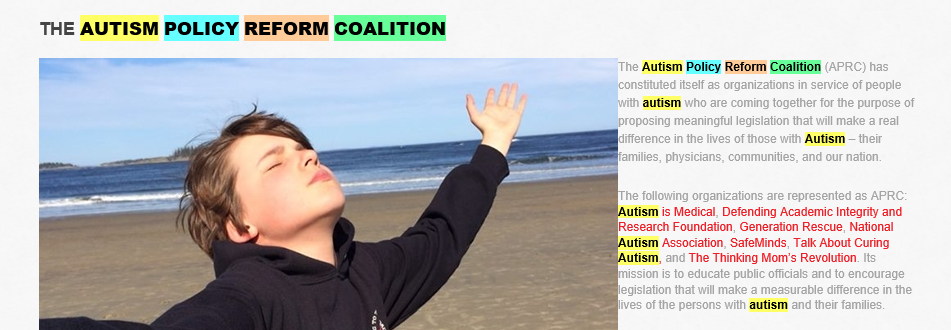
The Coalition has changed their website. The URL, the design and, apparently, the membership has changed. Here’s a bit of a screenshot of the original page at autismpolicy.org (click to enlarge):

aprc-orig

The new website is at autismpolicy.net. Yep, .org to .net. I guess there’s a reason for that but let’s look at bigger changes. Namely, the member organizations.

On AutismPolicy.net, we see the member organizations are:

The Thinking Mom’s Revolution
SafeMinds
Defending Academic Integrity and Research Foundation (D.A.I.R).
Generation Rescue
Talk About Curing Autism
The Autism Trust
Autism Is Medical

Perhaps I missed it but the National Autism Association isn’t on the member list now as far as I can see. Perhaps it will show up in a future edit of the page. Perhaps the NAA are no longer a part of the Coalition. If they left, it does beg the question of “why?”

I’ll note that The Autism Trust (a group with Andrew Wakefield involved) has been added to the APRC though. Not in my mind a step forward.

All these groups in the APRC have some focus on vaccines. Some are primarily focused on vaccines. The Autism Trust, Autism Is Medical and D.A.I.R. are all associated with Andrew Wakefield (the doctor who more than anyone promoted the idea that the MMR vaccine causes autism). As far as I can tell, the only group with dues paying members is the NAA, which is now absent from the list.

I wouldn’t be surprised if no one remembers that 4 years ago there was another coalition–the Combating Autism Act Reauthorization Coalition. Their website disappeared for a while but it’s back up now. I wonder if all the member organizations of that Coaltion were asked if they still wanted to participate. I’ll note that back in 2010, this coalition was willing to openly admit that vaccines were part of their platform. The new Autism Policy Reform Coalition does not mention vaccines, even though all the member groups believe in vaccine causation.

So, what do we have now in the Autism Policy Reform Coalition? A small and possibly shrinking group of vaccine-focused parent groups that won’t use the word vaccine? If the APRC has lost the NAA, that’s a big step back. The NAA is one of the larger groups and one with a mission that is no longer so focused on vaccines. It’s less easy to hide the vaccine connection without them.


By Matt Carey

It takes brains…to solve autism

11 Jul

A few years ago I was lucky enough to attend an IMFAR meeting. IMFAR is the largest autism science conference in the world. Two of the most important facts I took away from that were (1) brain tissue is a critical part of autism research and (2) there is a scarcity of brain tissue for autism research. OK, there’s a third point: they need tissue from autistics, relatives and people from outside the autism community.

No one wants to think about themselves or their loved ones dying. It’s hard think about tissue donation for one’s self and even harder for one’s loved one. Here’s my advice: think about it now. Make the decision now. Then, if you and your family are faced with the unthinkable, you or your loved ones won’t have to face that decision during a time of grief. The decision needs to be made quickly. For tissue to be useful to researchers, it needs to be prepared quickly.

When you register as a tissue donor for research you are not giving consent. You still have that right later. But you are committing yourself and informing yourself.

Autism BrainNet is a group of sites working together on tissue collection and distribution. It takes brains…to solve autism is an outreach program to inform people about the need for tissue donations and to register donors. The registration process is very fast. Take the time to plan now on what decision you want to make for yourself and your loved ones and if you agree with the importance of tissue donation, register. Don’t put it off.

Here is the description of It Takes Brains… from their website:

IT TAKES BRAINS is the outreach program of the Autism BrainNet, a new network of research institutions that will collaborate on groundbreaking brain research. Brain study is the key to solving autism, and our mission is to urge families to make the heroic decision to register for brain tissue donation.

Here is the longer description:

The It Takes Brains outreach program brings together a group of leading autism science research organizations: the Simons Foundation, the Autism Science Foundation, Autism Speaks, and the MIND Institute of the University of California at Davis.

Responding to the severe shortage of brain tissue that is holding back autism research, we have joined to make the public, and especially individuals and families affected by autism, aware of the critical need for donated brain tissue. The study of the postmortem brain tissue of both those who had autism and of those who were unaffected will have an enormous impact on the understanding and treatment of autism. We want to urge people with autism, families affected by autism, and unaffected people to register to donate brain tissue to autism research. Because brain tissue is so difficult to procure without advance planning, we are reaching out in order improve the future for countless individuals and families affected by autism.

In order to ensure the highest quality brain research and to streamline the donation process, the Simons Foundation and Autism Speaks have established the Autism BrainNet, a new network of research institutions that will enable the highest quality and most rigorous research into the causes of autism spectrum and other neurodevelopmental disorders. Studies undertaken with brain tissue acquired through the Autism BrainNet will generate data that will improve our understanding of autism and lead to the development of autism treatments. The mission of the Autism BrainNet, along with the It Takes Brains outreach initiative, is to create a partnership between the scientific community and individuals and families affected by autism to develop a sensitive, transparent, and effective strategy for acquiring and distributing the highest quality tissue for research worldwide.

The Autism BrainNet is currently comprised of:
The MIND Institute of the University of California at Davis, Sacramento
The Icahn School of Medicine at Mount Sinai, New York
The University of Texas Southwestern Medical School, Dallas
Harvard University/Beth Israel Deaconess Medical Center, Boston
Autism BrainNet plans to add sites across the U.S. and internationally for brain research, making the donation process as simple and compassionate as possible for donor families.

To solve autism, it will take the best brains in the scientific community, as well as the heroic actions of Superheroes- both people who have autism and those who are unaffected- who make the courageous, wise, and generous decision to donate brain tissue to this crucial mission. Our vision for what the Autism BrainNet can be is far more than a central management and collection site for brain tissue, but also a worldwide collaboration of research facilities whose unique resources and brilliant minds work together to advance autism research.


By Matt Carey

Comment on: Prevalence of overweight and obesity in a large clinical sample of children with autism

10 Jul

Medical comorbidities is a somewhat common topic of discussion in the autism communities. We don’t usually hear about neurological disorders other than epilepsy, or mental health conditions, even though these appear to be very prevalent in autistic youth.

Obesity is more common in autistic adults than non-autistics as is hypertension. And now a new study shows that the problems with overweight and obesity start in childhood. Autistic kids are twice as likely to be overweight and five times as likely to be obese as non autistic kids. The reason for this is not explored in this study. One obvious place to look is a lack of physical exercise and poor diet.

Prevalence of overweight and obesity in a large clinical sample of children with autism

BACKGROUND:
Overweight and obesity are major pediatric public health problems in the United States; however, limited data exist on the prevalence and correlates of overnutrition in children with autism.

METHODS:
Through a large integrated health care system’s patient database, we identified 6672 children ages 2 to 20 years with an assigned ICD-9 code of autism (299.0), Asperger syndrome (299.8), and control subjects from 2008 to 2011 who had at least 1 weight and height recorded in the same visit. We calculated age-adjusted, sex-adjusted body mass index and classified children as overweight (body mass index 85th to 95th percentile) or obese (≥95th percentile). We used multinomial logistic regression to compare the odds of overweight and obesity between groups. We then used logistic regression to evaluate factors associated with overweight and obesity in children with autism, including demographic and clinical characteristics.

RESULTS:
Compared to control subjects, children with autism and Asperger syndrome had significantly higher odds of overweight (odds ratio, 95% confidence interval: autism 2.24, 1.74-2.88; Asperger syndrome 1.49, 1.12-1.97) and obesity (autism 4.83, 3.85-6.06; Asperger syndrome 5.69, 4.50-7.21). Among children with autism, we found a higher odds of obesity in older children (aged 12-15 years 1.87, 1.33-2.63; aged 16-20 years 1.94, 1.39-2.71) compared to children aged 6 to 11 years. We also found higher odds of overweight and obesity in those with public insurance (overweight 1.54, 1.25-1.89; obese 1.16, 1.02-1.40) and with co-occurring sleep disorder (obese 1.23, 1.00-1.53).

CONCLUSIONS:
Children with autism and Asperger syndrome had significantly higher odds of overweight and obesity than control subjects. Older age, public insurance, and co-occurring sleep disorder were associated with overweight or obesity in this population.

Copyright © 2014 Academic Pediatric Association. Published by Elsevier Inc. All rights reserved.


By Matt Carey

Comment on: Immunization uptake in younger siblings of children with autism spectrum disorder.

10 Jul

While doing a bit of reading for a recent article: A study comparing vaccinated and unvaccinated kids is coming…and SafeMinds is concerned, I ran across this abstract: Immunization uptake in younger siblings of children with autism spectrum disorder.

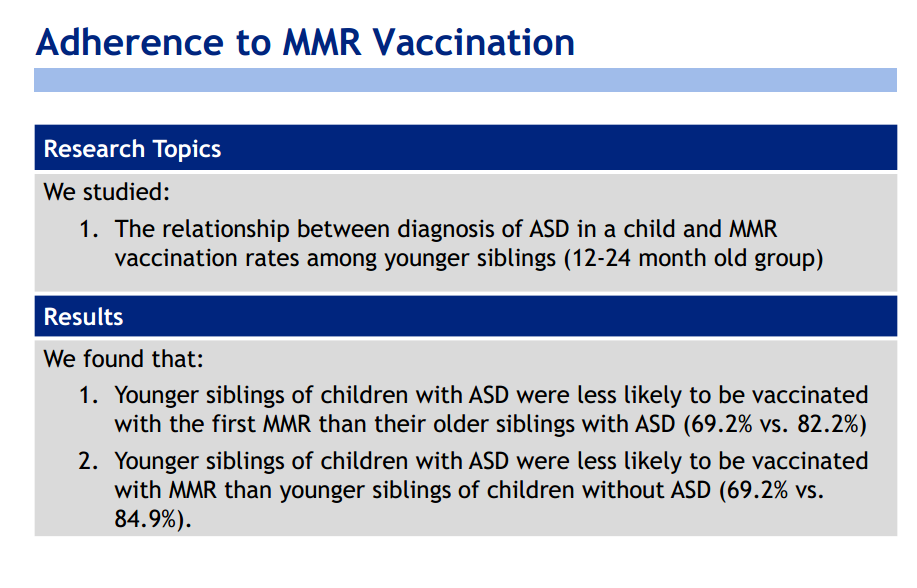
What did they find? That parents often delayed vaccines for younger siblings of autistic kids. And that this made no difference on the autism rate in those younger siblings. In fact, most of the younger siblings with ASD diagnoses were not fully immunized.

This isn’t a study of just MMR or just thimerosal. It’s all vaccines. In online autism/vaccine discussions, you will often read something to the effect of “only one vaccine and one ingredient have been studied”. Wasn’t true before this new study. Isn’t true now. Will be even less true when the next study comes out.

Why do I suspect that “Dr. Bob” Sears, SafeMinds, Generation Rescue, the National Autism Society and TACA won’t include this study in the literature they bring to parents’ attention?

Background: Parental concerns persist that immunization increases the risk of autism spectrum disorder, resulting in the potential for reduced uptake by parents of younger siblings of children with autism spectrum disorder (“younger sibs”). Objective: To compare immunization uptake by parents for their younger child relative to their older child with autism spectrum disorder (“proband”) and controls.

Design: Immunization status was obtained for 98 “younger sibs,” 98 “probands,” and 65 controls.

Results: A significant group difference emerged for overall immunization status (Fisher’s exact test = 62.70, p < .001). One or more immunizations in 59/98 younger sibs were delayed (47/98; 48%) or declined (12/98; 12.2%); immunizations were delayed in 16/98 probands (16.3%) and declined in only one. All controls were fully immunized, with only 6 (9.2%) delayed. Within the "younger sibs" group, 25/98 received an autism spectrum disorder diagnosis; 7 of whom (28%) were fully immunized. The rates of autism spectrum disorder diagnosis did not differ between immunized and nonimmunized younger sib groups, although small sample size limits interpretability of this result.

Conclusion: Parents who already have one child with autism spectrum disorder may delay or decline immunization for their younger children, potentially placing them at increased risk of preventable infectious diseases.


By Matt Carey

A study comparing vaccinated and unvaccinated kids is coming…and SafeMinds is concerned

10 Jul

If a discussion of autism goes on long enough in the online parent community, the question of vaccines will almost certainly come up. (I’ll note that in real life it rarely, almost never, comes up). If the vaccine topic takes over the discussion, one is very likely to hear the call for a “vaxed/unvaxed” study: a comparison of health outcomes for kids who were vaccinated compared to kids who were not vaccinated.

There are at least three such studies in the works. Two are being funded by groups antagonistic to vaccines. The self-named “National Vaccine Information Center” is funding a project at George Mason University. Said study is, I believe, run by someone from NVIC. Generation Rescue is funding a project at Jackson State University, “Researching into the causes of autism”. In previous years, Generation Rescue was funding Jackson State for a project “vaccination status and health outcomes among homeschool children in the United States”, which is likely the same project just with a different name. Perhaps that’s the same study that the founder of “Focus Autism” is complaining about here. Either way, there are two, maybe more, vaccinated/unvaccinated studies that have been underway for a few years, funded by groups generally antagonistic towards vaccines.

As an aside–in online discussions, the people calling for a vaxed/unvaxed study are connected to Generation Rescue and NVIC. And yet they act like no one is doing such a study.

Back to the topic at hand: there is another vaccinated/unvaccinated study in the works. A large study. In discussions at an IACC meeting this year, Tom Insel responded to a statement about a vaccinated vs. unvaccinated study:

Dr. Insel: So I might add, we have just done that study looking at, in this case, tens of thousands of children in a large health care system — younger siblings, many of whom did not vaccinated. So we could, whether you like it or not, compare what the risks are, both the risk for autism and the risks for medical consequences for not being vaccinated versus being vaccinated in children who have presumably some genetic risk because they’re young sibs.

And those data are submitted for peer review. We should — maybe by July we’d be able to have that presented here. So I’ll be happy to, since we’ve funded that through, be happy to ask the authors to come and talk to us about the results.

That statement was in April. We just had the July IACC meeting but the results were not presented. The study is in the works, though. At the time Dr. Insel made that statement it struck me that this study was likely a part of a project by the Lewin Group. The Lewin Group presented at the IACC in early 2013. That project has not yet been published, but the results presented last year were very interesting, so I’ll take some time to go through those results here. Keep in mind that it’s possible the upcoming vaccinated/unvaccinated study is not by the Lewin Group.

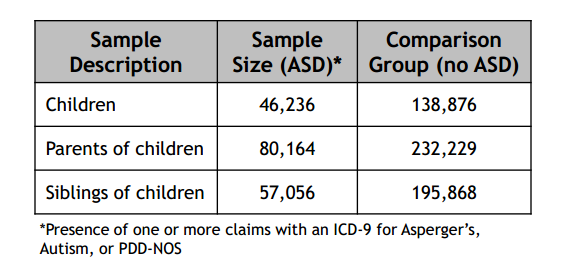
The Lewin Group study population was large and included a large cohort of siblings of ASD kids:

lewin1

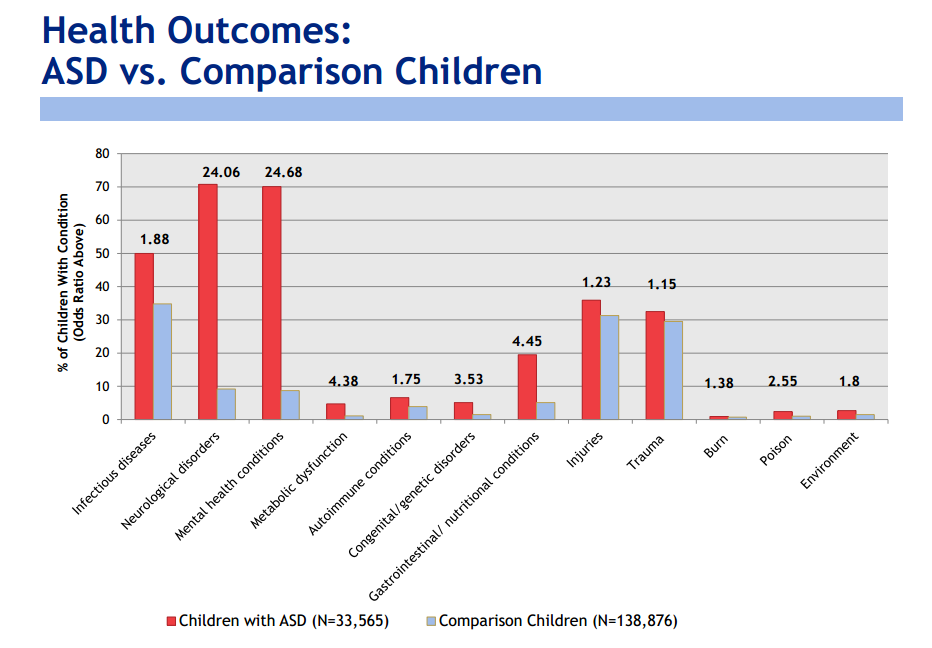
When I read or hear “comorbid conditions” discussed by advocacy groups or parents, they are almost always those conditions which those groups feel are part of their “vaccines cause autism” picture. Gastrointestinal complaints–falsely linked by Andrew Wakefield to the MMR vaccine and autism. Mitochondrial/metabolic disorders, brought to prominence by a famous vaccine court case.

Yes, in this study metabolic dysfunction and gastronintestinal/nutritional conditions are about 4.5 times more common in ASD kids. About 20% of kids are in the gastronintestinal/nutritional conditions group (I wonder how that breaks down into GI and nutritional as separate groups). About 5% have metabolic conditions.

But what if I were to tell you that these are not the most common comorbid conditions in ASD children (and ASD adults are yet another story)? Not by a long shot.

lewin2

About 70% of ASD kids have neurological disorders. About 70% have mental health conditions.

70%. 24 times higher than the general population for each condition.

You just don’t hear that from groups promoting vaccine causation. Groups like SafeMinds. Which brings us back to the vaccinated/unvaccinated study SafeMinds is concerned about. SafeMinds is preparing its readers for the vaccinated/unvaccinated study. Although they’ve been calling for this study for a long time, a fact they remind us of this fact in their article: The NIH is slated to release the results of a study on autism in vaccinated, partially vaccinated, and non-vaccinated children. Here’s what you need to know BEFORE it comes out.

SafeMinds begins their article comes with what I consider a rather ironic graphic:

SafeMindsBlowsAnIronyMeter

Why is this ironic? SafeMinds relies upon poorly done research to support their arguments about vaccines, mercury and autism. For example, their non-peer reviewed Autism: A Novel Form of Mercury Poisoning is one of the papers that first made me question the purported vaccine/autism link. It was never very good and really should be discarded. As another example, if you go the SafeMinds web page
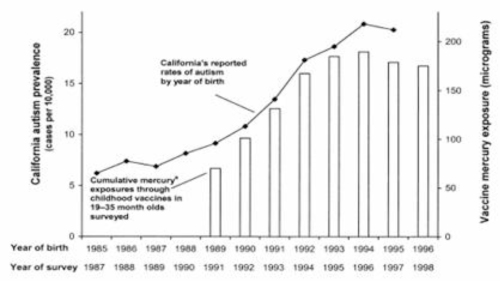
Correlation Between Increases in Autism Prevalence and Introduction of New Vaccines you will find this graph:

california-autism-prevalence

If you think that graph looks old, you’d be correct. It’s at least 10, if not 15 years old. It takes California Department of Developmental Services (CDDS) administrative data, pretends it’s actually autism prevalence, and graphs it against the mercury exposure from infant vaccines during the 1990’s and leads the reader to the idea that mercury exposure and autism are correlated and also related. But they aren’t correlated. That’s what happens when you use a 15 year old graph. California removed thimerosal from infant vaccines, even the flu shots, and also for vaccines for pregnant women. And what happened to the autism rate? It kept going up. Schechter and Grether published this in 2008 in Continuing increases in autism reported to California’s developmental services system: mercury in retrograde. In 2013, I showed that the increase was still going on. But SafeMinds is acting like the last decade didn’t happen. They tell us:

Autism prevalence increased rapidly in the late 1980s. The epidemic increased simultaneously in states across the United States, indicating that U.S. children were exposed to toxins in a consistent manner across the entire country. Due to the high adherence amongst the states to the CDC-recommended vaccination schedule, vaccines typically introduce a new exposure to children simultaneously throughout the country.

For people who actually looked at the CDDS data, we know the idea that autism was rising in the same way in various locations wasn’t true. The whole basis for a universal exposure causing the rise in identified autism was false. It’s one of those facts that made me question the vaccine hypothesis long ago. CDDS data even in 2000 showed autism rates varied wildly across the state of California and the increase was not the same from region to region within the state. Special Ed data (which has major limitations but is likely the data SafeMinds was using to make the above statement) showed large variation from state to state in the number of people getting services under the autism label. There is not and never was data to support the assertion SafeMinds makes above that the rates of autism increased simultaneously across the US.

All this is my long-winded way of saying, I find it more than ironic that SafeMinds wants to warn me about flawed research leading to bad conclusions.

So, let’s ask ourselves: why would SafeMinds be concerned enough about this new vaccinated/unvaccinated study? Well, siblings of autistic kids are (a) more likely to be unvaccinated and (b) more likely to be autistic, like 20 times more likely to be autistic (here and here)

The Lewin group reported that younger siblings were less likely to be vaccinated:

lewin3

In addtion, an unpublished study from 2011 compared vaccination status among ASD kids, their siblings and non-relatives. The authors found:

Instead, because siblings of children with autism were less likely to be vaccinated according to the recommended schedule, both correlations and multiple regressions revealed a significant relationship between higher rates of vaccination and non-ASD behavioral outcomes.

Or, to put it simply, if you look at younger siblings, they get fewer vaccines than the general public and have a higher rate of autism. If correlation is causation, this would mean that vaccines prevent autism. Which, in at least one case, is true. Correlation is not causation, though. The new study will likely find that delaying or forgoing vaccines does not reduce autism risk. And that, in my view, would concern SafeMinds. Enough that they want people prepared in advance for what to them will be “bad” news.


By Matt Carey

Comment on “Prenatal and neonatal peripheral blood mercury levels and autism spectrum disorders”

3 Jul

About a decade ago (even longer) there was a question posed as to whether thimerosal (a mercury containing preservative) in vaccines could increase the risk of autism. Many studies have been performed and the answer is no (for example, here).

Even though the question has been approached from multiple angles, research continues. A study out this week takes a look at blood mercury levels in the mother and newborn baby to see if they are correlated with later autism diagnoses in the baby.

California archives blood samples from pregnant mothers and blood spots (cards with a dried spot of blood) from newborns. A team looked at these samples to explore the question: are blood mercury levels in pregnant mothers or newborns correlated with autism.

Short answer: no.

Add this to a MIND Institute study from a few years ago , (Blood mercury concentrations in CHARGE Study children with and without autism) which showed no differences in blood mercury levels between ASD and non ASD preschool children when controlled for diet. And this study from Jamaica again showing no differences. So, while the authors in the recent study suggest a larger study would be valuable, I question whether resources would be wisely spent in that way.

The abstract is below of the new study is below:

Prenatal and neonatal peripheral blood mercury levels and autism spectrum disorders.

BACKGROUND:

Prenatal and early-life exposures to mercury have been hypothesized to be associated with increased risk of autism spectrum disorders (ASDs).

OBJECTIVES:

This study investigated the association between ASDs and levels of total mercury measured in maternal serum from mid-pregnancy and infant blood shortly after birth.

METHODS:

The study sample was drawn from the Early Markers for Autism (EMA) Study. Three groups of children who were born in Orange County, CA in 2000-2001 were identified: children with ASD (n=84), children with intellectual disability or developmental delay (DD) (n=49), and general population controls (GP) (n=159). Maternal serum specimens and newborn bloodspots were retrieved from the California Department of Public Health prenatal and newborn screening specimen archives. Blood mercury levels were measured in maternal serum samples using mass spectrometer and in infant bloodspots with a 213nm laser.

RESULTS:

Maternal serum and infant blood mercury levels were significantly correlated among all study groups (all correlations >0.38, p<0.01). Adjusted logistic regression models showed no significant associations between ASD and log transformed mercury levels in maternal serum samples (ASD vs. GP: OR [95% CI]=0.96 [0.49-1.90]; ASD vs. DD: OR [95% CI]=2.56 [0.89-7.39]). Results for mercury levels in newborn blood samples were similar (ASD vs. GP: OR [95% CI]=1.18 [0.71-1.95]; ASD vs. DD: OR [95% CI]=1.96 [0.75-5.14]).

CONCLUSIONS:

Results indicate that levels of total mercury in serum collected from mothers during mid-pregnancy and from newborn bloodspots were not significantly associated with risk of ASD, though additional studies with greater sample size and covariate measurement are needed.

Copyright © 2014 Elsevier Inc. All rights reserved.


By Matt Carey

HHS Announces Appointment of New Public Members to the Interagency Autism Coordinating Committee

2 Jul

The U.S. Interagency Autism Coordinating Committee (IACC) will have two new members when it meets next week. The press release is below. The new members are Wendy Chung from Simons Foundation and Robert Ring from Autism Speaks. The Simons Foundation is the largest non-governmental funder of autism research and previously had a member on the IACC (Dennis Choi). My understanding is that Mr. Choi took a position working with a foreign government and that conflict required him to resign the IACC. Geri Dawson is still on the IACC and started this session working for Autism Speaks. Ms. Dawson has since left Autism Speaks.

For Immediate Release
July 2, 2014

HHS Announces Appointment of New Public Members to the Interagency Autism Coordinating Committee

The Department of Health and Human Services today announced the appointments of Wendy Chung, M.D., Ph.D., and Robert Ring, Ph.D., as public members of the Interagency Autism Coordinating Committee (IACC), a federal advisory Committee composed of federal agency officials and appointed community stakeholders that provides coordination and a forum for public input on issues related to autism spectrum disorder (ASD). Prior to her departure, former HHS Secretary Kathleen Sebelius appointed Dr. Chung, Director of Clinical Research for the Simons Foundation Autism Research Initiative (SFARI), and Dr. Ring, Chief Science Officer of Autism Speaks, to join the IACC in order to provide additional perspectives and expertise to the Committee. Dr. Chung and Dr. Ring serve as leaders within the two organizations that are the largest private funders of autism research in the United States. Both organizations were previously represented on the Committee by individuals who were appointed in 2012, but who have since left or changed affiliation.

Dr. Insel, Chair of the IACC and Director of the National Institute of Mental Health, welcomed the expertise and dedication that Dr. Chung and Dr. Ring bring to the IACC. “Both Dr. Ring and Dr. Chung will be important additions to the Committee, given the depth of their scientific and clinical experience, and their dedication to improving the lives of people on the autism spectrum,” he said.

Dr. Chung, in addition to directing clinical research at SFARI, served as a member of SFARI’s scientific advisory board. Dr. Chung is also the Herbert Irving Associate Professor of Pediatrics and Medicine and Director of Clinical Genetics at Columbia University College of Physicians and Surgeons, where she is the principal investigator for the Simons Variation in Individuals Project (Simons VIP), funded by the Simons Foundation.

Dr. Ring, who has been the Chief Science Officer of Autism Speaks since 2013, also serves as the Chairman of the Board of Delivering Scientific Innovation for Autism (DELSIA), the venture philanthropy arm of Autism Speaks, and leads Autism Speaks’ collaboration with the Simons Foundation to launch the Autism BrainNet, a privately-funded multisite brain banking effort focused on supporting autism research. Dr. Ring previously served as Autism Speaks’ Vice President of Translational Research. He holds adjunct faculty appointments in the Departments of Psychiatry at Mount Sinai School of Medicine and Pharmacology and Physiology at Drexel University College of Medicine. Prior to his work at Autism Speaks, Dr. Ring served as Senior Director and Head of the Autism Research Unit at Pfizer Worldwide Research and Development and worked in the area of psychiatric drug discovery at Wyeth Research.

These two new members of the Committee will serve for the remaining months of IACC activity under the Combating Autism Reauthorization Act of 2011, which will expire on September 30, 2014. If reauthorized, the IACC will be open for nominations of new potential public members in late 2014.


By Matt Carey

The vaccine-autism notion as a liability

1 Jul

It wasn’t that long ago that my kid was diagnosed and I started on the search for information about autism. At that time the idea of vaccine causation was dominating the discussion, at least in the online world where autism parents were participating. Even mainstream news outlets seemed to think that getting a “balance” viewpoint from a parent espousing vaccine causation was necessary. Over the past near-decade the discussion landscape has changed a great deal. Sure, a small group of parent-activists (and non-parents using autism as a tool to attack vaccines) still present a vocal minority telling us about how vaccines cause autism. But for the most part the discussion has moved on from vaccines.

To use a simple example: a few years ago Jenny used the idea of vaccines causing autism as a springboard back into the public’s eye. These days, she’s quiet and even trying to distance herself from her previous statements.

As a more detailed example, Consider SafeMinds:

In 2006, SafeMinds endorsed the Combating Autism Act. In their endorsement at that time, SafeMinds mentions vaccines 25 times.

In 2011, the Combating Autism Act was up for reauthorization. >A coalition of vaccine focused autism parent organizations including SafeMinds was formed. They included in their statement “The membership includes advocates of the vaccine theory”. Right out there and public.

This year, 2014, we see a different coalition formed that includes SafeMinds: the Autism Policy Reform Coalition. Many of the groups in the new coalition were part of the 2011 coalition, and all of the APRC’s member organizations have a strong focus on vaccines as causing autism. But here’s the difference: there appears to be no mention of the word “vaccine” on the >APRC’s website. (here’s my Google search).

SafeMinds is still very clear on their position at their own website. A recent article make that clear: Dear Parents, you are being deceived about vaccines and autism.

There’s no mention of the word “vaccine” on the >SafeMinds announcement of the new Coalition.

Consider Generation Rescue. Their original website was all about how mercury in vaccines was the cause of autism. Autism was a “misdiagnosis” for mercury poisoning. That was 2005. A few years later, Jenny McCarthy became a spokesperson for, then president of Generation Rescue. The GR website proudly proclaimed, “Jenny McCarthy and Jim Carrey’s Autism Organization” and was, again, all about vaccines. Jenny McCarthy led a few hundred people in a march in Washington DC solely focused on vaccines: Green Our Vaccines Rally. She went on talk shows telling the public that we need to get the “sh*t” out of vaccines. Today? The Generation Rescue website hasn’t completely lost the discussion of vaccines, but has toned down a great deal. She wrote an op-ed for the Chicago Sun Times Jenny McCarthy: The gray area on vaccines.

As an aside–I have a hard time being lectured by Jenny McCarthy about “critical thinking” as she tries to do in her Sun-Times op-ed.

Recently the National Autism Association (another member of the coalition opposing the autism research reauthorization) ran into trouble in a fundraiser. When their views on vaccines and autism were made very, very public, Chili’s cancelled a fundraiser with them. The NAA responded:

Though NAA has changed our mission and efforts in recent years to focus on autism safety, namely wandering prevention, controversial views about vaccines remained on our website. Because of guest feedback about these views, Chili’s has opted to cancel tomorrow’s event. We respect their decision and ask everyone to please speak words of love and kindness.

The NAA felt that they needed to distance themselves from their older “controversial views”. At least that’s what they said. It’s worth noting that the NAA has not changed their website on those controversial views.

Three groups. All historically major players in promoting the failed autism/vaccine hypotheses. As a coalition, they avoid mention of the word. As separate entities, they still espouse the ideas to varying degrees. Some have mixed messages–for example telling us that they previously held “controversial” views while not changing those views.

Things have changed. The vaccine debate has shifted and largely dropped in prominence and acceptance. It’s now a liability. A political and public relations liability. Even the groups promoting vaccine-causation appear to understand this. I welcome this shift. Besides being wrong and diverting a great deal of attention into fruitless areas of research, the groups dominating the discussion with vaccine causation caused a lot of harm over the years. I just wish they would truly change their views and admit their mistakes.


By Matt Carey

Andrew Wakefield and Lance Armstrong: two unethical people exposed by the Sunday Times

30 Jun

The Sunday Times has a series of films (Unquiet Films, www.foreverunquiet.co.uk) has a series of short films about the impact of The Times has had over the years.

Newspapers are all about stories – but sometimes the best stories are the ones we don’t tell.

Let’s not forget that news is often something that someone, somewhere, doesn’t want you to know. The real-life tales of how world-changing exclusives – whether from foreign reporters under fire, or determined hacks banging against stone-walling bureaucracy – are brought out into the open can be just as extraordinary as the articles that end up in the newspaper. Sometimes the story behind our amazing photo-journalism, campaign to change the law on adoption, to make cities safe for cycling, to reveal the corruption at the heart of FIFA, or the lies of a champion like Lance Armstrong are as exciting as a thriller, as tense as an episode of House of Cards.

We decided it was time to showcase just what the best journalists do… the real lives, real struggles, real bravery behind the newspaper stories that change the course of history. It’s all very well to boast that The Times and the Sunday Times strive to speak truth to power, without fear or favour and to report the truth, whatever the cost. But too often exactly what that takes – the death threats to reporters, the legal battles, the toughness and integrity it takes to get the article on the page – gets lost in the telling.

So here, in a series of extraordinary and independently made short films are some of the amazing, true-life stories behind the stories – we hope you find them as moving and inspiring as we do.

As an example of the “best journalists do”, they have a segment entitled “question everything“. It focuses on Brian Deer (whose work exposed the unethical actions of Andrew Wakefield, later found proved by the GMC) and David Walsh (who pursued and uncovered the Lance Armstrong doping scandal).

From BAFTA-winning filmmaker Will Clark: We now live in a world where more often than not, only the surface facts of a story are reported. Real investigative journalism seems to be a dying art and I feel this is something we should all be deeply concerned about. I wanted to create a film that focused on two Sunday Times journalists whose pursuit for the truth turned into an obsession. From Lance Armstrong’s doping revelations to Andrew Wakefield’s fraudulent MMR claims, both were lengthy investigations that were published at risk by the newspaper. Both investigations also managed to reveal large scandals that would most likely have remained hidden were it not for the perseverance and tenacity of the journalists covering the stories. I’m sure every reporter has secretly wished for his or her very own All The President’s Men moment. This is the tale of two journalists who got their wish.

Here’s the video:


By Matt Carey