Archive | Autism RSS feed for this section

IACC Recommends Public and Private Insurance Coverage of Early Behavioral Interventions for Children with Autism

8 Apr

The U.S. Interagency Autism Coordinating Committee (IACC) sent a letter recently to Kathleen Sebelius, the Secretary of Health and Human Services calling for public and private health insurance coverage for behavioral interventions for autistic children. The letter and the press release are below:

IACC Recommends Public and Private Insurance Coverage of Early Behavioral Interventions for Children with Autism (PDF – 79 KB)

Today the Interagency Autism Coordinating Committee (IACC) submitted a letter to the Secretary of Health and Human Services, Kathleen Sebelius, recommending public and private insurance coverage of early behavioral interventions for children with autism spectrum disorder (ASD). The Committee developed the recommendations following discussions in early 2013 concerning the Affordable Care Act (ACA). While the IACC heard about the gains made toward meeting the needs of people with ASD through the first steps of the implementation of the Act, concerns were also voiced by the community about remaining gaps, including the lack of access to insurance coverage for early behavioral interventions.

As a part of the implementation of the ACA, States are in the process of defining “essential health benefits” (EHB) that will be covered by private insurers. The IACC was particularly concerned about the benefit for “mental health and substance use disorder services, including behavioral health treatment.” Under this benefit, the Committee considered it to be critically important that the benchmark plans in all States provide the robust and consistent coverage for behavioral therapy that has been shown to be effective for children with ASD.

Currently, only approximately half of States have decided to offer private insurance plans that provide autism-specific behavioral interventions, while others are still in the process of making decisions. Even less is known about what type of coverage for early behavioral interventions may be available through Medicaid, a publicly-funded insurance program that is the single largest funder of medical care for children with ASD.

In light of increasing evidence for the effectiveness of early interventions, including a recent study funded by the Health Resources and Services Administration (HRSA)1 and a Cochrane analysis,2 the IACC drafted a letter to Secretary Sebelius recommending support for coverage of and broad access to early behavioral interventions for children diagnosed with ASD, including children covered under both private and publicly-funded (Medicaid) health plans. The IACC also recommended a Federal minimum standard of autism coverage through the essential health benefits for all health plans offered in the individual and small group markets and that minimum coverage include early intervention for children with ASD at a level of intensity indicated by the evidence.

The IACC considers access to early behavioral interventions for those with autism to be a critically important issue and hopes that this letter will provide helpful information to Secretary Sebelius as well as to the larger community as they consider the best ways to address the needs of all people with disabilities. The Committee believes that broadening access to evidence-based early behavioral interventions has the potential to improve outcomes and the quality of life for people with autism and their families.

References
1 Maglione MA, Gans D, Das L, Timbie J, Kasari C; Technical Expert Panel; HRSA Autism Intervention Research – Behavioral (AIR-B) Network. Nonmedical interventions for children with ASD: recommended guidelines and further research needs. Pediatrics. 2012 Nov;130 Suppl 2:S169-78. [PMID: 23118248]

2 Reichow B, Barton EE, Boyd BA, Hume K. Early intensive behavioral intervention (EIBI) for young children with autism spectrum disorders (ASD). Cochrane Database Syst Rev. 2012 Oct 17. [PMID: 23076956]

***

The IACC is a Federal advisory committee that was created by Congress in an effort to accelerate progress in ASD research and services. The IACC works to improve coordination and communication across the Federal government and work in partnership with the autism community. The Committee is composed of officials from many different Federal agencies involved in autism research and services, as well as people with ASD, parents, advocates, and other members of the autism community. The documents and recommendations produced by the IACC reflect the views of the Committee as an independent advisory body and the expertise of the members of the Committee, but do not represent the views, official statements, policies or positions of the Federal government. For more information on the IACC, please visit: www.iacc.hhs.gov.


By Matt Carey

note: I serve as a public representative to the IACC but all comments here and elsewhere are my own.
San Jose Mercury News: Three East Bay parents of autistic kindergarten children file federal civil rights lawsuit claiming teacher abuse

5 Apr

Following on the discussion of Texas allowing video monitoring of special education classrooms, a story from the California San Francisco Bay Area points out why such monitors are needed: Three East Bay parents of autistic kindergarten children file federal civil rights lawsuit claiming teacher abuse. The story begins:

With the filing of a federal lawsuit Wednesday, a horrific child abuse scandal burst into public view in the Antioch school district, involving three autistic students who allegedly were slapped, pinched and verbally abused by a teacher — and school officials who failed to report the accusations to police as the law requires.

The incidents, which bear a sad similarity to others that have come to light around the Bay Area in recent months, have already forced the accused teacher’s resignation and compelled a criminal investigation into the abuse claims. And now the district’s leadership stands accused by the students’ parents of creating a hostile environment that violated the autistic children’s civil rights.

Documents show the Antioch district’s own investigation of the concerns about teacher Theresa Allen-Caulboy ramped up only after this newspaper first reported on a similar abuse situation in Brentwood, where a convicted child abuser was allowed to continue teaching special needs students. A classroom aide to Allen-Caulboy cited the newspaper report as her impetus for reporting the abuse allegations.

More at the Mercury News.


By Matt Carey

Thinking Person’s Guide to Autism: An Interview with IACC Member Dr. Matt Carey

4 Apr

I am way behind on blogging. So far behind that I didn’t even mention here an interview I did with the Thinking Person’s Guide to Autism: An Interview with IACC Member Dr. Matt Carey. It was a pleasure to work with the TPGA people. If you don’t know them, take a look at their blog. Their book is the classic “book I wish someone gave me when my kid was first diagnosed”.

The IACC will be holding a meeting next Tuesday. Also, the IACC recently submitted a letter to U.S. Department of Health and Human Services Secretary Sebelius recommending public and private insurance coverage of early behavioral interventions for children with autism spectrum disorder.


By Matt Carey

note: I serve as a public member to the IACC but all comments here and elsewhere are my own.

Letter from New York State Education Department to Judge Rotenberg Center: cease use of electric shock devices

4 Apr

The Judge Rotenberg Center (JRC) is known for its use of strong aversives in the educational programs of many of the students resident there. These aversives are delivered via electric shocks from “GED” devices many of the students wear. The GED devices have undergone some revisions over time and the current versions have not been approved for use on humans. Thus, the NY State Department of Education has notified JRC that they must cease using the unapproved devices. Apparently, JRC no longer manufactures nor has on hand the older, FDA approved devices. Thus, this letter in effect ends the use of electric shocks on New York students.

Below is a letter sent to JRC’s executive director, Glenda Crookes on March 12th, 2013 (the pdf is here, and I apologize for any mistakes in the OCR of that document).

Upon review of the “Warning Letter” CMS #367480 issued by the Department of Health and Human Services, Food and Drug Administration (FDA) on December 6, 2012 to the Judge Rotenberg Educational Center (JRC), and your responses thereto, the New York State Education Department (NYSED) finds JRC in violation of 8 NYCRR §200.22(f)(2)(viii) which states:

The use of any aversive conditioning device used to administer an electrical shock or other noxious stimuli to a student to modify undesirable behavioral characteristics shall be limited to devices tested for safety and efficacy and approved for such use by the United States Food and Drug Administration where such approval is required by Federal regulation.

In the above-referenced warning letter, the FDA states:

“In a letter dated May 23, 2011, FDA notified your facility that the changes and modifications to the originally-cleared GED device require a new premarket notification under 21 CFR 807. 81 (a)(3). As a result, the GED3A and GED4 devices violate the Federal Food, Drug, and Cosmetic Act (Act) because your facility has failed to obtain FDA clearance or approval. Specifically, the devices are adulterated under section 501(f)(1)(B) of the Act, 21 US.C. § 351(f)(1)(B), because your facility does not have an approved application for premarket approval in effect, pursuant to
section 515(a) of the Act, 21 US.C. § 360e(a), or an approved application for an investigational device exemption under section 520(g) of the Act, 21 US. C. § 360j(g). In a letter dated June 29, 2012, FDA again notified, your facility that the GED3A and GED4 devices are adulterated and require the submission of a premarket notification. In responses to the letters dated May 23, 2011, and June 29, 2012, your facility stated that it is planning to make a submission under section 510(k) of the Act, 21 US.C. § 360(k), for changes and modifications to the GE03A and GED4 devices by December 2012. We still have not received any submission from your facility. “

Therefore, consistent with the March 5, 2013 order by the Honorable Gary L. Sharpe, Chief Judge of the U.S. District Court, Northern District of New York, NYSED requires JRC to cease use of the GED-3A and GED-4 devices with NYS stUdents with disabilities not later than 30 days of receipt of this letter. All parties affected by this corrective action have been notified. This notification, which provides 30 days’ notice to JRC, replaces the corrective action letter issued to you on January 15, 2013.

As noted on the FDA website “Premarket Approval (PMA) is the most stringent type of device marketing application required by FDA. A PMA is an application submitted to FDA to request approval to market. Unlike premarket notification, PMA approval is to be based on a determination by FDA that the PMA contains sufficient valid scientific evidence that provides reasonable assurance that the device is safe and effective for its intended use or uses.” (emphasis added) 8 NYCRR §200.22(f)(2)(viii) specifically requires that devices used for aversive interventions be “limited to devices tested for safety and efficacy and approved for such use by the FDA where such approval is required by federal regulation.” Without premarket approval, the devices have not been ‘tested’ and determined to be safe and effective for their intended use or uses. The use of the word “approval” for purposes of the above-referenced regulation was intended to encompass all requirements by FDA regarding such devices, including premarket approvals.

JRC was first notified by the FDA that the above-referenced devices did not have FDA clearance or approval as early as May 2011, yet you chose not to disclose this information to the New York State Education Department (NYSED), despite your direct knowledge since 2006 of New York State (NYS) regulations that specifically require FDA approval or clearance of devices used for aversive conditioning. It is JRC’s responsibility to ensure compliance with applicable NYS laws and regulations relating to the education of NYS’ students with disabilities.

In a letter dated January 18, 2013, Mr. Flammia raises the claim that “treatment with the GED devices is federally mandated by the students’ IEPs.” While the IEPs of the NYS students may indicate use of Level III aversives or a GED device, only one specifies the use of the GED 4 device. Further, while IDEA guarantees a free appropriate public education (FAPE), 34 CFR §300.18 specifically states that FAPE means special education and related services that meet the standards of the State Educational Agency. The standards of this State include the requirement for a prohibition on the use of aversive interventions, except as provided in 8 NYCRR §200.22(e) and that the use of any aversive conditioning device used to administer an electrical shock or other noxious stimuli to a student to modify undesirable behavioral characteristics shall be limited to devices tested for safety and efficacy and approved for use by the FDA. The FDA has publicly posted that the GED3A and 4 do not meet their standards for a determination that they are “safe and effective for its intended use or uses.”

Nothing in Mr. Flammia’s response to the New York State Education Department (NYSED) provides any documentation that the FDA now finds these devices safe for use, even during a transition period. Further, Mr. Flammia states “JRC is currently assessing 2 the time that it would take to revert back to use of the original version of the GED device” … and that the “time that it will take to revert back to the original version of the GED device is being reviewed and is unknown at this time.” Even if a transition period were appropriate, it would be irresponsible and inappropriate for NYSED to authorize JRC to continue to use devices not tested and determined to be safe with NYS students. As I stated in my letter of January 15, 2013 if you have a letter or other documentation indicating that the FDA finds it safe to continue the use of such devices during a transition period or that it has issued premarket approval of such devices, determining them to be “safe and effective for its intended use or uses,” then you should immediately fax that information to me.

In Mr. Flammia’s January 18, 2013 letter, he notifies NYSED that JRC no longer manufactures the FDA-approved GED devices or has such devices in your inventory. (This is information that was not previously disclosed by JRC to NYSED.) Therefore, you must take immediate steps to provide an approved device to implement the students’ IEPs or, until such time as the FDA notifies JRC that such devices have been determined safe for continued use, you must implement an interim alternative behavioral intervention plan with these students that does not include the use of GED 3A or GED 4. We are notifying each of the school districts that their Committees on Special Education must take immediate action to address this issue in the students’ IEPs.

In summary, effective 30 days from receipt of this letter, unless otherwise directed by the court, JRC must cease the use of the GED 3A and GED 4 devices with NYS students until such time as the FDA notifies you that the use of such devices have the required FDA approvals. If you have additional information from the FDA that it has determined that it is safe to use such devices during a transition period, and you would like to discuss this transition plan, please contact my office to arrange a meeting.

The letter was dated March 12, so the 30 day time limit is approaching fast.

I think the New York Department of Education could do much more to support these students through this transition than merely inform their school districts that their IEP’s need to be updated. This is a major change for students with quite extraordinary needs.


By Matt Carey

United Nations statements on Autism Awareness Day

4 Apr

The United Nations released two statments on April 2nd, Autism Awareness day. Those statements, from the U.N. Secretary General and the U.N. as a whole are below.

Secretary-General, in Message, Says Vital to Work Hand-in-Hand with Persons with Autism to Help Cultivate Their Strengths, Address Their Challenges

Following is UN Secretary-General Ban Ki-moon’s message for World Autism Awareness Day, 2 April:

World Autism Awareness Day has succeeded in calling greater international attention to autism and other developmental disorders that affect millions of people worldwide.

The current session of the United Nations General Assembly has adopted a new resolution on this issue, demonstrating a commitment to help affected individuals and families. The resolution encourages Member States and others to strengthen research and expand their delivery of health, education, employment and other essential services. The Executive Board of the World Health Assembly will also take up the subject of autism spectrum disorders at its forthcoming session in May.

This international attention is essential to address stigma, lack of awareness and inadequate support structures. Current research indicates that early interventions can help persons with autistic conditions to achieve significant gains in their abilities. Now is the time to work for a more inclusive society, highlight the talents of affected people and ensure opportunities for them to realize their potential.

The General Assembly will hold a high-level meeting on 23 September to address the conditions of more than 1 billion persons with disabilities, including those with autism spectrum disorders. I hope leaders will seize this opportunity to make a meaningful difference that will help these individuals and our human family as a whole.

Let us continue to work hand-in-hand with persons with autism spectrum disorders, helping them to cultivate their strengths while addressing the challenges they face so they can lead the productive lives that are their birthright.

Films, Panel Discussions, Live Performances among Events to Mark Observance of World Autism Awareness Day at Headquarters, 2 April

A growing number of countries are heralding a new call for involvement in addressing autism and other developmental disorders that affect millions of individuals and their families and societies worldwide as the United Nations and communities around the globe mark World Autism Awareness Day on 2 April with commemorative events including film screenings, panel discussions and live performances.

“This international attention is essential to address stigma, lack of awareness and inadequate support structures,” said United Nations Secretary-General Ban Ki-moon in a message to mark the Day. “Current research indicates that early interventions can help persons with autistic conditions to achieve significant gains in their abilities. Now is the time to work for a more inclusive society, highlight the talents of affected people and ensure opportunities for them to realize their potential.” (See Press Release SG/SM/14890-OBV/1195 of 20 March.)

In December 2007, the United Nations General Assembly unanimously adopted resolution A/RES/62/139, declaring 2 April World Autism Awareness Day to highlight the need to help improve the lives of children and adults who suffer from the condition, so they can lead full and meaningful lives. The rate of autism — a lifelong developmental disability that manifests itself during the first three years of life — is high in all regions of the world, and it has a tremendous impact on children, their families, communities and societies. The number of children and adults with autistic conditions continues to rise across every nation and social group.

“Let us remind ourselves that together — whether we represent Governments, civil society, the private sector or the United Nations itself — we can make a significant difference in our collective goal to create a more caring and inclusive world for people with autism,” said Peter Launsky-Tieffenthal, Under-Secretary-General for Communications and Public Information.

Children and adults with autism face major barriers associated with stigma and adverse discrimination, lack of access to support, discrimination, abuse and isolation, all of which violate their fundamental human rights, according to a General Assembly resolution (document A/RES/67/82) sponsored by Bangladesh and adopted in December 2012. Giving young children the early and correct treatment is crucial for improving their prognosis and giving them the chance to maximize their potential, according to the text.

Those issues will be explored during two panel discussions, co-organized by the United Nations Department of Public Information and the Permanent Mission of the Philippines, to be held at Headquarters on 2 April from 1:15 p.m. to 6 p.m. in Conference Room 2 of the North Lawn Building. Panellists addressing their respective themes, “Finding the ability in the disability of autism” and “Successful transition to adulthood”, will be Stephen Shore, Professor of Special Education at Adelphi University; Elaine Hall, founder of The Miracle Project, a groundbreaking theatre arts programme for autistic individuals profiled in the award-winning HBO documentary AUTISM: The Musical; Neal Katz, a teenager with autism who was featured in that film; Fazli Azeem from Pakistan, a graphic design Fulbright Scholar in Boston who is on the autism spectrum; and Idil Abdull from Somalia, who has a child with autism.

That segment of the event will feature musical performances by Talina and The Miracle Project. It will include performers with autism and remarks by Mr. Launsky-Tieffenthal, who will also open a book-signing event at the United Nations Bookstore from 11:30 a.m. to 12:30 p.m. with Stephen Shore, author of Beyond the Wall.

While public awareness remains low, global awareness of autism is growing. The new General Assembly resolution demonstrates a commitment to helping affected individuals and families, and encouraging Member States and others to strengthen research and expand delivery of health, education, employment and other essential services.

A related panel discussion titled “Addressing the socioeconomic needs of individuals, families, and societies affected by autism spectrum disorders and other developmental disorders” will be held on the new resolution’s implementation. It is co-organized by the Permanent Missions of Bangladesh, Bahrain, India, Qatar, Saudi Arabia and the United States, in collaboration with the Department of Public Information and the Department of Economic and Social Affairs. It will take place from 10 a.m. to 1 p.m. in Conference Room 2 of the North Lawn Building. On 4 April, the Permanent Mission of Israel will host a screening of the film This Is My Child at 1:15 p.m. in Conference Room E of the North Lawn Building.

Throughout its history, the United Nations has promoted the rights and well-being of persons with disabilities, including children with disabilities. In 2006, the General Assembly adopted the United Nations Convention on the Rights of Persons with Disabilities, which sought to change the view of persons with disabilities as “objects” of charity to seeing them as “subjects” — capable of claiming their rights and making life decisions on the basis of their own free and informed consent — and as active members of society, thus reaffirming the fundamental principle of universal human rights for all.

This year, the World Health Assembly will take up the subject of autism spectrum disorders at its Executive Board session in May, while the General Assembly will hold a high-level meeting on 23 September to address the condition of more than 1 billion persons with disabilities, including those with autism spectrum disorders.

Mr. Ban hopes leaders attending the meeting will “seize this opportunity to make a meaningful difference that will help these individuals and our human family as a whole”. The Secretary-General says: “Let us continue to work hand in hand with persons with autism spectrum disorders, helping them to cultivate their strengths while addressing the challenges they face so they can lead the productive lives that are their birthright.”

Contacts: Fred Doulton, tel.: +1 212 963 4466 or e-mail: doultonf@un.org; and Eileen Travers, Department of Public Information, tel.: +1 212 963 2897 or e-mail: travers@un.org.


By Matt Carey

IACC Meeting next Tuesday (April 9)

4 Apr

The U.S. Interagency Autism Coordinating Committee will meet next Tuesday, April 9, at the NIH campus in Bethesda Maryland. The agenda reads

The committee will discuss autism related issues and will host activities in recognition of Autism Awareness Month and World Autism Awareness Day.

The meeting is to be held at

The National Institute of Mental Health
The Neuroscience Center
6001 Executive Boulevard, Conference Rooms C and D
Rockville, Maryland 20852

The meeting will also be webcast live.

More information can be found at the IACC website.


By Matt Carey

note: I serve as a public member to the IACC but all comments here and elsewhere are my own.

IMFAR program is now online

4 Apr

IMFAR, the International Meeting for Autism Research, is held in the spring of each year. Which makes me wonder, did the people who organized this have to go through IEP meetings? I ask because IEP meetings are often are held at the end of the school year and include a lot of evaluations, making it difficult for a parent to attend a Spring research meeting? It isn’t a parent conference, so this is really just an observation.

IMFAR is the top science conference for autism. It is big and it is where a lot of new work is presented. The meeting will be held in May and the abstracts will be available May 1st. But the program, meaning the titles of the talks, are available now. I’ve just done a little browsing and found some talks which are likely to spark conversations. These may not be the talks which reflect the research most likely to impact the lives of autistics and the broader autism communities, but I suspect these will be interesting to the online parent community. For example, one doesn’t need the abstract to get the conclusion of this talk: No Differences in Early Immunization Rates Among Children with Typical Development and Autism Spectrum Disorders. This paper is by the U.C. Davis MIND Institute, which carries a lot of weight with the groups who promote the vaccine-induced autism-epidemic idea, so perhaps this will help to move the discussion forward from the vaccine-focus of the past decade. One can hope.

On the first day, a keynote talk is being held: How Severe Is Autism – Really?

This session reviews the coexisting problems that usually exist in individuals with a diagnosis of autism spectrum disorder. It concludes on the note that it is possibly these associated problems and disorders that often drive the poor outcome that so many people now almost take for granted will be a consequence of autism in the longer term perspective. Language disorders, intellectual developmental disorders, non-verbal learning disability, epilepsy, medical disorders such as tuberous sclerosis and fragile X syndrome, ADHD, and depression are often the “real” cause of negative outcome in autism. Many people in the general population have marked autistic features without major “lifetime impairment”. The focus on *autism only* in early intervention programs is most likely a mistake.

And you probably thought when I said there would be talks which would likely “spark conversations” online, I was just talking epidemiology and etiology.

A recent paper proposed a correlation between a mother’s childhood history of abuse and autism risk in her children. (Emily Willingham discusses this study at Forbes). It appears the same team has a poster at IMFAR: Maternal Exposure to Childhood Abuse Is Associated with Elevated Risk of Autism. A big open question from that work is this: are autistics more likely to be abused as children? Which could make the link heritable. Which makes it interesting that this poster is in the same session at IMFAR:Epidemiology of Neglect and Maltreatment in Children with Autism Spectrum Disorders

There is an entire session on the ethical questions posed by biomarker research.

While the development of a blood biomarker as a screening or diagnostic tool for autism spectrum disorders is of great interest to the scientific and medical communities, it is also attracting intense scrutiny from other stakeholders including people with autism, ethicists, and parents. This symposium will therefore address the scientific, ethical and social challenges associated with the development of biomarkers for autism, and provide an update on the current status of research in this field. We will describe how the heterogeneity of autism, gender bias, and potential comorbidities, could derail the promise of identifying objective, reliable, and universally accepted biomarkers. We will consider the ethical and social issues relating to the development of biomarkers for autism in order to identify and describe the implications for the ‘difference versus disability’ debate; as well as consider possible wider tensions of biomarker research in relation to issues such as pre-natal screening and reproductive choice, and identity and inclusion for individuals on the autistic spectrum. Finally, we will summarize the most promising research on blood biomarkers for autism, describing the required steps to take a putative biomarker from the ‘bench to the bedside’. This educational symposium brings together researchers from scientific, ethical and psychological disciplines to provide a unique perspective on the utility of biomarkers for ascertaining autism risk, aiding in diagnosis and identifying therapeutic targets, all within the framework of the relevant ethical and social considerations.

Here’s the sort of research I wish were the sort to “spark conversations”. Adaptive Intervention For Communication In Minimally Verbal School Aged Children. That is a study I really want to see. Likewise, I am pleased to see an entire session on Young Children, Schools. And Adults, Lifespan, Methods. And services.

Terry Brugha, who headed up the U.K.’s adult autism prevalence studies of recent years will present: The Autism Epidemic Hypothesis: the Association of Autism With Age in the General Population.

There is a large international focus, with research from India, China, South America and other areas usually under represented in research. Another keynote talk discusses this in terms of epidemiology: The Epidemiology of Autism Spectrum Disorder: Toward a More Inclusive World:

We live in an era of exciting advances in our awareness and understanding of autism spectrum disorder, but also a time of enormous global imbalance. Most of what is known about the epidemiology, genetics, clinical manifestation and course, treatment, and nearly every other aspect of autism is based on research in high income countries, where fewer than 10% of births occur and less than 20% of the population lives globally. This talk will describe opportunities to expand the horizons of autism epidemiology and service delivery to include the 80 to 90% of affected individuals and families who live in low and middle income countries, as well as those who are socioeconomically disadvantaged and living in high income countries. It will also describe some of the cultural and financial barriers to progress, and make a case for incorporating concepts of the World Health Organization’s International Classification of Disability and Functioning into the classification and epidemiology of autism spectrum disorder, with the ultimate goals to include not only primary prevention of autism but also enhancement of participation and social inclusion of people with autism spectrum disorder.

One session is: 30-Year Follow-Up of Autism in Adulthood.

The population of adults with ASD is increasing rapidly, entering systems of healthcare and adult support that are already at capacity. Understanding the nature of ASD in adults, their unique needs, and availability of service options, is essential for resource planning and service development. Investigations into this period of life are increasing, but much remains unknown. This study examines adult outcomes for a large, population-based sample of adults identified as children in the 1980’s. Outcomes of interest concern diagnostic presentation, functional abilities, co-occurring medical and psychiatric conditions, social functioning, independence, service use, and access to services. Overall, outcomes for this sample were consistent with what has been reported for similar samples, yet there were notable differences in factors contributing to outcomes compared to what has been reported for other groups. Our findings support the importance of a range of accessible healthcare and support service options for adults with ASD. Detailed analyses are underway to investigate patterns leading to specific outcomes for subgroups of the population of adults with ASD.

I would have written that abstract a bit differently, but I am very appreciative that this session is being held.

Two years ago, I was able to attend IMFAR with the help of an Autism Science Foundation grant. I really wish I was able to attend this one. There looks to be a great deal of interesting research being discussed.


By Matt Carey

Autistic People Should…get a high five

8 Mar

During the past couple of weeks, a time when my focus has been on old and tired subjects, a small change in the online world happened. Small in the grand scheme of things, but a very good step forward. I’m speaking of the movement to change the way Google handles the phrase “autistic people should” in their auto-complete offerings.

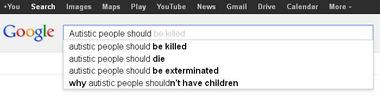
Ever notice how as you enter terms in the search box for Google, it creates suggestions for you? Well, it turns out that sometimes those suggestions are ugly. For example, if you entered “autistic people should” you would get answers like “die” or “be exterminated”.

Autistic self advocates reacted and got Google to respond. Consider this story:

Google eliminates ‘die’ search suggestion for autism

The “auto-complete” function attempts to save time by suggesting the most common searches that match a user’s first few words. In the case of autism, three of the four suggestions could double as bumper-stickers for hate speech.

Sparrow acknowledged the search engine algorithm isn’t the problem; it is, rather, the frequency of the hostile search terms typed in by Google’s users.

They took a screenshot of what the auto-complete used to look like:

12345234-large

I’ll admit that the number 1 answer I get right now is “autistic people should killed”, but the rest are changed and we can hope that as the changes Google puts into place take effect, this will change as well.

It’s a small change, though. We live in a world where many people, apparently, enter “autistic people should be killed” into Google.

Autism Speaks took notice of the story linked above. They had a short teaser on their site, one that didn’t point out the efforts of the autistics who made it happen. And then, after some pressure, “Updated 3/6/13 to reflect the amazing efforts of the self-advocacy community”

Congratulations to those who made this change happen.


By Matt Carey

In the News: John L. Young, a partner of Mark Geier, had his medical license suspended

6 Mar

The Baltimore Sun has an article up: USM regent said to have used controversial therapy for autism, subtitled: John L. Young, a partner of Mark Geier, had his medical license suspended.

USM in the Univiersity System of Maryland. John L. Young was a Regent of USM. And a former business partner for Mark Geier. From the article:

In the order suspending Young’s license, the Board of Physicians concluded he wrote Lupron prescriptions for nine of Geier’s patients, who ranged in age from six to 17 and who all lived outside of Maryland. The board also said in the order that Young, who sometimes used Skype to speak with patients, broke restrictions against prescribing medicine for people who live outside of the state.

Young’s actions “constitute a substantial likelihood of risk of serious harm to the public health, welfare and safety,” the board wrote in the suspension order. The board did not say Young used chelation therapy.

If I interpret this correctly, after his license was supsended, Mark Geier was using his partner to continue the Lupron perscriptions.

Geier’s theory was that autism was the result of high levels of mercury from vaccinations and that too much testosterone exacerbates the symptoms, hence the use of both Lupron and chelation therapy. Geier diagnosed the children with early-onset puberty, usually a rare diagnosis, and used Lupron to control their hormone development.

I note that the patients range in age from 6 to 17. 17’s a bit old for “precocious puberty”.

Mr. Young was to serve as a regent until 2014. He is not presently on the website for the board of regents.

It appears that the Maryland medical board is recognizing that prescribing Lupron itself as an autism treatment is worthy of censure.


By Matt Carey

Lobbying, donations and the Congressional Autism Hearing

5 Mar

Last year the U. S. Congressional Committee on Government Oversight and Reform held a hearing on the government’s response to the rise in autism diagnoses. One of the people at the hearing, photographed with the Focus Autism team, is “Dr. Gary”. “Dr. Gary” appears to be Gary Kompothecras, a Florida chiropractor whose chain of offices reportedly doing $70M in business annually. Kompothecras is also the parent of two autistic children and strong proponent of the idea that vaccines are responsible for the rise in autism diagnoses. Both children were petitioners to the vaccine court for autism as a vaccine injury. (Both cases were denied due to failure to prosecute. This example was under appeal during the events laid out below.)

Mr. Kompothecras has already been linked to the effort to initiate the hearing, however this from a far from reliable source. If you aren’t familiar with this gentleman, feel free to peruse his website (the link is to google cache).

Taking that source as highly questionable, consider this. He claims “Dr Gary is very influential with the Republican Party and is friends with two US Congressmen – Buchanan and Posey.

I won’t speak to “friends” or “very influential”, but I will point out that members of Congress Posey and Buchanan have received campaign donations from Mr. Kompothecras over the past few years. Here are donations from Mr. Kompothecras and Beth Kompothecras made to support Posey and Buchanan in 2008.

The unreliable source claims that Gary Kompothecras and Andrew Wakefield met with members of Congress Posey, Buchanan and Issa on May 1st. Essentially, he met with the two members with whom he had a past relationship plus the chair of the committee who was to hold the proposed hearing.

As an aside: I realize that Mr. Wakefield can spin a good yarn, good enough to take in even members of congress, who are rather too busy to check on his claims and credentials, but members of congress have health care legislative aides who should be able to offer advice on the fact that this man has been found guilty of unethical behavior and his research is, at best, fatally flawed.

That said, keep in mind that given the Kompothecras family’s support for Posey and Buchanan in the past, it isn’t surprising that they donated again in 2012. That doesn’t mean the timing is not interesting. The “Friends of Bill Posey” received donations on May 2nd (Mrs Kompothecras ) and Vern Buchanan for Congress on May 4th (Mrs. Kompothecras) and again on June 30th.

If you followed the links above, you may have noticed that the Kompothecras family also made donations to Darryl Issa, on May 14th. Congressman Issa, of course, is the chair of the committee which held the hearing. These appear to be the first donations to Mr. Issa from the Kompothecras family. Per our unreliable source, congressman Issa committed to hold hearings on May 18th, 4 days later.

Now there is nothing wrong with making political contributions. And if you look at Mr. Issa’s PAC, it is clear that he gets donations from around the country. It is also disingenuous to claim some shock that a congressional hearing involved lobbying and that donations were made in the same time frame. All three of these members of congress are honorable people. These details are, however, ones that the public has a right to know, hence the transparency laws which allowed me to find the donations.

It is worth noting that Mr. Wakefield obviously has a major personal and financial stake in seeing the vaccine discussion become publicly viable again. A factor I hope the members of congress weighed. It is also worth noting that Mr. Wakefield’s ideas on autism causation are flawed and that he was sanctioned for ethical lapses. Another factor I hope was weighed. If our unreliable source is accurate in revealing that Andrew Wakefield met with the members of Congress, I again ask, why would members of congress listen to him seriously? Frankly, if someone is lobbying congress and brings out someone with Mr. Wakefield’s history, I would be strongly disinclined to favor whatever position they brought forward.

I first heard of Mr. Kompothecras when a story came out (Crist backer Gary Kompothecras bullies Florida health officials) where Mr. Kompothecras was described as attempting to “bully” Florida’s health officials into allowing Mark and David Geier (yes, the Geiers) access to immunization records. Per the Miami New Times:

So it’s bound to turn heads when the man known to occasionally lend his private jet to the governor uses his political clout to try to bully Florida health officials into turning over scores of the state’s sealed immunization records. Especially when they’re for a father-son team, Dr. Mark and David Geier, infamous for injecting autistic children with Lupron, a drug used to chemically castrate prostate cancer patients and pedophiles.

For those unfamiliar with the Geiers, here’s the link again. It leads to the neurodiversity.com website where Kathleen Seidel’s investigations of the Geiers are laid out. Their work has been termed “uninterpretable” by the IOM and “intellectually dishonest” by the special masters of the vaccine court, to pick two out of many critiques. When they previously were given access to a different set of immunization records, they had their access cut after attempting to go beyond the approved study, including increasing the risk of breaching confidentiality.

For anyone wondering, I don’t think anything of the sort of improprieties in the Kompothecras/Crist news article are at play with the congressional hearing. I do think it is important to remind ourselves of past activities of Mr. Kompothecras to understand his approach to politics.

Having read a few “six degrees of separation” type articles online in the autism/vaccine discussion, and the reliance on one of the least reliable sources on the internet for some details, I’d be cautious about making too much out of this. But as far as details go, they are on one level rather interesting in adding to the stories which are online about how the hearings came to be. On the other hand, “wealthy person gains access to government officials and makes political donations” is rather a “dog bites man” story, isn’t it?


By Matt Carey