Archive | News RSS feed for this section

Andrew Wakefield gives NBC “talking points”

11 Sep

Dr. Wakefield “took issue” with a recent Dateline episode discussing him and his work. Thoughtful House (his clinic) has offered Dateline some talking points to, I gather, give “the full story” that Dateline supposedly missed.

Since there is next to zero chance that Dateline will act on them, I thought I would take a look at the talking points:

A. There has been extensive replication of the finding of bowel disease in children with autism (ASD) from five different countries. These findings have been published in peer-reviewed journals or presented at scientific meetings. It is therefore incorrect and misleading of Matt Lauer to have stated that every aspect of my original hypothesis has been disproved. On the contrary, the main findings of the original Lancet paper, that is, bowel disease in autistic children, has been repeatedly confirmed. This obvious inaccuracy requires clarification by NBC.

One of my many failings is that I am a sloppy writer and, yet, I key in on imprecise language in the work of others. Case in point:

“On the contrary, the main findings of the original Lancet paper, that is, bowel disease in autistic children, has been repeatedly confirmed. ”

“…the main point of the Lancet paper, bowel disease in autistic children…”

Very imprecise. What about bowel disease in autistic children is the finding of the Lancet article that Dr. Wakefield wants us to know? The statement is so vague that all we are left with is the fact that some autistic children have bowel disease.

This is misdirection on Dr. Wakefield’s part. It isn’t even good misdirection. The Dateline story wasn’t “the career of Andrew Wakefield, what he got right and wrong”. It was about the assertions that MMR cause autism.

Dr. Wakefield makes it appear that this statement was Matt Lauer’s. It is a fine point, but Matt Lauer didn’t state that “…every aspect of my original hypothesis has been disproved”. The statement was from the American Academy of Pediatrics, which Matt Lauer quoted with attribution.

It’s worth recalling what the Lancet paper stated. The concluding paragraph of the 1998 Lancet article was:

We have identified a chronic enterocolitis in children that may be related to neuropsychiatric dysfunction. In most cases, onset of symptoms was after measles, mumps, and rubella immunisation. Further investigations are needed to examine this syndrome and its possible relation to this vaccine.

Had Dr. Wakefield himself distanced himself from the MMR-causation theory in the last 10 years, even a little, I’d think it reasonable for him to emphasize the the idea that he brought to light GI disturbances in autistic kids. But he hasn’t. It isn’t what the Dateline story was about.

The big question, if he thought this was important, why didn’t Dr. Wakefield himself emphasize that in the interview?

Dr. Wakefield’s second point:

B. The shortcomings and the flaws of the studies quoted by Dr. Offit, claiming to disprove an association between vaccines and autism, were not discussed in the program. In my interview with Mr. Lauer I took as an example a paper from Dr. DeStefano from the CDC claiming to exonerate MMR that actually showed that a younger age of vaccination with MMR is associated with a greater risk of autism. This study confirms the association and has been falsely portrayed as vindicating the vaccine. This should have been included in order to provide balance to the program.

Can someone tell me what DeStefano paper and what analysis he is talking about?

C. Reference was made to an autistic child in the vaccine court whose claim for MMR damage was overturned by the judge. No reference was made to the successful vaccine court case on behalf of the child Bailey Banks, coming just one week after the unsuccessful claim described by Mr. Lauer, in which the judge ruled that MMR vaccine can cause autism. Therefore, in the view of vaccine court, it is not a question of whether or not MMR can cause autism, but rather how many children are affected.

The case referred to in the Dateline episode was that of Michelle Cedillo. Her’s was the first “test case” to be heard by the Autism Omnibus Proceeding.

Her case was first heard by a “special master”, who denied compensation. The case then was appealed, and the judge didn’t “overturn” anything. The judge upheld the original decision.

The Bailey Banks case is one that gets debated a lot on the net. Rather than go into that again, let’s ask: how does this relate to Dr. Wakefield’s research? Perhaps I missed it as I did some very quick searches, but I didn’t find anything in the Bailey Banks decision that had anything to do with digestion/inflamation/enterocolitis/constipation/diarrhea… I think you get the idea–the case has nothing to do with Dr. Wakefield’s ideas about autism and the gut.

I.e. Wakefield’s point C is another diversionary tactic.

D. There was a complete absence of comment on the lack of any adequate safety studies of childhood vaccines and the vaccine schedule in particular. There was no mention of the admission by vaccine regulators that there is no data on the long-term safety of vaccines, the chronic disease burden caused by vaccines, and the likely potentially harmful interactions between various vaccines in the routine schedule.

Have you heard the phrase “diversionary tactic” too often yet? What does any of this have to do with whether Dr. Wakefield’s research? This is a favored diversion in online discussions of vaccines/autism. When people run out of real ammunition (and they do quickly), switch to trying to debate general safety of vaccines–and it almost worked. Instead of addressing some of your comments, I’ll move on to your fifth point:

E. Undue credibility was given to Brian Deer, a discredited freelancejournalist, whose false reporting has caused so much misunderstanding and damage to children through the misrepresentation of the doctors and parents who were seeking answers to the vaccine-autism question. Deer has repeatedly misled the public and the medical profession and has been unable to respond to clear evidence of his false reporting in the Sunday Times through the UK’s Press Complaints Commission.

Nice slam, there, Dr. Wakefield. Given the sloppy nature of your previous comments, I am impressed that you pulled this together so well.

You make it seem like it is accepted that Brian Deer is “discredited”. I guess if you don’t get out of Thoughtful House or autism-parent conventions, you might think that.

The “unable to respond…” bit is pretty classic. The Press Complaints Commission isn’t hearing the complaint until after your own GMC hearing, correct? So, I guess he has been unable to respond at the PCC. But, did that really stop him from responding? I seem to recall a pretty sharp worded response that Orac hosted on Respectful Insolence.

Didn’t you, Dr. Wakefield, bring that complaint to the PCC? If so, nice job leaving out the fact. It would come across quite differently had you stated: “…and has yet been unable to respond to clear my claims of his false reporting in the Sunday Times through the UK’s Press Complaints Commission.”

F. It was not disclosed that I have repeatedly invited Dr. Offit to take part in public debate on the safety of MMR vaccine and the false and misleading claims that he has made in the media and his book. He has refused to accept this invitation and has continued to hide from an open and honest debate.

Why would NBC waste time on this? Was it pertinent to the discussion? Answer: no.

I think they did you a favor by not mentioning it. No one looks good with the “So and So won’t debate me” argument. They just don’t. The “please debate me” argument is a staple of the crank. I doubt you wish to appear to be in that category, do you?

Academics “debate” in the literature, not on some stage. If you want to debate Dr. Offit, come up with some good research. Publish it.

Alternatively, if you want to see how a Wakefield/Offit debate comes out, read “autism’s false prophets”. If that is “hiding”, he hasn’t done a very good job of it.

G. NBC alluded briefly to the fact that Richard Horton, editor of The Lancet, was informed of my participation as a medical expert in the MMR litigation almost one year before publication of the Lancet paper in 1998. NBC failed to clarify that when Horton was challenged to respond to the fact that when he so enthusiastically denounced me and the paper in 2004 the Lancet staff was already fully aware of the facts and at that time did not consider them to be relevant. Horton refused to be interviewed by NBC and the interview segment shown was from 2004. This refusal is in sharp contrast to his willingness to denounce me in the media in 2004. NBC also failed to mention that in the light of these facts Horton has been reported to UK’s General Medical Council on an allegation of perjury.

Even if true, this is just more diversions. If you thought it important enough to fax all this information to the Lancet, why didn’t you include a conflict of interest statement in the article itself? The referees would have appreciated that, I believe. Was there any mention of potential conflicts of interest in your cover letter to The Lancet when you submitted the paper? Or in the cover letter for your acceptance? All of those were places where you should have made such statements.

H. It was unfortunate that NBC, having stated their determination to resist external pressure to distort the balance of the program, yielded to such pressure from the American Academy of Pediatrics, allowing them the final word in the program while denying representation from the National Autism Association who put forward to NBC a rational and well reasoned call for further science to resolve this very real issue.

I’m sorry, but are you seriously putting he “National Autism Association” on equal footing with the American Academy of Pediatrics? How many members does the NAA have? (a lot less than the AAP) What is the name of their journal (they don’t have one) What is the impact factor of their journal? (Pediatrics is a very well respected journal).

Given the NAA’s recent childish antics with their attempted slime job against Dr. Offit (which you, Dr. Wakefield, participated in), I think that Dateline has been proven correct for not airing their comments.

I. Dr. Offit cited a large population study of autism and MMR from Denmark in support of his claim to ‘certainty that there is no link.’ This study was so flawed that it was rejected from consideration by the gold standard scientific review by the highly influential Cochrane Collaboration. Dr. Offitt, who is not an epidemiologist, was clearly at a loss to understand the study’s fatal flaws.

“Dr. Offitt, who is not an epidemiologist…” What’s up with that comment? I’m sorry, is Dr. Wakefield an epidemiologist? Answer: no. Do you have to be an epidemiologist to understand the study or it’s strengths or flaws? No.

What fatal flaws is Dr. Wakefield referring to? The big Danish study was by Madsen, et al.. The Cochrane Review lists this study as one of the “cohort studies included in the review”. Not “rejected from consideration”.

That aside, I have the Cochrane Review “Vaccines for measles, mumps and rubella in children (Review)” open. The version I have open is noted: “This is a reprint of a Cochrane review, prepared and maintained by The Cochrane Collaboration and published in The Cochrane Library 2009, Issue 3”, so I think it is the most recent.

I guess if the Cochrane review is “highly influential” and the “gold standard” it would make sense to see what they think of the autism/MMR hypothesis, eh? The review states:

No credible evidence of an involvement of MMR with either autism or Crohn’s disease was found.

Was this because they didn’t know about Dr. Wakefield’s work? Hardly. Four of Dr. Wakefield’s papers were listed. All were listed in the “excluded studies” section.

So where does this leave us? We have, what, nine talking points which are mostly diversions or misrepresentations. Anyone wonder why I don’t think Matt Lauer will be responding to these soon?

Special education takes a step forward in Egypt

7 Sep

A recent story from the Egypt Today website caught my eye:

Into the Mainstream

‘After decades of virtually no access to education, children with special needs are getting a shot at the regular school system.’

The story details how the Egyptian Ministry of Education is changing its policy towards special needs students. The story gives an interesting view into how special education is handled in what is to me a very different culture.

It is both encouraging and very discouraging at the same time. According to the story, few of Egypt’s special needs students are currently getting any education. About 1.8%. Egypt plans to increase this to about 10% by 2012. So they are increasing enrollment of special ed students a lot, and will still leave about 90% unserved.

As it stands, children with special needs have had practically no access to mainstream schooling. Now, as the MOE moves to open classroom doors for them, families are faced with a new dilemma: will their children be better off integrated into public and private schools, or should they remain in special schools for the disabled?

The idea is to allow kids only into regular education environments. This will obviously limit who is accepted:

Even after training and renovation, schools will not be able to accept all children with disabilities that come to their doors. A prospective special needs student will undergo an evaluation exam prior to admission. To be eligible for a regular school, a student must not have a dual disability, such as visual and hearing impairments or a combined mental and physical disability. His or her Stanford IQ must be higher than 52 points, and his or her hearing impairment may not exceed the diagnosis of moderately severe hearing loss. Under the MOE plan, each classroom will have no more than four special needs students.

I must say I disagreed with the following paragraph:

“If I’m a child with a disability and I’m always around others who also have disabilities, then I’m not challenged and I don’t have a role model,” says Abdel Hak. In regular schools, she says, a child with special needs interacts with other children and picks up some skills through observation and practice.

I hope Abdel Hak learns soon: a child can be challenged and have a role model while in a special education environment.

This story makes me appreciate all the more the people who pushed through special education laws in the United States. Our system is also both encouraging and (very) discouraging. It is certainly not what I think a special education system should be. But, with apologies to those in Egypt, it could be a lot worse.

Dr. Bernadine Healy talks about vaccines and autism…or does she?

1 Sep

Vaccines and autism: publicity of the topic just got a “shot in the arm” this weekend with a story on Dateline. As part of the story, Dr. Bernadine Healy was interviewed.

Dr. Healy has called for more research into the proposed vaccine-autism link. She has some good credentials (former head of the National Institutes of Health)

Take a look at what she had to say.

I really want people to actually watch her before reading my opinions. I’m very interested in what other people see, untainted by my opinion.

Did you watch? OK, go ahead.

My view: She sounds like a politician on a stump speech. She makes her “constituency” think that she made a commitment when, in fact, she never does.

“…in the area of autism, and in the area of vaccines, there are many many questions that need to be answered and they need a broad base of science.”

Does she ever say, “we need to research vaccines as a cause of autism”? No. She doesn’t. She mentions autism and she mentions vaccines, but doesn’t really put them together.

Another statement, in talking about vaccine safety:

“…it is about understanding if something is happening that we need to address in a small subset”

Her words are very imprecise, letting the reader interpret as he/she will.

“small subset”. Some will hear that and think, “children with autism, that’s the small subset” and the “take away” message will be, “she supports the idea of vaccines causing an epidemic of autism”. It’s possible that “small subset” means a small subset of autistics. In other words, she might be accepting the data that shows vaccines haven’t caused an epidemic of autism. It’s possible that “small subset” is the very small subset of people who are injured by vaccines, some of whom are autistic and some of whom are not. In which case, what she said isn’t controversial at all.

We just can’t tell what she meant from what she said.

And, yet, many would could come away thinking that her statement supports their side.

Perfect politician speak. Very reminiscent of the style Sentator McCain used in his comments courting the autism vote in the last U.S. presidential election.

Dr. Healy has not always been so cautious with her words. When she first appeared on the autism scene, she made accusations against the Institute of Medicine. She also made statements about young children having no risk for Hepatitis B, questioning the need for that vaccine. There are more examples, but these two serve the point: when we make specific statements, we run the risk of being wrong.

The rest of the interview was mostly “mom and apple pie” statements about good communication with parents, pediatricians and the American Academy of Pediatrics.

She also talks about vaccines and how there are “questions that must be addressed”. See what I mean about how that sounds like a politician? What questions must be addressed? The listener is likely to fill in the blank and feel that Dr. Healy made a statement supporting, say, questions about vaccines potentially causing autism.

Contrast Dr. Healy’s non-statements to the statement by the American Academy of Pediatrics on the Dateline website.

August 2009

Statement from the American Academy of Pediatrics to “Dateline”

The immunization schedule is considered the ideal schedule for healthy children. It is designed to stimulate children’s immune systems so they will not suffer illness, disability and death from vaccine-preventable diseases. The recommended immunization schedule is based on the latest scientific research. There is no scientific evidence to support the safety or effectiveness of alternative schedules. Delaying vaccines leaves babies unprotected when they are most vulnerable to vaccine-preventable diseases such as hepatitis B (a liver infection), rotavirus (severe diarrheal disease), whooping cough and bacterial meningitis.

Autism is a devastating, poorly understood neurodevelopmental condition. It is upsetting for families not to know what caused their child’s autism. The American Academy of Pediatrics (AAP) supports additional research to investigate genetic and environmental factors that may affect the developing brain. While it is likely that there are many environmental factors that influence the development of autism, vaccines are not the cause of autism. We know this because many careful and repeated studies show no link between vaccines and autism. Specifically, numerous studies have refuted Andrew Wakefield’s theory that MMR vaccine is linked to bowel disorders and autism. Every aspect of Dr. Wakefield’s theory has been disproven.

The AAP wants parents to have complete, science-based information so they can make the best decision for their child about immunization. The AAP urges parents who have questions about vaccines to talk to their pediatrician. For more information, visit www.aap.org.

See the difference between Dr. Healy’s interview and the AAP statement? The AAP said something concrete. They said that Wakefield’s theory has been disproven. They say that they support additional research into genetic and environmental factors.

Having done so, the AAP will almost certainly have their message picked apart and misinterpreted.

For example, one common attack I would expect to see is “if they don’t know what causes autism, how can they say that vaccines didn’t cause an autism epidemic?” This comes up enough that I have a handy counterexample: I, for one, feel safe in not applying research funding into the “refrigerator mother” theory, even though we don’t know what causes autism. I will go out on a limb and state that it is likely that most autism parents and autistics would agree with me on that. See, one can reject some ideas even without a complete understanding of autism.

What I really expect is for some people to jump on the “environmental factors” statement by the AAP. David Kirby, for one, has made a mini-career out of collecting such statements. Each time it is evidence of a “new” position on the possibility of environmental causes of autism by one group or another, Mr. Kirby jumps on it and adds it to his list.

I guess this hasn’t happened with this statement by the AAP because because this isn’t a new position. For example, this past May they stated, “A complex collection of variables, both genetic and environmental, have been associated with the development of autism spectrum disorders (ASD).”. This statement is a part of the FAQ (frequently asked questions) on the AAP autism website.

I was amazed then that Mr. Kirby didn’t extrapolate wildly on the “environmental” statements by the AAP.He tends to leave it implied that anyone who accepts “environmental causes” of autism is referring to events that happen to young children and not, as is most often the case in the studied environmental risk factors, prenatal events. Mr. Kirby tends to imply that anyone who agrees that there are environmental risk factors likely supports his contention that mercury causes autism.

In other words, he tends to claim support for his ideas even where there is none.

But, enough about Mr. Kirby. At least he sometimes makes definitive statements. Yes, he likes to hide behind the cloak of “what if” statements that are supposed to be “sparking a national debate”. But, he can and does occasionally make hard statements, unlike Dr. Healy in her interview.


The CDC also submitted a statement to Dateline
. It too has concrete statements:

August 26, 2009

NBC News
30 Rockefeller Plaza
Suite 325W-1
NY, NY 10112

CDC Statement on Vaccine Safety, Thimerosal and Autism

At the Centers for Disease Control and Prevention we understand that autism and autism spectrum disorders place a heavy burden on many families.

Despite compelling scientific evidence against a link between vaccines and autism, some parents wonder if vaccines could have caused their children to develop autism. The suggestion that MMR (Measles, Mumps and Rubella) vaccine could be related to autism was initially raised in a 1998 article by Andrew Wakefield and colleagues. Several subsequent studies by independent researchers, however, have not found an association. A study that included the same laboratory that was involved in Wakefield’s original studies was not able to replicate the original findings. Concerns have been raised about possible biases in the study by Wakefield, and 10 of the coauthors of the 1998 article have published a formal retraction of the article’s conclusions. A review by the Institute of Medicine in 2004 concluded that the evidence indicates that MMR vaccine does not cause autism.

In early 2000, concerns were raised that thimerosal, a mercury-based preservative that had been used in some childhood vaccines, could cause autism. Numerous studies have found no association between thimerosal exposure and autism. Since thimerosal was removed from all U.S. childhood vaccines by 2002 (with the exception of the flu vaccine), we have not seen a decline in children being identified with autism, indicating that thimerosal is unlikely to be related to autism.

The CDC supports research to better understand the causes of autism and to develop more effective treatments. Early intervention is critical and research is our best hope for understanding the causes of autism. Through collaborations with partners in government, research centers, and the public, CDC is focusing on three areas: 1) understanding the frequency and trends of autism spectrum disorders, 2) advancing research in the search for causes and 3) improving early detection and diagnosis.

CDC places a high priority on vaccine safety and the integrity and credibility of our vaccine safety research. CDC, along with other federal agencies, is committed to assuring the safety of vaccines through rigorous pre-licensure trials and post-licensure monitoring. This commitment not only stems from our scientific and medical dedication, it is also personal–for most of us who work at CDC are also parents and grandparents. We too, are concerned about the health and safety of children.

Frank Destefano, M.D., M.P.H. Edwin Trevathan, M.D., M.P.H.
Director Director

Immunization Safety Office, CDC National Center on Birth Defects
& Developmental Disabilities, CDC

Again, unlike Dr. Healy, the CDC makes definitive statements. On statement I am surprised I haven’t read people pointing out the “burden” statement.

I also am surprised I haven’t heard people jump on some other statements. Specifically, “understanding the frequency and trends of autism spectrum disorders”. That’s a perfect opening for people to claim that the CDC believes there could be a vaccine-caused epidemic of autism.

Most people tend to just equate the idea of the autism rate increasing with vaccines and or mercury. So, if anyone were to say, “so-and-so thinks the autism rate may be increasing”, they usually are trying to imply, “so-and-so thinks that vaccines cause autism”.

Well, guess what, the CDC does think it is possible that the autism rate is increasing. That’s why they are monitoring the autism rate.

But, bringing this back to Dr. Healy. I am on the one hand pleased that she didn’t make her false statements about the IOM or other unfounded comments. On the other hand, I would hope that if MSNBC thought it valuable to interview her, they would have found it valuable to get her to actually say something concrete.

It is interesting to look at the blog post on the Age of Autism blog about this. They show the video, with no commentary other than the title: “Dr. Bernadine Healy Implies Hubris on Part of Docs Who Deny Vaccine Autism Possibility”.

Even they couldn’t pull a concrete conclusion out of this interview. The strongest statement they are left with is “implies hubris”.

If AoA can’t spin this interview into a strong statement, it’s pretty clearly a fairly empty interview.

Autism Research Today

31 Aug

What is really important in autism research today? Believe it or not, the online world may give you a slightly skewed idea of what is really considered important.

Dateline had a special tonight on Autism. I’ve stayed away from it so far, but I saw this additional material on the MSNBC website and wanted to post it here.

It includes intereviews with Dr. Margaret Pericak-Vance, head of the new John P. Hussman Institute for Human Genomics and Dr. Eric CourchesneH of U.C. San Diego.

She is head of a new, $100M center and he is one of the top cited researchers in autism. Dr. Courchesne has been asking important questions and writing important papers since the 1990’s.

The video clip doesn’t go into depth about the research, but it is worth the watch.

Visit msnbc.com for Breaking News, World News, and News about the Economy

Univeristy of Miami to get $20M for autism research

27 Aug

The John P. Hussman Foundation has pledged $20 million to the University of Miami’s Institute of Human Genomics.

Mr. Hussman has supporting and personally working with Dr. Margaret Pericak-Vance and Dr. Jeffery Vance of the Institute of Human Genomics at the University of Miami. The Institute will be renamed the John P. Hussman Institute for Human Genomics.

The research goal of the Institute is to “… discover the genetic factors that contribute to the cause of autism and related disorders.”

Mr. Hussman runs the Hussman Funds. He is also the father of a 15 year old autistic son.

Mr Hussman is quoted as saying:

“I don’t expect that autism will be cured,” Hussman said. “And to some extent, I’m uncomfortable with the notion of a cure because it refers to the desire of people with autism to be something different. But it could help with intervention when something starts to go wrong.”

also,

“I am convinced that the research under way at the institute will lead to further breakthroughs in our knowledge of autism,” Hussman said in a telephone interview. “Simply put, I don’t expect that autism will be cured, but I do expect that this research will lead to interventions that will significantly improve the lives of children and adults with autism.”

Huffington Post uses erroneous data to promote autism epidemic

26 Aug

correction:

As noted in the comments below, Mr. Kirby appears to be basing argument suggesting that the Hepatitis B vaccine could have caused autism on ADDM data, not on the NSCH dataset, as I assumed.

A recent blog post on the Huffington Post contains serious errors and should be edited or pulled.  At the very least a public acknowledgment of the error must be made.

Using data from the recently published 2007 National Survey of Children’s Health to estimate autism prevalence, a Huffington Post blogger (David Kirby) attempted to draw a connection between the Hepatitis B vaccine and an “explosion” of autism . Here is what he wrote:

If there is an environmental component to autism, hopefully scientists will want to know which exposures might have increased between, say, 1992 and 1996.

One possible answer is the Hepatitis B vaccine, (which also contained 25 micrograms of mercury containing thimerosal).

Introduced in 1991, it was the first vaccine ever given on a population basis to newborn babies (within the first three hours after delivery) in human history.

But according to the CDC’s National Immunization Survey (which also includes parental telephone interviews), only 8% of infant children received the Hep B vaccine in 1992, when that birth cohort showed an ASD rate of 60-per-10,000.

By 1994, the number of children receiving Hep B vaccine had reached just 27% — and the cohort showed an ASD rate of 66-per-10,000.

But the Hep B coverage rate had risen to 82% by 1996, when that cohort’s ASD rate exploded to around 100-per-10,000.

Correlation, obviously, does not equal causation. And no one is suggesting that Hepatitis B vaccine is the singular “cause” of autism. But the uptake rate of that particular immunization is at least one environmental factor that did demonstrably change during the period in question.

Emphasis is mine. I emphasized the data which  are the data that are incorrect.

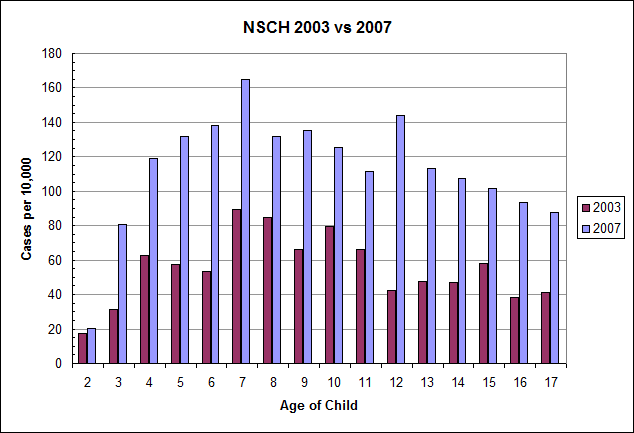
The analysis is simple. Here are the actual results compared to what Mr. Kirby misreported:

1992 “birth cohort*”:
102 per 10,000 (not 60 per 10,000 as on HuffPo)

1994 “birth cohort*”:
113 per 10,000 (not 66 per 10,000 as on HuffPo)

1996 “birth cohort*”:
111 per 10,000 (close to the “around” 100 per 10,000 quoted).

Or, to put it very simply: Mr. Kirby’s statement that there was an “explosion” in the autism rates is incorrect. The evidence that the introduction of the Hepatitis B vaccine is somehow related to the increase in autism rates is false.

That entire statement isn’t even a misinterpretation–it is just simply, demonstrably, false.

Unfortunately, this isn’t Mr. Kirby’s first clear and serious error. He has a history of mistakes. Unfortunately, he doesn’t have a history of correcting his mistakes. Consider these examples:

In June 2008, epiwonk publish a blog post “David Kirby: HuffPost Report on CDC’s Vaccine Safety Datalink Uninformative and Completely Misleading“, demonstrating clear errors in Mr. Kirby’s post “CDC: Vaccine Study Design “Uninformative and Potentially Misleading“”.

The errors were serious enough that Mr. Kirby rewrote his blog post as CDC: Vaccine Study Used Flawed Methods. This included the following introduction:

NOTE: My original post on this topic mischaracterized the 2003 CDC vaccine investigation as an “Ecological Study,” which it was not. I am reposting this piece to reflect that information accurately, but also to point out that many of the weaknesses identified in the CDC’s data and methods apply to the published 2003 “retrospective cohort” study, as much as they do to any future “ecological” ones. I regret and apologize for the error.

Mr. Kirby “regrets” and “apologizes” for the error. Yet his original, erroneous blog post is still on the Huffington Post website. He never took it down. He didn’t even add an apology or correction note to the piece. Anyone following a link to it would have no idea that even the author acknowledges the serious flaws in that piece.

It is also worth noting that the “corrected” version of Mr. Kirby’s blog post was also in error. Again, as noted by epiwonk, this time in his piece “David Kirby HuffPost, Take 2: My Original Story was Flawed, So Here’s A Second (”Corrected”) Story That’s Still Flawed, But I Hope I Can Snow You Under Again This Time…

Mr. Kirby compounded this error when he recreated it in his first “congressional briefing”, September 2008. Mr. Kirby misquoted a report by the National Institute of Enviornmental Health Sciences, and he was caught by a knowledgeable staffer.

Again, Mr. Kirbty has failed to correct his error.  He posted his power point presentation to his website, but without any acknowledgment of the error on page 6.  In the transcript for this talk, he only states, “NOTE: This statement omits important details of the CDC response” and sends you to other sites “For a more detailed explanation”. The “transcript” makes no reference to the exchange between Mr. Kirby and the congressional staffer, nor does it acknowledge that the omission was critical to the point being made. The transcript is noted as being a “Rush transcription by Nancy Hokkanen”. Being in a rush is not an excuse to leave important flaws unexplained.

Math errors are also not new to Mr. Kirby. In May 2008, Mr. Kirby wrote a piece analyzing data from Scotland. In doing so, Mr. Kirby misread a graph resulting in a factor of 10 error in a key piece of information (he misread a bar graph . After his error was blogged, Mr. Kirby corrected his Huffington Post piece. What he didn’t do, and he should have, was to note in the blog piece that he made the error and corrected it.

Mr. Kirby placed his Scotland data post in two sites: Huffington Post and the Age of Autism blog. In yet another odd move by Mr. Kirby, he left the original version of his post, complete with the factor of 10 error, on the Age of Autism blog (it still has 34,000 instead of 3,400). As noted above, Mr. Kirby obviously knows about the error, since he corrected it on the Huffington Post.

Since he clearly knew that his post on the Age of Autism blog had a big error, why didn’t he make a correction (with acknowledgment of the error) there?

Mr. Kirby had a bit of a problem with understanding the difference between Change.Org Change.Gov (the Obama transition team’s website) and Change.Org (a website that hosts blogs on important topics, including autism) (also noted here and here) He made a clear correction on the Huffington Post. However, his post on the Age of Autism blog just disappeared without a comment.

But let’s get back to the present. Mr. Kirby has blogged erroneous data and used this to show a false correlation between the Hepatitis B vaccine introduction and the rise in autism rates.

In case anyone is thinking, “are you sure you checked your own numbers, Sullivan?” The answer is yes. I double checked. I asked a frequent commenter on this blog, Dawn, to check my numbers. Another commenter independently collected and graphed the NCSH data as well. No evidence for an “explosion” of autism rates. Take a look at the graph. Mr. Kirby claimed that the 2007 survey data showed autism rates of about 60/10,000 for kids aged 13 and 15. There are no rates below 80 per 10,000 for the kids in those age ranges in that dataset.

So here we have a man with a history of errors, and with a history of failing to adequately correct his errors. He now has a new, big, obvious error. This error is likely the most serious of those listed here, in my opinion. Mr. Kirby has convinced people that the Hepatitis B vaccine could be causing autism. That was a serious accusation, and it was wrong. The question before us now is this: what will Mr. Kirby do now that he knows he made a mistake?

I’m very curious about that, so I’ve emailed Mr. Kirby and one of the editors at the Huffington Post with this information. I’ll let you all know what I hear back.

*note: the NSCH data are not given as “birth cohorts”. Instead, they are given by age. The survey was performed in 2007 and 2008. So, the 15 year old age group is roughly the “1992 birth cohort”. Likewise, 13 year olds are the 1994 “cohort” and 11 year olds are the 1996 “cohort”.

EDIT: Note that I too have a problem with keeping Change.Org and Change.Gov separate. This correction was made after the post was published.

Pittsburgh parents suing over alleged teacher abuse caught on video

24 Aug

The Pittsburgh station WXPI has a story, “YouTube Video Shows Teacher Slapping Autistic Boy“.

This is one of every parent’s worst nightmares–abuse behind closed doors in school. Without the video, this incident may never have come to light.

WXPI has their story video on their page, and the YouTube video is here. Sorry, I just can’t bring myself to embed it right now.

From the WXPI story:

Lori Davis is the teacher accused of hitting the boy. In the video, Davis can be heard shouting, “Stop moving your chair back. Move it, and you stay up there. I’ve had it with you.”

The criminal complaint against Davis alleges, “During the March 14, 2008 special education session, without warning or provocation, the defendant suddenly and violently struck (the victim) on the left side of the head.”

She is no longer employed by the district.

This teacher was immediately removed from the classroom and she is no longer employed with the district. We take these types of things very seriously. This is the only incident we were made aware of involving this teacher. When we found out, we immediately took action. She was removed from the classroom in June 2008.

Again, the idea of teacher or aide abuse is just a nightmare. Let’s face it, many autistic kids who can’t self-advocate or won’t be believed if they try.

Autistic Somali man denied return to Canada

21 Aug

If true, this is a travesty of justice.

According to a recent story in CBC news, a naturalized Canadian citizen has been stuck in Nairobi for three years. The man, Abdihakim Mohammed, is 25 years old, and autistic.

Here’s the story, in brief: Mr. Mohammed was born in Somalia and emigrated to Canada with his mother in 1990, at about age 6. He is a Canadian citizen. A psychiatrist recommended that he travel back to Somalia with his mother, with the idea that this might improve his communication and social skills.

His mother returned to Canada first, leaving Mr. Mohammed in Somalia. Fearing that he might lose his passport, she kept it in her possession. Officials in Canada took the passport on the grounds that it was in the possession of someone not the owner.

When Mr. Mohammed’s grandmother took him to Nairobi to try to send him back home, he was denied travel. His citizenship card was not enough to convince officials that he is who he claims to be. That was in 2006. He has been unable to leave Nairobi since.

In a classic catch-22, his mother can apply for a passport on his behalf if she can get a court order granting her guardianship. But, in order to do that, Mr. Mohammed must be present in Canada. So, she can bring him home to Canada if she can bring him before a court in Canada first.

Mr. Mohammed has offered to undergo DNA testing to prove his identity.

Note: I wrote a similar post a few days ago, but I managed to overwrite it with a different post. If you have a sense of deja vu, that is why.

Read this article in O magazine

21 Aug

You read that right, I am sending people to read an article in Oprah Winfrey’s “O” magazine.

I’ve been waiting for the article, An Inconvenient Youth: Raising Children with Autism to appear online since reading some discussion about it on the net.

I am happily surprised that Oprah’s magazine would have such an article, given her support for a certain celebrity autism “advocate”.

That out of the way, the story is really worth the time to read it. It isn’t perfect, but, hey nothing (and that includes my pieces) is.

Here are some quotes:

Accepting the “A word” requires a learning curve. “You graduate to it,” says Erin. “Because this is about: Let’s call it what it is, let’s deal with it together.”

and,

And that leads to a bigger issue—one that really burns this group: the implication that accepting your child’s autism is not okay….The simple fact is that not all autistic kids can “recover.” “We need to reexamine what it means to be a successful adult,” says Erin. “To me, now, a successful adult is a functional adult.

and

At this point, however, society still has a long way to go in terms of tolerating people who behave in unfamiliar ways.

Lisa Jo Rudy at autism.about.com has already blogged this. I am very interested in hearing other people’s opinions.

ASA-York billboard to come down

20 Aug

Just got this story in my inbox: After objections, autism billboard coming down.

As has been discussed here and elsewhere, ASA-York had a billboard that, well, was offensive to many autistics.

“It seems to send a message that we aren’t fully present in our own bodies,” said Ari Ne’eman, president of the Autistic Self Advocacy Network. Autism York might have been shooting for an “edgy” message, but its billboard was eerily reminiscent of the NYU Child Study Center’s ransom-note-style advertising campaign in 2007, Ne’eman said.

ASA-York has agreed to remove the billboard:

Autism York has agreed to take down a controversial billboard on Route 30 after disability rights advocates said the sign unfairly compares autistic people to kidnapping victims.

I appreciate them pulling the billboard.