Archive | IACC RSS feed for this section

With thanks to OARC

5 Nov

Last week there was supposed to be a 2 day workshop of the the U.S. Interagency Autism Coordinating Committee (IACC) to update the Strategic Plan. The workshop was to be held in Washington DC. The meeting was cancelled due to Hurricane Sandy.

Behind the scenes, making things work for the IACC is OARC: the Office of Autism Research Coordination. The people of OARC do a lot, including managing the meetings. No small task for this workshop. There are about 30 IACC members and about 20 experts were brought in to consult on the Plan update. These meetings are a lot of work and OARC staff were preparing long in advance and still, I am sure, were going to be working through the weekend before the workshop. And that without hurricane Sandy. With Sandy bearing down, they had to put together contigency plans. What if some people don’t make it in time? What if people can’t come? What if power goes out? Lots of contingencies which I am sure made this whole process very complicated. I was working with them to make sure I could get in and out of DC for the meeting. Or, at least I hoped to. Airports ended up shut down. Luckily OARC saw that it was going to be unworkable and cancelled the meeting the Saturday before.

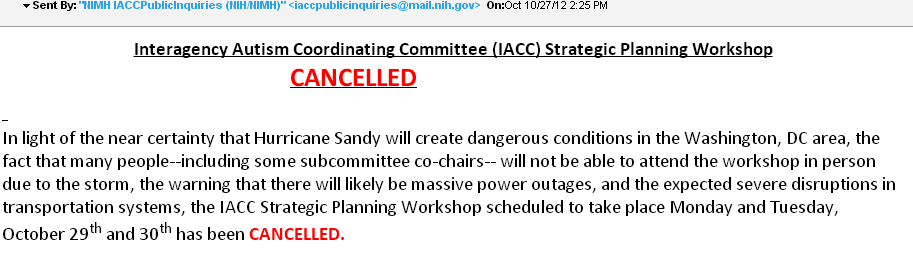
Here’s a screen shot from my email on Saturday(Click to enlarge):

The people of the Office of Autism Research Coordination (OARC) were working very hard to put this workshop together. Working hard on contingency plans. Working on the weekend. All this while a hurricane was bearing down on their homes. Thank you, OARC staff. I appreciate the dedication and the hard work.


By Matt Carey

Note: I serve as a public member to the IACC but my comments here and elsewhere are my own.

Let the IACC know what you think is important

29 Oct

If you haven’t taken the chance to email the IACC with feedback on where you think autism research and policy should be going, take the time now. You can do so by emailing IACCPublicInquiries@mail.nih.gov

Today and tomorrow were supposed to include the IACC 2012 Strategic Planning Workshop. The IACC being the U.S. Interagency Autism Coordinating Committee. One of the main products of the IACC is the Strategic Plan. Per public law 109-416 (which re-instituted the IACC back in 2006):

(b) RESPONSIBILITIES.—In carrying out its duties under this section, the Committee shall—
(1) develop and annually update a summary of advances in autism spectrum disorder research related to causes, prevention, treatment, early screening, diagnosis or rule out, intervention, and access to services and supports for individuals with autism spectrum disorder;
(2) monitor Federal activities with respect to autism spectrum disorder;
(3) make recommendations to the Secretary regarding anyappropriate changes to such activities, including recommendations to the Director of NIH with respect to the strategic plan developed under paragraph (5);
(4) make recommendations to the Secretary regarding public participation in decisions relating to autism spectrum disorder;
(5) develop and annually update a strategic plan for the conduct of, and support for, autism spectrum disorder research, including proposed budgetary requirements; and
(6) submit to the Congress such strategic plan and any updates to such plan.

You can read more about the Strategic Plan, at least how it looked in 2011, to help formulate ideas on what you think is working and what isn’t. But I would suggest don’t feel constrained to work into the Strategic Plan format. If there are areas you feel need more attention, let people know.


By Matt Carey

Note: I serve as a public member to the IACC but comments here and elsewhere are my own.

Interagency Autism Coordinating Committee (IACC) Strategic Planning Workshop CANCELLED

28 Oct

The U. S. Interagency Autism Coordinating Committee (IACC) was scheduled to hold a two day workshop on planning for an update of the Strategic Plan. Draft documents outlining progress and gaps in research had been prepared including input from experts outside the IACC, and those experts were scheduled to attend next week. But with a hurricane bear in down on the greater Washington DC area, the workshop had to be cancelled.

The email announcement is below.

In light of the near certainty that Hurricane Sandy will create dangerous conditions in the Washington, DC area, the fact that many people–including some subcommittee co-chairs– will not be able to attend the workshop in person due to the storm, the warning that there will likely be massive power outages, and the expected severe disruptions in transportation systems, the IACC Strategic Planning Workshop scheduled to take place Monday and Tuesday, October 29 th and 30 th has been CANCELLED.

While I am sure the Office of Autism Research Coordination (OARC) are already working on a backup plan for the meeting, let’s wish them and all the people who have been and will be affected by the storm well.


By Matt Carey

Note: I serve as a public member to the IACC, but my comment here and elsewhere are my own.

Interagency Autism Coordinating Committee’s (IACC) Services Research and Policy Subcommittee Conference Call and Webinar

10 Sep

The Services Research and Policy Subcommittee of the U.S. Interagency Autism Coordinating Committee (IACC) will hold a conference call on Wednesday. More details can be found here.

Interagency Autism Coordinating Committee’s (IACC) Services Research and Policy Subcommittee Conference Call and Webinar

Please join us for a conference call and webinar of the IACC’s Services Research and Policy Subcommittee on Wednesday, September 19, 2012 from 10:00a.m. to 2:00p.m. ET. The subcommittee will discuss plans for developing a 2012 IACC Strategic Plan Progress Update that will describe recent progress that has been made in the autism field and identify remaining gap areas in research.

The phone number and access code for the call and the webinar link are provided below. Members of the public who participate using the conference call phone number will be able to listen to the meeting, but will not be heard.

Conference Call Access
USA/Canada Phone Number: 800-369-3130
Access code: 1524980

Webinar Access
https://www2.gotomeeting.com/register/427830826

Individuals who participate using this service and who need special assistance, such as captioning of the conference call or other reasonable accommodations, should submit a request to the contact person listed below at least five days prior to the meeting. If you experience any technical problems with the webcast or conference call, please e-mail IACCTechSupport@acclaroresearch.com or call the IACC Technical Support Help Line at 443-680-0098.

Please visit the IACC Events page for the latest information about the meeting, remote access information, the agenda and information about other upcoming IACC events.

Contact Person for this meeting is:
Ms. Lina Perez
Office of Autism Research Coordination
National Institute of Mental Health, NIH
6001 Executive Boulevard, NSC
Room 6182A
Rockville, MD 20852
Phone: 301-443-6040
IACCpublicinquiries@mail.nih.gov


By Matt Carey

Note: I serve as a public member to the IACC but all comments here and elsewhere are my own.

NIH awards $100 million for Autism Centers of Excellence Program

7 Sep

The U.S. National Institutes of Health (NIH) Have awarded $100 million over five years to the next Autism Centers of Excellence (ACE). The press release discussing the groups and their focus is below:

NIH awards $100 million for Autism Centers of Excellence Program
Nine grantees receive research funding over next five years

The National Institutes of Health has announced grant awards of $100 million over five years for the Autism Centers of Excellence (ACE) research program, which will feature projects investigating sex differences in autism spectrum disorders, or ASD, and investigating ASD and limited speech.

The disorders are complex developmental disorders that affect how a person behaves, interacts with others, communicates and learns. According to the Centers for Disease Control and Prevention, ASD affects approximately 1 in 88 children in the United States.

NIH created the ACE Program in 2007 to launch an intense and coordinated research program into the causes of ASD and to find new treatments.

“The ACE program allows NIH institutes to leverage their resources to support the large collaborative efforts needed to advance the broad research goals of the Interagency Coordinating Committee Strategic Plan for ASD research,” said Alice Kau, Ph.D., of the Intellectual and Developmental Disabilities Branch at the Eunice Kennedy Shriver National Institute of Child Health and Human Development (NICHD), one of five institutes funding the ACE program. “This year, the program has expanded to such areas as children and adults who have limited, or no speech, possible links between ASD and other genetic syndromes, potential treatments and the possible reasons why ASD are more common among boys than girls.”

In addition to the NICHD, the NIH institutes that support the ACE program are the National Institute on Deafness and Other Communication Disorders, the National Institute of Environmental Health Sciences, the National Institute of Mental Health and the National Institute of Neurological Disorders and Stroke.

The nine awards for 2012 will support research at individual centers or at research networks, which involve multiple institutions, dedicated to the study of ASD.

Grants were awarded to research teams led by the following investigators:

2012 Center Grants

Susan Bookheimer, Ph.D. (University of California, Los Angeles)—This research group will use brain imaging technology to chart brain development among individuals having genes suspected of contributing to ASD. The researchers hope to link genetic variants to distinct patterns of brain development, structure and function in ASDs. Researchers in this center also are investigating treatments that will improve social behavior and attention in infants and acquisition of language in older children with ASD.

Ami Klin, Ph.D. (Emory University, Atlanta)—The Emory team will investigate risk and resilience in ASD, such as identifying factors associated with positive outcomes or social disability, starting in 1-month-old infants and will begin treatment in 12 month olds in randomized clinical trials. Through parallel studies in model systems, the researchers will chart brain development of neural networks involved in social interaction. This center will increase understanding of how ASD unfolds across early development.

Helen Tager–Flusberg, Ph.D. (Boston University)—Many individuals with ASD fail to acquire spoken language, and little is known about why this is so. This research team will use brain imaging technologies in an effort to understand why these individuals do not learn to speak, with the goal of helping them to overcome this limitation. The research team will also test new approaches to help young children with ASD acquire language.

2012 Network Grants

Connie Kasari, Ph.D. (University of California, Los Angeles)—This network will compare two types of intensive, daily instruction for children with ASD who use only minimal verbal communication. Earlier research has shown that even after early language-skills training, about one-third of school aged children with ASD remain minimally verbal. Researchers plan to enroll 200 children in four cities: Los Angeles, Nashville New York City, and Rochester, N.Y.

Kevin Pelphrey, Ph.D. (Yale University, New Haven, Conn.)—A team of researchers from Yale, UCLA, Harvard, and the University of Washington will investigate the poorly understood nature of ASD in females. The project will study a larger sample of girls with autism than has been studied previously, and will focus on genes, brain function, and behavior throughout childhood and adolescence. The objectives are to identify causes of ASD and develop new treatments. According to the U.S. Centers for Disease Control and Prevention, ASD are almost 5 times more common among boys (1 in 54) than among girls (1 in 252).

Joseph Piven, M.D. (University of North Carolina at Chapel Hill)—This research group previously used brain imaging to show atypical brain development at age 6 months in infants who were later diagnosed with ASD. The group now plans to follow another group of infants at risk for ASD. In this study, they will do more frequent scans throughout infancy and until age 2, to gain a greater understanding of early brain development in children with ASD.

Abraham Reichenberg, Ph.D. (Mount Sinai School of Medicine, New York City)—Researchers in this network will embark on an ambitious attempt to understand how genetic and environmental factors influence the development of autism. The researchers will analyze detailed records and biospecimens from 4.5 million births involving 20,000 cases of ASD, from 7 countries (the United States, Australia, Denmark, Finland, Israel, Norway, and Sweden.) The analysis will span three generations and involve grandparents, parents, aunts, uncles, and siblings and cousins.

Mustafa Sahin, M.D., Ph.D. (Harvard Medical School, Boston) and Darcy Krueger, M.D., Ph.D. (Cincinnati Children’s Hospital and University of Cincinnati)—This network will recruit patients with tuberous sclerosis complex, a rare genetic disease that causes tumors in the brain and other vital organs. Patients with tuberous sclerosis complex have an increased risk for developing autism. The researchers will track brain development in infants diagnosed with tuberous sclerosis complex, to gain insights into how autism develops.

Linmarie Sikich, M.D. (University of North Carolina at Chapel Hill)—The researchers will test whether treatment with oxytocin nasal spray can improve social interaction and communication in children with ASD. Oxytocin is a neuropeptide (used by brain cells to communicate) and has been associated with social behaviors. The researchers plan to enroll 300 children with ASD between 3 and 17 years old from Boston, Chapel Hill and Durham, N.C.; Nashville, New York City, and Seattle.

Additional information about ASD is available at http://health.nih.gov/topic/Autism.

About the Eunice Kennedy Shriver National Institute of Child Health and Human Development (NICHD): The NICHD sponsors research on development, before and after birth; maternal, child, and family health; reproductive biology and population issues; intellectual and developmental disabilities; and medical rehabilitation. For more information, visit the Institute’s website at http://www.nichd.nih.gov/.

About the National Institutes of Health (NIH): NIH, the nation’s medical research agency, includes 27 Institutes and Centers and is a component of the U.S. Department of Health and Human Services. NIH is the primary federal agency conducting and supporting basic, clinical, and translational medical research, and is investigating the causes, treatments, and cures for both common and rare diseases. For more information about NIH and its programs, visit www.nih.gov.

By Matt Carey

Note: this was originally published without a title

Announcing Release of the final IACC/OARC Autism Spectrum Disorder Research Publications Analysis Report: The Global Landscape of Autism Research

17 Aug

The Office of Autism Research Coordination has published a final version of the IACC/OARC report “The Global Landscape of Autism Research”. The announcement is below:

The Interagency Autism Coordinating Committee (IACC) and the Office of Autism Research Coordination (OARC) in collaboration with Thomson Reuters, Inc. are pleased to announce the release of the final IACC/OARC Autism Spectrum Disorder Research Publications Analysis Report: The Global Landscape of Autism Research. This final report replaces the pre-publication draft, which was released on July 9, 2012. The final report contains all final content, including high resolution figures and supplementary appendix information. If you have a hard copy of the pre-publication draft and would like to replace it with a hard copy of the final report, or if you would like to order a free copy of the final report, please send a note to IACCPublicInquiries@mail.nih.gov.

This inaugural report describes several key aspects of worldwide ASD research publications, which can be used to inform autism research strategic planning efforts. The report includes data encompassing biomedical, biological, behavioral, clinical, educational, social sciences, and health services research. ASD-related research articles published between 1980 and 2010 were analyzed to identify historical trends and publication outputs across the seven critical research areas of the 2011 IACC Strategic Plan for Autism Spectrum Disorder Research. Information found in research publications was also used to assess the institutions conducting ASD research, funding organizations supporting the research publications, and the extent of collaboration between authors from different countries and research institutions. Additionally, measures such as citation counts were used as an assessment of the impact of this published research. By analyzing publications as a major output of the autism research field, this report complements the annual IACC Autism Spectrum Disorder Research Portfolio Analysis Report, which tracks major US inputs or investments into autism research, and highlights trends that can provide a useful perspective on the development and current state of ASD research. A fully formatted, downloadable PDF of the IACC/OARC Publications Analysis is available on the IACC website at http://iacc.hhs.gov/publications-analysis/july2012/index.shtml.”

Note: I serve as a public member to the IACC, but all opinions expressed here and elsewhere by me are my own.


By Matt Carey

What projects are being funded in autism research? Part 2: Expanded Surveillance

3 Aug

At the IACC meeting OARC released it’s new IACC/OARC Autism Spectrum Disorder Research Portfolio Analysis Web Tool. There are many ways to explore what research is being performed. Since the CDC autism prevalence estimates get a lot of attention, it seemed valuable to see what is in the pipeline with them. The CDC estimates are made through ADDM, the Autism and Developmental Disabilities Monitoring Network, which is largely sites in various states working with the CDC, not the CDC itself.

One can search for ADDM for 2009 and 2010 projects.

In 2009 there were projects ongoing in Alabama, Arizona, Arkansas, Colorado, Florida, Maryland, Missouri, New Jersey, North Carolina, Pennsylvania, South Carolina, Utah and Wisconsin, as well as the Metropolitan Atlanta Developmental Disabilities Surveillance Program/Autism and Developmental Disabilities Monitoring (ADDM) network – Georgia.

13 states plus the Metro Atlanta study.

The latest prevalence estimate report from the CDC included 14 sites: Alabama, Arizona, Arkansas, Colorado, Florida, Maryland, Missouri, New Jersey, North Carolina, Pennsylvania, South Carolina, Utah, West Virginia, and Wisconsin. West Virginia appears to no longer be a part of the study.

In 2010 there were projects ongoing in 11 states plus the metro Atlanta site. Florida and Pennsylvania are no longer funded.

Now, here’s where it get’s interesting. At least to this reader. There are “expanded” projects in 2010:

Through surveillance of ASD among 4-year-old children, CDC can better understand the population characteristics of young children affected by ASDs and better inform early identification efforts.

Arizona, Missouri, New Jersey, South Carolina, Utah and Wisconsin are starting to count 4 year-olds as well as 8 year olds. This will be a good thing. As they say, this will inform early-intervention efforts. This will also benchmark 4 year olds, then (I assume) 4 years later find out what that same cohort looks like.

The CDC autism prevalence estimate reports find a large number of autistic students unidentified even at age 8. They are identified through the records review of the ADDM. This and other studies raise the question of what factors are involved with delays in autism diagnosis. A study is ongoing to answer just that question: Understanding the delay in the diagnosis of autism. The study has already resulted in numerous publications.

The Strategic Plan calls for even more expansion of the ADDM:

Expand the number of ADDM sites in order to conduct ASD surveillance in children and adults; conduct complementary direct screening to inform completeness of ongoing surveillance; and expand efforts to include autism subtypes by 2015.

Expanding to include adults is a good idea, but extremely tough. The current method uses educational and medical records of students. Obviously educational records will not be available for adults. This will make it difficult to make comparisons between adults and children in the same state. Most likely, the estimate will be lower than the actual autism prevalence in adults.

There is a study by the Mayo Clinic on adult autism prevalence and at least one more I am aware of.

Surveillance efforts are expanding into better identification of young children outside of ADDM. Two studies, the California Monitoring of Early Childhood Autism (CA-MECA) and the First Words Project: Implementing Surveillance to Determine the Prevalence of ASD project in Florida. Both are looking at young children (<4 years old) or infants (as young as 18 months). Both studies have been ongoing since 2006.

Studies are ongoing outside the U.S.. Including an Autism Speaks funded study in Kwa Zulu Natal (South Africa). KwaZulu-Natal (KZN) Autism Study will “…test how best to identify and assess children with ASD in the Zulu language and culture, explore the prevalence of autism in South Africa, and further explore the hypothesized relationship between autism and HIV infection.” The Korea Autism Study (also funded by Autism Speaks), which last year announced a prevalence of 2.62% using a whole-population screen, is ongoing.

Surveillance projects will generate questions, and that has definitely happened with autism surveillance work. Questions of why the estimated prevalences are increasing and why some groups are identified later than others are a couple of the big ones. Based on this quick look through the ongoing projects, there appear to be a number of projects in the pipeline which will probably shed some light on existing questions as well as spark new ones.


by Matt Carey

What projects are being funded in autism research? Part 1: vaccines and GI issues

23 Jul

The Office of Autism Research Coordination (OARC) rolled out a new web-based tool to explore research projects in autism. The IACC/OARC Autism Spectrum Disorder Research Portfolio Analysis Web Tool has already been discussed here at Left Brain/Right Brain, but I thought it was worth doing some exploring using the tool. In particular, let’s see what, if anything, is happening in some of the “hot button” issues from some segments of the online parent community.

I put in simple search terms. First was “gastrointestinal”. I found 11 projects ongoing in 2009 and 14 projects being funded in 2010. There is some overlap between the two years (as you would expect), and some projects mention the term “gastrointestinal” but are not focused on the topic (for example, this project on treating sleep issues in autistic children). But this project, Analysis of the small intestinal microbiome of children with autism, would seem to be right on target for what many parents are asking for. As is Novel probiotic therapies for autism. Much of the discussion of gastrointestinal function in autistics seems to be focused on the “leaky gut” theory. I would think that this study (noted in detail below) would be of particular interest to many.

Are autism spectrum disorders associated with leaky-gut at an early critical period in development?

Although there is general consensus of greater prevalence of gastrointestinal (GI) distress in individuals with autism spectrum disorders (ASD), the nature of the link is unknown. There is preliminary evidence to suggest that GI distress in ASD may be associated with “Leaky-Gut” (i.e., increased permeability of the intestinal mucosal barrier due to either delayed or abnormal development), as shown by a study showing higher-than-normal prevalence in ASD children 4 – 16 years of age (e.g., D’Eufemia et al., 1996). During normal digestion, the mucosal barrier is responsible for keeping digestive enzymes out of the intestinal wall. Recent evidence shows that if these powerful degrading enzymes enter the wall of the intestine, they will cause major damage to the intestinal wall as well as inflammation in the brain. Investigators hypothesize that ASD may be associated with Leaky-Gut early in development, which combines, or interacts, with diet (breast-milk, formula, solid foods) leading to intestinal wall damage and inflammation in: 1) the intestine, which could explain the GI distress, and 2) in the bloodstream, which could reach and damage the developing brain, thus contributing to the onset of ASD itself. In this study, researchers will track key aspects of GI function in Low-Risk and “High-Risk” infants (i.e., infants who have an older sibling diagnosed with ASD), including: 1) signs of Leaky-Gut, 2) symptoms of GI distress (e.g., diarrhea, reflux, constipation), 3) diet (breast-milk vs. formula), and 4) evidence of digestive enzymes and inflammatory markers of cell death in the bloodstream. They will correlate GI, diet, and inflammatory measures with results from cognitive, visual, and behavioral tests, including standard ASD diagnostic tests, at two and three years of age to determine if Leaky-Gut is associated with the development of ASD.

How about vaccines? Four projects in 2009, four in 2010. Three of those projects are the same from 2009 to 2010, and those three are funded by Autism Speaks. Two are funded by the Federal Government: Vaccine safety datalink thimerosol and autism study and A primate model of gut, immune, and CNS response to childhood vaccines. The second of those projects is, I believe, a follow-on study to the Laura Hewitson primate study (many supporters of that work complain that there has been no follow on to it)

While we are at it, there are four studies mentioning “mercury” in 2009, nine in 2010 (granted, in 2010 research funded by SafeMinds was added to the database. As they are a major proponent of the mercury hypothesis, it isn’t surprising that four of these studies were funded by them).

I am reminded of past criticisms about environmental risk factors levied at the IACC. In past years there was a discussion point that the IACC Strategic Plan did not include an emphasis on environmental risk factors for autism. A simple review of the strategic plan showed this not to be the case. Oddly enough, one could not find discussion of the facts on the websites of those claiming to be calling for environmental risk factor research, only here at Left Brain/Right Brain.

It has also been discussed here that the IACC does not control the research budgets and no direct control over what projects actually get funded. The IACC is an advisory committee. The fact that most research project items in the Strategic Plan do get funded suggests that the IACC is an effective advisory group.


by Matt Carey

note: I serve as a public member to the IACC, but my opinions and comments (even those about the IACC) are my own.

IACC/OARC Autism Spectrum Disorder Research Portfolio Analysis Web Tool

12 Jul

The Office of Autism Research Coordination (OARC) released a web-based tool to explore research projects. One can search or browse. Data are included for both government funded and non-government funding agencies (such as NIH, Autism Speaks, Simons Foundation, Autism Science Foundation, etc.). One can browse by objectives in the IACC’s Strategic Plan (for example, here is a starting point for 2009 projects)

For example, one can search for how many projects used the term “nonverbal” (six in 2009, fifteen in 2010). One can browse by funding group, through Strategic Plan question or other ways. You can download results in pdf or spreadsheet format.

If you are interested in seeing what research is funded, and not funded, this is a good tool.


By Matt Carey

What is the IACC charged to do?

12 Jul

The Interagency Autism Coordinating Committee (IACC) is charged with certain responsibilities under the law. At the same time, the scope of the IACC is actually quite limited and often misunderstood. In my opinion, the word “coordinating” may be a bit of an overstatement as the committee does not control funding nor does it have the power to make policy or to initiate research.

Here are the responsibilities of the IACC, as well as some of the limitations of the IACC, from the IACC Charge Document.

Statutory Responsibilities of the IACC under the Combating Autism Act and
Combating Autism Reauthorization Act

The IACC was established to coordinate all efforts within the Department of Health and Human
Services concerning autism spectrum disorder and is required to:

Develop and annually update a strategic plan for ASD research, and submit the strategic plan
and annual updates to Congress.

Develop and annually update a summary of advances in ASD research.

Monitor federal activities with respect to ASD.

Make recommendations to the HHS Secretary regarding research or public participation in
decisions related to ASD.

Meet at least twice a year (full committee) and conduct meetings in public with time for public
participation (public comment).

The committee may establish subcommittees and convene workshop and conferences.

How has the IACC executed these responsibilities?

The IACC serves as a forum for coordination, communication and collaboration between Federal
agencies, private organizations and community stakeholders.

The IACC developed its first strategic plan in 2009 and updated it in 2010 and 2011 with the goal
of focusing and accelerating research. The plan was developed with public input and a focus on
community needs.

The IACC has issued an annual Summary of Advances in ASD Research document each year –
2007, 2008, 2009, 2010 and 2011.

The IACC issues a Portfolio Analysis Report to analyze Federal and private funding for research
and how funding aligns with priorities identified in the Strategic Plan.

The IACC/OARC are launching a public database to provide information on federal and private
funded research projects.

IACC members and guest speakers provide research and services program updates at each
meeting of the IACC.

The IACC/OARC issues special reports on ASD activities such as the IACC/OARC ASD Research
Publications Analysis.

The IACC has made recommendations to the HHS Secretary in the Strategic Plan and through
advisory letters.

The IACC gathers public input and information on emerging issues in the autism community
through written and oral public comments at meetings of the full IACC, town hall meetings,
workshops and formal requests for public comment; all meetings, including phone meetings, are
open to the public by phone, webcast and/or webinar.

The IACC provides information to the public through its activities (all open to the public), public
website, news updates, listserv and Twitter announcements.

What is the committee not required or authorized to do?

To fund research – the IACC does not have or control a research budget.

To implement research or services programs – programs can only be implemented by
government agencies and private organizations.

To set government policies – the IACC is an advisory body that can raise awareness and make
recommendations for development or adoption of policies, but only government agencies and
private organizations can set policies.

To force government agencies to fund specific research projects or set particular policies.

Many seem to think of the IACC as a funding agency, or an group which sets the research agenda. It is “an advisory body”.

In my opiion, it is an advisory body which people listen to. Most of the research projects proposed in the Strategic Plan have been funded (which is pretty good in these economic times). Researchers I have spoken with have respect for the IACC.

By Matt Carey
(I serve as a public member on the IACC but all opinions expressed here and elsewhere are my own)