Archive | Politics RSS feed for this section

Donald Trump believes that “the education is flush with cash”. How did he get that “alternative fact”?

23 Jan

Donald Trump was inaugurated last Friday. His speech was overall very poor, but one statement stood out to me above all the others. A statement which is not getting much (if any) press:

But for too many of our citizens, a different reality exists: mothers and children trapped in poverty in our inner cities; rusted out factories scattered like tombstones across the landscape of our nation; an education system flush with cash, but which leaves our young and beautiful students deprived of all knowledge; and the crime and the gangs and the drugs that have stolen too many lives and robbed our country of so much unrealized potential.

Emphasis added.

I don’t think anyone who actually deals with the education system in America would consider it “flush with cash”. That said, no one involved in special education would every say such a clearly false statement.

We absolutely are not serving our students, but this is because our education system is woefully underfunded. My own district cut back on many school days a few years ago when California cut the funding sent to districts. Guess what, when funding returned, the district didn’t restore the days we lost. We have about 10 education days fewer than before the budget crunch.

And that’s just in general. Special Education, since the first law in the 1970’s, was supposed to come with 40% of the costs covered by the Federal Government. OK, they said a “maximum” of 40%, but the Federal government has never come close. Estimates are that the contribution is about 17%.

These are the disabled children of our country. Does “America First” mean, “non disabled American’s first”, Mr Trump? Or will you be the one who finally corrects this injustice? That’s going to be hard to do if you think that schools are “flush with cash”.

You’ve come down from your tower to live in a mansion. One walled off from the world. And you surround yourself with people who, like you, don’t understand the experiences of the majority of Americans. And when you make statements like “flush with cash”, it shows.

I’ll be honest, one disappointment with Mr. Obama’s administration was his failure to live up to America’s commitment to people with disabilities, including funding Special Education. How about you prove you can do better than Mr. Obama–don’t tell us that school systems are “flush with cash”, make them flush with cash.


By Matt Carey

Bernie Marcus was one of Trump’s biggest supporters. Will that help the autism communities?

11 Nov

Even though Donald Trump reports that he’s very wealthy, he did take in a lot of money to to support his presidential campaign. I checked who the large donors were to the Trump campaign and was surprised to see that one of the top donors was the Marcus Foundation. That appears to be Bernie Marcus, founder of Home Depot. He came out a while back in vocal support of Donald Trump (Why I Stand With Donald Trump).

Bernie Marcus also founded the Marcus Autism Center, and if memory serves, jump-started Autism Speaks with about $25M.

Now I am not a supporter of Donald Trump. In fact, I believe Mr. Trump is quite bad for the autism communities. Given that, I have this hope that as a big donor, Mr. Marcus might get some time with Mr. Trump and might be able to advise him on a few topics.

For instance, Mr. Trump once suggested that radio show host Michael Savage should head the National Institutes of Health. Mr. Savage is on record as saying:

In 2008, he said nearly every autistic kid was “a brat who hasn’t been told to cut the act out” and said “there is no definitive medical diagnosis for autism.”

One guesses that Mr. Trump wasn’t serious but was trolling for publicity. But, just in case, someone should tell Mr. Trump that Mr. Savage is a rather poor choice for NIH head. I mean, really, it’s a $31B concern. Not something you pass off to a guy with no experience, no understanding of medicine and research, and who tells callers to “get AIDS and die”.

If memory serves, the Autism CARES act comes up for renewal towards the end of the Trump presidency. As someone who has supported funding for autism research, perhaps Mr. Marcus could put in a good word with Mr. Trump.

Perhaps we should just step back a bit and ask that perhaps someone could suggest to Mr. Trump that having a policy on disability–any policy–might be a worthwhile thing to consider?

Reading Mr. Marcus’ statements of support for Mr. Trump, it appears that he takes issue with the Affordable Care Act. Perhaps Mr. Marcus could explain to Mr. Trump that many autistics and autism parents rely on this new insurance structure in the U.S., and they can’t afford medical health savings accounts. That any restructuring should take the needs of our most vulnerable into account.

A while back Mr. Trump tweeted that he believes in the failed idea that autism is caused by vaccines. Mr. Marcus, who actually had access to real researchers on the topic, has stated:

“Everything that comes back is the same,” he said. “They cannot find any connection between immunization and autism.”

People are going so far as to claim that Trump took time out of his busy campaign schedule to sit down and talk with none other than Andrew Wakefield. Perhaps Mr. Marcus could talk to Mr. Trump, one billionaire to another, about just how much weight to give to Mr. Wakefield (in case you are wondering–the answer is none. Give him no weight).

Sorry to end on that whole Andrew Wakefield thing. Wakefield is a sideshow act in the autism story. Heck, he’s the understudy to the sideshow. But, he’s also a sideshow that has caused more damage to the autism communities than anyone in recent memory.

Mr. Trump has built his image as someone who shoots from the hip and believes his instincts. Perhaps Mr. Marcus could step in and offer some guidance to Mr. Trump’s instincts. As least as far as autism is concerned.


By Matt Carey

Donald Trump in language some autism parents will understand: Train Wreck

8 Nov

I should stop being surprised by my fellow autism parents–those who still cling to the idea that autism is a “vaccine epidemic”. I shouldn’t be surprised that they support Donald Trump. Trump has said he believes the failed vaccine-causation idea. So what if he’d be horrible for the future of our community, Trump says what those parents want to hear.

So, let’s just put this in language those parents will understand:

Donald Trump is a Train Wreck.

“Train Wreck” was a common phrase used to describe autistics 10 years ago. Perhaps the most prominent voice was a guy named Rick Rollens, autism parent and believer in the idea that vaccines cause autism. When people talked about the fact that many autistics are undiagnosed, Rollens responded “Missing child with autism is like missing a train wreck”. Thank you Kathleen Seidel for getting Rollens to stop that.

Now back to Donald Trump: missing the fact that he would be terrible president is like missing a train wreck. Let’s leave out the fact for now that he’s proved himself to be completely unfit for the main duties the president would take on with his childish outbursts and lack of self control, let’s just consider this fact:

He has no disability policy. Further, we can expect nothing from him. He has shown himself to be an arrogant ableist; a man who mocks the disabled.

Trump has no backbone. No guts. It takes guts to admit a mistake and apologize. Trump never will. Sounds a lot (LOT) like the proponents of the idea that vaccines cause autism (looking at you, Andrew Wakefield). When called out for his attack on a disabled reporter, Trump responded that the reporter should apologize (no, seriously, he did!), and further stated:

Mr. Trump stated, “Serge Kovaleski must think a lot of himself if he thinks I remember him from decades ago – if I ever met him at all, which I doubt I did. He should stop using his disability to grandstand and get back to reporting for a paper that is rapidly going down the tubes.”

That press release on Trump demanding an apology was one of the 10–ten!–hits on his website for the search term “disability”. None of those hits are relevant to a better life for my kid.

This is the guy you “vaccines-cause-autism” people want making policies on disability?

Contrast this with Hillary Clinton. 336 hits for “disability” on her website. She’s actively campaigned on disability issues.

But, hey, Trump says you aren’t chasing a failed idea on vaccines. So promote him. Trash your kids’ futures for a chance to hear someone important say, “I, a person who ignores science, facts and anything else I disagree with, think vaccines cause autism. Who needs research when I have twitter?”

I know the “vaccines-cause-autism” groups shy away from the word “acceptance”. We live in a world where acceptance has already dramatically changed the lives of people with disabilities. Want to go back to a world where you can’t send your kid to school? Because Special Education came about due to acceptance: accepting that people with disabilities have rights. Want to go back to a world where you parents can’t take your kid in public? Where stores and restaurants can deny you service because you have a disabled kid with you? Where adult housing means “so you didn’t institutionalize your kid when they were young, so now you can pick one”?

Progress will be made by people who accept people with disabilities. Progress will be lost when people who don’t accept people with disabilities make the choices.

Who is Donald Trump if not a man who has made “othering” a principle part of his campaign? Othering is when you treat another person or group based on how they are different than you, rather than on your common humanity.

Trump’s immigration policy? Othering.

Trump’s policy towards minorities? Othering.

Trump’s plan to roll back marriage equality? Othering.

But, let’s accept that so we can have someone say, “ignore data. Ignore facts. Vaccines cause autism.”

Let’s vote someone in who would gut access to health insurance for many in our community. Everyone has risks of serious medical conditions. Autistics even more so. Heck, that’s one of the “vaccines-cause-autism” community’s favorite talking points. The Affordable Care Act gave access to medical insurance to millions of people who didn’t have it–and that includes many, many autistics.

But let’s take that away. Let’s go with Trump’s plan for medical health savings accounts. A plan that basically says, “do you have enough money to play for medical expenses? Great, here’s a tax break for you.”

Does that sound like an insurance program friendly to people with disabilities? Here, let me answer that for you: NO!

Donald Trump is a train wreck for the disability community. The fact that we have autism parents supporting him is just another example of how the failed vaccine idea has turned many potentially useful advocates down a fruitless and destructive path.

I am so glad this election is almost over. But the serious problems we have as a country will remain, including a vocal contingent of autism parents who will take us to self-destrcution in their one-(failed)-issue voting.

Matt Carey

PBS NewsHour: What the candidates offer to Americans with disabilities, a growing voting bloc

4 Nov

The PBS NewsHour has a segment up about the upcoming U.S. election and the disability community.

Unlike in past presidential contests, disability is something both campaigns have addressed this cycle, if sometimes inadvertently. More than 35 million Americans with disabilities will be eligible to vote, making up almost one-sixth of the electorate. Judy Woodruff gets views from both Clinton and Trump supporters on how they’re voting.

Unfortunately, wordpress.com won’t let me embed the video, so here is the link:

http://player.pbs.org/viralplayer/2365881917/

The NewsHour does a good job of actually bringing in the viewpoints of people with disabilities, including an autistic young man who communicates his thoughts on this topic through a letter board.

The NewsHour also does a good job of bringing in both sides of the discussion: people with disabilities who support Clinton and who support Trump.

That said, Donald Trump is clearly a bad choice for the disability communities. Given what a disaster he would be as a president in general, his disability policy (or, lack thereof) and respect for people with disabilities (or, lack thereof) are sometimes lost in the noise of this election. But make no mistake, Donald Trump is just flat out bad for the disability communities.


By Matt Carey

Dr. Joshua Gordon Appointed as New IACC Chair

25 Oct

The Interagency Autism Coordinating Committee (IACC) has just announced a new chair, Joshua Gordon. This follows the pattern of the IACC chair being the same as the director of the National Institute of Mental Health (NIMH).

Here is the announcement just sent out:

Joshua Gordon, M.D, Ph.D., who was appointed as the Director of the National Institute of Mental Health (NIMH ) in September 2016, has been appointed as the new Chair of Interagency Autism Coordinating Committee. Prior to joining the NIH, Dr. Gordon served on the faculty of Columbia University’s Department of Psychiatry from 2014-2016, where he used his training in psychiatry and neuroscience to combine laboratory-based studies examining mouse models of human psychiatric illness with clinical practice and teaching in general psychiatry. His expertise in neurophysiology, or the study of patterns of electrical activity in the brain that underlie behavior, has allowed him to investigate features of the neural circuitry that underlies mental health conditions such as schizophrenia, anxiety, and depression. He earned his B.A. degree in Biology from Washington University in St. Louis, and his M.D./Ph.D. from the University of California at San Francisco. He did his residency and fellowship in Psychiatry at Columbia University/New York State Psychiatry Institute. While teaching and conducting research at Columbia University, he also directed Neuroscience Education for Columbia’s Psychiatric Residency Training Program. Dr. Gordon has received several awards and grants for his research, including an IMHRO Rising Star Award, two NARSAD Young Investigator awards, an APA-GlaxoSmithKline Young Faculty award, and research grants from the National Institute of Mental Health. In his role as NIMH Director, Dr. Gordon oversees the lead federal agency for research on mental health disorders and conditions. With an annual budget of approximately $1.5 billion, NIMH supports more than 2,000 mental health and neuroscience-related research grants and contracts at universities and other institutions across the country and overseas. In addition, the NIMH intramural research program supports approximately 300 scientists who work in laboratories at NIH. The mission of the NIMH is to transform the understanding and treatment of mental illnesses through basic and clinical research, paving the way for prevention, recovery and cure.

The time is NOW–please give the IACC input on the Strategic Plan

6 Jul

As many readers here may recall, I spent a few years as a public member to the Interagency Autism Coordinating Committee (IACC). The IACC is mandated by the same law that commits the government to funding autism research. The most important thing the IACC does is draft the Strategic Plan. This is the how the autism communities tell the government and other funding agencies what research projects we want performed. That Plan is up for a major revision. Something that hasn’t happened since before I was on the IACC. Now is when the real work of the IACC is going to happen.

And they want your feedback. They need your feedback. There is a website open now to submit feedback: Request for Public Comments – 2016 IACC Strategic Plan. I list the questions below so you can prepare–but go to that website and give feedback. Do it now. Don’t put it off and possibly miss the chance to give feedback.

Maybe you want to give feedback on only one topic. Great. Maybe you want to give a lot of feedback. Great. But do it. Do it now.

Why?

Do you want a major focus on, say, supporting high support adults? Early intervention? Better education supports and strategies for older students?

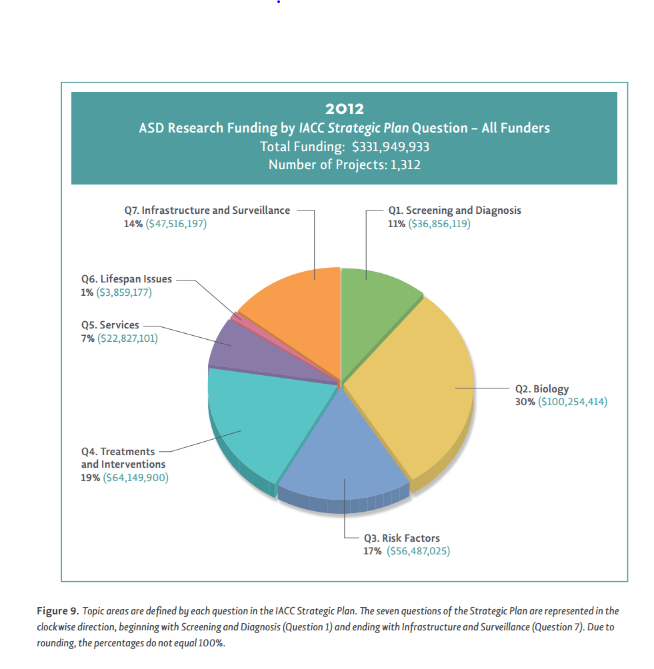
We aren’t talking small amounts of money. Here’s a figure from the IACC’s Portfolio Analysis from 2012. That’s over $300,000,000.00 spent in one year. Three hundred million plus dollars.

Autism Expenses 2012

Is that the breakdown you want to see? Is that what will make a difference in your life, or the life of someone you care about?

It isn’t what I want or need. Research takes time to impact real life. I want autistic adults–especially those with high support needs–to have a better life. I’d like it NOW, but I need it by the time my kid ages out of school. In the pie chart above, “lifespan issues” account for 1% of the total funding. Lifespan issues is the term for issues involving adults.

1%.

That has to change. And I’ll give that feedback, and more.

You may have other areas, or other specific projects you want to see advances in. Let the IACC know. Let them know NOW. Request for Public Comments – 2016 IACC Strategic Plan

Here are the questions you will see on the website.

Question 1: When Should I Be Concerned? (Diagnosis and Screening)

Please identify what you consider the most important priorities and gaps in research, services and policy for Question 1. Topics include: diagnosis and screening tools, early signs, symptoms, and biomarkers, identification of subgroups, disparities in diagnosis

Question 2: How can I understand what is happening? (Biology of ASD)

Please identify what you consider the most important priorities and gaps in research, services and policy for Question 2. Topics include: molecular biology and neuroscience, developmental biology, cognitive and behavioral biology, genetic syndromes related to ASD, sex differences, immune and metabolic aspects, and co-occurring conditions in ASD

Question 3: What Caused This to Happen and Can it be Prevented? (Risk Factors)

Please identify what you cosnider the most important priorities and gaps in research, services and policy for Question 3. Topics include: genetic and environmental risk factors, gene-environment interactions, and the potential role of epigentics and the microbiome

Question 4: How can I understand what is happeing? (Treatments and Interventions)

Please identify what you consider the most important priorities and gaps in research, services and policy for Question 4. Topics include: behavioral, medical/pharmacologic, educational, techonology-based, and complementary/integrative interventions.

Question 5. Where can I turn for services? (Services)

Please identify what you consider the most important priorities and gaps in research, services and policy for Question 5. Topics include: service access and utilization, service systems, education, family well-being, efficacious and cost-effective service delivery, health and safety issues affecting children, and community inclusion.

Question 6. What does the future hold, especially for adults? (Lifespan Issues).

Please identify what you consider the most important priorities and gaps in research, services and policy for Question 6. Topics include: health and quality of life across the lifespan, aging, transition, and adult services, including eduction, vocational training, employment, housing, financial planning and community integration.

Question 7. What other infrastructure and surveillance needs must be met? (Lifespan Issues)

Please identify what you consider the most important priorities and gaps in research, services and policy for Question 7. Topics include: research infrastructure needs, ASD surveillance research, research workforce development, dissemination of research information, and strengthening collaboration.

Go to the website. Request for Public Comments – 2016 IACC Strategic Plan. Give them feedback. Did I mention you should do it now and not wait?


By Matt Carey

California budget battle to restore disability services–WE WON!

17 Mar

My apologies for not posting this right away. For those who have been following the battle in the California Legislature to restore some of the lost funding to disability services, WE WON!

OK, we started out trying for a 10% increase and got 7.5%, but this is a heck of lot better than when we got nothing in the new budget.

The ARC and United Cerebral Palsy California Collaboration spent a lot of time getting support for this and deserve a lot of thanks from our community. The letter announcing the final decision is below.

Dear Friends,
The Assembly and Senate just passed the bills to save our community services. The bills now to Governor Brown for his signature, which is certain.
As Assembly Speaker Toni Atkins said, “The passionate advocates for this funding should be proud of their persistence” – two years of persistent, vocal, united community advocacy.
The bipartisan vote on the key bill to provide the funding was 28-11 in the Senate and 60-16 in the Assembly. To find out how your assemblymember voted, clickhere. The Senate vote isn’t up yet, but the 28 “aye” votes were all the Democrats and two Republicans, Senator Huff and Senator Cannella.
If your senator and/or assembly member voted “aye,” please call them now to thank them. Click here to find them. If you talked to someone in their office before, call that person and let them know we don’t just complain, we thank them when they deserve it. And save their name and number; there will be more fights.  
If your senator or assembly member is among those Republicans who for one reason or another felt they couldn’t vote for it, don’t hold it against them! The Republicans’ vocal support for months was a big reason why we got this far. And if they had tried to stop their fellow Republicans from voting “aye” today, they probably could have stopped them, which would have blocked the bill — but they didn’t.
This isn’t the last fight. As Assemblymember Mark Stone said to all his colleagues who voted for the package, “Stay with us next year, the year after that, the year after that, to protect this particularly vulnerable community.”
(Actually, we can’t even wait till next year. Today’s action will, for the most part, stop the deterioration of our community services, but we have some gaps to try to fill in the budget that will get adopted in June. Stay tuned.)
But for now, it’s time to celebrate.
And thank you for your advocacy.
Greg
 
Greg deGiere
Public Policy Director
The Arc & United Cerebral Palsy California Collaboration
1225 Eighth Street, Suite 350, Sacramento, CA 95814


By

Matt Carey

California Legislative Action Alert: The Vote to Save Our Services is Set for Monday!

26 Feb

The California developmental disabilities community has been fighting a long and hard fight to regain lost ground in support for services. Basically, the budgets keep leaving us out and with inflation we keep losing ground.

The budget support is coming up for vote on Monday. I know I’ve asked many times for calls, faxes, emails, etc., but with luck this is the last time. Make it count–make your needs heard. Details are below in a letter from Tony Anderson of the Arc California and the Lanterman Coalition.

The Vote to Save Our Services is Set for Monday!
 
 
Dear Friends,
From everything we hear, we’re going to win in both the Senate and Assembly on Monday! We appear to have the two-thirds, bipartisan majorities we need to pass the compromise agreement to save our community services.
But just be safe, we’re asking everyone to make two more calls before noonMonday – one to your state senator, and one to your assembly member. Click here to find who they are.
As usual, if you already have talked to someone in your senator’s or local office, call him or her. Otherwise, call their Capitol office in Sacramento.
The message is even simpler than usual – just give them your name and address, and ask them to please vote yes on ABx2-1 and SBx2-2 to save ourt developmental services. There’s no need for confrontation at this time, we just need the policymakers to know we are watching close and we want their vote on Monday.
As we acknowledged earlier, the agreement doesn’t achieve everything needed – our community is going to need to stay united to fight for the rest iof what we need in the months and years ahead — but it is a critically important step to provide relief and recovery.
Please make two calls before noon Monday.
And thank you for your advocacy!
Tony
 
Tony Anderson
Executive Director, The Arc California and
Chair, The Lanterman Coalition
1225 Eighth Street, Suite 350, Sacramento, CA 95814


The IACC will meet in January: submit comments now!

14 Dec

Below is a meeting announcement for the U.S. Interagency Autism Coordinating Committee (IACC).

Now would be a great time to submit a written comment to IACCpublicinquiries@mail.nih.gov

As a former member of the IACC I can tell you that comments are read and considered seriously.  I can also tell you that the groups pushing the idea that vaccines cause autism do a good job of submitting comments.  There’s a lot of work to be done with the new IACC.  The Strategic Plan needs to be rewritten.  Now is when your input can have a big impact.

Meeting of the Interagency Autism CoordinatingCommittee

Please join us for an IACC Full Committee meeting that will take place on Tuesday, January 12, 2016 from 9:00 a.m. to 5:00 p.m. ET at the National Institutes of Health, 31 Center Drive, Building 31, C Wing, 6thFloor, Conference Room 6, Bethesda, MD 20892. Registration will begin at 8:00a.m. The meeting will also be available by live webcast and conference call.

Agenda: To discuss business, updates and issues related to ASD research and services activities. The committee will discuss the next update of the IACC Strategic Plan.

Meeting location:
National Institutes of Health

31 Center Drive

Building 31, C Wing, 6th Floor, Conference Room 6

Bethesda, MD 2089

Nearest Metro stop:

Medical Center Drive Metro Station – Red Line


In the interest of security, NIH has instituted stringent procedures for entrance onto the NIH campus. All visitor vehicles, including taxicabs, hotel, and airport shuttles will be inspected before being allowed on campus. Visitors will be asked to show one form of identification (for example, a government-issued photo ID, driver’s license, or passport) and to state the purpose of their visit. Also as a part of security procedures, attendees should be prepared to present a photo ID at the meeting registration desk during the check-in process. Pre-registration is recommended.


Pre-Registration:

The meeting will be open to the public and pre-registration is recommended. Seating will be limited to the room capacity and seats will be on a first come, first served basis, with expedited check-in for those who are pre-registered. Online registration will be opening shortly. Please check the IACC website for updates.


Public Comment – Deadlines:

Notification of intent to present oral comments: Monday, January 4th by 5:00p.m. ET

Submission of written/electronic statement for oral comments: Tuesday, January 5th by 5:00p.m. ET

Submission of written comments: Tuesday, January 5th by 5:00p.m. ET


Remote Access:

The meeting will be remotely accessible by videocast  (http://videocast.nih.gov/) and conference call.  Members of the public who participate using the conference call phone number will be in listen-only mode.
Conference Call Access
USA/Canada Phone Number: 800-988-9744

Access code: 3700810


Individuals who participate using this service and who need special assistance, such as captioning of the conference call or other reasonable accommodations, should submit a request to the contact person listed below at least five days prior to the meeting. If you experience any technical problems with the conference call, please e-mail at helpdeskiacc@gmail.com or call the IACC Technical Support Help Line at 415-652-8023.


Please visit the IACC Events page for the latest information about the meeting, including registration, remote access information, the agenda, materials and information about prior IACC events.


Contact Person for this meeting is:


Ms. Lina Perez
Office of Autism Research Coordination
National Institute of Mental Health, NIH
6001 Executive Boulevard, NSC
Room 6182A
Rockville, MD 20852
Phone: 301-443-6040
E-mail: IACCpublicinquiries@mail.nih.gov

HHS Announces Appointment of New Membership and New Chair for the Interagency Autism Coordinating Committee

28 Oct

The Secretary of Health and Human Services has selected and seated a new Interagency Autism Coordinating Committee. The press release is below.

HHS Announces Appointment of New Membership and New Chair for the Interagency Autism
Coordinating Committee

The U.S. Department of Health and Human Services (HHS) today announced the appointments of new
and returning members to the Interagency Autism Coordinating Committee (IACC), reauthorized under
the Autism CARES Act. After an open call for nominations for members of the public to serve on the
committee, Secretary of Health and Human Services, Sylvia M. Burwell, appointed this group of
individuals to provide her with advice to advance research, strengthen services, and increase
opportunities for people on the autism spectrum. The public member appointees include three adults
on the autism spectrum, several family members of children and adults on the autism spectrum,
clinicians, researchers, and leaders of national autism research, services, and advocacy organizations.
Many of the appointed individuals serve dual roles, dedicating their professional careers to helping
people on the autism spectrum because of their personal experiences with autism spectrum disorder
(ASD). The first meeting of the new committee will take place on November 17, 2015 in Rockville,
Maryland.

In addition to the new public members, the IACC will have a new chair when it reconvenes. Dr. Thomas
Insel, who served as the Director of the National Institute of Mental Health (NIMH) and as Chair of the
committee for more than a decade, announced his planned departure for Google Life Sciences in at the
end of October 2015. Dr. Bruce Cuthbert, who will become Acting Director of NIMH on November 1,
has been appointed to serve as the IACC Chair over the next year.

Autism research, services, and advocacy organizations represented by new and returning appointees to
the committee include: Association of University Centers on Disabilities, Arc of the United States, Autism
Science Foundation, Autism Speaks, Autism Society, Simons Foundation, and Autistic Self Advocacy
Network. Federal departments and agencies represented on the committee include several agencies
within HHS: Administration for Children and Families, Administration for Community Living, Agency for
Healthcare Research and Quality, Centers for Disease Control and Prevention, Centers for Medicare &
Medicaid Services, Food and Drug Administration, Health Resources and Services Administration, and
National Institutes of Health; as well as Department of Education, Environmental Protection Agency, and
Department of Defense .

The responsibilities of the committee include annually updating the IACC Strategic Plan for ASD,
preparing an annual summary of advances in ASD research, monitoring federal ASD activities, and
providing guidance to the HHS Secretary on matters related to ASD.
The public members appointed by the Secretary to serve on the renewed IACC are:

David Amaral, Ph.D.
Dr. David Amaral is a new public member of the IACC. He is a Professor of Psychiatry, Behavioral
Sciences and Neuroscience at the University of California, Davis. He is also Chair of the Beneto
Foundation, Founding Research Director of the UC Davis MIND (Medical Investigation of
Neurodevelopmental Disorders) Institute, and Director of the Autism BrainNet. Dr. Amaral conducts
research on the neurobiology of ASD. He received a joint Ph.D. in psychology and neurobiology from the
University of Rochester and carried out postdoctoral work at Washington University in neuroanatomy.

James Ball, Ed.D., B.C.B.A.-D.
Dr. Jim Ball has served on the IACC as a public member since 2012. He is a Board Certified Behavior
Analyst (BCBA-D) and President and CEO of JB Autism Consulting. He has worked in the autism field for
more than 25 years, providing educational, employment, and residential services to children and adults
affected with autism. He is the Executive Director of the Autism Society’s (AS) Board of Directors. He
received his Doctor of Education degree from Nova Southeastern University in Fort Lauderdale, Florida.

Samantha Crane, J.D.
Ms. Samantha Crane is a new public member of the IACC. She is Legal Director and Director of Public
Policy at the Autistic Self Advocacy Network (ASAN) and an autistic self-advocate. Ms. Crane previously
served as staff attorney at the Bazelon Center of Mental Health Law, focusing on enforcing the right to
community integration as established by the Supreme Court in Olmstead v. L.C.. Ms. Crane holds a B.A.
from Swarthmore College, with high honors, in Psychology, and she received her J.D. degree from
Harvard Law School.

Geraldine Dawson, Ph.D.
Dr. Geraldine Dawson has served on the IACC as a public member since 2012. She is a Professor of
Psychiatry and Behavioral Sciences in the Duke School of Medicine and a faculty member of the Duke
Institute for Brain Sciences. Dr. Dawson also is Director of the Duke Center for Autism and Brain
Development and President of the International Society for Autism Research. Dr. Dawson is a licensed
clinical psychologist and researcher who has published extensively on ASD, focusing on early detection,
intervention, and early brain development. She received her Ph.D. in Developmental Psychology with a
minor in Child Clinical Psychology from the University of Washington and was a postdoctoral fellow at
the University of California at Los Angeles.

Amy Goodman, M.A.
Ms. Amy Goodman is a new public member of the IACC. She is the Director of the Arc of the United
States’ Autism NOW Resource and Information Center, which serves the needs of individuals with
autism and their families. She is a self-advocate for individuals on the autism spectrum and holds a
master’s degree in special education from Marshall University in West Virginia.

Shannon Haworth, M.A.
Ms. Shannon Haworth is a new public member of the IACC. She is the Public Health Program Manager
for the Public Health team at Association of University Centers on Disabilities (AUCD) and a parent of a
child on the autism spectrum. She has a master’s degree in Applied Behavior Analysis and a graduate
certificate in Autism from Ball State University. She has also earned a Post Baccalaureate Graduate
Certificate in Disability Leadership from Virginia Commonwealth University, is currently a doctoral
candidate (DrPH) studying Public Health at Walden University, and is a certified Early Intervention
Specialist for the state of Virginia.

David Mandell, Sc.D.
Dr. David Mandell has served on the IACC as a public member since 2012. He is an Associate Professor of
Psychiatry and Pediatrics at the University of Pennsylvania’s School of Medicine. He is a health services
researcher and psychiatric epidemiologist whose work focuses on identifying the best ways to organize,
finance and deliver services to children with autism and other psychiatric and developmental disabilities.
Dr. Mandell holds a Bachelor of Arts in psychology from Columbia University and a Doctor of Science
from the Johns Hopkins School of Hygiene and Public Health.

Brian Parnell, M.S.W., C.S.W.
Mr. Brian Parnell is a new public member of the IACC. He has led a distinguished career in child welfare
and disabilities services and as an administrator of public and nonprofit agencies, having supervised and
managed social service programs for more than 20 years. Mr. Parnell currently works at the Utah
Division of Services for People with Disabilities, Department of Human Services, and helped develop
Utah’s Medicaid Autism Waiver program. Mr. Parnell is a parent of seven children, three of whom are
on the autism spectrum.

Kevin Pelphrey, Ph.D.
Dr. Kevin Pelphrey is a new public member of the IACC. He is the Harris Professor in the Child Study
Center and Professor of Psychology at Yale University and Director of the Yale Center for Translational
Developmental Neuroscience. He also is the father of two children on the autism spectrum. Dr.
Pelphrey’s research focuses on the development of brain mechanisms for social cognition in children
with and without ASD. He also is the Principal Investigator for a federally-funded multisite Autism Center
for Excellence, “Multimodal Developmental Neurogenetics of Females with ASD.” Dr. Pelphrey received
his Ph.D. in Psychology from the University of North Carolina at Chapel Hill.

Edlyn Peña, Ph.D.
Dr. Edlyn Peña is a new public member of the IACC. She is an Assistant Professor of Higher Education
Leadership at California Lutheran University (CLU) and is a parent of a child on the autism spectrum. Dr.
Peña’s research focuses on social justice issues for ethnic/racial minorities and students with autism and
other developmental disabilities in higher education. She earned her Ph.D. in Education with a
concentration in Higher Education from the University of Southern California.

Louis Reichardt, Ph.D.
Dr. Louis Reichardt is a new member of the IACC. He is the Director of the Simons Foundation Autism
Research Initiative (SFARI), whose goal is to improve the understanding, diagnosis, and treatment of ASD
by funding innovative, high quality research. Prior to this, he was a Professor of Biochemistry and
Biophysics at the University of California, San Francisco, where he directed its neuroscience graduate
program and Herbert W. Boyer Program in Biological Sciences. His research has focused on
neurotrophins, a family of proteins that play a key role in brain development and function. Dr. Reichardt
was a Fulbright scholar and earned his undergraduate degree from Harvard University and a Ph.D. in
Biochemistry from Stanford University.

Robert Ring, Ph.D.
Dr. Robert Ring has served on the IACC as a public member since 2014. He is the Chief Science Officer
(CSO) for Autism Speaks, the largest autism science and advocacy organization in the U.S. Dr. Ring is
responsible for leading the science program at Autism Speaks, which features a diverse portfolio of
research investments targeting medical research on the underlying biology of ASD, diagnosis, treatment,
etiology, public health, and innovative technologies. Dr. Ring holds adjunct faculty appointments in the
Department of Psychiatry at Mount Sinai School of Medicine (New York) and the Department of
Pharmacology and Physiology at Drexel University College of Medicine (Philadelphia). He holds a Ph.D. in
Molecular Neurobiology from City of Hope National Medical Center in Southern California.

John Elder Robison
Mr. John Elder Robison has served on the IACC as a public member since 2012. He is the Neurodiversity
Scholar in Residence at the College of William & Mary in Williamsburg, Virginia, where he teaches
courses on neurodiversity and living with autism. He is an autistic adult who is best known for working
to increase public understanding of autism, and he is the author of several popular books about living
life with autism, including Look Me in the Eye, My Life with Asperger’s, Be Different: Adventures of a
Free-Range Aspergian, and Raising Cubby.

Alison Singer, M.B.A.
Ms. Alison Singer has served on the IACC as a public member since 2007. She is Co-Founder and
President of the Autism Science Foundation, a not-for-profit organization launched in April 2009 to
support autism research by providing funding and other assistance to scientists and organizations
conducting, facilitating, publicizing, and disseminating autism research. Ms. Singer is the mother of a
daughter with autism and legal guardian of her adult brother with autism. Ms. Singer graduated magna
cum laude from Yale University with a B.A. in Economics and has an M.B.A. from Harvard Business
School.

Julie Lounds Taylor, Ph.D.
Dr. Julie Lounds Taylor is a new public member of the IACC. Dr. Taylor is an assistant professor of
Pediatrics and Special Education at Vanderbilt University and an Investigator at the Vanderbilt Kennedy
Center. Her research focuses on factors that promote a positive transition to adulthood for individuals
with ASD and their families, as well as the impact of having a sibling with an intellectual or
developmental disability. She has published research on a variety of autism and disability servicesrelated
issues, including sex and gender differences, peer victimization, transition planning, secondary
education and vocational training, employment, and daily life skills for people on the autism spectrum.
Dr. Taylor earned her Ph.D. in developmental psychology at the University of Notre Dame.

***

The IACC is a Federal advisory committee that was created by Congress in an effort to accelerate
progress in ASD research and services. The IACC works to improve coordination and communication
across the Federal government and work in partnership with the autism community. The Committee is
composed of officials from many different Federal agencies involved in autism research and services, as
well as adults on the autism spectrum, parents and family members of individuals on the autism
spectrum, advocates, researchers, providers, and other members of the autism community. The
documents and recommendations produced by the IACC reflect the views of the Committee as an
independent advisory body and the expertise of the members of the Committee, but do not represent
the views, official statements, policies or positions of the Federal government. For more information on
the IACC, please visit: www.iacc.hhs.gov.