Archive | Science RSS feed for this section

Harold L Doherty builds a strawman army

18 Feb

I’ve been reading Mr Doherty for awhile now. He keeps a blog that discusses his views on autism advocacy and to his credit he stresses the importance of evidence based methods for helping his autistic son, Conor. This means he holds the vaccine/autism bull in as much disdain as I do.

However, this would seem to be the beginning and the end of his skeptical nature. He has, over recent weeks, been involved in a blog war with Michelle Dawson during which he claims (as far as I can see) that Ms Dawson is actively campaigning against ABA based therapies. Ms Dawson claims (with some justification) that what she is doing is suggesting that ABA is not the only methodology that helps. He makes occasional side references to this issue in the comments of blog posts such as this one in response to Kristina’s take on autism mythology:

Today, in place of Bettleheim, we have new forces ready to condemn parents of autistic children. Bettleim’s handiwork today is done by those who attack parents because they advocate for improved health and education of their autistic children and are accused of violating the human rights of all persons with autism by doing so. One hurtful urban myth gives way to another.

This was the first of Mr Doherty’s strawmen army that I noticed. I asked Mr Doherty to back up his position with a quote from someone actually doing that:

Could you provide an example of someone attacking parents of autistic people for advocating for improved health and education for the reason that these same people think that improved health and education violate human rights?

To which he answered:

If you want an example try this one, a comment attributed to Ms. Dawson in reference to parent advocates “they make me sick” is what she is quoted as having said

And he is correct, that’s indeed what she said. However, that wasn’t what I asked. I asked for a quote that showed someone attacking parents of autistic people for advocating for improved health and education for the reason that these same people think that improved health and education violate human rights, which Ms Dawson’s stated opinion clearly does not. Mr Doherty’s reply was:

I gave you a very obvious example. You simply refuse to accept the statement for what it is.

Which is just a new variation on the close minded doggerel.

Today I noted a new post from Mr Doherty. This post is simply one logical fallacy after another. He starts of by defining ‘Sirens’ for us as those who would seduce sailors to their deaths with sweet sounds.

Lets not forget that a siren is also that which makes a long, wailing, irritating noise.

Anyway. Lets address Mr Doherty’s first strawman:

Parents and families of children newly diagnosed with autism will face many daunting, at times overwhelming challenges. As the father of a soon to be 11 year old boy with classic Autism Disorder I have dealt with those realities for the 9 years since my son was diagnosed at age 2. One of the more seductive challenges that parents will face is the siren calls of those who oppose any effort to treat, educate or heaven forbid change an autistic child for the better. Do not listen to the sirens’ call.

This paragraph encapsulates the position of the rest of the post perfectly. It also reveals its weakness. It is simply a strawman argument. A regurgitation and expansion of his comment on Kristina’s blog. No one I know has ever opposed ‘any effort to treat, educate or change an autistic child for the better’. If Mr Doherty believes they have I would appreciate seeing supporting material or quotes. As has happened many times before, Mr Doherty is taking a very easy to understand proposition – that desiring a cure for autism is not analogous to respecting autistic people – and imbuing it with false exaggerations in order to demonise that position.

Here’s another example:

The sirens will outright mislead you and tell you that autism is not a disorder or a disability, that it is simply another variation in the human condition, neither good nor bad

Again, this is simply false. I personally tell people that autism is both a disability _and_ a difference. To pretend that being autistic cannot present one with disabling situations is ridiculous _so nobody I know presents it as a belief_. That includes Ms Dawson.

The sirens will not talk about such realities as lack of communication, self injurious behavior, or lack of awareness of potentially life threatening dangers posed by automobiles or broken glass. The sirens will not tell you that some autistic children are sent home from neighborhood schools sometimes in handcuffs or that they are sometimes housed in criminal detention centers for youths because no decent facilities exist in which autistic youths and adults with severe behavioral issues can reside. They will not talk to you about autistic adults residing in mental health hospitals.

Here we say Mr Doherty taking the ‘scattergun’ approach to logical fallacy. Just about every sentence in that scaremongering paragraph is fallacious. For example, its no secret that my daughter doesn’t speak. Ballastexitenz has a whole category regarding self-injurious behaviour. I have written more than once about the horrors that can happen when there is a lack of decent facilities for autistic youths and adults, as has Ballastexistenz, Mike Stanton, Kristina Chew and most of the online community Mr Doherty would think of as falling under the umbrella of ‘sirens’.

The attraction of the siren’s call is the attraction of sweet surrender. If a parent is told that their child’s autism is a beautiful thing, a joy to be embraced by the parent it will be easier to let go, to give up and to refrain from taking on the enormous challenge of doing the best that can be done for your child. It is not easy to raise, care for and educate many autistic children. It is absolutely one of the most rewarding tasks a parent can face but it is challenging, stressful and costly. It would be easy to give up and let go.

Here we have another old ‘ND’ logical fallacy – that accepting autism is the same as doing nothing. I can personally attest that this is laughably fallacious. What my wife and I spend most of our time on is raising, caring for and educating our children – including our autistic daughter. Mr Doherty’s implication that those of us who don’t believe in the things he does have have given up is a particularly cowardly and distasteful Ad Hominem fallacy.

Moving away from logical fallacies, Mr Doherty expresses what – to my mind – are gravely disturbing opinions regarding the nature of acceptance and moving on:

The sirens will tell you not to mourn for your autistic child, to accept your child’s autism; the will even tell you to find joy in your child’s autism. They will encourage you to accept your child as he or she is and not to seek to change your child.

Mr Doherty seems to be alluding to the essay ‘Don’t Mourn For Us‘ with this statement. If so it is an incorrect reference. Here’s what Jim Sinclair says about mourning:

Some amount of grief is natural as parents adjust to the fact that an event and a relationship they’ve been looking forward to isn’t going to materialize. But this grief over a fantasized normal child needs to be separated from the parents’ perceptions of the child they do have: the autistic child who needs the support of adult caretakers and who can form very meaningful relationships with those caretakers if given the opportunity

Mr Doherty’s exhortation to wallow in grief seems to me to be the opposite of sense and practicality. There have been times in my life I have mourned friends and family who have died. I don’t believe it is healthy to try and force a relationship that is motivated or fed on grief. The autistic child is _still alive_ . To behave as if it is dead is not, in my opinion, a good thing for parent or child.

I would indeed heartily recommend finding the joy in your child’s autism. It is there to be found if you look. My autistic child is a delight. Yesterday was her 7th birthday and we had a great time doing the things _she_ likes. We didn’t have a party. We didn’t make her unwrap her presents. We didn’t have lots of people around. It was just the five of us. We did it that way as that’s what _she_ feels comfortable with. It was truly a lovely day. I don’t understand why Mr Doherty would rather (if I understand him) I turned these sort of days into a funeral dirge.

I would also like to once again quote from one of my favourite peer reviewed papers entitled: _”A qualitative investigation of changes in the belief systems of families of children with autism or Down syndrome”_. In this paper the authors have investigated the lives of families who have autistic members or members with Down’s Syndrome:

Over time, parents may experience changes in ways of seeing their child, themselves and the world. These new perspectives may encompass profound rewards, enrichments, and the appreciation of the positive contributions made by people with disabilities

and

A wide range of positive changes or transformational outcomes have been reported by parents of children with disabilities, including: the development of personal qualities such as patience, love, compassion and tolerance (Summers et al 1989; Behr & Murphy 1993; Scorgie & Sobsey 2000; Kausar et al. 2003); improved relationships with family members and others (Stainton & Besser 1998; Scorgie & Sobsey 2000; Kausar et al 2003); stronger spiritual or religious beliefs (Yatchmenoffet al. 1998; Scorgie & Sobsey 2000; Poston & Turnbull 2004); an ability to focus on the present (Featherstone 1980); and a greater appreciation of the small and simple things in life (Abbott & Meredith 1986; Kausaret al. 2003). Studies therefore indicate that, with time and experience, parents of children with disabilities may come to regain a sense of control over their circumstances and a sense of meaning in life by seeing the positive contributions of their children with respect to personal growth and learning whatis important.

and

Our children have taught us the true worth of an individual. Our society tends to value persons based on performance, knowledge, education, the ability to earn income. And these children have taught us that there are so many more inherently important values, which have shaped us as a family.

and

Another thing that makes me feel that I am so much smarter than I used to be is that I have given up trying to fix my son. . . . All I have to do is figure out . . . what he wants and what will make him happy, and try to put a structure around it. . . . He’s fine the way he is, and it was for me to figure that out and, gee, the poor guy while I was figuring that out.

and

And it’s true that if you don’t change the way you think about this child, if you always think that you wanted to have a normal child and you are always comparing your child to a normal child, you’ll never really be accepting and you just don’t get anywhere.

I hope Mr Doherty can one day stop constructing strawmen to fight his battles and can start to appreciate the truths he ignores.

Update

Mr Doherty failed to publish many of the comments I know he received. That’s fine – his blog, his rules. He did however make another post on the subject which I’ll reproduce below:


When I posted yesterday about “Neurodiversity’s” attempts to downplay the existence of severely autistic persons I expected, and received, some heated comments although some were civil and on topic enough to post. But none of the comments that I received acknowledged a central reality that the Neurodiversity movement seems ashamed to admit – that there are many autistic persons in the world whoin fact are severely disabled, who are dangerous to themselves and who require 24/7 care and attendance to ensure their safety. I am still waiting for one of the Neurodiversity advocates to admit these truths – but I am not holding my breath while I wait.

The ugly truth is that many in the Neurodiversity movement seem ashamed to acknowledge the existence of severely autistic persons – like my son.


Here we see yet more Strawmen. Mr Doherty has shifted from specifics – as he was challenged on them and obviously had no response – back to generalities. He now states that the neurodiversity ‘movement’ fail to acknowledge a ‘central reality’ – that there are autistic people who:

a) are severely disabled
b) are dangerous to themselves
c) who require 24/7 care

He claims he is still waiting for one of the neurodiversity advocates to admit these truths, but (put on a lofty tone of voice) ‘I am not holding my breath while I wait’.

Several times in my blogging career I have mentioned my great uncle. He died some years ago. He was born before 1920 and I never met him. He was according to his sister-in-law, my grandmother, severely disabled and whilst he was not considered dangerous he was adjudged to need 24/7 care which he duly received. He was occasionally self-injurious and during those times he was, I suppose, a danger to himself.

As I say, this is not the first time I have mentioned my great uncle. If Mr Doherty spent as much time researching the stated facts regarding those he chooses to misrepresent as he does constructing logically weak arguments then we might do away with all this silliness.

Jeff Bradstreet deserts the sinking ship

12 Feb

Cast you mind back, dear Reader, to July last year when the RhoGAM ruling failed to find general or specific causation for thiomersal causing autism. That little episode has taken a heavy toll on the ‘expert witness’ status of both Mark Geier and Boyd Haley, both of whom were eviscerated by the presiding judge.

But, hey, at least they had the guts to stick around. Some people decide to do a runner at the first sign of trouble.

Enter Jeff Bradstreet, advocate of <a href="exorcism (yes, really) for treating autism.

In September of 2006, Bradstreet was the designated ‘expert witness’ in a case of Aventis Pasteur, Inc. v. Skevofilax, the latter being a family that filed suit on the claim that:

…their minor son’s autism was caused by toxic levels of mercury contained in thimerosal, a preservative used in the vaccines.

This trial ended abruptly when:

After three amended scheduling orders and nearly eleven months of discovery, Respondents’ sole expert on specific causation withdrew from further participation in the case without ever having rendered his expert opinion.

There’s a lot of legal stuff going on in the background of this case regarding whether it was right to hold the Skevofilax’s responsible for the failure of the case. The first trial said it was, they appealed and the appeal judge supported this appeal and now this summary judgement has reversed the appeal.

However, what I’m really interested in is _why_ the ‘expert witness’ failed to materialise.

James Jeffrey Bradstreet, M.D., was designated to testify to specific causation, i.e., “that significant amounts of mercury to which the minor plaintiff was exposed, including bolus doses received as a result of vaccination, was a substantial factor in causing [Michael’s] current injuries and symptoms,” and further, “that the exposure to toxic levels of mercury within the vaccines [was] a substantial contributing factor to the minor Plaintiff’s ultimate injuries and symptoms.”

But what happened? Why did Bradstreet never testify?

On 26 October 2004, Respondents notified Petitioners, by letter, that “due to unforeseen circumstances [genomic profiling] test results critical to [Dr.] Bradstreet’s opinions” would be delayed up to sixty days. The relevant genomic susceptibility tests assertedly needed for Dr. Bradstreet’s expert medical opinion were being performed by a laboratory at the University of Arkansas. An affidavit completed by Dr. Bradstreet stated that an outbreak of leukemia in New Mexico caused the Arkansas lab ‘s director, Dr. Jill James, to be called out of town to consult on that outbreak, and that she would not be returning for several weeks. Drs. James and Bradstreet previously had collaborated on other projects. According to Dr. Bradstreet, he would be unable to formulate an expert medical opinion regarding causation specific to Michael’s injuries until the results of the genetic test results were received fro m Dr. James’ lab

Who else is rolling their eyes right now? Apparently, these ‘tests’ can only be performed by Jill James lab. And only by Jill James herself (I assume the other employees are useless?). There’s further no evidence to assume that these tests provide evedence of anything anyway and apparently the dog once ate his homework.

So, respondents and plaintiffs argued over a new schedule and a new schedule had to be enforced by the court in the end and Jeff Bradstreet was once again instructed to be made available for deposition, this time on 19 Nov 2005. Subjects at that deposition concerning Bradstreets role as an expert witness would include:

[a]ppropriate topics of inquiry for this deposition, [were to] include, but not be limited to, the nature and purpose of the GST [glutathione-S-transferase, a particular family of enzymes in the human genome] M1 [a particular gene which encodes the GST enzyme] polymorphism [i.e., difference or variation] test, the work that Dr. Brad street [had] performed to date in this action, his qualifications, his affidavit submitted in connection with Plaintiff ‘s Motion for Continuance, all of his opinions on the subject of general causation, and the results of those tests that Dr. Bradstreet [had] performed or directed to be performed and that [were] available as of the date of [the] initial discovery deposition.

In other words, a thorough examination of the man, his qualifications and the quality of his science.

But, the court decided if the results of his tests of unknown origin or efficacy that could only be performed by Jill James at Jill James lab ‘became available’ (snigger) then:

Dr. Bradstreet would be made available for additional discovery by no later than 14 January 2005 in order to explain how those results pertained to his expert opinion regarding specific causation.

And then (gasp!) the court received the following:

Counsel for Respondents informed the Circuit Court and opposing counsel, by letter dated 23 November 2004, that Dr. Bradstreet declined to participate further in the litigation. According to Respondents’ counsel, Dr. Bradstreet withdrew due to outside “professional and personal commitments and time constraints.

According to Bradstreet:

…the primary reason for his withdrawal was the impact the time commitment would have on his ability to spend time with his family.

So either he had no family before the start of proceedings or he forgot he had a family and then remembered or…oh hell, I don’t know…but strangely, Bradstreet was not to busy to speak at The Autism One conference in May 2005, or May 2006, or to attend and speak at a conference of the American Dietetic Assoc in October 2005.

I guess ‘too busy’ depends pretty much on how much money each gig pays and how often difficult questions are asked.

The end result for the Skevofilax’s?

Despite three amended scheduling orders, and approximately 11 months allotted to conduct discovery, Respondents failed to produce an expert who could testify to specific causation within a reason able degree of scientific certainty. Without such an expert, Respondents’ claims must fail as a matter of law.

Bradstreet hung them out to dry and they couldn’t find anyone else prepared to take on causation.

Thanks to A for the file :o) .

Problems with prevalence

8 Feb

The ‘autism epidemic’ lives and dies on prevalence. The assumed prevalence in the US again came under the spotlight due to a CDC study being released that showed an increased rate of prevalence.

Autism is more common in the United States than anyone had estimated, affecting about one in every 150 children, the U.S. Centers for Disease Control and Prevention reported Thursday.

Pfft – that’s nothing. Us Brits can post a recent prevalence estimate of one in every 100 children and as Joseph shows a 1% prevalence is not really anything new either. What _is_ new is that this new study from the CDC is slowly beginning to approach the prevalence rate of around 1% reported in the UK, Canada, Germany, Sweden and, less strongly, Norway.

So when I say ‘increase in prevalence’ – and when these people refer to the same – are we all saying that the prevalence rate is actively increasing? No. No one (at least no one legitimate) is suggesting that there is an active increase in the amount of people who _are_ autistic. Rather the suggestion is that we continue to move (some countries faster than others) to an international autism prevalence of (as yet) some undiscovered figure, but one which is definitely over 1% where rates will probably plateau with minor tweaks up and down.

An interesting quote from the same interview:

“The older statistics always estimated 70 to 75 percent of kids with autism had cognitive impairment,” Rice said. “We found 33 to 62 percent.”

So, ask yourself, is this a cognitive impairment ‘anti-epidemic’? If you believe the changes in autism prevalence represent an epidemic, surely it must follow that these figures represent an ‘anti-epidemic’?

Or maybe, just maybe, this is an illustration of two things a) the changes in diagnostic criteria for autism as a whole and b) improved diagnosticians and diagnosing techniques.

As a further exercise and as I’ve been perseverating a tad on them of late, lets see what the changing face of prevalence can tell us about CDDS data as of 2005 (year end).

OK, as of 2005, the population of California was 36,132,147. The number of CDDS registrants as of 2005 was 29,424. This gives an autistic population in CA in 2005 of 0.08% according to CDDS.

We now have three potential prevalence rates to measure the accuracy of CDDS – do the CDDS numbers accurately match any of the three prevalence rates? Well, clearly the answer is no. At a rate of 1 in 166 (the ‘old’ prevalence rate) there should be an autistic population of 0.60% and using the ‘new’ 1 in 150 rate there should be an autistic population of 0.66% – and we already know that in Canada and parts of Europe the rate is 1%.

Let’s be clear here, CDDS is reporting between 8.1% and 13.5% (depending on the prevalence rate you go with) of all autism in California. That’s not so good. Especially when even _those_ figures have stopped supporting your hypothesis.

David Kirby/Arthur Allen Debate Part IV

4 Feb

There’s Something About California!

So says David Kirby in the second part of his look at CDDS numbers. Lest we forget, whilst the California numbers seemed to support the thiomersal hypothesis, there was _nothing_ unusual about California. Now they don’t, there apparently is.

Right.

So, Kirby says there are seven reasons why ‘there’s something about California’. The first one is fascinating:

Wow. That’s pure, unadulterated bull. Sorry to be so blunt but it is. Far from ‘phoning people up to see what they had in the fridge’, here’s what the minutes of the meeting in which this was raised actually said:

….N.I.P. estimated the amount of thimerosal in provider vaccine inventories in a survey conducted September 20, 2001 to February 20, 2002. The targets were a convenience sample of providers getting site visits from public health officials across the country. Inventory counts were done of all refrigerators for D.T.a.P., Hib, and hep B pediatric vaccines. The thimerosal classification was based on the lot number information, which was verified by the manufacturers. In September 2001, 225 sites were canvassed, and 447 by February 2002…..During the visits, the providers were surveyed about thimerosal-containing vaccines in their inventories. Of the 447 interviews, 83.5 percent reported no thimerosal-containing vaccines in stock at any time since October 2001.

So, no Mr Kirby no one ‘picked up the phone and asked – do you have any mercury in your refrigerator’. Site visits. Public health officials went out and counted. No one’s claiming its iron clad but its hardly throw away either.

But it is, however, nice to know what Kirby’s opinion on phone call based surveys are. I’ll remember that when Brad launches the fruits of his recent labour.

Kirby’s six other points are the same old same old about RhoGAM (not a vaccine and recently and recently trounced in court), Flu shots in mercury. Thats an odd one. Maybe someone could explain to me how a voluntary flu shot, given once a year that contains about a 1/8th of the thiomersal that vaccines used to can cause autism rates to go _up_ ?

What else? Oh yeah – immigration and population grew in CA and hey – maybe some of those durn immigrants got vaccinated twice? Cus – y’know – immigrants ain’t too smart at counting.

Then to add to the illogical fear of foreigners David ‘yellow peril’ Kirby brings out his piéce de resistance – Asian coal. Yeah. Damned Asians and their coal. Grrrrr. Sorry – what? Even if it is true, what the hell has it got to do with thiomersal?

Oh and he mentions that Aluminium might play some unspecified part in some unspecified way maybe.

Truly, in the annals of debating history, DK will go down as the ‘shuck and jive’ expert. When in doubt, change the subject, make up some stuff and show some cool looking graphs really, really quickly.

Sacking Dr. Nick

2 Feb

Yesterday’s post on the CDDS numbers drew a response from JB Handley. Cool. However it seemed that he entirely missed the point of the post, either through misunderstanding or wilful choice. I’ll discuss this aspect of his commentary later, but for now, lets try and remove all ambiguity from the point of the CDDS post.

Poor Dr. Nick.I fondly imagined that using a well known quack would demonstrate the usefullness of CDDS for autism epidemiology as subtly as the dialogue in an Arnie movie demonstrates Arnie enjoys big guns. Sadly it seems that that optimism was misplaced as both commenter ‘666sigma’ and Brad showed they didn’t get it.

In one sentence, the previous post was made to illustrate the inability of CDDS data to show anything meaningful regarding the epidemiology of autism. Using CDDS I managed to ‘prove’ that the fastest growing cohort on CDDS was the 62 – 99 year olds.

I did this as for the last few years Brad, David Kirby and Rick Rollens have made a series of suggestions, proclamations and predictions regarding this data. All revolve around the central hypothesis of thiomersal containing vaccines causing autism. Lets look at what they’ve said.

In an interview with FAIR Autism Media, David Kirby said:

It’s now 2005. Mercury started to be removed from vaccines roughly in 2001, we don’t know exactly when as the FDA won’t tell us, but kids entering the system now, four year olds for example in California entering the Dept of Developmental Services [CDDS] were born in 2001. So those kids theoretically get less mercury on average than kids born in 2000. So we should see fewer cases entering the system this year than we did last year.

So in 2005 David Kirby says CDDS should show a dropoff in numbers starting in 2005. 2005 came and went and guess what? No dropoff. He then claimed he’d never said that and instead said in an email to blogger Citizen Cain that:

if the total number of 3-5 year olds in the California DDS system has not declined by 2007, that would deal a severe blow to the autism-thimerosal hypothesis….total cases among 3-5 year olds, not changes in the rate of increase is the right measure.

No explanation was given for this tacking on of two extra years.

And so, 2006 came and went and here we are in 2007 and guess what? Still no decline.

No explanation has been offered by David Kirby as to this. He is now claiming, in debates about vaccines, that enviornmental mercury from forest fires, crematoriums and China is partialy to blame.

Lets be clear on this – he might be right. But a) No data has been offered to support this hypthesis either and b) this has absolutely no bearing on the vaccine hypothesis.

David Kirby put forward a hypothesis that thiomersal containing vaccines cause autism and that using CDDS data we would see a decline in 2005. We didn’t. He then claimed he meant 2007. Again, we didn’t.

And what of Brad? IN an interview with the Times Union in July 2005, Brad said:

Late 2006 should be the first time that rates go down,” said Handley. “If they don’t, our. hypothesis will need to be reexamined.

Just to reiterate, rates did not go down. They are still rising according to CDDS data.

And so we come to the crux of this issue. Do the mercury militia want to carry on using CDDS or not? If they do, then they need to explain why all of their predictions have so far failed to come true.

If they do not then they need to contradict Rick Rollens, who launched another epidemic-supporting missive yesterday. He says that there must be an epidemic because 78% of the CDDS autism population are under 18. Rollens claims this works out to approximately 14,000 ‘missing’ adult autistic people.

Mr Rollens reached these figures by using CDDS data. Amusingly, Brad quoted Mr Rollens in his comments yesterday and thus exposed the poor logic he utilises.

Which is true? Is there an epidemic of autism as shown by CDDS numbers? Or does thiomersal cause autism?

In the past, the ‘epidemic’ hypothesis supported the thiomersal hypothesis but as we have now passed three separate deadlines for a drop in numbers and as a drop in numbers fails to materialise (as evidenced by Mr Rollens) then these two hypothesis have now become competing rather than complimentary. You can’t have an ongoing epidemic and still say thiomersal causes autism. As I’ve discussed before, at an ACIP meeting in 2002 it was revealed that the total thiomersal containing vaccine (TCV) population was 1.9% as of Feb 2002.

So, on one hand we have virtually no TCV’s and on the other we have a steadily increasing amount of autistic people in CDDS across all cohorts.

The combination of this extreme paucity of TCV’s and Mr Rollens continued insistence we have an autism epidemic are thiomersal hypothesis killers.

But lets turn this whole thing around a minute. The point of yesterdays post was to illustrate that CDDS is not a good source of epidemiology. Why do I say that?

First we should note that Brad accused me of only saying this _after_ my post. As I said at the start of this one, I would’ve thought Dr. Nick guest blogging this would’ve been a bit of a giveaway, as would the title ‘manipulating CDDS’ but still….

I first recall mentioning the shortcomings of CDDS in Feb 2006. I can also recall Do’C, Joseph, Diva and Jon posting at various times between then and now about how poorly the mercury militia were using CDDS figures. And in fact, I can remember Brad being part of those debates too. He must’ve forgotten that.

So why are so many of us saying that CDDS is a poor source of data for autism epidemiology?

Well, mainly because thats what CDDS says themselves. There is a PDF on the front of the site with a warning against doing exactly what Rollens, Kirby and Handley have done/are doing. In April 2005 Autism Diva wrote to CDDS for clarification as to why this was. The following points emerged (bulleted – read the whole entry on Diva’s site for detail – quotes from a CDDS email to Diva)

1) Numbers reported do not represent all persons with developmental disabilities in the State of California
2) The numbers can not be used to report the incidence of autism
3) The number does not represent only individuals newly added (or new intakes) to the DDS system.
4) New intakes may be one component of the net value.
5) The difference in the number of persons reported with a given characteristic from one quarter to the next is simply a net value of the above factors
6) It is inaccurate to represent the change in the numbers reported from one quarter to the next as “new intakes”
7) In some cases the developmental disability recorded on an individual’s CDER may be changed to another type of developmental disability

Surely it must be clear to even the most opportunistic of armchair epidemiologists that using this data is _a bad idea_ ?

Diva has also provided further clarification as to the makeup of those autistic people in the CDDS system. It has long been an article of faith to the mercury militia that CDDS figures are good because they are made up _only_ of ‘full spectrum’ autism (classic, low functioning, whatever) and they use this to exclude Aspergers, High functioning etc. Here’s David Kirby:

…the Golden State, however, is said to operate the gold standard of autism epidemiology, having always tracked “full-blown” autism only, as defined by the DSM-IV manual. In other words, children with milder forms of the disorder, such as PDD and Apserger Syndrome, need not apply for services.

It seems that that just isn’t so:

The following was published in the Journal of Autism and Developmental Disabilities. It is a letter written by Rita Eagle PhD of the California Dept. of Developmental Services (DDS). (Journal of Autism and Developmental Disorders, Vol. 34, No. 1, February 2004)…..The California Department of Developmental Services (April 2003) reports that the proportion of “higher functioning” children among the autism population has substantially increased and is on the rise, with a steady decline in the proportion of persons with autism who also have MR……To many clinicians, it appears that more and more children who, in th epast, would never have been referred to the regional centers–for example, bright but anxious and slightly socially inept kids with average or better IQs and children who, in the past, had been or would have been diagnosed as ADHD, OCD, ODD, anxiety disorder, learning disabilities, psychotic, and so forth—are now being diagnosed wit high-functioning autism and/or Asperger syndrome and referred to the regional centers for services.

So not only are the mercury militia using bad source data, they are presenting it to back up a scenario that simply doesn’t exist.

But hang on here – what am I saying? Surely if I’m stating that CDDS data is no good for autism epidemiology then I must be giving more weight back to the thiomersal hypothesis? If the Rollens/CDDS supported epidemic now undermines the CDDS supported thiomersal hypothesis (which it does) then surely by undermining the epidemic I’m re-establishing the thiomersal hypothesis? Haven’t I and lots of others been using CDDS data to show that autism rates are still increasing even after 5 years plus of TCV removal?

No. What we were doing was saying, ‘OK, if you want to use this data then use it but be aware that we can show that the same data shows the serious flaws in the thiomersal theory.’ Personally, I don’t believe CDDS data shows anything one way or the other. That was the point of yesterdays post – if you can use CDDS data to show that the heaviest area of growth in the ‘epidemic’ is the 62 – 99 cohort then I think we can pretty much say anything.

However, what I _know_ is that its now been five years since thiomersal was removed from vaccines. If it was even a partly contributing causative agent to a rise in autism then we should’ve seen a massive fall in autism. This fall would’ve been absolutely unmissable.

Guest Blogger on CDDS

31 Jan

Manipulating CDDS - guest blogger Dr Nick Riviera

Hi Everybody!

Wow! OK, so here I am again – I’m Dr. Nick Riviera, and I will perform any major operation for just 129.95!

So today I’m supposed to tell you about CDDS data and how, just like VAERS, you can use it to say anything really. And hey – if there’s any Autism Omnibus lawyers reading – You don’t have to make up stories here. Save that for court.

Now there’s this guy called David Kirby who once said that CDDS was the gold standard of autism epidemiology (long word friends – just means numbers) but it seems that now, after the numbers started to disagree with his hypothesis (long word friends – it just means any old thing you want to make up) that they’re suddenly not so important. That makes perfect sense to Dr Nick friends – who wants to be caught right? In fact, Mr Kirby – did you go to Hollywood Upstairs Medical College too?

So, I wanna show you some more number examinations from CDDS – see what you think of them friends.

OK, so, the autism epidemic is thought to be demonstrated by the ever-increasing number of entries to the 3 – 5 age group (side note: the sci-guys only had 1.9% of mercury containing vaccines available by Feb 2002 and the 3 – 5 year olds are still increasing….even Dr. Nick can make the obvious conclusion from _that_ fact friends).

Those people who think that there _isn’t_ an epidemic say that the increase is just due to diagnosis catching up to the actual rate.

Those who say there _is_ an epidemic (man this is tiring) say, if that’s true where are all the older autistics? Some say there can’t be any autistic people over 75 as Eli Lilly invented autism in 1931.

Dr. Nick presents his first graph – ta da (click for bigger version)!

CDDS numbers for 62 - 99 year olds

This is 62 – 99 year old autistic people in CDDS from 1992 – 2005. First thing that seems pretty clear, even to Dr Nick, is that having a reporting category that goes up to 99 years old takes care of the claim that autism was invented by Eli Lilly in 1931.

But _man_ look at that graph – look at that rate climb! Just for your information friends, what you’re looking at there in the 62 – 99 category is a 16 times increase. Woah.

OK! Next graph friends – (click for bigger again, you get the drill right?)

CDDS numbers for 52 - 61 year olds

So this one shows 52 – 61 year olds in CDDS. Another pretty impressive climb there friends! This one shows a 15 times increase. Phew!

So what about the 3 – 5 year old category? They key category? Well this is where Dr Nick gets a bit confused friends. Here’s the graphs (clicky!!)

CDDS numbers for 03 - 05 year olds

So this one shows a climb too but – I dunno – what about the rate of increase? Well, unlike the 62 – 99 year olds which showed a 16 times increase (the biggest of all categories) and unlike the 52 – 61 year olds which showed a 15 times increase, the 3 – 5 year olds showed a 12 times increase.

So from what Dr Nick can _tell_ – it would seem that the age category that’s made the biggest gains since 1992 would be the 62 – 99 year old group.

Damn, Dr Nick just had a delivery of sun cream to put into medicinal looking bottles as well.

David Kirby/Arthur Allen Debate Part III

24 Jan

“It’s understood that Hollywood sells Californication”
~ Red Hot Chilli Peppers

In this section I want to look at Kirby’s presentation regarding what he terms as the first of seven skeptical rebuttals to the autism/thiomersal hypothesis. He says that skeptics say:

Hmm. Not really. I think most people are agreed that autism is a ‘mix’ of genes and environment. However, this is a popular and recurring strawman from the anti-thiomersal hypothesisers – that thiomersal and environment are interchangeable. They’re not. Maybe ice cream is the environmental trigger for autism. What science _is_ pretty sure about however, is that thiomersal (i.e. one _possible_ environmental ‘trigger’) is _not_ in the frame. So straight away we can see the Kirby is proceeding from a misleading position. If his argument is so strong, why does he feel the need to do this I wonder?

However, the point Kirby is (misleadingly) making is to try and push the idea of there having been an epidemic. Lets see how he does this.

(A lot of the next section has been amply covered by Mike – I won’t repeat his work)

NB: The years Kirby refers to here are between 1988 – 1992.

Guess what else happened around that time?

In 1987, one year before the time period Kirby is talking about, the DSM (III-R) was published. This was a revision to the previously published (1980) DSM (III). Here’s what the DSM (III) criteria was for what it called ‘Diagnostic criteria for Infantile Autism’- this is in full by the way:

A. Onset before 30 months of age

B. Pervasive lack of responsiveness to other people (autism)

C. Gross deficits in language development

D. If speech is present, peculiar speech patterns such as immediate and delayed echolalia, metaphorical language, pronominal reversal.

E. Bizarre responses to various aspects of the environment, e.g., resistance to change, peculiar interest in or attachments to animate or inanimate objects.

F. Absence of delusions, hallucinations, loosening of associations, and incoherence as in Schizophrenia.

So that is the sole and only reference for autism in 1980. Next up, this is the 1987 revision – DSM (III-R):

Diagnostic Criteria for Autistic Disorder

At least eight of the following sixteen items are present, these to include at least two items from A, one from B, and one from C.

A. Qualitative impairment in reciprocal social interaction (the examples within parentheses are arranged so that those first listed are more likely to apply to younger or more disabled, and the later ones, to older or less disabled) as manifested by the following:

1.Marked lack of awareness of the existence or feelings of others (for example, treats a person as if that person were a piece of furniture; does not notice another person’s distress; apparently has no concept of the need of others for privacy);

2. No or abnormal seeking of comfort at times of distress (for example, does not come for comfort even when ill, hurt, or tired; seeks comfort in a stereotyped way, for example, says “cheese, cheese, cheese” whenever hurt);

3. No or impaired imitation (for example, does not wave bye-bye; does not copy parent’s domestic activities; mechanical imitation of others’ actions out of context);

4. No or abnormal social play (for example, does not actively participate in simple games; refers solitary play activities; involves other children in play only as mechanical aids); and

5. Gross impairment in ability to make peer friendships (for example, no interest in making peer friendships despite interest in making fiends, demonstrates lack of understanding of conventions of social interaction, for example, reads phone book to uninterested peer.

B. Qualitative impairment in verbal and nonverbal communication and in imaginative activity, (the numbered items are arranged so that those first listed are more likely to apply to younger or more disabled, and the later ones, to older or less disabled) as manifested by the following:

1. No mode of communication, such as: communicative babbling, facial expression, gesture, mime, or spoken language;

2. Markedly abnormal nonverbal communication, as in the use of eye-to-eye gaze, facial expression, body posture, or gestures to initiate or modulate social interaction (for example, does not anticipate being held, stiffens when held, does not look at the person or smile when making a social approach, does not greet parents or visitors, has a fixed stare in social situations);

3. Absence of imaginative activity, such as play-acting of adult roles, fantasy character or animals; lack of interest in stories about imaginary events;

4. Marked abnormalities in the production of speech, including volume, pitch, stress, rate, rhythm, and intonation (for example, monotonous tone, question-like melody, or high pitch);

5. Marked abnormalities in the form or content of speech, including stereotyped and repetitive use of speech (for example, immediate echolalia or mechanical repetition of a television commercial); use of “you” when “I” is meant (for example, using “You want cookie?” to mean “I want a cookie”); idiosyncratic use of words or phrases (for example, “Go on green riding” to mean “I want to go on the swing”); or frequent irrelevant remarks (for example, starts talking about train schedules during a conversation about ports); and

6. Marked impairment in the ability to initiate or sustain a conversation with others, despite adequate speech (for example, indulging in lengthy monologues on one subject regardless of interjections from others);

C. Markedly restricted repertoire of activities and interests as manifested by the following:

1. Stereotyped body movements (for example, hand flicking or twisting, spinning, head-banging, complex whole-body movements);

2. Persistent preoccupation with parts of objects (for example, sniffing or smelling objects, repetitive feeling of texture of materials, spinning wheels of toy cars) or attachment to unusual objects (for example, insists on carrying around a piece of string);

3. Marked distress over changes in trivial aspects of environment (for example, when a vase is moved from usual position);

4. Unreasonable insistence on following routines in precise detail (for example, insisting that exactly the same route always be followed when shopping);

5. Markedly restricted range of interests and a preoccupation with one narrow interest, e.g., interested only in lining up objects, in amassing facts about meteorology, or in pretending to be a fantasy character.

D. Onset during infancy or early childhood

Specify if childhood onset (after 36 months of age)

Slight difference huh? Of key importance – in 1980 we only had ‘infantile autism’. In 1987, we had ‘autistic disorder’.

The DSM (III-R) is a quantum leap in diagnostic precision (far from perfect of course and as we all know the DSM (IV) came along in 1994 and the DSM (IV-R) came along in 2000) but surely it is blindingly obvious what a massively more accurate and precise set of criteria must mean – better recognition. More diagnosis.

Now Kirby says that this increase ties in to the ‘spike in mercury in vaccines’ over the same time period. Could be. But lets _also_ not forget that – as Kirby says in this debate – you need clinical science to support a clinical idea such as thiomersal causing autism.

Nine years now and there is _not one_ paper that even suggests that the symptoms of autism can be attributed to thiomersal (or MMR, or both together come to that). Nine years. In terms of science this hypothesis has four papers that might be considered of publishable quality. One shows that if you take a strain of mice known for aggressiveness and severely overdose them with thiomersal then they get more aggressive. Another shows that if you take a control group high in mercury levels and compare them with new born babies then the babies will look like poor excretors of mercury. The third shows that ethyl mercury and methyl mercury cannot be used to represent each other. The last one shows that thimerosal might cause methionine synthase dysfunction (MSD) – a condition that bears no resemblance to autism.

So here we are with the thiomersal hypothesis resting squarely and solely on epidemiology. Once upon a time, Kirby said CDDS epidemiology was ‘the gold standard’ – now he says its not enough. However, make no mistake. Epidemiology is all this hypothesis has.

So what is the state of this epidemiology? Is it of good quality? Well, no. As Mike has shown (see link above) Kirby’s presentation numbers are awful. As I have shown, his opinion of CDDS fluctuates depending on whether the numbers work for him or not and as Jospeh has shown, his new source is equally as badly reported on as his initial take on CDDS was.

Another example of the epidemiology not only not working for Kirby but being actively manipulated is this:

Have a close look at that graph. Remember in the previous slide Kirby said that the biggest increase in thiomersal was between 1988 and 1992. Take a close look at the dates in _this_ slide. They start in 1993. That’s pretty misleading Mr Kirby. Tut-tut-tut.

Also in this slide I want you to notice that according to this data that Kirby is using, the numbers are continuing to climb in 2001, 2002 and 2003. However, we know from a recently discovered CDC set of meeting minutes that according to a survey, in September 2001, only 5.6%1 of _all vaccines_ contained thiomersal. By Feb 2002, only 1.9% of _all vaccines_ contained thiomersal.

So apparently, Mr Kirby is happy to use data from two sources that shows an increasing amount of autism. CDDS and IDEA data. Both show climbing autism against a backdrop of miniscule amounts of mercury in the general population.

Danger, Will Robinson. Does not compute.

(More Californication to come soon….stay tuned…)

Kevin Barry and dumbing down science

20 Jan

Kevin Barry’s Ethics

Kevin Barry used to be deputy (or something) to Brad Handley’s Sherriff at Generation Rescue. He announced to the EoH Yahoo Group on 21st Nov 2006 that:

As of December 1st, I begin work as a consultant to Autism Speaks. In order to avoid any conflict of interest, I am resigning as President of Generation Rescue.

What a decent guy – wanting to avoid any conflict of interest.

End of story? Of course not. Never is with these goons.

Yesterday, it was noted that one Heidi Roger had made a post to the EoH group exhorting members to flood the Autism Speaks website who had asked for opinions on ‘Unstrange Minds‘ (which you may recall is skeptical regarding a vaccine initiated epidemic).

Except, Heidi had forgotten to strip out the message she had got from the person who had sent her this news. Good old conflict-of-interest avoider, Kevin Barry:

Hi Heidi, Confidential. I am not allowed to comment on the Boards. Would you post this to the EOH board as if you can upon it yourself? It is a page where people can comment on the epidemic “debate”. It would not hurt if Autism Speaks heard more feedback from EOH parents. Thanks, Kevin

Oops (screenshot attached).

So, here we have the moral and ethical finery of Generation Rescue and militia members on show. It seems that Barry is keen only not to get caught. I hope he gets fired. He should be.

Dumbing Down Science

Some fascinating legal developments in the Omnibus Autism Proceedings (OAP). Firstly a quick recap:

A bunch of people decided thiomersal caused their kids autism and decided to sue various people. By doing this, they stepped out of the opportunity to go down the Vaccine Program route which would allow them to contest their beliefs in a very much less stringent legal environment. However, the vaccine makers would suffer no liability and the plaintiffs would gain only a set amount (I think US$100,000) should they win their case.

They eschewed this process and decided they wanted to go down the full, legal shenanigans route. I’ve read invective from various blowhards who talk about taking the vaccine makers to account publicly and making sure that they are vindicated in a proper court of law (and of course the unspoken promise of megabucks).

OK, so fast forward a couple of years and we come to the RhoGAM/autism/thiomersal case in which the vaccine causation hypothesis was utterly demolished under the (totally appropriate) legal principle of Daubert. The take home quote from that case was:

This Court must find more than the “hypothesis and speculation,” engaged in [by Dr. Geier] in this instance….

The science was so bad, the case never even made it to trial. It was dismissed as a total waste of time.

Now you can bet the legal team for the OAP petitioners (numbering some 4,700 claims by now) were watching this closely and on Jan 9th this year, a new document was submitted which detailed how the Petitioners thought the trial should be conducted.

First of all, they want to use a ‘test case’ i.e. a handpicked petitioner from the 4,700 who would:

…serve as a representative case for a significant number of children who claim that a combination of thimerosal exposure and the MMR vaccine caused injury.

and then followed by cases solely addressing thiomersal and cases solely addressing MMR.

Okaaay. Also in this document was a reminder in this document that:

they needed ‘more time for the science to crystallize.’

Heh – you can say that again. Has the ‘crystallisation’ occurred? Maybe the overall intent of this document will tell us.

On page six of the document I have linked to above, the petitioners start to argue that the same legal rules that govern the Vaccine Program (described above) should be used to ‘judge’ the OAP proceedings. They repeat the arguments that led to the setting up of the Vaccine Program originally touching on how vaccines were a national health priority and that supply should not be endangered. The purpose of this legislation therefore was to try and limit the number of civil cases against vaccine manufacturers so that the health of the nations children was never compromised (see pages 6 – 7) .

In order to do this, it was accepted that the burden of proof would be substantially less. It was also noted that from time to time, people who’s kids weren’t actually damaged by vaccines would be awarded compensation. As the petitioners define the statute it reads:

As enacted the vaccinate act has a unique evidentiary standard, a unique standard, one that facilitates resolution of cases in the Vaccine Program and discourages the diversion of cases to the civil arena. It does not require a petitioner to prove his or her case with scientific certainty. It does not require ‘truth’. It does not require a petitioner to show ’cause in fact’

So why is all this lead up to the vaccine program necessary? Because the petitioners – who eschewed their option to go down the vaccine program option if you recall – now want their cases to be tried under these same ‘relaxed’ standards. They want their _civil legal cases_ to be tried under conditions that do not require the truth.

Wow. Just wow. The bare faced, cowardly effrontery of it defies belief.

Let us recall that at the start of these proceedings, plaintiffs stated they required time for their science to crystallize. Now they want to their omnibus case to be tried under a standard that doesn’t require scientific certainty or indeed, truth. That tells its own story about how good the state of the ‘science’ is underpinning the OAP case.

But what really galls me is that here are these people who had their opportunity to go down the route of the vaccine program and follow the same set of rules as described above and refused. They wanted to make a big song and dance about it and parade their science. Now that its apparent that their science is crap, they want their cases to be tried under the same legalities as the vaccine program cases are. Talk about wanting your cake and eating it.

If it was up to me, I’d tell them to go away and accept the consequences of their actions.

UPDATE: Please scroll down and read Anne’s comments on the _actual_ status of the OAP. It seems a whole lot of people who are part of the Omnibus are badly mistaken as to the nature of it and I’ve duplicated their misunderstanding.

Stat-tastic!

12 Jan

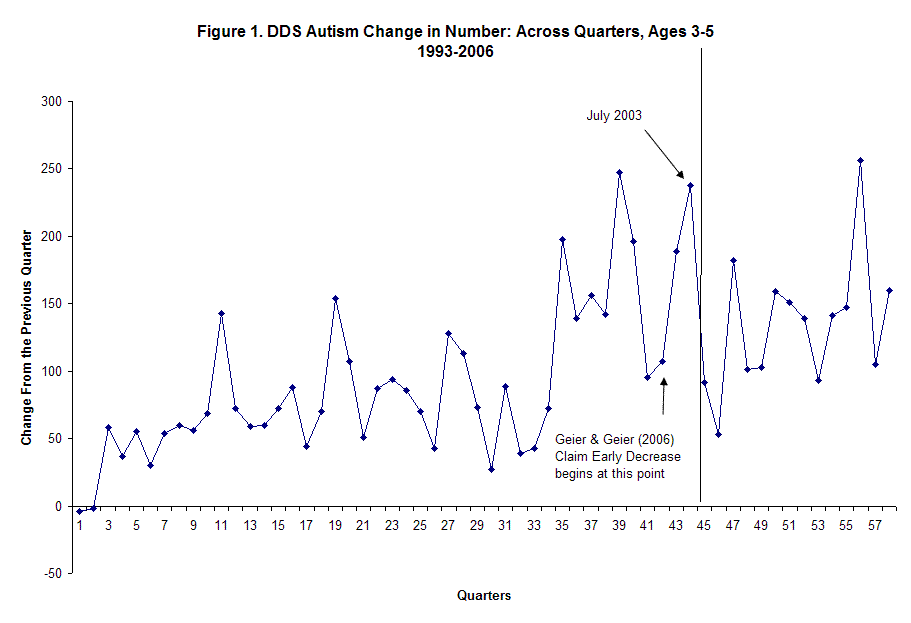
if the total number of 3-5 year olds in the California DDS system has not declined by 2007, that would deal a severe blow to the autism-thimerosal hypothesis…..total cases among 3-5 year olds, not changes in the rate of increase is the right measure.

David Kirby, Nov 2005.

Time’s up Mr Kirby. The last quarter numbers for 2006 are now in.

Jonathon even took the trouble to highlight on his graph where the Geier’s made asses of themselves declaring an early decrease in their 2006 paper. As can be seen from Jon’s graph (and even more clearly on Dad of Cameron’s) – _the numbers are still going up_.

A severe blow to the autism-thimerosal hypothesis has been dealt.

Jospeph tells us what to expect in the coming months in the way of excuses from Kirby. Something I also discussed in April 2006. In short, the militia will argue that there’s still TCV’s sitting around waiting to be used up (rubbish, but even if true, would be a very, very minimal amount, click the link to my previous post to see Sallie Bernard of SafeMinds struggling to locate TCV’s in June 2001), they will also argue that the flu shot supports the ‘epidemic’ (again, rubbish. Are we really comparing mandatory TCV administration culminating in 187 ug Hg with optional flu vaccines, administered in one season of the year, culminating in 25 ug Hg?). They will also argue that RhoGAM was a contributing factor (but as we all kow, that one’s got no legs.). They may also try and argue that some other vaccine/environmental ‘thing’ comes into play. This takes us right back to square one and is a virtual admission that thiomersal doesn’t do a goddamn thing except act as a preservative.

In fact, that process is already under way from the Big Cheese himself. In a post on Jan 9th 2007 to his munchkins on the EoH yahoo group, Kirby said:

I believe this puzzle will be solved by looking at TOTAL “environmental” toxic burden from ALL sources, including other chemicals, and, of course, thimerosal in vaccines,

Oh, of _course_ ;o)

This prompted a bit of controversy: H Coleman replied:

Please stop it- you’re all giving me a headache.

And Robert Krakow replied:

I disagree somewhat with the emphasis of your message. I don’t know anyone who focuses on the vaccine issue who believes that other environmental exposure is unimportant. To suggest so underestimates the intelligence of most of the members of this list.

‘Most’ obviously not including John Best, Rescue Angel, who said on that same group:

I view any talk of mercury in the air as a problem as utter nonsense. It’s just propaganda to deflect blame from pharma and I don’t buy one word of it.

See Robert? There’s more than a few idiots who need things spelled out to them on EoH.

Anyway, the impact of Kirby’s statement has not been lost amongst the rank and file militia members. They know he’s trying to move on. Memo to Mr Kirby: it would be quicker and more painless to just fess up: _A severe blow to the autism-thimerosal hypothesis has been dealt._

Two items of interest for US folks

8 Jan

There will be a debate titled “Vaccines and Autism: Is There a Connection?” between David Kirby and Arthur Allen. The debate will take place in San Diego, California (UC San Diego Price Center, 9500 Gilman Dr. La Jolla CA 92093) on Saturday, January 13, at 10am:

Admission is free, provided you register with TACA before January 10. (Be prepared to give out a mailing address). Or you can pay $10 on-site.

Sponsors include Generation Rescue, SafeMinds, TACA and the Autism Research Institute so as you can imagine, the quackery quotient will be high – anyone who favours a bit of reality and is in San Diego should go and give Mr Allen some support as I think he’s going to need it – the audience sounds like it will be partisan to say the least. Apparently some mercury mum or other has suggested wearing t-shirts with pictures of their autistic kids on them. Sounds like it’ll be conducted on a sound scientific footing.

The other thing regards the NIH which, not being ‘merican I’m not up to speed with so I’ll quote Diva:

Would you like to have a voice in how the National Institutes of Health (NIH) – National Institute of Mental Health (NIMH) spends it’s autism research dollars? The NIMH may be getting a windfall of cash for autism research by way of the “Combatting Autism Act.” Whether or not they get that windfall, money will continue to be spent on autism research. Whether that research will benefit humanity to a greater or lesser degree depends on how the money is spent.

Many people shudder at the thought of science driving a big eugenics campaign where every last unfavored gene is scrubbed from the gene pool by culling or sterilizing the genetically defective, though it should be noted that not all studies of genetics are aimed at eugenics. If prenatal testing for autism sounds bad to you, for instance, or if another kind of research bothers you, what kinds of sensible research can be done with all that money? And how can you have a say in how the money is spent?

Go read this petition that will be sent to the NIH/NIMH, and if you agree with it, sign it. Signatures are needed before January 16th, it would probably be better to sign it by the Friday the 12th as that would give someone a chance to send the petition to the NIMH properly by the Tuesday the 16th. A few hundred or a thousand signatures would be really great.

Spread the word as quickly as possible :o)