

When Andrew Wakefield presented his hypothesis linking autism to the MMR vaccine in 2014 1998, he fueled a vaccine scare that is still alive today. It wasn’t until 6 years later that specifics about Mr. Wakefield’s actions were to surface. First in a newspaper story by Brian Deer (Revealed: MMR research scandal). Later that year in a BBC Channel 4 investigation: “MMR What they didn’t tell you.” I’ve never seen that Channel 4 program. Until today. Mr. Deer has placed it on YouTube. In three parts.
Part 1 introduces the topic. The MMR scare, the Wakefield 1998 Lancet paper and the press conference and the Royal Free’s video given out to the press. A discussion with an epidemiologist about the fact that there was nothing in Mr. Wakefield’s own work to support the triple MMR vaccine. Which leads us to the Wakefield patent for a substance that could be used as a vaccine–a vaccine which could only reasonably be expected to make a profit if the existing measles vaccine were considered unsafe–and as an autism “cure”.
Mr. Deer speaks with Ian Bruce, a researcher who worked with Andrew Wakefield on the patent. “The interpretation of that is quite clear to me..and that is that they have a vaccine for measles. Which presumably is an alternative to the existing vaccine.”
The thing is, the public was not told that Mr. Wakefield and the Royal Free had these commercial interests prior to Mr. Deer’s show.
Part 2 discusses the patent–the cure and vaccine aspects. The idea was that measles virus would be injected into a mouse. Those would be extracted, frozen, thawed, mixed with human cells, and injected into pregnant goats. The colostrum (part of the goat’s milk) would then form the basis of this vaccine/cure substance.
Sound like a strange idea to you? Well, Mr. Deer interviews medical experts who also think so. “the whole technique doesn’t make sense”. “It’s not credible”. “It’s strange”.
Mr. Deer tries to interview Dr. Roy Pounder, Mr. Wakefield’s former supervisor at the Royal Free. Mr. Pounder at first agrees then refuses to be interviewed.
Mr. Deer then goes to American and interviews Hugh Fudenberg, collaborator with Mr. Wakefield and co-inventor on the patent. Mr. Fudenberg at the time was charging up to $750 an hour to see and treat autistic children. He too considers Mr. Wakefield’s treatment to be unfounded. However, Mr. Fudenberg had a cure of his own, made from his own bone marrow.
Mr. Deer discusses some of the criticism of Mr. Wakefield’s work, including a statement from someone who worked in the Royal Free Hospital, including a comment that the work amounted to abuse.
Part 3 includes a discussion with Nick Chadwick, a student in Mr. Wakefield’s laboratory during the MMR/Autism research. Mr. Chadwick tested the tissues for measles virus, and found there was none in the autistic children being seen by Mr. Wakefield’s team. Also interviewed was Ian Bruce, a colleague of Mr. Wakefield’s, and also a supervisor for Nick Chadwick. Both Chadwick and Bruce are highly confident that if there were measles virus in the tissues, they would have detected it.
Mr. Deer discusses the 2000 measles outbreak in Ireland. He interviews the parents of one of the children who died in that outbreak. For those who keep saying that measles is mild, that in first world countries no one dies or is injured, here’s what a child dying of measles looks like in the first world. She took 11 months to die.
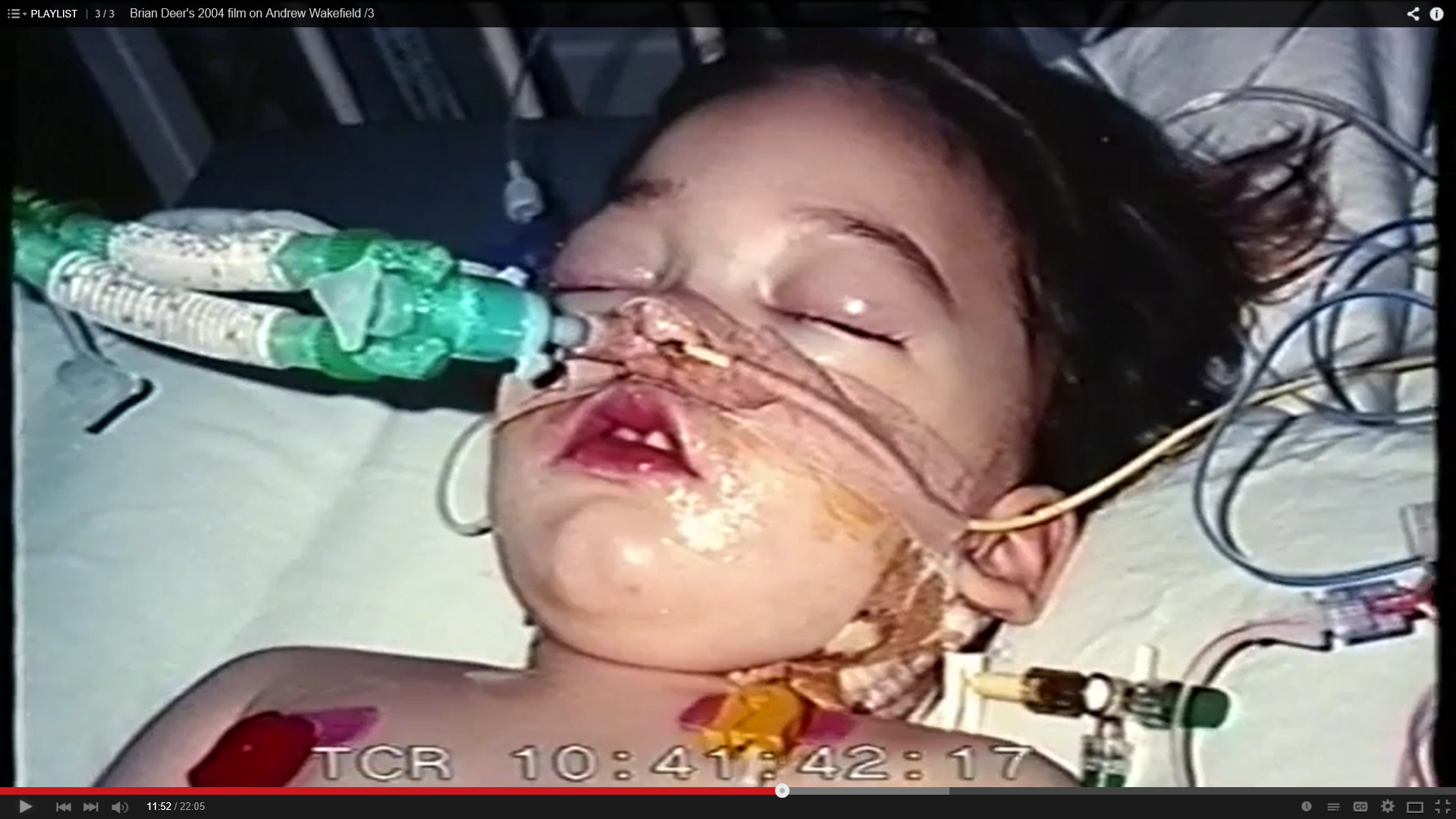
Mr. Deer then goes to America to find and try to speak with Mr. Wakefield. Mr. Wakefield was listed as “research director” for Jeff Bradstreet’s clinic in Florida, but wasn’t there. The Bradstreet clinic had a host of supplements that one could purchase to “treat” autism. Mr. Deer eventually finds Mr. Wakefield at an Autism Society of America convention. Whereupon Mr. Wakefield runs away.
By the way–Thank you ASA for no longer inviting Andrew Wakefield to speak.
This investigative report together with the Sunday Times articles earlier in 2004 made a huge impact at the time. I know as I lived through it. The retraction of interpretation published by most of Mr. Wakefield’s co-authors on the 1998 Lancet paper (since fully retracted by the journal), was a big statement that this work was not solid. Of course, Brian Deer would eventually go on to win a U.K. Press Award for his MMR journalism and Mr. Wakefield would eventually be found to have been unethical in his research and struck off the register (lose his medical license).
The embedded version below should go through all three parts in sequence.


 Left Brain Right Brain
Recent Comments