Archive | Vaccines RSS feed for this section

An Interview with Andrew Wakefield

16 Feb

Andrew Wakefield recently participated in a cruise/meeting called the ConspiraSea cruise.  Among the audience was Colin McRoberts, a skeptic.  He reported back during the cruise and, as you will see below, interviewed Dr. Wakefield.  Since much of the interview involves William Thompson, Mr. McRoberts asked for my input.

The interview is below.  Mr. McRobert’s words are in black, Mr. Wakefield’s in red and mine in green.  (If there are any mistakes in that formatting below, they are mine.)

The original interview can be found at  An Interview with Andrew Wakefield at


Andrew Wakefield and I were both on the ConspiraSea Cruise in January 2016. By the last full day of the cruise, we’d had a few encounters ranging from standing in the same line for coffee to a fairly tense exchange during one of his lectures. I asked Wakefield after that lecture if he would answer a few questions regarding the so-called “CDC Whistleblower.” He consented, and this is the interview that resulted. Wakefield was aware that I was recording and that I am a critic of his position on vaccines and autism; he did not refuse to answer any of my questions.
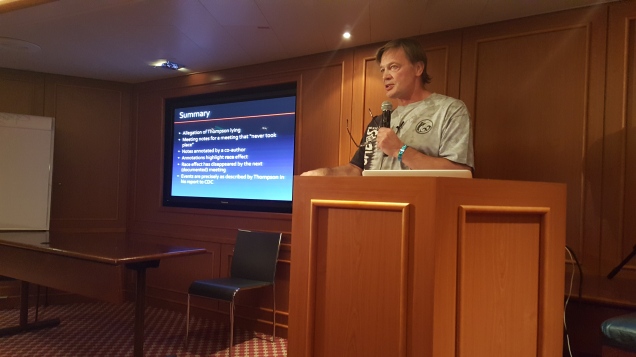
2016-01-29 15.13.13
Wakefield lecturing on the cruise

This transcript is my own work, and I welcome any corrections. I’ve edited it slightly to make it more readable and remove irrelevant dialog. I have also added parenthetical comments to note where a statement is inaudible on the recording, which is not of high quality, and provide my best guess at what was said in a few places. I have not changed the substance of any question or answer.

Wakefield answered several questions before I turned the recording on. According to my memory and my notes, I asked him questions about the Thompson documents such as what specific deviations there were from the approved study plan (as he had alleged such deviations in two lectures). He referred me generally to his letter of October 2014, written with Brian Hooker and attorney James Moody, and directed to the federal Office of Research Integrity. He indicated both that he had documents from Thompson at the time he wrote that letter, and that Congressman Posey subsequently received additional documents from Thompson. At that point I began the recording.

I am not an expert in the documents Wakefield discussed. So in order to provide context for these answers, we have asked Matt Carey of Left Brain Right Brain to provide commentary. Carey is a published scientist, a parent of an autistic child, and extremely familiar with the Thompson documents. He has written an in-depth analysis of the Thompson documents and was able to provide an important counterpoint to Wakefield’s claims. Please read that excellent analysis prior to this interview if you are not familiar with the affair. The questions and answers will make little sense without context.

My questions are in black, Wakefield’s answers are in red, and Carey’s comments are in green. We welcome your own comments as well.

So the Posey documents that were released are, as far as you know, the documents Posey was given? He hasn’t held anything back?

I think he has probably given Posey more documents than he’s given me. The reason for that is that I’ve just been given the Posey documents, and they’ve been released and they’re available to anyone—you can get them.

I’ve got them.

And I have not been through them as yet, so I do not know to what extent they overlap completely with the documents I’ve got. And the reason I say that is that there may be additional documents he provided to Posey on Thimerosal or other things, because he was involved in two other vaccine safety studies. I have (inaudible: “all the”?) documents relevant to the MMR studies.

The two thimerosal studies were much larger studies and are more significant than the DeStefano MMR study in the evidence against the idea that vaccines cause autism. Given that, it’s interesting that there isn’t much on the thimerosal studies in the Thompson documents. In Thompson’s personal statement he makes no indication that the results of those studies are anything but valid or that the CDC team acted in any way other than ethically in performing those studies.


And then do you know if there are documents you have from Thompson that Posey does not?

I have documents that Posey does not because Thompson and I were in private correspondence.

And when you say that, are they documents that were that correspondence, or were they documents from the DeStefano days?

They are correspondence between us.

So do you have documents from the research or from his work at the CDC that Posey doesn’t have, other than the correspondence?

I don’t know, because I haven’t been through Posey’s documents yet.

One has to ask why he has not yet been through those documents? They’ve been public for some time. I put them online January 4th, nearly 3 weeks before the cruise. A journalist announced he had received the documents from Representative Posey’s office. That was in November of last year. Dr. Wakefield could have submitted his own request then. If Dr. Wakefield felt there was a possibility of evidence of misconduct in these documents, wouldn’t he have read through them at his first opportunity? In his role as creating a documentary about these events, why isn’t he jumping at the chance to add to or confirm his story?


That will answer a lot of my questions, actually. So, Hooker’s study came out, and again, I’m not a scientist—I’m not qualified to review or really have intelligent commentary on a statistical research study. Do you support the conclusions Hooker drew? Do you endorse them?

Do I –

It would be interesting to know what conclusions Dr. Wakefield is thinking of when he responds. There are the conclusions in the paper and there are the conclusions Dr. Hooker has stated publicly since. The last sentence of Dr. Hooker’s retracted study is “Additional research is required to better understand the relationship between MMR exposure and autism in African American males.” That’s quite different from concluding that the study shows a causal link between the MMR vaccine and autism. I believe both Dr. Wakefield and Dr. Hooker have made the latter claim publicly. It is worth noting that an epidemiological study like Hooker’s cannot, on its own, show a causal connection even if the correlation found is strong. The African American males/autism correlation in the Hooker reanalysis is far from strong.

Do you endorse the conclusions Hooker drew in his study based on the DeStefano research?

Yes, I do. I know, and I know you’re going to say it was retracted. It was retracted on the basis that the did not disclose a conflict of interest. There was absolutely no – on the initial basis, the initial rationale for the retraction was nothing to do with the scientific analysis. Which was a very simple analysis, a very simple statistical manip- analysis, which replicated what Thompson found. It was withdrawn on the basis that there was an undisclosed conflict. And that’s why it was withdrawn. There was no undisclosed conflict, and I suspect that there was pressure on the journal to withdraw [inaudible].

First, as I noted above, we aren’t entirely sure what conclusions he stands behind.

As to the retraction, Dr. Wakefield only gives part of the reason why the Hooker study was retracted. Here is the full statement from the journal:

The Editor and Publisher regretfully retract the article [1] as there were undeclared competing interests on the part of the author which compromised the peer review process. Furthermore, post-publication peer review raised concerns about the validity of the methods and statistical analysis, therefore the Editors no longer have confidence in the soundness of the findings. We apologise to all affected parties for the inconvenience caused.

The editors were concerned about the validity of the methods and analysis and “no longer have confidence in the soundness of the findings.” That’s a pretty stinging rebuke of the study itself in a retraction and completely avoided by Dr. Wakefield.

But you don’t know that.

No I don’t.

I’ve heard, and again I’m not qualified to even understand the criticism, that Hooker misunderstood how to analyze case control studies. Are you familiar with that criticism?

No I’m not. The criteria for the, if you go to the criteria for the journal, Translational Neurodegeneration, it says papers will be published on the basis of expert peer review. And only when they pass that expert peer review will they be published. The paper went expert peer review which included a statistical analysis and whether he used appropriate methodology. So it passed muster on the basis of the journal’s own rigorous criteria. That gives me cause for concern, because there was nothing in Hooker’s analysis which substantiates or supports the contention that he did not know how to analyze a case control study.

Again, look to the retraction statement by the Journal: Furthermore, post-publication peer review raised concerns about the validity of the methods and statistical analysis, therefore the Editors no longer have confidence in the soundness of the findings. Peer review specifically looking at the statistical analysis found the paper lacking.

I’ve peer reviewed many papers, and even edited the proceedings of a large conference. Some peer reviewers are more rigorous than others. We don’t know what “statistical analysis” Dr. Wakefield is claiming that the reviewer(s) performed. A referee could not replicate Dr. Hooker’s analysis as the data are not in the paper. And datasets like these are not “public use”, they are intended only for those who have shown in their application to be “qualified researchers.” Dr. Hooker should not be sharing the dataset with referees or others.

Also, one question that has been in a lot of people’s minds was who did the first peer review of the paper. Often an author can suggest to a journal potential referees and can use that to get people involved who would be favorable to the authors and/or their conclusions. I can’t say for certain that this occurred in this paper, but it is a possibility.

And of course it’s possible that the peer review was just not very rigorous. A while back a peer reviewed paper included the parenthetical comment, “should we cite the crappy … paper here?” That inappropriate comment made it past referees, editors, type setting, and proofs.


Would it be fair to say that you’ve analyzed the statistical work Hooker did, or –

No I didn’t. I’m not a statistician, although I’ve been involved in a lot of statistical analyses, I would not consider myself an expert in statistics and I am not qualified, certainly over and above the expert who clearly was involved in peer review of the paper, to approve or disapprove of it.

Brian Hooker is also not a statistician. Like many of us in research, Dr. Hooker has some knowledge of statistics, but his own statements (for example, “I reanalyzed the datasets using what’s in a very, very simple statistical technique”) show that he is not an expert in the field.

First, in statistics simple is not always the most valid approach. In this case it certainly is not the most valid approach. Second, and more importantly, this isn’t a statistics study. It’s an epidemiological study. In epidemiology strong studies are those that correct for factors that can lead to false conclusions. Here’s a simple example: rich people can afford healthcare and, as a result, tend to see doctors more often. They are more likely to be diagnosed for many diseases because they seek out healthcare. If a study ignores such factors—takes a “simple statistical technique” it could erroneously conclude that rich people get some diseases more than poor people. Dr. Hooker’s analysis is not only too simplistic statistically, it is too simplistic from an epidemiology standpoint.

Here are two technical critiques of the statistical analysis Dr. Hooker used:

Analysis and Reanalysis: The Controversy Behind MMR Vaccinations and Autism, part 2

Directed Acyclic Graphs and the MMR vaccine doesn’t cause autism

If you’re comfortable saying so, are you still in contact with Thompson?

No. When we – let me qualify that. I write to Thompson. Updating him on our progress. I do not anticipate a response. Because in getting him or encouraging him to get a whistleblower lawyer, his lawyer advised as any good lawyer should that he should make no further comment until a congressional hearing or the equivalent. And therefore I have not heard back from him.

If Dr. Thompson has whistleblower protection, why does he need to only comment in a congressional hearing? The vast majority of whistleblowers are not called before congressional committees.

More to the point, if Dr. Thompson felt that there was ongoing harm—that there was strong evidence of an actual connection between vaccines and autism–he would be ethically compelled to come forward and speak out. In fact, in his public statement Dr. Thompson made it very clear that parents should vaccinate:

“I want to be absolutely clear that I believe vaccines have saved and continue to save countless lives. I would never suggest that any parent avoid vaccinating children of any race. Vaccines prevent serious diseases, and the risks associated with their administration are vastly outweighed by their individual and societal benefits.”

And just to make sure I understand, is that what you understand what his lawyers have told him to do or what you expect his lawyers would tell him to do?

He has said something to that effect in a text. I can’t remember precisely what it is, but he said based upon my lawyer’s advice, I can now have no further contact. So it’s explicitly based on his lawyers.

I’m not surprised. You made a comment that I hadn’t heard before, that it was not true that the data Thompson released showed a protective effect for on-time MMR vaccinations in non-African American male children.

Sorry…

It’s an awkward question. So I had understood that the Thompson data showed a protective effect for on-time MMR vaccinations in non-male, non-African American children. And in your first –

Quite the opposite, quite the opposite. This is the greatest, one of the most misleading things of all, is when the head of science over Autism Speaks, Dr. Wang, was interviewed by Ronan Farrow, that was precisely what he said and what he took from the fraudulent paper. And that underlines just how deceitful the paper was, that the head of science for an organization which is the biggest autism charity in the world, gets it completely wrong when presenting in national media, that giving MMR vaccination on time appears to be protective against autism is the most egregious of all of the sins that they committed.

Dr. Wakefield appears to be misremembering the interview. The Paul Wang/Ronan Farrow interview can be found here. In discussing the DeStefano study, the one that Hooker reanalyzed, Paul Wang stated:

“If you look at children who got the vaccine on time, there is no increased risk.”

Not that there is a “protective effect” but that there is “no increased risk.”

Later in the interview, discussing a different study, Wang mentioned the “protective” effect found. A good discussion of this can be found at Forbes. Allow me to include a few paragraphs from that discussion because it makes an important point about why simplistic statistical analyses can lead to possibly false findings:

Even more surprising was the relative risk among children who had an older sibling with autism: in this smaller group, children with 2 doses of MMR were just 44% as likely to be diagnosed with autism as unvaccinated children. This statistically significant finding indicates, unexpectedly, that vaccines might actually protect children from autism.

The authors were quick to note that there are other good reasons for this apparent protective effect of vaccines: in particular, if parents of autistic children withheld vaccines from their younger children, this could explain the effect. Why? Because we know that autism has a genetic component, and that if one child has autism, his younger sibling is more likely (because they share many genes) to have autism as well. Jain and colleagues explained that if these parents withheld vaccines–because of fears spread by the anti-vaccine movement–then their children could contribute to the apparently lower rate of autism in children who were vaccinated. The authors couldn’t rule out a protective effect of vaccines, but scientifically it seems unlikely, and they wisely offered an alternative explanation.

The “protective” effect is likely an artifact of the study design and the authors acknowledged it. The first thing a good researcher does when she/he finds a result is to challenge it, test it. “If I do a more in-depth analysis, does this finding hold up?” “Is there an alternate explanation that could be causing this and make this result spurious?” Simple is not elegant, as Dr. Hooker asserts. Simple is the first step. And if you don’t take the next steps, your study is weak and your conclusions more likely to be wrong.

This may also be in the letter you told me to look up, but the destruction of documents—are you aware of specific documents that were destroyed, or types of documents that were destroyed? Or was it just an allegation that documents were destroyed?

Well, what I have are all of the serial outputs of the data covering that period during which the documents were destroyed, and what was quite clear was that the data tables showing highly significant association between autism and vaccination [inaudible: “on time”?] were there before the alleged destruction of documents and were gone afterwards. In other words, the documentary evidence provided by Thompson confirms exactly what he said, that data were destroyed.

This is the story made public in the “garbage can quote” read into the Congressional record by Representative Bill Posey. That can be found in the statement by William Thompson included with the document provided by the Representative to me (and made public by me). Here’s the end key paragraph quoted by Representative Posey. Note that the last line was not read into the record:

However, because I assumed this was illegal and would violate both FOIA laws and DOJ requests, I kept hard copies of all my documents in my office and I retained all the associated computer files. This included all the Word files (agendas and manuscript drafts), Excel files with analysis and results, and SAS files that I used to generate the statistical findings. I also kept all my written notes from meetings. All the associated MMR-Autism Study computer files have been retained on the Immunization Safety Office computer servers since the inception of the study and they continue to reside there today [emphasis added].

Emphasis added. All the files have been retained. If printouts were shredded but the files kept, what’s the controversy? Dr. Hooker and Dr. Wakefield appear to have been claiming that Hooker recreated the CDC team’s analysis solely using the dataset maintained by the CDC and provided upon request to qualified researchers. So, again, what data was deleted?

One might think, well personal notes were shredded and those could show actions that indicate wrongdoing on the part of the CDC team. We don’t know what notes the other researchers retained. But we do have William Thompson’s notes—notes by the person most likely to record wrong doing. We don’t have statements in his personal notes–taken while the study was ongoing–that suggest fraud. In fact one of the few notes that goes to the mindset of the research team states, “we all have good intentions.”

I don’t understand what that means in this context. You have a report of what’s on the servers? Or you have a report of what was in file cabinets? Or you have –

No, I have printouts, or well, sorry, I have email documents. These are documents generated in Word with a date of creation, so that you can confirm that those documents were created contemporaneously with when Thompson said they were created. And they reflect meetings that took place on a serial basis every month, or twice monthly, between the group, the coauthors for that paper. And in September 2002, when Thompson alleges these documents were destroyed, then the African American effect, for example, and the isolated autism effect, were there. And then afterwards, they were completely gone. So that would support Thompson’s contention that documents were destroyed.

The story is much more mundane than Dr. Wakefield is implying here. What is clear in these documents is that this timeframe–around Sept. 2002–is when the research phase of this project ended. Dr. Wakefield tells us, “And then afterwards, they were completely gone.” When you go through the documents you see that after September 2002 there are pretty much no more research group meetings. There were a handful of meetings after this, but the analysis was over and the figures basically finalized. A preliminary draft of the study manuscript is dated Oct. 2002. So the idea that the team met to discuss what to archive and what to shred, and that the figures were finalized about this time is not only not surprising, it’s expected.

And this is where it’s good to have the actual documents. Dr. Wakefield did not share the documents he had, only quotes and screenshots. Bits that supported the arguments he was making. When we see the actual documents we see a different story. When I put up my own analysis of the documents, I made the documents publicly available so people could form their own opinions. From what I can see Dr. Wakefield did not do this.

Speaking of mundane, yes the documents “reflect meeting that took place on a serial basis” as Dr. Wakefield states. In one folder there are about 500 pages of agendas, tables and graphs for those meetings. And when one goes through these documents one finds they are very redundant. The same talking points, the same graphs and tables meeting after meeting. We are asked to be shocked that the CDC team discarded documents. I’ve posed this question publicly–what in those documents needed to be kept? Do we really need multiple researchers archiving every meeting agenda? The answer is simple: no, we don’t. I not only expect them to discard much of this paperwork, I hope they aren’t hanging on to all this paperwork for every project they work on.

I still don’t understand quite what this means. So there was a word document, and in that document, it refers to the African American effect, the isolated autism effect –

It shows the data. It shows the data table.

And in later versions of that document, those tables are gone?

I’ll give you an example. All of the data are contained in a table called Table 5. That table is there in September and it’s gone in October. Never to be seen again.

The last one of these documents– that has “table 5” is, as Dr. Wakefield says, in September 2005. So is Table 8, which includes things like variables “M_AGEC11” and “B_MULTB.” Why is that important? Because those are variable names important to the researchers but were obviously not intended for the final study. The fact that Table 8 (or table 5 for that matter) got cut isn’t a smoking gun, just evidence that these were preliminary tables and that study hit the turning point of finalization.

Most of the attention in this discussion goes to the African American effect. Let’s consider the “isolated autism” effect. “Isolated” autism means autism without other disabilities. What happened to that? The CDC team published it. They narrowed it down to autism without MR, but it’s basically the same thing as “isolated.” They also showed that in the simple analysis (the sort that Dr. Hooker claims is “elegant”) there is an apparent association, but that association disappears when one does a more rigorous analysis. Aside from debunking the controversy over “isolated” autism, this serves as another example of why simple isn’t the best.

But the data that was used to create Table 5 – was that destroyed?

Very good question, was the data destroyed. No. No it was not. Because it was not – it was intended to be destroyed. All of the – it was Thompson’s claim that all of the hard copy documents, and all of the computer files, relevant to this paper were targeted for destruction. The original data tables or data files from which the tables were generated were preserved by Thompson and are available and can be reconstructed in order to generate the information. As an example, the data tables – the excel – sorry, they were SAS spreadsheets – provided to Hooker, by which he then did an analysis.

Personally, I want to check the source every time Dr. Wakefield or Dr. Hooker claim to be speaking for William Thompson. Thompson has made very few public comments, plus a few conversations secretly recorded by Brian Hooker and since released by Hooker. Given this, let’s ask ourselves: instead of Dr. Wakefield giving his interpretation of what Dr. Thompson said, why not just quote Thompson? For example, consider the very strong claim “it was Thompson’s claim that all of the hard copy documents, and all of the computer files, relevant to this paper were targeted for destruction.” Now Thompson’s statement, “All the associated MMR-Autism Study computer files have been retained on the Immunization Safety Office computer servers since the inception of the study and they continue to reside there today.”

We don’t know what hard copy documents were kept by the other authors. Or what notes were in notebooks they kept. We hear that they discarded some, but we don’t know that they may have kept. Also, consider this: if “all the hard copy documents” were “targeted for destruction” why meet to decide which documents to shred if the decision is to shred them all? Is it so they can watch everyone discard documents? If so, consider this: we know from Thompson’s own statements that one of the MMR study leaders was missing from the “garbage can” meeting. The story just doesn’t make sense.

We should address the question of discarding research documents: is it unethical? I’ve been a researcher for 30 years. It is common practice to periodically decide what documents to keep in my office, which to archive to a warehouse and which to discard. When I would clear out documents my company would provide me large confidential bins. They look like “garbage cans” except the lid is locked and the only access is through a slot in the top so people can’t fish documents out. After these bins are collected they are sent to a confidential shredder. [Colin: Although I’m not a scientist, I’ve seen similar procedures in very many offices where confidential documents like legal or financial files are used.] I would expect the CDC to have a similar procedure. A researcher keeps the documents that are required to recreate the final analysis and, in my case, determine dates of invention.

http://www.lbmedwaste.com/products_confidential_document.html
Bins like these are used to dispose of confidential documents in many offices, to protect privacy when clearing out old hard copies containing things like social security numbers or health records.

As long as we are talking about the few public statements Dr. Thompson has made, allow me to repeat this one:

I want to be absolutely clear that I believe vaccines have saved and continue to save countless lives. I would never suggest that any parent avoid vaccinating children of any race. Vaccines prevent serious diseases, and the risks associated with their administration are vastly outweighed by their individual and societal benefits.

So that data exists, so far as you know, only in Thompson’s files and not in the CDC’s main files, wherever those may be?

According to Thompson, all of those – he was the only one who preserved all of those records. Beyond that, I do not know the infrastructure of the CDC’s filing system, so I don’t know – I think I’ve probably reached the limit of my knowledge about that. Is there some sort of backup system that retains the original SAS files, I don’t know [inaudible].

“I don’t know.” I believe he should. I see it as ironic that Dr. Wakefield claims to speak for Dr. Thompson (“According to Thompson”) while having not read all the documents Dr. Thompson released to Representative Posey. As I’ve already noted above, Dr. Thompson made it explicitly clear that all the associated MMR-Autism Study computer files have been retained on the Immunization Safety Office computer servers since the inception of the study and they continue to reside there today. At the very least, the raw data exist. Clearly, since Dr. Hooker used those data for his analysis. Also, I’d be curious how Dr. Wakefield knows that Thompson “was the only one who preserved all of those records”. We know that some documents were discarded, but we don’t know what was kept by the other team members.

And then are you referring to statements that Thompson made that have been released, or statements that are still confidential regarding his allegation that those files were deleted?

Both. Both. So his statement to Bill Posey and other documents that I have obtained that are in the documentary. Documents which are not publicly released.

If by the “statement to Bill Posey” Dr. Wakefield means the full statement that Representative Posey excerpted in his House speech, that is indeed publicly released. I released the documents Representative Posey’s office provided to me. I discussed the full statement here.

The full statement is much longer than the excerpts that Representative Posey read. It includes the statement:

“The fact that we found a strong statistically significant finding among black males does not mean that there was a true association between the MMR vaccine and autism-like features in this subpopulation.”

Emphasis added. I’ll be curious to see if this statement (and others that are problematic for Dr. Wakefield’s story) appear in the documentary.

You mentioned that you’ve analyzed the notes, and that you know who the coauthor was who made some handwritten annotations. Would you disclose who that coauthor is?

No.

Would you disclose how you did the analysis?

No.

Will that be in the documentary?

Yes.

Both the type of analysis and the name of the author?

As yet undecided. [Inaudible: “As yet”?] a matter of discussion.

I was talking to Nick Begich earlier as he dropped these off [pointing to DVDs], and he kind of referred to the breadth of opinions expressed at the conference. And some – I wouldn’t say alarm, but some surprise at some of the views that have been expressed here. And I know that you haven’t been at all the various panels that haven’t involved vaccines or autism, but I think you’ve heard some relatively wild statements. Would you be comfortable establishing a line at which you feel it’s irresponsible to speculate about the cause of autism, or about conspiracies related to medical care?

So sorry, is there a line –

At which you’d object to some of the speculation that’s gone on at the conference.

My reason for coming, or what persuaded me to come, was that Jeffrey Smith was presenting. And Sherri Tenpenny. The other people I don’t know. I’ve met one other person one time. So I know nothing about any of the other people. But I’ve been someone who’s followed Jeffrey Smith for a long time. And I think his approach to his subject is very thorough, is informed, and very valuable. And so every time I get an opportunity to listen to him then I’m very grateful. Sherri similarly. A great deal of knowledge and understanding of the subject. The others, as you say I haven’t been to the talks. I don’t know what their discussions were about.

I am less interested in his “reason for coming” as for why he didn’t consider association with many speakers a reason for not coming.

I’m thinking for example of Len Horowitz’s discussion of the 528 frequency –

Yeah, I didn’t hear that. [Inaudible: “I wasn’t there”?] I just don’t know. So no, I just don’t know. I wasn’t there. So it would be unfair of me to comment on [inaudible].

I heard you speak in Austin, when we were still living there, at an Autism Speaks conference. [I was mistaken; it was an Autism Trust event called the “Give Autism a Chance Summit.”] You were MCing, I think it was Autism Speaks, at the music center downtown in Austin. There were people on the stage like Dr. Kriegsman, and I can’t think of the other guy’s name, who was instructing parents to turn off their routers and their cell phones so the EM waves wouldn’t hurt their autistic children. And I was hoping at the time you would comment to the parents in the room as to whether you thought that was reasonable advice or not, and you haven’t made a statement on it as far as I know. Is that kind of advice something you think is reasonable?

I don’t – if I do not know the subject, I’m not going to give advice. I’m just not going to do it. It’s irresponsible. I’m not going to give advice that could even be potentially construed as medical if I have not done a thorough analysis of the data. Now that said, I keep my mind open to the possibility that there are co-factors that may influence autism risk [inaudible]. I don’t know what those co-factors are. But I’m never going to advise people on what to do based on something about which I know nothing. I’m going to confine myself to the things which I know and I’ve worked on and I’ve read and understood. And where I don’t know I’m going to say I don’t know. If someone has a competing theory of autism, OK, let them talk about it.

One of the reasons my wife and I came to this country is that has a constitution that includes the values we respect. And god forbid that people should be censored or excluded from expressing opinions. Just like the journalists on this trip feeling threatened, that they couldn’t be in discussions, that’s not right, that’s not the way I operate. I encourage dissent because in the end, it’s only through the presentation of competing arguments that truth is going to win. Just in the same way that I talked to you about how it was not our job to censor the parents’ story just because others found it inconvenient or didn’t believe it. It’s not my job to censor other people expressing opinions that may not concur with my own.

I find this highly ironic given the legal threats Dr. Wakefield has made to journalists. He’s even brought suit multiple times against a journalist. A judge in one case referred to Dr. Wakefield’s use of litigation “as a weapon in his attempts to close down discussion and debate over an important public issue.”

Do you feel that given your high profile, your presence might be an endorsement, or at least perceived that way by people who don’t have a chance to talk to you personally?

Well if that is the case, then I should shut myself in a cave on a high mountain, become a hermit. And that’s not going to happen because that’s not the way in which knowledge is going to spread. If people take it as that then it is because they want to take it as that. Because that’s the spin that’s placed on it.

I wanted to ask just one more question.

Go, one more question.

And feel free not to answer. What evidence would change your mind, about a link between autism and vaccines?

What evidence would change my mind… [long pause] What is my position, firstly let’s define what my position is. That’s very very important. Vaccination should operate from a position of an abundance of caution. What you’re doing is you’re taking healthy children and exposing them to a risk or a potential risk. And you’re doing it on the background of the available data on the safety and efficacy of that vaccine. It’s not like you’re taking patients with end-stage cancer, where you say, “Look, you’ve got a fifty percent chance of dying and a fifty percent chance of living, and there may be some benefit but we don’t know.” You’re taking entirely healthy children and you’re giving them an exposure, which incurs a risk. And the risks are all spelled out in the product insert.

So my position, and the position that medicine should be in, is that you operate from an abundance of caution. If there is even a possible risk of harm, then you do everything in your power to either exclude that risk or stop the vaccination policy. First do no harm.

So my position is not that it’s black and white. It is that you operate from an abundance of caution. You have to be very very clear that what you are doing has a minimal, an absolutely minimal risk, for the maximum benefit.

The interesting thing here is the for years the narrative that I recall from his supporters was that Dr. Wakefield didn’t say that vaccines cause autism. He was just posing questions.

That said, see what Dr. Wakefield has done here? He’s framed the question as though there is only one source of risk–vaccinating (and implies falsely that one of those risks is autism). He doesn’t even approach the question of the risk in not vaccinating and leaving one’s self vulnerable to disease. Ignoring that is hardly an “abundance of caution.” Quite the opposite, it’s an abundance of irresponsibility in my opinion.

The positions and the rhetoric that you’ve taken at this conference make it pretty clear you feel that there is extremely good reason to believe that the MMR vaccine in particular, and possibly vaccines in general, and possibly GMOs as well, have a causative link to autism.

Yes.

What would change your mind?

That is because I’ve sat in this field now for twenty years, and nothing has persuaded me that the science is wrong. And what now convinces me that there is a real cause for concern is William Thompson coming forward and saying that a hypothesis that I put forward in the year 2000 is proven to be correct by the year 2001 and was kept concealed for 13 years. How would you feel in that position? Would you feel that it reaffirmed your concern that the parents’ story was right? Or would you think, well, we can dismiss that because – no. It is quite clear that there is a problem they have covered up. So it makes me feel more strongly than ever that we need good, independent science—and I mean independent, independent of the CDC, independent of influence by government or the pharmaceutical industry—that gives us the answers. Will we ever get that? No. We will not get that. Why? Because the system is so distorted, and that’s very very sad. And I’m a scientist, I’ve published 140 papers and I’ve never committed fraud in my life. And I’ve published papers which suggest my hypotheses is wrong. Very few people do that. I publish them. I publish papers – and you can look them up, in the Journal of Medical Virology, saying “we do not find this virus in these tissues.” Despite that being our hypothesis [inaudible]. So I’m perfectly open to the counter-argument. But nothing so far has persuaded me that there isn’t a link, and Thompson’s revelations have reaffirmed to me that there is a link. There is no question, there is a link, they’ve found it. [inaudible] So there we are.

Let’s take on the most important statement here first:

“But nothing so far has persuaded me that there isn’t a link, and Thompson’s revelations have reaffirmed to me that there is a link. There is no question, there is a link, they’ve found it. [inaudible] So there we are.”

But that is not what Thompson says. Again, I’ll quote him directly:

“The fact that we found a strong statistically significant finding among black males does not mean that there was a true association between the MMR vaccine and autism-like features in this subpopulation.”

 Thompson doesn’t say there is a link. He doesn’t say “without question.” So, there we are.

Also, it’s worth noting that the above response is worthy of a politician. Ask yourself, did Dr. Wakefield ever answer the question (what would change your mind)? If so, I don’t see it.

If I may, let me discuss the general question of vaccines and autism. I’ve taken this very seriously from the start. This is personal to me in a way that it will never be to Andrew Wakefield as I have an autistic child. I am also a researcher, a Ph.D. I’ve immersed myself in the literature—especially that which claims to show a link between vaccines and autism.

Actually it is Dr. Wakefield’s science, and that of many others who purport to show a link, that showed me that there is no substance to the claim of vaccines being linked to autism. And from that I can say this: it isn’t a question of refuting that claim, it’s a matter of the fact that the claim just isn’t strong at all to begin with.

For example, look at Dr. Wakefield’s conclusion here “Thompson’s revelations have reaffirmed to me that there is a link.” He ignores the bulk of even Hooker’s analysis (most groups show no increased risk of autism) and clings to one small subgroup. OK, that’s a weak stance on his part, but it gets worse. He claims that subgroup result shows not only a correlation, but causation. Even though such a study as this cannot show causation. Even though Thompson himself says this finding “…does not mean that there was a true association.”

There is a large body of evidence, epidemiological and biological, that says that the Wakefield MMR/Autism hypothesis is wrong. But the fact is that the Wakefield MMR/autism hypothesis was never very strong. It’s built on arguments such as “Thompson’s revelations have reaffirmed to me that there is a link.” And, ironically, Wakefield’s work is some of the strongest in the “vaccines cause autism” portfolio.

This post has been edited to restore formatting to the links in Carey’s comments.
A look at the “Garbage Can Quote” in full context

6 Jan

Last summer Representative Bill Posey read a statement in the House regarding William Thompson of the CDC. In it was a quote from a statement that quickly became known as the “garbage can quote”. The statement basically said that the CDC got rid of a number of documents related to one of their MMR studies, that William Thompson thought this was inappropriate, and that he had retained copies of the documents.

I obtained copies of the documents provided to Representative Posey’s office, posted them online and discussed them here at Left Brain/Right Brain.

Here is the “garbage can quote” as discussed at Emily Willingham’s column at Forbes.com last summer.

At the bottom of Table 7 it also shows that for the non-birth certificate sample, the adjusted race effect statistical significance was huge. All the authors and I met and decided sometime between August and September ’02 not to report any race effects for the paper. Sometime soon after the meeting, we decided to exclude reporting any race effects, the co-authors scheduled a meeting to destroy documents related to the study. The remaining four co-authors all met and brought a big garbage can into the meeting room and reviewed and went through all the hard copy documents that we had thought we should discard and put them in a huge garbage can. However, because I assumed it was illegal and would violate both FOIA and DOJ requests, I kept hard copies of all documents in my office and I retained all associated computer files. I believe we intentionally withheld controversial findings from the final draft of the Pediatrics paper

The statement in its entirety is in the package provided by Representative Posey’s office, so I was able to read it in context. Let’s take a quick look, shall we?

12. On June 28, 2002, all coauthors met and examined subgroup analyses by RACE for Whites and Blacks. (See page 17 in the Agendas Attachment and handout that includes Table 5).

13. In the Excel File named “describe_results_2002_0702.xls”, Table 7 shows the RACE analyses that I had run using ONLY the BIRTH CERTIFICATE Sample — the unadjusted RACE effect was statistically significant. (OR=1.51, [95%CI 1.02 – 2.24]). At the bottom of Table 7, it also shows that for the NON-BIRTH Certificate Sample, the adjusted RACE effect statistically significance was HUGE. (OR=2.94 [95%CI 1.48 – 5.81). That is the main reason why we decided to report the RACE effects for ONLY the BIRTH Certificate Sample.

14. In the Excel File named “describe_results_2002_0801.xls”, I split Table 7 into three different Tables (Table 7a, Table 7b, and Table 7c) to further investigate the RACE subgroup analyses.

15. All the coauthors met and decided sometime between August 2002 and September 2002 not to report any RACE effects for the paper.

16. Sometime soon after the meeting where we decided to exclude reporting any RACE effects, also between August 2002 and September 2002, the coauthors scheduled a meeting to destroy documents related to the study. Dr. Coleen Boyle was not present at the meeting even though she was involved in scheduling that meeting. The remaining 4 coauthors all met and brought a big garbage can into the meeting room and reviewed and went through all our hard copy documents that we thought we should discard and put them in the large garbage can. However, because I assumed this was illegal and would violate both FOIA laws and DOJ requests, I kept hard copies of all my documents in my office and I retained all the associated computer files. This included all the Word files (agendas and manuscript drafts), Excel files with analysis and results, and SAS files that I used to generate the statistical findings. I also kept all my written notes from meetings. All the associated MMR-Autism Study computer files have been retained on the Immunization Safety Office computer servers since the inception of the
study and they continue to reside there today.

Emphasis added to highlight text that appears to have been left out in the speech by Representative Posey.

Note that the last line in what was quoted by Representative Posey, “I believe we intentionally withheld controversial findings from the final draft of the Pediatrics paper”, was in the conclusion. Which was about 14 paragraphs after the rest of the text he quoted. I don’t think that is significant, but it’s worth noting.

I find a few things interesting in this. First, the omission of the sentence about Coleen Boyle (Dr. Coleen Boyle was not present at the meeting even though she was involved in scheduling that meeting.) Without that the paragraph reads as though Thompson was not present for the meeting. Instead, we now see that he was one of the “four remaining authors”. As such, why doesn’t he comment on the criteria for shredding documents? Second, it is very interesting that Coleen Boyle wasn’t there. Wakefield and Hooker have specifically targeted her in their attacks, and the fact that she wasn’t participating in this meeting goes against their narrative. If for no other reason that we don’t have any idea now what Ms. Boyle kept or didn’t keep.

A more important ommission, dare I say a significant omission: “All the associated MMR-Autism Study computer files have been retained on the Immunization Safety Office computer servers since the inception of the study and they continue to reside there today.”

Many people have claimed that the “garbage can” quote means that the data were deleted. Well, that’s not what Thompson said. It’s also a clearly false claim as Brian Hooker was able to obtain the data for his own version of the analysis. Here’s what Dan Olmsted of the Age of Autism blog had to say just a few days ago (he’s listing his “true” conspiracies) “The conspiracy by William Thompson and his colleagues dumping raw data into a wastebasket after they had twisted it into obscuring a link between the MMR and autism.”

It’s hard to dump raw computer data into a wastebasket, Dan. Delete, sure. Well, unless you are at a government lab that mandates backups of important raw data. Leaving that aside, data weren’t dumped. It appears that they discarded a huge amount of redundant paper based on what Thompson held on to. Most if not all of which could clearly be sent to a confidential shredder without any question of ethical lapse.

Another line of that statement also is of importance to note. Specifically because a lot of people are claiming that Thompson has said that the CDC team found that the MMR vaccine causes autism. He doesn’t:

The fact that we found a strong statistically significant finding among black males does not mean that there was a true association between the MMR vaccine and autism-like features in this subpopulation.

Emphasis added.

As to those who think I am skipping over the really important statements like “the adjusted race effect statistical significance was huge”. Let’s consider that a moment. One does adjustments, say with data from birth certificates, specifically in order to make sure that one doesn’t announce a possible association that is spurious. Beyond that, what Thompson doesn’t do is say, “here’s the scientific arguments that were given to not report this result and here is why I disagree.” Instead we are left to assume that the reason was to hide the result. If so, back it up. Where in his contemporary notes does he say, “they are doing this and it is wrong”. He says he’s not comfortable not presenting it, but he also says they all have “good intentions”.

But let’s get back to what the statement does say, rather than what it doesn’t.

Data were not deleted.

Even if the race effect isn’t considered spurious, it does not mean that there is a true association between the MMR and autism.

And some people are telling you that Thompson said the opposite.

Edit to add:

I am in no way suggesting that Representative Posey edited this statement to be manipulative. He may not have even been the one who wrote his statement in the House. But I do think that there is something to learn from the ommitted parts.


By Matt Carey

The William Thompson Documents. There’s no whistle to blow.

4 Jan

For those unfamiliar with the story of William Thompson, here’s a brief introduction. William Thompson is a CDC researcher who has worked on vaccine/autism studies. About 2 years ago he approached Brian Hooker (an autism parent and very vocal advocate for the idea that vaccines cause autism) stating that a statistically significant result was not only left out of an old study but that this represented not a scientific decision, but misconduct on the part of the CDC. It is worth noting that “statistically significant” is not the same as “proof of a connection”. Brian Hooker published his own analysis (incorrectly claimed as being the same as the CDC analysis method) in a now retracted paper. The result he presented was that there was an apparent increased risk of autism for one small subset of the study population: African American males, who were vaccinated not on schedule but before age 3.

There are some questions, of course, that this raises. Is this result very strong? Does the lack of inclusion in the paper represent scientific fraud or a legitimate scientific decision?

A few epidemiologists and other scientists have chimed in (for example here, here and here) and stated that the result was very likely spurious and that Hooker’s approach is somewhat flawed and definitely overplayed.

In fact, Brian Hooker’s paper was more of a publicity event than a scientific inquiry. When the paper was published, Brian Hooker and Andrew Wakefield released a video. It is difficult to describe just how bad this video was but here are a two examples. Wakefield tried to put forth the inflammatory claim that the CDC’s vaccine program was a new Tuskegee experiment. Which is to say that the CDC are intentionally allowing African Americans to become autistic due to vaccines as part of some sort of study. Second, according to Andrew Wakefield, the CDC team is so evil that they are worse than Hitler, Pol Pot and Stalin. =Mr Wakefield’s logic being that those dictators were sincere and the CDC team were not. No, really, Hitler was sincere per Wakefield.

In a series of phone calls between Thompson and Hooker (secretly taped by Hooker and released without Thompson’s permission), we find that Thompson was very interested in testifying before congress. It turns out that William Thompson kept much (if not all) of the paperwork involved in this study and, probably at least in part motivated by the hope for a hearing, passed these along to a member of Congress: Bill Posey. It has been claimed that this cache of documents numbers as many as 100,000 pages. Many have hoped that these documents will expose fraud by the CDC. (They don’t)

Congressman Posey released the documents to a journalist recently and, given that they are now in the public domain, Dorit Reiss and I requested that they be made available to us as well. Mr. Posey’s office graciously granted our request and I have spent some time going through them.

For those hoping for an exciting look into CDC malfeasance, sorry to disappoint you. Not only is it not present here, but these documents are very mundane and repetitive. Many people seem to think there will be evidence that the CDC are covering up. No “Vaccines cause autism! How do we cover this up”. Nothing like it. Wakefield and Hooker have already cherry picked–and misrepresented–whatever they could to “best” make their case.

For more introduction, I point you to these articles as a start:

MMR, the CDC and Brian Hooker: A Guide for Parents and the Media

Did a high ranking whistleblower really reveal that the CDC covered up proof that vaccines cause autism in African-American boys?
The “CDC whistleblower saga”: Updates, backlash, and (I hope) a wrap-up
Brian Hooker and Andrew Wakefield accuse the CDC of scientific fraud. Irony meters everywhere explode.

Given that long introduction, what is in the documents? Well, there’s about 1000 pages, not the claimed 100,000. Documents provided by Mr. Thompson and, also, documents that submitted as part of the complaint that Wakefield and Hooker filed with HHS were included in the zip file. Which is convenient as I had submitted a FOIA request for those.

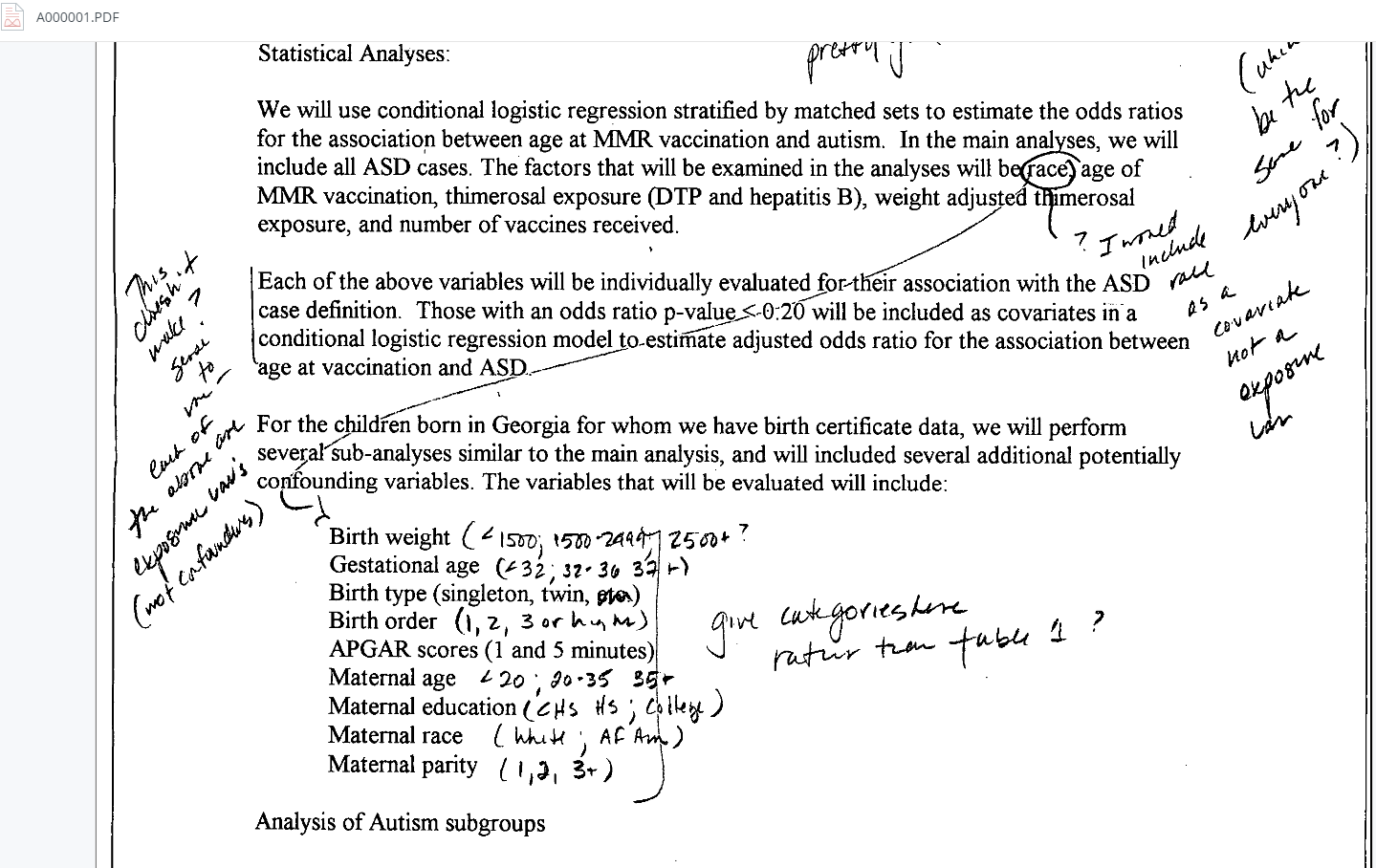
There are multiple drafts of the analysis plan. Analysis Plan is the same thing as the “protocol” that Wakefield and Hooker claim was changed after the first race data were analyzed. And the fact that we have the revisions gives us the chance to check two of the fundamental claims behind the Wakefield/Hooker “fraud” charge against CDC. (1) Did the CDC plan to look at race as an exposure variable? Wakefield and Hooker are claiming (although they use different words) this is what the CDC was doing. This is different from using race as a control variable. (2) Did CDC add the birth certificate analysis after the first race analysis was done, in order to dilute the effect?

No. Very clearly no. I’ve covered (2) already based on information Wakefield and Hooker made available. The final analysis plan was dated Sept.5, the first race analysis wasn’t until late October or early November. And we see the same in these documents.

But now we have new information that answers (1). Here is what appears to be the first draft of the analysis plan. And here is a capture of a very important part:

First Draft Analysis plan segment 1

Note that this draft analysis plan is from April 3, 2001. Well before the final version, the “protocol”, which was September 5. More importantly, this is a long time before a race analysis was started. But even more, notice how there’s an annotation “I would include race as a covariate, not as an exposure variable.” That’s critical–they decided against using race as an exposure variable from the start. Before they did a race analysis. Another point: they were already planning on using birth certificate data right from the start.

William Thompson certainly should have known this, it’s very probable that he did know this. Wakefield and Hooker likely knew this. They showed documents from this collection in their video and elsewhere. But they told us the opposite.

Whether they knew or not, they were wrong. Wildly irresponsibly wrong.

Ever wonder why they didn’t make documents public? We can’t tell if Hooker and Wakefield had all the Thompson documents, but we know they had some. While they cry out for transparency, they were carefully guarding information in order to craft the story they wanted told. The full documents tell a different story.

Let me put this more simply: if Wakefield and Hooker worked for me they would be fired for just their handling of the Thompson story (of course, they would have been fired years ago for many other causes, but promoting this sort of misinformation is simply wrong.)

Also in that same directory appears to be the first draft of the paper (A000071.PDF), with William Thompson as first author. I find it interesting that Thompson is first author there as later it would be Frank DeStefano who would be first author of the published study.

There are also meeting notes. Lots of meeting notes. Here’s the first batch, as near as I can tell. Meetings were held every month or two.

Now is a good time to address the “garbage can” quote. Congressman Posey read a statement from William Thompson into the congressional record. Emily Willingham discussed this in A Congressman, A CDC Whisteblower And An Autism Tempest In A Trashcan. On the other side, here’s an article by Jon Rappoport Bombshell: CDC destroyed vaccine documents, Congressman reveals Bombshell: CDC destroyed vaccine documents, Congressman reveals; CDC whistleblower case is back.

Here’s the thing–there’s zero “bombshell” involved in putting these documents into a confidential bin for shredding/recycling. There’s no reason to keep all these revisions of the analysis plan, all these meeting notes, all this redundant material. I hope people at CDC are not keeping all this paper. Beyond that, the rules are that they have to keep enough information to recreate the study. Aside from the fact that all these meeting notes are not required for that, Brian Hooker proved that requirement was met when he claimed to have done exactly that–recreated the study.

Mr. Thompson also provided a file with ALL Agendas for mmr autism meetings with written interpretation. Which is to say Thompson added his own annotations (purple pen) to the agendas.

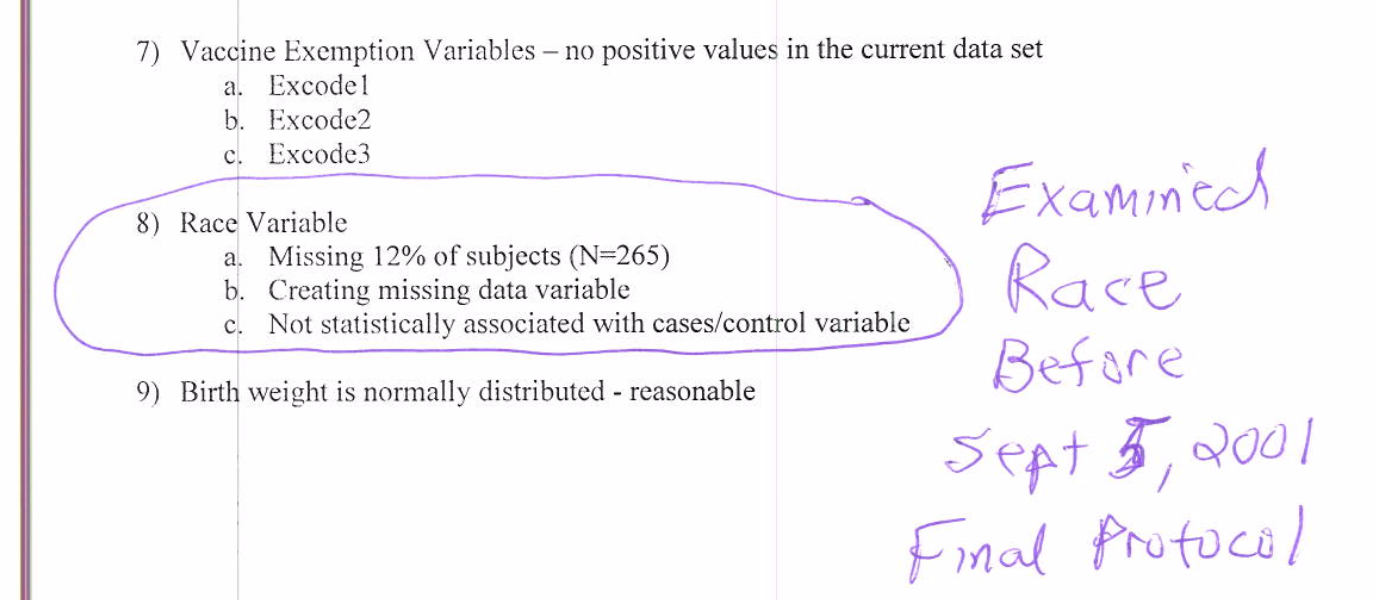
Here’s an example of his annotations. And a great example of trying to make data fit a story. Thompson appears to be trying to support the idea that the CDC team changed the protocol to include the birth certificate analysis in response to analyzing the race data:

Race examined before final protocol

The implication that the race analysis and had somehow influenced the final protocol (as Wakefield and Hooker have claimed and this comment appears to support) is just plain wrong. First, as we have already seen, the birth certificate analysis was included from first draft of the analysis plan, in April 2001. That’s four months before this meeting note. Second, the so-called “race effect” isn’t seen in this meeting note. In fact, we see the opposite: “not statistically associated with case/control variable”.

From the phone conversations between Brian Hooker and William Thompson (secretly taped by Hooker), we have found that Thompson was very interested in participating in a congressional hearing. Hooker and his colleagues had been involved in arranging a previous congressional hearing on autism. Frankly it appears to me as though Thompson was involved in a bit of a quid pro quo: Thompson coaching Hooker in ways to spread fear about vaccines in exchange for a chance to be involved in a hearing. Which begs the question: why no hearing based on all that Thompson has laid out?

In case it isn’t already abundantly clear: there’s no hearing because there is no reason for a hearing. There’s no evidence of fraud. Many of the reasons given by Wakefield and Hooker to call this fraud are, well, just flat out wrong. Contradicted by the evidence. For those hoping that Thompson’s personal notes would show some evidence of a cover up, here they are mmr autism study 2001-2002 hand written notes.

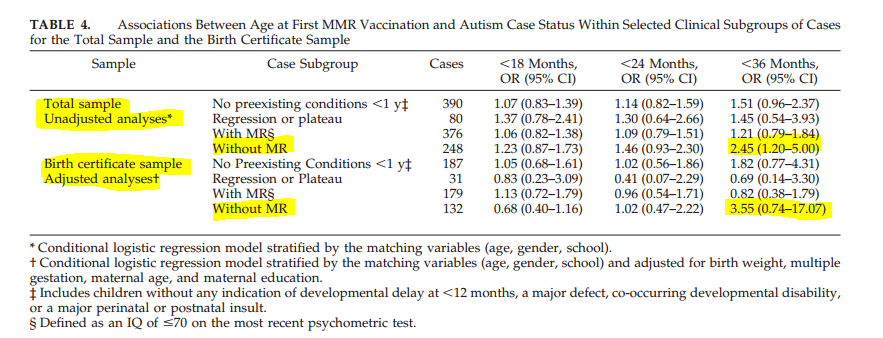
Ah, one will say, what about the finding of an association between the MMR and autism for African American boys vaccinated late (between 18 months and 36 months)? Why wasn’t that included in the published paper or public presentations? The reasons given by Thompson/Hooker/Wakefield don’t hold water as I’ve shown. So, what was the scientific reason for not including this result in the paper? Many online writers have discussed how weak this result is; how it is a spurious result. But I’d like to know the reasoning at the time behind the CDC decision to leave this out. As a community member–an autism parent–I’d like to see all the results and understand the reasons why certain results are spurious. Of course it is easy to say now, but leaving this out of the public’s eye was a mistake. It gave Thompson, Hooker and Wakefield the chance to cherry pick, hide information and craft a story that has been very damaging to the autism communities and to public health.

The first thing I did when I heard about this story was email a few epidemiologists I know and point this story out and ask them if they had the data to address the question raised. I no longer feel this way. Why should the autism communities spend precious funds and researcher time every time Andrew Wakefield (Time Magazine’s #1 on their list of great science frauds) comes up with a new story? Especially now that we know the story was built on lies. But consider this: Wakefield and Hooker have not been calling for more research. Instead they are calling for a congressional hearing. If you watched any part of the previous hearings you know they are political theater and have done nothing (NOTHING) to help make a better life for autistics. They have done nothing except provide video and blog fodder for those promoting the failed idea that vaccines cause autism.

Also, consider this: before Thompson Wakefield and Hooker didn’t talk about the issues of racial/ethnic minorities. For the most part, the entire “autism is caused by vaccines” community have ignored minority communities. Why? Because they are a clear example that the vaccine hypothesis is a failure. Prevalence estimates for racial/ethnic minority groups have been typically much lower than for Caucasians (Hispanics are diagnosed at a rate of 1/3 that of Caucasians in California. And this has been consistent for over 10 years.) This presents a huge problem for the likes of Hooker and Wakefield. If vaccines are a major cause of autism, why do minority groups have such low prevalences? If they were honest about their own beliefs, they would be calling for a study into the “protective” effect for minorities. But they don’t. More importantly, if they were real autism advocates they would be calling for better diagnosis, better awareness, better services for these under served communities. Instead they have just ignored these minority communities. That is, until they could use them as part of their campaign against vaccines.

And they still aren’t calling for better services better diagnosis in these underserved groups. Instead they are just trying to recruit as many parents as they into the vaccines-cause-autism camp. Imagine being convinced, wrongly, that you participated in injuring your own child. The charlatans who prey on our community with fake–and sometimes abusive–therapies rely on the vaccine/autism idea for the majority of their business.

The vaccines-cause-autism story is built on lies and it is very damaging. There has been nothing since the Kanner/Bettleheim “refrigerator parent” idea that has caused so much damage to our community. And that is the real story here. A group of people perpetuating a failed idea by carefully crafting a story.

The Zip file provided to me by Representative Posey’s office is at this DropBox link
https://www.dropbox.com/sh/jxtr06s5ddc82s7/AADaZvp7yu_daBhbuZwMfQy4a?dl=0

Again, I am grateful to Representative Posey and his staff for providing these files to me.


By Matt Carey

Comment on study: Early exposure to the combined measles-mumps-rubella vaccine and thimerosal-containing vaccines and risk of autism spectrum disorder

23 Nov

Missed this one from earlier this year. A study that looked at both MMR uptake and thimerosal exposure from infant vaccines. Guess what? “No convincing evidence was found in this study that MMR vaccination and increasing thimerosal dose were associated with an increased risk of ASD onset”

Again.

The abstract is below.

Why do I suspect that this is not included on “vaccine information” websites like the so-called “National Vaccine Information Center”, or “Dr. Bob’s” new site? Oh, because it doesn’t scare parents about vaccines, that’s why. And they can’t even blame the CDC or drug manufacturers for putting out a biased study (well, they can, they will, because they always do).

This study was done by Japanese academics. I’m sure some connection to Big Pharma will be produced to discount the fact that this study tells us what every other actual study on MMR and thimerosal and autism has said.

Early exposure to the combined measles-mumps-rubella vaccine and thimerosal-containing vaccines and risk of autism spectrum disorder.
Uno Y1, Uchiyama T2, Kurosawa M3, Aleksic B4, Ozaki N5.
Author information
Abstract
OBJECTIVE:
This case-control study investigated the relationship between the risk of Autism Spectrum Disorder (ASD) onset, and early exposure to the combined Measles-Mumps-Rubella (MMR) vaccine and thimerosal consumption measured from vaccinations in the highly genetically homogenous Japanese population.

METHODS:
Vaccination histories at 1, 3, 6, 12, 18, 24, and 36 months from birth were investigated in ASD cases (189 samples), and controls (224 samples) matching age and sex in each case. Crude odds ratios (ORs) and 95% confidence intervals (95% CIs) were calculated to determine relationship between MMR vaccination and ASD. The differences in mean values of the thimerosal dosage between cases and controls were analyzed using an unpaired t-test. MMR vaccination and thimerosal dosage were also investigated using a conditional multiple-regression model.

RESULTS:
There were no significant differences in MMR vaccination and thimerosal dosage between cases and controls at any age. Furthermore, the ORs (95% CIs) of MMR vaccination and thimerosal dosage associated with ASD in the conditional multiple regression model were, respectively, 0.875 (0.345-2.222) and 1.205 (0.862-1.683) at age 18 months, 0.724 (0.421-1.243) and 1.343 (0.997-1.808) at 24 months, and 1.040 (0.648-1.668) and 0.844 (0.632-1.128) at 36 months. Thus, there were no significant differences.

CONCLUSIONS:
No convincing evidence was found in this study that MMR vaccination and increasing thimerosal dose were associated with an increased risk of ASD onset.

Copyright © 2014 Elsevier Ltd. All rights reserved.

KEYWORDS:
Autism Spectrum Disorder; Case–control study; Environmental factors; Measles–Mumps–Rubella vaccine; Risk factor; Thimerosal


By Matt Carey

Mr. Kennedy, if you know the science, why did you claim that the MMR vaccine contains mercury?

16 Nov

Robert Kennedy (son of Robert F. Kennedy) has been focused on reducing mercury exposure for some time. His advocacy against mercury led him to focus on vaccines (infant vaccines used to contain a mercury compound as a preservative). And, the main argument against mercury in vaccines is the (now totally failed) idea that mercury in vaccines causes autism.

It’s important to keep that autism is not his priority. It’s his tool to allege dangers of vaccines. He’s not out to help us out, but instead to use us to help him.

Add to this that he’s a lawyer, not a scientist and he’s from a very political family. Three are lawyers and politicians actually understand science. Mr Kennedy claims he is in that number (he’s “rabidly pro-science”), but in reality he either doesn’t understand the science or the facts are just be a political tool for him.

That Mr. Kennedy feels the need to instill in us the message that he understands science may stem from the fact that his first attempt at discussing autism and vaccines met with disaster. He published an article “deadly immunity” (because, you know, very pro-vaccine people use terms like “deadly immunity” to discuss vaccines, right?). This article was published both in Rolling Stone and Salon.com. In Salon’s Correcting our record, We’ve removed an explosive 2005 report by Robert F. Kennedy Jr. about autism and vaccines. Here’s why we read:

In 2005, Salon published online an exclusive story by Robert F. Kennedy Jr. that offered an explosive premise: that the mercury-based thimerosal compound present in vaccines until 2001 was dangerous, and that he was “convinced that the link between thimerosal and the epidemic of childhood neurological disorders is real.”

The piece was co-published with Rolling Stone magazine — they fact-checked it and published it in print; we posted it online. In the days after running “Deadly Immunity,” we amended the story with five corrections (which can still be found logged here) that went far in undermining Kennedy’s exposé. At the time, we felt that correcting the piece — and keeping it on the site, in the spirit of transparency — was the best way to operate. But subsequent critics, including most recently, Seth Mnookin in his book “The Panic Virus,” further eroded any faith we had in the story’s value. We’ve grown to believe the best reader service is to delete the piece entirely.

“I regret we didn’t move on this more quickly, as evidence continued to emerge debunking the vaccines and autism link,” says former Salon editor in chief Joan Walsh, now editor at large. “But continued revelations of the flaws and even fraud tainting the science behind the connection make taking down the story the right thing to do.” The story’s original URL now links to our autism topics page, which we believe now offers a strong record of clear thinking and skeptical coverage we’re proud of — including the critical pursuit of others who continue to propagate the debunked, and dangerous, autism-vaccine link.

“…critical pursuit of others who continue to propagate the debunked, and dangerous, autism-vaccine link”. Not exactly a ringing endorsement of Mr. Kennedy’s approach nor the “science” he still promotes.

One take a moment here to discuss Mr. Kennedy’s strong record of advocating for real changes that would benefit autistics. Or we could if there were such a record. Again, we aren’t his focus. We are his tool.

So, given this long introduction, what about the claim that that the MMR vaccine contains mercury? It is in this video Mr. Kennedy produced recently. And while it may seem like a small thing, it is a clear example of misunderstanding or ignoring simple facts in order to support his argument that mercury in vaccines cause autism. Mr. Kennedy is jumping on the controversy that Brian Hooker and Andrew Wakefield tried to make last year about the MMR vaccine.

Now for those who have a basic understanding of the science, one will immediately wonder, “why is Kennedy latching on to this MMR story when there is no mercury in the MMR vaccine?” Not only does the MMR vaccine not contain mercury, it can’t contain mercury. The MMR vaccine is a live virus vaccine. Mercury is a preservative; it’s specific purpose is to kill bacteria (mostly) and viruses.

Let’s leave out the other huge warning flags here–such as the current MMR controversy Wakefield and Hooker tried to create is based on a huge amount of misrepresentations. Let’s ignore that and ask, surely Mr. Kennedy wouldn’t claim that the MMR vaccine contains mercury, right? Because that would mean either he doesn’t care about the facts or doesn’t understand the facts. It would suggest that sticking to very simple facts is taking back seat to political advocacy.

Why care, one might ask? Politicians have been ignoring facts for millennia. I care beause of the harm Mr. Kennedy brings to my community. I care because he is be scaring parents, especially African American parents, needlessly and convincing them to avoid a vaccine which prevents three very serious diseases. But more, he’s instilling in a new community the guilt and shame that comes with belief in the vaccines-cause-autism idea.

Given that long intro, here’s the video where Mr. Kennedy sends out his message to the African American community:

You can jump right to the point I’m discussing (6:45 into the video).

“…it proved that these vaccines, these mercury containing vaccines particularly, were causing autism”

When he’s talking about the William Thompson story, he’s talking about this study, Age at first measles-mumps-rubella vaccination in children with autism and school-matched control subjects: a population-based study in metropolitan atlanta. He’s talking about the MMR vaccine.

Again, the MMR doesn’t contain mercury. Never has. In fact, it can’t. And there’s no good reason why after all these years why Mr. Kennedy would not know this. In his book “Thimerosal, let the science speak”, Mr. Kennedy on two occasions (Kennedy MMR-not thimerosal 1 and Kennedy MMR-not thimerosal 1) notes that the MMR vaccine does not contain mercury.

Again, this may seem like a small thing–he got this fact wrong. So what?

There was a time when I thought that the leaders of the movements that promote the idea that vaccines cause autism were just misguided. Probably good, decent people who somehow got themselves to believe wrong ideas. It’s not that hard to believe in something false, and just because you are wrong doesn’t mean you are lying.

Well, in my opinion, that doesn’t describe Mr. Kennedy. And as I’ve noted, the consequences for my community are huge. And I don’t appreciate Mr. Kennedy what appears to be Mr. Kennedy using us as his tool.


By Matt Carey

To all who use Paul Offit’s 10,000 vaccine paper to scare others–put up or shut up. And that means you, Age of Autism and all your team.

6 Oct

I’ve generally stopped countering the misinformation by the Age of Autism blog. They are pretty much irrelevant now that they lost their star power, now that Jenny McCarthy and Jim Carrey have dropped out of the picture. They still cause harm, but on a much smaller scale than in the past.

That said, I recently saw one of the Age of Autism contributors in an online discussion. And as is typical, the conversation devolved into throwing around the usual tired arguments. For example–

The notorious Offit 10,000 vaccine paper (we might add 10,000 vaccine doctrine) was written to be re-assuring to parents. The reality is that 1 vaccine might kill an infant. But what is the rhetorical effect of saying 10,000 vaccines (or 100,000 vaccines originally) are “theoretically safe”. It really says that if we give them 10 at time and hundreds over a childhood it is no big deal. What we are really on to here is the hit and run strategy. It doesn’t matter egregious the effects of the ever extended and mandated schedule are you can always insist that it wasn’t vaccines (which are theoretically safe). And you can flood the media with people like you deriding the experience of actual rather than theoretical families who have found that products are not necessarily that safe after all. And you can claim that everything you say is thoroughly scientific (hoho).

Now, this is a new way to misrepresent what Dr. Offit wrote. So far off that one wonders if the author of the comment (one John Stone) has actually read the original. He claims that the Offit paper’s claim is ” It really says that if we give them 10 at time and hundreds over a childhood it is no big deal.”

Really?

Nope. Not even close.

Here’s the section of the paper that that is being referred to:

Studies on the diversity of antigen receptors indicate that the immune system has the capacity to respond to extremely large numbers of antigens. Current data suggest that the theoretical capacity determined by diversity of antibody variable gene regions would allow for as many as 109 to 1011 different antibody specificities.38 But this prediction is limited by the number of circulating B cells and the likely redundancy of antibodies generated by an individual.

A more practical way to determine the diversity of the immune response would be to estimate the number of vaccines to which a child could respond at one time. If we assume that 1) approximately 10 ng/mL of antibody is likely to be an effective concentration of antibody per epitope (an immunologically distinct region of a protein or polysaccharide),39 2) generation of 10 ng/mL requires approximately 103 B-cells per mL,39 3) a single B-cell clone takes about 1 week to reach the 103 progeny B-cells required to secrete 10 ng/mL of antibody39 (therefore, vaccine-epitope-specific immune responses found about 1 week after immunization can be generated initially from a single B-cell clone per mL), 4) each vaccine contains approximately 100 antigens and 10 epitopes per antigen (ie, 103 epitopes), and 5) approximately 107 B cells are present per mL of circulating blood,39 then each infant would have the theoretical capacity to respond to about 10 000 vaccines at any one time (obtained by dividing 107 B cells per mL by 103 epitopes per vaccine).

The paper merely states that an infant’s immune system can respond to the antigens in 10,000 vaccines.

So here is the challenge to Mr. John Stone (who wrote the above comment), the Age of Autism blog (where he writes, but not the above comment.) and everyone else who claims that the 10,000 number is wrong.

Prove it.

Prove the claim is wrong.

What in the above calculation is wrong? Is it the biology? The assumptions? The math? State clearly what is inaccurate in that calculation.

The answer is that many who cry out about “10,000 vaccines” haven’t read the paper. Or they have and they don’t understand it. Or, in rare cases, they understand it and are willfully trying to use it to scare people.

I have posted this challenge before on various internet discussions. And it is always, and I mean always, met with silence.

Notice that Dr. Offit doesn’t say that an infant can take 10,000 injections. But that “each infant would have the theoretical capacity to respond to about 10 000 vaccines at any one time (obtained by dividing 107 B cells per mL by 103 epitopes per vaccine).” I.e. that an infant can respond to the challenge posed by the antigens in 10,000 vaccines.

But that’s not scary. And fear and doubt is what people are trying to create when they claim that Paul Offit’s 10,000 vaccine paper is “notorious”.

So, go ahead anyone and everyone that uses the 10,000 vaccine statement to scare people about vaccines. Back up your complaint. I’ve been waiting for years and expect to continue waiting.


by Matt Carey

Press Release: New Research Finds No Evidence That Thimerosal-Containing Vaccines Affect Behavior or Neuroanatomy in Infant Primates

30 Sep

Below is a press release from the Johnson Center for Child Health and Development (formerly Thoughtful House). The press release discusses a recent study which investigated the safety of vaccine schedules (present and past) using monkeys as test subjects.

The study is a follow on study to a previous series of pilot studies involving some of the same authors. The pilot studies were considered by many to be an indication of evidence that vaccines cause autism and other neurological conditions. This larger study shows no evidence of adverse effects from vaccines.

Here is the press release:

New Research Finds No Evidence That Thimerosal-Containing Vaccines Affect Behavior or Neuroanatomy in Infant Primates

(Austin, Texas) – September 28, 2015 – New research finds no evidence that thimerosal- containing vaccines cause negative behaviors or result in neuropathology in infant primates, according to a study that will be published today in the Proceedings of the National Academy of Sciences. In this study, conducted by Dr. Dwight German of the University of Texas Southwestern School of Medicine, and colleagues, infant rhesus macaques received several pediatric vaccines containing thimerosal (a mercury-based preservative) in a schedule similar to that given to infants in the 1990s. Other animals received just the measles-mumps- rubella (MMR) vaccine, which does not contain thimerosal, or an expanded vaccine schedule similar to that recommended for US infants today. Control animals received a saline injection.

Regardless of vaccination status, all animals developed normal social behaviors. Cellular analysis of three brain regions, the cerebellum, amygdala and hippocampus (all known to be altered in autism), was similar in vaccinated and unvaccinated animals.

“This comprehensive analysis of social behavior and neuropathology in 12-18 month old rhesus macaques indicated that vaccinated primates were not negatively affected by thimerosal; the same was true for animals receiving an expanded 2008 vaccine schedule, which is similar to that recommended for US infants today” explained Dr. Laura Hewitson of The Johnson Center for Child Health and Development, one of the principle investigators working on the study. Hewitson was part of a team of researchers from The Johnson Center; the University of Texas Southwestern; the Center on Human Development and Disability Infant Primate Research Laboratory; the Washington National Primate Research Center (WaNPRC) at the University of Washington, Seattle WA; and Texas A&M Health Science Center & Central Texas Veterans Health Care System.

According to Hewitson, the study was designed to compare the safety of different vaccination schedules, including the schedule from the 1990s, when thimerosal was used as a preservative in multi-dose vaccine preparations. The data from this study indicate that administration of TCVs and/or the MMR vaccine to rhesus macaques did not result in neuropathological abnormalities,or aberrant behaviors, like those often observed in autism.


Citation
Administration of thimerosal-containing vaccines to infant rhesus macaques does not result in autism-like behavior or neuropathology. Bharathi S. Gadad, Wenhao Li, Umar Yazdani, Stephen Grady, Trevor Johnson, Jacob Hammond, Howard Gunn, Britni Curtis, Chris English, Vernon Yutuc, Clayton Ferrier, Gene P. Sackett, C. Nathan Marti, Keith Young, Laura Hewitson and Dwight C. German. PNAS

This article can be downloaded for free here.

This study was supported by The Ted Lindsay Foundation, SafeMinds, National Autism Association, and the Johnson and Vernick families. This work was also supported by WaNPRC Core Grant RR00166 and CHDD Core Grant HD02274.

About The Johnson Center
The mission of The Johnson Center for Child Health and Development is to advance the understanding of childhood development through clinical care, research, and education.

Previous Press Releases
For Immediate Release
Contact: media@johnson-center.org
512-732-8400


By Matt Carey

Cochrane review: no clinical trial evidence was found to suggest that pharmaceutical chelation is an effective intervention for ASD

10 Sep

Chelation was never used by the majority of parents on their autistic kids. And that is a good thing. Chelation use is way down in the autism communities, but it hasn’t gone away. Many of those who use chelation are also vaccine antagonistic, and many of those rely upon the Chochrane reviews to support their vaccine-antagonistic arguments (generally by cherry picking and misrepresenting the Chochrane reviews). So, I was intrigued when I saw this abstract come up recently: Chelation for autism spectrum disorder (ASD).

A Chochrane team looked at the evidence for chelation and found that there is none.

A while back there was a plan for a chelation trial at the National Institutes of Health. It was cancelled when animal studies found a drop in cognitive scores when chelation was used without heavy metal intoxication. Which is to say, if you chelate someone needlessly, you could be shaving off IQ points. And since there is no evidence that autism is a form of heavy metal intoxication, chelation may actually have been harming already disabled kids.

I bring this up because the Chochrane review mentions a possible clinical trial in their last abstract sentence: “Before further trials are conducted, evidence that supports a causal link between heavy metals and autism and methods that ensure the safety of participants are needed.”

Yeah, I know that teams of people with MBA’s and other non-related degrees will tell you that there is evidence. As will doctors who sell chelation. Or recommend it (Hello, Dr. Bob Sears, I’m talking to you and your community of non-autism docs). They are wrong. And potentially harming autistic children.

Here is the abstract

Abstract
BACKGROUND:
It has been suggested that the severity of autism spectrum disorder (ASD) symptoms is positively correlated with the level of circulating or stored toxic metals, and that excretion of these heavy metals, brought about by the use of pharmaceutical chelating agents, results in improved symptoms.
OBJECTIVES:
To assess the potential benefits and adverse effects of pharmaceutical chelating agents (referred to as chelation therapy throughout this review) for autism spectrum disorder (ASD) symptoms.
SEARCH METHODS:
We searched the following databases on 6 November 2014: CENTRAL, Ovid MEDLINE, Ovid MEDLINE In-Process, Embase,PsycINFO, Cumulative Index to Nursing and Allied Health Literature (CINAHL) and 15 other databases, including three trials registers. In addition we checked references lists and contacted experts.
SELECTION CRITERIA:
All randomised controlled trials of pharmaceutical chelating agents compared with placebo in individuals with ASD.
DATA COLLECTION AND ANALYSIS:
Two review authors independently selected studies, assessed them for risk of bias and extracted relevant data. We did not conduct a meta-analysis, as only one study was included.
MAIN RESULTS:
We excluded nine studies because they were non-randomised trials or were withdrawn before enrolment.We included one study, which was conducted in two phases. During the first phase of the study, 77 children with ASD were randomly assigned to receive seven days of glutathione lotion or placebo lotion, followed by three days of oral dimercaptosuccinic acid (DMSA). Forty-nine children who were found to be high excreters of heavy metals during phase one continued on to phase two to receive three days of oral DMSA or placebo followed by 11 days off, with the cycle repeated up to six times. The second phase thus assessed the effectiveness of multiple doses of oral DMSA compared with placebo in children who were high excreters of heavy metals and who received a three-day course of oral DMSA. Overall, no evidence suggests that multiple rounds of oral DMSA had an effect on ASD symptoms.
AUTHORS’ CONCLUSIONS:
This review included data from only one study, which had methodological limitations. As such, no clinical trial evidence was found to suggest that pharmaceutical chelation is an effective intervention for ASD. Given prior reports of serious adverse events, such as hypocalcaemia, renal impairment and reported death, the risks of using chelation for ASD currently outweigh proven benefits. Before further trials are conducted, evidence that supports a causal link between heavy metals and autism and methods that ensure the safety of participants are needed.


By Matt Carey

SafeMinds: why won’t you tell your membership about the vaccine safety study you funded? Perhaps because it says vaccines are safe?

28 Aug

Earlier this year a paper was published on vaccine safety: Examination of the Safety of Pediatric Vaccine Schedules in a Non-Human Primate Model: Assessments of Neurodevelopment, Learning, and Social Behavior. This was a followup study to earlier pilot studies that got a lot of attention in the “vaccines-cause-autism” groups (Delayed acquisition of neonatal reflexes in newborn primates receiving a thimerosal-containing hepatitis B vaccine: influence of gestational age and birth weight and Influence of pediatric vaccines on amygdala growth and opioid ligand binding in rhesus macaque infants: a pilot study.)

It is worth noting that the pilot studies didn’t link vaccines to autism. They did make claims that some early reflexes were delayed in the monkeys given thimerosal containing vaccines. If you see someone talking about “root” or “snout” or “suck” reflexes in a vaccine discussion, they are referring to the studies above. These were pilot studies–small preliminary studies to see if it is worth launching a larger study. As such the results should have been taken with caution. But caution is not what groups like SafeMinds (or any of the groups that promote the failed vaccine-autism link) are known for. Inflating any scrap of evidence that can support their political point of view, that’s what they are known for.

SafeMinds made a big deal out of the early studies. Mark Blaxill (then of SafeMinds) called the study a “blockbuster” in a four thousand word analysis. That’s a lot of space to devote considering the full study was eight thousand words. And, as noted already, preliminary. But politics is politics.

Now, an intellectually honest person, or group, would watch for the followup study and report on it no matter the result. Because, let’s face it, if you are going to spend 4000 words overstating the importance of a study, scaring people and instilling them with guilt and pain over their child’s disability, you have a responsibility to do a follow up.

If you are intellectually honest.

So, as noted above, the follow up study was published. It was published in April. Four months ago. And I don’t see anything from Mr. Blaxill on the Age of Autism blog (where he posted his “blockbuster” article) or at the SafeMinds website on the followup study. SafeMinds has their own blog, and if you search it for, say “snout”, you get this article (Ground-Breaking Monkey Study: Mercury-Containing Hepatitis B Vaccine Causes Brain Damage) on the pilot study, calling it “groundbreaking” and claiming that it demonstrates that the thimerosal containing HepB vaccine causes brain damage.

Very strong words. Words which, if overblown, are very damaging. Imagine going through life as a parent thinking that you agreed to a vaccine and that caused brain damage to your child. Now imagine that the evidence you used to draw that conclusion was (a) not strong to begin with and (b) now refuted.

Wouldn’t you want to know the truth? Wouldn’t you expect the people and the organizations that convinced you of this falshood to seek you out and correct their mistake?

And this is why people don’t hold Mr. Blaxill or SafeMinds in high regard. They are quick to scare but don’t have the courage to admit they were wrong. Courage isn’t standing up and saying unpopular truths. Courage is standing up and admitting that your “unpopular truth” was, in fact, not the truth at all.

Now, why pick on SafeMinds in specific here? A lot of people and groups jumped on the pilot study and spread a lot of fear. Check out the footnotes of the study.

This work was supported by the Ted Lindsay Foundation, SafeMinds, National Autism Association, the Vernick family, and the Johnson family

SafeMinds helped fund the new study. The one they are ignoring. They were likely aware of the results before they were published. But no word.

I expect more from decent advocacy organizations. But I am not surprised with SafeMinds, nor Mark Blaxill.

Yes, the National Autism Association did too and they need to step up as well (a point I hope to make in a later article).

How about the Johnson Family? Well, the Johnson Center stepped up and put out a press release New Research Finds No Evidence That Thimerosal-Containing Vaccines Affect Neurodevelopment and Behavior in Infant Primates. (all SafeMinds, the Age of Autism and the National Autism Association needs to do as a start is publish the press release).

Here’s the last sentence of the press release, quoting the lead researcher: “Despite these limitations, the data in this primate study overwhelmingly provides support for the safety of pediatric vaccines”

It would take a lot of courage for SafeMinds and Mark Blaxill to publicize such a statement. More than they have.


By Matt Carey

Autistic kids are more likely to be hospitalized–and that includes for vaccine preventable diseases

15 Jul

There’s a lot of talk about comorbid conditions and autism. Sadly that conversation is often used to suggest that vaccines cause autism. As in, “look at how much GI disease there is in autism. Must be caused by vaccines!”

And because of that discussion, probably most of the people drawn to read this article will be because I highlighted vaccines in the title. So let’s get that out of the way first. A group of researchers looked at what leads to hospitalization of autistic kids. In specific, they looked at “Ambulatory care sensitive conditions” which are defined as: (ACSCs) are conditions for which appropriate outpatient care prevents or reduces the need for hospitalization. The study was presented at IMFAR and is titled Ambulatory Care Sensitive Hospitalizations Among Children with Autism Spectrum Disorder

What did they find for vaccine preventable diseases? Autistic kids are 3 times more likely to be hospitalized for vaccine preventable diseases than are kids with no chronic conditions.

Hospitalized.

Three times more often.

For diseases that can be easily prevented with vaccines.

But sadly some of the most vocal opponents to vaccines are autism parents. All due to the misinformation that claims that autism is caused by vaccines. And the result is that autistic kids suffer from preventable diseases.

Not only do these parents contribute to the misinformation campaign against vaccines, they also ignore the fact that other conditions are even more common among autistics than, say, GI disease. Not to downplay GI disease. Not at all. From this study, hospitalization from constipation occurred in 1.2% of autistic kids. That’s over 4 times higher than for kids without chronic conditions and that’s a big deal. But what fraction of autistic kids hospitalized for mental health conditions? 23.5%. That’s over 8 times more often than kids without chronic conditions. And nearly 10 times more common than hospitalization from constipation and gastroenteritis combined.

14.5% of autistic kids were hospitalized for epilepsy. Nearly 10 times the value for the general population.

But as a community, autism parents are not talking about mental health conditions and epilepsy much. The most vocal among us have let themselves focus on the (now dead) vaccine debate. And it is hurting us as a community. It is hurting the people we are supposedly working to serve: autistics.

To bring this back from a critique of the harm that vocal minority of the parents cause–

Yes, autistics are more likely to be hospitalized than are the general population. And big issues for us include mental health and epilepsy.

Hospitalization–any hospitalization–is a big deal. Especially in the autistic population. Not too long ago we saw that autistics were more likely to be restrained in the ER. I remember being left overnight in the hospital when I was a kid. No way I could do that with my autistic kid, and I don’t see being left alone as a viable option for many of the autistics (both kids and adults) I know. How do we support autistics (and other disabled people) when hospitalized? From my experiences, I can say “not well”.

And that’s something I hope we can change. I hope enough people read past the vaccine part of this article and take the time to really think about where we are applying our advocacy in the autism communities.

Here’s the table from a paper
Paper_18942_abstract_10437_0

Ambulatory Care Sensitive Hospitalizations Among Children with Autism Spectrum Disorder

P. S. Carbone1, P. Young1, G. Stoddard1, J. Wilkes1 and L. Trasande2, (1)University of Utah, Salt Lake City, UT, (2)NYU School of Medicine, New York, NY

Background: “Ambulatory care sensitive conditions” (ACSCs) are conditions for which appropriate outpatient care prevents or reduces the need for hospitalization. Children with autism spectrum disorder (ASD) may be at risk for hospitalization for ACSCs because of difficulty accessing high quality primary care.
Objectives: The purpose of this study is to describe the prevalence and health care utilization of children with ASD who are hospitalized for ACSCs and compare them with the prevalence and health care utilization for the same conditions in hospitalized children without ASD.

Methods: Using the 2009 Kids Inpatient Database, hospitalizations for an ACSC were examined within three cohorts of children aged 3-20 years: children with ASD, children with chronic conditions without ASD (CC), and children with no chronic conditions (no-CC). In order to compare the prevalence of each ACSC for the three cohorts we separately analyzed discharges with a primary diagnosis ICD-9-CM code that corresponded to each of ACSCs listed in the table. In order to compare inpatient health care utilization for the three cohorts we analyzed total charges (TC) and length of stay (LOS), for each ACSC.

Results: Within the 24,174 in the ASD cohort, we found that the proportion of hospitalizations for an ACSC was 55.9%, compared with 28.2% in the CC cohort and 22.9% in the no-CC cohort (p<0.001). The most prevalent ACSCs among children with ASD were mental health conditions (e.g. anxiety, depression, mood disorder) (23.5%) and epilepsy (14.7%). Children with ASD were more likely to be hospitalized for a mental health condition, epilepsy, constipation, dehydration, underweight and a dental condition compared with the other cohorts (Table). After adjusting for covariates (age, gender, race, median household income, primary payor, hospital variables [size, location region, teaching status, type] and point of origin of admission), we found that children with ASD were nearly ten times more likely to be hospitalized for a mental health condition (OR: 9.72; 95% CI: 8.39-11.26; p <0.001), nearly seven times more likely to be hospitalized for epilepsy (OR: 6.58; 95% CI: 5.95-7.29; p <0.001) and more likely to be hospitalized for constipation, pneumonia, dehydration, vaccine preventable diseases, underweight and nutritional deficiencies, compared with the no-CC cohort. Adjusting for the same covariates we found that children with ASD were twice as likely to be hospitalized for mental health conditions (OR: 2.19; 95% CI: 1.99-2.41; p <0.001), five times more likely to be hospitalized for epilepsy (OR: 4.99; 95% CI: 4.60-5.41; p <0.001), and were significantly more likely to be hospitalized for constipation, dehydration, and underweight compared with the CC cohort. The ASD cohort had higher TC and longer LOS for mental health conditions compared with the other two cohorts.

Conclusions: Outpatient efforts to prevent hospitalizations in children with ASD should focus on mental health care needs and seizure management. Other strategies should include actively managing constipation and dehydration, monitoring nutritional status, and immunizing against vaccine preventable conditions. Understanding the reasons for the higher healthcare utilization among children with ASD hospitalized for mental health conditions should be the subject of further research.


By Matt Carey