Autism, emergency rooms, sedation and restraints

4 Dec

When I saw this abstract in my daily summary from pubmed I was saddened to see how serious this problem is. In addition, I was glad to see a paper exposing this great need. The problem in short: autistics are heavy users of the emergency room and are too often subjected to sedation and/or restraints during their visit.

I don’t have the full paper so I can’t see if they do the comparison of emergency room (ER) visits between autistics and non autistics. The authors report 13% of autistics (adolescents and adults) had at least one ER visit in a 2 month period. That sounds high. But how high? If we assume a low estimate, 1 visit per individual in the 2 month period, that would give us 78 visits/100 autistics in a year. Compare this to the CDC stats for the general population of 42 ER visits per hundred people per year. To put it simply: autistics are using the ER about twice as often as the general population. And that is clearly an underestimate given that a major predictor of autistics using the ER is previous use of the ER. Which is to say–there appear to be a fraction of autistics who are frequent ER users.

That is serious enough, but here’s the statistic that really calls for action: 23% of autistics in the ER were restrained either chemically (sedation) or physically. 23%. Any restraint or sedation calls out for action, but this statistic screams of a need for action.

The Autism CARES Act calls for an increased emphasis on services. And here is a great example of a paper that demonstrates the need where specific supports or services would help. Autistics have different and greater needs in the ER. We need to determine now what services those services are. And I do use plural on purpose because it is highly likely that the reasons and the needs of autistics in the ER are varied. We need to figure out why autistics are using the ER more often. We also need to figure out why a large fraction are being sedated and/or restrained. We can speculate and possibly there’s more information in the full paper. But this looks like an area begging for more information.

Here is the abstract from pubmed for this paper:

Predictors of emergency service use in adolescents and adults with autism spectrum disorder living with family.

INTRODUCTION:
The use of emergency services among adolescents and adults with autism spectrum disorder (ASD) transitioning into adult health services has not been well described.

OBJECTIVES:
To describe emergency service use including emergency departments (EDs), paramedics, and police involvement among adolescents and adults with ASD and to examine predictors of using emergency services.

METHODS:
Caregivers of 396 adolescents and adults with ASD were recruited through autism advocacy agencies and support programmes in Ontario to complete a survey about their child’s health service use. Surveys were completed online, by mail and over the phone between December 2010 and October 2012. Parents were asked to describe their child’s emergency service use and provide information about potential predictive factors including predisposing, enabling and clinical need variables.

RESULTS:
According to parents, 13% of their children with ASD used at least one emergency service in a 2-month period. Sedation or restraints were used 23% of the time. A combination of need and enabling variables predicted emergency service use with previous ED use in the last year (OR 3.4, 95% CI 1.7 to 6.8), a history of hurting others (OR 2.3, 95% 1.2 CI to 4.7) and having no structured daytime activities (OR 3.2, 95% CI 1.4 to 7.0) being the strongest multivariate predictors in the model.

CONCLUSIONS:
Patients with ASD and their families are likely to engage with paramedics or police or visit the ED. Further education and support to families and emergency clinicians are needed to improve and, when possible, prevent such occurrences.

I will note that there is an inherent bias in the study in that they are surveying parents. In doing so, they will miss those adults who are living away from parents.

We have to be able to do better than sedation and restraints for a quarter of autistics who visit the ER. The first step was exposing the issue and for that I thank the authors. But this is only the first step.


By Matt Carey

Jerry Seinfeld, still not autistic after all these years

4 Dec

Jerry Seinfeld made a bit of a stir in the autism community recently by stating in an interview that, well, let’s use his own words:

I think, on a very drawn out scale, I think I’m on the spectrum.

This statement caused some excitement in some quarters and some vocal pushback in other quarters.  Well, that and this statement:

But, I don’t see it as dysfunctional. I see think of it as an alternate mindset.

My guess is that this second statement caused much if not most of the pushback that Mr. Seinfeld received.  Why?  Because it says that, say, Jerry Seinfeld can have autistic traits and those traits are not dysfunctional for him.  Much more, people expressed a fear that Jerry Seinfeld (or someone else with little or no disability) would become the face of autism and that the significant challenges faced by many on the spectrum would be ignored.

Looking back at the first statement above, note that we never get to hear what “it” is.  Is “it” autism in general?  Or, is “it” that part of Mr. Seinfeld’s experience that he identifies as being somewhat like autism?  It seemed very clear to me that Mr. Seinfeld was talking about his own experience, but I can see how others might not see it that way.  In which case we as a community should have said, “Hey Mr. Seinfeld, could you clarify that statement?”  Sadly there won’t be a clarification.  Likely because of the pushback, largely from a few vocal parents of autistic children who face extraordinary challenges due to autism (and intellectual disability and other disabilities), Mr. Seinfeld has made it clear that he’s not autistic and stopped the conversation there.  I never thought he was saying he was autistic, hence that whole “very drawn out scale” caveat he put in his initial statement.

In a newer interview, on Access Hollywood,  here (my apologies but the embed code doesn’t seem to be working or I’d have that video embedded here) we hear Mr. Seinfeld put the brakes on the entire Seinfeld/autism discussion.  The “money” quotes from that interview?  From Time Magazine’s article:

“I don’t have autism, I’m not on the spectrum,” theComedians in Cars Getting Coffee star said Wednesday. “I was just watching a play about it, and … I related to it on some level”

To this observer, the interview comes across as though Mr. Seinfeld asked, “Hey, I got myself into some difficulty.  Could you interview me and help me get out of it?”.  Whatever the background, Mr. Seinfeld put a stop to the discussion.

In the end, we as a community lost a potential ally by using his celebrity to air our own dirty laundry.   We are certainly a divided community on a few issues.  The one in particular here is the way in which some people don’t want to accept the fact that autism is a spectrum.  Autistics have varying degrees of challenges, both due to autism and to other conditions (e.g. epilepsy, intellectual disability, anxiety, etc.) that are common within the autistic population.  One reason I don’t particularly like the term “spectrum” is that implies a one-dimensional distribution, a line with those requiring constant support on one side and those who can manage independently on another.  Well that’s not really accurate.  By that model, the students in my kid’s classroom are all in one narrow band of the spectrum.  But they aren’t.  They are each unique in their strengths and weaknesses.  Autism for one is not the same as autism for another.

But let’s get back to that division.  Some people spoke out about a “war” between “autistic self advocates and parents of severely autistic children” and that the autism spectrum should be split.  Others said that were Mr. Seinfeld to become one of the public faces of autism, he (like Temple Grandin, somehow) would be used by officials to downplay the significant needs of those with great challenges and, again, the spectrum should be split.

We are so divided that we need some sort of civil war to divide the spectrum.  Really?  Here’s the thing, we don’t.  There is a large, growing and vibrant community I in invite those who want division to join it.  The founder of this blog, Kev Leitch, understood that.  He understood it when he made Left Brain/Right Brain a group blog with parents, professionals and autistics as contributors.  He understood it when he built a discussion forum which was inclusive.  The people at The Thinking Person’s Guide to Autism understood that when they built a community with voices from all over the community.  Their Facebook page has over 108,000 likes at this point.

There is a place for advocates who have a very narrow focus.  Say, only autistics with intellectual disability or only self-advocates.  But when you take that to the level of claiming that we should split the community over some “war”, you are doing harm.  The strongest advocates are those who see beyond their own self interests, who advocate for those in the community whose needs differ from one’s own self-interest (even if that “self” interest is in supporting a loved one).

Or, to put it simply, I expect that self-advocates will support advocacy that directly benefits kids and adults who require 24 hour support, like my kid. Just as I think self advocates deserve advocacy support from parents like myself.

In this whole hullabaloo about Seinfeld and autism I’ve seen some reasonable voices.  I’ve saved them for now.

First, from Jerry Seinfeld and Autism, an article by John Elder Robison (autistic adult) at Psychology Today:

Someone like Mr. Seinfeld – by virtue of his public persona – could easily be seen as a “face of autism,” when in fact we are a very diverse community and many of us want or need far more services and supports than Mr. Seinfeld has so far requested publically. The uninformed public could look at him and say, “autistic people are millionaire comedians,” which is far from accurate. Sure, there are some autistic comedians and some rich ones but most of us are somewhere in the middle. We are all individuals.

Then, from Amy Daniels at Autism Speaks in Celebrate Seinfeld, But Don’t Forget Those Whose Needs Are Great:

So while we celebrate the unique abilities that autism can bring, we must not forget that no one “face” represents autism. We need to remember that around a third of those with autism have co-occurring intellectual disability. A similar number are nonverbal and have tremendous difficulty communicating their thoughts and needs. Thanks to research, we also know that most children and adults with autism have related physical and mental health conditions. These conditions include epilepsy, extreme and chronic anxiety, painful gastrointestinal disorders and disturbed sleep.

We don’t need to fear that the one face of autism will not represent our interests.  We need to make sure that there is no “one face” of autism.  It would have been great if Jerry Seinfeld had been one of those faces.  A face of success (isn’t that what we parents want for our kids?) to serve as a hero for some.  That would not have taken away anything from my kid, as long as we had other faces of autism to represent the whole spectrum.

By Matt Carey

Disneyland and the Disability Access Service Card

2 Dec

When Disney announced that they were going to change how they handled services for disabled guests, I and many others were concerned. The old system was very informal and worked well, in my opinion.  It was just a piece of paper and you showed it to people at the line and they would help you by either putting you in a separate disability line or let you go to the exit and get in line there.  It made it possible to enjoy the park without waiting in long lines where the disabled person and, possibly, others in the line would have a much less than optimal experience.  While it didn’t guarantee short lines, in practice that’s they way it often worked.  So people who just can’t take Disneyland for long periods of time could get a “full day” in a few hours.  With Disney costing $90 for kids, $96 for those 10 and older, it’s a big deal if you can only be there for a few hours and most of that time is spent in line.  I could seriously see getting on one, maybe two major rides and that’s it.

But, sadly, informal systems can be gamed easily.  And that’s what happened.  See Rich Manhattan moms hire handicapped tour guides so kids can cut lines at Disney World for an example.  Or just read the title.

Shannon Rosa wrote about the new system over at The Thinking Person’s Guide to Autism as One Autistic Teen’s Disneyland Success Story.   She and Leo visited Disneyland a few weeks ago (Nov. 2014).  Also, there’s Disney DAS from a diary of a mom describing their trip in May to Walt Disney World.

Shannon mentioned in her article that they were about to change the disability access service again.  And by the time I went with my family, changes had taken place.

I’ll go into more detail below, but the main point in how the disability pass works is this: for rides where they have a fast-pass entrance, the ticket for the disabled person is the disability pass.  That ticket works much like a fast-pass.

So, here’s the “more detail” part:

Step 1: go to City Hall on Main Street (it’s too your left as you enter the park).  Bring your entire party and all the tickets.  I stood in line and called my family when I got to the front (that whole, not doing well with lines, thing).

Step 2: At City Hall they will take the picture(s) of the disabled person(s).  They will scan all the tickets.  You need to specify which ticket(s) belong to the disabled person(s).  They ask you to write that person’s name on the ticket. That ticket has to be used for most rides where he/she wants disability access.

You will also be given a white piece of paper with the terms and conditions for disability access.  You will be asked to sign a copy of these terms and conditions.  Keep your copy–it’s your disability pass for rides without the fastpass like access.

Step 3: They will explain the process to you while they scan your tickets so you can get more accurate and up-to-date information than I’m giving here.

Step 4: The Disney cast member who is helping you will ask which ride you want to go on first.  Tell them that and they will scan your tickets and tell you when you can go on that ride.  For example, we said, “It’s a small world”. It was 10:30am.  We were told that any time after 11am we could go to the disability line.

Step 5: Enjoy the park, other rides, shopping, music, resting, etc. until your time.  Any time after your appointed time, you can go to the disability access line for that ride.  Tickets are scanned and you are allowed in line. For It’s a Small World, there is a separate disability access line.  For other rides, say, Star Tours, one goes to the fastpass person.  That person will scan your ticket and then you are in the regular line.  The Star Tours person gave us a plastic laminated pass that we took with us to the next person in line.  I’m not sure what purpose that serves.

Step 6: Once done with a ride, you can get in another “virtual” line with your pass.  There are three kiosks in Disneyland for this.  One in the Main Street central plaza.  One is in Fantasy Land between Dumbo and the Storybook Land ride.  The third is in Tomorrow Land between Star Tours and the gift shop at the exit of Star Tours.  The person at the kiosk will scan your tickets and tell you what time you can get in the disability access line.

Alternatively, one can go to the fastpass person at the line for the ride you want to get on and ask to be put on the virtual line for that ride (and that ride only).  When I went to some rides I was asked “do you want to get in line or are you already registered”.  So, you don’t have to go to one of the three disability kiosks each time.  I got some mixed messages about that, though.  One person told me that I couldn’t be added.

Not all rides have disability access lines or fastpass.  For example, the train. At the train we asked a cast member what to do and were told to just wait at the exit.  When the train came to the station, we showed another cast member our white pass (remember those terms and conditions discussed above?) and got on the train.  Basically, this is how the old disability access pass worked.

Disney has a web page on disability access and strategies: Services for Guests with Disabilities.  There’s a pdf on the Disability Access Service (DAS) there, and I’ve copied it here: dlr-disability-access-service_2014-11-19.

I bring this up because here’s a key paragraph in that document:

DAS, with its virtual wait, will accommodate many of our Guests with disabilities. We recognize, however, that our Guests with disabilities have varying needs, and we will continue to work individually with our Guests to provide assistance.
In unique situations, our Guest Relations staff will discuss special accommodations for persons who are concerned DAS doesn’t meet their needs (e.g., those whose disability limits the duration of their visit to the park or limits their choice of attractions).

All accommodations will be made in person, on site at Guest Relations. We are unable to provide accommodations in advance of a Guest visit.

This tells me they’ve been paying attention to people like myself who have complained that it isn’t just the lines for each ride that matter.  For some of us, our time in the park is very limited.  And at $100/ticket ($90/kids under 10), it’s a big deal to go to Disneyland.  Even with accommodations, my kid was melting down in the last line and we were not at the park for very long.

Next time I’m printing out that pdf (or whatever they have at the time) and bringing it along.

By Matt Carey

ASAN Series: JRC Survivor Speaks Out

23 Nov

The Judge Rotenberg Center (JRC) is most infamous for it’s use of electric shocks as a behavior modification method.  But electric shocks are not the only aversive technique they use.  In a four part series, the Autistic Self Advocacy Network presents a rare insider’s view of life at the JRC.   So far three parts have been published.  But rather than wait for part 4, I’ve decided to post links to the articles now.

The series starts with this introduction:

The Judge Rotenberg Center (JRC) is a residential facility in Massachusetts where disabled residents are subject to electric shock, sensory assault, food deprivation, prolonged restraint and seclusion, and a host of other horrifying and aversive “treatments.” The United Nations has condemned the JRC’s treatment of its residents as torture, and disability rights advocates have been trying to get the facility shut down for over 30 years. The Autistic Self Advocacy Network has previously published an in-depth piece about the history and practices of the JRC, which you can read here.

This post is the first of a four-part series written by Jennifer, a survivor of the JRC. We are extremely grateful to have her permission to publish this brave account of her own experiences with the so-called “treatments” the JRC provides.

Here are links to the series so far:

JRC Survivor Speaks Out (Part 1)

JRC Survivor Speaks Out (Part 2)

JRC Survivor Speaks Out (Part 3)

By Matt Carey

Andrew Wakefield’s CDC Whistleblower documentary trailer. Words can not do this justice.

20 Nov

Andrew Wakefield, the British former academic surgeon who fueled the MMR scare, has turned to film making as his career.  Someone chose Mr. Wakefield to manage the publicity for what they termed the “CDC Whistleblower” incident. to recap that: a William Thompson from the CDC had the extreme bad judgment to approach Brian Hooker with concerns about an old MMR/autism study.  Mr. Hooker is well known for his antagonistic stance on vaccines and his bad science attempting to link vaccines and autism.  Mr. Hooker published a (now retracted) study based on the information given to him by Mr. Thompson at CDC.  To publicize this “CDC Whistleblower” incident, Mr. Wakefield came out with probably the most over-the-top bad video I’ve ever seen.   It’s basically the Plan 9 From Outer Space of mini documentaries, complete with Mr. Wakefield’s voice over claiming that the CDC are worse that Hitler, Pol Pot and Stalin.  Those dictators, you see, were at least sincere in Mr. Wakefield’s view.

Well it seems Mr. Wakefield wants to expand the “CDC Whistleblower” story to a full documentary.  He has an indigogo campaign to raise funds. As of now, it has collected $2,213 of his $230,000 goal.

And now he has a trailer.  It is seriously worth a look.  And before you read my own commentary on this one.  Here, go ahead:

Thankfully it is not as long at the Hitler/Pol Pot/Stalin video so I could manage to watch it again.  Because on one view I just had to say–really? Is this for real?

We start out with a shadowy figure. Presumably an actor playing the role of the whistleblower (although, physically he looks more like Poul Thorsen than Mr. Thompson).

Feast-shadow figure

Interspersed with video of autistic kids in severe distress, we get images of police in riot gear.  Because, that’s what one does in a documentary, splice in footage that has nothing to do with the story, right?feast-riot gear

And, lest we forget, a helicopter.  Black.  Has to be black.  OK, it looks like only the bottom is black, but as that quick clip went by all I could think was “really?  A black helicopter? ”

feast black helicopter

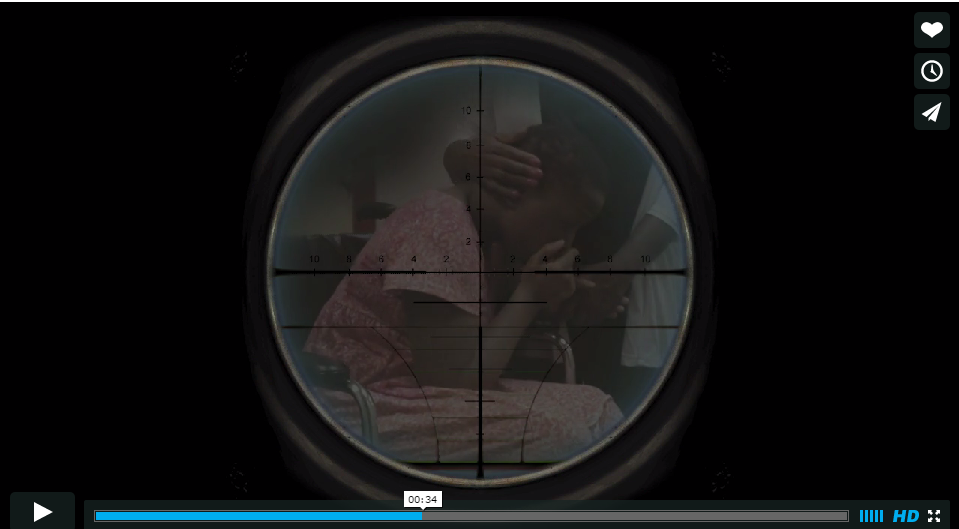
And in case we had any remaining thoughts that this was a documentary, enter the image of a house as seen through a sniper scope.  As the sniper scope zooms in we see that the target is an African American in a wheel chair.

feast sniper

Perhaps this is some sort of allusion to Mr. Wakefield’s first video, the Hitler/Pol Pot/Stalin video where he claimed that the CDC was engaging in a new Tuskegee experiment.   If so, why is the image of an African American female? I ask because the alleged controversy Mr. Wakefield is trying to highlight was about African American males.

The video ends with footage of parents telling us that vaccines cause autism and an actor (presumably representing the “whistleblower”) walking up some stairs.  Finally, Congressman Darrell Issa is shown banging a gavel at a congressional hearing.  From the start of these events, Mr. Wakefield and Mr. Hooker and their team have been calling for a congressional hearing.  I do hope they sent this video (and the Hitler/Pol Pot/Stalin video) to Mr. Issa’s office.  I have a feeling that since the time that Mr. Issa accepted $40,000 in donations from people seeking a congressional hearing, he’s learned a great deal and this video will further his education.

The sad part of this is the exploitative use of autistic children seen under severe distress.  This exploitation does nothing to serve the very real needs of our community.  Also seen towards the end are images of Avonte Oquendo, who went missing from his school and was found dead months later.  Again, exploitation which does nothing to serve our communities.  Mr. Wakefield is grabbing whatever film clips he can whether they are related or not to his purported story.  This is the same trick he used with a previous trailer he produced, where he spliced video from the Judge Rotenberg Center into a completely different story.

If Mr. Wakefield weren’t doing so much damage to my community, his videos would be laughably bad.  I’m not laughing.

By Matt Carey

Andrew Wakefield wants another appeal

20 Nov

Andrew Wakefield, the ex academic gastroenterologist who as much as anyone has promoted the failed autism/MMR link, has asked for an extension to file a petition for review.

To briefly summarize the events:
1) the BMJ and Brian Deer wrote a series of articles on Mr. Wakefield’s research.
2) Mr. Wakefield took issue with being called a fraud.
3) Mr. Wakefield filed suit in Texas claiming defamation
4) Mr. Wakefield was found to not have the standing to bring his case in Texas.
5) Mr. Wakefield appealed (4) and lost

Apparently, Mr. Wakefield needs to find yet another attorney to help with continuing his case.

As for my view:

What a pathetic waste of time. Mr. Wakefield has more gifts that my kid will likely ever understand and he’s thrown it all down the tubes. It’s difficult to not scream–just do something with your remaining years. You, Mr. Wakefield, are the reason why your accomplishments to date amount to nothing. Rather than throw your (or whoever’s) money down this rat hole of litigation, why not apply yourself to anything that will actually affect change in this world. You don’t have to change the whole world, just do something, anything, to justify all the skills you have and the resources that have been spent on you.

Clearly you didn’t excel at research. Nor writing. Nor film making. Nor autism advocacy. Perhaps a new career? It may not be as lucrative as getting my community to support you, but perhaps you could regain your self respect.


By Matt Carey

IACC Presentation by Lisa Croen: Psychiatric and Medical Conditions Among Adults with ASD

20 Nov

The last meeting of the previous Interagency Autism Coordinating Committee (IACC) was a workshop on under recognized co-occurring conditions in ASD. One of the speakers was Lisa Croen of Kaiser Permanente. She spoke about psychiatric and medical conditions among adults with ASD. Much of this work (and more) was presented as a webinar at SFARI. This work was also presented at IMFAR.

If you can find the time to watch the video (it’s 17 minutes long), it’s well worth it. This is the sort of work we just haven’t seen before now–a look at medical needs of autistic adults. If you don’t have that time, here are a few highlights.

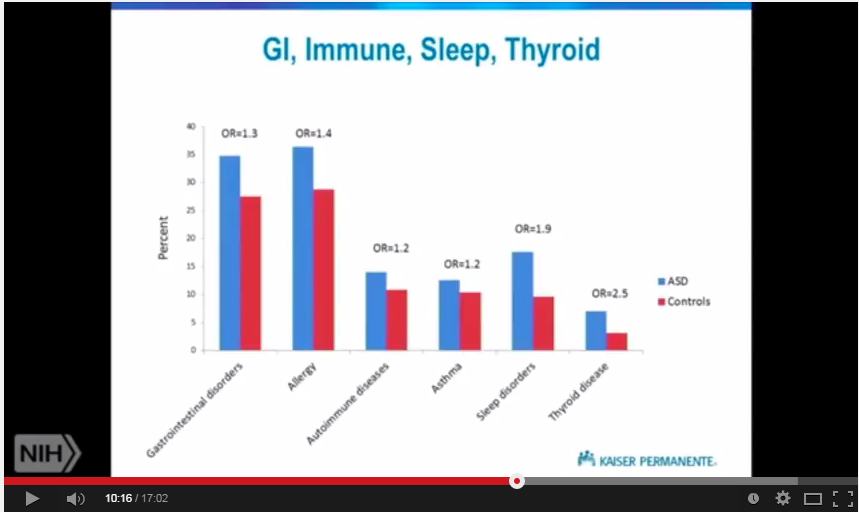
First consider the sort of medical conditions that get a lot of attention in the pediatric population: Sleep, GI and immune. For the pediatric population, one can watch the presentation by the Lewin group that was also given at the IACC workshop: IACC Co-occurring conditions workshop: Lewin Group presentation on co-occurring conditions in autistic children in the U.S..

In adults, GI, sleep and immune conditions are found more often in the autistic population than in the general population. Moderately more often. Interestingly, thyroid conditions are 2.5 times more common (compare this to GI disorders, which are 1.3 times more common).

croen 3

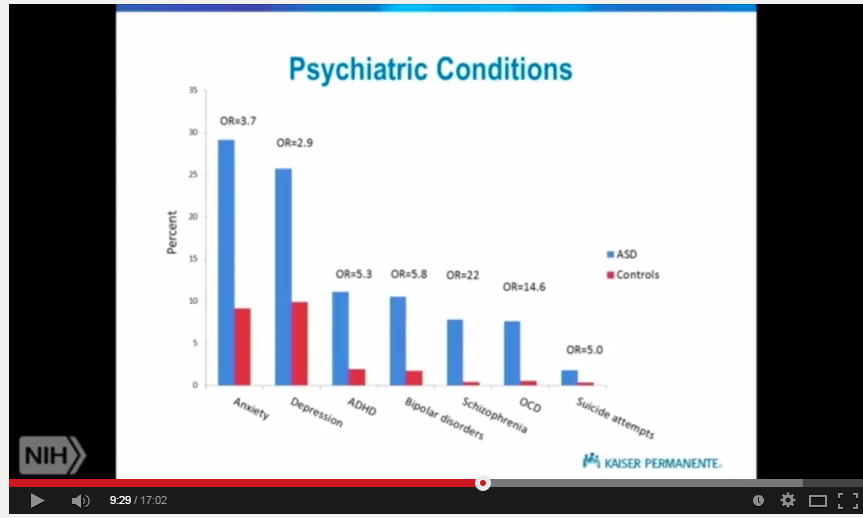
By contrast, psychiatric conditions like anxiety, depression and suicide attempts are even more common in the autistic population. Schizophrenia is 22 times more common.

croen 1

Neurologic conditions are also more common in the autistic population. Parkinson’s is 32 times more common in autistics. Dementia is 4.4 times more common.

croen 2

This is the sort of work I’ve been calling for since even before I was appointed to the IACC. The autism parent community and the research community spends a lot of time talking about learning about kids and getting tools into the hands of pediatricians. But what about adults? We know that epilepsy often has an onset about puberty for autistic kids. We know that for another developmental disability, Down Syndrome, early onset dementia is relatively common. But what is going on right now with adults? What is do we, parents and autistics, have to plan around for the future?

If I recall correctly, the last comment I made as a member of the IACC had to do with this study.

Those are exactly the kind of things that frankly scare the heck out of me and I would like to know more about. And know there’s something on the horizon I need to know about and if there is a way to intervene with adults.


By Matt Carey

The Center for Personal Rights, another charity with rather high salary/revenue

19 Nov

Odds are you haven’t heard of the Center for Personal Rights. It’s a small organization recently formed to promote “vaccine choice”. If you’ve heard of the book Vaccine Epidemic, that’s their work. And, yes, a big piece of the “vaccine choice” movement involves promoting the failed “vaccines-caused-an-autism-epidemic” idea.

Tax forms are now available for the first three years of the Center for Personal Rights (2010, 2011 and 2012). The records show that they’ve pulled in a respectable $165,000 in that time, and revenues were up each year. By far the majority of revenue is from contributions/gifts/grants and not from sales of their book. Here are those tax forms

Center for Personal rights 2010 form 990

Center for Personal rights 2011 form 990

Center for Personal rights 2012 form 990

Let’s take a look at how much of the money taken in has gone to salaries of the board members. Well, board member, as it appears that the executive director, Louise Kuo Habakis, is the only one on the board being paid. Here are revenue and compensation:

2010:
Total Revenue: $42,072
executive compensation: $0

2011:
Total Revenue: $53,300
Executive compensation: $33,065

i.e. 62% of revenue went to board member compensation.

2012:
Total Revenue: $69,823
Executive Compensation: $74,355

i.e. 106% of revenue went to board member compensation.

Total for three years?
Revenue: $165,195
Board member compensation: $107,420

Or, 65% of revenue went to compensation of Ms. Hubakis. It’s a rather modest salary, but a large fraction of the revenue.

What else has the Center for Personal Rights accomplished?

Well, they held a rally ($23,788 in 2010)

They produced the book, Vaccine Epidemic, for which they list expenses of
$556 in 2010
$15,182 in 2011
$28,132 in 2012

So, that’s about $43k to produce the book. Much of that expense appears to be Ms. Hubakis’ compensation.

Here’s their list of program expenses for 2012.

Center for personal rights 2012 program expenses

From what I can tell, they took their total expenses for the year, including Ms. Hubakis’ compensation, and divided it by three and put that amount into each category. Hence my statement above that much of the expenses attributed to the book appear to be her compensation.

Their end of the year balances (net assets) have been declining:
$22,625 in 2010
$19,361 in 2011
-$1,220 in 2012

One might think they are on the way out. They would need a large infusion of cash to stay afloat. They still have a web presence and, well, Ms. Hubakis is a board member of Barry Segal’s “Focus Autism”. Mr. Segal and Focus Autism have distributed a significant amount of money to vaccine-antagonistic groups in recent years. And there are other wealthy people who contribute to such causes. So I wouldn’t count the Center for Personal Rights out just yet.


By Matt Carey

Thinking Person’s Guide to Autism: How ASAN Helped Issy Stapleton Get Justice

18 Nov

Isabelle (Issy) Stapleton is an autistic teenager. Her mother, Kelli, was recently sentenced in the attempted murder of Isabelle. The Thinking Person’s Guide to Autism has an interview with Autistic Self Advocacy Network’s Samantha Crane on How ASAN Helped Issy Stapleton Get Justice.

Here’s the TPGA introduction to the article:

Kelli Stapleton was recently sentenced to 10 to 22 years in prison for child abuse, after attempting to kill her autistic teen daughter Issy. We spoke with lawyer Samantha Crane, who is the Autistic Self-Advocacy Network’s Director of Public Policy, about ASAN’s efforts on the Stapleton case: both in helping the prosecution send the message that disability does not justify murder, and in urging the court to ensure Issy saw the same justice as any other victim of felony child abuse.

The full interview can be read at How ASAN Helped Issy Stapleton Get Justice


By Matt Carey

Autism and wandering, another story in the news

18 Nov

A news story from my old home town (as much as the LA area can be considered a “town”) brings up an important point: many of the issues that get advocate attention are not limited to children. Case in point: Police ask for help finding missing Redondo Beach man with autism.

A 61-year-old man suffering from autism was missing from the south Redondo Beach area, poilice said.

Yong Boo Keum was last seen in the south Redondo Beach about 10:30 a.m. Saturday. He went out for a walk and did not return home, according to a news statement from the Redondo Beach Police Department.

Keum has limited Korean and English language skills, and was described as a 5-foot, 1-inch tall Asian male with short black hair, brown eyes and weighing 95 to 100 pounds, according to the news statement.

He was last seen wearing a gray “LA” baseball cap, a navy blue windbreaker with “POLO” displayed on the front in white lettering, dark-colored jeans and possibly a gold-colored watch, according to the statement.

Police asked anyone with information regarding Keum’s whereabouts to call the Redondo Beach Police Department at (310) 379-5411.


By Matt Carey