Autism risk not increased by “Too Many Too Soon”

29 Mar

The idea that vaccines are a primary cause of autism has been around for some time. The idea took off in the 1990’s when Andrew Wakefield claimed that the MMR was causing autism, including suggesting that not only was MMR causing autism but was responsible for the rise in diagnoses observed. Later, the idea that the increase in thimerosal exposure in the pediatric vaccine schedule of the 1990’s in the US was proposed by some groups as causing the increase in diagnoses. Both ideas have since been shown to be invalid. As the evidence mounted that the idea that thimerosal and/or MMR caused an autism epidemic was false, the idea that the increase in vaccines themselves was causing autism. This idea was popularized by Jenny McCarthy of Generation Rescue in the slogan “too many too soon”.

The study is in the journal Pediatrics (full version available free): Increasing Exposure to Antibody-Stimulating Proteins and Polysaccharides
in Vaccines Is Not Associated with Risk of Autism
.

The abstract:

Objective To evaluate the association between autism and the level of immunologic stimulation received from vaccines administered during the first 2 years of life.

Study design We analyzed data from a case-control study conducted in 3 managed care organizations (MCOs) of 256 children with autism spectrum disorder (ASD) and 752 control children matched on birth year, sex, and MCO. In addition to the broader category of ASD, we also evaluated autistic disorder and ASD with regression. ASD diagnoses were validated through standardized in-person evaluations. Exposure to total antibody-stimulating proteins and polysaccharides from vaccines was determined by summing the antigen content of each vaccine received, as obtained from immunization registries and medical records. Potential confounding factors were ascertained from parent interviews and medical charts. Conditional logistic regression was used to assess associations between ASD outcomes and exposure to antigens in selected time periods.

Results The aOR (95% CI) of ASD associated with each 25-unit increase in total antigen exposure was 0.999 (0.994-1.003) for cumulative exposure to age 3 months, 0.999 (0.997-1.001) for cumulative exposure to age 7 months, and 0.999 (0.998-1.001) for cumulative exposure to age 2 years. Similarly, no increased risk was found for autistic disorder or ASD with regression.

Conclusion In this study of MCO members, increasing exposure to antibody-stimulating proteins and polysaccharides
in vaccines during the first 2 years of life was not related to the risk of developing an ASD.

The study included autism with regression.

Of the 321 potential case children who participated in standardized assessments, 256 (79.8%) met study criteria for ASD. Among these 256 children, 187 (73%) met the stricter criteria for AD and 49 (19%) met the criteria for ASD with regression.

The authors begin the discussion section with:

We found no evidence indicating an association between exposure to antibody-stimulating proteins and polysaccharides contained in vaccines during the first 2 years of life and the risk of acquiring ASD, AD, or ASD with regression. We also detected no associations when exposures were evaluated as cumulative exposure from birth to 3 months, from birth to 7 months, or from birth to 2 years, or as maximum exposure on a single day during those 3 time periods. These results indicate that parental concerns that their children are receiving too many vaccines in the first 2 years of life or too many vaccines at a single doctor visit are not supported in terms of an increased risk of autism.

Are there limitations to this study? Sure. Enough to discount it or disregard it? No. Will some people discount it and disregard it? Yes.

Thimerosal doesn’t increase autism risk. MMR doesn’t increase autism risk. Number of antigens in vaccines doesn’t increase autism risk. There is limited researcher time and money in this world. It is good that we are applying those resources to other areas of autism etiology.

The CDC discusses this at Vaccines not associated with risk of autism. Shot of Prevention discusses this in Study Concludes Concern Over “Too Many, Too Soon” is Unfounded.


By Matt Carey

Autism Rate 2%, what now?

25 Mar

Autism prevalence data are always news makers. Although, maybe it’s just me, but the announcement of a new autism prevalence estimate for the U.S. didn’t seem to be as big a news story as previous reports. That said, so much of the discussion around prevalence estimates centers on “what does this tell us about the past” or “what about the future”.

“What does this tell us about the past” is the discussion around “was there/is there an epidemic (usually with an explicit or implicit reference to vaccines)”. “What about the future” is usually a discussion focused on the economic burden and what happens in we project the trends out to the future.

But what about right now? We have roughly 2% of our school age children in the U.S. who are autistic. Disabled to various degrees. Probably a like number of adults as well. For those who don’t accept this notion, keep in mind that one of the major themes of the recent report was how a large fraction of autistics were identified late. They had fallen through the cracks and were possibly not receiving the supports they needed. We are talking teenagers, not just young children. It isn’t that great a leap to say that we there is a large population of unidentified autistic adults.

Most news stories and most discussion will focus on one number: 2%. I would argue, and will argue, that a factor of at least equal importance is not how many autistics there are, but how diverse this population is and how little is really known.

There is no biological test for autism. As this study and many others have shown, the understanding of what autism is, even behaviorally, is still evolving. And this is important whether you take a medical model of autism or a disability model or some combination of the two.

We (a society of autistic and non-autistic people) need to give autistics the tools and supports needed to succeed in this world, with various definitions of success. And we can’t do that if we don’t understand what is needed. 2% is a number that can grab people’s attention. And that includes politicians. But to me, the bigger issue is the breadth of the spectrum. The diversity of the autistic population. Consider the report again. There are so many ways to look at the data, but let me pick some facts to highlight. The prevalence estimate for 10-13 year olds was about 2.4%. Of this, roughly half fall into the so-called “mild” autism category. Only 5% of parents placed their child into the “severe” category. Of course, there is no real definition of mild, moderate, or severe to use for this, and parents might be biased to report milder needs, but let’s go with the structure we are given. But, in the end, 1%, 5%, 95%, is less important than the fact that there are subpopulations of autistics which needs a very different support structure than others.

Many people discussing the new prevalence values focus on the need to have the money to provide supports (be it in the home, the school or the workplace, medical or non-medical) for a wide variety of autistics. But in order to do that, we have to know what supports and tools are needed. I know this is getting repetitive, but no amount of money can give autistics, parents, teachers, caregivers and employers the tools needed if we don’t know what the appropriate tools are.

There is a broad spectrum of autism, and a broad spectrum of ages. Perhaps the most overlooked area of autism, be it research or supports and services, are the needs of adults. Many parents tend to categorize autism by IQ, with a linear spectrum with those with lower IQ’s on one side and those with higher IQ’s on the other. Even with this simple model, we have a huge matrix of needs for autistics: with age on one axis, and IQ on another. But the IQ-category idea is too simplistic. Which means, the real matrix of needs we have to understand is multidimensional.

Ask someone outside the community who has a basic understanding of the autism discussion, “what should we do for autistics?” and you are likely to get, “behavioral intervention”. OK, for some fraction of a young population, that may be a good answer. Maybe, one might argue, truly individualized education plans (IEP) will allow parents and teachers to customize supports for the needs of the autistic during school. That’s how it is supposed to work, but this process would be much more efficient if we had better recommendations for autistic students of all ages.

It is worth taking a moment here to point out that here is a point where more money directly into services is needed. Mention special education to a school administer and you are likely to hear “unfunded mandate”, “budget”, and “encroachment”. We in the U.S. have never lived up to our responsibility to support special education as promised from a federal level (federal special education support is less than 1/2 what was promised). And it isn’t like state and local governments are supporting special education to the levels needed.

But that’s just school. What about transition to adulthood? Thank god for people like Paul Shattuck who has been asking these questions, but this study only came out last year. And adulthood and autism has recently been referred to as “the great unknown” in one paper.

And medical issues? These get a lot of discussion, especially in online parent forums. Ask what medical conditions are more common in autistics and you will likely hear, “GI complaints”, “immune dysfunction”, “metabolic dysfunction”. Anyone want to venture a guess as to what are, by far, the most common comorbid conditions to autism in children? Neurological disorders and mental health conditions. Autistics are 25 times more likely to have one or both of these. And what happens in older populations? Another “great unknown”.

So, yes, 2% is big. And it’s important. And it will get people’s attention. But if we don’t know what tools or how to support any given segment of the population, it’s just saying how many people we can’t support.

Of course we need to take autism seriously. It doesn’t matter if 2%, 0.2% or 0.02% of the population are autistic, it is still important. But we need to recognize that there are whole areas of questions we haven’t even asked yet, much less found good answers for. It is hard to package this essage into a sound bite, but the focus needs to be on the breadth of the questions, not just te size of the population.


By Matt Carey

CDC-HRSA report: Changes in Prevalence of Parent-reported Autism Spectrum Disorder in School-aged U.S. Children: 2007 to 2011–2012

20 Mar

A new report came out today: Changes in Prevalence of Parent-reported Autism Spectrum Disorder in School-aged U.S. Children: 2007 to 2011–2012. I’ll come back for more detail and discussion soon, but the bottom line: the autism prevalence estimate for the US is now about 2%. 3.23% for boys.

Here is the press release for this:

CDC and HRSA issue report on changes in prevalence of parent-reported

Autism Spectrum Disorder in school-aged children

Who: CDC’s National Center for Health Statistics and the Health Resources and Services Administration

What: “Changes in Prevalence of Parent-Reported Autism Spectrum Disorder in School-Aged Children: 2007 to 2011-2012.”

The report was co-authored by HRSA and data collection was conducted by the CDC. The data come from the National Survey of Children’s Health, a nationally representative phone survey of households with children. This survey is conducted every four years.

Main findings of the report:

· The prevalence of parent-reported ASD among children aged 6-17 years was 2 percent in 2011-2012 compared to 1.2 percent in 2007.

· The change in prevalence estimates was greatest for boys and for adolescents aged 14 to 17 years.

· Children who were first diagnosed in or after 2008 were more likely to have milder ASD than those diagnosed in or before 2007.

· Much of the increase in the prevalence estimates from 2007 to 2011-2012 for school-aged children was the result of diagnoses of children with previously unrecognized ASD.

The report is available at http://www.cdc.gov/nchs.

For information about HRSA’s autism efforts visit http://mchb.hrsa.gov/programs/autism/index.html.

For information about CDC’s autism efforts visit http://www.cdc.gov/ncbddd/autism/index.html.

As indicated above, there are clearly social factors at play involving identification of individuals previously unidentified. For example: If one looks at the prevalence estimate for 6-9 year olds in 2007, a value of 1.31% was obtained. In 2010-11, the prevalence for children born in the same years (now aged 10-13 years old) is 2.39%. In other words, children born in the years 1998-2001 saw an big increase in the estimated autism prevalence.

For the 2010-11 report, about 1/3 of the children were diagnosed after 2008. These are children 6-17 years old, so they were born in 2005 and before. About 30% of children born in 1998-2001 were diagnosed after 2008. These are children aged 7-13.

And, yes, this means that the thimerosal hypothesis, the notion that the increased exposure to thimerosal from vaccines in the 1990’s cause an autism-epidemic, is even less viable. There are obviously a number of social influences behind the increase in autism prevalence estimates in the U.S.. These could mask a “real” increase (or, interestingly, a real decrease). But had thimerosal been a primary driver of the increased prevalence, the prevalence would be dropping. The prevalence for children 6-9 years old, children born after the phase out of thimerosal, now is estimated at 1.82%.


By Matt Carey

Autistic People Should…get a high five

8 Mar

During the past couple of weeks, a time when my focus has been on old and tired subjects, a small change in the online world happened. Small in the grand scheme of things, but a very good step forward. I’m speaking of the movement to change the way Google handles the phrase “autistic people should” in their auto-complete offerings.

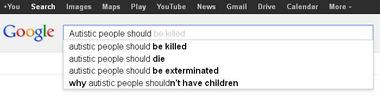
Ever notice how as you enter terms in the search box for Google, it creates suggestions for you? Well, it turns out that sometimes those suggestions are ugly. For example, if you entered “autistic people should” you would get answers like “die” or “be exterminated”.

Autistic self advocates reacted and got Google to respond. Consider this story:

Google eliminates ‘die’ search suggestion for autism

The “auto-complete” function attempts to save time by suggesting the most common searches that match a user’s first few words. In the case of autism, three of the four suggestions could double as bumper-stickers for hate speech.

Sparrow acknowledged the search engine algorithm isn’t the problem; it is, rather, the frequency of the hostile search terms typed in by Google’s users.

They took a screenshot of what the auto-complete used to look like:

12345234-large

I’ll admit that the number 1 answer I get right now is “autistic people should killed”, but the rest are changed and we can hope that as the changes Google puts into place take effect, this will change as well.

It’s a small change, though. We live in a world where many people, apparently, enter “autistic people should be killed” into Google.

Autism Speaks took notice of the story linked above. They had a short teaser on their site, one that didn’t point out the efforts of the autistics who made it happen. And then, after some pressure, “Updated 3/6/13 to reflect the amazing efforts of the self-advocacy community”

Congratulations to those who made this change happen.


By Matt Carey

In the News: John L. Young, a partner of Mark Geier, had his medical license suspended

6 Mar

The Baltimore Sun has an article up: USM regent said to have used controversial therapy for autism, subtitled: John L. Young, a partner of Mark Geier, had his medical license suspended.

USM in the Univiersity System of Maryland. John L. Young was a Regent of USM. And a former business partner for Mark Geier. From the article:

In the order suspending Young’s license, the Board of Physicians concluded he wrote Lupron prescriptions for nine of Geier’s patients, who ranged in age from six to 17 and who all lived outside of Maryland. The board also said in the order that Young, who sometimes used Skype to speak with patients, broke restrictions against prescribing medicine for people who live outside of the state.

Young’s actions “constitute a substantial likelihood of risk of serious harm to the public health, welfare and safety,” the board wrote in the suspension order. The board did not say Young used chelation therapy.

If I interpret this correctly, after his license was supsended, Mark Geier was using his partner to continue the Lupron perscriptions.

Geier’s theory was that autism was the result of high levels of mercury from vaccinations and that too much testosterone exacerbates the symptoms, hence the use of both Lupron and chelation therapy. Geier diagnosed the children with early-onset puberty, usually a rare diagnosis, and used Lupron to control their hormone development.

I note that the patients range in age from 6 to 17. 17’s a bit old for “precocious puberty”.

Mr. Young was to serve as a regent until 2014. He is not presently on the website for the board of regents.

It appears that the Maryland medical board is recognizing that prescribing Lupron itself as an autism treatment is worthy of censure.


By Matt Carey

Lobbying, donations and the Congressional Autism Hearing

5 Mar

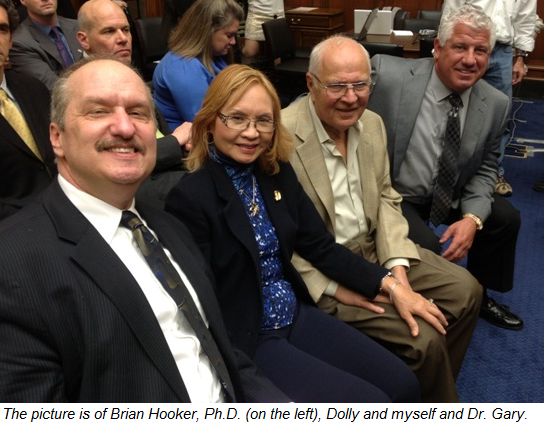
Last year the U. S. Congressional Committee on Government Oversight and Reform held a hearing on the government’s response to the rise in autism diagnoses. One of the people at the hearing, photographed with the Focus Autism team, is “Dr. Gary”. “Dr. Gary” appears to be Gary Kompothecras, a Florida chiropractor whose chain of offices reportedly doing $70M in business annually. Kompothecras is also the parent of two autistic children and strong proponent of the idea that vaccines are responsible for the rise in autism diagnoses. Both children were petitioners to the vaccine court for autism as a vaccine injury. (Both cases were denied due to failure to prosecute. This example was under appeal during the events laid out below.)

Mr. Kompothecras has already been linked to the effort to initiate the hearing, however this from a far from reliable source. If you aren’t familiar with this gentleman, feel free to peruse his website (the link is to google cache).

Taking that source as highly questionable, consider this. He claims “Dr Gary is very influential with the Republican Party and is friends with two US Congressmen – Buchanan and Posey.

I won’t speak to “friends” or “very influential”, but I will point out that members of Congress Posey and Buchanan have received campaign donations from Mr. Kompothecras over the past few years. Here are donations from Mr. Kompothecras and Beth Kompothecras made to support Posey and Buchanan in 2008.

The unreliable source claims that Gary Kompothecras and Andrew Wakefield met with members of Congress Posey, Buchanan and Issa on May 1st. Essentially, he met with the two members with whom he had a past relationship plus the chair of the committee who was to hold the proposed hearing.

As an aside: I realize that Mr. Wakefield can spin a good yarn, good enough to take in even members of congress, who are rather too busy to check on his claims and credentials, but members of congress have health care legislative aides who should be able to offer advice on the fact that this man has been found guilty of unethical behavior and his research is, at best, fatally flawed.

That said, keep in mind that given the Kompothecras family’s support for Posey and Buchanan in the past, it isn’t surprising that they donated again in 2012. That doesn’t mean the timing is not interesting. The “Friends of Bill Posey” received donations on May 2nd (Mrs Kompothecras ) and Vern Buchanan for Congress on May 4th (Mrs. Kompothecras) and again on June 30th.

If you followed the links above, you may have noticed that the Kompothecras family also made donations to Darryl Issa, on May 14th. Congressman Issa, of course, is the chair of the committee which held the hearing. These appear to be the first donations to Mr. Issa from the Kompothecras family. Per our unreliable source, congressman Issa committed to hold hearings on May 18th, 4 days later.

Now there is nothing wrong with making political contributions. And if you look at Mr. Issa’s PAC, it is clear that he gets donations from around the country. It is also disingenuous to claim some shock that a congressional hearing involved lobbying and that donations were made in the same time frame. All three of these members of congress are honorable people. These details are, however, ones that the public has a right to know, hence the transparency laws which allowed me to find the donations.

It is worth noting that Mr. Wakefield obviously has a major personal and financial stake in seeing the vaccine discussion become publicly viable again. A factor I hope the members of congress weighed. It is also worth noting that Mr. Wakefield’s ideas on autism causation are flawed and that he was sanctioned for ethical lapses. Another factor I hope was weighed. If our unreliable source is accurate in revealing that Andrew Wakefield met with the members of Congress, I again ask, why would members of congress listen to him seriously? Frankly, if someone is lobbying congress and brings out someone with Mr. Wakefield’s history, I would be strongly disinclined to favor whatever position they brought forward.

I first heard of Mr. Kompothecras when a story came out (Crist backer Gary Kompothecras bullies Florida health officials) where Mr. Kompothecras was described as attempting to “bully” Florida’s health officials into allowing Mark and David Geier (yes, the Geiers) access to immunization records. Per the Miami New Times:

So it’s bound to turn heads when the man known to occasionally lend his private jet to the governor uses his political clout to try to bully Florida health officials into turning over scores of the state’s sealed immunization records. Especially when they’re for a father-son team, Dr. Mark and David Geier, infamous for injecting autistic children with Lupron, a drug used to chemically castrate prostate cancer patients and pedophiles.

For those unfamiliar with the Geiers, here’s the link again. It leads to the neurodiversity.com website where Kathleen Seidel’s investigations of the Geiers are laid out. Their work has been termed “uninterpretable” by the IOM and “intellectually dishonest” by the special masters of the vaccine court, to pick two out of many critiques. When they previously were given access to a different set of immunization records, they had their access cut after attempting to go beyond the approved study, including increasing the risk of breaching confidentiality.

For anyone wondering, I don’t think anything of the sort of improprieties in the Kompothecras/Crist news article are at play with the congressional hearing. I do think it is important to remind ourselves of past activities of Mr. Kompothecras to understand his approach to politics.

Having read a few “six degrees of separation” type articles online in the autism/vaccine discussion, and the reliance on one of the least reliable sources on the internet for some details, I’d be cautious about making too much out of this. But as far as details go, they are on one level rather interesting in adding to the stories which are online about how the hearings came to be. On the other hand, “wealthy person gains access to government officials and makes political donations” is rather a “dog bites man” story, isn’t it?


By Matt Carey

Was Mark Roithmayr pushed out of Autism Speaks over vaccines?

1 Mar

Last June Autism Speaks suddenly announced that their president, Mark Roithmayr, was leaving and being replaced by Liz Feld. (Mr. Roithmayr is now Chief Development Officer at the Leukemia & Lymphoma Society) There was little information about why Mr. Roithmayr left. The suddenness and the lack of information given out for the departure of an executive pointed to there being much more going on behind the scenes. Things going on which Autism Speaks would prefer did not become public.

In reading up on the group Focus Autism, I found a past webpage of emails from the founder, Barry Segal. One of those is copied below:

Barry Segal’s email to Bob Wright June 21, 2012

Bob,

Good work on Mark. On June 1st, I sent an email to you as well as Peter Bell that stated, “I feel Mark Roithmayr is not an asset to Autism Speaks.” In three weeks he was gone. You acted faster than Warren Buffet. When I wrote him that his top three men at JM knew nothing about roofing, it took him 90 days to replace them.

Here’s the problem. The gist of it is that the government was not going to do the necessary environmental and vaccine research due to political restrictions of public money, but that did not mean that private sector organizations, like Autism Speaks, had to follow those restrictions, per Kevin Barry.

It doesn’t matter whether you have Liz Feld, Donald Trump or Alex Rodriguez on the board. Unless Bernie relents and lets Autism Speaks go after the vaccine involvement, nothing will be gained.

Barry

It appears clear to me from this email that Mr. Roithmayr was pushed out. If we take the email above at face value, Barry Segal (a large donor to Autism Speaks) wrote to Bob Wright (Founder of Autism Speaks) and Peter Bell (executive vice president for Autism Speaks), pushing for Mr. Roitmayr’s ouster. Mr. Segal has elsewhere indicated that both Bob Wright and Peter Bell want more work done on vaccines and autism.

Given the next two paragraphs of the email, it appears that Mr. Segal’s complaint about Mr. Roithmayr was, indeed, his stance on vaccines:

It doesn’t matter whether you have Liz Feld, Donald Trump or Alex Rodriguez on the board. Unless Bernie relents and lets Autism Speaks go after the vaccine involvement, nothing will be gained.

I read this to say that while pushing Mr. Roithmayr out was a step forward (in Mr. Segal’s view), that Bernie (I assume Marcus, of the Marcus Autism Center and Autism Speaks) is still in the way of the wish to push Autism Speaks further into pursuing vaccines.

Kevin Barry, on the other hand, is a former president of Generation Rescue (an organization which especially then was very vocal about vaccine causation) who went to work as a consultant for Autism Speaks in 2006. While at Autism Speaks, Mr. Barry was apparently using others to post his messages to discussion boards. In this case, a call was sent out on the “Evidence of Harm” board for people to give input to Autism Speaks on the “epimdemic ‘debate’ “:

Hi Heidi, Confidential. I am not allowed to comment on the Boards. Would you post this to the EOH board as if you can upon it yourself? It is a page where people can comment on the epidemic “debate”. It would not hurt if Autism Speaks heard more feedback from EOH parents. Thanks, Kevin

In 2009 Autism Speaks lost Eric London (founder of NAAR and member of the Autism Speaks Scientific Affairs Committee) largely due to difference over vaccines. Earlier in 2009, Autism Speaks’ executive vice president of communications and awareness, Alison Tepper Singer, resigned prior to an IACC meeting in which a vote was to take place on vaccine related research. “Knowing she might cast a vote with which Autism Speaks might disagree, she resigned from Autism Speaks prior to the meeting.” In the press release following her departure, Ms. Singer wrote:

“However, for some time I have had concerns about Autism Speaks’ policy on vaccine research. Dozens of credible scientific studies have exonerated vaccines as a cause of autism. I believe we must devote limited funding to more promising areas of autism research.”

The same day, Autism Speaks published a press release, Autism Speaks Withdraws Support for Strategic Plan for Autism Research, Decries Unexpected Change in Final Approval Process. Yes, Autism Speaks pulled it’s support for the Strategic Plan because it didn’t include vaccines. The press release included this statement from Bob Wright:

“We are angered and disappointed by this last-minute deviation in the painstaking process of approving the Strategic Plan. Members of the autism community have worked tirelessly during the last two years to develop a plan that would set the stage for significant progress and discoveries for autism research over the next five years,” said Bob Wright, co-founder of Autism Speaks. “In a matter of minutes, the Federal Members of the IACC destroyed much of the good will that had been established during the course of this process. Because of this surprise tactic, we now have a plan that is tainted and cannot be supported by the autism community.”

It appears that even though Autism Speaks has not made such strong statements about vaccine causation in the past few years, the sentiments remain strong within the organization. Strong enough apparently to push the president out.

If it is true that Mr. Roithmayr was pushed out over vaccines, this would mean that the fears of many are validated: that Autism Speaks has a public face adhering to the science of today, while inside they still have a strong faction, including the founders and executives, pushing for a focus on vaccines. And that there is no room for someone with an opposing view.


By Matt Carey

Is there a split in the autism-vaccine groups?

1 Mar

For people who watch the public discussion of autism and vaccines, organizations like Generation Rescue, SafeMinds, the National Autism Association and TACA (and others) come to mind. One less public organization is Focus Autism. Focus Autism is a private foundation. In other words, they don’t accept donations from people outside the foundation. Here are tax forms submitted by Focus Autism in 2010 and 2011:

2010 tax form 990
2011 tax form 990

In 2011, Focus Autism pulled in $1.7M, which makes it as big or bigger than most of the other groups named above. If you peruse their website, it is clear that they have promote the vaccine-epidemic idea. Their “about” statement is:

FOCUS AUTISM is dedicated to finding answers about autism causation, no matter how inconvenient it might be. We believe in accountability, transparency and above all, a sense of urgency.

Childhood vaccine policies must be carefully administered. We demand strict avoidance of neonatal vaccination and vaccination of vulnerable children.

We must hold leaders of government, corporations, and the medical establishment accountable for failures that have led to the autism epidemic.

Leaders in the field agree there is a subset of vulnerable children who are predisposed to vaccine-related injury. We want those children identified, so that we do not needlessly harm innocent children.

Millions of dollars have been funnelled into genetic research in a frantic search for the single gene or a small number of genes responsible for the autism epidemic. Emerging consensus rejects a purely genetic cause. Most experts now agree that the primary causes must be a combination of genetic and environmental factors.

They have funded a mix of projects and groups. In 2010, most projects were not vaccine-focused. In 2011 they funded: Autism Speaks ($51,000), the Marcus Autism Center ($50,000), projects in Africa and many other non-vaccine focused projects. In 2011, Focus Autism funded vaccine-oriented groups such as the National Vaccine Information Center ($37,500), SafeMinds ($70,000), Generation Rescue ($40,000).

In 2011, Focus Autism added to its board Louise Kuo Habakis and Katie Wright, both vocal proponents of the vaccine-causation idea. The board currently includes Brian Hooker, who is also a vocal proponent of the idea. There has been some discussion lately about Mr. Hooker’s involvement with the autism hearing held by the Committee on Government Oversight and Reform last year. The idea being presented that Mr. Hooker, lone citizen, made contact with members of congress and got the hearing moving.

Consider that Focus Autism was founded and is apparently run by Barry Segal. Mr. Segal’s family foundation has over $50M in assets, and seems to be doing a great deal of good work, especially in sub-saharan Africa. Mr. Segal’s company sold for an undisclosed amount, but had sales of $1.7B (yes B) in 2006.

Here is a picture from Facebook showing Mr. Hooker in the audience of the congressional hearing from Focus Autism’s facebook page. Sitting next to him is Mr. Segal’s wife, then Mr. Segal.
Hooker-Segal 2

I consider it possible he had a bit more support in his efforts than, say, I might have.

Focus Autism includes in its list of partners: Age of Autism, EBCALA, the National Vaccine Information Center, the Canary Party and the Dwoskin Family Foundation. All groups promoting the idea that vaccines cause autism.

As to the split mentioned in the title of this article, consider this short blog post on the Focus Autism website: The Fragmented Autism Community:

The so called autism community is represented by:

#1 Autism Speaks, which because of Bernie-Julie thing refuses to meaningfully go after environmental issues, especially vaccines.

#2 Safe Minds, another disaster and I don’t know (or care) what their agenda is.

The rest of the community is fragmented, acts like our congress, accomplishes nothing and has an approval rating similar to congress. In both cases we need to change.

“Bernie” is most likely Bernie Marcus, co-founder of Home Depot and founder of the Marcus Autism Center. I’m not sure who “Julie” refers to. SafeMinds, well that reference is clear. It is also interesting in that Focus Autism donated money to both the Marcus Autism Center and SafeMinds in 2011. Somewhere in the past couple of years, there seems to have been a falling out.

Given some of the current discussion about the way the congressional hearing was put together, specifically Mr. Hooker’s and SafeMinds’ roles (see here, here and here), it is interesting to see the organization he works with taking such a harsh stance on SafeMinds.

The name Barry Segal was familiar to me, and it took me a few days to recall where I saw it before. It was on a discussion at the Forbes website. I usually avoid bringing discussions held on other sites to this blog, but I think these statements show the possibility of further rifts, both between autism organizations and within organizations. Here are the statements made by Mr. Segal (or someone using his name, but I have no reason otherwise) at Forbes:

First this one (actually two, it was repeated):

I guess you are aware that in 1960, 3 years before the measles shot, 100 people died of measles. In 2012 over 80,000 of the babies born that year will end up on the spectrum. Bob Wright knows certain children are vulnerable to vaccines but Bernie Marcus won’t let him go there. Do you really give your child or grandchildren a Hep b shot at birth, or do you have them practice safe sex till they are 6 years old. (That is when the shot wears off)

Indicating his opinion that Bob Wright (founder of Autism Speaks) wants more vaccine research but that Bernie Marcus (Marcus Autism Center and Autism Speaks) is blocking it.

Mr. Segal went on:

I won’t discuss Hepatitis B with you except that the following five countries, Denmark, Sweden, France, Germany and Japan only give the Hepatitis B vaccination to children whose mothers test positive.

As far as Bob Wright, I have met with him and he shared with me, the following thoughts:
1.That there needs to be more vaccine research
2.That there should be no more thimerosal in any vaccines or medicines

I had dinner with Bernie Marcus in Florida. Towards dessert, I mentioned what Bob Wright had said and he told me, “There is no thimerosal in this country today,” to which I replied, “ You’ve got to be kidding me, you can go to your local drug store and get a shot of thimerosal in your flu injection.” He is clueless and after starting the Marcus Autism Center and hearing Bob Wright had an autistic grandchild, he reached out to Bob Wright to form Autism Speaks with the intent that they do not address the vaccine issue. Peter Bell and Holly Peete both have vaccine injured children and will not vaccinate their subsequent children as mandated.

And this:

I had breakfast with Peter Bell on 12/8/11. He explained to me that the increase in the vaccinations alters the immune system. When he lived in CA, he didn’t have to vaccinate his children (philosophical exemption is available in CA) but when he came to NJ, he slowed it down as much as possible. Peter suggested Tylenol could be part of the problem.

Rodney Peete said in his book, “NOT MY BOY!” co-authored by Danelle Morton:

“At home that night, R.J. had a terrible fever and started shaking violently, just short of something like a seizure. Holly called the pediatrician to ask him what could have caused this. Should we take R.J. to the hospital? The doctor was unruffled and told us it was not a reaction to the shots. He recommended that we give R.J. some Tylenol to help him with the fever and he promised that R.J. would be fine. R.J. had a terrible reaction to the Tylenol and we rushed him to the emergency room late that night. We believe he went into some kind of toxic overload shock. After that, we didn’t hear the words “Mommy” or “No” for about four years.”

As far as vaccine safety, the problem is much more than just thimerosol. Today, the autism incidence rate is 1 in 88 and this is for children born in 2000. If we apply a more conservative 8% growth rate to this rate, we’re looking at over 80,000 children born this year being on the spectrum!

In these two suggesting that Peter Bell (Autism Speaks), Holly Robinson Peete and her husband Rodney Peete (HollyRod foundation, Autism Speaks) are also proponents of the vaccine-causation idea.

All this again indicating tensions between and within autism orgs over the topic.

For anyone who thinks the vaccine-autism-epidemic idea is going away from the public discouse any time soon, keep in mind that this is not a grass roots movement. There are millions of dollars being spent by these groups every year. Much of it from wealthy donors.

Mr. Segal had some very interesting things to say about the departure from Autism Speaks of their previous president. That is discussed in Was Mark Roithmayr pushed out of Autism Speaks over vaccines?


By Matt Carey

New York to pull students from the Judge Rotenberg Center?

27 Feb

The press release below was just forwarded to me. New York City Councilmember Vincent Gentile is calling for students from the city (roughly 1/2 of the total) at the Judge Rotenberg Center (JRC) to be pulled from the school.

The JRC is facing other pressures, including losing medicaid funding for students in their care.

GENTILE CALLS ON CHANCELLOR TO REMOVE ALL NYC CHILDREN FROM CONTROVERSIAL SCHOOL ONCE AND FOR ALLCITY HALL – In light of recent developments, Councilman Vincent J. Gentile, a long-time advocate for New York’s most vulnerable, is calling on New York City Department of Education Chancellor Dennis M. Walcott to remove all New York children from the infamous Judge Rotenberg Center in Canton, Massachusetts once and for all. The Centers for Medicare & Medicaid Services (CMS) sent a letter to the Massachusetts Executive Office of Health and Human Services saying it would no longer allow federal Medicaid money to be used by anyone who lives at a facility that employs electric shock intervention, even if that person is not receiving the treatment themselves. Massachusetts has begun notifying the families of its students that they must either move to a new facility or unenroll from state benefits immediately.

“CMS made the right decision – no federal tax dollars should be going to an institution that uses these electric shock techniques on children. It’s time New York State and New York City to do the same – no city or state money should go to support an institution which subjects its students to these cruel and unusual forms of ‘behavior modification’. The Rotenberg Center in Massachusetts where 120 NYC developmentally disabled students currently attend, is in gross violation of the most fundamental standards of humane treatment of people with disabilities”, Councilman Gentile said. “With CMS pulling its funding, we are one step closer to shutting down Rotenberg once and for all.” As a New York State Senator, Councilman Gentile introduced legislation to mandate oversight and accountability when developmentally disabled students are sent out-of-state for education and treatment. Then, in late 2009, Councilman Gentile sponsored “Billy’s Law” which requires the Department of Education to provide the City Council with bi-annual reports monitoring all out-of-state residential facilities that house New York State children for specialized educational services – both pieces of legislation passed unanimously. “It is a sad fact that our City still sends children to this Center, and sadder still that it is our tax-payer dollars that fund about half of the children at this school,” Gentile wrote in a letter to Chancellor Walcott. “I know that with your leadership, we can finally remove our children from this barbaric facility. I am asking that you immediately develop a plan, if one does not already exist, to bring these students home and that you share it with my office and the New York City Council.” New York City Education officials have paid more than $13 million last year to treat 120 city kids at Judge Rotenberg Educational Center outside Boston, which until now was the only clinic in the country that uses electric shock treatments to discipline students.


By Matt Carey

California Special Education autism counts, ages 3-5 over the past decade

27 Feb

The California Department of Developmental Services data, once called “the gold standard” for autism epidemiology by those promoting the vaccine-autism link, shows that autism rates are higher today for kids who did not receive thimerosal containing vaccines compared to those who did. This was discussed recently in No, the autism prevalence in California did not go down after removing thimerosal from vaccines.

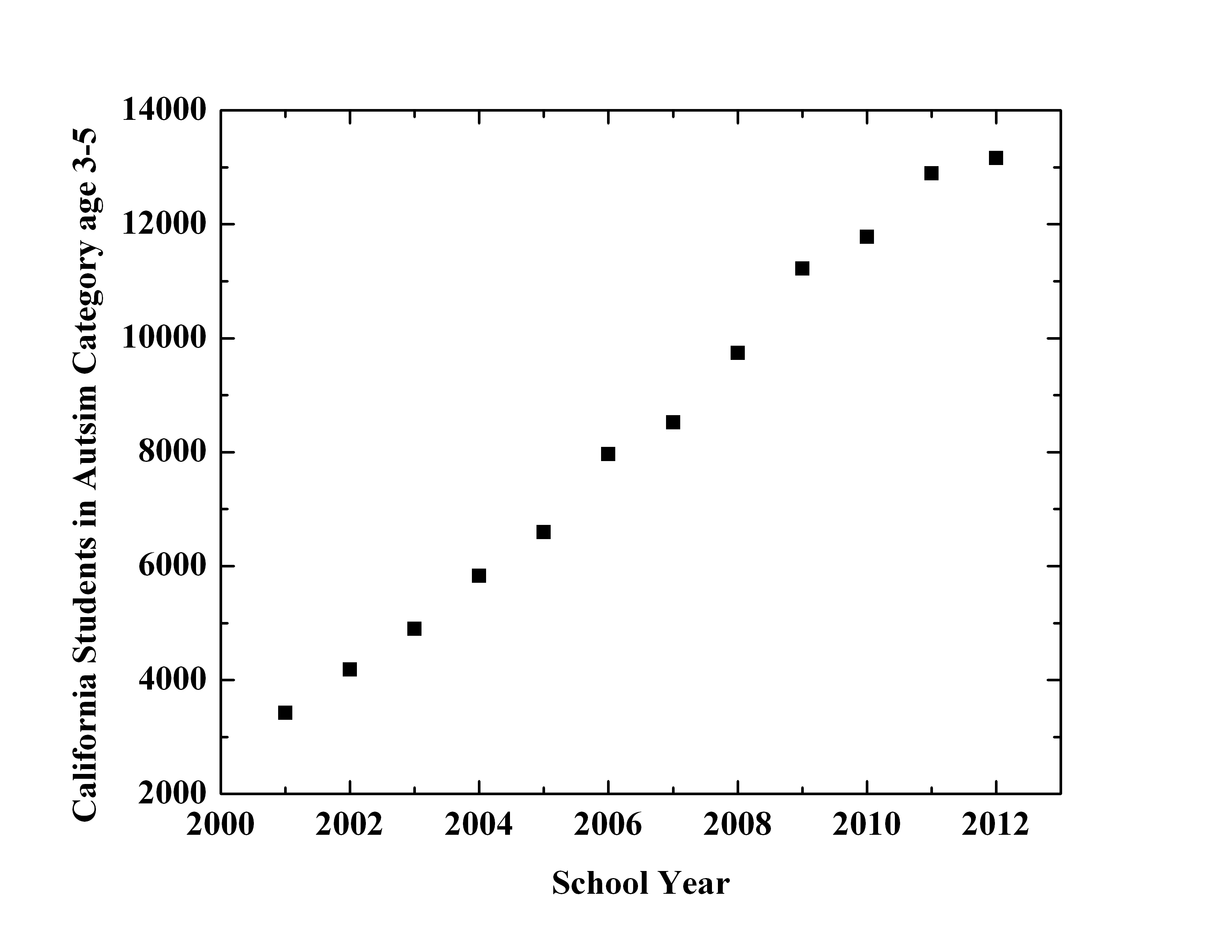
Here are those data:
California SpEd age 3-5

As noted previously, thimerosal was removed from vaccines nationwide, phasing out production by 2001. California passed a law prohiting the administration of vaccines with thimerosal in pregnant women and children under 3 from 2006 onwards. So, kids 3-5 in 2012 did not receive thimerosal from vaccines. And there are more kids in the Autism special ed category in 2012 than in any year previously. The trend is a relatlively smooth increase over time.

It is very clear that these data do not in any way indicate a drop in the increase in autism special ed rates with the removal of thimerosal.

Add to that, vaccine uptake in general and MMR in specific are not changing much over time.

Special Ed data and CDDS data are not the best for tracking autism, especially in such a raw form as this. But these are exactly the tools that were used for years to promote the idea that vaccines cause autism. I don’t think it is a coincidence that there aren’t webistes and discussions devoted to special education any more. I’ll await the claim that it must be the rotavirus vaccine…which contains neither thimerosal, measles virus or aluminum.


By Matt Carey