California’s Legislative Analyst Office report on special education

8 Feb

Recently the California Legislative Analyst’s Office (LAO) released a report on special education in California, Overview of Special Education in California. The report goes over many details of special education, but I will focus on only a few here.

First, the time trend. Yes, the number of students receiving services under the autism label is going up.
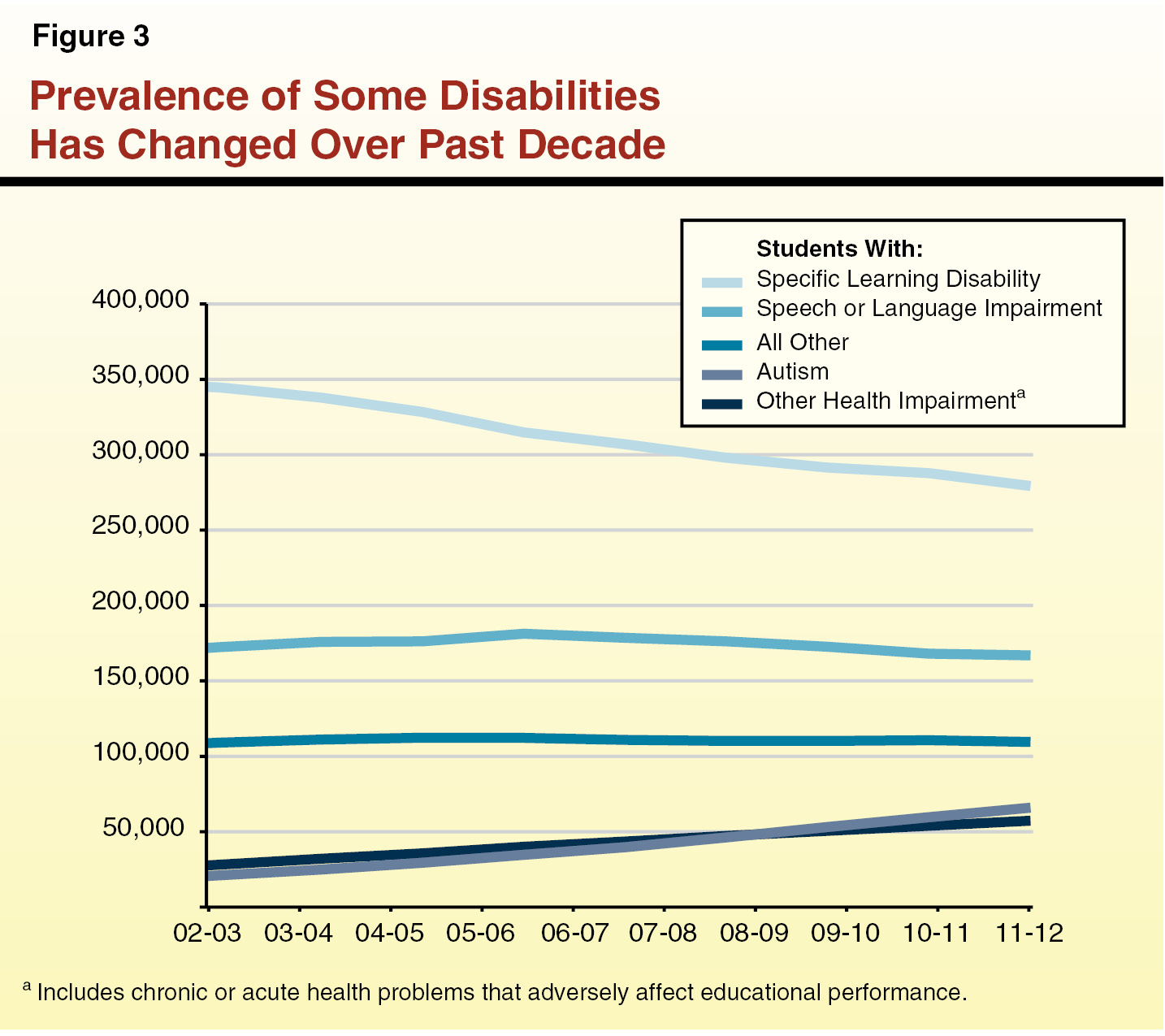
LAO Figure 3

Then again, no sign that it is going down after the removal of thimerosal. Also worth noting is the fact that other health impairments as a category is also increasing. Specific Learning Disability is going down. So it’s a bit more complex than just “autism is going up”.

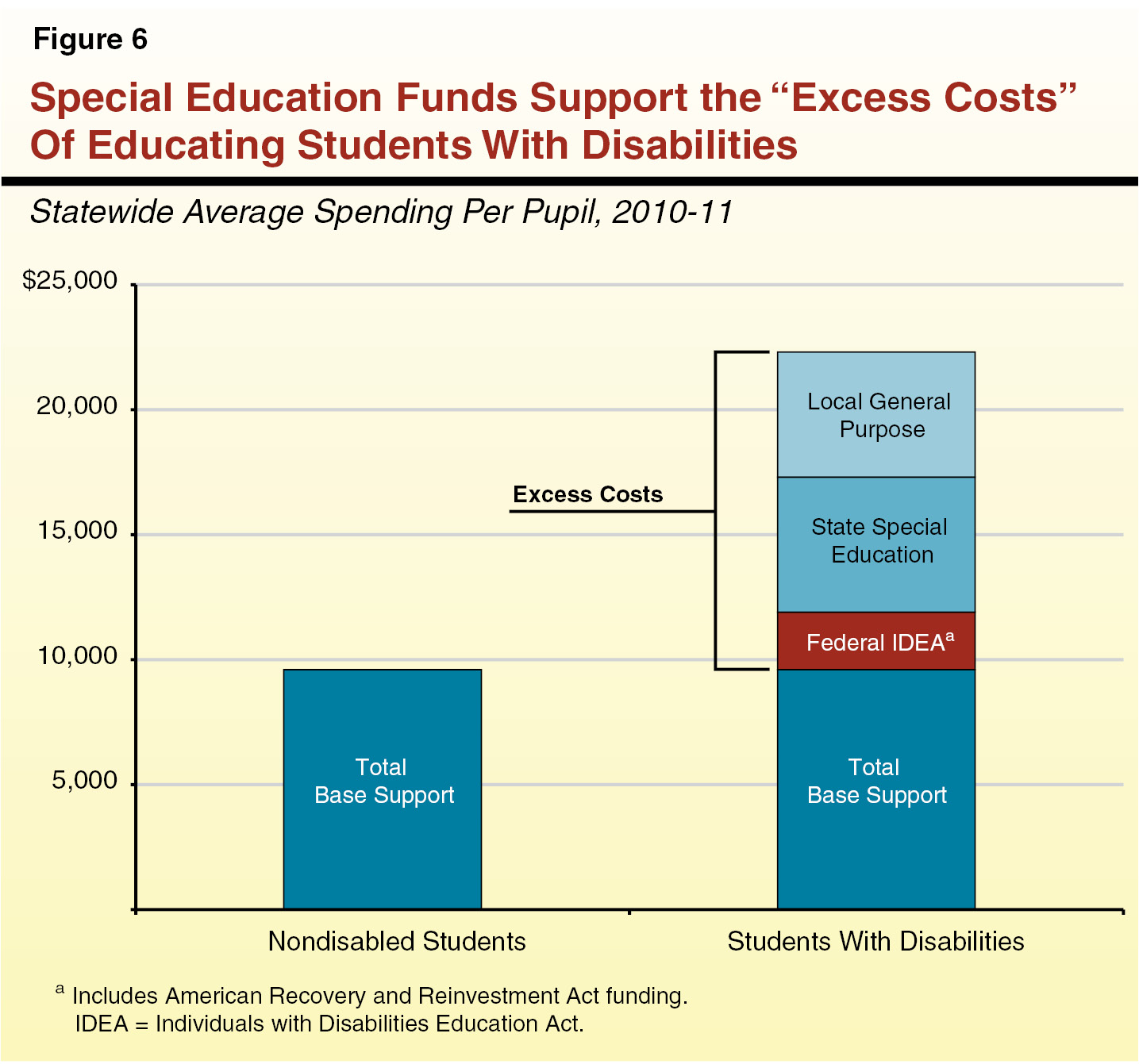
What interests me more is the discussion of costs and finances. On term that often bothers me is the term “encroachment”. As in, “special ed students cost more, and that is an encroachment on the funds for the regular education students”. The LAO report discusses one aspect of that misconception:

(Note: SWD are “students with disabilities”)

Misconceptions About “Encroachment” Some local educational agencies (LEAs) complain that local contributions for special education “encroach” upon their general education programs, sometimes implying that any local dollar spent towards educating a student with disabilities (SWD) imposes unfair expenditure requirements on their general purpose budgets. This argument, however, is a mischaracterization of both federal and state laws. Federal Individuals with Disabilities Education Act (IDEA) and state special education categorical funds never were intended to cover the full costs of educating a SWD—instead the bulk of the “regular” education costs are intended to be covered using local revenue limit and categorical funding, just as for nondisabled students. Moreover, federal IDEA and state special education categorical funds never were intended to fully cover the excess costs of educating a SWD—the special education funding model always has been predicated on a three–way cost–sharing model, including local sources. Despite this basic design of the funding model, LEAs sometimes express frustration that their local share of special education costs is too high. This frustration tends to increase as their local share of special education costs increases, as this leaves them with fewer resources to serve other students.
LAO figure 6

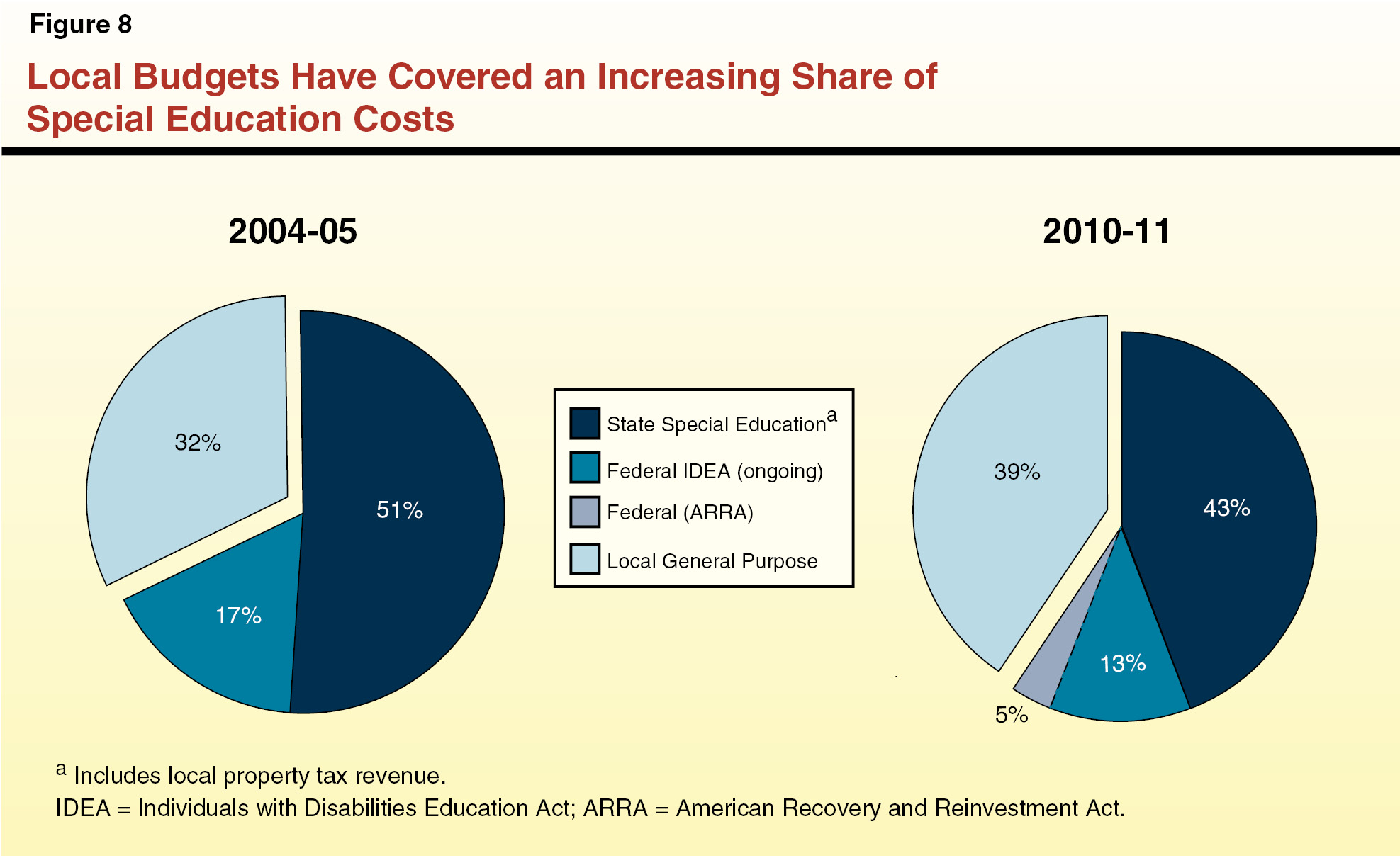
Schools are required to provide free appropriate public education (FAPE) to all students, not just students with disabilities. Some students cost more, some cost less, some cost much more. In California, on average, schools spend $9,600 per non disabled student and, on average, $22,300 per disabled student. Where does that money come from to pay for the disabled student’s costs? Well, $9,600 comes from the money the school would spend anyway. The rest is: $2,300 in federal funds, about $5,400 in state funds, and about $5,000 local funds. So, the “extra” cost for special education students is largely paid by state and federal funds. The Federal government has never paid the full amount they committed for special education. The LAO notes:
LAO figure 8

Federal Share Has Never Reached Intended Contribution Level. As shown in Figure 8, federal IDEA funds typically cover less than 20 percent of overall special education expenditures. This is notably lower than the amount the federal government originally committed to provide in support of special education services. The IDEA expresses intent to appropriate funding for each SWD up to 40 percent of the national average expenditure level per K–12 pupil, which would equate to roughly 40 percent of California’s overall special education expenditures. The federal budget, however, has never come close to providing states with this amount. We estimate that California would receive roughly $2 billion more annually if the federal government were to “fully fund” the intended level articulated in the IDEA.

If the Federal Government made good on it’s promise, it would be a great help to education. How’s that for an obvious statement. Somehow this obvious fact hasn’t made an impression on our legislators. That all said–just because the Federal Government isn’t helping as much as they should, that doesn’t mean that cost is an “encroachment” by special ed students.

Now, how does the state decide how much to give to each school district? It isn’t based on “your expenses are $XX, so we will give you a fraction of that.” It isn’t based on, “You have so many special ed students, so we will give you $YY per special ed student.” No, it’s, “your student population is ZZZ, so we give you money based on that number.”

In other words, if a school district has 100% special students, they get the same funding as if they have 0%. If the costs are high or low, they get the same amount from the State and Federal Governments. This isn’t the full story, but it is close:

Two Distribution Models Exist. Across the nation, states generally use one of two approaches to distribute special education funding to the local level. Some use a “cost–based” model, with funding allocations driven by how many SWDs are served or the magnitude of special education costs incurred. In contrast, other states rely primarily on a census–based funding methodology that is not linked to particular SWDs. Under this model, the state allocates special education funds based on the total number of students enrolled, regardless of students’ disability status. This funding model implicitly assumes that SWDs—and associated special education costs—are relatively equally distributed among the general student population and across the state. While the majority of federal special education funds are distributed using a census–based model, the IDEA formula does allocate a small portion (typically around 10 percent) of funds based on counts of economically disadvantaged students, on the assumption that this group contains a greater proportion of SWDs.

A district (or SELPA or LEA) gets paid the same amount whether a student is receiving services for special education or not. Whether a student’s special education services cost a little or a lot. And some districts feel that some or all dollars spent on special education are “encroachment”. We can complain, but in the end we’ve built a system which strongly disincentivises schools from taking a true “cost blind” approach to finding an appropriate education.


By Matt Carey

The Next Vaccine-Autism Newsmaker…5 years later

6 Feb

Years back, much focus in online autism parent community discussions focused on the Omnibus Autism Proceeding (OAP). This was the large “vaccine court” proceeding to explore if people could be compensated for autism as a vaccine injury. Those hearings were held in 2008, and the decisions went against the families.

A year ago I wrote (The Omnibus Autism Proceeding: effectively over), and while, yes, as an “Omnibus” it is effectively over, there is still activity for those who filed claims and were included in the Omnibus Autism Proceeding. Statistics as of today show there were 5,635 claims included in the Omnibus, and 4,564 have been dismissed. 2 claimants have been compensated, with the caveat given that “**HHS has never concluded in any case that autism was caused by vaccination.” This leaves 1,069 cases still pending. A relatively small fraction of the original Omnibus, but a large number nonetheless.

Another way to look at this is the Omnibus proceedings are over, the docket hasn’t been updated for quite some time but there are still individual cases to be decided. Including one case that was rather prominent in the Omnibus: that of A. Krakow. He was intended to be one of the test cases for the thimerosal but was pulled out to pursue another argument: that metabolic dysfunction is involved. David Kirby referred to him as “The Next Vaccine-Autism Newsmaker”, following the supposed game-changer of Hannah Poling.

That was in 2008. As it’s been nearly 5 years, I checked the status of the case. It turns out the first hearing was held in December (a hearing on fact) and a second hearing is set for expert witnesses to testify in April of this year. One way to explore the arguments the family may be taking is to review the experts that are testifying. For example, the family has chosen Richard Deth as an expert. His work has not focused on mitochondria. On the other hand, Yuval Shafir is also listed as an expert and has listed many articles on mitochondria with his report. Richard Frye’s CV was submitted (he also has some work on mitochondria and autism), but I don’t see that an expert report from him has been submitted.

Other experts date from 2008 (from when he was going to be an Omnibus test case) include: Elizabeth A. Mumper, Robert S. Rust, Richard Deth and Sander Greenland.

(edit to add, I see a report in the docket from Marcel Kinsbourne in 2010).

So, is this going ahead as a “mitochondrial autism” case? The “Next Hannah Poling” as David Kirby claimed in Spectrum Magazine? Well, even Hannah Poling wasn’t the game-changer some people predicted. Probably the most we can say is that is 10 years old, with a docket 16 pages long, will finally be heard.

edit to add: For the curious, here is the docket.

By Matt Carey

A correction

5 Feb

Last year, following the autism hearing in the Oversight and Government Reform Committee, I wrote a piece Mr. Wright, is autism an epidemic or not? Why not give real examples of how to make a financial impact? In the article I used an example of how getting more autistics employed could make a real impact financially in our country.

It was pointed out to me that the way I framed it, it read that only a fraction of the autistic population would be able to gain employment. An adult self-advocate pointed out to me that this is not the case, that real employment should be a goal for the entire population. And this self advocate is correct and I regret the way I worded that article.

It is worth noting that a self advocate was informing the parent of a child with multiple disabilities, including intellectual disability, that employment should be a goal for all. There is an important lesson in that apparent role reversal. Self-advocacy does not mean one advocates only for one’s self, nor for only other self advocates. This simple message often gets lost in the stereotyped presentations of self-advocates and parents.

The autism community is broad. No one person will advocate great change. No segment of the population will be very effective on its own. We are going to work together or we are going to fail.


By Matt Carey

IACC to take more active role

4 Feb

The U.S. Interagency Autism Coordinating Committee (IACC) met last week. There were presentations on important subjects but for me the real event happened in the final hour, during the discussion. You can get an idea of that from two Autism Speaks articles: IACC Pledges More Assertive Role in Federal Autism Policy and IACC Tackles Healthcare Disparities and Access to Care.

If one looks at Public Law 109-416 (the law based on the Combating Autism Act)

(b) RESPONSIBILITIES.—In carrying out its duties under this section, the Committee shall—
(1) develop and annually update a summary of advances in autism spectrum disorder research related to causes, prevention, treatment, early screening, diagnosis or rule out, intervention, and access to services and supports for individuals with autism spectrum disorder;
(2) monitor Federal activities with respect to autism spectrum disorder;
(3) make recommendations to the Secretary regarding any appropriate changes to such activities, including recommendations to the Director of NIH with respect to the strategic plan developed under paragraph (5);
(4) make recommendations to the Secretary regarding public participation in decisions relating to autism spectrum disorder;
(5) develop and annually update a strategic plan for the conduct of, and support for, autism spectrum disorder research, including proposed budgetary requirements; and
(6) submit to the Congress such strategic plan and any updates to such plan.

If you look at (2) and (3), they constitute a very broad mandate to “monitor Federal activities with respect to autism spectrum disorder [and] make recommendations to the Secretary regarding any appropriate changes to such activities”

This is an area which the IACC has up until not been the primary focus of the IACC, from what I have observed. The IACC has spent much effort, and rightfully so, on developing and updating the strategic plan for autism research.

The IACC is working on a document to offer advice on how autism should be considered in the implementation of the Affordable Care Act and the insurance exchanges the Act will set up.

The meeting started with Tom Insel (chair of the IACC, director of the NIMH) discussing some recent papers in autism. These include studies on elopement, markers of maternal inflammation as a risk factor for autism, an imaging study showing microglial activation in autistic brains, studies by IACC member David Mandell and more.

A presentation was given about the CDC Minnesota Somali Autism Project. The presentation discussed the methodology (using the same system as the ADDM network) and the difficulties in building the infrastructure from scratch. No information on preliminary results.

Jose Cordero spoke about the prevalence of autism in Puerto Rico. It is one of the highest in the United States at 1.6%. This is especially noteworthy given the relatively low prevalence for autism among the Hispanic communities regularly reported. Another presentation was made on the recent “Optimal Outcomes” study, with much discussion afterwards about what “optimal” outcomes really are. Of note was the fact that the study authors never made the statement that people “grow out of autism”, that was an interpretation added by journalists. Anjali Jain of The Lewin Group and Craig Newschaffer of Drexel University spoke about health outcomes among autistics, showing that there are more health issues among autistics. Alan Guttmacher of the National Institute of Child Health and Human Development spoke about the National Children’s study which is starting and will follow 100,000 children’s health outcomes and track possible environmental risk factors.

Public comments were given both orally and written. Unfortunately, there was no time for discussing the comments, which included statements by Dena Gassner, Amy Lutz, Dawn Loughborough and Jake Crosby.

The meeting was recorded by video. (I’ll try to get the embed code to work) http://videocast.nih.gov/launch.asp?17778


By Matt Carey

note: I serve as a public member to the IACC but all opinions here and elsewhere are my own.

Jenny McCarthy loses gig for health-related fundraiser

3 Feb

I haven’t spent much time discussing Jenny McCarthy in a while. The reason is pretty simple, aside from her annual presentation at the AutismOne parent convention (where she criticizes parents who don’t use alternative medicine), she’s basically dropped out of the public discussion on autism. Years back she stopped expressing her views on vaccines publicly. Gone are the days of shouting “bullshit” at pediatricians on national TV and leading “green our vaccines” demonstrations in Washington DC.

So when I heard that she was going to headline a fundraiser for a cancer charity in Ottawa, I didn’t feel any need to write about it. Sure, it was a bad decision on the charity’s part. Why spend some of their credibility on Ms. McCarthy?

We are talking a cancer charity. Cancer patients often have reduced immune systems due to treatments they receive. They are highly dependent on the rest of us providing protection from serious vaccine-preventable diseases. The efforts of Ms. McCarthy and her organization have, by their own words, reduced vaccine uptake, endangering the very population the charity seeks to serve.

The Ottowa Citizen is reporting that Ms. McCarthy has been replaced for the event. I thank the charity for that. Ms. McCarthy is tweeting that she has a conflict and had to pull out. If this is true, perhaps she could return the “financial settlement” she is reportedly still being paid. In other words, I’m finding it hard to believe her tweet. If she wants to save face, she can save the charity money at the same time.

With luck, this will be the only Jenny McCarthy article here this year. Her time came and passed. We will be feeling the damage of her efforts for years to come. I’m not feeling much sympathy that she has to accept some consenquences.


By Matt Carey

The Geiers’ Second Home

2 Feb

Mark Geier is well known within the autism alternative medicine community (think chelation, lupron) and as a consultant and expert for the attorneys in the vaccine court. David Geier is his son and has also been associated with the alt-med treatments (much criticised research, being accused of practicing medicine without a license) and tried to break in to the vaccine-court expert/consultant business. The Geiers are currently suing the attorneys who represented the families in the Ominibus Autism Proceeding (the vaccine court hearings on vaccine causation of autism). According to court papers, the Geiers are seeking $600,000 in fees and expenses they feel are owed to them. The vaccine court denied the application for paying for their fees.

In looking over the documents I was struck by an odd fact: the address given for the Geiers is not the same one I am used to seeing. It isn’t their usual home base in Maryland. So I decided to take a look at what sort of home they are currently claiming as their residence.

Here’s a picture (click to enlarge pictures):

House 1

The home is described online as 7,800 square feet, on a 20 acre lot. The backyard comes complete with a swimming pool.

House 2

Apparently, the estate was listed for $2.6M in 2011, but pulled from the market. Eidt to add: I’ve been informed that Mark and David Geier (not Mark and his wife) purchased the property in Nov. 2011 for $2M.

the Interior is not understated:

B-Room Geier

and

B-Room Geier

If you work out where they live, please don’t post it here. It is publicly available information, but it is not relevant to this discussion. What is releavant is this: there’s a lot of money in alternative medicine and promoting the idea that vaccines cause autism. Mark Geier has 20 years experience working with, and being critcized by, the vaccine court, including for double charging and for charging for costs well outside their roles (such as trips to Europe)

A single study they assisted in preparing for the Omnibus was billed at $440k, even though it was of low quality and was not useful in the case. The special master was very clear:

Clearly, no rational “hypothetical paying client” of the PSC would have agreed to pay for the production of such a flawed study. Thus, the fact that the Young-Geier article did not add any value to the petitioners’ causation presentation in this case is a very strong reason why I should decline to compensate the PSC for the cost of producing the article.

The Special Masters of the Court of Federal Claims (the vaccine court) appear to have closed the door on payments to the Geiers. But not until nearly two decades of low quality work was compensated. Mark Geier has lost his license to practice medicine in multiple states, but, again, not until after he was able to spend decades “treating” people with and charging people for therapies which make no sense.

The Geiers may not get the $600k they believe they are owed for work on the Omnibus. Their multistate franchise of lupron treatment centers may be closed. They may not be able to charge the American taxpayer for future low quality “expert” reports for the Court. Perhaps Mark Geier will have to retire a little early (reportedly, he’s 64), to his new home. Shared with his wife and son. Except for the living out one’s retirement with David Geier, I’m not seeing this as a difficult time for him. As to David Geier, one does wonder if he will ever amount to anything. Extrapolating from existing data, I’m not betting on it. But, as with his father, I don’t see cause to worry for his future. The U.S. taxpayers, and medical consumers, have taken care of this father/son team far better than we have our disabled citizens. And with less return to show for it.


By Matt Carey

Princeton families make $1.5M donation to Rutgers to study adult autism

2 Feb

NJ.com is reporting Princeton families make $1.5M donation to Rutgers to study adult autism. Two families donated $750,000 each, matched by another gift to the university to endow a chair in the psychology department:

Located at the Graduate School of Applied and Professional Psychology, the Karmazin and Lillard Chair in Adult Autism will pay for research and training future professionals to work in the growing field.

I find it very encouraging that the donors are parents of adolescent autistics.


By Matt Carey

IACC to hear about Minnesota Somali Project, Optimal Outcomes and National Children’s Study

28 Jan

The U.S. Interagency Autism Coordinating Committee (IACC) meets tomorrow (January 29th). The agenda is listed online and below.

The committee and the public will hear updates on the Minnesota Somali Autism Project–a project to explore whether there is a high prevalence of autism in the Minnesota Somali community and, if so, why. The autism prevalence in Puerto Rico ranks high for the U.S., even though the territory population is largely Hispanic and Hispanics typically have a low reported autism prevalence in the U.S.. An update on the autism prevalence in Puerto Rico will be presented. A recent study on individuals who achieved what the authors refer to as “optimal outcomes” will be discussed. Also, a study of health outcomes in children with autism and their families will be presented.

The IACC will also discuss plans for moving forward. There are many areas I would like to see some focus applied to. But three I have proposed and hope to discuss are (1) the needs specific to children and adults with autism and intellectual disability and/or communication difficulty and (2) difficulties in delivery of medical services to autistics and (3) autism and epilepsy. It is too late for comments to be included in the record for this meeting, but if you have opinions of where autism research and policy should be moving towards, send the IACC comments at IACCPublicInquiries@mail.nih.gov.

Here is tomorrow’s agenda:

10:00 a.m. Welcome, Roll Call and Approval of Minutes
Thomas Insel, M.D.
Director, National Institute of Mental Health
Chair, IACC

10:05 Science Update
Thomas Insel, M.D.
Director, National Institute of Mental Health
Chair, IACC

10:20 Round Robin

10:50 Centers for Disease Control and Prevention (CDC) Minnesota Somali Project Update
Amy Hewitt, Ph.D.
Director, Research and Training Center on Community Living
University of Minnesota

Mashalyn Yeargin-Allsopp, M.D.
Chief, Developmental Disabilities Branch, National Center on Birth Defects and Developmental Disabilities (NCBDDD)
Centers for Disease Control and Prevention

11:20 Update on Autism Prevalence in Puerto Rico
Jose Cordero, M.D.
Dean, Graduate School of Public Health
University of Puerto Rico
Member, IACC

11:35 Lunch

1:00 p.m. Oral Public Comments

1:30 Optimal Outcomes in Individuals with a History of Autism
Deborah Fein, Ph.D.
University of Connecticut
Board of Trustees Distinguished Professor Department of Psychology
Department of Pediatrics

2:00 Study of Health Outcomes in Children with Autism and their Families
Anjali Jain, M.D.
The Lewin Group

Craig Newschaffer, Ph.D.
AJ Drexel Autism Institute, Drexel University

2:30 National Children’s Study Update
Alan Guttmacher, M.D.
Director, Eunice Kennedy Shriver National Institute of Child Health and Human Development
Member, IACC

2:50 Break

3:05 IACC Business
Thomas Insel, M.D.
Director, National Institute of Mental Health
Chair, IACC

Susan A. Daniels, Ph.D.
Acting Director, Office of Autism Research Coordination
Executive Secretary, IACC

•2012 Strategic Plan Update
•2013 Strategic Plan Update Process
•2012 Summary of Advances
•2011-2012 Portfolio Analysis
•Other Activities

4:15 Public Comments Discussion Period

4:45 Wrap-Up

5:00 Adjournment


By Matt Carey

Note: I serve as a public member to the IACC. However, all comments and opinions, here and elsewhere are my own.
Note: I made small edits after I published this article to include the third area I would like to see get greater focus.

A paper retraction and a strange blog post

25 Jan

My pubmed email alerts had a retraction notice recently. Enhanced Polyubiquitination of Shank3 and NMDA Receptor in a Mouse Model of Autism now shows “retracted”.

Per a tweet from Steve Silberman:

It turns out a blog called “Autism Researchers” noted that figures in the paper included identical data, but in non-identical places. For example:

Aside from the odd possibility that a blog may have contributed to the downfall of a paper (not too odd if you recall ERV’s analysis of an XMRV paper), is the fact that the blog has one real entry. They have a first “hello world” entry, which is a throwaway WordPress first blog entry, and the one discussing this paper (Alleged Image Data Falsification in a CELL Paper). Looks to this observer like someone created a throwaway blog to note the possible problems with this paper.

This is a top journal (Cell), and a top research group and insitution (Johns Hopkins, The University of Texas Southwestern Medical Center, National Institute on Deafness and Other Communication Disorders and Sichuan University, Chengdu). The paper has been cited 54 times. Retraction Watch reports that the Office of Research Integrity (ORI) is aware if thus case.

The “improperly assembled” figures all appear in the same paper in Cell. This is unlike the case of (non autism researcher) Jan Hendrik Schön of Bell Labs, who had what could be phrased as “improperly assembled” figures (in his case, duplicated data) in multiple papers.

We don’t have the time and the money to have multiple researchers pursuing projects based on “improperly assembled” figures in a high profile paper. The Cell paper hasn’t led to public health scares, as another case of improperly assembled research data. But with NIH funding and 54 citations, it may be wasting time and money that are both very scarce in the autism world.


By Matt Carey

An update: Adverse reaction data for alternative therapies for autism?

24 Jan

With apologies for how long this took to put online: Last September I wrote an article Adverse reaction data for alternative therapies for autism? In it I pointed out how the Autism Research Institute (ARI) had a different standard for reporting adverse reactions for FDA approved drugs and for altnerative therapies. Jane Johnson graciously participated in the conversation and saw that the web page in question was changed. The page now includes this paragraph:

If your son/daughter experiences side effects from taking prescribed medications, please contact the FDA at: http://www.fda.gov/medwatch. Since supplements may also lead to side effects, please report them to: http://www.fda.gov/Food/DietarySupplements/Alerts/ucm111110.htm. You can also call: 1.800.FDA.1088 (1.800.332.1088) to report adverse effects associated with prescription drugs and supplements.

I greatly appreciate the change and again apologize for taking so long to acknowledge it here.


By Matt Carey