Autistics Speaking Day

6 Nov

I missed it. Autistic Speaking Day. Autistics Speaking Day grew out of a response to a poorly conceived awareness/fundraising event from Autism Speaks: Communication Shutdown (the link seems to be no longer valid).

Here’s part of what Corina Becker wrote last year about Autistics Speaking Day:

At the end of my last post, I stated that on November 1st, Autistic people should speak up and be heard. That in the absence of NT voices, Autistics should reclaim the Autism community by communicating in our own ways on our life experiences.

A series of blog posts are collected at http://autisticsspeakingday.blogspot.ca/

Yes, clearly, not all autistics participate by speaking or writing as many are non-verbal, non-conversational or have intellectual disability.


By Matt Carey

Presidential Election tomorrow

6 Nov

The U.S. is holding their Presidential election tomorrow (Nov.6). Four years ago I wrote about the election as it approached. Both major candidates made a few comments that were, well, ill informed. Barack Obama held forth a promise to make life better for the disability community. He had the clearest disability plan, including fully funding IDEA (special education) and naming an “Autism Czar”. These did not come to pass. Some extra money was set aside for special education as a one time event during the economic stimulus budget, but special education remains underfunded. No one person is in place to oversee autism research and policy, but there is a renewed commitment to keep funding research.

All in all, not where I hoped we would be four years ago.

And, yet, I have even less hope for the future with Mr. Romney.

I hope all is well for Americans who wish to vote. The east coast is still recovering. Whoever you support, make your voice heard.


By Matt Carey

With thanks to OARC

5 Nov

Last week there was supposed to be a 2 day workshop of the the U.S. Interagency Autism Coordinating Committee (IACC) to update the Strategic Plan. The workshop was to be held in Washington DC. The meeting was cancelled due to Hurricane Sandy.

Behind the scenes, making things work for the IACC is OARC: the Office of Autism Research Coordination. The people of OARC do a lot, including managing the meetings. No small task for this workshop. There are about 30 IACC members and about 20 experts were brought in to consult on the Plan update. These meetings are a lot of work and OARC staff were preparing long in advance and still, I am sure, were going to be working through the weekend before the workshop. And that without hurricane Sandy. With Sandy bearing down, they had to put together contigency plans. What if some people don’t make it in time? What if people can’t come? What if power goes out? Lots of contingencies which I am sure made this whole process very complicated. I was working with them to make sure I could get in and out of DC for the meeting. Or, at least I hoped to. Airports ended up shut down. Luckily OARC saw that it was going to be unworkable and cancelled the meeting the Saturday before.

Here’s a screen shot from my email on Saturday(Click to enlarge):

The people of the Office of Autism Research Coordination (OARC) were working very hard to put this workshop together. Working hard on contingency plans. Working on the weekend. All this while a hurricane was bearing down on their homes. Thank you, OARC staff. I appreciate the dedication and the hard work.


By Matt Carey

Note: I serve as a public member to the IACC but my comments here and elsewhere are my own.

Controversial autism doctor Mark Geier loses licenses in Missouri, Illinois

4 Nov

Mark Geier has been discussed a great deal here on Left Brain/Right Brain. Including very recently on the topic of this article. Much of that discussion has recently centered on his belief that not only is autism caused by mercury, but that mercury somehow is bound to testosterone and that by reducing the amount of testosterone in the body one can reduce the amount of mercury and, thus in his flawed model, treat autism. Mr. Geier’s clinical practice was found to have been flawed as well and he lost his license to practice medicine in his home state of Maryland. He was licensed in multiple other states as well, including Missouri and Illinois. With the loss of his license in Maryland, other states have followed in license actions.

The St. Louis Post Dispatch reports: ” Controversial autism doctor Mark Geier loses licenses in Missouri, Illinois”.

Todd W. Of Harpocrates Speaks writes about this in “Mark Geier on his Last Leg” where he notes that Mark Geier is still licensed in Hawai’i only.

Todd W. keeps a map of states where Mark Geier has lost his license.


By Matt Carey

OIG Fugitive: Poul Thorsen

30 Oct

The Office of the Inspector General (OIG) for the U.S. Department of Health and Human Services (HHS) lists Paul Thorsen as their number one fugitive and states that he is in his home country of Denmark awaiting extradition to the U.S. to stand trial.

The OIG statement on Paul Thorsen is below. He is alleged to have defrauded the U.S. government by diverting funds intended to support research contracted by the CDC.

While he is indicted on multiple counts of wire fraud and money laundering, there is no crime involved in the massive breach of the public trust involved. Poul Thorsen’s group’s work included studies into the alleged link between vaccines and autism. His indictment has been and is being exploited by groups who wish to cast doubt on his entire group’s efforts and the results they found. There is no charge, no crime for the damage potentially done to public health efforts.

Here is the OIG statement:

From approximately February 2004 until February 2010, Poul Thorsen executed a scheme to steal grant money awarded by the Centers for Disease Control and Prevention (CDC). CDC had awarded grant money to Denmark for research involving infant disabilities, autism, genetic disorders, and fetal alcohol syndrome. CDC awarded the grant to fund studies of the relationship between autism and the exposure to vaccines, the relationship between cerebral palsy and infection during pregnancy, and the relationship between developmental outcomes and fetal alcohol exposure.
Thorsen worked as a visiting scientist at CDC, Division of Birth Defects and Developmental Disabilities, before the grant was awarded.
The initial grant was awarded to the Danish Medical Research Council. In approximately 2007, a second grant was awarded to the Danish Agency for Science, Technology, and Innovation. Both agencies are governmental agencies in Denmark. The research was done by the Aarhaus University and Odense University Hospital in Denmark.
Thorsen allegedly diverted over $1 million of the CDC grant money to his own personal bank account. Thorsen submitted fraudulent invoices on CDC letterhead to medical facilities assisting in the research for reimbursement of work allegedly covered by the grants. The invoices were addressed to Aarhaus University and Sahlgrenska University Hospital. The fact that the invoices were on CDC letterhead made it appear that CDC was requesting the money from Aarhaus University and Sahlgrenska University Hospital although the bank account listed on the invoices belonged to Thorsen.
In April 2011, Thorsen was indicted on 22 counts of Wire Fraud and Money Laundering.
According to bank account records, Thorsen purchased a home in Atlanta, a Harley Davidson motorcycle, an Audi automobile, and a Honda SUV with funds that he received from the CDC grants.
Thorsen is currently in Denmark and is awaiting extradition to the United States.

Let the IACC know what you think is important

29 Oct

If you haven’t taken the chance to email the IACC with feedback on where you think autism research and policy should be going, take the time now. You can do so by emailing IACCPublicInquiries@mail.nih.gov

Today and tomorrow were supposed to include the IACC 2012 Strategic Planning Workshop. The IACC being the U.S. Interagency Autism Coordinating Committee. One of the main products of the IACC is the Strategic Plan. Per public law 109-416 (which re-instituted the IACC back in 2006):

(b) RESPONSIBILITIES.—In carrying out its duties under this section, the Committee shall—
(1) develop and annually update a summary of advances in autism spectrum disorder research related to causes, prevention, treatment, early screening, diagnosis or rule out, intervention, and access to services and supports for individuals with autism spectrum disorder;
(2) monitor Federal activities with respect to autism spectrum disorder;
(3) make recommendations to the Secretary regarding anyappropriate changes to such activities, including recommendations to the Director of NIH with respect to the strategic plan developed under paragraph (5);
(4) make recommendations to the Secretary regarding public participation in decisions relating to autism spectrum disorder;
(5) develop and annually update a strategic plan for the conduct of, and support for, autism spectrum disorder research, including proposed budgetary requirements; and
(6) submit to the Congress such strategic plan and any updates to such plan.

You can read more about the Strategic Plan, at least how it looked in 2011, to help formulate ideas on what you think is working and what isn’t. But I would suggest don’t feel constrained to work into the Strategic Plan format. If there are areas you feel need more attention, let people know.


By Matt Carey

Note: I serve as a public member to the IACC but comments here and elsewhere are my own.

For the first time in history!

29 Oct

Here’s one of those statements that seem dramatic until one puts it into historical context:

For the first time in history, a biologically plausible mechanism of action has been discovered linking a vaccine to a serious adverse event.

Who wrote that? Someone from a group calling itself “SaneVax”. And repeated by none other than Dan Olmsted, proprietor of the Age of Autism blog. Yes, a man who has for years promoted the (failed) idea that mercury in vaccines caused an epidemic of autism is repeating the claim that ” For the first time in history, a biologically plausible mechanism of action has been discovered linking a vaccine to a serious adverse event.” The same Dan Olmsted who has offered up support for Andrew Wakefield and his failed claims that the MMR vaccine also caused a rise in autism rates.

Begs the question of why Mr. Olmsted has put so much time and effort into ideas like mercury and the MMR if they had no biologically plausible mechanism.

Of course no one believes Mr. Olmsted has changed his mind. It’s fairly clear this is just sloppy writing by “SaneVax” and some quick copy-and-paste work by Mr. Olmsted (sure he cited the source but did he read it?) . It would be amusing if the thimerosal and MMR ideas didn’t cause (and didn’t continue to cause) harm both within the autism communities and the general population.

For the record, this claimed “first biologically plausible mechanism” is from a paper by Prof. Shaw. His paper proposing a link between aluminum in vaccines and autism was very poor. Add this to the lack of relavence to autism andI see little point in putting much time into this new (gardasil) paper.

Also for the record and more historical context:

There were reactions to multi dose vaccines in the pre preservative era. The biologically plausible mechanism there was the growth of bacteria introduced into the vial by the needle.

There were reactions to the early polio vaccine produced by Cutter Laboratories. The biologically plausible mechanism there was the injection of live polio virus instead of the inactivated virus that was supposed to be used.

Similarly, the live virus in the oral polio vaccine  can occasionally cause paralysis. The OPV is no longer used in the U. S. after the efforts of a true vaccine safety advocate.

It probably seems strange but it is these last examples that strike me then most sad. Sure, they forgot their own claims that vaccines cause autism. But these other examples are very real, demonstrated vaccine reactions with clear biological mechanisms. But I am being naive. I am expecting a discussion of facts rather than a public relations and political commentary.

Edit to add: I’m not the first to notice this sloppy writing.

Interagency Autism Coordinating Committee (IACC) Strategic Planning Workshop CANCELLED

28 Oct

The U. S. Interagency Autism Coordinating Committee (IACC) was scheduled to hold a two day workshop on planning for an update of the Strategic Plan. Draft documents outlining progress and gaps in research had been prepared including input from experts outside the IACC, and those experts were scheduled to attend next week. But with a hurricane bear in down on the greater Washington DC area, the workshop had to be cancelled.

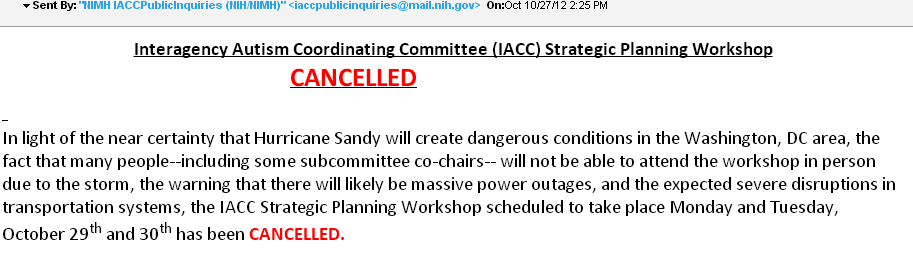
The email announcement is below.

In light of the near certainty that Hurricane Sandy will create dangerous conditions in the Washington, DC area, the fact that many people–including some subcommittee co-chairs– will not be able to attend the workshop in person due to the storm, the warning that there will likely be massive power outages, and the expected severe disruptions in transportation systems, the IACC Strategic Planning Workshop scheduled to take place Monday and Tuesday, October 29 th and 30 th has been CANCELLED.

While I am sure the Office of Autism Research Coordination (OARC) are already working on a backup plan for the meeting, let’s wish them and all the people who have been and will be affected by the storm well.


By Matt Carey

Note: I serve as a public member to the IACC, but my comment here and elsewhere are my own.

Hyperbaric oxygen in the treatment of childhood autism: a randomised controlled trial

24 Oct

Hyperbaric Oxygen therapy (HBOT) has risen in recent years as an “alternative” therapy for many conditions, autism included. The logic behind HBOT is rather fuzzy. For example, there was some discussion of using HBOT to reduce oxidative stress a few years back. How increasing oxygen in the body would decrease oxidative stress was not clear. Some other discussions focused on oxygen perfusion. Basically, some studies have shown that some areas of the brain may be getting less oxygen in autistics than in non-autistics. The idea was that increasing the oxygen to those areas might result in some improvement in some measure or another.

This begs the question: are there areas of higher perfusion (hyperperfusion) in the brains of autistics? Seems an important question to pose when proposing increasing perfusion. But one can not find the term “hyperperfusion” in this review promoting HBOT and autism, for example. But the answer is, yes, people have measured hyperperfusion in autistic’s brains:

Brain perfusion SPECT and EEG findings in children with autism spectrum disorders and medically intractable epilepsy

In specific, they found

The areas of hypoperfusion and EEG focus were highly related in seven of 12 children, while the areas of hyperperfusion were highly related to EEG focus in six of 12 children. The areas of hypoperfusion were highly related to the focus observed on EEG, but were not always related.

Using the simplistic logic of HBOT/autism promotors, one then is left with the question of whether could HBOT make seizure activity worse? I wouldn’t put too much weight on this question other than to point out that it isn’t 100% clear that there can be no downside to HBOT. The logic “there is hypoperfusion therefore HBOT should benefit” isn’t strong; the idea that “there are areas of hyperperfusion, therefore HBOT could have a downside” is also not strong. There are three other studies mentioning hyperperfusion and autism. And, I was interested to see that there are 350 hits for a search of hyperperfusion and epilepsy in pubmed. Compare this to 30 hits for autism and hypoperfusion.

Back to HBOT. There isn’t much science for HBOT, to be frank. Most of the momentum, at least in publications, is from one source: Dan Rossignol. An early paper: Hyperbaric oxygen therapy may improve symptoms in autistic children. by Dr. Rossignol was published in Medical Hypotheses–a pseudo medical journal. I believe Dr. Rossignol’s clinic in Florida provides HBOT.

While there have been articles like the above and some small open label study reports, true randomized trials have been lacking. A recent review Hyperbaric oxygen therapy for treatment of children with autism: a systematic review of randomized trials reported

While some uncontrolled and controlled studies suggested that HBO therapy is effective for the treatment of autism, these promising effects are not replicated. Therefore, sham-controlled studies with rigorous methodology are required to be conducted in order to provide scientific evidence-based HBO therapy for autism treatment.

Also worth noting is that HBOT is currently rated as “non-accepted” by the European Committee for Hyperbaric Medicine. An indication that there was not good evidence either way at the time they prepared their statement.

Two recent studies (the one which is the focus of this article and another) have used a more randomized/blind methodology and one has looked at biomarkers considered important in HBOT and autism (cytokines). The results have not been encouraging.

First the more biomarker based study. This group studied autistic children given HBOT and looked at cytokine levels (Brief report: Hyperbaric oxygen therapy (HBOT) in children with autism spectrum disorder: a clinical trial.) Per that study,

Ten children completed 80 sessions of HBOT and all improved by 2 points on the clinician-rated CGI-I scale (much improved) as well as several parent-completed measures of behavior. The lack of a control group limits the ability to determine if improvements were related to HBOT.

and also:

“Although this study was limited by the small sample size and by the variable nature of cytokines, we found no evidence that HBOT affects cytokine levels or that cytokine levels were associated with behavioral changes”

So, if there is a benefit from HBOT, it isn’t due to changes in cytokines. Which HBOT doesn’t seem to affect.

Another somewhat recent study attempted a clinical trial as well
Controlled evaluation of the effects of hyperbaric oxygen therapy on the behavior of 16 children with autism spectrum disorders. This study, out of the old “Thoughtful House” including Andrew Wakefield as an author found ” No consistent effects were observed across any group or within any individual participant, demonstrating that HBOT was not an effective treatment for the participants in this study. This study represents the first relatively large-scale controlled study evaluating the effects of HBOT at the level of the individual participant, on a wide array of behaviors.”

Finally, a study out in the past couple of months again attempts a randomized controlled study: “Hyperbaric oxygen in the treatment of childhood autism: a randomised controlled trial.” The study is out of Thailand. One factor of note is the attempt to do a real control using a “sham” air group. Obviously HBOT studies are complicated in that study subjects can easily detect the changes in pressure. Of note, HBOT in this case is 100% oxygen:

This study was a prospective, randomised, double-blind, controlled trial of HBOT at 153 kPa (1.5 ATA) with 100% oxygen for one hour daily, weekdays to a total of 20 sessions, versus a sham air treatment consisting of pressurised room air at 116 kPa (1.15 ATA) on the same schedule.

While some reports have used 100% oxygen at 1.5ATA, many have used either air or enriched air and sometimes lower pressure (1.3ATA). I.e. this study involves higher oxygen exposure than in many studies. Air is about 21% oxygen. So, a 1.5 atmospheres of pure oxygen is about 7.5 times the oxygen partial pressure in air. Many reports in early studies were about 1.3 ATA air or slightly enriched air. 1.3 ATA (atmospheres absolute) at 25% O2 is about 32% oxygen. For divers, these levels of oxygen are comparable to Nitrox or enriched air. One can get a higher oxygen level from a mask at 1 atmosphere. Which has been a critique of HBOT from the start. Early anecdotal reports from HBOT practitioners claimed that oxygen delivered by mask was not effective. Only high pressures gave whatever results were claimed. Which is counter intuitive to the simple explanations of how HBOT should work.

But, with both high pressure and pure O2, the Thailand study should provide clarity in these questions. Which begs the question, what are those results? The full paper is online and the abstract is below.

BACKGROUND:
Promising results with hyperbaric therapy for children with autism have been reported, but most involved the use of only mild pressure with oxygen supplementation. To date, there has been no randomised, blinded trial of 100% oxygen administered at hyperbaric pressure. This study evaluated the efficacy of hyperbaric oxygen therapy (HBOT).

METHODS:
Sixty Thai children with autism, aged three to nine years, were randomly assigned to receive 20 one-hour sessions of either HBOT at 153 kPa (1.5 ATA) or sham air at 116 kPa (1.15 ATA). Effects on behaviour were measured using the Autism Treatment Evaluation Checklist score (ATEC) and clinical improvement was measured with the Clinical Global Impression (CGI) system; in particular the clinical change (CGIC) and severity (CGIS) sub-scores. These were evaluated by parents and clinicians, both of whom were blinded to the actual exposure.

RESULTS:
The mean total ATEC scores by both parents and clinicians were significantly improved after intervention in both arms of the study compared to the score before intervention (P <; 0.001 in both groups by parents, P = 0.015 in HBOT group and P = 0.004 in sham group by clinician). There were no statistically significant differences in average percentage changes of total ATEC score and all subscales scores when comparing the HBOT and sham air groups, either by parents or clinicians. Changes in the CGI scores following intervention were inconsistent between parents and clinicians. For severity scores (CGIS), parents rated their children as more improved following HBOT (P = 0.005), while the clinicians found no significant differences (P = 0.10). On the other hand, for change scores (CGIC) the clinicians indicated greater improvement following HBOT (P = 0.03), but the parents found no such difference (P = 0.28).

CONCLUSIONS:
Children with autism who received 20 sessions of either HBOT or a sham air exposure had significant improvements in overall behaviour but there were no significant differences in improvement between groups. The inconsistent changes on CGI sub-scores between parents and clinicians are difficult to interpret, but no overall clinically significant benefit from HBOT could be shown. Both interventions were safe and well tolerated with minimal side effect from middle ear barotraumas.

Repeat for emphasis: “Children with autism who received 20 sessions of either HBOT or a sham air exposure had significant improvements in overall behaviour but there were no significant differences in improvement between groups”

Reports from parents and clinicians did not agree and the authors conclude “no overall clinically significant benefit from HBOT could be shown”.

HBOT is not cheap. A single “dive” can cost in the neighborhood of $100. Parents have purchased portable chambers which run in the $10-20k range (depending on model and whether new). And have modified these to provide O2 enriched air, outside the manufacturer’s specifications. There is a resale value in these chambers so far, so the net cost is not going to be as high. But, all told, there is substantial outlay of funds and time in HBOT. The science pro is shaky at best. And now there are two negative controlled trials.

These results will likely do little to dampen the enthusiasm for HBOT. All studies of HBOT and autism in clinicaltrials.gov are completed, so future data may not be forthcoming.


By Matt Carey

Chronic Intranasal Oxytocin Causes Long-Term Impairments in Partner Preference Formation in Male Prairie Voles

21 Oct

There is a great deal of discussion here and elsewhere about alternative medicine and it’s application to autism. If one points out that a specific therapy is poorly founded in facts and/or not completely tested, a common response is that one is “anti-cure” “anti-treatment” or the like. Safety issues, always at the forefront to the point of misrepresentation when discussion of vaccines, are often completely ignored in the alt-med world when discussing proposed therapies.

One therapy that hasn’t been discussed much here at LBRB is oxytocin. Some of the studies on oxytocin and autism have been, well, odd. But others have covered those aspects better than I could. Now comes a study on lab animals exploring long-term effects:

Chronic Intranasal Oxytocin Causes Long-Term Impairments in Partner Preference Formation in Male Prairie Voles.

Here is the abstract:

BACKGROUND: Oxytocin (OT) is a hormone shown to be involved in social bonding in animal models. Intranasal OT is currently in clinical trials for use in disorders such as autism and schizophrenia. We examined long-term effects of intranasal OT given developmentally in the prairie vole (Microtus ochrogaster), a socially monogamous rodent, often used as an animal model to screen drugs that have therapeutic potential for social disorders.

METHODS: We treated voles with one of three dosages of intranasal OT, or saline, from day 21 (weaning) through day 42 (sexual maturity). We examined both social behavior immediately following administration, as well as long-term changes in social and anxiety behavior after treatment ceased. Group sizes varied from 8 to 15 voles (n = 89 voles total).

RESULTS: Treatment with OT resulted in acute increases in social behavior in male voles with familiar partners, as seen in humans. However, long-term developmental treatment with low doses of intranasal OT resulted in a deficit in partner preference behavior (a reduction of contact with a familiar opposite-sex partner, used to index pair-bond formation) by male voles.

CONCLUSIONS: Long-term developmental treatment with OT may show results different to those predicted by short-term studies, as well as significant sex differences and dosage effects. Further animal study is crucial to determining safe and effective strategies for use of chronic intranasal OT, especially during development.

Basically they exposed prairie voles to oxytocin from about the equivalent of being a toddler (weaning) to adulthood (sexual maturity). It’s a short time for these animals (21 days) but in that amount of time the males showed changes in behavior beyond those observed in short-term trials.

This isn’t a complete “put the brakes on this line of research” study, but it does shed light on the sort of caution that should (and, sadly, often isn’t) applied to alt-med. Some have jumped the gun on oxytocin as a therapy before dosage and long-term effects have been explored.