Archive by Author

New Definition of Autism May Exclude Many, Study Suggests

20 Jan

The New York Times reports New Definition of Autism May Exclude Many, Study Suggests. The study is not published yet and was presented at a conference in Iceland.

The Times reports:

The study results, presented on Thursday at a meeting of the Icelandic Medical Association, are still preliminary, but they offer the latest and most dramatic estimate of how tightening the criteria for autism could affect the rate of diagnosis. Rates of autism and related disorders like Asperger syndrome have taken off since the early 1980s, to prevalence rates as high as one in 100 children in some places. Many researchers suspect that these numbers are inflated because of vagueness in the current criteria.

The conference program doesn’t have abstracts, just paper titles. Prof. Volkmar had two talks on autism: “The Changing Face of Autism: An Introduction and Overview” and “Understanding Autism: Implications for Health Care”. This leaves us with the Times article as our source for information.

According to the Times:

In the new analysis, Dr. Volkmar, along with Brian Reichow and James McPartland, both at Yale, used data from a large 1993 study that served as the basis for the current criteria. They focused on 372 children and adults who were among the highest-functioning and found that over all, only 45 percent of them would qualify for the proposed autism spectrum diagnosis now under review. The focus on a high-functioning group may have slightly exaggerated that percentage, the authors acknowledge.

The Times has quotes from Catherine Lord (who, amongst other achievements, is one of the authors of the ADOS) who disagrees with Prof. Volkmar to some degree:

Dr. Lord said that the study numbers are probably exaggerated because the research team relied on old data, collected by doctors who were not aware of what kinds of behaviors the proposed definition requires. “It’s not that the behaviors didn’t exist, but that they weren’t even asking about them — they wouldn’t show up at all in the data,” Dr. Lord said.

The question of how the DSM 5 will change the criteria for how autism is defined has been a subject of great speculation and some study. One can find parents claiming that the DSM 5 is designed to redefine autism as only “high functioning” all the way to autistics worried that many with Asperger syndrome will no longer be classified as autistic.

The results presented by Prof. Volkmar would suggest that “classic” autism, PDD-NOS and Asperger syndrome would all see significant changes:

The likelihood of being left out under the new definition depended on the original diagnosis: About a quarter of those identified with classic autism in 1993 would not be so identified under the proposed criteria; about three quarters of those with Asperger’s would not qualify; and 85 percent of those with P.D.D.-N.O.S. would not.

As noted above, this is not the first study to consider the DSM 5 and autism. For example, a group from Finland published Autism spectrum disorders according to DSM-IV-TR and comparison with DSM-5 draft criteria: an epidemiological study. they found the DSM-5 draft criteria were ” less sensitive in regard to identification of subjects with ASDs, particularly those with Asperger’s syndrome and some high-functioning subjects with autism.”

Abstract
OBJECTIVE:

The latest definitions of autism spectrum disorders (ASDs) were specified in DSM-IV-TR in 2000. DSM-5 criteria are planned for 2013. Here, we estimated the prevalence of ASDs and autism according to DSM-IV-TR, clarified confusion concerning diagnostic criteria, and evaluated DSM-5 draft criteria for ASD posted by the American Psychiatry Association (APA) in February 2010.
METHOD:

This was an epidemiological study of 5,484 eight-year-old children in Finland, 4,422 (81%) of them rated via the Autism Spectrum Screening Questionnaire by parents and/or teachers, and 110 examined by using a structured interview, semi-structured observation, IQ measurement, school-day observation, and patient records. Diagnoses were assigned according to DSM-IV-TR criteria and DSM-5 draft criteria in children with a full-scale IQ (FSIQ) ?50. Patient records were evaluated in children with an FSIQ <50 to discover diagnoses of ASDs.
RESULTS:

The prevalence of ASDs was 8.4 in 1,000 and that of autism 4.1 in 1,000 according to DSM-IV-TR. Of the subjects with ASDs and autism, 65% and 61% were high-functioning (FSIQ ?70), respectively. The prevalence of pervasive developmental disorder not otherwise specified was not estimated because of inconsistency in DSM-IV-TR criteria. DSM-5 draft criteria were shown to be less sensitive in regard to identification of subjects with ASDs, particularly those with Asperger's syndrome and some high-functioning subjects with autism.
CONCLUSIONS:

DSM-IV-TR helps with the definition of ASDs only up to a point. We suggest modifications to five details of DSM-5 draft criteria posted by the APA in February 2010. Completing revision of DSM criteria for ASDs is a challenging task.

Comment on “Timing of Increased Autistic Disorder Cumulative Incidence”

19 Jan

In 2010 a paper was published called “Timing of increased autistic disorder cumulative incidence.” The paper has made very little, if any, impact on the scientific community. But it has become part of the stable of poor quality papers used by those claiming that vaccines caused an autism epidemic.

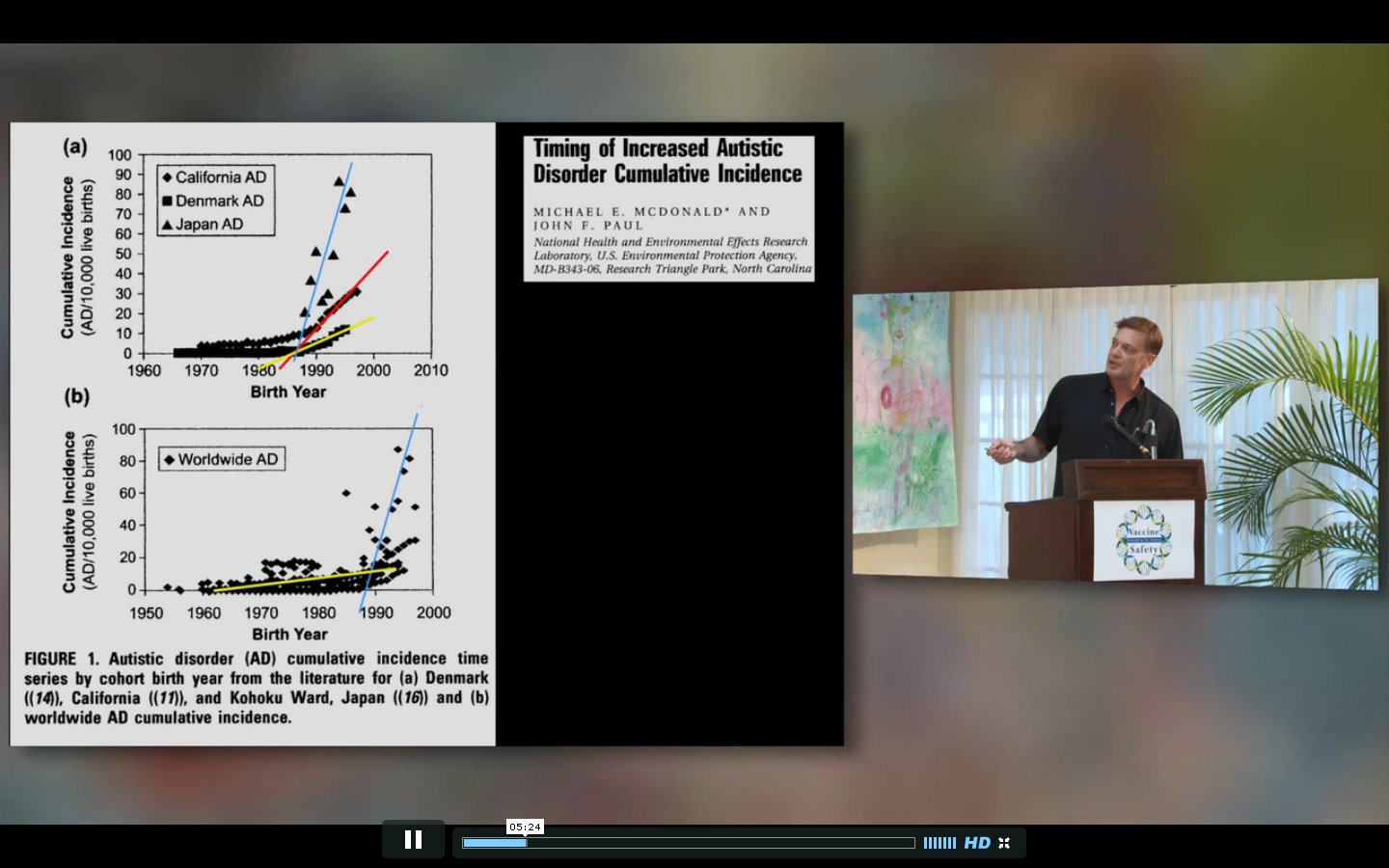
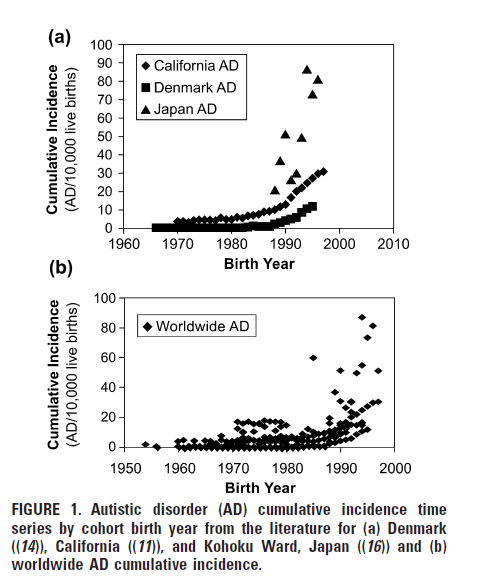
The paper took data from other published papers and applied a “hockey-stick” analysis to try to identify change points in the administrative prevalence of autism in California, Japan and Denmark. Here’s the main figure from that paper (click to enlarge)
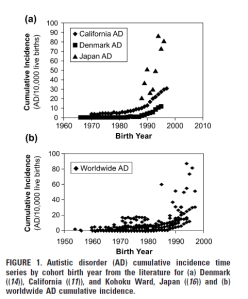
Figure-1-from-Timing-paper

The idea of a hockey-stick analysis is to fit the data to two lines of different slopes which meet at a change point. Those two lines look like a hockey stick, hence the name. For multiple reasons, I believe this analysis was not appropriate for these data.

The paper is being discussed in the literature. Once by Helen Ratajczak in her review paper Theoretical aspects of autism: Causes – A review. Another citation comes from a published response to that review: Coincidental associations do not provide proof for the etiology of autism. Also “Hypothesis: Conjugate vaccines may predispose children to autism spectrum disorders“.

Two additional papers citing the Timing paper include “Mast cell activation and autism” (funded by the National Autism Association, an organization which promotes the vaccine-autism epidemic idea) and “Oxytocin and autism: a hypothesis to research. Can perinatal oxitocinergic manipulation facilitate autism?” (in Spanish).

In my view, much like Ms. Ratajczak’s review, the major impact of “Timing of Increased Autistic Disorder Cumulative Incidence” has not been in the scientific literature. An internet search quickly shows that both papers have been quite well received by those promoting vaccines as a cause of autism, both within part of the autism/parent community and from the anti-abortion community. The “Timing” paper was immediately promoted by David Kirby in an article at the Huffington Post (Mr. Kirby was a major promoter of the idea that mercury caused an autism epidemic). The paper has since been picked up by many, including Andrew Wakefield who attempts to give his interpretation of a “hockey stick” analysis in his talks (click to enlarge):
Wakefield-Jamaica

The “Timing” paper is, quite frankly, weak at best. Weak enough that I am unsure why the authors’ superiors at the EPA chose to approve it even with the disclaimer, “Approval does not signify that the contents reflect the views of the Agency” (a disclaimer which Mr. Kirby ignored as he made comments like “according to the EPA” in his piece). With much better analyses of the California Data by Peter Bearman’s group at Columbia and Irva Hertz-Picciotto‘s group at U.C. Davis, the time for such simple analyses as in the MacDonald and Paul paper is past. Especially in a highly charged area such as autism.

If I had room given the word count restrictions on a reply I would have included some of these points. Instead in “Comment on Timing of Increased Autistic Disorder Cumulative Incidence” I focused on three points. First, the source that MacDonald and Paul used for their California data has a very clear and explicit disclaimer about the fact that those data are not high enough quality for scientific research. Second, the data are exponential. One can fit a “hockey-stick” to exponential data but the results are meaningless. There is no change point in an exponential curve. Third, plotting the data shows that there are change points, but at 1960 and 1974, not 1988 as MacDonald and Paul claimed from fitting one of the exponential regions of data.

In their original paper, MacDonald and Paul point out: “All data were taken from the publications with no attempt to access the original data.” This, as I pointed out in my comment, was unfortunate because the CDDS makes their data available to the public. This would allow one to double check hypotheses, such as whether a “hockey-stick” analysis is appropriate. For many reasons, it is an inappropriate analysis.

First, the California Department of Developmental Services (CDDS) make it clear that these data are not to be used to draw scientific conclusions. From the report where the EPA authors gathered their data:

The information presented in this report is purely descriptive in nature and standing alone, should not be used to draw scientifically valid conclusions about the incidence or prevalence of ASD in California. The numbers of persons with ASD described in this report reflect point-in-time counts and do not constitute formal epidemiological measures of incidence or prevalence. The information contained in this report is limited by factors such as case finding, accuracy of diagnosis and the recording, on an individual basis, of a large array of information contained in the records of persons comprising California’s Developmental Services System. Finally, it is important to note that entry into the California Developmental Services System is voluntary. This may further alter the data presented herein relative to the actual population of persons with autism in California.

If one ignores this major point (as the EPA authors did), there are still other reasons why their analysis method is inappropriate. One big reason is that trying to look for a single “change point” year in California isn’t supported by the data. The fact that autism rates vary dramatically by geography within California (as shown by both Prof. Hertz-Picciotto’s group and Prof Bearman’s group) points away from any universal exposure (such as vaccines). The data I have from the CDDS which breaks down the counts by region only go back to the early 1990’s, so with this and space considerations I did not included these data. These geographic data make it clear that not only do the autism rates vary by region, the time trends of those rates vary a great deal from one region to another. In other words, what is a change point for one region may not be one for another. Applying a single change point to all of California is not warranted using these data.

Another reason why the hockey-stick analysis is inappropriate is the fact that it forces a functional form to the data which is plainly a bad fit. A hockey-stick analysis fits the time trend to two lines with a “change point” where the lines intersect. Unfortunately, the data are exponential. The result is quite remarkable, really, given the geographic variability and the changing social influences on autism rates.

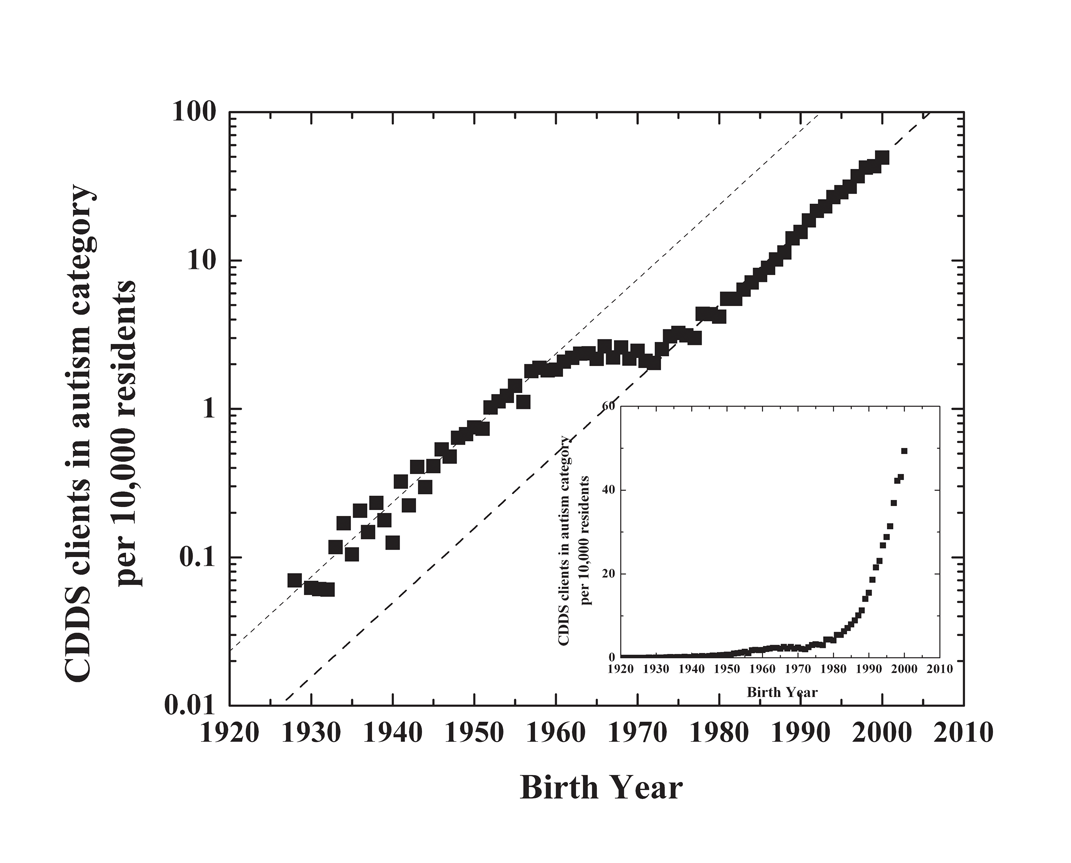
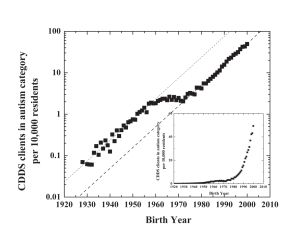
If one takes one of the CDDS datasets (I used one from 2007) and combines it with census type data, one can produce this figure (Figure 1 from the published comment):
Comment-figure

Graphing the data on a log-normal graph such as this shows that the data are exponential. Going all the way back to birth year 1930. It isn’t a simple exponential, though. There is a region around 1960 to 1974 where the growth stalled. It is remarkable that the same time constant fits the data all the way back to 1930, with the exception of this 1960-1974 region.

Fitting exponential data to two lines just doesn’t make sense. There is no “change point” in an exponential. One can force a fit onto exponential data, but it isn’t meaningful.

Using the log-normal plot I supplied one can see that there are change points in the trend. Obvious to any observer. But they are in 1960 and 1974, not in about 1987/88 as MacDonald and Paul calculated.

As is customary, MacDonald and Paul supplied a reply to my comment. In this they make only a very brief reference to the fact that the very document from which they pulled the California data states it is inappropriate to use it the way they did: “We agree with Carey (3) that analysis of long term epidemiological studies would be desirable and that there are a number of potential confounding issues associated with analysis of administrative databases.”

One mistake I made was in not clearly spelling out that fitting a hockey-stick to exponential data is inappropriate. It is obvious, but rather than address this problem MacDonald and Paul state:

Changepoints were determined by fitting a hockey-stick model (10) to the data for each dataset. This approach uses ordered data and piecewise linear regression to split the response variable into two groups. A linear regression line is generated for each group, and the point of intersection for these regression lines and the residual sum of squares for each line are determined. The intersection point that minimizes the residual sum of squares is the changepoint.

Carey (3) used a log transformation of the cumulative incidence to produce a log-linear relationship for the CDDS data of the form: Log (Cumulative Incidence) = B0 + B1 (Year). Subsequently, he states that he could not observe changes in the log-linear relationship of CDDS cumulative incidence at or around our changepoint year of 1989, but no other analysis was performed. Examining original CDDS data in the inset of Carey’s (3) Figure 1, it certainly seems likely that there is a changepoint in the 1985-1990 range, and being unable to observe such a change in the log-linear plot may be purely an artifact of the scaling of the plot. We conducted a changepoint analysis on transformed CDDS data from 1970 to 1997 (from (7)) and found a changepoint in 1984. The shift to an earlier changepoint using the log transformed data may result from stabilization of the variance associated with the transformation, and the resulting shift in the minimization point for the residual sum of squares for the regression line for the larger cumulative incidence values in later years.

It’s an odd response. The authors are focused on defending their original result of a change point in the 1980’s rather than considering the entire new dataset. They ignore the problems inherent in claiming a change point in exponential data, but I should have stressed that more in my comment. Even if MacDonald and Paul claim it is appropriate to make this fit, they ignore the obvious change points in the log-normal graph. Consider the change point at about 1960. It is abundantly clear in the log-normal graph. In the inset of my figure, the linear graph, that change point is still obvious to the eye.

If the real goal of their work was to identify change points there is no reason to ignore those which were (a) outside of their original time span and (b) obvious in a different presentation of the data. This is not just flawed, it is irresponsible. They are ignoring their own stated goal:

As we point out in the paper, while artifacts associated with observed increases in various studies cannot be ruled out, from a precautionary standpoint, it seems prudent to assume that at least some portion of the observed increases in incidence is real and results from the interaction of environmental factors with genetically susceptible populations. Since exposure to environmental factors is potentially preventable, identification of relevant candidate factors should be a research priority.

Why, I would ask, are potential environmental candidates which might involve change points in 1960 and 1974 not important, but one in the late 1980’s is?

Apply Now for a Travel Grant to IMFAR

18 Jan

IMFAR, the International Meeting for Autism Research is approaching and that means that it is time for the Autism Science Foundation’s Travel Grants. These are grants for stakeholders which reimburse up to $1,000 of expenses to attend IMFAR.

I was an ASF Travel Grant recipient last year. It was a great experience. A very busy experience, but a great opportunity to meet a number of researchers and see talks on the latest research.

Here is the email announcement from the ASF:

Apply Now for a Travel Grant to the International Meeting for Autism Research

The Autism Science Foundation announced today that it is offering a limited number of grants to parents of children with autism, individuals with autism, special education teachers, and other stakeholders to attend the International Meeting for Autism Research (IMFAR). This year the conference will be held in Toronto, Canada from May 17-19.

The awards will reimburse up to $1,000 of actual expenses and can be used to cover registration, travel, accommodations, meals and other directly related expenses, including childcare or special accommodations to enable individuals with autism to participate.

“We are thrilled to be able to offer this program for the third year in a row and to give back to the autism stakeholder community in a research-focused way,” said Alison Singer, president of the Autism Science Foundation.

“These scholarships are a wonderful opportunity to bring more stakeholders to IMFAR and enhance discussion and interactions among all key constituencies,” said Dr. Helen Tager-Flusberg, President of INSAR and Professor of Psychology, Anatomy & Neurobiology and Pediatrics, Boston University.

To apply:

Open to all autism stakeholders: individuals with autism, parents of children with autism, special education teachers, graduate and undergraduate students, journalists, scientists, and others.
Grants can be awarded to US citizens only.
Applicants should send a letter to grants@autismsciencefoundation.org describing why they want to attend IMFAR and explaining how they would share what they learned with the broader autism community.
Letters should be sent as Microsoft Word attachments of no more than 2 pages, 12-point type, “Arial” font, with standard margins.
In the email subject line please write: IMFAR Grant.
Letters must be received by February 29, 2012.

Additional application information is available at http://www.autismsciencefoundation.org/what-we-fund/apply-for-IMFAR-travel-grant.

Grant recipients will be announced in March.

Newt Gingrich, Autism Advocate

18 Jan

2012 is a presidential election year in the United States. With the campaigns comes the courting of voters. Newt Gingich, Republican Hopeful, has posted an article to his site: Newt Gingrich, Autism Advocate. It’s an excerpt from a Tea Party website article.

I’d love to take the time to go through Mr. Gingrich’s voting record on disability issues. The Republican Party has not always been the best ally from what I’ve seen. Should Mr. Gingrich move up in the ranking (he’s about 20 points behind Mitt Romney at the moment) perhaps I’ll take that time.

If you recall, 4 years ago the candidates courted the “autism vote” even to the point of thinking that we are all behind the failed vaccine-epidemic model of causation. Both Mr. Obama and Mr. McCain made statements on the subject. This campaign season has already seen the departure of Michele Bachmann, whose unsupported (“over the top” according to Time Magazine) statements on Gardasail were credited with contributing to her decline in the polls.

Time Magazine: Great Science Frauds

14 Jan

Add Time magazine to the list of those calling out Andrew Wakefield a fraud. Not just any fraud, a “great science fraud”:

Great Science Frauds

Thinking Person’s Guide to Autism, the first two chapters

12 Jan

When I first wrote about the Thinking Person’s Guide to Autism (TPGA) I mentioned I planned a series of articles. Multi-part discussions of books have been done before on Left Brain/Right Brain but usually for books that are, shall we say, less helpful than TPGA.

TPGA is a series of essays. Some are as short as two pages. Some up to 5 pages and maybe even more. The essays are arranged in chapters like “After the diagnosis: first steps” and “Autism–Adult Voices” and “Autism–Parent Voices”. This approach makes TPGA exactly the sort of book I find useful and I wish I had access to when my kid was first diagnosed. I love books. I love to read. But my approach to reading has had to change. In the past I’d read Robert K. Massie’s 928 page Peter the Great: His Life and World more than once. That was before kids. Kids, any kids, change your life in many ways. For those who find that they can still read lengthy books, you have my respect. I can’t. Being able to grab 5 or 10 minute to read an essay is more my usual approach these days. With TPGA you are also not stuck reading the book front to back. Want to read about “School and Education Issues”? Jump to that chapter. Want to read about “Therapies and Service Providers”? Flip to an essay in that chapter.

The introduction makes clear the scope and goals for the book.

The Goal of The Thinking Person’s Guide to Autism is to help you fast-forward past society’s rampant autism fabrications and negativity by providing clear, thoughtfully presented, balanced, and referenced information. We also want you to understand that autism awareness and acceptance are not merely noble but also necessary attitudes–and are separate matters from the autistic and other autism communities’ never-ending fights for medical, legal, social, and educational accommodation.

The first two chapters in TPGA are “After the Autism Diagnosis: First Steps” and “Practical Advice for Autism Parents”. Some essays can be found online and will give you an idea of the book. From the “After the Autism Diagnosis” chapter, here are a couple examples:

Squillo’sadvice in “What Now? Ten Tips for Families with a New Autism Diagnosis” is right on target. Here are some example topics: “Take a few days (at least) before making any important decisions” and “Keep a record of every interaction you have with schools, therapists, doctors, etc. regarding your child, even if it’s just a casual discussion in a hallway. Make copies of every questionnaire you fill out.”

Emily Willingham’s How Do People React When They Learn Your Child Has Special Needs? is likewise excellent.

Practical Advice for Autism Parents includes essays “Autism: Feeding Issues and Picky Eaters” by Judy McCrary Koeppen and Does Your Child With Autism Have a Daily Record? by Shannon Des Roches Rosa.

These are just examples but they make the point: there is a lot of information which is extremely valuable to parents who are trying to quickly come up to speed on subjects they probably have little experience with.

Also included in the “First Steps” chapter are two essays I would like to highlight. First is “Identifying and Avoiding Autism Cults” by Shannon Rosa. She speaks from personal experience for many of her points:

Families of children with new autism diagnoses can avoid cultish mistakes like ours if enough veteran parents reach out to them, and encourage them to choose logic over hype. We can help parents of newly diagnosed children with autism make careful choices and maximize limited resources. We can prevent them from taking their kids on expensive and emotionally-propelled journeys to nowhere.

Another excellent essay is “What Is Neurodiversity” by Mike Stanton. Mr. Stanton is one of those people I have never met but for whom I have an enormous respect. Mr. Stanton brings not only his views as a parent to the question, but some input from his child as well. “What is Neurodiversity” is an essay that could help a lot of people who have misconceptions about the topic as well as people new to the subject. Not to steal his thunder, but in case you don’t take the time to read the essay here is Mr. Stanton’s concluding paragraph:

I am a parent and a professional. I am not autistic and therefore would not presume to speak for autistic people. There are many who can speak for themselves. You can find a really good sample at the Autism Hub, a place where autistic people, parents and professionals meet with no distinction and anyone is welcome providing you share our respect for the condition of being autistic. We seek no fundamental alteration to this state of being but we do seek to intervene sometimes should the situation require it. And when we do intervene we should remember the words of a very wise person with autism, my son.

My autism is not a problem. It creates problems. But it is not going to go away. I want help with my problems not with who I am. I want you to offer support but do not try and change me into someone else.

Autistic Advocacy Group Condemns Presidential Appointment of Anti-Vaccine Activist Peter Bell

12 Jan

Peter Bell of Autism Speaks has been appointed to the President’s Committee for People with Intellectual Disabilities. As I read about the appointment I felt that there would be some reaction. Perhaps even a strong reaction. And, as you will see, I was correct. The Autistic Self Advocacy Network (ASAN) has issued a press release condemning the appointment.

Here is the press release:

FOR IMMEDIATE RELEASE

PRESS CONTACT:
Melody Latimer
Autistic Self Advocacy Network
Phone: 202-630-7477
mlatimer@autisticadvocacy.org

AUTISTIC ADVOCACY GROUP CONDEMNS PRESIDENTIAL APPOINTMENT OF ANTI-VACCINE ACTIVIST PETER BELL

Recent appointee Peter Bell has a long history of supporting fringe, anti-vaccine positions widely discredited in the scientific community

Washington, DC – January 12, 2012 – The Autistic Self Advocacy Network, the nation’s leading advocacy group run by and for Autistic adults, today expressed concern and disappointment over President Obama’s announcement Tuesday of his intent to appoint anti-vaccine activist Peter H. Bell as a member of the President’s Committee for People with Intellectual Disabilities.

“Bell’s appointment shows such contrast to the forward motion the Obama administration has shown in the areas of autism and disability as a whole,” said Melody Latimer, ASAN Director of Community Engagement and an autistic parent of autistic children herself.

Bell, Executive Vice President of Programs at Autism Speaks, has a long history of supporting anti-vaccination related causes, dating back to his time as President and CEO of Cure Autism Now, which merged with Autism Speaks in 2007. Despite wide ranging scientific evidence to the contrary, Bell and others in the anti-vaccine movement have long maintained the existence of a link, a position viewed as irresponsible by many public health advocates.

“The link between Autism and vaccines has long been discredited, and so an appointment placing an anti-vaccine leader in a position to influence a greater audience and re-open the issue is disappointing and ill-advised. We respect and appreciate the Obama Administration’s commitment to autism issues, but hope they will vet their appointees more carefully going forward,” Latimer noted.

Autism Speaks, Bell’s employer, has a checkered and controversial history. In 2009, Autism Speaks lashed out at the Department of Health and Human Services for refusing to incorporate research objectives connecting autism to vaccines in the Inter-Agency Autism Coordinating Committee’s Strategic Plan for Autism Research. In response to Autism Speaks’ disconnect from mainstream science on this question, several senior executives resigned from the organization in protest.

Autism Speaks has also been viewed with substantial controversy by Autistic people themselves, in large part due to the organization’s failure to meaningfully include individuals with the disability on their board of directors or in more than token roles in their senior leadership. Other criticisms of the organization include the low percentage of funds Autism Speaks invests in services, abnormally high executive salaries and what many have interpreted as deeply offensive advertising utilizing fear and pity to raise money. In 2009, the organization debuted its much-ridiculed video “I Am Autism” at the United Nations in New York City, presenting autism as an anthropomorphic force aiming to steal children. After widespread protests from Autistic adults across the country and criticisms from other disability organizations, Autism Speaks eventually pulled the promotional film.

The Autistic Self Advocacy Network (ASAN) is the nation’s leading advocacy organization run entirely by and for Autistic adults and youth. ASAN’s supporters include Autistic adults and youth, cross-disability advocates, family members, professionals, educators and friends. ASAN was created to provide support and services to individuals on the autism spectrum while working to change public perception and combat misinformation by educating communities about persons on the autism spectrum. The organization’s activities include public policy advocacy, community engagement to encourage inclusion and respect for neurodiversity, quality of life oriented research and the development of Autistic cultural activities and other opportunities for Autistic people to engage with others on the spectrum.

Brian Deer responds to David Lewis’ complaint

10 Jan

Much attention has been focused on Andrew Wakefield again recently. This follows Mr. Wakefield’s lawsuit against Brian Deer, Fiona Godlee and the British Medical Journal (BMJ). Also, a lengthy complaint authored by David Lewis was made public, detailing his views about the allegations of fraud levied against Mr. Wakefield by the BMJ.

The two are not directly related as Mr. Lewis’ complaint fails to address many of the issues raised by the BMJ in their articles alleging fraud. That said, If one pokes around Mr. Deer’s website, one will eventually stumble upon this page: David L Lewis: indignant abuse as complaints turn to nothing. There is an introduction to the subject including Mr. Deer’s interactions with Mr. Lewis followed by a point by point response to Mr. Lewis’ complaint. For anyone who may be thinking that Mr. Deer is intimidated by the complaint I encourage you to read the response. It is very much in the style of Brian Deer. For example

DAVID L LEWIS: “My report, which I have submitted to UCL, UKRIO and HEFCE, includes 72 emails exchanged between me and the BMJ’s editors.”

DEER: I offer the recipients at UCL, UKRIO and HEFCE my sympathy.

Aside from such dismissive statements, Mr. Deer takes on the many (often repetitive) claims by Mr. Lewis directly. Mr. Lewis’ complaint and main thesis in his rapid response to the BMJ focus on non-specific colitis as used in the Lancet paper: the histology grading sheets of Dr. Dillhon somehow prove that there was no fraud. It is a confusing argument because it doesn’t address the many issues raised by Mr. Deer and the BMJ.

Per Mr. Deer in his introduction:

These biopsy assessments, however, weren’t the basis upon which, in January 2011, the BMJ concluded that Wakefield’s MMR work was “an elaborate fraud”. The evidence we presented rested firmly on the GMC panel’s findings of research dishonesty, and was overwhelmingly related to Wakefield’s activities with regard to the admission of patients to the study, as well as the purported clinical histories and findings which lay behind a claim by Wakefield of a 14-day temporal link between the administration of MMR and the first “behavioural symptoms” of autism. We say this purported link was fraudulent.

Later, in response to Mr. Lewis’ claim:

DAVID L LEWIS: “… alleged that Andrew Wakefield fabricated the diagnosis of colitis in a 1998 Lancet study involving 12 children with autistic spectrum disorder (ASD).”

Mr. Deer responds:

DEER: At the core of our problems in dealing with Lewis is that nowhere was such an allegation made in the BMJ. He repeatedly identifies my feature “Autistic enterocolitis under the microscope”, published in April 2010, but this simply doesn’t make such an allegation. Plain reading would make this clear.

Not only can I find no foundation for this fundamental of Lewis’s complaint (and I think I’d remember forming any view at that time that the histopathology reporting in the Lancet was fraudulent, as distinct from, say, wrong, misleading or incompetent), we consulted legal counsel, before and after publication, and expert peer-reviewers. We remain unable to identify any text inferring Wakefield’s intent with regard to histology reporting. I’ve similarly asked Nature to identify any such text, and they too have failed

Mr. Lewis has taken issue with the fact that the BMJ did not print his rapid response exactly as submitted:

DAVID L LEWIS: “To support their new fraud theory, Godlee rewrote my Rapid Response, removing any evidence that undermined their allegations against Wakefield and others.”

DEER: Lewis’s rapid response was extensively re-written because it was false and defamatory. Legal advice was taken. Two peer reviewers rejected the submitted text. No changes had any effect in supporting any “fraud theory”, whether new or otherwise. Lewis approved the published text.

In hosting the words of Mr. Lewis, the BMJ would itself be responsible in part for any defamatory language included. This is the way of the law in the U.K..

In my opinion, the Mr. Lewis’ arguments are a side show of the the Wakefield saga (Yes, in my view Mr. Wakefield is a major side show in itself). They don’t address the substance of the claims of fraud put forth by the BMJ.

Navigating Love and Autism

9 Jan

If you haven’t already read it, Navigating Love and Autism, is worth your time. It is an article by Amy Harmon of the New York Times.

When I first saw the pictures from the article I though, “Hey, I know these guys!” It took me a minute to realize I know them from the series “Autism Talk TV” (the best TV on TV) with Alex Plank (if you don’t know Alex Plank, maybe you know his site: Wrong Planet)

I’ve been hoping to get the time to do a good piece on the article. In my delay, Seth Mnookin has done better than I could. Mr. Mnookin’s first piece is The New York Times’s incredible piece on the lives and loves of two adults with Aspergers” and the second is “SciWriteLabs 7.1: The New York Times’s Amy Harmon on neurodiversity and writing about autism is an interview with the author.

If you are a parent and your reaction is, “those aren’t the experiences of my kid”, I’d encourage you to check it out.

Besides, how can you stay away from a New York Times article with the following correction:

Correction: December 30, 2011

An article on Monday about Jack Robison and Kirsten Lindsmith, two college students with Asperger syndrome who are navigating the perils of an intimate relationship, misidentified the character from the animated children’s TV show “My Little Pony” that Ms. Lindsmith said she visualized to cheer herself up. It is Twilight Sparkle, the nerdy intellectual, not Fluttershy, the kind animal lover.

Around the blogosphere January 8 2012

8 Jan

Or, at least, a small fraction of it. There are times when I have to remind myself to get out and read more. Not papers, not news, but blogs. I don’t know why I have to remind myself. There is so much good stuff out there.

In no particular order, and for no other reason than these stuck in my mind for sometimes long periods of time, here are some blog posts and bloggers I’ve been reading:

When I first came into the online autism discussions one of my favorite writers was Jeanette (Mom26children). As you can gather, she has six children. Of those, 5 are autistic and she’s seen the breadth of the spectrum in them. The last post on her blog is from May, but it is a great one: Age (s) of Autism…. I Couldn’t Resist 🙂 . She tells us that two of her kids, kids who had major challenges as young children, no longer meet the criteria for special education. She credits her kids and the people who worked with them.

Emily Willingham is part of the Thinking Person’s Guide team. She has a Ph.D. in biology. That’s really only a starting point. She has the research background and, much more, repeated shows that she has science chops to delve into research papers on autism (as journal editor, this shouldn’t be surprising). In a recent post (On autism, sAPPa, immunity, and subsets ) she deconstructs the publicity around a recent paper. It’s a classic problem where the paper and the press release oversell the relevance to autism. This problem isn’t restricted to autism, by the way. I see it a lot where people try to link their work to some hot topic.

The Crowded Autism Web is a recent post from The Autistic Me. As the writer points out, The Autistic Me has been around for several years but 2012 is a year for expanding readership. Also, you can follow The Autistic Me on Twitter.

Shannon Rosa is another member of the Thinking Person’s Guide team. One thing TPGA does that I really wish I could do well is interviews. One example is Interview: Christa Dahlstrom of Flummox and Friends, where Ms. Rosa interviews the creator of a live-action show which looks to explore social interactions. “[A] little bit Pee Wee’s Playhouse, mixed with The Big Bang Theory, with a little old-school Electric Company thrown in.

http://www.kickstarter.com/projects/2055453201/flummox-and-friends/widget/video.html