Archive by Author

Good Information being spread on Capital Hill

2 Oct

Last week, there was a briefing for U.S. legislators by Mr. David Kirby and Mr. Mark Blaxill. As you can imagine, the topic was vaccines and autism. As you can imagine, there were some inaccuracies and there was at least one outright misrepresentation.

I applauded an effort by Amy Pisani of Every Child By Two, who wrote the staffers ahead of the meeting. I was also appreciative of a letter by Voices For Vaccines.

Well, now I give a great big thank you to Congressman Waxman. Congressman Waxman is the chair of the Congressional Committee on Oversight and Reform. To put that in perspective, “Oversight and Reform” is the committee that Congressman Dan Burton used to investigate autism and vaccines. (a very good discussion of what went wrong there is in Autism’s False Prophets).

Congressman Waxman’s office sent out a “Dear Colleague” letter. It is a good, succinct discussion of autism and vaccines, and, as such, I think it worth posting. And forwarding to people who may have questions about this issue.

It’s also worth thanking Congressman Waxman for taking the time to work on autism issues.

Resources Regarding Vaccines and Autism

October 1, 2008

Dear Colleague,

Since 1998 some people have been raising concerns that there may be an
association between childhood immunizations and autism spectrum
disorder. I am writing to let you and your staff know that there are a
number of resources available to understand what the science says
about whether vaccines could contribute to autism.

Institute of Medicine report on vaccines and autism

In 1999 the Department of Health and Human Services contracted with
the Institute of Medicine (IOM) to review a number of different
vaccine safety issues and to make recommendations about future
research needs. IOM convened a committee of experts that was carefully
vetted for conflicts of interest. The committee issued nine reports,
all of which are available on line at: http://www.iom.edu/CMS/3793/4705.aspx.

In 2004, the committee issued its final report, which analyzed the
studies, published and unpublished, that looked at two theories:
whether the Measles-Mumps-Rubella (MMR) vaccine could cause autism;
and whether the mercury-containing vaccine preservative thimerosal
could cause autism. The committee concluded that the “evidence favors
rejection of a causal relationship between thimerosal-containing
vaccines and autism” and the committee also concluded that the
“evidence favors rejection of a causal relationship between MMR
vaccine and autism.” This report is available at:
http://www.iom.edu/CMS/3793/4705/20155.aspx.

Other resources on vaccines and vaccine safety

Since the IOM report was published there have been additional studies
that looked at a possible link between vaccines and autism. Below are
several other links to government or private organizations with
helpful information about the latest research into vaccines, vaccine
safety, and autism and vaccines:

The Centers for Disease Control and Prevention
http://www.cdc.gov/ncbddd/autism/vaccines.htm

National Network for Immunization Information
http://www.immunizationinfo.org

Institute for Vaccine Safety at Johns Hopkins University
http://www.vaccinesafety.edu

American Academy of Pediatrics
http://www.aap.org/healthtopics/Immunizations.cfm

Information regarding mitochondrial disorders and vaccines

Another concern that has received some attention is whether people
with mitochondrial disorders are more susceptible to vaccine injury.
This issue was in the media after it became public that in 2007, the
Vaccine Injury Compensation Program (VICP), the no-fault compensation
program for people who have been injured by immunizations, compensated
nine-year-old Hannah Poling for injuries she sustained from her
immunizations. Hannah Poling suffered from a mitochondrial disorder,
which is a genetic or acquired defect in the part of each cell that
helps produce energy. People with these disorders are susceptible to a
number of stressors, including fever, illness, dehydration and certain
kinds of medication. In Hannah Poling’s case, after her immunizations
she developed a fever, lethargy, irritability, and other symptoms of
encephalopathy. These symptoms worsened over a period of months to
includ! e muscle weakness and features of autism. Instead of taking
this case to the vaccine court, the VICP conceded the case and agreed
to compensate Hannah Poling.

This case raised concerns that there may be an association between
mitochondrial disorders and autism. Mitochondrial disorders are poorly
understood and there is much research that needs to be done. However,
according to the United Mitochondrial Disease Foundation: “There are
no scientific studies documenting that childhood vaccinations cause
mitochondrial diseases or worsen mitochondrial disease symptoms. In
the absence of scientific evidence, the UMDF cannot confirm any
association between mitochondrial diseases and vaccines.” This
statement is available at: http://www.umdf.org/site/c.dnJEKLNqFoG/b.3616911/apps/s/content.asp?ct=5087517.

Following this case, NIH, HHS, and CDC organized a workshop entitled
“Mitochondrial Encephalopathies: Potential Relationships to Autism.”
The workshop was held on June 29, 2008 in order to explore this
complicated topic and panelists included experts from around the
country. The proceedings from this workshop state that because
acquired infections and the associated inflammatory responses are a
known trigger for mitochondrial disease, “the workshop panelists
strongly encourage vaccinations in the hundreds of children they treat
for mitochondrial disease.” A summary of this workshop is available
at: http://www.ninds.nih.gov/news_and_events/proceedings/20090629_mitochondrial.htm

CDC has additional information on its website at:
http://www.cdc.gov/ncbddd/autism/mitochondrial.htm

I hope you find these links useful. If you are interested in other
resources, please do not hesitate to call Sarah Despres or Dr. Stephen
Cha on my staff at 5-5056.

Sincerely,

/s
HENRY A. WAXMAN
Member of Congress

Reality bites back II

2 Oct

Its all going wrong for the believers of the vaccine/autism religion. This was supposed to be the time of their Fall offensive, spearheaded of course by Mother Warrior Jenny McCarthy and her appearance on the Oprah Winfrey show.

So far though, the media seem markedly less keen to talk to her about her recovering/no, recovered/ah….recovering/no, recovered/oh whatever autistic child. And the science is beginning to get equal air time. Recently, Dr. Ari Brown, Dr Lou Cooper and our very own Ken participated alongside a couple of minor league celebs on a discussion regarding autism and vaccines on the US show Good Morning America.

Yesterday the Age of Autism exhorted its members to mob a website that had created a Jenny vs Amanda poll (because popularity contests will definitely help autistic people). When the Pharyngula blog got wind of this PZ, the blog owner, asked his readers to vote too. The outcome?

Yikes.

The world view of the autism/vaccine zealots was shaken mightily yesterday. They’ve always imagined themselves as a large group with considerable power. Yesterday, they got squashed like a flea on a windscreen over something as meaningless as a celeb poll. Imagine how they must’ve felt to read some of the comments there. In fact, I’ve been tracking a lot of the gossip websites who’ve mentioned Jenny of late. She’s not popular outside her own crowd. Parents of autistic kids are catching on. Here’s a quote from someone I do not know and have never heard of before today commenting on Hollywood Today:

I am a single father of an autistic child and agree that Jenny Mcarthy is doing more harm than good. Why do we put more credibility in an actress / playboy bunny than doctors and other more credible sources.

And a mother of two autistic kids says on Ecorazzi:

As a mother with TWO autistic children, I find McCarthy’s ignorance appalling. Don’t we have enough difficulty in dealing with and understanding the Autism Spectrum without letting fad pseudo-science sway our families away from proper health care for our children?

These are not isolated examples I am very happy to report.

Yesterday the mercury militia – who think we’re just a few people compared to their ‘tens of thousands’ got a great big wet fish slap of reality.

Mother Warrior McCarthy is now complaining the US Presidential candidates are snubbing her. For goodness sake, why on earth did you ever think they would listen to you? You’re a D-list celeb who can’t even get her story straight on whether her son is recovered or not.

Anyway, she says:

I literally flew to go see MCCain, his team agreed to it (meeting), I was prepped and then all of a sudden his campaign manager said, ‘We’re ahead in the polls and this is a very, very touchy subject. Let’s not give this interview right now.

Wow, McCain employs the worst PR people in the world. They tell someone that they’re not going to interview them as they’re too controversial. How convenient for Jenny!

I’m thinking the conversation went something more like this:

JM: Hi, I’m Jenny McCarthy, can I speak to John McCain?

PR Dude: Sorry? You’re who?

JM: Jenny McCarthy, I’ve appeared in films such as ‘Scary Movie 3’ and…uh…

PR Dude: Whatever…why do you want to speak to the boss?

JM: About vaccines and autism! They’re poisoning our kids! Except mine is now recovered! No, wait – I have a book coming out, make that ‘recoverING’.

PR Dude: The country – no, the world – is in a national financial crisis and you want to talk to the boss about some quacky ideas never supported by science. Go away lady.

JM: But…but…I’m JENNY MCCARTHY…BULLSHIT!….BULLSHIT!!! (Where’s the camera?)

Now Jenny is desperate to get ahold of Obama:

MCCarthy is now desperately hoping Barack Obama, MCCain’s opponent in the race for the White House, agrees to champion her cause and address the autism versus vaccines issue.
She says, “We are trying (to contact him)… We have sent numerous (requests).

This is the same Barrack Obama who has said:

I am not for selective vaccination, I believe that it will bring back deadly diseases, like polio.

He might see you Jenny. Me might even pretend to listen. You might even get your picture taken with him. Better yet, he might pass on the opportunity to see you and then you can tell people how its a big conspiracy. You might even manage to squeeze another book out of it.

None of that will change reality though. The tide isn’t changing just yet but there’s been a few signs that it might be on its way.

Collecting IACC comments

2 Oct

Thanks to all who wrote to the IACC (or even thought about it!) about the Strategic Plan.

I’m trying to compile a list of responses. If you are OK with your comments being included, send them to sullivansjourney@gmail.com.. If you would like to remain anonymous, send your comments using a form that’s been set up here.

These responses will be shown to researchers to let them know that the greater autism community isn’t just about vaccines. It will show them that, yes, the greater autism community appreciates their support.

ScienceBlogs Book Club

1 Oct

I was very honoured to be asked to participate in the latest round of the ScienceBlogs Book Club.

ScienceBlogs Book Club

ScienceBlogs Book Club

The ScienceBlogs Book Club is exactly as it sounds – a discussion round table on a particular science related book. In this instance, the book in question is Dr Paul Offit’s Autism’s False Prophets.

This promises to be a very interesting discussion, mostly because numbered amongst the contributors is Dr. Offit himself. The full line up of contributors is:

Dr. Offit
Kristina
Orac
Professor Bob Park
and me.

A rather intimidating line up in which to ply my blogging wares. Everyone except me is either a Doctor or a Professor. It does feel a little like being made to sit outside the Headmasters office (again).

All joking aside, it really is an honour to be asked to blog alongside such heavy hitters (even if I do know two of the bloggers pretty well) and I hope to be making sure I am talking as much about autism and the future of autism research as I am vaccines. I think Dr. Offit – given his final chapter – will approve of that.

So – come across and participate. I’d like to see UK-ers over there too if possible (Rutty, I’m thinking of you 😉 ).

Respond Now to the IACC Request for Information (Please)

30 Sep

Here is a link to an email form that will help you to respond to the Interagency Autism Coordinating Committee. It is the “long form.”

Go ahead.

Really.

Check it out.

Now would be good.

There’s a link at the top of that page to a “short form” if the long one feels too daunting (I don’t think it is.)

Here’s a reminder of what the IACC wants to hear:

Information Requested

The IACC welcomes your comments on the draft Strategic Plan for ASD Research. The draft plan can be accessed at the following website:http://www.nimh.nih.gov/research-funding/scientific-meetings/recurring-meetings/iacc/strategic-plan/2008/iacc-strategic-plan-august-2008.pdf

Please organize your comments by the sections of the draft Strategic Plan:

How to Submit a Response

Responses will be accepted until September 30, 2008 via email to iacc@mail.nih.gov. Please limit your response to two pages (approximately 1,000 words) and mark it with the RFI identifier NOT-MH-08-021 in the subject line. You will receive an email confirmation acknowledging receipt of your response, but will not receive individualized feedback on any suggestions. The collected information will be reviewed by the IACC, may appear in reports, and shared publicly on the IACC website: http://www.nimh.nih.gov/research-funding/scientific-meetings/recurring-meetings/iacc/index.shtml.

Where it says, “Please organize your comments by the sections of the draft Strategic Plan…. Well the form (made by Sullivan) is laid out for you in the proper order and gives you the framework for waht you might want to say first, second, third, and so on.

Have you sent your thoughts to the IACC? Why not? Click here for that form I mentioned earlier. They want to know what Y.O.U. think. Seriously. They want to know what you think. If you only have one thought about autism research (too much money has been spent beating a horse that was dead to begin with… the vaccine/autism connection, then say something about that, if you love PECS and want more research about PECS then tell them that, if you want research into whether a certain PR man to the mercury-militia has a conscience … well, that’s not on topic, but you could say that you want more research into how to provide communication devices for autistic people who need them, or more research into the stress-induced diseases of autistic people like irritable bowel syndrome, or more research about the way the peculiarities of autistic people’s vision or hearing, how about research into the use of melatonin for sleep, or research into how to get kids off of certain prescription drugs by reducing stress, or how about how best to take care of the teeth of autistic children…) then share it! Don’t keep it to yourself. Share it! Now would be good. Time is a wasting! Let your voice be heard. They’ve heard more than enough from the likes of Lyndell Redwood and Jim Moody, let them hear what YOU want them to hear. If you have an aunt or grandparent who has some big ideas about what they should be researching for autistic people, then you can forward the URL for the automated form to them http://rolihlahla.com/iacc_longform.html . If you are an autistic adult you could tell them that you would prefer that autism not be eradicated in Suzanne Wright’s lifetime, or tell them you want help in figuring out how to get and keep a job. But they need to answer right now because time is flying.

http://www.7is7.com/otto/countdown.html?year=2008&month=9&date=30&hrs=23&ts=24&min=59&sec=59&tz=-240&lang=en&show=dhms&mode=r&cdir=down&bgcolor=%23CCFFFF&fgcolor=%23000000&title=Countdown%20To%20Deadline%20to%20Respond%20to%20the%20IACC

Mitochondrial disease discussion in Indianapolis

29 Sep

You may recall that there was a panel discussion on Mitochondrial Disease and Autism following the United Mitochondrial Disease Foundation’s (UMDF) meeting in Indianapolis. This, of course, was prompted by the news reports of the Hannah Poling case.

If you are looking for the incredibly short answer, quote mine, here it is:

To reduce the risk presented by acquired infections, the workshop panelists strongly encourage vaccinations in the hundreds of children they treat for mitochondrial disease. Among thousands of patients they had collectively seen, very few had deteriorated following vaccination, and in those few cases, it is difficult to determine that other stressors besides the vaccine did not play a role in the neurologic deterioration.

The panel discussion was held June 29th, and the report from that has just been published.

The panel was organized by people from NIH, NINDS, HHS and CDC.

Thomas R. Insel, M.D.
Director, National Institute of Mental Health, National Institutes of Health

Walter Koroshetz, M.D.
Deputy Director, National Institute of Neurological Disorders and Stroke, National Institutes of Health

Daniel Salmon, Ph.D., M.P.H.
Vaccine Safety Specialist, U.S. Department of Health and Human Services

Ed Trevathan, M.D., M.P.H.
Director, National Center on Birth Defects and Developmental Disabilities, Centers for Disease Control and Prevention

The panel included a lot of the names you would expect to hear from:

Kim M. Cecil, Ph.D.
Research Associate Professor, Cincinnati Children’s Hospital Medical Center

Bruce Cohen, M.D.
Department of Neurology, Cleveland Clinic Foundation

Stephen R. Dager, M.D.
Departments of Radiology, Psychiatry, and Bioengineering, University of Washington School of Medicine
Interim Director, University of Washington Autism Center,

Darryl DeVivo, M.D.
Sidney Carter Professor of Neurology and Pediatrics, Columbia University

Salvatore DiMauro, M.D.
Lucy G. Moses Professor of Neurology, Neurological Institute of New York, Columbia University Medical Center

Pauline Filipek, M.D.
Associate Professor of Pediatrics and Neurology, University of California, Irvine

James F. Gusella, Ph.D.
Director, Department of Genetics, Center for Human Genetic Research, Massachusetts General Hospital

Richard Haas, M.D.
Co-Director, Mitochondrial and Metabolic Disease Center, University of California, San Diego, School of Medicine

Robert K. Naviaux, M.D., Ph.D.
Co-Director, Mitochondrial and Metabolic Disease Center, University of California, San Diego, School of Medicine

Joseph Piven, M.D.
Director, Neurodevelopmental Disabilities Research Center, University of North Carolina, Chapel Hill

Roberto Tuchman, M.D.
Director, Autism Programs, Miami Children’s Hospital Dan Marino Center

Douglas Wallace, Ph.D.
Director, Center for Molecular and Mitochondrial Medicine and Genetics, University of California, Irvine

The proceedings are a summary, not a transcript of the actual event. It is a very good summary of what is known about mitochondria and mitochondrial disorders. It’s worth reading, and it is not very long. However, I’ll pull some summary information out here:

Mitochondrial genetics and biology

We all have two sets of DNA–the nuclear DNA (nDNA) that we are used to hearing about as the “blueprints” for inheritance and mitochondrial DNA (mtDNA) that are inside the mitochondria and help with the processes in the mitochondria.

Even though mitochondria are inherited from the mother, mitochondrial disease can involve both the nuclear and mitochondrial DNA, and, thus, mitochondrial diseases have multiple inheritance pathways.

You can have different mtDNA in a single cell or in different tissues–this is called heteroplasmy.

An overview of mitochondrial diseases

There are 200 mtDNA mutations and 2,000 nDNA mutations that can lead to mitochondrial disease. (The nDNA is much bigger than the mtDNA, so it isn’t surprising that more of the mutations are found on the nDNA).

The incidence of mitochondrial disease is between 1-5 in 10,000. But, the understanding is evolving.

Mitochondrial diseases present a very large spectrum. But, some generalizations can be made.

…they are typically progressive and multisystemic, most often affecting organs that have high energy demands such as the brain and nerves, skeletal and cardiac muscle, and the liver and kidneys.

There are a number of possible flags for mitochondrial disease, often when more than one area is affected at once. They noted, when the idea of autism and mitochondrial disease is discussed:

Of particular interest for this workshop, central nervous system manifestations of mitochondrial disease can include hypotonia, seizures, encephalopathy, ataxia, intellectual disabilities, global delay, and brain malformations. Sensory and peripheral nerves can also be affected, leading to deafness, blindness, or neuropathy.

Diagnosing mitochondrial disease

If you’ve already read about diagnosis of mitochondrial disease, you know it is a very complicated process.

The workshop panelists explained that diagnosis is often a lengthy process beginning with a general clinical evaluation followed by metabolic screening and imaging and finally by genetic tests and more invasive biochemical and histological analyses.

Metabolic screening, MRI, genetic testing and enzyme function through biopsy are all noted as tests, but no single test or even set of tests are definitive.

Known triggers of mitochondrial disease

If there is one section that the online autism communities are likely to zero in on, it’s this.

Mitochondrial diseases can go undetected for many years, and many cases display an episodic course with relatively stable periods punctuated by abrupt degeneration that may coincide with an infection or other stress to mitochondrial function.

If you’ve been thinking about this a lot, you’ve probably asked yourself how the mitochondria react during a fever. Fevers are an increase in temperature, which, naturally, takes an increased energy output.

Of possible importance, mitochondria are the major generators of body heat and are therefore extremely active during fever. It is not known whether fever or other aspects of the inflammatory or immune response to a virus or bacteria trigger deterioration after infection

The phrase that probably will be the one take-away for most people in the autism community who have been following the mitochondrial issue:

To reduce the risk presented by acquired infections, the workshop panelists strongly encourage vaccinations in the hundreds of children they treat for mitochondrial disease. Among thousands of patients they had collectively seen, very few had deteriorated following vaccination, and in those few cases, it is difficult to determine that other stressors besides the vaccine did not play a role in the neurologic deterioration.

From what I’ve heard, they were very, very strong in their recommendation for vaccination to protect against infectious disease in this very vulnerable population.

Other triggers include dehyration, reduced caloric intake or, in some cases, exercise.

Environmental causes of mitochondrial impairment: AZT, valproate, statins, chemicals like MPTP and the pesticide rotenone, fungal toxins, and even cigarette smoke and alcohol.

Mitochondrial diseases and autism: clinical parallels and evidence for a relationship

Both Autism and Mitochondrial Disease are broad spectrums. The subtypes for autism are less well defined, making it hard to make good comparison. It is difficult to pull only a couple phrases out of this section, but I will pick two:

Workshop panelists who treat children with mitochondrial disease noted that some of these children have autistic features, and some children eventually found to have mitochondrial disease are initially diagnosed with an ASD. In addition, siblings of children with maternally inherited mitochondrial disorders sometimes present with autism. Presumably, they have inherited the same mitochondrial mutation from their mother, but the mutation may be difficult to find. Workshop panelists who mainly see individuals with a primary diagnosis of autism found parallels with clinical observations in mitochondrial disease such as developmental regression, seizures, and gastrointestinal complications

and,

Additional parallels between ASDs and mitochondrial disease noted by the workshop panelists were in family histories and patterns of inheritance. These included possible maternal inheritance in some ASDs, a similar higher prevalence in males for both ASDs and some mitochondrial diseases, and a high frequency of psychiatric conditions such as depression, delusions and attention deficit disorder in families with mitochondrial disease, including in relatives who seem otherwise unaffected.

Advancing research on the relationship between mitochondrial disease and autism: needs, priorities and emerging tools

This section notes two types of studies which they suggest should be done: a targeted and an unbiased approach.

By targeted they mean a study that

…would involve a thorough investigation of a relatively small ASD population selected for characteristics that indicate a greater likelihood of mitochondrial involvement. Such a strategy might involve more in-depth or invasive testing, including, for example, muscle biopsy and brain imaging with MR spectroscopy.

On the other hand, the unbiased approach:

… would instead survey a larger, more diverse population and could inform questions about the extent to which mitochondrial disease contributes to ASDs more broadly.

From my perspective, both sound like good avenues for research–neither better or more important than the other.

If you are following this subject, I would again urge you to read the entire summary. It isn’t very long. It is unfortunate that people (myself included) will pull bits and pieces out.

Broken Families, Not Broken Children

29 Sep

Introduction – This is a Guest Blogged piece, written by a father in what is a far from unique situation and yet a situation we hardly ever discuss. Its humbling, touching, sad and affecting. Its also a microcosm of how fractured the autism community has become and how some are prepared to accept dangerous treatments where others are simply not. I hope you can give the author some feedback after you read this piece. Kev.

Broken Families, Not Broken Children

By a Proud Father

I’m sitting here, having just put my son to bed, and dreading having to take him over to his mother’s in the morning. This is my long weekend with him – Friday evening until Tuesday morning – and they go by so quickly. I’ll see him in a couple of days for 24 hours before he’s gone again for another 4 or 5 days. It’s a convoluted mess, but the best I can do right now. He’s handling it very well and we have way too much fun when we’re together. I don’t know about the other days, and I try hard not to think about them too much. I hope he’s as happy as he seems to be here.

You always hear about the high divorce rate among parents of autistic children. I guess my assumption was always that one of the parents was never able to deal with the realities of raising an autistic child and bailed out of the marriage with a comment like, “I just can’t handle this. I’m sorry.” (Sound of front door closing.) But now I wonder whether it’s often a different situation entirely – two parents who love their autistic child but are at completely opposite ends as to how to “treat” them. I say that because that is exactly what has happened to my marriage and my family.

I will be the very first to admit that our marriage had never been perfect, that it had more than its share of rocky times. But there were never any “external” factors as such, and our lives were devoted to our son, who will be 5 at the end of this year. I won’t go into all of the details of the first few years of his life; I’m sure everyone has heard of – or lived – them all: missed milestones, speech delays, socialization problems, repetitive behaviors, and so on. But we accepted it – I thought – and started the usual speech, occupational, and physical therapies, and he began attending a preschool PPCD class at the elementary school down the street where he will eventually go to Kindergarten and grade school.

About a year and a half ago, my wife mentioned she had heard of a place in Austin that could help our son. At that time, we had not heard of Wakefield et al, and were only marginally aware of the vaccine-thimerosal-autism “issues”. Our first appointment went fine it seemed, and we got a list of supplements as well as dietary guidelines to follow. I remember leaving there and heading home to Houston on a mild, pleasant winter afternoon, thinking, “Wow, now we can really get him some help and everything will be fine.”

But it went downhill from there. As I started to do more and more reading and more and more research on what they wanted to do to our son, I became increasingly concerned about the lack of proven effectiveness – and more importantly – the safety of the treatments. I tried to show my wife that this was all starting to get more than a little scary, but she blew it off, saying that these people were the only ones that really cared about helping our son.

I had allowed our son to undergo several weeks of B-12 shots, the only effect being that it made him jumpy and restless at night (he has always been a good sleeper and consistently gets 10 hours a night). I had allowed him to get several weeks of DMSA suppositories to absolutely no effect. I had allowed gallon after pound of blood, urine, and stool samples to be taken from him and sent off to the mail-order labs we all know about, the ones who send back pretty, colorful lab reports designed to show parents how much they know and how much they care about their kids. I showed her the lab reports that we did manage to get from the reputable labs that completely contradicted the other ones. She refused to allow him to get his 2nd MMR shot (although his pediatrician – an excellent, common-sense doctor – allowed us to wait a bit on that one, she did insist that when he turns 5, he will get the shot.) The DAN! protocol, the Yasko protocol, homeopathy, naturopathy, functional medicine, and so on, and so on.

I kept telling my wife that this had to stop. In the meantime, I heard things like, “You don’t want him to get any better so he can remain dependent on you the rest of your life”, and “If you don’t want to help your son, get out of my way”, and “Didn’t you hear the (DAN) doctor when he said ‘It’s clear the metals are there’?”, and “Do you want him to stay like this forever?” (that last one – and other similar comments – said in front of our son). No, there is no such thing as an autistic meltdown, they’re all temper tantrums and should be treated as such. Stop every single stem, it’s bad for him. No, he’s a child with autism, not an autistic child (as if it were a disease that needed to be eradicated).
And then, of course, along came Jenny McCarthy to validate everything.

I somehow managed to keep the scary stuff away from him for a while (I’ve found out that at least some of these doctors are hesitant to insist on treatments if one parent is adamantly opposed to it). But then one day a new package came in the mail: DMSA suppositories, B12 shots, Valtrex, and glutathione cream. She had gone behind my back and gotten the DAN doctor to prescribe these things. I knew then the marriage was over. No matter what, I was not going to allow our son to be subjected to this insanity all over again.

So that’s where we are now: in the middle of a divorce; fighting to do what each of us thinks is best for our son; fighting over who has the right to determine his treatments and therapies. So far, I have managed to do what I set out to do: stop our son from being hurt any further. Alternative medicine treatments have been stopped – no chelation, no injections. When he is with me, there is no GFCF diet (he has always tested negative for celiac disease and reputable allergy tests show he’s not allergic to anything). He can have dairy milk, whole wheat, and all of the fruits, vegetables, and nuts that he supposedly was deathly allergic to. And he has never shown any external or internal adverse effects from any of that. I do not give him the dozen or so supplements that were a part of his life for too long – although I’m sure he gets them on other days.

I know that there are those who treat autistic children who are fully aware of the utter ineffectiveness of their treatments as well as the very serious risks associated with them. I honestly believe there is a special place in hell for them.

I also know that there are those who honestly believe that their treatments are effective and that they are doing autistic children a great service. I sometimes pity them – as I pity my wife – that they can’t admit that they are wrong in the face of overwhelming scientific evidence. But then I think about how this lack of objectiveness and concern affects the health and safety of innocent children, and my pity disappears – completely – and is replaced with anger.

They say that what matters most when raising an autistic child – above all else – is love and acceptance. While I know that both of his parents love him dearly, one of them does not have the acceptance. And that is sad – sad for our son, sad for his parents, and sad for the family.

I have lost my wife as well as family members over this; in-laws that were like members of my own family. But it is really all about our son. He is a genuinely happy, smart, and gentle child who is the most incredible gift I can possibly imagine. And I will not allow anyone to tell me – or him – that he is broken, that he needs to be fixed, that he needs to be released from his prison, or that he is soulless.

One of the most beautiful statements I’ve read in the last couple of years comes from a wonderful essay that Kerry Cohen wrote called What’s Wrong With This Picture ?. She ends it with:

But if I am only able to do one thing for him as I usher him through childhood, it will be this: I will protect him from anyone who might make him feel that he is somehow not perfect.

Sunday Solutions – No. 2

28 Sep

Social Stories are short descriptions of very particular situations. Some autistic people find them very useful for grasping new situations, as strategies and as tools to assist in learning key skills.

We have learnt with my autistic child that the ‘traditional’ social story is useful but not quite enough. Xe responds better when there is a definite and concrete sensory link to what is being said. For example, when xe started pre-school, we took pictures of the staff that would be there and constructed social stories around who these people were and what xe could expect of them.

Taking that one step further is the idea of constructing mini-presentations as social stories. I have been experimenting with these for 4 or 5 months so far and whilst I have yet to find a perfect balance, they are an upgrade from static pictures.

This tutorial shows you how to use the free online tool Empressr to build truly interactive social stories. For autistic people like my child who are very IT literate, being able to click through as many times as xe likes seems to help. You can also build them with video, audio etc as well as just pictures and text.

I hope this weeks Sunday Solution is of some help.

Hey, "Big Autism". This is what a PSA looks like.

28 Sep

This is a PSA from the National Down Syndrome Society.

Big Autism is a term coined by the blogger Prometheus.  I believe he had in mind “Autism Speaks” (which consumed Cure Autism Now, and National Alliance for Autism Research) and “Autism Society of America” (which is affliated on some level with “Defeat Autism Now!”/DAN! and the badly named “National Autism Association”of Nixa, Missouri).  Big Autism, unlike the National Down Syndrome Society, still needs to get a clue.  Big Autism has done a  horrendous job of representing autism to the public.  It’s shocking how bad they are at advocating for autistic people.  It can’t be a good sign when an organization picks a number to represent how many people they are supposed to be helping because it sounds good or looks good.  This is apparently what Autism Speaks has done in their choice of “1.5 million” which is supposed to be how many people in the US have autism.  Autism Speaks , when asked, refuses to say how they arrived at the magic “1.5 million,” probably because if they bother to explain it, the explanation would undo their autism epidemic story.  It doesn’t matter if it’s accurate, what matters is if it brings in the donations.

But back to how PSAs should be done. One of my favorite PSA videos ever is from the National Down Syndrome Society and is called “Dreams”. Click here to see it. If you’re like me you will become verklempt, so get a hanky first.

I love this one, too. It’s from Brazil.

Here’s another I just found.  It’s from the UK.

The (US based) National Down Syndrome Society has three more, new, advocacy videos, here featuring three celebrities, including Chris Burke, a Down syndrome adult and actor.  In my opinion, the NDSS knows how to do advocacy for DS people.

Why is it that autism can’t get some decent celebrity spokespeople? (OK, so we sort of have Sigourney Weaver). And Amanda Peet is great, of course, but she’s a spokesperson for vaccines, not especially for autism.  It’s like the US autistic community got stuck with the worst of the dregs for celebrities. I know, I know … “LEAVE BRITNEY ALONE!” If she and Jenny McIndigo will leave autism alone, I think we’ll all be relieved.

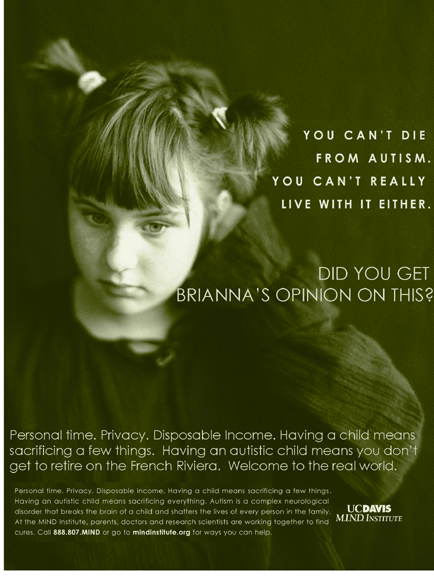
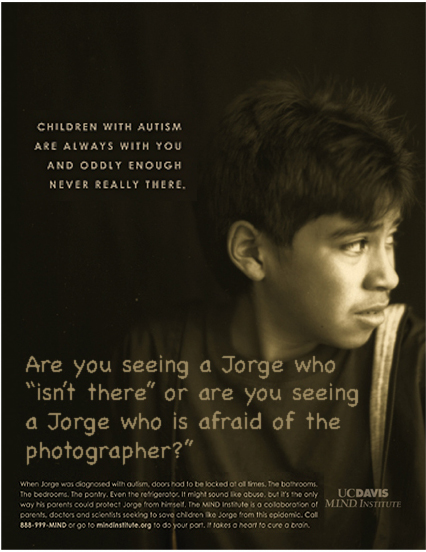
In the US, to my knowlege, the big autism orgs have never gotten it.  Their “outreach efforts” usually reach out and devalue autistic people; their “Public Service Announcements” are in reality “Public Disservice Announcements”.  The UC Davis MIND Institute put out a really awful set of PSA’s when they first moved into their fancy building. And let’s not forget the ransom notes campaign.

This is part of a longer video called “Living with Fragile X”-

In case you don’t actually watch that one.  At the end a mom of an adult son says,

“I wanted him to be normal.  And if I have any regrets it’s that I did not let myself love him at that moment.  Just say, ‘I love you just the way you are.’ And I hope he forgives me…for ever thinking I wanted him to be different.”

That! That is what a Public Service Announcement should look like.  It even features a researcher from the UC Davis MIND Institute who mentions autism, if you can believe that. It doesn’t candy-coat the problems of Fragile X people, but neither does it over-dramatize the problems and go out of it’s way to stigmatize anyone.

Belgium seems to have figured out how to do autism PSA’s already.

Setting a nice example for the English speaking world, this is amazing video showing what the NAS, the National Autistic Society, has been doing for some time now, that is, actually respecting and helping autistic people.

Here are four more PSA’s, professionally made ones, these from the NAS.  I don’t think they are perfect but they are so much better than anything that’s being done by “Big Autism” in the US.  See the videos, here, here, here, and here.  This one is good, too, the NAS President and individual Members of Parliament discussing the way autistic adults have been ignored to a huge extent.

The following ones are new to me.  They are fairly informal NAS interviews with autistic adults, here, here and here and an interview with a boy. The UK has been invaded by Autism Speaks, but the British version seems to be slightly less bombastic, so far, maybe not, though. “Treehouse” is having a conference in London next month and Bob Wright of Autism Speaks will be there to speak. I understand that autistic adults will attending and representing autism realistically, one can only hope that Bob Wright will take notice.

It’s amazing what can be accomplished when people in authority are tuned into reality and the long term, instead of being tuned into damaging illusions and distortions and short term pay-offs.

Vaccines on the Hill III

26 Sep

Somehow I never thought there would be a “Vaccines on the Hill II”, much less III. That said, a question from Lisa (from about.autism.com) got me thinking and, well, I’d rather do this a post than a response.

I admit, this isn’t directly related to her comment, who commented on how David Kirby makes a point of stating he is not “anti-vaccine”.

Instead this is about frustrations with Mr. Kirby. As an example, let’s discuss how Mr. Kirby “quoted” a response that the CDC made to an NEIHS report in his congressional briefing. Yes, “quoted” is in quotes for a good reason.

On his presentation, page six, Mr. Kirby “quotes” (there’s those quotation marks again!) the NIEHS report:

NIH: “We identified several areas of weakness that were judged to reduce the usefulness of the VSD for addressing the potential association between exposure to thimerosal and risk of ASD.”

With the response from Dr. Gerberding at CDC of:

Gerberding General Response: CDC CONCURS

What was the real quote?

The panel identified several serious problems that were judged to reduce the usefulness of an ecologic study design using the VSD to address the potential association between thimerosal and the risk of AD/ASD.

Emphasis mine.

Yep. Mr. Kirby left out the fact that the NIEHS was specifically talking about ecological studies.

Makes a BIG difference in how that phrase is interpreted. This was a major part of two epiwonk blog posts, here and here. Mr. Kirby’s original blog post on this was retracted, so Mr. Kirby is well aware of the importance of the fact that the NIEHS limited the statement to ecological studies.

By the way, the real CDC response?

CDC Response: CDC concurs with this conclusion and does not plan to use VSD for ecological studies.

They did most certainly not concur with the statement that Mr Kirby “quoted”. Instead, they see the limitation for ecological studies. There is strength in using the VSD. They don’t see it as valuable for discussing the thimerosal/autism question, as we’ve discussed before.

Here’s the NEIHS report, and here, the CDC response.

Mr. Kirby’s “quote” of the NIH was incorrect. This isn’t incorrect in the way Dan Olmsted thinks that “has” vs. “have” is an important difference. No, the quote by Mr. Kirby completely changed the very meaning of the statement that NIEHS made and implied the CDC concurred with.

It sounds like Mr Kirby was caught red-handed trying it too, by a staffer who obviously came in very well informed. The bright side is that the legislature got an idea of Mr. Kirby’s tactics. The down side, they may not realize that the entire autism community is not represented by Mr. Kirby and his tactics.

This misinformation effort has already had an effect. Mr. Kirby’s original treatment of the CDC response made people think that the CDC position is that the Verstraten study was flawed. As epiwonk makes very clear, the opposite is true. The NIEHS panel suggested expanding the Verstraten study (which was not ecological) with additional years.

And people wonder why I get frustrated with Mr. Kirby.