Archive by Author

My response to Mrs. Wright of Autism Speaks

20 Dec

As I recently wrote, Autism Speaks has once again shown it’s lack of respect for autistics and their parents with an opinion piece by Mrs. Suzanne Wright, co-founder of Autism Speaks.

I left the message below in response to Mrs. Wright’s piece.

I can not resign any position with Autism Speaks, as John Robison has done. I have been a member of one autism organization–a group which later became the local chapter for Autism Speaks. I resigned that group when they showed that they would waste their efforts lobbying against legislation that had nothing to do with autism. I’m glad I quit then.

One thing autism has taught me is that so many things we take for granted are gifts. It is a gift to have average or above intelligence. We don’t earn intelligence. It is our responsibility to use our gifts well.

Mrs. Wright, you aren’t using your gifts. After years with the autism community, you continue to speak for us as without understanding us. You aren’t using your gifts. My kid will never have the ability to understand the world like you can. Your gifts are squandered and that is a terrible shame.

I am doing more than “existing”. I am living. Is it harder with a disabled kid? Sure. It’s harder for him.

Use your gifts. Much more–use the gifts of those working for you. Learn how to frame the situation as being difficult, for that is what it is. But not as a life without hope. A life of despair.

I live. I love. I have joy. My son lives. Loves. Has joy. I have not lost touch with him. He has not lost touch with me.

It will be harder for him to enjoy life if the world sees him as less than a full person. It will be harder for him if we don’t put his needs first rather than mine. Please learn to put first the needs of the people we represent and advocate for.

If we in the autism community can’t put forth this message, how can we expect the rest of the world to do so?

Before we can craft a national plan we in the autism community must have a plan of our own. It must start with respect. Respect for autistics. Respect for families. And you are not showing that.

I saw the response Autism Speaks put forth in your home town newspaper in Florida. Please stop dodging this important question by framing it as “high functioning” adults vs. parents of “low functioning” children. Many of us who are parents of children with great challenges disagree with your stances. We’ve been telling you this for years. It’s time to listen.


By Matt Carey

Autism Speaks: it’s time to listen

18 Dec

I’ve always found the Autism Speaks motto ironic: “Autism Speaks. It’s time to listen.” Change he period to a colon and you get “Autism Speaks: it’s time to listen”. And, please, could you start listening, Autism Speaks?

Autism Speaks got off to a rocky start. Although they claimed an ” overwhelming positive response from the autism community”, the rollout of the organization was met with much criticism. Autism Speaks co-founder Suzanne Wright adhered to the “missing child” model of autism with phrases like: “It is as if he’d been kidnapped, or somehow had his mind and spirit locked in a dark hole deep within him”. She also had the parent-centric model of the autism community with phrases like “Such an effort must be driven by those with most at stake: the parents of autistic children.”

Shortly after their launch, Autism Speaks released a short film, Autism Every Day. While Autism Speaks told themselves and the world that the response was positive, in reality there was a great deal of negative reaction. (e.g. here, here, here, here, and more.)

It took years, but eventually Autism Speaks listened. The video disappeared from their website and YouTube channel.

Another video debacle came in the form of “I am autism” which depicted autism as a sinister monster stealing babies and ruining parent’s lives. Here’s the transcript in case you think I’m exaggerating. The video is now also removed.

Every now an then, I feel hope for Autism Speaks. There are some really excellent people at AS. AS took on the phrase “different, not less“. Sometimes a blog post comes by that I particularly like. And a lot of their research portfolio is quite good.

Then you get announcements like this one: Autism Speaks to Washington – A Call for Action. And we see that we are back to 2006. We are back to “I am autism” but this time it’s phrased “This is Autism”.

As a result of that opinion piece, John Elder Robison quit. He was one of the few (if not the only) autistics working in a high profile position with Autism Speaks. Here’s a section from his article, I resign my roles at Autism Speaks:

For the past four years I have worked very hard to defend Autism Speak after a series of public relations missteps; beginning with the I Am Autism video. The most recent “Autism Speaks Point of View” http://www.autismspeaks.org/news/news-item/autism-speaks-washington-call-action shows me that my words and efforts have had no real impact on the beliefs of the actual leadership of the organization.

I have tried to help Autism Speaks staffers understand how destructive its messages have been to the psyches of autistic people. We do not like hearing that we are defective or diseased. We do not like hearing that we are part of an epidemic. We are not problems for our parents or society, or genes to be eliminated. We are people.

We do have problems, and we need help. Some of us need counseling or training, while others have significant medical challenges. We also need acceptance, and support. There is a great diversity in our community, which means we have a very broad range of needs. Unfortunately, the majority of the research Autism Speaks has funded to date does not meet those needs, and the community services are too small a percentage of total budget to be truly meaningful. We have delivered very little value to autistic people, for the many millions raised.

A newspaper in Palm Beach, Florida (where the Wrights have a home) published the article: Autism Speaks post rattles some readers One board member resigns, saying he can’t stand by co-founder Suzanne Wright’s views. While they couldn’t get a comment from Mrs. Wright, they did get some statements from Autism Speaks itself.

Autism Speaks took the old cop out. Whenever there’s a discussion of whether a depiction of autism is demeaning, one can count on hearing the argument that the discussion is between parents of “severely” autistic kids and “high functioning” adults.

Michael Rosen, executive vice president of strategic communications at Autism Speaks, said Robison was the only one who resigned over the post. He said the organization understands that higher-functioning people with autism may have a different point of view about the issue.

“The people who are not sick, not unhappy, and are totally fulfilled and happy with their differences, we totally support them as well,” Rosen said. “We’re not looking to change anybody, we’re looking to support and get services for everyone who needs them.

“What that column had was a lot of empathy for those who are struggling the most. But for those who just need support and services, we work for them as well.”

Eight years ago Autism Speaks could pretend to be ignorant of the fact that much, a great deal in fact, of the criticism they get is from parents like me. Parents of children. Children who are “struggling the most”.

Then there’s the old “they see autism as a good thing” bit:

He said some people with autism feel it’s “a good thing” that just makes them “neurologically different. It’s a matter of diversity, and diversity is a good thing. We understand that and get that. They’re proud of their diversity and we salute them.”

Unless John Robison was VERY different at Autism Speaks meetings than the John Robison I’ve seen at IACC meetings, Mr. Rosen had no business saying what he did. Perhaps he could have read Mr. Robison’s resignation article:

I celebrate the gifts autism brings us, and I have discussed at length the emerging realization that autism – as a neurological difference – confers both gift and disability on everyone it touches. It’s the fire the moves humanity forward, while simultaneously being a fire that can burn us individuals as we try to make our way.

Many autistic people are aware of this dichotomy. Some of us feel “totally disabled” and others feel “totally gifted.” Most of us – I’d venture to say – feel both ways, at different times, depending on what we’re doing at that particular moment.

It’s so much easier to build the straw man that criticism comes from those who are “totally fulfilled and happy” than to face the criticism head on.

Doing a quick google search, I found these criticisms of Mrs. Wrights op-ed:

A Reporter’s Guide to the Autism Speaks Debacle
by Lucy Berrington, autistic adult

AWN SQUARES OFF WITH AUTISM SPEAKS OVER NATIONAL AUTISM PLAN
by the Autism Women’s Network

A Poem For Suzanne Wright. A Call To Action; A Call To Be. November 15, 2013
By Cheairs Graves, mother of an autistic child.

no more – a letter to suzanne wright
by Jess, mother of an autistic child.

The Price We Pay for Autism Speaks
by Heather Clark, mother to two autistic children

Why Autism Speaks Doesn’t Speak for Me
by Emily Willingham, mother of an autistic child.

And there’s more. I did run into a couple articles supporting Mrs. Wright too. But this isn’t about who has more articles, it’s about the fact that Autism Speaks chose to frame the discussion in a very simplistic and, frankly, insulting way. They dismiss the criticism and ignore the fact that much of it comes from parents. The people Autism Speaks claims to represent in this discussion.

Autism Speaks: it’s time to understand.


By Matt Carey

Meeting of the Interagency Autism Coordinating Committee January 14, 2014

17 Dec

Below is the announcement emailed by OARC (the Office of Autism Research Coordination) announcing the next Interagency Autism Coordinating Committee meeting. The meeting will be held on January 14th. Deadline for submission of comments is January 7th.

Note: I serve as a public member to the IACC but my comments here and everywhere are my own.

Meeting of the Interagency Autism Coordinating Committee
Please join us for an IACC Full Committee meeting that will take place on Tuesday, January 14, 2014 from 8:30 a.m. to 5:00 p.m. ET at the National Institutes of Health, 31 Center Drive, Building 31, C Wing, 6th Floor, Conference Room 6, Bethesda, MD 20892.  Onsite registration will begin at 8:00a.m.

Agenda: The committee will discuss and finalize the 2013 IACC Strategic Plan Update and discuss committee business, agency updates and issues related to autism spectrum disorder (ASD) research and services activities.

Meeting location: National Institutes of Health

31 Center Drive

Building 31, C Wing, 6th Floor, Conference Room 6

Bethesda, MD 20892

Nearest Metro stop:

Medical Center – Red Line

In the interest of security, NIH has instituted stringent procedures for entrance onto the NIH campus.  All visitor vehicles, including taxicabs, hotel, and airport shuttles will be inspected before being allowed on campus. Visitors will be asked to show one form of identification (for example, a government-issued photo ID, driver’s license, or passport) and to state the purpose of their visit.

Pre-Registration:

The meeting will be open to the public and pre-registration is recommended. Seating will be limited to the room capacity and seats will be on a first come, first served basis, with expedited check-in for those who are pre-registered. Please visit the IACC website for access and information about registering.

Public Comment – Deadlines:

Notification of intent to present oral comments: Tuesday, January 7th by 5:00p.m. ET

Submission of written/electronic statement for oral comments: Wednesday, January 8th by 5:00p.m. ET

Submission of written comments: Wednesday, January 8th by 5:00p.m. ET

Remote Access:

The meeting will be remotely accessible by videocast  (http://videocast.nih.gov/) and conference call. Members of the public who participate using the conference call phone number will only be able to listen to the meeting.

Conference Call Access
USA/Canada Phone Number: 888-769-9402
Access code: 4632869

Individuals who participate using this service and who need special assistance, such as captioning of the conference call or other reasonable accommodations, should submit a request to the contact person listed above at least five days prior to the meeting. If you experience any technical problems with the conference call, please e-mail at helpdeskiacc@gmail.com or call the IACC Technical Support Help Line at 415-652-8023.

Please visit the IACC Events page for the latest information about the meeting, including registration, remote access information, the agenda, materials and information about prior IACC events.

Contact Person for this meeting is:

Ms. Lina Perez
Office of Autism Research Coordination
National Institute of Mental Health, NIH
6001 Executive Boulevard, NSC
Room 6182A
Rockville, MD 20852
Phone: 301-443-6040
E-mail: IACCpublicinquiries@mail.nih.gov

The hearing that wasn’t

21 Nov

There’s been a lot of internet chatter for the past few months about a hearing by the U.S. House of Representatives’ Committee on Oversight and Government Reform. The hearing, if we are to believe the internet chatter, was promised by the committee chair, Darrell Issa but has been cancelled, postponed, or by some other name has gone from a hope to nothing. By what is surely pure coincidence, a prominent member of one of the groups calling for and talking about the hearing was one of Representative Issa’s largest political donors this year. Perhaps it was due to the Committee’s busy schedule, investigating hot topics like “Reviewing Alternatives to Amtrak’s Annual Losses in Food and Beverage Service

Oversight has held a number of hearings in the past on autism and vaccines. Most were in the old days, when Congressman Burton was pushing his agenda hard (but not his witnesses–he let Andrew Wakefield pass on a misleading response to a question of how his research was funded). Last year Congressman Issa (again after donations) held a hearing on the government’s response to the rise in autism prevalence. Congressman Issa then proceeded to not support autism or vaccine related legislation. Not that I’m cynical, mind you, but I don’t see the value behind all the work and donations to get a few YouTube videos of members of congress talking about a topic they aren’t going to really throw their support behind. Then again, I don’t see the point in trying to make a political movement out of a failed hypothesis (or two or three) and a shrinking base of support.

The autism communities could use the support of congress. We could use some legislation. If I may say so, I think we need support to re-authorize the Combatting Autism Act, which sunsets next year. We need support for the disability communities, like services. Do the parents (and the support for this hearing was from a subset of the autism parent community) involved with the hearing feel that, say, the schools have the money and tools they need? Do they feel that there’s adequate support for autistic adults? Probably not. But they throw their passion, their time and their money behind hearings which wouldn’t even result in a diffrence for their own focus on vaccines.

Congress has better things to do. Like gridlock. We parents have better things to do, like making congress stop gridlock long enough to make a difference in our kids’ lives.


Matt Carey

Age of Autism expresses concern over “acting in the best interests of the child”

27 Oct

A while back I stopped reading the blog “age of autism”. It’s repetitive, degrades people with disabilities and, in general, is applying 99% of their effort to counterproductive aims. My google news searches for “autism” are “autism -“ageofautism.com””. But, once in a while, something sneaks through. Such is the case today.

Consider the United Nations Convention on the Rights of Persons with Disabilities (CRPD). It’s an international agreement, up for ratification in the U.S.. From the U.N.’s FAQ on the Convention:

What are the principles of the Convention?

Article 3 sets out the General Principles that apply to the enjoyment of the rights of persons with disabilities. These are:

• Respect for inherent dignity, individual autonomy, including the freedom to make one’s own choices and independence of persons
• Non-discrimination
• Full and effective participation and inclusion in society
• Respect for difference and acceptance of persons with disabilities as part of human diversity and humanity
• Equality of opportunity
• Accessibility
• Equality between men and women
• Respect for the evolving capacities of children with disabilities and respect for the right of children with disabilities to preserve their identities.

Most countries have ratified the Convention. Here is an analysis by the U.S. National Council on Disability.

Why is AoA concerned? “The fundamental concern with this document is its adoption of the “best interests of the child” standard.”

Yes. Let’s shoot down an international agreement that gives people with disabilities accessibility, opportunity, equality, inclusion and the rest. Because we wouldn’t want to act in the best interests of children.

Many states in the U.S. already use the “best interests of the child” standard in many aspects. In fact,

All States, the District of Columbia, American Samoa, Guam, the Northern Mariana Islands, Puerto Rico, and the U.S. Virgin Islands have statutes requiring that the child’s best interests be considered whenever specified types of decisions are made regarding a child’s custody, placement, or other critical life issues.

Why would AoA be afraid of putting the child’s best interests as paramount?

As you know Michael Bloomberg is now pushing for universal vaccinations for all preschoolers. This requirement will be mandated nationally with ratification of the UN CRPD and, ultimately with the ratification of the UN CRC.

Yes. Fear vaccines. Fear the government. The author of the AoA article makes huge leaps of logic (nothing new for AoA, I know) to claim that if we ratify the Convention on the Rights of Persons with Disabilities, children will be vaccinated.

The woman who wrote this article may not even have a direct connection to the autism community or the disability community. She’s using the fear government+vaccine angle to try to get support for her cause at AoA. Here are her reasons for disliking the Convention. The CRPD would somehow give rights to homosexuals. Can’t have that here in America, can we? Well, except for here in California where we once again have marriage equality…or many other places in the U.S….

If we believe her, the U.N. will tell the U.S. how to spend it’s money, including making us help poorer countries (oh, no, let’s not help poor countries). It isn’t going to happen, but let’s fear it.

Also,

According to Article 23, the disabled have a right to make reproductive health and family planning decisions and a right to be educated about those decisions and given the means to carry out those decisions.

Can’t give those rights to the disabled, can we?

Many countries have ratified the CRPD. Years ago. Does she give examples of other countries, say England, France, Inda, China, where her predictions have come true? No. They are just fear mongering.

The ironic tagline for the AoA piece? “Ignore your rights and they will go away”. So when we as a nation see abuses in another country, abuses of the rights of the disabled, we can complain. And wait for the response, “but you won’t even ratify the CRPD”. Yes, let’s not ratify an agreement on rights for people with disabilities. Let’s not affirm that our own citizens have rights irrespective of disability. AoA is supposedly a community of parents of autistic kids. Let’s not protect the rights of those children. Fear of a parent losing his/her rights to not vaccinate (which is only that, fear, not a real prediction of what might actually happen) should stand in the way.

And, let’s not forget the unspoken fear. That parents might lose their rights to try anything and everything as a “therapy”. It’s a parent’s right, after all, to give a disabled child bleach containing enemas. Or make the kid drink a bleach solution. Or to ingest a drug which shuts down sex hormone production during puberty. Or be subjected to chelation without being appropriately diagnosed with heavy metal poisoning. Subjected to chelation often for years, when a standard course of chelation is very limited in time. Or to take one’s child to another country for infusions of what may or may not be stem cells, without any good science to back up the practice. Or to use an industrial chelator, designed for treating mining waste, untested for safety on humans, as a “supplement”.

Let’s not consider what is “best for the child”. No, parent rights are at stake.

When were we parents given the right to do things which are not in the best interests of our children? And, if we had that right, why would we put protecting that right in front of a chance to improve the rights of the disabled?

I gave up on reading AoA. Good idea that.


By Matt Carey

Geiers lose case against PSC

20 Oct

The attorneys for the families in the Omnibus Autism Proceeding (OAP, the class-action type hearings held in the “vaccine court”) were grouped into the “Petitioner’s Steering Committee” (PSC). The PSC hired experts to help their case. Mark and David Geier did not serve as experts on the OAP but felt that they deserved compensation. $600,000 in compensation. Nearly 10% of the total costs for the OAP.

Thanks to Left Brain/Right Brain commenter Anne, we now know the Geiers lost this suit.

The Geiers presented eight counts, and failed to make them stick

Count I — Breach of Contract;
Count II — Joint Venturer Liability for Breach of Contract;
Count III — Ratification;
Count IV — Implied Contract;
Count V — Unjust Enrichment;
Count VI — Joint and Several Liability for Professional Negligence (Malpractice);
Count VII — Civil Conspiracy for Fraud; and
Count VIII — Breach of Implied Warranty.

Here are some excerpts from the decision:

In sum, the Geiers have failed to present a factual basis for the Court’s exercise of specific personal jurisdiction over the Law Firms

Even if the Court has personal jurisdiction over the Law Firms due to their continuous and systematic contacts with the District of Columbia, it is necessary to dismiss the Complaint for failure to state a claim.

The Geiers’ malpractice claim is based on the disingenuous assertion that the agreement to assist the Geiers in petitioning the Vaccine Court for fee payment created an attorney-client relationship between the Geiers and the Law Firms. This allegation is not “plausible on its face.”

The Geiers’ civil conspiracy allegations are threadbare accusations that fail to state a claim, see Iqbal, 556 U.S. at 678, let alone meet the heightened pleading standard required by Rule 9(b).

One does wonder where the future lies for the Geiers. Mark Geier (the father and doctor of the team) is 65 and could retire. David Geier (the son who holds a B.A.) is a bit young for retirement. Mark Geier’s medical licenses have been suspended. The Special Masters in the vaccine court have made it clear that neither Geier is qualified to act as an expert or a consultant. And, now, the Geiers have burned bridges with many of the attorneys in the vaccine court. I’ve heard that the Geier address in Florida is registered as a mail order pharmacy.


By Matt Carey

Looking back at two decades of Geier

20 Oct

In the past Mark and (to a lesser extent) his son David Geier were frequently being discussed online. It struck me that given how far back the Geier saga goes, many may not be aware of the myriad stories of the Geiers. How often and from how many angles the news has come about just how bad the Geier legacy is. They’ve been involved in the vaccine court (and from the outset–1993–showing “intellectual dishonesty“), publishing questionable research and running a clinic whose special “therapy” is so clearly wrong.

I went back to an article I wrote in 2007 where a Special Master (the judge in the “vaccine court”) wrote that the Geiers’ work was of such poor quality that the court would no longer pay for them to act as experts. I was going to just re-run that article (and it is copied in full below) when I thought it worthwhile to list some of the more notable actions of the Geier team.

The best writing on the Geiers was done by Kathleen Seidel of Neurodiversity.com (some of the best investigative reporting ever). Unfortunately a server crash took down the site, but one can find the articles on the Wayback Machine (archive.org).

Just a few specific examples:

Maryland Authorities Charge “Lupron Protocol” Promoters With Unprofessional Conduct, Unlicensed Practice of Medicine ·

Significant Misrepresentations: Mark Geier, David Geier & the Evolution of the Lupron Protocol

A Silent Withdrawal (details behind the withdrawal of a Geier paper).

The withdrawal followed and was likely caused by Ms. Seidel’s investigations, laid out in this letter to the Journal (autoimmunity reviews) in which she noted (among other facts) that the Geiers actions were questionable from an ethics standpoint. In specific, in regard the their IRB (Institutional Review Board) approval for their study:

The Office of Human Research Protection registration of the IRB of the “Institute for Chronic Illnesses” was submitted by Mark Geier in February 2006 — fifteen months after the commencement of the research the Geiers describe in this article, which began in November 2004, the same month in which Dr. Geier testified in court that he had no prior experience in the diagnosis or treatment of autistic children. (13,14) The seven-member IRB consists of Mark and David Geier; Dr. Geier’s wife; two of Dr. Geier’s business associates; and two mothers of autistic children, one of whom has publicly acknowledged that her son is a patient/subject of Dr. Geier, and the other of whom is plaintiff in three pending vaccine-injury claims. The membership of the IRB gives rise to misgivings about the independence of ethical review of Dr. and Mr. Geiers’ research. Every member has discernible conflicts of interest, and none has any discernible expertise in endocrinology — expertise crucial to the competent oversight and conduct of research involving pharmaceutical manipulation of children’s hormones.

Yes, they got “approval” from themselves after they did the research. Just astonishingly bad. Completely circumventing the entire purpose of an IRB.

There’s so much more good work at Neurodiversity.com. But let me switch to articles here at Left Brain/Right Brain:

David Geier ordered to pay $10,000 for practicing medicine without a license

Is Mark Geier finished as an expert witness in the vaccine court? A quote from this vaccine court decision:

I will not likely be inclined to compensate attorneys in any future opinions for consultant work performed by Mark Geier after the publication date of this opinion.

Note that the question is whether to pay Mark Geier as a consultant. This was in 2011, after it was established that he was not an expert and would not be compensated for work as an expert. This didn’t stop attorneys tried to keep him on the payroll as a “consultant”.

How about the Geier theory behind using Lupron to shut down hormone production in autistic kids? It started as a way to enhance chelation. Chelation is without merit in autism treatment to begin with, but the Geiers took it a step further. One of their collaborators, and apparently the parent of one of the first kids to be subjected to the “Lupron Protocol” quoted David Geier as saying, “We figured something new out…..we think we can get rid of the mercury by lowering the testosterone”. The “science” behind the “Lupron Protocol” AutismOne throws their support behind the Geiers in Autism Science Digest is ridiculous. Even the Geiers shifted away from their original theory, leaving out the mercury angle: The Geier Story on Testosterone Shifts Again.

In their research, the Geiers cite Simon Baron-Cohen, whose has worked on the idea that exposure to testosterone in-utero could be a cause of autism. Baron-Cohen’s work had no scientific relevance to the Geier work. But, thankfully, Baron-Cohen was quoted in a news article about the Geiers:

Simon Baron-Cohen, a professor of developmental psychopathology at the University of Cambridge in England and director of the Autism Research Center in Cambridge, said it is irresponsible to treat autistic children with Lupron.

“The idea of using it with vulnerable children with autism, who do not have a life-threatening disease and pose no danger to anyone, without a careful trial to determine the unwanted side effects or indeed any benefits, fills me with horror,” he said.

Mark Geier lost his medical licenses. Yes, licenses plural. Lost in many states. He had franchised his Lupron work out. It took a cease and desist order issued to make him really stop practicing medicine.

Criticism of Mark Geier’s “expertise” was not limited to the “vaccine court”. In Boyd Haley and Mark Geier: Experts? we see how he failed to meet the standards of an expert in a civil court.

The Geiers’ have done well, financially. Charging over $50k/year, plus over $10k in tests, could do that. Here’s their home in Florida (The Geiers’ Second Home)

As part of the action to strip Mark Geier of his medical license: Maryland Board of Phyicians: Mark Geier “endangers autistic children and exploits their parents”

In Crist backer Gary Kompothecras bullies Florida health officials, we learned that political pressure was being brought to bear to give the Geiers access to Florida’s health records to perform a study.

The Geiers requested over $100,000 for work on the Hepatitis B Omnibus, including multiple trips to Europe. (almost $24k for one trip alone). Much of the request had no documentation (bills, airline tickets, etc.)

Quotes from the special master in the decision in that case:

I found that the articles authored by Dr. Geier unpersuasive and not scientifically sound, based on my prior reading of the articles and critiques of them. I am also aware that Dr. Geier is trained as a geneticist and obstetrician, not an immunologist, epidemiologist, or rheumatologist, and that my fellow special masters and several other judges have opined unfavorably on his qualifications and testimony as an expert.

and, in regards to David Geier (who holds no advanced degrees):

“In summary, the undersigned finds the costs for David Geier’s efforts to be obviously unreasonable as Mr. Geier is not qualified to address the medical issues involved in the Program and his work was duplicative of the efforts by Dr. Geier. Thus, the undersigned denies the request for costs for David Geier in its entirety.”

The egregious billing activities of the Geiers amount to treating the vaccine program as their personal piggy bank, in my opinion.

In the courts, in their research and in their clinics, the Geiers have time and again shown behavior which is just reprehensible.

Below is the article I wrote in 2007 which prompted this summary: For your own good, don’t use that study!.

____________________________________________

I just read something interesting on the web.  Someone was telling a petitioner in a Vaccine Court trial that she would have a better chance of winning if her expert witness didn’t use a research report by the Geiers.

Was this a blog?  Was this a yahoo group?  Nope, this was a decision on the Vaccine Court’s website.  This was the opinion of Special Master Vowell.

If that name sounds familiar, it’s because she is one of the three Special Masters working on the Autism Omnibus Proceedings.  What exactly did she say?

“I suggested that, in view of the criticisms leveled at Dr. Geier and his research, petitioner would be better served if her expert could opine favorably at the hearing without relying on the cited articles. “

and

“In attempting to assist this petitioner in presenting the strongest possible case for vaccine causation of her illness, I urged her counsel to caution her expert against relying on the Geier articles he cited.”

Ouch.

In case you were wondering, I wasn’t just reading the Vaccine Court decisions for fun.   I was prompted by something that Mark Geier said on NightLine.  Dr. Geier made a comment about “Wining” in vaccine court.

This struck me as a very odd statement.  Petitioners (plaintiffs) win.  Lawyers win.  Expert witnesses?  They can help someone win, but I don’t see them as “winning”.  Besides, there was something in the way he said it.  Something like when a kid says, “of course I did my homework” and you know you have to go check.  So, check I did.

I looked through the published and unpublished decisions and searched for “Geier” in each.  These go back to 1997 for published decisions.   “Decisions” include actual cases as well as pre- and post-trial actions.  The one quoted above is a good example of “pretrial”.  Post-trial Decisions are often about whether everyone should get paid what they billed.  Or, at least, this seems to be the case in more recent times.

Not all Decisions are trials.  Keep in mind, a single trial could have multiple Decisions.  I haven’t tried to group them together by case, I just made a list of all of the ones I could find involving Dr. Mark Geier.

With all that out of the way, what did I find?  There are 31 Decisions posted that involve Dr. Geier.  Of those, three are cases “won” where Dr. Geier was involved.  A further 3 may be considered “mixed” or “neutral”.  Figure that in 80% of the cases, the Petitioner and/or Dr. Geier loses.  I consider that a generous take.  It really is more like 90%.

Let’s look at those “winners”.

1999: The petitioner won the case.  “The court’s decision in this case is not based on Dr. Geier’s testimony, but neither will the court discard his testimony as unreliable.”  Not the most ringing endorsement.

2000: The petitioner won the case.  Dr. Geier submitted an affadavit which was used to “buttress” the case made by the expert witness who actually testified.

2006: Discussion of fees where Dr. Geier’s fees and use is found to be reasonable. ” In the instant case, $1562.50 in expert witness fees for Dr. Mark Geier’s services is reasonable.”

Yes, in the last 10 years, those are the “good ones”.   Not impressive.

I have seen people post that somehow the Special Masters are trying to discredit Dr. Geier because he is so effective.  People seem to imply that his recent stances on mercury and autism caused the Government to try to neutralize Dr. Geier. 

With that in mind I looked to see if the tone of the rejections has changed with time.  I didn’t really see that.  Keep in mind that some of the well known comments about Dr. Geier predate all these decisions.  For example, he was called “intellectually dishonest” way back in 1993!

Here is a sampling of quotes from other decisions through the past 10 years:

1997: Dr. Geier’s opinion, which is in an area outside his expertise, was not persuasive to the court.

1998: The court is unpersuaded by the opinions of Drs. Kinsbourne and Geier.

1999: This conclusion itself effectively renders the rest of Dr. Geier’s theory useless to petitioner in this case.

2002: “First of all, Dr. Geier is wholly unqualified to testify concerning the two major issues in this case”

2003: “Intellectual rigor is missing from Dr. Tornatore’s testimony and the stealth witness Dr. Geier’s submission after trial. ”

2004: “He is however a professional witness in areas for which he has no training, expertise, and experience”

2005: “The Special Master also noted that Dr. Geier’s opinions have been increasingly criticized in other vaccine cases. See Decision at 5. The Special Master identified seven cases in which Special Masters had rejected the expert opinion offered by Dr. Geier because the opinion related to areas outside Dr. Geier’s areas of education, training and experience.”

2006: This was a question of charges.  Dr. Geier charged $29,350.  In the end, they found $8,520 was reasonable.  It was  found that he was (1) not qualified as an expert, (2) charging for work on his own publications and (3) charging for time spent working in a related civil case.

“Since Dr. Geier did not possess the necessary expertise to testify in this case, the Court will reduce his hourly rate from $250.00/hour to $200.00/hour. Petitioner will not be compensated for costs that can be directly attributed to Dr. Geier’s original publications, attorney/lawyer consultations, and physician consultations. Additionally, the work billed for petitioner’s civil cases is not compensable.”

2007: Again Dr. Geier’s payment is cut. 

“For the reasons stated above, the undersigned finds 13.5 hours to be excessive. Dr. Geier  will be compensated for only those hours that are reasonable. Based on the undersigned’s experience with the Vaccine Program, Dr. Geier will be awarded compensation for five hours of  his time which is a reasonable, indeed generous, number of hours for a literature search and review of articles. ”

Again, that is just a sampling,  No attempt was made to be random.  The tone has been increasing against Dr. Geier, though.  As noted in 2005, “The Special Master also noted that Dr. Geier’s opinions have been increasingly criticized in other vaccine cases”.  So it is increasing.  But that is only increasing by going from Bad to Worse. 

You are welcome to go through the decisions and see if I have been quote mining.  One thing you will see is the possible reason why the Special Master has started warning petitioners to avoid Dr. Geier’s studies.  There are statements to the effect of, “If I had known Dr. Geier was useless as an expert witness, I would have hired someone else”.

Sounds like good advice. 

Mark Blaxill on the Geiers: they do sloppy work

13 Oct

Mark Geier and, more recently, his son David have been active promoting autism as vaccine injury for over 10 years (Mark Geier has been active as an expert in, and been criticized for his lack of quality work, the vaccine court on non-autism issues for about 20 years). They have written multiple papers, ranging from bad to worse, attempting to argue the case that vaccines (and especially thimerosal) are a primary cause of autism.

There are multiple discussions over the years of the Geiers here on Left Brain/Right Brain, Respectful Insolence as well as many other places. The best work was done by Kathleen Seidel at Neurodiversity.com, but due to a server crash much of that content is not readily available. (although it is worth searching for the cached versions or the versions on the Wayback Machine).

The work of the Geiers is so poor that it has always been a wonder to me that no criticism has come from anyone promoting the idea that vaccines caused an epidemic of autism. It isn’t that those promoting the vaccine-epidemic idea are not bright, leaving me wondering if they are too biased by their beliefs or just unwilling to speak publicly against an ally. But, recall, these are the same people who closed ranks around Andrew Wakefield in the face of clear and proved ethical violations.

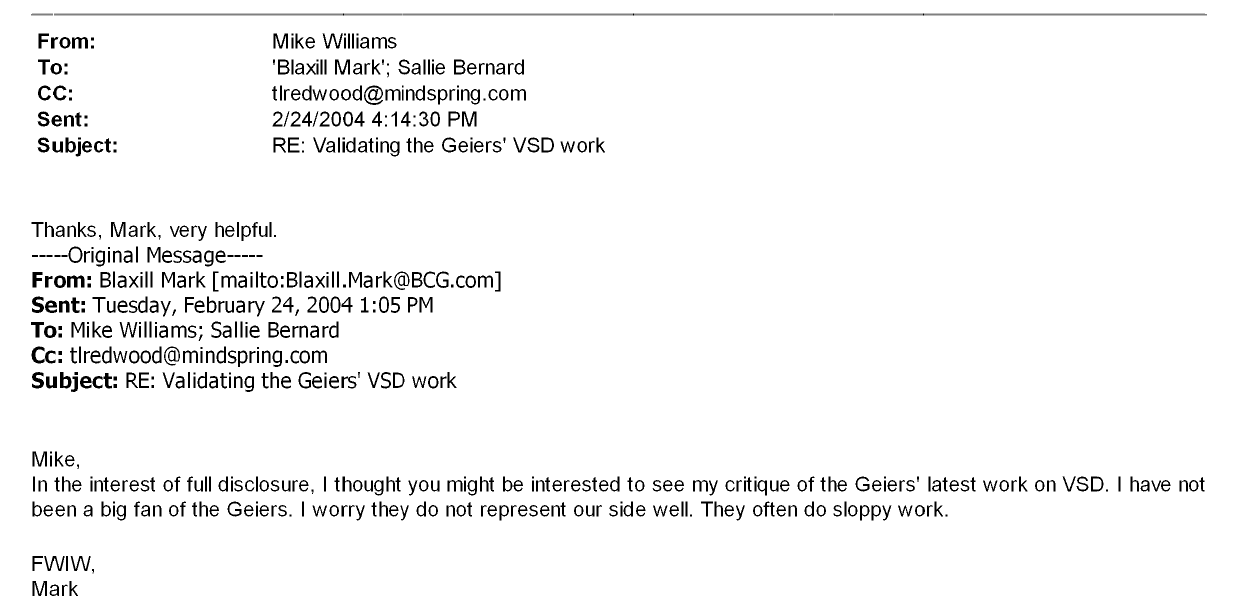
If we are to believe Jake Crosby, former writer for the Age of Autism blog, it appears that the tacit approval of the Geiers has, at least in part, been a case of “circle the wagons”. I.e. people defending an ally over speak their opinions. Mr. Crosby has blaxillwilliams and quotes more emails where Mark Blaxill (former board member of SafeMinds and a long-time proponent of the idea that mercury in vaccines are a primary cause of autism) expresses his views about the Geiers to Mike Williams (attorney involved representing the families in the Omnibus Autism Proceeding).

In an email image on Mr. Crosby’s blog, Mr. Blaxill is reported to have stated:

In the interest of full disclosure. I thought you might like to see my critique of the Geiers’ latest work on VSD. I have not been a big fan of the Geiers. I worry they do not represent our side well. They do sloppy work.

In another email (quoted by Mr. Crosby, the link to the original is nonfunctioning) quotes Mr. Blaxill as stating:

“As to the Geiers, I may be a bit of a minority voice here, but I worry very much that they can do our cause more harm than good. They are not very good scientists, write bad papers (both writing badly and reporting in sloppy fashion) and attract too much attention to themselves as individuals. In this last regard, they don’t show nearly as well as Andy Wakefield but they’re trying to play the same role. Frankly, if I were on the other side and were asked to critique their work, I could rip it to shreds. I’m surprised they haven’t been hit harder. So I think you are wise to diversify.”

Mr. Crosby’s stance is that this constitutes “interference” in the Omnibus Autism Proceeding. I.e. Mr. Crosby seems to imply that the Geiers are not sloppy scientists whose work is poor, but that the Geiers should have been allowed a more active role in the Omnibus.

In this case I find myself agreeing, in part at least, with Mr. Blaxill. The work by the Geiers is poor. Where I don’t agree is Mr. Blaxill’s decision to hold back on making those statement public. Not just because it’s hard to take the stance that one is a only “…interested in the quest for the truth” when one holds back on key information like an entire critique of the Geiers’ VSD paper. No. It goes deeper than that. The Geiers’ junk science went beyond promotion of the idea that thimerosal is a primary cause of autism. The Geiers ran a clinic for many years. Mark Geier was a licensed physician, David Geier worked in the clinic (and has been accused of practicing medicine without a license). Through their papers and their talks at autism parent conventions like AutismOne, the Geiers became well known. One of the “brand name” autism clinics. They reached this level of respect within their community because no one within that community dared to speak out.

I’ve noted on Left Brain/Right Brain many times before that these parent conventions differ markedly from real science conferences in that no one ever seriously challenges the speakers. They can present almost any theory or idea, especially if they tie it to autism as vaccine injury, without anyone standing up and saying, “that makes zero sense”. These aren’t science presentations, they are advertisements. It would be interesting to see how many of these conventions Mr. Blaxill attended and yet remained silent on the “sloppy” work that could be “ripp[ed] to shreds” that the Geiers presented. Instead, parents were presented a view that the Geiers were good scientists who suffered unjust criticism for their “brave” stance on vaccines.

The Geiers were promoters of chelation as a treatment for autism. Not only does chelation have no scientific basis to be an autism treatment, a study just out this week using rodents states that chelation could be harmful if there is no real heavy metal toxicity:

Finally, we also found that succimer treatment produced lasting adverse neurobehavioral effects when administered to non-lead-exposed rodents, highlighting the potential risks of administering succimer or other metal-chelating agents to children who do not have elevated tissue lead levels. It is of significant concern that this type of therapy has been advocated for treating autism.

It is highly likely that Mr. Blaxill would disagree with the statement that chelation has no good scientific basis as a treatment for autism. He’d be wrong, but that’s been covered over and over before. The Geiers moved on from standard chelation to stranger, more dangerous therapies. As an aside, if chelation was a successful treatment one has to wonder why the Geiers were prompted to move on to using Lupron as an autism treatment. Lupron is very serious medicine and it shuts down sex hormone production in the body. Why Lupron, one might ask? The Geiers convinced themselves (or convinced themselves that they could pass off this explanation) that mercury bound itself to testosterone in the brain, making it hard to chelate. They cited a paper showing that if one heats testosterone and mercury salts in benzene, one could form these mercury/testosterone complexes. They actually claim (yes, they tried to patent this idea to make money off it) that this paper shows that “It is known in the art that mercuric chloride binds arid forms a complex with testosterone in subjects”. The “subjects” are beakers of benzene, not animals and not people. Add to that the lack of an explanation of how shutting down hormone production would break up these complexes. The Geier “science” supporting Lupron would be laughably bad if it wasn’t used to subject disabled children to Lupron injections.

Lupron clearly has no basis as an autism therapy. In fact, the “lupron protocol” played a major part in Mark Geier losing his medical licenses. One has to ask, how did the get such traction for such an obviously bad idea? For one thing, the Geiers were considered respected scientists in the vaccine injury/alternative medicine autism community due to their previous and ongoing work trying to link thimerosal and autism. Work which Mark Blaxill considered “sloppy” and worthy of being ripped to shreds. But instead of sharing his views on the Geier papers with the public, Mr. Blaxill shared them privately within his own circle.

It’s worth noting that the email quoted above was written before the “Lupron Protocol” was developed. We don’t know if Mr. Blaxill was alarmed by the emergence of the “Lupron Protocol”. I can’t find where he spoke out against it. We can see that his blog (under a different writer) promoted the idea as “MERCURY, TESTOSTERONE AND AUTISM – A REALLY BIG IDEA!“. Mr. Blaxill doesn’t seem to have commented there. For all the papers the Geiers have published, Mr. Blaxill only mentions them once in his book “Age of Autism. But as we’ve seen, tacit approval (silence) may not be the same thing as real approval.

Mr. Blaxill had the courage to testify before a congressional hearing last year. A hearing where the politicians had been lobbied in advance to be favorable to his cause. When it came to disagreeing with one of his allies, that courage was lacking. He allowed “sloppy” science from an ally to go unchallenged. An example of the fallout of such a decision, in my opinion had he stood up he could have slowed or even stopped the “Lupron Protocol”, a therapy which in my opinion amounts to the abusive treatment of disabled children in an uncontrolled and unapproved experiment.


By Matt Carey

Demonstration tomorrow at DisneyLand

9 Oct

Late notice, I know, but I just got an email that a demonstration is scheduled for DisneyLand tomorrow to protest the fact that they are discontinuing the special needs passes.

This from Facebook:

Demonstration and Petition Delivery

Tommorrow, Wed, Oct. 9th at Disney 7-11
10:00 am

611 W Katella Ave
Anaheim, CA 92802

Meet up with your signs, your shirts and your children (only if it will not be upsetting, disruptive or dangerous to them.

I just spoke with ABC News and they intend to show up.
Anaheim Petition is being printed now (we still dont have a Fl person to delivery other copy :/)
SHARE

Per the facebook page, they have 4,000 pages of signatures for the petition. Here is box 1:

box one of the petition

I wish I could be there. Back in the day I worked at DisneyLand. Spent many a day and night in the park. It’s been great for our family to be able to make use of the special needs passes. Without them we just couldn’t do DisneyLand. It’s $400 minimum to go and we only get a few hours. The new system they’ve proposed wouldn’t work for us.

By Matt Carey

No, the thimerosal in the flu vaccine does not explain why autism rates did not go down

6 Oct

Surprisingly enough, there are still people promoting the idea that the rise in autism diagnoses observed over the last decades was caused by thimerosal in vaccines. The original argument was this–vaccines were added to the vaccine schedule in the 1990’s and with them the infant exposure to thimerosal increased. Concurrent with this rise in infant thimerosal exposure was a rise in autism diagnoses. Add to this a poorly concocted argument that autism resembles mercury intoxication and you have the basis for the mercury hypothesis.

Thimerosal was phased out of infant vaccines over 10 years ago. Thus, if the thimerosal hypothesis were true, reported autism rates should be declining by now. As far back as 2005 David Kirby (whose book “Evidence of Harm” played a major role in promoting the mercury hypothesis) acknowledged this point in a statement

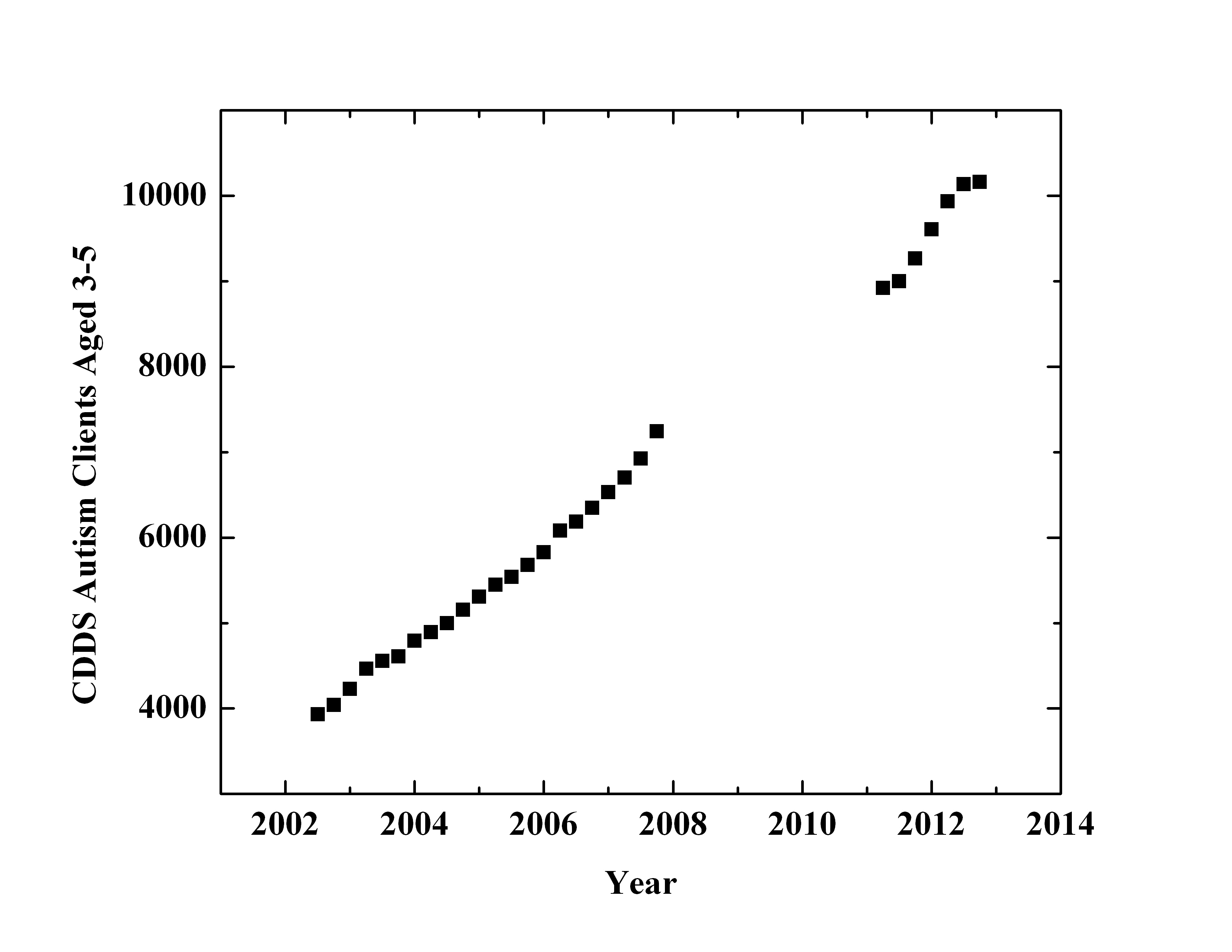
If the total number of 3-5 year olds in the California DDS system has not declined by 2007, that would deal a severe blow to the autism-thimerosal hypothesis.

It’s 2013. Autism rates in California have not declined. Not in Special Education. Not in the CDDS roles. And, yes, we are six years past the 2007 deadline that David Kirby gave us.

To be specific, let’s use the same method that David Kirby and others used to claim a thimerosal induced autism epidemic in the 1990’s (namely the California DDS client count–which not a good method, by the way). Autism “rates” have gone up by over 150% since thimerosal was phased out of infant vaccines. The age 3-5 bracket had about 4000 children in 2003 and is currently over 10,000.

CDDS 3-5

So we have more kids in California receiving services under the autism label than when thimerosal was in vaccines.

This is but one in a huge list of reasons why the thimerosal hypothesis doesn’t work.

But let’s go back in time a bit. Not so long ago one would hear proposals that we go back to the vaccine schedule of the early 1980’s when, it is claimed, the autism rate was 1 in 10,000. Fewer vaccines, less thimerosal, less autism. So goes the logic.

Generation Rescue, in fact, used to recommend the 1983 schedule as one of their alternative schedules

Turn back the clock
Comment: This is the schedule from 1983. If it worked for kids then, why doesn’t it work for kids now?”

Does it make sense to go back to the 1983 schedule? No. Why? OK a lot of reasons, but let’s focus on the fact that infants were exposed to more thimerosal in the 1980’s than today. Infant vaccines have no or only trace amounts of thimerosal.  So if thimerosal were the (or even a single) primary cause of autism risk, we would see autism rates lower today. To not only 1990’s levels, but to something like 1980’s reported levels. Assuming that the reported rates in the 1980’s were an accurate count of how many autistics there were then (a bad assumption but it’s the one they use).

To recap–Infant thimerosal exposure from vaccines peaked at nearly 200 micrograms in the 1990’s, up from about 100 micrograms in the 1980’s and is now less than 10 micrograms. And autism rates have not declined at all. Much less to 1980’s levels.

Once anyone says this the instant answer is that there is still thimerosal in some influenza vaccines. This, they say, is why autism rates have not declined. (note that thimerosal containing vaccines, including influenza vaccines, are banned in California for infants and pregnant women…and autism “rates” have continued to climb here).  

For completeness sake, let’s consider a kid who gets the maximum exposure to thimerosal from vaccines. I.e. a non California kid.  A kid who turns 6 months (the earliest age they will give a flu vaccine to a kid) during the flu season.  That kid will get 2 vaccines in the first year (6 and 7 months) then another influenza vaccine each year thereafter. Each with 25 micrograms of mercury from thimerosal. How does the thimerosal exposure compare to the 1983 schedule?  Take a look for yourself (exposures in micrograms of mercury from thimerosal):

1983 schedule 2013 schedule
DPT Inluenza
2 months 25
4 months 25
6 months 25 25
7 months 25
Total by 1 year 75 50
18 months 25 25
Total by 2 years 100 75
30 Months 25
Total by 3 years 100 100

So by age 3, the exposures are the same.  Except that the kid of today gets the thimerosal later and more spread out over time.  As an aside–most people who talk about the rise in thimerosal exposure during the 1990’s neglect to point out that the cumulative exposure in the 1980’s was already 100 micrograms. I.e. the “safe” level was significant.

If thimerosal were the driving force behind the rise in autism diagnoses, we should be back to 1983 levels, misrepresented by those claiming an epidemic as 1 in 10,000.  Instead we are at 1-2%.  The “rates” didn’t go down.

By this point the proponents of thimerosal are basically screaming, “you are forgetting the vaccines recommended to pregnant women!” No, I just put that off until now.  Sure, the influenza vaccine is recommended for pregnant women, but as the CDC notes:

Prior to 2009, influenza vaccination levels among pregnant women were generally low (~15%) (5,9).

So, from about 2000 to 2009 there wasn’t a big increase (or even a large part of the population) getting influenza vaccines while pregnant, nor were their children getting exposures higher than those in the 1983 schedule.

Take a look at that graph for California administrative autism prevalence again. Between 2002 (after the drawdown of thimerosal in vaccines) and 2012 the autism count doubled. Thimerosal exposure was down. A lot. Below 1990’s “epidemic” levels. Back to the 1983 “worked for kids then” levels. But autism “rates” continue to climb.

The people still pushing the idea that thimerosal is a (or even the) primary cause of autism are not unintelligent. We are talking about college educated people. Ivy league schools. A former journalist, an intellectual property expert and more. There is no math above. It’s all quite simple and straightforward. It uses the exact same logic and methodology they used to promote the idea that mercury causes autism. This is where intellectual honesty and basic integrity should kick in and get people to suck it up, admit their mistakes and start repairing the harm they have caused.

I’m not holding my breath.

By Matt Carey