Archive | Authors RSS feed for this section

Comment on “Do aluminum vaccine adjuvants contribute to the rising prevalence of autism?”

10 Jul

As a graduate student I once watched a speaker at a conference give a clearly bad talk. My advisor was next to me and when the talk was opened for questions I asked him why he wasn’t pointing out the major flaws in the study. “Why bother” was the response. The study was so bad that one didn’t need to comment.

That’s how I felt when a paper came out 2 years ago alleging a link between autism prevalence and aluminum in vaccines. The paper, “Do aluminum vaccine adjuvants contribute to the rising prevalence of autism?” made a great effort to present itself as being rigorous. It was a bit more slick than, say, your average Geier paper, but still bad.

The authors of the new study, Tomljenovic and Shaw, took U.S. special education data to create a time trend and data from various countries to compare by geography. The idea of comparing various countries to implicate vaccines isn’t new. Generation Rescue tried it a as well in an unpublished and unsigned “special report“.

Here’s what both groups do–take prevalence data from various countries and compare it to vaccine schedules per country. In the case of Generation Rescue, they ignored the fact that the data are for vastly different birth cohorts (for example, some data are for kids born in the 1970’s and these are compared directly to those born in the 1990’s). In the case of Tomljenovic and Shaw paper, they made minor modifications to their aluminum exposure data to account for the fact that kids born in various birth cohorts would have had dramatically different vaccine exposures. It was a weak attempt at best and assumes that the only cause of rising prevalence is the exposure they are studying.

In short, both are junk science.

When the recent study from Iceland came out, I was reminded of the Tomljenovic and Shaw paper. One of the countries they included in their study was Iceland. And, as I’ll point out below, not only did they use really old data for Iceland, they made another very sloppy error at the same time. With that stuck in my memory, it was time to write up this comment.

Here are the prevalence data by country from their paper:

ShawByCountry

Yes, they used a prevalence for Iceland of 12.4/10,000. Which, we know now has a prevalence ten times higher. That’s the sort of mistake you get for using old prevalence numbers. But there’s more.

Consider Sweden. Tomljenovic and Shaw quote a prevalence of 53.4/10,000, using this study as their citation: Brief report: “the autism epidemic”. The registered prevalence of autism in a Swedish urban area. Here’s the abstract from that study:

The objective of this study was to establish rates of diagnosed autism spectrum disorders (ASDs) in a circumscribed geographical region. The total population born in 1977-1994, living in Göteborg Sweden in 2001, was screened for ASD in registers of the Child Neuropsychiatry Clinic. The minimum registered rate of autistic disorder was 20.5 in 10,000. Other ASDs were 32.9 in 10,000, including 9.2 in 10,000 with Asperger syndrome. Males predominated. In the youngest group (7-12 years), 1.23% had a registered diagnosis of ASD. There was an increase in the rate of diagnosed registered ASD over time; the cause was not determined. The increase tended to level off in the younger age cohort, perhaps due to Asperger syndrome cases missed in screening.

They used the full cohort, from birth year 1977 to 1994, giving a medium prevalence number. In their study, they are making a comparison to a U.S. study with a prevalence of 110/10,000 whose kids were born between 1990 and 2004. Not a great comparison of cohorts. What makes it clearly cherrypicking on the part of Tomljenovic and Shaw is that they could have used a prevalence for Sweden for a cohort with birth years 1989 to 1994. Still not a perfect match, but closer. That cohort had a prevalence of 123/10,000.

To put it simply, had Tomljenovic and Shaw used the younger Swedish cohort, they would have had Swedish kids with a lower aluminum exposure (due to earlier birth cohort and differences between the U.S. and Sweden vaccine schedule), but a higher autism prevalence.

Cherrypicking. They ignored the data that clearly goes against their theory.

There is some very sloppy data analysis going on with their value for Iceland. They quote a prevalence for Iceland as 12.4/10,000. Here’s part of the abstract from that study.

This clinic-based study estimated the prevalence of autism in Iceland in two consecutive birth cohorts, subjects born in 1974-1983 and in 1984-1993. In the older cohort classification was based on the ICD-9 in 72% of cases while in the younger cohort 89% of cases were classified according to the ICD-10. Estimated prevalence rates for Infantile autism/Childhood autism were 3.8 per 10,000 in the older cohort and 8.6 per 10,000 in the younger cohort.

Do you see 12.4/10,000 in there? The nearest I can tell is that they added the prevalence values from the two cohorts (3.8+8.6=12.4). Maybe they arrived at 12.4 by some other method. Doesn’t matter, the number is wrong. And, as we now know, it has been updated to 120.

So, for their international comparison, both Iceland and Sweden prevalence numbers are wrong. One by clear cherrypicking of data. So, their conclusions based on those data are clearly wrong.

What about the other part of their study–using special education data to show that as aluminum exposure from vaccines increased, so did the autism prevalence in the U.S.. First, special education data are very problematic–they don’t really represent autism prevalence. Jim Laidler spelled it out in his paper in Pediatrics: US Department of Education data on “autism” are not reliable for tracking autism prevalence.

But let’s ask a simple question: Tomljenovic and Shaw used one collection of data (variation by country) to show how a geographic variation in autism prevalence supposedly correlates to aluminum exposure, but another set of data to show time trends (U.S. special education data). Why? U.S. special education data include geographic variation. So, for that matter, do the CDC reports on autism. For example, the 2012 report U.S. prevalence varied from 48/10,000 in Alabama to 212/10,000 in Utah. A factor of four difference, with little variation in vaccine uptake.

To put it another way, had Tomljenovic and Shaw used special education data or CDC reports for their geographic comparison, they would have had to report a completely different answer than they did.

Their study was funded by private foundations. Namely, “This work was supported by the Katlyn Fox and the Dwoskin Family Foundations.” Claire Dwoskin is a former board member of the self-named “National Vaccine Information Center”, which is heavily biased against vaccines. Ms. Dwoskin herself is heavily biased against vaccines, having stated that “Vaccines are a holocaust of poison on our children’s brains and immune systems.”

If a pharmaceutical company had funded a study which was so poor and clearly biased towards the interests of the funding company, there would be a very rightful outcry. Here we have a direct parallel. Very poor research, clearly biased and matching the interests of the funding agency. But, those promoting the idea that vaccines cause autism welcomed and promote this study.

Frankly, had I funded this work, it would have been the last time Tomljenovic and Shaw would have seen a dime from me again. Not because of the answer, but because this effort so clearly cherrypicked results and produced such a clearly biased answer. Tomljenovic and Shaw, however, have continued to receive support from at least the Dwoskin Family Foundation.


By Matt Carey

IACC meeting next Tuesday (July 9)

7 Jul

The U.S. Interagency Autism Coordinating Committee (IACC) will meet next week (Tuesday, July 9).

The agenda looks quite interesting. Dr. James Perrin, president of the American Academy of Pediatrics (AAP) and a clinical director of the Autism Speaks Autism Treatment Network (ATN) will speak. Dr. Tim Buie will speak on GI issues and autism. And there will be discussions of comorbid conditions, wandering and more.

The meeting will be videocast and be available via conference call (Dial: 800-369-3170 , Access code: 9936478)

9:00 a.m. Welcome, Roll Call and Approval of Minutes

Thomas Insel, M.D.
Director, National Institute of Mental Health
Chair, IACC

Susan Daniels, Ph.D.
Acting Director, Office of Autism Research Coordination, NIMH
Executive Secretary, IACC
9:05 Racial and Ethnic Differences in Subspecialty Service Use by Children With Autism

James Perrin, M.D.
Professor of Pediatrics, Harvard Medical School
Director, Center for Child and Adolescent Health Policy
Massachusetts General Hospital
9:20 Commentary on Parent-Physician Efforts to Address Wandering

James Perrin, M.D.
Professor of Pediatrics, Harvard Medical School
Director, Center for Child and Adolescent Health Policy
Massachusetts General Hospital
9:30 Panel on Comorbid Conditions in People with Autism
9:30-9:45 Comorbidities Among Patients Served by the AutismTreatment Network

James Perrin, M.D.
Professor of Pediatrics, Harvard Medical School
Director, Center for Child and Adolescent Health Policy
Massachusetts General Hospital
9:45-10:00 Gastrointestinal Disorders in Patients with Autism
Timothy Buie, M.D.
Associate, Department of Pediatrics
Massachusetts General Hospital for Children
10:00-10:15 Catatonia in Autism Spectrum Disorders

Lee Wachtel, M.D.
Medical Director, Neurobehavioral Unit
Kennedy Krieger Institute
10:15-10:30 Immune and Metabolic Conditions in Patients with Autism Population

Richard Frye, M.D., Ph.D.
Director of Autism Research
Arkansas Children’s Hospital Research Institute
Associate Professor of Pediatrics
University of Arkansas for Medical Sciences
College of Medicine
10:30-11:00 Committee and Panel Discussion
11:00 Meeting Report: Environmental Epigenetics Symposium
Held: March 22-23, 2013, UC Davis MIND Institute, Sacramento, California
Sponsors: Autism Speaks, Escher Fund for Autism and UC Davis MIND Institute

Jill Escher
Escher Fund for Autism

Alycia Halladay, Ph.D.
Senior Director, Environmental and Clinical Sciences
Autism Speaks
11:30 Rethinking Nonverbal Autism

Portia Iversen
Parent and Advocate
12:15 p.m. Lunch
1:15 Oral Public Comments Session
1:50 IACC Discussion of Public Comments
2:15 Break
2:30 Panel on Wandering
2:30-2:40 Wandering and Autism: What We Know, What We Need

Wendy Fournier
President and Founding Board Member
National Autism Association
2:40-2:50 IACC Activities to Address Wandering

Alison Tepper Singer, M.B.A.
President
Autism Science Foundation
Member, IACC
2:50-3:10 The Amber Alert Program

Robert Lowery
Executive Director, Missing Children Division
National Center for Missing and Exploited Children
Jeff Slowikowski
Associate Administrator, Office of Juvenile Justice and Delinquency Prevention
U.S. Department of Justice
3:10-3:30 Committee and Panel Discussion
3:30 Tips for Early Care and Education Providers

Shantel Meek, M.S.
Policy Advisor, Early Childhood Development
Administration for Children and Families
3:40 Science Update

Thomas Insel, M.D.
Director, National Institute of Mental Health
Chair, IACC
4:00 IACC Business
Thomas Insel, M.D.
Director, National Institute of Mental Health
Chair, IACC

Susan Daniels, Ph.D.
Acting Director, Office of Autism Research Coordination, NIMH
Executive Secretary, IACC

4:00-4:15 DSM-5 Planning Group Update

Geraldine Dawson Ph.D.
Professor of Psychiatry and Behavioral Sciences, Duke University
Chair, IACC DSM-5 Planning Group
4:15-5:00 OARC and IACC Business Update and Discussion
Susan Daniels, Ph.D.
Acting Director, Office of Autism Research Coordination, NIMH
Executive Secretary, IACC
5:00-5:30 Round Robin and Open Committee Discussion
5:30 Adjournment


By Matt Carey

note: I serve as a public member to the IACC but all comments and opinions expressed here and elsewhere are my own.

Autism prevalence in Iceland 1.2%

5 Jul

Years back (2007 to be exact) an autistic blogger wrote a piece “Moving Toward a New Consensus Prevalence of 1% or Higher“. In the late 1990’s, studies had come out showing a prevalence of about 1% in Sweden and, at the time Joseph wrote his piece, more studies had come out, this time in the UK, showing a prevalence of about 1% or higher. Since then we’ve seen multiple reports from the U.S. of 1% or higher, including a recent study claiming 2%. Also, a study in Korea claimed 2.6%, using a whole-population screen. Japan reports 1.8%. Back in the U.S., Puerto Rico is reporting 1.6%.

With all this, it comes as no surprise that a recent study out of Iceland would report a prevalence greater than 1%. In Prevalence of autism spectrum disorders in an Icelandic birth cohort, the authors report a prevalence of 1.2% of clinically confirmed autism. The data, discussed below, shows a clear indication that better identification has played a major role in this prevalence.

For ASD, many had intellectual disability, but the majority did not (click to enlarge). For childhood autism (autistic disorder) the opposite is true. The majority (72%) had ID.

Other health conditions were reported, with epilepsy being the most prevalent co-occuring condition (other than ID). Epilepsy was more common among those with autism+epilepsy compared to autism without epilepsy, as found in other studies.

The authors note that 1.2% is much higher than previously reported, and that the prevalence just for childhood autism is also higher:

In the present study, the diagnostic category of CA represented a relatively small proportion (28%) of the total number of cases, even if the prevalence is high (0.34%). This prevalence is 7.7 times higher than that reported in the first study on autism published in Iceland. [26] and almost four times that reported in a more recent study.[27]

citation [26] is: Magnússon GT. Athugun á geðveikum börnum á Íslandi: Börn fædd 1964–1973. (An investigation of psychotic children in Iceland: children born 1964–1973). Laeknabladid 1977;63:237–43.

Citation [27] is Prevalence of autism in Iceland, from 2001.

The prevalence numbers are climbing with time even within the cohort in this study. The authors note:

In a 4-year period, from the end of 2005 to the end of 2009, the prevalence of ASD in the cohort studied doubled, moving from 0.6% to 1.2%. This increase cannot be explained by immigration to Iceland, confirmed by the National Registry,22 and migration of people from one part of the country to another is irrelevant since the area studied and the whole country are the same. As expected, children diagnosed earlier (by 2005) were more likely to have CA than AS and were generally more impaired than those diagnosed later (2006–2009), although the groups did not differ regarding the frequency of ID and medical conditions. In order to examine symptom severity from another angle than diagnostic classification, we compared the earlier and later diagnosed groups on ADI-R total score. This comparison did not reveal differences between groups. High scores on ADI-R for those diagnosed later indicate serious autistic symptoms, possibly in association with co-occurring developmental and psychiatric disorders. Another point of interest is that the number of boys did not increase, contrary to what is suggested by some investigators.33 One interpretation of these results is simply that as the cohort studied grows older, more girls are identified with ASD,34 and because girls with ASD are more likely to be cognitively impaired, it would counteract the predicted trend for fewer children with co-occurring ID as the prevalence of ASD increases. Comparing the distribution of boys and girls in the group of children with ID (n=91) diagnosed earlier or later with ASD revealed some support for this hypothesis, as the gender ratio was 2.8 and 1.2, respectively, although this difference fell short of statistical significance.

The prevalence doubled from 2005 to 2009. Doubled. This for kids who were born between 1994 and 1998. In 2005, the kids in this study were 7-11 years old, and over the next few years the fraction of those kids identified as autistic doubled. For critics of the idea that better identification is a major factor in prevalence increases, I await your explanation of this. Actually, I don’t await your explanation as this is not that surprising a result. Better identification, worldwide, has (and still is) a driving force behind increases of autism prevalence.

Here is the abstract (the full paper is online as well):

OBJECTIVES: A steady increase in the prevalence of autism spectrum disorders (ASD) has been reported in studies based on different methods, requiring adjustment for participation and missing data. Recent studies with high ASD prevalence rates rarely report on co-occurring medical conditions. The aim of the study was to describe the prevalence of clinically confirmed cases of ASD in Iceland and medical conditions.

DESIGN: The cohort is based on a nationwide database on ASD among children born during 1994-1998.

PARTICIPANTS: A total of 267 children were diagnosed with ASD, 197 boys and 70 girls. Only clinically confirmed cases were included. All received physical and neurological examination, standardised diagnostic workup for ASD, as well as cognitive testing. ASD diagnosis was established by interdisciplinary teams. Information on medical conditions and chromosomal testing was obtained by record linkage with hospital registers.

SETTING: Two tertiary institutions in Iceland. The population registry recorded 22 229 children in the birth cohort.

RESULTS: Prevalence of all ASD was 120.1/10 000 (95% CI 106.6 to 135.3), for boys 172.4/10 000 (95% CI 150.1 to 198.0) and for girls 64.8/10 000 (95% CI 51.3 to 81.8). Prevalence of all medical conditions was 17.2% (95% CI 13.2 to 22.2), including epilepsy of 7.1% (95% CI 4.6 to 10.8). The proportion of ASD cases with cognitive impairment (intellectual quotient <70) was 45.3%, but only 34.1% were diagnosed with intellectual disability (ID). Children diagnosed earlier or later did not differ on mean total score on a standardised interview for autism.

CONCLUSIONS: The number of clinically verified cases is larger than in previous studies, yielding a prevalence of ASD on a similar level as found in recent non-clinical studies. The prevalence of co-occurring medical conditions was high, considering the low proportion of ASD cases that also had ID. Earlier detection is clearly desirable in order to provide counselling and treatment.


By Matt Carey

Bullying leads to suicidal behavior

3 Jul

The study below is not directly related to autism but when the press release showed up in my inbox I knew I had to write about it.

In a fact sheet put out as part of this study, it is pointed out that “Some of the factors associated with a higher likelihood of victimization include:”

• Friendship difficulties
• Poor self-esteem
• Perceived by peers as different or quiet

Pretty clearly, the autistic community is at a higher risk for bullying. And, per the press release, “The panel looked at the latest research that examined youth involvement in bullying as a victim, perpetrator, or both and found them to be highly associated with suicidal thoughts and behaviors.”

Having recently seen some pretty horrible anti-acceptance images I feel compelled to make this statement: yes, the portrayal of autism by many parent advocates contributes to bullying. If we don’t accept our own children, with their differences and disabilities, if we promote a message that our children and adults like them are not to be accepted, we contribute many problems, bullying being one. Yes, I understand the argument that when some reject acceptance “it’s the autism not the person”. I reject that logic. It’s damaging the way we as parents often portray our kids. It contributes to bullying, and bullying contributes to many bad outcomes.

Here is the press release:

CDC findings show higher suicide-related behaviors among youth involved in bullying

What: The Journal of Adolescent Health released a special issue focusing for the first time on the relationship between bullying and suicide. The special issue was assembled by an expert panel brought together by the Centers for Disease Control and Prevention. The panel looked at the latest research that examined youth involvement in bullying as a victim, perpetrator, or both and found them to be highly associated with suicidal thoughts and behaviors. The panel also examined the association of youth involved in bullying who experience suicide-related behaviors and other risk factors for suicide, such as depression, delinquency, physical and sexual abuse, and exposure to violence.

The special issue includes the following:

1. Bullying and Suicide: A Public Health Approach (editorial)

2. Precipitating Circumstances of Suicide Among Youth Aged 10–17 Years by Sex: Data From the National Violent Death Reporting System, 16 States, 2005–2008

3. Acutely Suicidal Adolescents Who Engage in Bullying Behavior: 1-Year Trajectories

4. Suicidal Adolescents’ Experiences With Bullying Perpetration and Victimization during High School as Risk Factors for Later Depression and Suicidality

5. Psychological, Physical, and Academic Correlates of Cyberbullying and Traditional Bullying

6. Suicidal Thinking and Behavior Among Youth Involved in Verbal and Social Bullying: Risk and Protective Factors

7. Potential Suicide Ideation and Its Association With Observing Bullying at School

8. Inclusive Anti-bullying Policies and Reduced Risk of Suicide Attempts in Lesbian and Gay Youth

Where: Journal of Adolescent Health

When: June 19, 2013 at Noon ET

For more information on bullying, visit: http://www.cdc.gov/violenceprevention/pdf/bullyingfactsheet2012-a.pdf

Youth suicide: http://www.cdc.gov/violenceprevention/pub/youth_suicide.html

CDC’s role in preventing suicidal behavior: http://www.cdc.gov/violenceprevention/pdf/Suicide_Strategic_Directio_-One-Pager-a.pdf


By Matt Carey

Autism is more prevalent in urban areas

1 Jul

When my kid was first diagnosed autistic I was presented with the idea of the “autism epidemic”. There was a great deal of discussion at that time about the rising number of clients in the California Department of Developmental Services (CDDS) system receiving services for autism. One of the first thing I did was to search through another database in California–that of the California Department of Education. What I learned quickly was that autism is not identified at the same rate for various locations or various racial/ethnic groups. The disparities are quite large. In my own school district, for example, the administrative prevalence of autism is 1/3 that of Caucasians. This has remained constant over the past 10 years, even as the overall numbers increase. Another disparity that has been observed repeatedly is a disparity between cities (urban) and rural areas. The fraction of autistics identified in urban areas is higher than that in non urban areas.

Recently, a study of the Danish population finds that, yes, the more urban area a kid lives in, the higher the chances are that s/he will be diagnosed autistic:

Urbanicity and Autism Spectrum Disorders.

The etiology of autism spectrum disorders (ASD) is for the majority of cases unknown and more studies of risk factors are needed. Geographic variation in ASD occurrence has been observed, and urban residence has been suggested to serve as a proxy for etiologic and identification factors in ASD. We examined the association between urbanicity level and ASD at birth and during childhood. The study used a Danish register-based cohort of more than 800,000 children of which nearly 4,000 children were diagnosed with ASD. We found a dose-response association with greater level of urbanicity and risk of ASD. This association was found for residence at birth as well as residence during childhood. Further, we found an increased risk of ASD in children who moved to a higher level of urbanicity after birth. Also, earlier age of ASD diagnosis in urban areas was observed. While we could not directly examine the specific reasons behind these associations, our results demonstrating particularly strong associations between ASD diagnosis and post-birth migration suggest the influence of identification-related factors such as access to services might have a substantive role on the ASD differentials we observed.

Let’s repeat that last line for emphasis: “our results demonstrating particularly strong associations between ASD diagnosis and post-birth migration suggest the influence of identification-related factors such as access to services might have a substantive role on the ASD differentials we observed.”

Yes, a larger fraction of kids in rural urban areas are identified as autistic–even if they were born in a rural area.

While many will see this as a threat to the idea that there is a vaccine-induced epidemic of autism. After all, if we aren’t identifying all the autistics in a given population, how can one take services related data and claim that the true rate of autism is rising? While there is some small value in putting yet another nail into that coffin lid, the real value of a study like this is pointing out that there is likely a substantial population left unidentified. Even today. Those not identified as autistic are either (a) identified as having some other disability or (b) not identified as disabled at all. In other words, there is likely a large population who are not receiving the services and supports which are best suited to their needs. That’s real. That’s wrong. And we need more people advocating to correct it.


By Matt Carey

Is autism associated with violent criminal activity?

29 Jun

Short answer: no. Just in case you don’t want to read through my introduction or skip down to the abstract below.

Whenever there is a major news story involving, say, mass murder, it is just a matter of time before speculation arises that the perpetrator was autistic. It happened last year with the Sandy Hook elementary shooting. It happened with the Virginia Tech shooting. It happened after Columbine.

We on the IACC felt it important enough to issue a statement following Sandy Hook. At the end of that statement one can find three studies indicating no association between autism (or autism spectrum disorders) and violent/criminal behavior. And now we can add another study, this one from Sweden:

Childhood Neurodevelopmental Disorders and Violent Criminality: A Sibling Control Study.

Here is the abstract:

The longitudinal relationship between attention deficit hyperactivity disorder (ADHD) and violent criminality has been extensively documented, while long-term effects of autism spectrum disorders (ASDs), tic disorders (TDs), and obsessive compulsive disorder (OCD) on criminality have been scarcely studied. Using population-based registers of all child and adolescent mental health services in Stockholm, we identified 3,391 children, born 1984-1994, with neurodevelopmental disorders, and compared their risk for subsequent violent criminality with matched controls. Individuals with ADHD or TDs were at elevated risk of committing violent crimes, no such association could be seen for ASDs or OCD. ADHD and TDs are risk factors for subsequent violent criminality, while ASDs and OCD are not associated with violent criminality.

The next time such a news story comes out (and, sadly, we can expect that there will be more such events) there will almost certainly be speculation again as to whether the perpetrator is autistic and whether autism was involved in the events. With luck, some journalists will search for evidence on whether violent/criminal behavior before they file their stories.


By Matt Carey

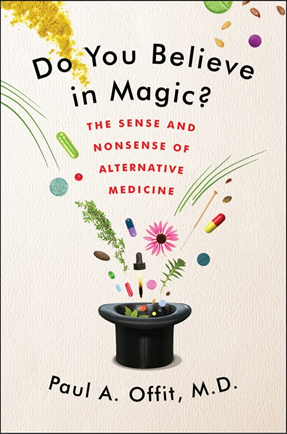
Book Review: Do you believe in magic? The science and nonsense of alternative medicine.

26 Jun

The name Paul Offit is fairly well known in the autism communities. He has spent considerable time countering the false idea that the rise in autism diagnoses seen in the past is due to an epidemic of vaccine injury. He spends most of his time as Chief of Infectious Diseases at the Children’s Hospital of Philadelphia. He is co-inventor of a vaccine which protects infants against rotavirus. Dr. Offit has written a number of books including one on autism: Autism’s False Prophets and one on the anti vaccine movements, which includes large sections on autism: Deadly Choices, How the Anti-Vaccine Movement Threatens Us All. And now he has a new book on alternative medicine: Do You Believe in Magic? The Sense and Nonsense of Alternative Medicine.

bookimg1big

There are two phrases which come to my mind when I hear about alternative medicine. First is a question: what do you call alternative medicine that works? Answer: medicine. The second phrase is more dark: medical fraud is a multi billion dollar business, and the bad guys know about autism.

Alternative medicine is big. Big as in a large fraction of the populations partakes in alt med in one form or another. Big as in it is big business. And, in terms of the subject of this site, big as in alt med is strongly promoted to and popular with the autism communities. Particularly the autism parent community.

As with other books by Dr. Offit, Do You Believe in Magic gives both sides of the various stories presented. He usually starts by giving the pro side, in this case the pro side of alternative medicine. For example, he presents the success stories of various alt-med practioners like chelationist Rashid Buttar and faux cancer therapist Stanislaw Burzynski. If you know the background behind a given story (say, Buttar) it can be quite jarring. You know that the claims aren’t true but you read Dr. Offit presenting them like they are. But when you get to the rebuttal it makes it very powerful.

The media has focused largely on the topic of vitamins–which does get a lot of play in the book. Dr. Offit points out how they supplement industry got a major boost from legislation which removed oversight on the industry. He also points out examples of how the claims for many supplements are either false (they don’t work) or worse (people on supplements live shorter lives than those with the same conditions who do not take supplements). As this is an autism focused site, I’ll point out the two chapters which focus on autism. The chapters largely center around various personalities and for autism the chapter focuses on Jenny McCarthy–the “pied piper of autism”. The chapter goes into detail–as in three page–listing the various theories of what causes autism (heavy metals, vaccines, misaligned spines, etc.) and the various therapies which are purported cures. Three pages. It’s amazing to see it laid out like that–showing that the alt-med community doesn’t have a real idea of what causes autism. Instead, they have dozens of ideas, sometimes contradictory, sometimes disproved, sometimes just without scientific merit. The second chapter with an autism focus is that on Rashid Buttar. He is a chelationist who includes autism as one of the many conditions he “treats”. He also came to fame recently as the doctor (recommended by Jenny McCarthy) chosen to treat Desiree Jennings, whose story of faux vaccine injury became a YouTube phenomenon.

In case you don’t recall him, here is Rashid Buttar’s IV chelation suite for children, complete with Disney characters painted on the walls.

ChildrensIVSuite

Yes, there is room for 10 kids to receive IV chelation at the same time. Which is a small example of how this is big business. Dr. Offit makes the point even more clearly, with Dr. Buttar as one example. Many millions of dollars have been spent by patients on Dr. Buttar’s concoctions–some of which have been clearly shown to do nothing. Some people are getting very rich in the alt-med business. Very rich. Rashid Buttar is one. Stanislaw Burzynski is another. His cancer therapies are amazingly expensive, make no sense and are a grand example of selling false hope.

Bookstores are filled with books on alternative medicine. There are very few books which take a critical look at this industry. Do You Believe in Magic is a welcome addition. Unfortunately, it will likely never sell as well as false hope.

I recently had the opportunity to meet Dr. Offit. One question I posed to him was simply, why does he stay at a teaching hospital? Given his successes, he could do pretty much anything he wants. His answer boiled down to simply–he is doing what he wants. He has the freedom to say what he wants. On more than one occasion this has led to frivolous lawsuits, and even those haven’t shut him up. In his latest book he takes on faux medicine, practitioners who are making huge profits from it and the leglistors who facilitated the industry. One could ponder who will sue him first except that facts are laid out so clearly as to make it difficult for anyone to do so.


By Matt Carey

Wakefield dodges debate – again

9 Jun

The following comment was submitted to the Age of Autism blog but not approved:

Dr Wakefield is being disingenuous. In an earlier video posted on Age of Autism, he offered to debate the MMR-autism link ‘with any serious contender’. In an article published in the online magazine Spiked on 16 April, readily accessible through a link on AoA, I indicated that, as both the parent of an autistic son and as a doctor who has been engaged in this controversy for 15 years, I was prepared to engage in such a debate:

http://www.spiked-online.com/site/article/13532/

On 17 April Matt Carey published an article on the Left Brain, Right Brain blog, entitled ‘Mike Fitzpatrick calls Andrew Wakefield’s Bluff. Wakefield moves the goalposts’, drawing attention to Dr Wakefield’s apparent switch from being ready to debate ‘any serious contender’ to proposing that he was only prepared to debate with British immunisation chief, Dr David Salisbury: https://leftbrainrightbrain.co.uk/2013/04/

As Dr Wakefield is well aware, this is a very safe offer because Dr Salisbury has publicly indicated that he will not engage in any debate with Dr Wakefield.

Still receiving no response from Dr Wakefield, I publicly repeated this challenge in a posting on the Left Brain, Right Brain blog on 30 April, under the title ‘Andrew Wakefield: Now What About That Debate?’: https://leftbrainrightbrain.co.uk/2013/04/

Given the findings of the General Medical Council inquiry that removed Dr Wakefield’s name from the medical register on the grounds of ‘dishonesty’ and ‘irresponsibility’ in the conduct of his research, doctors and scientists are reluctant to engage in any public discussion with him. Many have advised me against accepting his challenge on these grounds. Yet I recognise that he continues to exert some influence among parents of autistic children. Hence I am prepared to engage in a debate that can only expose his failure, after 15 years, to produce any evidence in support of a link between the MMR vaccine and autism.

Michael Fitzpatrick 6 June 2013

Currently, there is insufficient evidence to support instituting a gluten-free diet as a treatment for autism.

24 May

Perhaps the most commonly cited alternative therapy approach for autism is the gluten free/casein free diet. The idea was promoted largely based on the “leaky gut” and “opiod excess” idea of autism. The basic idea was that the intestines of autistics are for some reason “leaky” and incompletely digested proteins from gluten (grains) and casein (milk) enter the bloodstream and act much like an opiod (drug) causing (somehow) autism. Multiple research teams have looked for evidence of these “opiods” without success. But the idea that eliminating gluten and/or casein as an autism treatment.

Timothy Buie is perhaps one of the most respected gastroenterologists in the autism communities. He has recently written a literature review on the topic: The relationship of autism and gluten.

Here is the abstract:

BACKGROUND:

Autism is now a common condition with a prevalence of 1 in 88 children. There is no known etiology. Speculation about possible treatments for autism or autism spectrum disorders (ASD) has included the use of various dietary interventions, including a gluten-free diet.

OBJECTIVE:

The goal of this article was to review the literature available evaluating the use of gluten-free diets in patients with autism to determine if diet should be instituted as a treatment.

METHODS:

A literature review was performed, identifying previously published studies in which a gluten-free diet was instituted as an autism treatment. These studies were not limited to randomized controlled trials because only 1 article was available that used a double-blind crossover design. Most publish reports were unblinded, observational studies.

RESULTS:

In the only double-blind, crossover study, no benefit of a gluten-free diet was identified. Several other studies did report benefit from gluten-free diet. Controlling for observer bias and what may have represented unrelated progress over time in these studies is not possible. There are many barriers to evaluating treatment benefits for patients with autism. Gluten sensitivity may present in a variety of ways, including gastrointestinal and neurologic symptoms. Although making a diagnosis of celiac disease is easier with new serology and genetic testing, a large number of gluten-sensitive patients do not have celiac disease. Testing to confirm non-celiac gluten sensitivity is not available.

CONCLUSIONS:

A variety of symptoms may be present with gluten sensitivity. Currently, there is insufficient evidence to support instituting a gluten-free diet as a treatment for autism. There may be a subgroup of patients who might benefit from a gluten-free diet, but the symptom or testing profile of these candidates remains unclear.

To paraphrase the conclusions: The evidence is not there for eliminating gluten from the diets of autistics. Perhaps some minority has a gluten sensitivity but so far there is no good test for this possible subgroup.


By Matt Carey

Mark Geier loses his last medical license

23 May

At one time, Mark Geier held licenses in 12 different states. Not any more. Until recently he had a license in Hawaii, but no longer. Per Todd W at Harpocrates Speaks: Mark Geier: Not a Leg to Stand On. Mark Geier, who promoted the idea that shutting down sex-hormone production in autistic children, adolescents and young adults was an autism cure, is no longer licensed to practice medicine in the U.S..

More thorough discussion at Mark Geier: Not a Leg to Stand On.


By Matt Carey