Archive | Authors RSS feed for this section

No, the autism “rate” in California did not go down after removing thimerosal from vaccines

26 Feb

I recently attended a talk where the speaker showed autism prevalence by age group for a large HMO in California. The administrative prevalence (fraction of people in the HMO identified autistic) was still going up as of 2010, and the speaker indicated this trend continued to 2012. California is an interesting case study because not only was thimerosal removed from vaccines along with the rest of the U.S. starting in the late 1990’s, but the state enacted a law which required that pregnant women and children under three be given thimerosal free vaccines from 2006 onward. So, with the exception of an an exemption in 2009 and another one right now, even the influenza vaccine in thimerosal free. I bring this up because it is a common argument that somehow the exposure from the flu vaccine is keeping the rate climbing, even though at most this is a lower exposure than that from the 1990’s pediatric vaccine schedule.

This all said, the talk made me dive back into looking at autism prevalence. I decided to finally write about the fact that the autism prevalence in Denmark is higher post thimerosal than while thimerosal containing vaccines were in use. This is completely unsurprising, but a myth has been propogating that it came down and that fact was being hidden.

As it turns out I also checked back with what once was the most common source of autism data for the armchair epidemiologist: the California Department of Developmental Services (CDDS). (I admit one could argue that Special Education data are the most common source for the armchair epidemiologist). The CDDS provides services to disabled Californians and keeps and makes public statistics on their client base. For a long time, every quarter they would come out with a report. For a long time, every quarter these reports would be followed by announcements about how the data showed that vaccines cause autism. One of the people you could always count on was David Kirby (author of the book, Evidence of Harm: Mercury in Vaccines and the Autism Epidemic: A Medical Controversy, and basically a PR man for some of the vaccine-causation groups). Mr. Kirby went so far as to claim that these data were the “gold standard of autism epidemiology”. Well, the data had their uses (such as identifying and quantifying some of the social influences behind the increase) but it is not an easy task to get results from them. The idea that they represent an accurate count of all those with ASD’s (or even accurately account for all individuals with autistic disorder) is a stretch.

But this didn’t stop David Kirby. Back in 2005, David Kirby was claiming that there was an indication that the administrative prevalence in California was starting to drop, and if the trend continued this was a sign that the removal of thimerosal was having an effect:

Stay tuned. If the numbers in California and elsewhere continue to drop – and that still is a big if — the implication of thimerosal in the autism epidemic will be practically undeniable.

Well, by 2007 it was clear that the California data were not really showing a drop. In addition, the lack of a drop was published in 2008 as Continuing increases in autism reported to California’s developmental services system: mercury in retrograde.\

The rise in the number of autism clients in the CDDS database was key to the idea of the mercury-induced epidemic. David Kirby (and others) relied on these data and Mr. Kirby even acknowledged that the data should start showing a drop (statement from 2005):

If the total number of 3-5 year olds in the California DDS system has not declined by 2007, that would deal a severe blow to the autism-thimerosal hypothesis.

The reason is that 5 year olds in 2007 were born after the removal of thimerosal from vaccines. Their exposure to thimerosal was much less than kids in the 1990’s. If the “thimerosal caused an autism epidemic” idea were true, the rates would have to drop. They should drop back to pre-1990 (actually pre 1980) levels if thimerosal were the main, or even a main, cause of the rise.

My recollection is that Mr. Kirby did later backpedal and claim that we would have to wait until some much later date, but it was a weak argument (even by David Kirby standards).

Sorry to keep diving into past history, but one of the strangest moments in the mecury debate (and I can use the term this time, because there was a debate) came in San Diego in 2007. David Kirby debated Arthur Allen in the UCSD Price Center (about 100 yards from my old office, as it turns out). Presented with the fact that even though thimerosal exposure from vaccines had gone down, the California numbers kept going up, David Kirby presented (in something like 100 power point slides!) a four pronged response. First was a claim that California HMO’s had stockpiled thimerosal containing vaccines, so the exposure from vaccines didn’t really go down as much as reports were claiming. Then:

1) A gigantic plume of coal smoke from Chinese power plants has settled on California, depositing lots of mercury and therefore causing the autism numbers in the state to continue to grow.

2) Bad forest fires have put tons of mercury into the air, depositing lots of mercury etc…

3) Cremations (!). The burning of dead bodies with mercury amalgam in their mouths has added even more mercury to the air.

It was a hail Mary pass, to be blunt. Lot’s of handwaving and ignoring the facts.

In 2007, the CDDS changed the way they assessed and counted their clients and they stopped publishing the quarterly reports. As you can imagine, many claimed this was part of a conspiracy to hide the fact that the autism rates were declining in California. And with that the quarterly ritual of misinterpreting and deconstrucing the data came to an end.

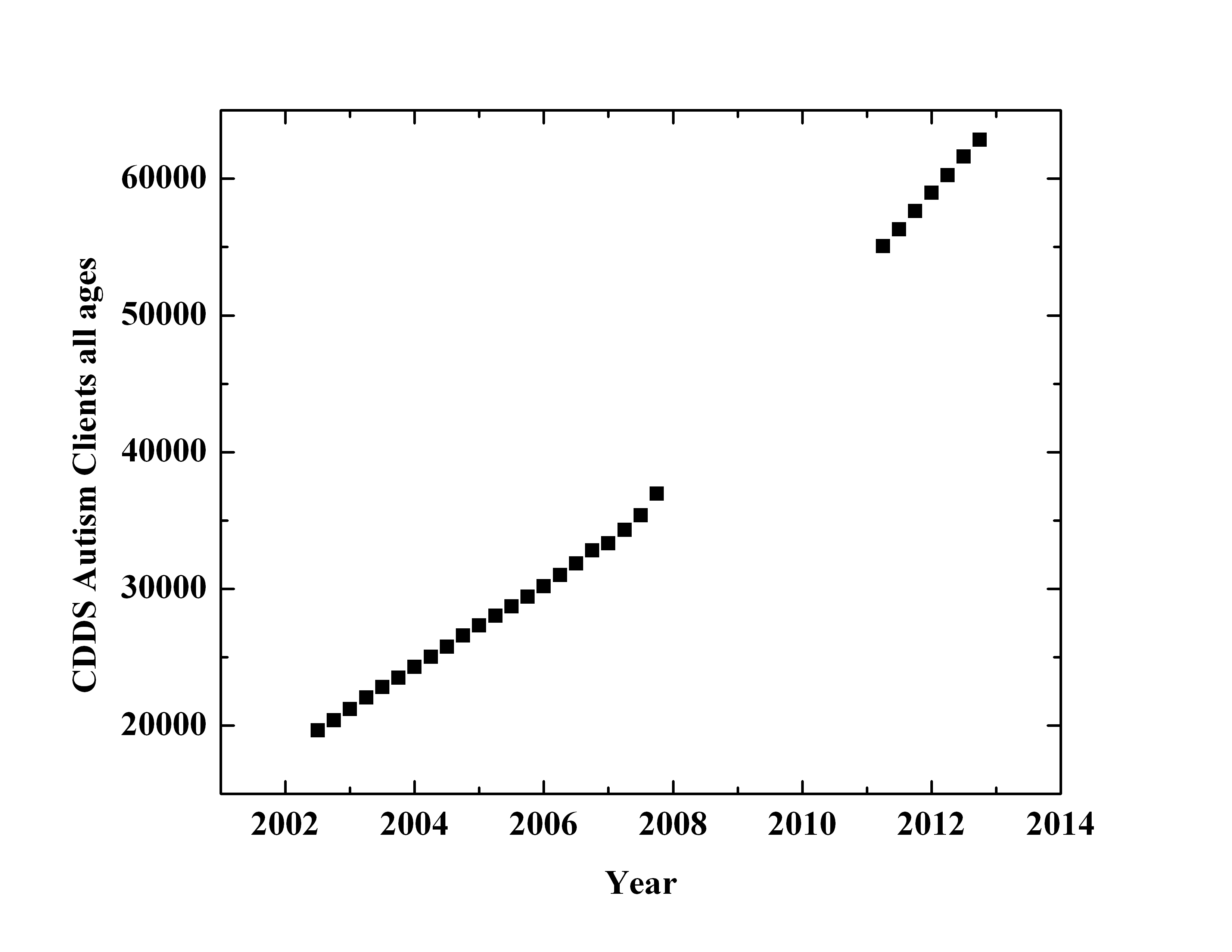
All amusing history, sure, but one might ask, why bring all this up again? Well, because it turns out that the CDDS started putting out quarterly reports again in 2011. Yes, there’s a gap of a few years in the data. Yes, some things changed (for example, the CDDS now shows the PDD fraction of autism client base). Given these limitations–and the other limitations in the CDDS data (i.e. they are *not* the “gold standard” of autism epidemiology), what do these data show? The upward trends continue. More individuals served by the CDDS with autism, even though thimerosal was removed from vaccines. Here’s the total–all ages–count for CDDS clients in the autism category (click to enlarge):

CDDS total

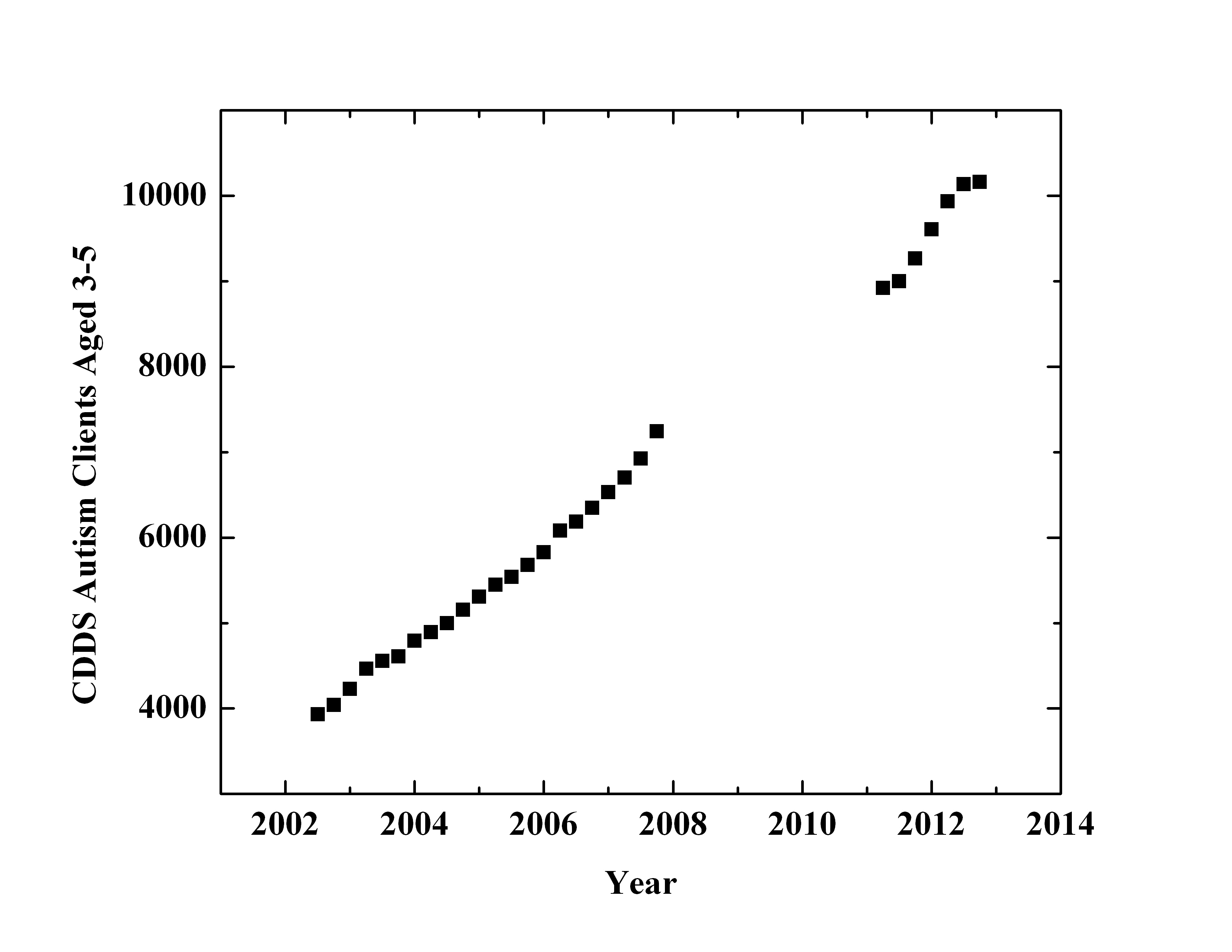
Looking at the younger age groups, those whose exposure to thimerosal is much lower than for kids born in the 1990s, there is also an increase. Here is the age 3-5 age group (click to enlarge)

CDDS 3-5

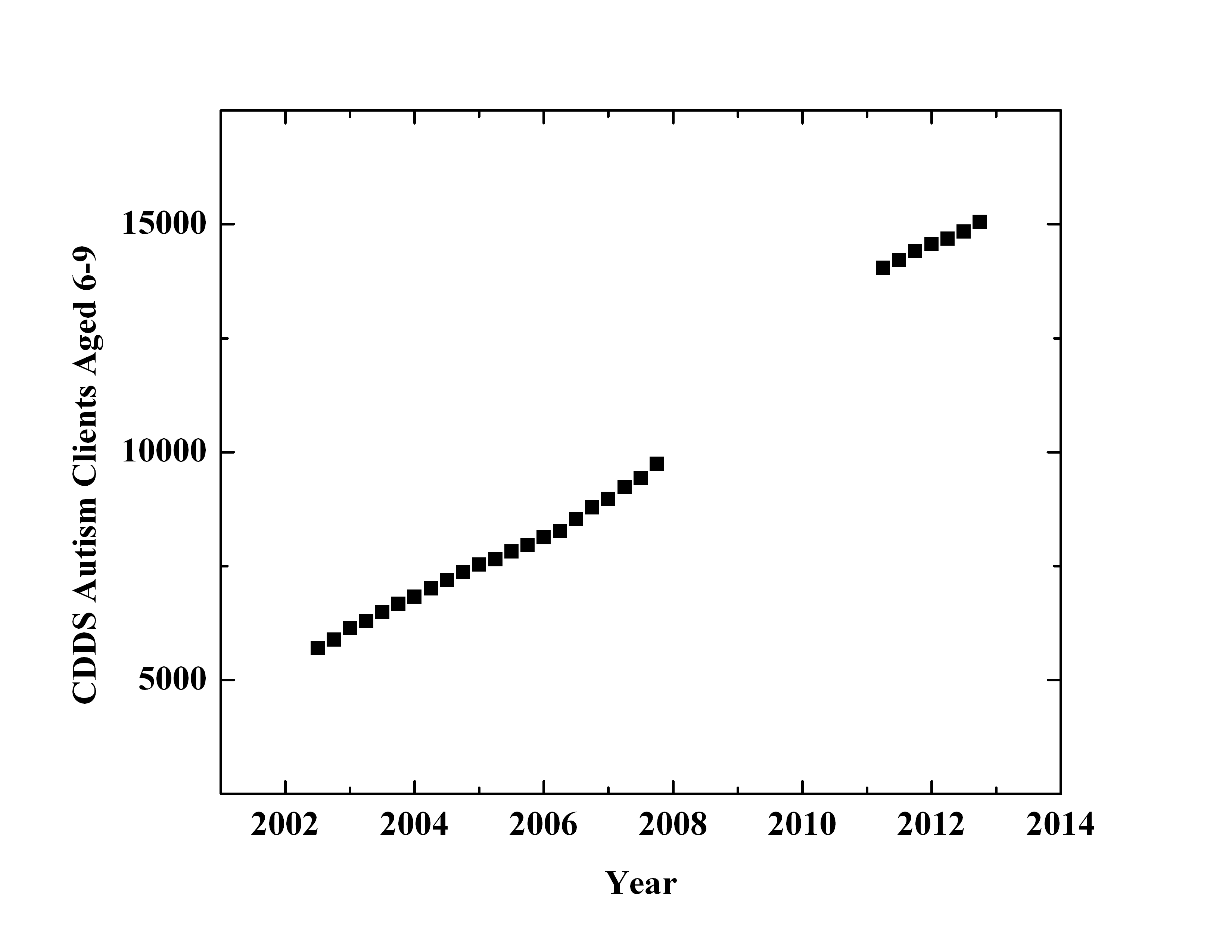
and the 6-9 age group (click to enlarge):

CDDS 6-9

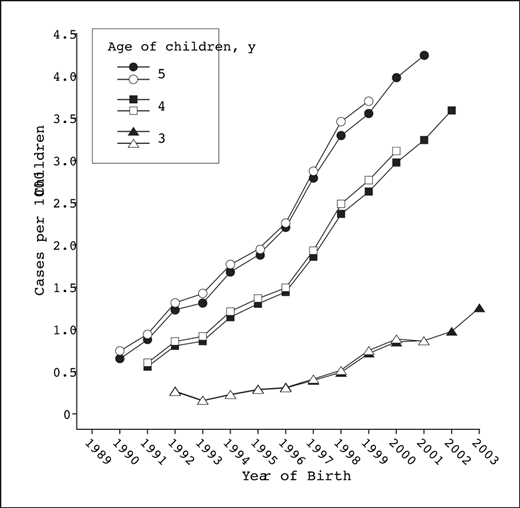
9 year olds in 2012 were born in 2003. Post the removal of thimerosal nationwide. 5 year olds were born in 2007, post thimerosal nationwide and post the California law prohibiting mercury in vaccines for pregnant women and small children. In both groups, the CDDS autism counts are higher than they were in 2002 (the earliest date in the currently available data). Which, in turn, was much higher than the counts from the 1990’s. Here is a figure from the Schechter-Grether paper refenced above:

S-G CDDS paper figure

Which is all a very long way of saying: years ago the evidence was against the thimerosal/epidemic idea; it is even more clear now. For years we heard Mr. Kirby and others talk about how those responsible should step up and admit what happened. Well, the fact is they did. Now it is time for those who promoted the mercury notion to step forward and show they have the guts to admit they were wrong. Because they were. Clearly wrong. It would take a lot of guts to step forward and admit the mistakes. Even though their influence has waned, it would help the autism communities. While I have focused on David Kirby in this discussion, the list is much longer of people who should step forward. I’m not going to hold my breath.


By Matt Carey

No, the autism prevalence did not go down in Denmark after the removal of thimerosal

25 Feb

Once there was an open question of whether the thimerosal containing vaccines, previously used for infants in the U.S. could be contributing to the increase in autism diagnoses being reported. Even with multiple studies showing no increased risk due to thimerosal exposure, there is still a group who not only believes in the mercury-induced epidemic, but they believe that there has been a concerted effort on behalf of the U.S. government and other groups to hide this “fact”.

An email obtained through a freedom of information act (FOIA) request is often cited in online discussions of not only the “fact” that the mercury-induced-epidemic is real, but that the government conspiracy is real. The email reportedly was made by one of the authors of a study from Denmark. The authors had used a sort of natural experiment: Denmark had phased out thimerosal from vaccines in the early 1990’s. They reported that the prevalence of autism continued to increase even with the phase out, thus indicating that thimerosal was not the driving force behind the increase.

The study, by Madsen, et al., was published in 2003. An email obtained by FOIA reportedly shows the authors removing data for the final years of the study period:

I need to tell you that the figures in the manuscript do not include the latest data from 2001….But the incidence and prevalence are still decreasing in 2001.

Sounds alarming, doesn’t it? Data which supposedly shows that autism rates actually dropped following the removal of thimerosal was removed from a paper. Well, I think they should have included the data, a possible explanation and done a follow-up study. That said, the statement really doesn’t bother me. Why? A few reasons but mainly because the data are clear that autism prevalence did continue to go up in Denmark. And much of that data are below.

First, what was the prevalence in the 1990s? Here’s a study from 2007. They were using data where from 2004 (followup through 2004):

Time trends in reported diagnoses of childhood neuropsychiatric disorders: a Danish cohort study. 2007
ASD:
Birth cohort 1994-1995. Prevalence: 0.58%
Birth cohort 1995-1996. Prevalence: 0.47%
Birth cohort 1998-1999. Prevalence: 0.32%

Childhood autism:
Birth cohort 1994-1995. Prevalence: 0.18%
Birth cohort 1995-1996. Prevalence: 0.17%
Birth cohort 1998-1999. Prevalence: 0.18%

Yes, they are showing ASD prevalence dropping in the 1990’s, which should be an admission that the prevalence went down after the removal of thimerosal! I guess they forgot to censor that paper. While ASD prevalence seems to be going down, Childhood Autism is relatively flat. Why would that happen, do you think? Here’s one reason: average age of diagnosis for autistic disorder (childhood autism) is lower than that for the other ASD’s. While autism is not as obvious as many would have us believe, childhood autism *is* more obvious than the other ASD’s (and even with that it gets missed). Consider 1998-1999. That’s only 5 years or so until the followup date from the study: 2004. Average age of diagnosis for ASD in Denmark was about 5 years. So, about 1/2 of the ASD kids born 1998-1999 were not diagnosed at the time of the study. More of the ASD kids born in 1995-1996 and even more of those from 1994-1995. So, what looks like a declining prevalence is most likely just an artifact of how many years of follow-up there were from birth to study date.

I’d say it is even more than “looks like”. Consider the studies below. These are the papers I could easily find that give autism prevalence values for Denmark. I give the title, with a link to pubmed, the year of the study, the birth cohorts reported and the prevalence.

Autism prevalence in the 1990’s?

a href=”http://www.ncbi.nlm.nih.gov/pubmed/14519711″>Association between thimerosal-containing vaccine and autism. 2003
Birth cohort 1990-1996. Prevalence 0.26%

Autism prevalence for cohorts including kids born after 2000? More like 1%. Consider this first paper:

Autism after infection, febrile episodes, and antibiotic use during pregnancy: an exploratory study. 2012
Birth cohorts 1997-2003. Prevalence: 1%

But there are more. The cohorts don’t always match between studies, and we don’t have individual years for kids born 2000 and later. But the prevalence is repeatedly reported as above the 0.26% found for the 1990’s.

In other words, the prevalence continued to go up.

Using maternally reported data to investigate the association between early childhood infection and autism spectrum disorder: the importance of data source. 2012
Birth cohorts 1997-2003. Prevalence: 1%

Parental age and autism spectrum disorders. 2012
Birth cohorts 1980-2003. Prevalence: 0.73%

The rising prevalence of autism: a prospective longitudinal study in the Faroe Islands. 2012
Birth cohort 2002. Prevalence: 0.56%
Birth cohort 2009. Prevalence:0.94%

A comparison of autism prevalence trends in Denmark and Western Australia. 2011
Birth cohort not in abstract. Prevalence (ASD) 0.685%

Risk of autism spectrum disorders in children born after assisted conception: a population-based follow-up study. 2011
Birth cohort 1995-2003. Prevalence: 0.61%

Association of hospitalization for infection in childhood with diagnosis of autism spectrum disorders: a Danish cohort study. 2010
Birth cohort 1980-2002. Prevalence 0.52%

Association of family history of autoimmune diseases and autism spectrum disorders. 2009
Birth Cohort 1993-2004. Prevalence: 0.48%

The incidence and prevalence of pervasive developmental disorders: a Danish population-based studyBirth cohort 1971-2000. Prevalence 34.4 (“corrected”)

Association between thimerosal-containing vaccine and autism. 2003
Birth cohort 1990-1996. Prevalence 0.26%

A population-based study of measles, mumps, and rubella vaccination and autism 2002
Birth cohort 1991-1998. Prevalence: 0.14%

The more early birth cohorts a given study uses, the lower the average prevalence. The more years included post 2000, the closer the prevalence is to 1%.

Sure, it would be great if we had data for prevalence by individual birth year going to 2000 and beyond. But there’s enough data above to make it clear that the autism prevalence in Denmark did not go down after 2000. Quite the contrary. Similarly, measures of autism prevalence in my home state, California, have continued to go up even after thimerosal was removed.

The idea that thimerosal caused an autism-epidemic is just not consistent with the facts. The same data people used over and over to make the argument that thimerosal causes autism–the various autism prevalence estimates–don’t support the idea any more. Thimerosal went away, autism prevalence continued to climb.

So I’m just not swayed when I read people write about how the autism prevalence went down in Denmark with the removal of thimerosal. It didn’t go down. It is sad that people are being misled to think there is still some substance to the mercury-epidemic idea. Cherry pick one email out of how many FOIA’d documents, present it out of context and play it up as something real–while ignoring the evidence that is right in front of you. This is not treating the autism community with respect. This is misleading people.


By Matt Carey

Folic acid supplements and autism

22 Feb

A recent study claims that women who take folic acid supplements before conception are at a lower risk of having an autistic child. In Association Between Maternal Use of Folic Acid Supplements and Risk of Autism Spectrum Disorders in Children the authors found that the odds of a child being autistic were 40% lower if the mother took prenatal folic acid supplements.  The researchers used the Norwegian Mother and Child Cohort Study(MoBa). A couple of points need to be raised: the report focused on autistic disorder, not ASD’s in general. The number of individuals with Asperger syndrome or PDD-NOS were low, limiting the ability to detect differences.  Given that limitation, they found no decreased risk for AS and PDD-NOS with pre conception folic acid supplementation.

Here is part of the abstract:

Results  At the end of follow-up, 270 children in the study sample had been diagnosed with ASDs: 114 with autistic disorder, 56 with Asperger syndrome, and 100 with PDD-NOS. In children whose mothers took folic acid, 0.10% (64/61 042) had autistic disorder, compared with 0.21% (50/24 134) in those unexposed to folic acid. The adjusted OR for autistic disorder in children of folic acid users was 0.61 (95% CI, 0.41-0.90). No association was found with Asperger syndrome or PDD-NOS, but power was limited. Similar analyses for prenatal fish oil supplements showed no such association with autistic disorder, even though fish oil use was associated with the same maternal characteristics as folic acid use.

Conclusions and Relevance  Use of prenatal folic acid supplements around the time of conception was associated with a lower risk of autistic disorder in the MoBa cohort. Although these findings cannot establish causality, they do support prenatal folic acid supplementation.

The overall prevalence is somewhat low at 0.1-0.2%, but recall that they are focusing on autistic disorder, not ASD’s in general (especially in the abstract). A 40% reduction in autism risk is quite large if real. How does that stack up against other studies? There was a study just last year in the U.S.: Maternal periconceptional folic acid intake and risk of autism spectrum disorders and developmental delay in the CHARGE (CHildhood Autism Risks from Genetics and Environment) case-control study, which also found a 40% lower risk of autism with Folic acid supplementation. From that abstract:

RESULTS: Mean (±SEM) folic acid intake was significantly greater for mothers of TD children than for mothers of children with ASD in the first month of pregnancy (P1; 779.0 ± 36.1 and 655.0 ± 28.7 μg, respectively; P < 0.01). A mean daily folic acid intake of ≥600 μg (compared with T variant genotypes. A trend toward an association between lower maternal folic acid intake during the 3 mo before pregnancy and DD was observed, but not after adjustment for confounders.

CONCLUSIONS: Periconceptional folic acid may reduce ASD risk in those with inefficient folate metabolism. The replication of these findings and investigations of mechanisms involved are warranted.

One might think this is rather coincidental that two folic acid studies came out so quickly after one another. Or, perhaps not. One study that received a lot of attention in 2009 was Prenatal and Infant Exposure to Thimerosal From Vaccines and Immunoglobulins and Risk of Autism. The study was one of many which showed no increased risk of autism from thimerosal exposure from vaccines. One side finding of the study was published in their technical report: Price C, Robertson A, Goodson B. Thimerosal and Autism. Technical report. They found a possible increased risk due to maternal folic acid supplementation. That study relied upon maternal report, i.e. memory rather than medical records. It would not surprise me if the two recent studies came out of concerns raised by and during the Price study.

What if pre conception folic acid supplementation reduces autism risk? For one thing, this would point again to the prenatal period as important in autism development. Another factor is that this would point out the fact that given the social factors driving up the autism rate, it is very difficult to pull out factors which could be “real” factors driving autism prevalence up–or down as in this case. Folic acid supplementation is a relatively new practice, and still not universal. In the U.S. fewer than 50% of women report taking these vitamins prenatally. But this fraction has increased:

Although year-to-year variation has been observed over time, the percentage of women of childbearing age who reported consumption of a daily supplement containing folic acid increased overall from 28% in 1995 to 32% in 2003 and to 40% in 2004 and 2007

It’s very much a secondary question to whether folic acid supplementation is reducing autism risk, but an interesting question nonetheless.


By Matt Carey

NCD Response to the State of the Union Address

18 Feb

The U.S. National Council on Disability (NCD) has issued a response to the State of the Union address presented by President Obama recently. I am presenting it in its entirety below:

In the annual State of the Union address, President Barack Obama addressed several policy areas of importance to the 56 million Americans with disabilities and their families. As the independent federal agency which advises the President and Congress on disability policy, the National Council on Disability (NCD) applauds the significant agenda proposed by the President and recommends the following actions to guarantee full participation and integration in all aspects of society for Americans with disabilities.

The President called for an increase in the minimum wage to $9.00 an hour by stating “in the wealthiest nation on Earth, no one who works full-time should have to live in poverty.”

NCD agrees. In 2010, statistics released by the U.S. Census Bureau revealed that nearly 28 percent of Americans with disabilities aged 18 to 64 live in poverty.

Today, hundreds of thousands of Americans with disabilities earn less than minimum wage under a little-known relic of employment policy that assumed people with disabilities were not capable of meaningful, competitive employment.

As the President said, “America is not a place where chance of birth or circumstance should decide our destiny. And that is why we need to build new ladders of opportunity into the middle class for all who are willing to climb them.”

Twenty three years after the passage of the Americans with Disabilities Act, the time has come for minimum wage to be available to everyone who works, including Americans with disabilities. Over a quarter of a million Americans with disabilities work under the Fair Labor Standards Act 14 (c) program resigning people with disabilities to earning less than minimum wages and the poverty, isolation and segregation that often results.

In our August 2012 Report on Subminimum Wage and Supported Employment, NCD recommended a gradual phase out of the 14 (c) program. The ladders our nation builds to opportunity must be accessible to every American – including those with disabilities. As America works toward increasing minimum wage, implementation of a comprehensive set of supports and targeted investments in integrated employment services to make it possible for people with disabilities to rise to the same heights as other Americans must also be assured.

In addition, the President announced a non-partisan commission to improve voting in America by emphasizing “our most fundamental right as citizens: the right to vote. When any Americans … are denied that right … we are betraying our ideals.” A Fact Sheet on the Voting Commission issued by the White House lists voters with disabilities and “physical barriers” among the issues to be corrected.

NCD appreciates inclusion of the difficulties faced by voters with disabilities as part of the Commission’s work. A Government Accountability Office (GAO) report found as recently as 2008, only 27 percent of polling places were barrier-free. In fact, the Federal Election Commission confirmed that, in violation of state and federal laws, more than 20,000 polling places across the nation are inaccessible, depriving Americans with disabilities of their fundamental right to vote. People with disabilities and senior citizens are particularly disenfranchised by long lines at polling places and by constraints on and, in some places, the discontinuation of early voting.

To address this disparity, NCD has been collecting the experiences of voters with disabilities in the November 2012 General Election from across the nation in coordination with the National Disability Rights Network and EIN SOF Communications. NCD will issue a report on our findings later this year.

NCD urges the Voting Commission to consider the findings of our upcoming report and to include voters with disabilities on their Commission.

The President also stressed the importance of key reforms to realize cost savings in the Medicare program, including the shift from a fee for service payment system to a managed care model designed to pay for performance. NCD understands the importance of shifting to payment models that both manage costs and increase quality for our health care financing infrastructure. However, it is crucial that people with disabilities and seniors retain the ability to have their needs met.

Over the last two years, NCD has conducted a detailed exploration of managed care within Medicaid, issuing comprehensive recommendations on due process safeguards, program design, performance measures and other facets of responsible managed care frameworks that consider the needs of Americans with disabilities without causing adverse consequences on the quality of care we receive. As the Administration considers various measures to enhance health care quality while controlling costs, NCD stands ready to apply this expertise to Medicare reforms.

As President Obama affirmed, “the responsibility of improving this union remains the task of us all.” NCD looks to continuing its role in developing and promoting robust disability policies in close collaboration with the Administration, Congress and the public.

— Jeff Rosen, Chairperson
On behalf of the National Council on Disability


By Matt Carey

Tax forms for CoMeD (a Geier nonprofit)

17 Feb

A recent article here at Left Brain/Right Brain showed how Mark and David Geier spend their money: on a large house in this case. Another place where the Geiers spend their money is on their nonprofit: CoMeD, the Coalition for Mercury Free Drugs. Their 990 forms are avaiable on GuideStar.com:

2009 Form 990
2010 Form 990
2011 Form 990

In 2009, CoMeD was Mark Geier (President) and David Geier (VP). Mark Geier was paid $1000.

In 2010 and 2011, the officers are:

Mark Geier (Treasurer)
David Geier (VP)
Lisa Sykes (President)
Paul King (Secretary)

In 2010, officers were all paid $500 each. In 2011, officers were all paid $6,000 each.

CoMeD brought in the following sums:
2009: $12,693
2010: $61,062
2011: $121,217

That’s a big jump. A factor of 10 increase in 2 years. Where does CoMeD spend their money? In 2009 they list one contributer (JB and Lisa Handley, of Generation Rescue) with a $5,000 donation. They don’t list contributers in 2010, but in 2011 the contributers are:

ASD Centers, LLC: $103,915
James and Wendy Abrams: $20,000
Institute of Chronic Illness: $1,975
MEDCON: $5,083.

ASD Centers, Institute for Chronic Illness and MEDCON are all run by the Geiers. So, CoMeD is run by and mostly funded by the Geiers.

Where do they spend their money? Let’s focus on 2011 as it is the largest budget:

$44.6k on travel
$34.8k was spent on legal fees.
$24k on compensation of the officers.
$17k on printing and publications.
$15.3k on other professional services

So, CoMeD apparently spends its money on flying the Geiers around and paying attorneys. Plus paying the Geiers small salary. But they are the primary donors so CoMeD is paying the Geiers their own money. Plus printing and publications.

I would be very interested in seeing the details of these expenses. Especially considering how close inspection of expenses by the special masters in the vaccine court have routinely found strange accounting practices. The Geiers have been travelling to try to convince the U.N. to include a ban on thimerosal in vaccines in the global mercury treaty. They have brought lawsuits against two HHS secretaries (Leavitt and Sebelius. But did those require large legal fees? And that much travel? And publications? Their website certainly doesn’t cost much money. Perhaps there are flyers out there somewhere. Or, maybe, they are paying the publication charges for their papers?

Bottom line: if you want to pay the Geiers to travel the world, pay attorneys and pay themselves, this could be the charitable contribution for you.


By Matt Carey

Boston Globe: Patrick fights Rotenberg shock therapy decree

16 Feb

The Judge Rotenberg Center (JRC) is known for its use of electric shocks as an aversive therapy for behavior modification.  The center is named for Judge Rotenbrg, whose settlement decision 25 years ago allowed for then use of aversives.

The Governor of Massachusetts is now moving to nullify (vacate) that settlement decree.  The Boston Globe reports, Patrick fights Rotenberg shock therapy decree. (Note there is a paywall).

While some families and others connected with the Judge Rotenberg Center in Canton argue that the skin-shock procedure is necessary to treat people with the most severe conditions, others say it is tantamount to torture. Disability rights advocates and some former patients have worked for years to shut down the ­center.

The state’s motion comes two months after federal health officials said they would stop paying for treatment at Rotenberg. If approved, it could mark the beginning of the end of that decades-long debate.

I’ve also been informed that the State’s medicaid office is moving to stop payments to facilities that use electric shock treatments, even for those who are not receiving the shocks.

The electric shock devices are being considered for FDA approval.

It looks like pressure is being brought to bear on JRC from many sides all at once. They could lose their settlement decree allowing for the use of aversives. The could fail to get FDA approval for their shock devices. They could lose federal and state funding. All told, it looks like the use of electric shocks at JRC may be coming to an end.


Matt Carey

Gluyas v Best: autistic blogger wins defamation suit

16 Feb

Long time readers of this site may recall the name John Best. Mr. Best was a very active participant on online discussions, including this blog. Mr. Best is a staunch believer in the notion that autism is mercury poisoning and that chelation is the cure.

Over time Mr. Best’s activities have, in my opinion, increasingly focused on attacking people. For example, Phil Gluyas, an Australian autistic blogger.

Examples of blog posts Mr. Best has published include:

“Is Phil Gluyas the next Adam Lanza?”
“Phil Gluyas’ history of brutality”
“Severely deranged mental case sues me again”

For those familiar with John Best, a defamation case is not surprising. For those who are not familiar with Mr. Best, count yourself lucky.

The judge found in favor of Mr. Gluyas:

The defendant’s responses to the plaintiff’s views have gone well beyond the bounds of ordinary discussion and intellectual debate. The items posted by the defendant on the internet, concerning the plaintiff, contain an extraordinary level of invective and personal denigration, which, in some measure, have been repeated in two letters which he has forwarded to the court in response to the proceedings served on him.

and Mr. Best did not argue that his statements are true:

Taken together, the article, and the imputations to be derived from them, are highly defamatory of the plaintiff. Again, the defendant has not sought to plead and prove the truth of any of those allegations. As such, each of the allegations by him about the plaintiff are false.

This, and much more, led to Mr. Best losing the defamation suit. Instead of the originally requested $10,000, the judge awarded $50,000. With a comment that he could have gone even higher:

Taking into account the foregoing considerations, I consider that it is appropriate to award the plaintiff the sum of $50,000 damages to compensate him for the publications made by the defendant of the plaintiff in Victoria. I should add that, if I had been satisfied that the publication in Victoria of the items, of which the plaintiff complained, had been more widespread than that proven in the evidence, I would have awarded the plaintiff a considerably larger sum of damages

I fear that the ability of someone finding Mr. Best capable of paying anything, much less $50,000, is slim. Accomplishing that from Australia might be even more difficult. It is an attempt to get blood from a turnip. But, Mr. Gluyas has been awarded the right to draw blood from this turnip and that alone is a victory.

There is room to be critical of the actions of others online. John Best crossed that line. To quote the TV show “Friends”, “you’re so far past the line that you can’t even see the line! The line is a dot to you!”


By Matt Carey

An autism reality show…run by Andrew Wakefield?

15 Feb

There is a TV reality show being shopped around right now focused on autism. The team behind this project includes Andrew Wakefield and Polly Tommey. They have an enterprise called the “autism media channel” which has been making YouTube videos for some time. But they have a promo for their “Autism Team” program which appears to be the basis for their reality show.

Where Mr. Wakefield failed to accomplish with science, where he failed to accomplish with books, he is now attempting to accomplish with TV: create the image that his ideas of autistic enterocolitis is a real entity and that he and his friends (such as Arthur Krigsman) are the source of hope for the autism community. Like many reality shows, it appears to be a commercial.

There is a blog post on the Autism Media Channel website, Guest Post by Autism Mother Diane-Cecilia Graham, which begins:

Did you know someone stole my children? He took them away from me and never intended to give them back but I am fighting him. I used all my skills and abilities to learn what I could about him. In battles knowing your enemy is your best defence. He is a mystery, his place of birth is unknown, his future is unpredictable, no one knows how far he can go and he snatches every child in a unique way and holds them captive for an indeterminable amount of time. He comes when you do not see him coming.

Very reminiscent of the “I am autism” video that Autism Speaks put out a few years back, to much criticism. Take autism and personify it as a monster, stealing children.

The framing is all too familiar: create an atmosphere of doom and gloom, plus fear, then bring in the heroes to save the day. The nice thing about TV is that there is no peer review. Editing for effect is expected. Facts are supposed to take backseat to a good story.

I didn’t consider this a viable project. But, Andrew Wakefield has been spotted at a convention for reality TV people recently. And he has the support of a husband/wife film maker/producer team who have a studio in Austin, his home town.

We are a community with great needs. There is no denying that the needs of autistics are often times very great. But I don’t see how a failed researcher, failed author turned TV reality show producer is on the path to a better future for this community. Especially when the failed researcher is one whose lost his medical license for multiple counts of unethical behavior.

Andrew Wakefield may have hit on something: being a business guy for TV or movies. He could probably sell a studio on the sequel to Plan 9 from Outer Space. But the thought of him creating a reality TV show in his image is frankly frightening.


By Matt Carey

Note:edited to correct spelling of Ms. Tommey’s name

A look at the financials for Generation Rescue and the Strategic Autism Initiative

15 Feb

Generation Rescue is a well known charity with a focus on alternative therapies for autism and promoting the idea that vaccines cause autism. The Strategic Autism Initiative was formed by Andrew Wakefield after he left Thoughtful House (now the Johnson Center). Many of these organizations have close ties and, in fact, GR helped SAI get started with a $100k grant its first year.

The most recent tax forms are from 2011 and are below:

Generation Rescue IRS form 990Strategic Autism Initiative IRS form 990

Generation Rescue pulls in a great deal of money, nearly $1.2M. Of which about $240k goes to the “rescue grant” program. About $125k goes to running their website. Another $125k to pay their executive director.

Under grants, Generation Rescue (GR) has two:

$25,000 to the Strategic Autism Initiative
$20,000 to Jackson State University

Both “for researching causes of autism”. We see again the link between GR and SAI. Jackson State is the institution engaged by Generation Rescue and the SAI to perform a vaccinated/unvaccinated study using homeschooled kids. I’ll point out that when I reviewed the GR and SAI tax forms last year, I speculated that they were starting to fund the vax/unvaxed study.

Now consider the SAI’s form 990. SAI pulled in $284k. They paid out $250k in salaries and other compensations. Yep, 88% of intake went to salaries. Luckily they had a bit of a war chest from the year before to draw on. But let’s look at those salaries. Andrew Wakefield is compensated $200k/year for a reported 30hours/week. That’s $270k/year (his salary at Thoughtful House). Terri Arranga ( of AutismOne) was paid $28.8k for reported 15hours/week.

But, as I said, they had a war chest from 2010 (due in big part to a $100k donation from GR). How did they spend that? Well, they appear to have a grant of $25k to Generation Rescue for “research related to the vax/unvax study”. Which strikes me odd as GR gave SAI $25k, so it looks like the money went in a circle.

That said, what expenses did SAI report?

$158k to Dr. “Lenys G. Gonzalez” to work with Arthur Krigsman and Stephen Walker on “molecular and clinical signatures of inflammatory bowel disease and adverse vaccine reactions in autistic children.”

Lenny Gonzalez is a researcher in Venezuela who was funded by Wakefield at Thoughtful House in one of the supposed “independent” replications of Wakefield’s findings. Arthur Krigsman is a former colleague at Thoughful House, with a colorful history. Stephen Walker’s name comes up periodically in regards to a study he presented at IMFAR but never published which supposedly confirmed Andrew Wakefield’s finding of measles virus in intestinal tissues of autistics.

$43k for a study on “vaccination status and health outcomes among homeschool children in the United States”, with Anthony Mawson of Jackson State. Mr. Mawson was named as the lead researcher for this project back when GR was seeking funding from money left over from a class action lawsuit to fund it.

$86k for an “IRB approved” (are the others not?) investigation using the Florida Medicaid database. And, no surprise, this is to look at vaccines. (1) acute adverse reactions to vaccines as predictors of neurodevelopmental disorders and (2) age of vaccination and risk of adverse outcome.

I am curious if the Florida project is the same one the Geiers were attempting to get pushed through approval a few years ago. A t that time a vaccine-causation focused chiropractor and heavy political donor was pushing both access to the Florida medical records and for things like changing a bill to improve access to services for families with autistic children into a vaccine bill.

Many people might be wondering how Andrew Wakefield managed to gather half a million dollars in under two years. I can’t say for sure but I can put out some information for speculation.

One of his board members is Elizabeth Avellan. She also serves on the board for Mr. Wakefield’s “Autism Trust”, which lists her accomplishments as including ” highly successful film producer and co owner of Trouble Maker studios “. Troublemaker Studios has the “Spy Kids” franchise.

Another board member is Phil Rawlins. There was a Phil Rawlins in Austin who owned a soccer team. He has since moved to Florida.

So whatever skills he had, Mr. Wakefield is basically now a fundraiser. He’s good at it, you gotta hand it to him. I can think of a lot of ways that money could be better spent, though.


By Matt Carey

An account from a survivor of the Judge Rotenberg Center

15 Feb

Recently I wrote about a letter from a survivor of the Judge Rotenberg Center (JRC). At the time I did not know if I needed permission to publish the letter in full so I linked to the post I found it at, from Autistic Hoya: Judge Rotenberg Center Survivor’s Letter. I’ve since contacted Nancy Weiss and confirmed that the author gave permission for people to post. Below is that letter. It is very difficult to read and could be a trigger.

—————————

The following letter was sent to Nancy Weiss, Director of the National Leadership Consortium on Developmental Disabilities at the University of Delaware on January 11, 2013. Ms. Weiss assured the author that she would protect the writer’s anonymity. Ms. Weiss can pass messages to the author. Ms Weiss can be contacted as below:
Home Office: 443-318-4879
Cell: 410-241-7257
email: nancy-weiss@comcast.net

Dear Ms. Weiss

Hello my name is xxx. I was told you are someone I can talk to in confidence and be safe. I would like to share with you my letter that I wrote to the FDA about life inside JRC and on the GEDs. It was torture being there. And I suffered so much. I am still tormented. Here is my letter of testimony:

My name is xxx and I attended the Judge Rotenberg Center. I am writing to ask you to please reconsider your approval of the GED for use on ANY human being. I was placed on the GED about 2 months after arriving. I started out on the GED-1, and during my last few years I was placed on the GED-4. There are so many of us that were tortured with these devices, this “treatment”. I believe the reason why more ex-students haven’t spoken out is because they are either non-verbal, afraid, or believe that no one cares about us or it will not make a difference. Parents and families that speak and rally in favor of the GED, are not the ones who have to experience it, the pain and anxiety, day after day for years on end.

The GED IS harmful. Even the GED-1. I was burned many times, and I still have scars on my stomach from being repeatedly shocked there, by the FDA approved GED-1. The electrodes had actually burned into my skin. I experienced long term loss of sensation and numbness in my lower left leg, after getting a shock there. I felt searing pain all the way down to the bottom of my foot, and was left with no feeling in my skin from the knee down for about a year. Again, this was with the GED-1. After complaining to JRC nursing about my leg, they told me to tell the Neurologist about it during a follow up visit for a suspected seizure. He asked the staff what that device was on my leg, and they explained to him it was an electrode. After their explanation, the Neurologist said, “Well, I don’t know what that thing is, but it needs to come off.” JRC left the device off my leg for about a year, then decided on their own, without sending me back to a Neurologist, it was ok to put it back. I have seen students with torso electrodes accidentally placed on their spine area, get a shock there and be violently bent backwards.

Also, I would like you to know that the devices have a tendency to malfunction and go off all by themselves. JRC refers to this as a “misapplication”. It happened to me and other students so many times I cannot count. Sometimes the GED’s will just start to go off and shock you by themselves. Other times the staff shock one student but the remote can also set off someone else’s device at the same time. I have also gotten accidentally shocked from staff mixing up my device with another student’s device, shocking me instead. Then there are the times when staff intentionally misuse the GED. I have had a staff who became angry with me and started pushing more than one remote at a time, shocking me several places on my body at once. I have had staff intentionally give me shocks for things I didn’t do in places like the bus where there was no camera to prove it. I have had numerous staff over my years there threaten me with a GED, antagonize me to try and get me to have a behavior they can then shock me for, merely for the sport of it. Staff can and DO use the GED to scare non-verbal students into doing what they want them to by pretending they are about to shock them. Some even laugh when they do this.

Many of the things I and others get shocked for at JRC were very small things. They would often shock us for things simply because staff found them annoying and they would keep writing therapy notes until our psychologist added it to our program. I got shocked for tic like body movements, for which I have no control over, and which don’t hurt me or anybody else. I would be shocked for waving my hand in front of my face for more than 5 seconds, for closing my ears with my fingers, which I do when things get too loud, because I cannot tolerate too much noise. I would be shocked for wrapping my foot around the leg of my chair, for tensing up my body or my fingers, and the list goes on and on. There was a period of time where I and many of the other students were getting shocked for having 5 verbal behaviors in an hour. A verbal behavior is a minor behavior like talking to yourself, noises (such as clearing your throat), or talking without permission. Every hour would start a new block. And if you were pinpointed more than 4 times in that hour, on the 5th you would get a shock, and then for EVERY minor verbal behavior after that you would be shocked. If you talked out a 6th time, shock. If you had to go to the bathroom, and you had to go really bad, but you asked more then once, that would be nagging, which is a verbal behavior. And these were the things we were getting shocked for. My program was this way for a while. Some of my verbal behaviors I got pinpointed for were crying, talking to myself (even quietly), noises, laughing, humming, repeating myself and inappropriate tone of voice (which was based on staff’s opinion of how my voice should sound). Almost every time I spoke or answered a question, I was pinpointed with these behaviors. My reaction was to stop speaking, but they also made part of my program that if I didn’t answer staff in 5 seconds, I would automatically be shocked. I was paralyzed with fear every day. No matter what I did I was doomed. I ask those who read my letter to think to themselves about how often they do some of these things while they are working. Twirl their pens, talk to yourself or think out loud, ask a question to someone nearby, hum a song that’s in your head, laugh at something funny in the room. These are things humans do. And they are not harmful. Yet we were being subjected to terrible pain and fear for doing these simple things. One day, out of the blue, the case managers went through the building and scratched off this punishment from all their students recording sheets. They didn’t say anything to us about it, just made it like it never happened. Although I can’t say for sure, I overheard talk that one of the male students had told his lawyer and family they were shocking him for talking, and that JRC was never supposed to be allowed to do that to us. Whatever the reason, they covered it up fast. And even though they stopped, they still need to be held accountable for all of it. Because it went on for a very long time, and I suffered greatly because of it. People NEED to know these things happened.

There was a time when I was there that I was on the portion program. This is where JRC starves you as a punishment for having a behavior. For example, my first plan was that for every time I had a minor behavior, such as talking to myself, rocking, wiggling my fingers, I would lose a part of my next meal. My meals came to the classroom cut into tiny pieces and divided into portions inside of a little plastic cup. Every time I had one of these little behaviors, I was forced to stand up and throw one cup away. There were many days I would lose most of my meals. And the hungrier I got, the more frantic and restless my body became. This caused me to have more behaviors like tics and rocking, and in turn I would lose more food. My mind clouded and I could no longer concentrate. I would often become so frustrated from this I would end up hurting myself. At the end of the day, at 7pm, I was offered “LOP” (loss of privilege) food. This was made intentionally to be completely unappetizing. It was ice cold, and it was made up of chicken chunks, mash potato, spinach, and then doused with liver powder, then set to sit in the refrigerator for days. The smell alone made me sick. And I never once was able to eat it, no matter how hungry I got.

It was very difficult to sleep at JRC. There are several alarms in the room and over the bed. Every time someone moved in bed it would set a loud alarm off that could be heard throughout the house. Most of us on GED’s had to sleep with the devices on. That means locks and straps that get all tangled around you and make it very hard to lay down in a comfortable way. I was very anxious to close my eyes, always fearing a shock for something I might not have even known I did. My fears came true one day, and I was given a GED-4 shock while I was asleep. It was not explained to me why I got this shock. I was terrified and angry. I was crying. I kept asking why? And they kept telling me “No talking out”. After a few minutes Monitoring called, and told the staff to shock me again for “Loud, repetitive, disruptive talking out.” The next day I asked the supervisor why I had gotten that GED. And she explained that staff had found a small piece of plastic in my self-care box, which contained my shampoo bottles etc, and that they considered this a hidden weapon. I could not believe it. I did not hide anything in my self-care box. I had not done anything wrong. Yet I was shocked for it, and worse off in my sleep. That piece of plastic, of which I was never shown, had probably broken off of one of the plastic containers inside the box. And I was severely punished for this. After this incident I really stopped sleeping. Every time I closed my eyes they would jump open, anticipating that jolt somewhere in my body.

I truly believe that the judges that approve us for the GED have no idea what it really is like. All they have to go on is what JRC claims. The GED does not feel like a “hard pinch” or a “bee sting.” It is a horrible pain that causes your muscles to contract very hard, leaving you sore afterward. I would often have a limp for one or two days after receiving a GED. The devices JRC puts on us are not the same ones they show to the outside world when they let outsiders try the GED. Students wear a different electrode, a long one with 2 metal electrodes that radiate the electricity across a large area.

Besides the physical pain, life with GEDs is a life of constant anxiety. I experienced heart palpitations daily, had a very hard time sleeping and eating, and became rather paranoid, always wondering if I was about to get shocked and constantly alert in all directions. I eventually became very depressed there and contemplated suicide every night. Now, after having been gone almost 4 years, I am still having nightmares and flashbacks during the day, especially when I hear certain noises that remind me of GEDs and JRC.

I want to mention, similar to many other students, I was also tied to the 4-point restraint board and given multiple shocks for a single behavior. And if I screamed out in fear while on the board, I would be shocked for that as well. I was shocked for behaviors I had no control over, such as tensing up and tic-like body movements. We were always having to watch others getting shocked in the room. Hearing others scream, cry, beg to not be shocked. Students would scream “I’m sorry, No, Please!!” all day. I, like other students, would cringe and feel sick and helpless while watching others getting shocked. I was so anxious about getting shocked that I would many times bang my head just to get it over with. The GED often was the cause of my behavior problems. The students that get shocked the most at JRC are non-verbal. So they cannot speak up. I feel that just because we were born different, we are not given the same rights to be protected from tortures like the GED.

We are at the mercy of guardians and judges. When I was brought to court to be approved for the GED, I was not told where we were going or why. I was brought into the courtroom wearing a helmet and restraints on my wrists and ankles. I was not questioned by the judge. All he had to go on was my appearance in those restraints, testimony from JRC officials, and charts of provoked behaviors. These behaviors came from being forced to sit in isolation with a straight upright posture, in the center of a hard restraint board, day after day, week after week, for two months. I received no real help and no socialization. For those two months I was not allowed to sit in a chair, at the classroom or residence. I was to sit on the board. Also, JRC provoked me by not allowing me to shower during those two months. Instead of showers, I was bathed tied to a restraint board, naked, while staff washed me, putting their hands all over me. All in front of cameras, where Monitoring watched, including men. Being tied on a restraint board, naked, with my private areas exposed to the staff in the bathroom and the cameras was the most horrible, vulnerable, frightening experience for me. I would scream out “rape, rape!” And these were recorded as major behaviors for me. When I first arrived at JRC, I was immediately subjected to humiliation and provocation by them forcing me to wear a diaper. I in NO WAY needed or have ever needed a diaper as an adult. I am completely independent in all toilet and hygiene skills. And they knew that. I had NEVER worn a diaper up until that day, except of course when I was a little baby. And that is exactly how they made me feel, like a little baby. I was embarrassed and confused and angry. I took that diaper off constantly. When I would take the diaper off they would mark that down on my chart that they would later show the judge as destructive behavior. I would often get restrained on the 4 point board for taking off the diaper and fighting staff not to make me put it back on. In these ways and more, JRC provoked many behaviors in me that were shown on a chart to the judge. There is no way the judge could know what was provoking my behaviors. JRC told the judges that their program was the only thing that could help me. That theirs is the only last resort treatment.

I was considered a difficult case. I would like you to know that I am doing very well in a new program that is nothing like JRC. I don’t get shocked or put in restraints, and I am given help by staff and doctors that I can talk to. I am not drugged up as JRC claims I would be if I left. JRC made no attempt to understand me. Feelings do not matter to JRC and we were specifically not allowed to express them. I felt like an animal test subject there. My new program does not punish me for my problems, that are the result of having Aspergers Syndrome. I have gotten so much better from getting real help instead of constant punishment and pain.

I ask you to please investigate carefully into the GED. The ones that are actually being used on the students, not the samples JRC provides, as I have experienced them to be extremely manipulative in all things. There are no doctors overseeing us with the GED. Every few years they would drive me to a doctors office near Framingham, Ma, and not tell me why. In his office he would literally walk in, say hi how are you, and before you can answer he has signed their papers and you are shown the door.

I have attached with this email a document I wrote called “The Board” which is about one of JRC’s worst tortures that they used on me and others. I wrote it so that outsiders can feel what we feel, and hopefully to help others understand the agony of GED treatment. I invite you to read it, and I hope it will share a new perspective for you, the perspective of the ones that should matter the most, the human beings on which these devices are being used.

Sincerely,
xxx
————————————————————————————————————

The Board
By: xxx
December 2012

The most sickening, horrifying experience of my life was being shocked on the restraint board. What is the board? It is a large, door sized contraption made out of hard plastic, with locking restraint cuffs on each corner where your wrists and ankles get locked in. Your body becomes stretched spread eagle style, pinned tight, rendering you completely helpless, combined with an overwhelming feeling of vulnerability. It is a torture that you would expect to see in a horror movie. The kind that makes you cringe and scream while you watch. The kind you cant get out of your head even a after it’s over. Only this was happening for real, to me.

They added the restraint board, which for me was 5 shocks over 10 minutes to my program after a few months, which means getting shocked 5 different times, over a period of 10 minutes for having just one single behavior. If you have just one of those behaviors on your sheet, which can be getting out of your seat without permission (even without doing anything violent), tensing your body, anything they decide to put in your program. A behavior is anything you do that JRC considers a problem. Anything from hitting your head, to talking to yourself, saying a swear word, rocking, even screaming from fear and pain of the shocks, is a “behavior”. The staff grab you, put you in restraints, walk or drag you to where the board is kept (usually right in the middle of the classroom with all the other students watching and stepping around you), and thanrestrain you to the board. Arms and legs locked in. Then the terror starts. You have to wait for it. You never know when it’s coming. The staff shocking you usually hides behind a door or desk so you can not see them. JRC lavishes in the element of surprise when shocking us. Then all of a sudden the searing pain and jolt in your arm or leg or stomach, or sometimes even the fingertips or thigh or even bottom of your feet. Whichever part of the body gets shocked, it will travel throughout. If you get shocked in your arm, for example, it is not a “hard pinch” it is a radiating electricity that will travel from your bicep through to your fingertips. Your whole arm jerks against the restraints, causing added pain from your muscles being forced to contract against being tied up. The loud screech of the device goes off with it, and they say, “(name) there is no tensing up”. One down, 4 to go. Your heart races immediately, and you sweat profusely. All you want to do is throw up. That ten minutes feels like hours. You try to prepare yourself for the next shock. I keep saying in my head, 4 more, 4 more. Please just finish please. Trying not to scream in fear because i will be shocked for that as well. It comes again without warning, next time maybe in your stomach, the stabbing pain runs from left to right, right to left, across your belly button area. Your stomach heaves in and you lose your breath. More sweat now. Your heart beats faster now than you can feel possible. I start to hope my heart stops. Anything to let me away from this.3 more. But now it’s even harder, I don’t feel I can take any more of this torture. Besides the pain, it’s the panic and fear in your mind. There were times when I peed on myself. One particular time I was put on the board for hitting my head the night before. They said because the staff did not “follow my program”. They put me on the board. They shocked me repeatedly in the stomach. And when they finally got to 5, I thought “it’s over”. But then they didn’t take me off the board. They gave me a 6th, than 7th, than 8th. They kept going. I was so filled with fear, not knowing what was happening or when they would ever stop. I went away in my head. I started floating. I had no more tears left. When they finally stopped after 10, they sent other staff in to “change my batteries”. When they lifted the electrodes off of my stomach, it was stuck. They had to pull because it had burned into my skin. I still have those scars on my stomach. When they took the devices off of me to test them, I was still strapped to the board. Every time I heard the noise from the test, I cried and panicked. The staff attempted to comfort me, she whispered to me so they wouldn’t hear her, because any kind of comforting is never allowed. I was shocked on the board on many separate occasions. One time for something I never even did.

I lived this. These things happened. These things were done to me and I witnessed them done to many others.