Archive | Autism RSS feed for this section

Newsweek: Anti-Vaxxers Accidentally Fund a Study Showing No Link Between Autism and Vaccines

3 Oct

Newsweek has an article up at Newsweek about the recent vaccine study–the one discussed in the press release here. The title of the article pulls no punches: Anti-Vaxxers Accidentally Fund a Study Showing No Link Between Autism and Vaccines

Here’s how it starts:

Most experts today agree that the belief that childhood vaccines cause autism is based on bunk science. Even still, some advocacy groups claim immunizations are responsible for raising the risk for this neurodevelopmental condition, despite a growing body of research that shows there isn’t a link. (The study that most anti-vaccination groups point to was retracted after it was found to be based on falsified data.)

If the title didn’t tip you off that there would be no false balance here, this first paragraph is very clear.

Here’s the second paragraph, where they discuss how SafeMinds, called an organization in the anti-vaccine movement:

Despite the science, organizations involved in the anti-vaccine movement still hope to find some evidence that vaccines threaten children’s health. For example, the autism advocacy organization SafeMinds recently funded research it hoped would prove vaccines cause autism in children. But this effort appears to have backfired for the organization—whose mission is to raise awareness about how certain environmental exposures may be linked to autism—since the study SafeMinds supported showed a link between autism and vaccines does not exist.

SafeMinds, even though they funded the study and were kept aware of the progress, even though they knew the methods and approved of them, wants to do their own analysis.

But Sallie Bernard, president of SafeMinds, says she would at least like to see a re-analysis of the newest data. “We feel that embedded within these data sets there are animals that have potentially an adverse reaction to this vaccine schedule that would mirror what happens in human infants,” she says. “The majority who get vaccines are fine, but we believe there is a subset that have an adverse reaction to their vaccines. By looking at the raw data, not data in aggregate, we may be able to identify the subgroup that had that reaction.”

And who at SafeMinds would be better qualified than the authors to do this analysis? (who would even be remotely qualified?)

No one.

Has SafeMinds shown excellence in research methods and integrity in the past?

No.

Does anyone doubt that SafeMinds would torture the data to the point of getting the answer they want?

Integrity would be accepting the results of the study they sponsored. SafeMinds lacks that integrity.


Matt Carey

Press Release: New Research Finds No Evidence That Thimerosal-Containing Vaccines Affect Behavior or Neuroanatomy in Infant Primates

30 Sep

Below is a press release from the Johnson Center for Child Health and Development (formerly Thoughtful House). The press release discusses a recent study which investigated the safety of vaccine schedules (present and past) using monkeys as test subjects.

The study is a follow on study to a previous series of pilot studies involving some of the same authors. The pilot studies were considered by many to be an indication of evidence that vaccines cause autism and other neurological conditions. This larger study shows no evidence of adverse effects from vaccines.

Here is the press release:

New Research Finds No Evidence That Thimerosal-Containing Vaccines Affect Behavior or Neuroanatomy in Infant Primates

(Austin, Texas) – September 28, 2015 – New research finds no evidence that thimerosal- containing vaccines cause negative behaviors or result in neuropathology in infant primates, according to a study that will be published today in the Proceedings of the National Academy of Sciences. In this study, conducted by Dr. Dwight German of the University of Texas Southwestern School of Medicine, and colleagues, infant rhesus macaques received several pediatric vaccines containing thimerosal (a mercury-based preservative) in a schedule similar to that given to infants in the 1990s. Other animals received just the measles-mumps- rubella (MMR) vaccine, which does not contain thimerosal, or an expanded vaccine schedule similar to that recommended for US infants today. Control animals received a saline injection.

Regardless of vaccination status, all animals developed normal social behaviors. Cellular analysis of three brain regions, the cerebellum, amygdala and hippocampus (all known to be altered in autism), was similar in vaccinated and unvaccinated animals.

“This comprehensive analysis of social behavior and neuropathology in 12-18 month old rhesus macaques indicated that vaccinated primates were not negatively affected by thimerosal; the same was true for animals receiving an expanded 2008 vaccine schedule, which is similar to that recommended for US infants today” explained Dr. Laura Hewitson of The Johnson Center for Child Health and Development, one of the principle investigators working on the study. Hewitson was part of a team of researchers from The Johnson Center; the University of Texas Southwestern; the Center on Human Development and Disability Infant Primate Research Laboratory; the Washington National Primate Research Center (WaNPRC) at the University of Washington, Seattle WA; and Texas A&M Health Science Center & Central Texas Veterans Health Care System.

According to Hewitson, the study was designed to compare the safety of different vaccination schedules, including the schedule from the 1990s, when thimerosal was used as a preservative in multi-dose vaccine preparations. The data from this study indicate that administration of TCVs and/or the MMR vaccine to rhesus macaques did not result in neuropathological abnormalities,or aberrant behaviors, like those often observed in autism.


Citation
Administration of thimerosal-containing vaccines to infant rhesus macaques does not result in autism-like behavior or neuropathology. Bharathi S. Gadad, Wenhao Li, Umar Yazdani, Stephen Grady, Trevor Johnson, Jacob Hammond, Howard Gunn, Britni Curtis, Chris English, Vernon Yutuc, Clayton Ferrier, Gene P. Sackett, C. Nathan Marti, Keith Young, Laura Hewitson and Dwight C. German. PNAS

This article can be downloaded for free here.

This study was supported by The Ted Lindsay Foundation, SafeMinds, National Autism Association, and the Johnson and Vernick families. This work was also supported by WaNPRC Core Grant RR00166 and CHDD Core Grant HD02274.

About The Johnson Center
The mission of The Johnson Center for Child Health and Development is to advance the understanding of childhood development through clinical care, research, and education.

Previous Press Releases
For Immediate Release
Contact: media@johnson-center.org
512-732-8400


By Matt Carey

Literature review: HBOT is not recommended for ASD treatement

28 Sep

Hyperbaric Oxygen Treatment (HBOT) is one of the many “treatments” that are promoted for autism.   This recent literature review shows that there is no good basis for HBOT and autism.

Or, as the abstract concludes “HBO2 should not be recommended for ASD treatment until more conclusive favorable results and long-term outcomes are demonstrated from well-designed controlled trials.”

Using hyperbaric oxygen for autism treatment: A review and discussion of literature.

PURPOSE:

To determine whether hyperbaric oxygen (HBO2) therapy should be used for the treatment of autism spectrum disorders (ASD).

METHODS:

A literature search was performed on PubMed, Cochrane Library and DynaMed for studies evaluating the use of HBO2 for ASD treatment. The studies were then reviewed for the highest quality evidence.

RESULTS:

The evidence is weak for the use of HBO2 in ASD, with only one, likely flawed, randomized control study showing treatment benefit.

CONCLUSIONS:

HBO2 should not be recommended for ASD treatment until more conclusive favorable results and long-term outcomes are demonstrated from well-designed controlled trials.

By Matt Carey

Study shows societal inclusion improves life satisfaction

27 Sep

I know a lot of people will read the title of this post and say, “that’s obvious”. But keep in mind–studies give people a chance to advocate better. Now for the limitations–the study was only on individuals who did not have difficulties in areas of daily living skills. And, yes, the study population did not have intellectual disability.

But with all that, here’s the sentence I’ll highlight from the abstract: “Participating in society was identified as the only factor predicting life satisfaction in individuals with ASD.”

Here is the pubmed link
Psychosocial Functioning and Life Satisfaction in Adults With Autism Spectrum Disorder Without Intellectual Impairment.

and here is the abstract:

OBJECTIVES:
This study aimed at (a) comparing psychosocial functioning and life satisfaction in adults with autism spectrum disorder (ASD) and nonclinical participants and (b) identifying areas of functioning that are most predictive for life satisfaction in individuals with ASD.
METHOD:
A total of 43 adults with ASD without intellectual impairment (age: mean = 31, standard deviation = 10 years; 63% females) and healthy nonclinical individuals (N = 44) were surveyed.
RESULTS:
Individuals with ASD reported significant functional impairments and less life satisfaction compared with nonclinical individuals in many areas of life. Although impairments were prominent in domains involving interaction with other people such as understanding and communication, getting along with others, and participation in society, daily living skills (e.g., getting around, self-care, and household) were not different from nonclinical participants. Participating in society was identified as the only factor predicting life satisfaction in individuals with ASD.
CONCLUSION:
There is a need for interventions facilitating functioning on a broad level and support toward societal inclusion for individuals with ASD.


By Matt Carey

Thank you Kevin Moon Loh

25 Sep

An actor in a major musical production has a facebook post about a recent performance. In this performance, an autistic child made noise during a quiet part of the show. And Mr. Loh comes to the defense of the child.

The post begins:

I am angry and sad.
Just got off stage from today’s matinee and yes, something happened. Someone brought their autistic child to the theater.
That being said- this post won’t go the way you think it will.
You think I will admonish that mother for bringing a child who yelped during a quiet moment in the show. You think I will herald an audience that yelled at this mother for bringing their child to the theater. You think that I will have sympathy for my own company whose performances were disturbed from a foreign sound coming from in front of them.
No.
Instead, I ask you- when did we as theater people, performers and audience members become so concerned with our own experience that we lose compassion for others?

Mr. Loh quotes Joseph Papp that theater is created for all people. It’s a message that resonates with my family. We have worked to make the theater experience accessible to our own child and also to other disabled people in our community. I am proud to say that my wife started on this effort even before the idea of a “sensory friendly” performance became big news. Proud not because she was ahead of the curve, but because this shows that this is an effort of passion on her part.

Mr. Loh, I thank you. Theater is for everyone.


By Matt Carey

Autism Speaks founder Bob Wright’s opinion is more important than science

24 Sep

Last year the Chief Science Officer of Autism Speaks made a simple and clear statement

“Over the last two decades, extensive research has asked whether there is any link between childhood vaccinations and autism.  The results of this research are clear: Vaccines do not cause autism.  We urge that all children be fully vaccinated.”

It was nice to finally see someone from Autism Speaks make a clear statement without a lot of equivocation and “leave the door open” language.

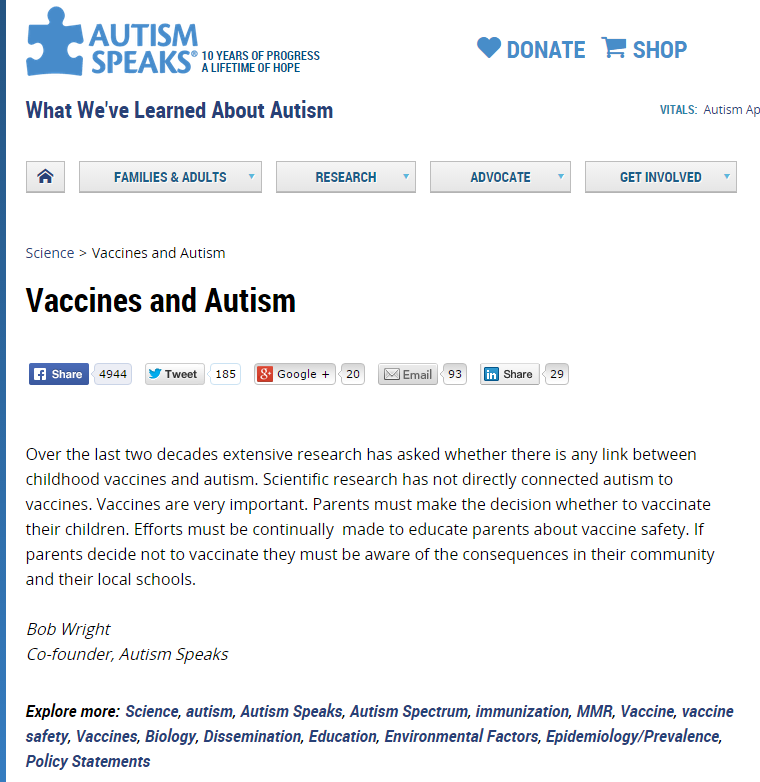
But what I think is nice and what Bob Wright, the founder of Autism Speaks, thinks is nice are two different things.  The Wright family is, at least, sympathetic to the idea that vaccines cause autism (and, in at least one case, very outspoken on the idea.)  So perhaps I should have been surprised when Autism Speaks put on their website Rob Ring’s statement together with a statement by Bob Wright.

Over the last two decades, extensive research has asked whether there is any link between childhood vaccinations and autism.  The results of this research are clear: Vaccines do not cause autism.  We urge that all children be fully vaccinated.
Rob Ring
Chief Science Officer, Autism Speaks
Over the last two decades extensive research has asked whether there is any link between childhood vaccines and autism. Scientific research has not directly connected autism to vaccines. Vaccines are very important. Parents must make the decision whether to vaccinate their children. Efforts must be continually  made to educate parents about vaccine safety. If parents decide not to vaccinate they must be aware of the consequences in their community and their local schools.
Bob Wright
Co-founder, Autism Speaks
Because why should we let the Chief Science Officer have the actual word on what Autism Speaks thinks about an issue of science?  Why let a clear statement stand alone when one can leave the door open with “Scientific research has not directly connected autism to vaccines.”
And that was sad.  A sad move by Autism Speaks.  A sad move by Bob Wright.
But I’ve already written about that.  Why bring it up again now?  Well, because a reader here alerted me to the fact that Bob Wright and Autism Speaks have expunged the statement by their science officer. If one now goes to https://www.autismspeaks.org/science/policy-statements/information-about-vaccines-and-autism, one finds only Bob Wright’s statement:
AS backpedals on vaccines
I so want Autism Speaks to be an organization I could support.  And sometimes they seem to be moving in that direction.  But, in the end, they are still clinging to ideas like “vaccines cause autism”, ideas that cause a lot of harm within the autism communities.  And they also take a very stigmatizing approach to the discussion of autism, but that is another discussion.

Autism Speaks pretends to be a science driven organization, but they just aren’t.  The founder is the founder and his opinion means more than the results of scientific studies as expressed by their own Chief Science Officer.

By Matt Carey

Steve Silberman discusses Neurotribes in a New York Magazine interview, dispels common myth about Neurodiversity

24 Sep

Author Steve Silberman (author of Neurotribes) was interviewed in New York Magazine recently: The Problematic Obsession With ‘Curing’ Autism. Mr. Silberman has been interviewed a lot recently as his best selling book (Neurotribes) has rolled out, so one might wonder why I’m focused on this particular interview. Well, as it turns out, one statement clearly and concisely addresses many of the misconceptions (read straw man arguments) that people make about the neurodiversity movement.

Silberman believes that our conversation about autism could be made a great deal clearer and more humane if we viewed the condition as a disability. “For various reasons that I talk about in the book, we haven’t thought about it as a disability in the same way that we talk about blindness and deafness as disabilities.” That is, while everyone agrees that printing Braille books and offering closed-captioning services are worthwhile things to spend money on, autism is different — as Silberman put it, imagine if our attitude was “Forget the wheelchair access! Someday, everyone will walk.”

If you are unfamiliar with the discussion, let me explain. Many of those who criticize the neurodiversity movement claim that the neurodiversity movement denies that autism is a disability.

If one wants to hunt down autism misinformation, a good first place to look is the blog “The Age of Autism”. So, I went to google, search silberman site:ageofautism.com, and read. Top of the list, an article titled “Autism Speaks vs. Steve Silberman”. Search the page for “disability” and get–

NO ONE CAN TELL US. We’re absolutely paralyzed by autism. We have the view of neurodiversity people who look at autism not as a disability, but as just another way of seeing the world.

See the difference? According to the Age of Autism writer, “neurodiversity people who look at autism not as a disability”. But, as Mr. Silberman tells us, it is precisely because we need to see autism as a disability in order to move forward on the making achievable improvements in the lives of autistic. (And not view autism some passing phase for a child, should we just find the correct industrial chemical to sprinkle on their gluten free waffles, as the Age of Autism would have it).

Go to the next article in the google search and one finds

The coverage below is very convincing. People who haven’t looked into the issues involved here might think Steve Silberman makes sense. So, if all the autism is really due to a broader definition and better diagnosing, shouldn’t we just recognize and provide for this minority of unique people among us? Calling autism a disability is really an insult.

In another article, the Age of Autism writes “Unless and until people like Steve Silberman can show us the one in 68 autistic adults out there, his book is fantasy fiction.”

And there you see the reason why AoA doesn’t like Mr. Silberman or his views. Because Mr. Silberman lays out in detail why we should listen to the man who discovered autism (Hans Asperger) and accept that autism is not new. If autism is not new, then the Age of Autism “The Daily Web Newspaper of the Autism Epidemic” (read, we exist to promote the idea that vaccines-cause autism) would be built on a false premise.

Which it is.

By the way, those details that Mr. Silberman lays out are ones which apparently the writers at the Age of Autism don’t have the time to read, as there’s no evidence anyone there critiquing his book has actually read it. Seriously, the articles are all based on interviews and reviews of the book rather than the book itself.

And we are left with the irony of the Age of Autism (a strong proponent of the failed idea that vaccines cause autism and that pretty much anything touted as a “cure” for autism should be purchased by parents and subjected to disabled children) calling something “fantasy fiction”.

Pointing out that the Age of Autism is wrong can be a full time job. Or at least a daily exercise in that the are pretty much always wrong. So, why bother now? Because, once again, I felt that Mr. Silberman spelled out one aspect of the neurodiversity movement so well. So well, in fact, that I will copy that paragraph here:

Silberman believes that our conversation about autism could be made a great deal clearer and more humane if we viewed the condition as a disability. “For various reasons that I talk about in the book, we haven’t thought about it as a disability in the same way that we talk about blindness and deafness as disabilities.” That is, while everyone agrees that printing Braille books and offering closed-captioning services are worthwhile things to spend money on, autism is different — as Silberman put it, imagine if our attitude was “Forget the wheelchair access! Someday, everyone will walk.”


By Matt Carey

The (Budget) Fight Goes On

14 Sep

After the end of the California legislative session last week I was very curious as to how the budget battle went. We’ve been working to get funding restored for developmental services here and there was a big push to get this included before the legislature recessed.

But I couldn’t find information over the weekend. Thankfully an email came out today from Greg deGiere at The Arc & United Cerebral Palsy California Collaboration.

Short version–the restoration of the developmental services funding was not added to the budget but–and this is big–the legislative special session didn’t end.

Which means–the fight goes on. We will need calls, tweets, etc. in the future.

Here’s the email.

Dear Friends,

So what happened in the Capitol last week in the fight to save our developmental services?

The bad news is that the Legislature didn’t take any action before going home Friday night. The final push stalled by the end of the day, leading to the Democrats and Republicans angrily blaming each other for why they still couldn’t do anything for our community.

The good news is that they didn’t adjourn the special legislative session Friday as they had planned to — so the Legislature will officially be in session even though they aren’t here, and the legislators can be called back to Sacramento to vote if there’s a deal. And they created a Senate-Assembly conference committee with members of both parties to work on it this fall.

The other good news is that our community has built more political power — and put it into action in the Capitol on this — than I’ve seen any time in my almost seven years as a professional advocate for you.

Thanks to our community’s united effort for the last year, climaxing with a flood of calls to key legislators last week, every senator and assemblymember now is painfully aware of the problem and that we need to fix it before the system completely collapses. And they all feel pressure from the voters they represent to get it done this year. When they start complaining about how many calls they got, you know we have their attention.

Senator Ed Hernandez, who led the charge for us at the end, will be on the Senate-Assembly committee. So will Assemblymember Rob Bonta, who we know gets it and who put his vote where is mouth is in the budget process in June. We don’t know who else will be on the committee.

So the outcome is that our service system will continue to disintegrate while the fight go on.

One potentially very positive development last week was that Senator Hernandez said that his goal is for the Legislature to develop a bill to solve the problem and pass it to the governor for his signature or veto – the first time a legislative leader has publicly acknowledged that they should pass a bill whether Jerry Brown likes it or not. And since it will likely be a comprehensive bill that also fixes the MediCal funding program, which Brown wants a lot, it’s very unlikely he would veto it over our relatively small piece.

By the end of the night Friday, I was as angry as everybody else around here. Even after some rest this weekend, I still get mad when I think much about it. But the fact is that we’re getting closer to a real solution, and the key is to keep up the pressure – not give in to cynicism and fatigue, no matter how tempting.

So you’ll be hearing more from us in the coming weeks.

And thank you for your advocacy.

Greg

Greg deGiere
Public Policy Director
The Arc & United Cerebral Palsy California Collaboration
1225 Eighth Street, Suite 350, Sacramento, CA 95814

Last Day of Legislative Session – Just Two More Short Calls Needed NOW

11 Sep

Below is an action alert from United Cerebral Palsey and The Arc of California.

PLEASE–Make two phone calls today. Call your state senator and assembly member.
For those who aren’t sure who their state senator or assemblymember is or what their Capitol numbers are, click here.

Details below.

Dear Friends,

The statewide campaign of calling the 26 key legislators was fantastically successful yesterday. We definitely have their attention!

But for today and tonight — the last day of session — we need to switch tactics. Instead of calling the 26, everyone needs to call their own state senator and assemblymember. Every member of the Legislature needs to get calls from his or her own voters NOW!

The message should be short and sweet, such as:

– Give them your name and address so they know you live in the district they represent.
– Thank them for all their support in the past, but tell them we need them more than ever TODAY. Our developmental services system is collapsing and we are desperate!

Call their Capitol offices, not their local district offices. And don’t please don’t call a legislator’s personal cell phone unless you know them very, very well.

For those who aren’t sure who their state senator or assemblymember is or what their Capitol numbers are, click here.

And here’s an encouraging editorial from today’s Sacramento Bee.

Thank you for your advocacy – again today!

Greg

Greg deGiere
Public Policy Director
The Arc & United Cerebral Palsy Collaboration
1225 Eighth Street, Suite 350, Sacramento, CA 95814

Cochrane review: no clinical trial evidence was found to suggest that pharmaceutical chelation is an effective intervention for ASD

10 Sep

Chelation was never used by the majority of parents on their autistic kids. And that is a good thing. Chelation use is way down in the autism communities, but it hasn’t gone away. Many of those who use chelation are also vaccine antagonistic, and many of those rely upon the Chochrane reviews to support their vaccine-antagonistic arguments (generally by cherry picking and misrepresenting the Chochrane reviews). So, I was intrigued when I saw this abstract come up recently: Chelation for autism spectrum disorder (ASD).

A Chochrane team looked at the evidence for chelation and found that there is none.

A while back there was a plan for a chelation trial at the National Institutes of Health. It was cancelled when animal studies found a drop in cognitive scores when chelation was used without heavy metal intoxication. Which is to say, if you chelate someone needlessly, you could be shaving off IQ points. And since there is no evidence that autism is a form of heavy metal intoxication, chelation may actually have been harming already disabled kids.

I bring this up because the Chochrane review mentions a possible clinical trial in their last abstract sentence: “Before further trials are conducted, evidence that supports a causal link between heavy metals and autism and methods that ensure the safety of participants are needed.”

Yeah, I know that teams of people with MBA’s and other non-related degrees will tell you that there is evidence. As will doctors who sell chelation. Or recommend it (Hello, Dr. Bob Sears, I’m talking to you and your community of non-autism docs). They are wrong. And potentially harming autistic children.

Here is the abstract

Abstract
BACKGROUND:
It has been suggested that the severity of autism spectrum disorder (ASD) symptoms is positively correlated with the level of circulating or stored toxic metals, and that excretion of these heavy metals, brought about by the use of pharmaceutical chelating agents, results in improved symptoms.
OBJECTIVES:
To assess the potential benefits and adverse effects of pharmaceutical chelating agents (referred to as chelation therapy throughout this review) for autism spectrum disorder (ASD) symptoms.
SEARCH METHODS:
We searched the following databases on 6 November 2014: CENTRAL, Ovid MEDLINE, Ovid MEDLINE In-Process, Embase,PsycINFO, Cumulative Index to Nursing and Allied Health Literature (CINAHL) and 15 other databases, including three trials registers. In addition we checked references lists and contacted experts.
SELECTION CRITERIA:
All randomised controlled trials of pharmaceutical chelating agents compared with placebo in individuals with ASD.
DATA COLLECTION AND ANALYSIS:
Two review authors independently selected studies, assessed them for risk of bias and extracted relevant data. We did not conduct a meta-analysis, as only one study was included.
MAIN RESULTS:
We excluded nine studies because they were non-randomised trials or were withdrawn before enrolment.We included one study, which was conducted in two phases. During the first phase of the study, 77 children with ASD were randomly assigned to receive seven days of glutathione lotion or placebo lotion, followed by three days of oral dimercaptosuccinic acid (DMSA). Forty-nine children who were found to be high excreters of heavy metals during phase one continued on to phase two to receive three days of oral DMSA or placebo followed by 11 days off, with the cycle repeated up to six times. The second phase thus assessed the effectiveness of multiple doses of oral DMSA compared with placebo in children who were high excreters of heavy metals and who received a three-day course of oral DMSA. Overall, no evidence suggests that multiple rounds of oral DMSA had an effect on ASD symptoms.
AUTHORS’ CONCLUSIONS:
This review included data from only one study, which had methodological limitations. As such, no clinical trial evidence was found to suggest that pharmaceutical chelation is an effective intervention for ASD. Given prior reports of serious adverse events, such as hypocalcaemia, renal impairment and reported death, the risks of using chelation for ASD currently outweigh proven benefits. Before further trials are conducted, evidence that supports a causal link between heavy metals and autism and methods that ensure the safety of participants are needed.


By Matt Carey