Archive | Autism RSS feed for this section

Extremely Urgent! Please Make 26 Calls Tonight or Thursday Morning!

10 Sep

We have a chance to restore services here in California but we have to act now. Below is an email with the details but we need calls tonight (Wednesday the 15th) or tomorrow morning. If you’ve been calling or sending emails, we need you again. If you’ve been putting it off, now is your chance to make a difference.

Call. As many of these people as you can. Call now.

Extremely Urgent!

Please Make 26 Calls Tonight or

Thursday Morning!


Dear Friends,


The Legislature is set to adjourn Thursday night or Friday, and we finally have a live bill – introduced today — that has a real hope of saving our community services.


We need everyone to pick up the phone and call 26 – yes, 26 – key legislators now (no matter how late it is when you read this) or first thing Thursday morning! They have voice mail if you want to call tonight.


The voting in the first Senate committee should start shortly after 9 Thursday morning, with the votes in the full Senate and maybe Assembly before the end of the day or Friday morning.

When you call, just give them your name and tell them:


–      This is the last chance to save our developmental services system. We’re desperate! Thank you for all your support in the past, but we need you more than ever now!

–      Please put politics aside and pass Senate Bill x2-14 by Senator Ed Hernandez!

–      And please increase the funding in the bill to allow the full 10% across-the-board increase that we need to stabilize our system!


Please call each of these key legislators, no matter where you live:


1.   Senator Jim Nielsen, 916-651-4004


2.   Senator Tom Berryhill, 916-651-4008


3.   Senator Anthony Cannella, 916-651-4012


4.   Senate President Pro Tem Kevin de Leon, 916-651-4024


5.   Senator Jean Fuller, 916-651-4016


6.   Senator Cathleen Galgiani, 916-651-4005


7.   Senator Steve Glazer, 916-651-4007


8.   Senator Bob Huff, 916-651-4029


9.   Senator Jeff Stone, 916-651-4028


10.                Assemblymember Katcho Achadjian, 916-319-2035


11.                Assemblymember Luis Alejo, 916-319-2030


12.                Assembly Speaker Toni Atkins, 916-319-2078


13.                Assemblymember Catharine Baker, 916-319-2016


14.                Assemblymember Ian Calderon, 916-319-2057


15.                Assemblymember Rocky Chavez, 916-319-2076


16.                Assemblymember Jim Cooper, 916-319-2009


17.                Assemblymember Matthew Dababneh, 916-319-2045


18.                Assemblymember Mike Gipson, 916-319-2064


19.                Assemblymember Adam Gray, 916-319-2021


20.                Assemblymember Brian Maienschein (“Mainshine”),916-319-2077


21.                Assemblymember Jose Medina, 916-319-2061


22.                Assemblymember Adrin Nazarian, 916-319-2046


23.                Assemblymember Henry Perea, 916-319-2031


24.                Assemblymember Sebastian Ridley-Thomas, 916-319-2054


25.                Assemblymember Rudy Salas, 916-319-2032


26.                Assemblymember Marc Steinnorth, 916-319-2040


Thank you for your advocacy!


Greg


PS. Please make the calls now!


Greg deGiere

Public Policy Director

The Arc & United Cerebral Palsy California Collaboration

1225 Eighth Street, Suite 350, Sacramento, CA 95814

It’s been 10 years since Tariq Nadama died needlessly at the hands of a chelationist

10 Sep

Ten years ago Tariq Nadama died. He was autistic and his parents brought him from the UK to the US for IV chelation. The drug used depleted his system of calcium and, as a result, his heart stopped. He died. And there was never a reason for him to be chelated.

Autism boy dies after alternative therapy

I can’t believe it’s been ten years. Tariq should be growing up. Sure, he would have challenges, but challenges are better than death.

It is very painful to remember his story, and in going through this I am reminded of many autistics who have died over the years and made the news. And many, many more never make the news.

I wish I had never heard your name, Tariq. I wish you had grown up and were spending time doing things you enjoy.

By Matt Carey

Another study on the gluten free/casein free diet and autism. This time focusing on kids with a sign of “leaky gut”

9 Sep

I recently wrote about a study of the gluten free/casein free (GF/CF) diet and autistic kids. The kids in that study were put on the diet and then given snacks with gluten and/or casein and their behavior was monitored. And nothing happened. Breaking the diet did not cause increases in autistic behaviors. But people complained that the study size was small (valid complaint, but not a killer) and that the kids in the study didn’t have GI disease (again, not a killer for the study. The GF/CF diet is marketed as a very general autism “therapy”).

But I wrote the previous article knowing that another study had just come out. A study focused on kids with “severe maladaptive behavior” and a sign of the so-called “leaky gut” syndrome. Gluten and casein supplementation does not increase symptoms in children with autism spectrum disorder.

The abstract is below. The researchers looked at 74 kids with “increased urinary I-FABP” I-FABP is intestinal fatty acid binding protein. And this is considered a “marker of gut wall integrity“. The study team found this marker elevated in a number of their subjects from a previous study.

While it isn’t clear in the abstract, the autistics in the study were on a GF/CF diet

To our knowledge, our study is the first randomised controlled trial to study the behavioural effects of adding gluten and casein to the diets of children with ASD who were already on a GFCF diet.

So, they had autistic kids who were on the GF/CF diet and they gave some of them gluten and casein snacks and the others GF/CF snacks. For a week. And they looked at the changes in behavior.

Both groups–those given gluten and casein and those who weren’t–saw improvements on measures of behavior. But there was no difference between the two groups on the measures of behavior.

There was no regression. No children made more autistic by gluten and casein.

In other words, no indication that the diet was doing these kids any good.

Here’s the abstract.

AIM:
A gluten- and casein-free diet is often given to children with autism spectrum disorder (ASD). We aimed to determine the effect of gluten and casein supplementation on maladaptive behaviour, gastrointestinal symptom severity and intestinal fatty acids binding protein (I-FABP) excretion in children with ASD.

METHODS:
A randomised, controlled, double-blind trial was performed on 74 children with ASD with severe maladaptive behaviour and increased urinary I-FABP. Subjects were randomised to receive gluten-casein or a placebo for seven days. We evaluated maladaptive behaviour before and after supplementation, using I-FABP excretion, the approach withdrawal problem composite subtest of the Pervasive Developmental Disorder Behavior Inventory and the Gastrointestinal Symptom Severity Index.

RESULTS:
The mean approach withdrawal problem composite score was significantly higher before supplementation than after, both in the placebo and in the gluten-casein group. However, the mean difference was not significant and may have been caused by additional therapy. There was no significant difference in gastrointestinal symptoms and urinary I-FABP excretion.

CONCLUSION:
Administrating gluten-casein to children with ASD for one week did not increase maladaptive behaviour, gastrointestinal symptom severity or urinary I-FABP excretion. The effect of prolonged administration or other mechanisms of enterocyte damage in ASD should be explored.

©2015 Foundation Acta Paediatrica. Published by John Wiley & Sons Ltd.

KEYWORDS:
Autism spectrum disorder; Casein-free diet; Gluten-free; Intestinal fatty acids binding protein; Maladaptive behaviour

There are a lot of limitations with this study, and the authors do discuss them. But, frankly, if the GF/CF diet were as good as people claim, this study would have shown at least some benefit.


By Matt Carey

Gluten Free/Casein Free diet and autism studied…and no sign of a benefit

9 Sep

Perhaps one of the more common alternative medical approach to treating autism is the gluten free/casein free diet. And alternative means–not demonstrated to be beneficial and, very often, not even well founded on sound reasoning. And by common, it appears that about 17% of parents have opted for some form of special diet, so GF/CF in particular is likely less than that.

The GF/CF diet (as it is often known) was first proposed based on the “opiod excess” theory and the “leaky gut” theory. Neither theory has shown itself to be valid.

A previous review found that “Currently, there is insufficient evidence to support instituting a gluten-free diet as a treatment for autism.” The clinical trial just published appears to be based on a study presented at IMFAR a few years ago.

The study was fairly simple–they put children on a GF/CF diet. They then gave the children snacks. Some contained gluten and/or casein. Some did not. The parents didn’t know which snacks were which. The behavior of the children was recorded and correlated against the inclusion of gluten or casein. And no benefit was observed. Here’s the study:

The Gluten-Free/Casein-Free Diet: A Double-Blind Challenge Trial in Children with Autism.

and abstract:

To obtain information on the safety and efficacy of the gluten-free/casein-free (GFCF) diet, we placed 14 children with autism, age 3-5 years, on the diet for 4-6 weeks and then conducted a double-blind, placebo-controlled challenge study for 12 weeks while continuing the diet, with a 12-week follow-up. Dietary challenges were delivered via weekly snacks that contained gluten, casein, gluten and casein, or placebo. With nutritional counseling, the diet was safe and well-tolerated. However, dietary challenges did not have statistically significant effects on measures of physiologic functioning, behavior problems, or autism symptoms. Although these findings must be interpreted with caution because of the small sample size, the study does not provide evidence to support general use of the GFCF diet

The study group is small, so it is possible they missed some benefit. But if the parent survey often quoted were correct and 69% of children showed a benefit, this study should have picked that up.

There are, of course, people who are sensitive to various foods. People both autistic and not. So some fraction of the population will benefit from elimination diets. But the idea that many promote of elimination diets as the first thing to try, no matter what (and there are people who do), is flawed at best.


By Matt Carey

Another William Thompson quote they won’t tell you: “I will say the Geiers were not right”

4 Sep

As I’ve noted a few times already, the taped conversations between William Thompson at the CDC and Brian Hooker, proponent of the failed autism/vaccine notion, are very telling. There are certainly aspects of these conversations which I doubt Mr. Hooker’s team would like to be made public (and, as we will see, may be keeping out of the public eye). For example, when Hooker pressed Thompson to state that the CDC team worked to dilute an apparent association between the MMR vaccine and autism, Mr. Thompson declined (discussed here).

Here’s another statement by Mr. Thompson. This time it is in relation to Mark and David Geier, a father/son team that has written a great deal of junk science trying to promote the idea that thimerosal in vaccines and autism are linked. The Geiers have been criticized in many venues, being called “intellectually dishonest” as one of the more polite ways of characterizing their work. Brian Hooker relies upon the Geiers for his own beliefs about autism and thimerosal and even calls the Geiers his friends.

Dr. Thompson: But it’s a marketing thing. It’s a marketing thing. You have to figure out how to market this. And this has to come from other voices, it can’t just come from you because you…they made you the poster boy of, they want to portray you as crazy and you know um, and honestly I think, you’ve been persistent. You have been right most of the time. I will say the Geiers were not right and the Geiers…you know the Geiers; I do not know them personally. But, I know the things they did. They took exact copies of papers we wrote and published them under their own names. Word for word and I just thought that [UI].

Want to bet this quote doesn’t end up in the “documentary” Andrew Wakefield is making on Thompson?

[UI] likely means unintelligible. As in, “we can’t provide the transcript here because we can’t understand the recording.” I really have to wonder if [UI] means, “Thompson harshed on the Geiers even more and we decided to edit here.”

Who knows. We have enough to see that Thompson clearly thought the Geiers were wrong. And calls them out for their unethical attempt at getting a paper by copying the CDC’s team’s work.

There’s a list of papers out there that people claim shows there’s a link between vaccines and autism. I bet a lot of papers on that list are authored by the Geiers. And even their own hero, the “CDC Whistleblower” calls those papers out as junk.

The Geiers–the team that claimed that chemical castration was an autism treatment–criticized by Mark Blaxill* (another vocal proponent of the idea that vaccines cause autism) and now by the new hero to the movement.


By Matt Carey

*Although it must be said that Mr. Blaxill never showed the courage to make his opinion public.

Neurotribes–#8 on the New York Times bestselller list

4 Sep

I (and many others) have recently reviewed Steve Silberman’s book, Neurotribes. Not taking any credit for this accomplishment–that’s all Steve’s. It’s on the New York Times best seller list. #8 in hard back nonfiction.

NYT Bestseller

Congratulations Steve! Glad to see this effort recognized.

Here are a few reviews of the book–

Thinking Person’s Guide to Autism: How We Autistics Got to Here: Reviewing Steve Silberman’s NeuroTribes and also as NeuroTribes Is Finally Here: Celebrating With a Review, and a Giveaway

Here’s a review an interview on AutismShow.org 50: The forgotten history of autism: NeuroTribes with Steve Silberman

Emily Willingham with an interview and review at Forbes as ‘NeuroTribes’ Will Change What You Think About Autism And Here’s Why

And, yeah, you can find reviews at the New York Times, Atlantic and many other large media outlets too 🙂


By Matt Carey

Here’s a statement by William Thompson that they won’t be quoting

3 Sep

For those who know the story of William Thompson–he’s the CDC researcher who decided it was a good idea to coach vaccine-antagonist advocate Brian Hooker in how to scare people from using vaccines–you know that he’s become a favorite sock puppet for the people who claim vaccines cause autism. I’ve seen many discussions where people say Thompson said this, or Thompson said that–all without any evidence.

Here’s a quote from Robert Kennedy Jr. in the book

“Dr. Thompsom told Dr. Hooker that whenever the CDC finds an adverse effect from vaccines, the agency supervisors assemble CDC scientists in a room and order them to massage the data until they have devised a gimmick for eliminating the unwanted signal.”

One does wonder if Kennedy actually read the transcripts. Because that isn’t in there anywhere. I don’t expect accuracy from Kennedy. Politics. Misguided politics. That’s what I expect. And he came through with his introduction to the book.

One more claim made by Mr. Hooker’s team is that the CDC abandoned their initial research plan (which, now that we’ve seen the plan, we know isn’t true) and that they did so in order to dilute an effect they saw in the African American Cohort. And this is all somehow backed up by William Thompson’s statements in the phone conversations.

Well, now we have transcripts of some of the calls. And here we can see Brian Hooker trying to get Thompson to say that and Thompson, well, not saying it.

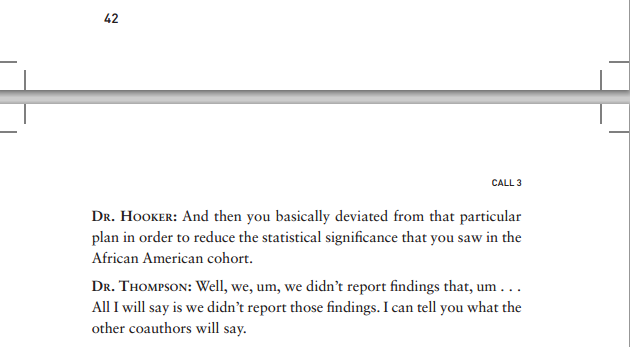
Dr. Hooker: And then you basically deviated from that particular plan in order to reduce the statistical significance that you saw in the African American Cohort.

Dr. Thompson: Well, we, um, we didn’t report findings that, um…All I will say is we didn’t report those findings. I can tell you what the other coauthors will say.

Recall that Brian Hooker knew he was recording. He wanted this on tape. And that it appears Thompson didn’t know he was being recorded, but he still wouldn’t say what Hooker wanted him to say.

As I said–don’t expect this exchange to be widely discussed. It doesn’t fit the story they want to tell.

edit to add–here’s a screenshot of this exchange (click to enlarge):
Thompson---all I will say


By Matt Carey

It’s not over yet in California: Rallies this week to get the legislature to reinstate disability services funding.

31 Aug

Below is an email from Greg deGiere The Arc & United Cerebral Palsy California Collaboration. As many of you will recall, there’s been a big effort to restore funding for disability related services here in California. We were pushing for a 10% increase, got a 5% increase only to lose even that in a budget deal. But there’s still time and need to be heard. Three rallies are being held here in California and we need people to attend and make themselves heard.

Here are the details.

LA, San Diego, and Sacramento rallies this week!

Dear Friends,

Believe it or not, the Legislature is planning to adjourn for the year in two weeks – and it shows no sign to taking action to save our developmental services by then.

Our community service system is crumbling now. We need to tell them forcefully, in person that we can’t wait until 2016.

Please come to one of the three Lanterman Coalition rallies this week to tell the Legislature’s leaders and members to get the job done before they go home. Their words of support aren’t enough – we need their action now!

The rallies will be:

· 11 a.m. TOMORROW (Tuesday, September 1) at the office of Senate leader Kevin de Leon, 1808 W. Sunset Blvd., Los Angeles. Click here for details.

· 11 a.m. TOMORROW (Tuesday, September 1) at the office of Assembly leader Toni Atkins, 1350 Front Street, San Diego. Click here for details.

· 10 a.m. THURSDAY (September 3) at the beautiful, historic Crest Theater, 1013 K Street, two blocks from the Capitol, Sacramento. At 12 noon (note time change), we’ll march to the Capitol to deliver the message in person. (Bay Area friends – we especially need you here Thursday).

Please come to at least one of the rallies – and bring some friends. If you can’t get to any of them on your own, ask your community service provider to arrange transportation.

As one of your professional advocates here in Sacramento, it’s amazing to me that the legislative leaders would even consider breaking for the year without acting. I can hardly imagine how infuriating it must be to people with developmental disabilities and their families, friends, and service providers like you.

Thanks to the coordinated advocacy of you throughout the state and us in Sacramento, every legislator now knows about our system’s crisis, and most of them have given us strong words of support. Now they need to hear from you that you need them to match their strong words with strong action.

Thank you for your advocacy.

Greg

Greg deGiere
Public Policy Director
The Arc & United Cerebral Palsy California Collaboration
1225 Eighth Street, Suite 350, Sacramento, CA 95814
916-552-6619 x4

SafeMinds: why won’t you tell your membership about the vaccine safety study you funded? Perhaps because it says vaccines are safe?

28 Aug

Earlier this year a paper was published on vaccine safety: Examination of the Safety of Pediatric Vaccine Schedules in a Non-Human Primate Model: Assessments of Neurodevelopment, Learning, and Social Behavior. This was a followup study to earlier pilot studies that got a lot of attention in the “vaccines-cause-autism” groups (Delayed acquisition of neonatal reflexes in newborn primates receiving a thimerosal-containing hepatitis B vaccine: influence of gestational age and birth weight and Influence of pediatric vaccines on amygdala growth and opioid ligand binding in rhesus macaque infants: a pilot study.)

It is worth noting that the pilot studies didn’t link vaccines to autism. They did make claims that some early reflexes were delayed in the monkeys given thimerosal containing vaccines. If you see someone talking about “root” or “snout” or “suck” reflexes in a vaccine discussion, they are referring to the studies above. These were pilot studies–small preliminary studies to see if it is worth launching a larger study. As such the results should have been taken with caution. But caution is not what groups like SafeMinds (or any of the groups that promote the failed vaccine-autism link) are known for. Inflating any scrap of evidence that can support their political point of view, that’s what they are known for.

SafeMinds made a big deal out of the early studies. Mark Blaxill (then of SafeMinds) called the study a “blockbuster” in a four thousand word analysis. That’s a lot of space to devote considering the full study was eight thousand words. And, as noted already, preliminary. But politics is politics.

Now, an intellectually honest person, or group, would watch for the followup study and report on it no matter the result. Because, let’s face it, if you are going to spend 4000 words overstating the importance of a study, scaring people and instilling them with guilt and pain over their child’s disability, you have a responsibility to do a follow up.

If you are intellectually honest.

So, as noted above, the follow up study was published. It was published in April. Four months ago. And I don’t see anything from Mr. Blaxill on the Age of Autism blog (where he posted his “blockbuster” article) or at the SafeMinds website on the followup study. SafeMinds has their own blog, and if you search it for, say “snout”, you get this article (Ground-Breaking Monkey Study: Mercury-Containing Hepatitis B Vaccine Causes Brain Damage) on the pilot study, calling it “groundbreaking” and claiming that it demonstrates that the thimerosal containing HepB vaccine causes brain damage.

Very strong words. Words which, if overblown, are very damaging. Imagine going through life as a parent thinking that you agreed to a vaccine and that caused brain damage to your child. Now imagine that the evidence you used to draw that conclusion was (a) not strong to begin with and (b) now refuted.

Wouldn’t you want to know the truth? Wouldn’t you expect the people and the organizations that convinced you of this falshood to seek you out and correct their mistake?

And this is why people don’t hold Mr. Blaxill or SafeMinds in high regard. They are quick to scare but don’t have the courage to admit they were wrong. Courage isn’t standing up and saying unpopular truths. Courage is standing up and admitting that your “unpopular truth” was, in fact, not the truth at all.

Now, why pick on SafeMinds in specific here? A lot of people and groups jumped on the pilot study and spread a lot of fear. Check out the footnotes of the study.

This work was supported by the Ted Lindsay Foundation, SafeMinds, National Autism Association, the Vernick family, and the Johnson family

SafeMinds helped fund the new study. The one they are ignoring. They were likely aware of the results before they were published. But no word.

I expect more from decent advocacy organizations. But I am not surprised with SafeMinds, nor Mark Blaxill.

Yes, the National Autism Association did too and they need to step up as well (a point I hope to make in a later article).

How about the Johnson Family? Well, the Johnson Center stepped up and put out a press release New Research Finds No Evidence That Thimerosal-Containing Vaccines Affect Neurodevelopment and Behavior in Infant Primates. (all SafeMinds, the Age of Autism and the National Autism Association needs to do as a start is publish the press release).

Here’s the last sentence of the press release, quoting the lead researcher: “Despite these limitations, the data in this primate study overwhelmingly provides support for the safety of pediatric vaccines”

It would take a lot of courage for SafeMinds and Mark Blaxill to publicize such a statement. More than they have.


By Matt Carey

The Hooker/Thompson conversations: were significant analyses omitted from Hooker’s paper?

27 Aug

As a few people have written about recently, a book was recently published in which we get to read transcripts of conversations between Brian Hooker (a vocal advocate of the idea that vaccines cause autism) and William Thompson (a researcher at the CDC).

The basic story we have been told is that supposedly the CDC team (of which Thompson was a member) saw a “statistically significant” association between MMR vaccination and autism in African American boys. Specifically for boys who got the vaccine late, but before age 3. The story then goes on to claim that he CDC team worked furiously to bury this association. William Thompson, wracked with guilt over this, finally reached out to Brian Hooker to guide him towards this result.

This story is full of holes, as has been discussed here and elsewhere. Rather than go through that again, just take this backstory and ask yourself: given this claim that significant results were omitted by the CDC, wouldn’t Brian Hooker make damned sure that nothing important was left out of the “reanalysis” paper? After all, the main criticism Hooker levied against the CDC team was omission.

You’d think so, wouldn’t you. But you’d also guess that I wouldn’t go through this long introduction if that was the case.

Brian Hooker sold his reanalysis as strong because he took a simple approach. I.e. he didn’t control for any confounding factors. Epidemiologists will tell you the opposite–a raw data analysis is suspect.

In the conversations, we hear that Brian Hooker was well aware that he would get criticism for not making corrections:

Dr. Hooker: Right. Right. Well, what would happen…Okay, so let me play this out … My paper gets published; my MMR paper gets published. They…I get heavily criticized, because I haven’t corrected for scioeconomic factors or maternal education. Yeah. I’ll take my hits, and then eventually it gets published. And then there’s a piece of information that I receive from the CDC, but I don’t source. Is that going to be a red flag?

OK, he knows that a “simple” approach is not considered strong. This begs the question: how important are socioeconomic factors and maternal education he’s worried about? I could tell you that they are huge factors for the conclusion he’s trying to make. But don’t take my word for it, because Hooker and Thompson did discuss the importance of maternal education in the recorded calls. And this discussion is very telling. Consider this exchange:

Dr. Hooker: Right. Right. Well, it does…You know, it does kind of play backwards.

Plays backwards–as in this goes against the story they are trying to tell. Going on:

Dr. Thompson: yeah.

Dr. Hooker:… in terms of: Will those kids that got vaccinated later; then you would expect less healthcare-seeking behavior; so they would be less likely to get an autism diagnosis.

Dr. Thompson: yep.

Yep?!? That’s all he can say? This is KEY to the entire argument that there is an increased risk in African American boys.

Let’s step back a moment and look at this issue. Brian Hooker’s reanalysis is based on very few subjects (seven–African American autistic boys who got their MMR vaccine late). Implicit in his “simple” analysis is the assumption that these boys were in every way similar to the other boys in the study, aside from autism and when they got their MMR vaccine. Let’s say that there’s a reason why these autistic kids were vaccinated late–like their parents didn’t have insurance so they didn’t go to well baby checks. This would correlate with the education of the mother and, thus, this variable could help control for this “health-care seeking behavior”.

This leaves us with a HUGE potentially confounding variable in Hooker’s analysis, and in precisely the population they are most interested in–the kids who got vaccinated later. But he don’t address it in the “reanalysis”. He sweeps it under the rug.

Which is to say, this is a very ironic conversation Hooker and Thompson are having. Hooker appears to be doing exactly what he claimes the CDC was doing: crafting a story around the results he wants to report and omitting important information to make that point.

The conversation goes on.

Dr. Hooker: But if you had maternal education, then you could correct for that.

Dr. Thompson: Right. But …

Dr. Hooker: So, I don’t think I have it.

Dr. Thompson: You could argue the most important confounder was not included in that study. So, why would you even consider the results valid?

Dr. Hooker:Valid.Right. Right, you can’t say either way.

Dr. Thompson: Exactly.

Dr. Hooker: Essentially.

Dr. Thompson: Yep.

Dr. Hooker: You can’t…

Let’s repeat one line for emphasis: You could argue the most important confounder was not included in that study. So, why would you even consider the results valid?

The most important confounder being maternal education. They know this is a big deal.

And this wasn’t just a passing thought in that conversation. Later in that same call, Hooker asked again about how strong an effect one could see from maternal education. In this case, from Thompson’s experience from his 2007 thimerosal paper. And again Thompson tells him that maternal education is a strong factor that should be included in an analysis.

Given this repeated discussion of the need to adjust your results for external variables, you’d expect Hooker to explore maternal education in his own paper, wouldn’t you? As in, do the math and see how much this factor affects his calculated relative risk for MMR in African American boys, right? At the very least, you’d expect a discussion similar to the one above–how this is a potential confounding variable and how exactly it could affect his results (it could go “backwards”).

You’d expect that of an ethical researcher. I would.

Here’s the thing: Brian Hooker did not include maternal education in his re-analysis. the closest he gets in in the final paragraph of his reanalysis paper. This is where he focuses on the weaknesses of his study. He goes into detail about age of diagnosis and how that might affect his results, for example. When it comes to maternal education the closest he says:

In addition, socioeconomic factors were not assessed in the current analysis. Thus, any differences in “healthcare seeking behavior” among individuals vaccinated ontime versus late could not be assessed.

Sorry to be so repetitive, but no word about how important maternal education or other socioeconomic factors are to precisely the conclusion he’s trying to draw. Just a statement that amounts to “controlling for socioeconomic factors can’t be done because I didn’t do it.” The data were available to Hooker in the birth certificates. Hooker even used the birth certificate data elsewhere in his paper (from the paper: “Georgia state birth certificate information was used to further obtain each child’s birthweight”). So he can’t say he didn’t have it.

This is ironic in the extreme: after complaining that the CDC left out a “statistically signficant” result, Brian Hooker doesn’t include a factor which he knows is a major without which one can’t consider the results valid.

I’ll go beyond ironic. This is in my opinion scientifically unethical. And, since his study is really more political than scientific, I consider this politically unethical. Frankly, if someone working for me did something like this as part of his work, he’d be fired.

But, wait, the story is even more strange. Recall how Thompson was bashing the original study (DeStefano, et al.) for being invalid due to not controlling for maternal education (“You could argue the most important confounder was not included in that study. So, why would you even consider the results valid?”). DeStefano et. al did control for maternal education. And not only should William Thompson and Brian Hooker have known this if they were reanalyzing the paper, William Thompson was a coauthor on the DeStefano paper!

One does have to wonder if Hooker did the analysis using maternal education and chose to not report it. Given the discussions he had with Thompson, my opinion is that either Hooker did the analysis or he’s incompetent.

Bottom line, though, if you are going to make some public relations/political hay claiming some group omitted a result, you shouldn’t be omitting important analyses yourself.

Were significant analyses omitted from Hooker’s paper? In my opinion, yes. And from his conversations with William Thompson, we see that Hooker was aware of the importance of factoring in maternal education.


By Matt Carey