Archive | Autism RSS feed for this section

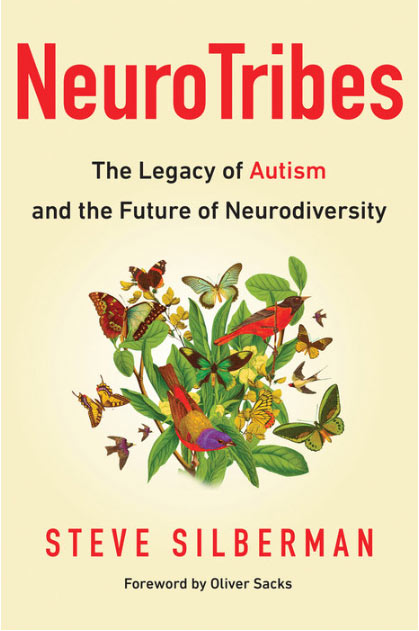
Book review: Neurotribes by Steve Silberman

25 Aug

A book I have been waiting literally years for comes out tomorrow. I’m speaking of Neurotribes (Amazon link), a book by Steve Silberman. I was lucky enough to obtain an advance copy to review. First let me say that there are a number of good reviews of Neurotribes by Steve Silberman already on the web. I highly recommend this one by Emily Willingham, which includes an interview with the author.

Having referred the reader to an excellent review, I’ll start here with a simple recommendation: buy the book. Or, at least, find a copy somewhere and read it.

If you are autistic, read the book. Silberman gives one of the most sensitive discussions of autism a non autistic can give.

If you are a parent or loved one of an autistic, read the book. If you are at the beginning of the journey, you may want to spend your precious extra time now on books that help you advocate (like special education focused books), but there will be a time when you want this book and will be grateful it’s on your shelf. If you’ve already gone through the advocacy learning curve, it’s a good book to get.

If you are a professional and think you understand how our present understanding of autism came about, you need to get this book. You will be surprised with what you didn’t know.

If you are not in the autism communities, Silberman is a wonderful writer and the book will give you a great read and you will learn a great deal about autism, autistic people and non-autistic people.

Neurotribes is a rather thick book on what seems a specialized subject and I worried at first that it wouldn’t be accessible or interesting to the average reader. But I was immediately struck by how beautifully Silberman’s writes. It is very accessible and entertaining to a general audience.

By now readers are probably wondering when I’m going to stop recommending the book and start reviewing it. Answer: now.

Autism is comprised of many very disparate topics and Neurtribes captures that, with each chapter touching on the various aspects of autism. First and foremost, autism is about people. Autistic people primarily. And Silberman approaches his book with a great sensitivity towards autistics. The book begins and ends with autistics. We start with Henry Cavendish a historical figure who was very likely autistic and ends with an epilogue about Mark Rimland, who has a key place in defining current perceptions of autism is. Mark’s father was autism researcher Bernard Rimland, who is best remembered for his role in defeating the idea that autism was caused by bad parenting. Mark was also one of the role models for the fictional character Raymond Babbit–Rain Man.

Silberman ends the book with a simple statement. And like many simple statements, many of us forget the message:

Midway through the journey of his life, Mark has the most precious and elusive thing that anyone can hope for. He is completely at home on earth.

Autism is a disability. It is a different operating system for the brain. It is a difference. It is so many thing. But all of us, autistic or not, autism parents or not, would do well to follow Mark’s example. Find our place.

Autism is also about non autistics. People who love autistics and people who research autism (and there’s a lot of overlap in those groups). And Silberman pulls all the various groups together in his telling of the story.

Silberman establishes himself as the foremost expert on the history of autism. How did Kanner and Asperger independently come up with the concept of autism (hint–they weren’t completely independent). Why did Asperger focus on the less clearly disabling aspects of autism (hint: he was at work at a time when disabled people in his country were rounded up and killed). We can go on and one, but these little snippets do not do justice to the depth that comes from the fact that Silberman has spent the past four years researching and writing this book.

The depth that Silberman brings to autism’s history (and present!) could easily become bogged down in the details. Neurotribes avoids this without sacrificing the detail. Autism is told through the people, people with personalities and people placed in the context of their time and culture. And that’s what makes this more than an example of thorough research but of skillful writing. We not only hear about Kanner and Asperger (the two credited with first describing autism), but of the people in their labs and the people who followed them. But mostly, of autistics. And not just autistic patients in clinics. We meet one of my personal favorite people, Leo Rosa (an autistic young man) and his mother Shannon. I met Shannon and Steve at about the same time, at IMFAR, an autism science conference, in 2011. We meet many more people and the book is influenced by literally hundreds of people, autistic and non, for whom there just wasn’t room in the book. By telling the stories through people, the book becomes a real read.

I realize that I have yet to discuss neurodiversity. The full title of the book after all is NeuroTribes, The Legacy of Autism and the Future of Neurodiversity. Silberman introduces the topic thus (referring to his 2002 Wired article “The Geek Syndrome”)

One of the most promising developments since the publication of “The Geek Syndrome” has been the emergence of the concept of neurodiversity:the notion that conditions like autism, dyslexia, and attention-deficit/hyperactivity disorder (ADHD) should be regarded as naturally occurring cognitive variations with distinctive strengths that have contributed to the evolution of technology and culture rather than mere checklists of deficits and dysfunctions. Though the spectrum model of autism and the concept of neurodiversity are widely believed to be products of our postmodern world, they turn out to be very old ideas, proposed by Hans Asperger in his first public lecture on autism in 1938.

and in another place, he states

Neurodiversity advocates propose that instead of viewing this gift as an error of nature—a puzzle to be solved and eliminated with techniques like prenatal testing and selective abortion—society should regard it as a valuable part of humanity’s genetic legacy while ameliorating the aspects of autism that can be profoundly disabling without adequate forms of support. They suggest that, instead of investing millions of dollars a year to uncover the causes of autism in the future, we should be helping autistic people and their families live happier, healthier, more productive, and more secure lives in the present.

One last note: autism’s history has some very low points. It can be very difficult to read about the Nazi eugenics program or the way some non-Nazi’s treated their autistic research subjects. I know that some, especially autistics, will find these sections painful to read.

That said, in case my recommendation was too subtle above: I recommend buying the book 🙂

Here are more reviews:

The Atlantic has Before Autism Had a Name.

The Guardian has: Neurotribes review – the evolution of our understanding of autism

The New York Times: ‘NeuroTribes,’ by Steve Silberman.

There are more if you search a site such as google news.

Cover-large


By Matt Carey

note: I have personally met the author of Neurotribes.

The Brian Hooker/William Thompson conversations

24 Aug

A year ago we learned that a CDC researcher (William Thompson) had reached out to Brian Hooker (of all people!) and was talking about his (Thompson’s) view of what goes on inside the CDC. Most especially, Thompson appears to have guided Hooker towards a spurious result one can obtain from an old CDC dataset: that if one avoids controlling for any possible confounding variables one can claim that in a small subset of the study population, there is a calcluated risk of autism from the MMR vaccine.

There are so many strange aspects of this story. So many. One that has wracked my brain for the past year is this: why did Thompson reach out to Brian Hooker? Brian Hooker is not an unknown quantity. In the world of people claiming vaccines cause autism, far from it. Brian Hooker is a fixture in the community that promotes the idea that vaccines cause autism. His claim to fame for years was that he was constantly placing freedom of information act (FOIA) requests for documents from the CDC. His family are petitioners to the Court of Federal Claims (i.e. they have a claim in about a family member whose autism they believe was caused by vaccines). Mr. Hooker even spoke with CDC vaccine researchers–including William Thompson–many years back.

In the end, Brian Hooker published a paper (now retracted), teamed up with Andrew Wakefield, totally misused their spurious result in an ugly, race-baiting attack on the CDC, and betrayed Thompson’s trust by outing him.

And pretty much all of that was predictable, if you had any idea who Brian Hooker is.

Given that, there were two possibilities in my mind as to why Thompson reached out:

1) William Thompson was so stressed by what he thought was an unreleased result that he reached out to someone, anyone outside of CDC to get the result out. That he wasn’t aware of who he was working with.

2) William Thompson either didn’t care about the harm that would be cause by his actions, or wanted to cause harm. Let’s face it, Thompson chose the precise person who could make the most damage with the information. It wasn’t a strong result, or even a good result. But it was something that an intellectually dishonest person could sensationalize.

(2) Was very hard to believe. Thompson has spent many years working on public health. He was the lead author on one paper that showed no risk of neurodevelopmental disorders from thimerosal in vaccines. The idea that he would willingly ally with someone whose efforts are very much, let’s say, vaccine antagonistic, is difficult to accept.

As noted above, Brian Hooker betrayed the trust of William Thompson: Hooker not only outed Thompson, but Hooker secretly recorded at least 4 phone calls. And purported transcripts of those calls have been gathered together in a book. The forward is by Robert Kennedy Jr. (who has a long history of claiming he’s “pro vaccine” while acting completely the opposite) and is filled out by a someone named Kevin Barry. It’s a thin book and the material by Kennedy and Barry is basically filler, so you are left with transcripts from 4 phone calls.

From the conversations in the book we see that Thompson is angry. Angry at people. Not as much angry about science or omitted data. You can read more about that at Science Based Medicine.

Was Thompson aware of who he was dealing with in Brian Hooker? Yes. He says, “I see a lot of your stuff online. I saw that you interviewed Congressman Posey, is it?”

There’s a lot of talk of Posey and Congressman Issa. It seems like Hooker’s connections with congress were a big draw for Thompson.

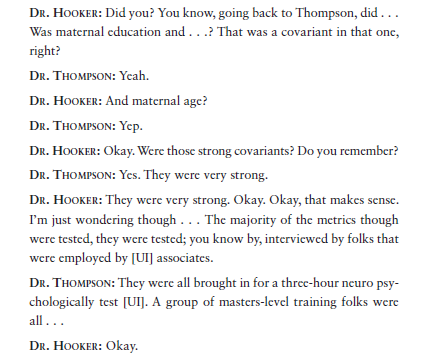
Here’s one exchanges. Not about congress, but we get an idea of Thompson at work.

Dr. Hooker: I’m afraid of those people. I’m afraid of Kevin Malone. I’m afraid of Deborah Tress, I mean, these people, ya know, they don’t like me.

Dr. Thompson: They’re scumbags. But here’s the deal. She is like a twenty-five-year-old and I apologize as I am saying this, she’s like a twenty-five-year-old bimbo that they have do their dirty work. So her sending this email, the fact that they didn’t come from someone with a lawyer. It came from this woman who’s just out of school and just doesn’t know her head from her ass. This is the type of stuff they do. They don’t say who it’s from, they just say OGC.

Here’s a quote attributed to Mr. Thompson:

“But I also have to say these drug companies and their promoters, they’re making such a big deal of these measles outbreaks and they are now, they’re making a big deal that polio is coming back and polio comes back all the time in third world countries. It’s like a never- ending thing where the press loves to hype it and it scares people. It scares the crap out of people when they hype those two types of outbreaks”

Really? A vaccine researcher at CDC thinks it’s “hype” to talk about polio coming back?

Here’s the thing–we want to eradicate polio. That’s what vaccine researchers at CDC are supposed to be helping. Polio is really bad. If it weren’t for people like Brian Hooker, Thompson’s new friend, we might have done that by now. Any outbreak is a big deal. But not to William Thompson.

Boggles the mind.

In discussing the MMR paper–the one where Hooker claims a large risk for MMR in African American boys who are vaccinated late (by not controlling for any confounding variables)–Hooker notes in his conversation:

“I mean, whites are getting diagnosed twice as much as blacks”

That’s a pretty key observation. If you are going to claim a large risk for African American’s, you have to discuss in your paper the fact that this doesn’t mesh with the actual prevalence. The raw prevalence has African American’s not getting counted as much as caucasians.

Does Brian Hooker bring this up in his paper? Address it? No. He ignores a significant result of the analysis. That’s right, he does exactly what he claims is fraud. Well, not exactly–he compounds his error. Let’s look at his (now retracted) paper:

It should be noted that a recent publication has shown that the prevalence of autism in African Americans is nearly 25% higher than that of whites [15].

Yes–even though the data he is analyzing says exactly the opposite, he claims a higher than average prevalence of autism in the African American population.

Let’s belabor that one step further–if he actually believes a higher prevalence in this population, there is a huge issue with the data he’s analyzing. He doesn’t account for this, controlling for any socioeconomic factors, for example. He doesn’t even mention it. It appears that he intentionally omitted significant findings from his paper.

Hooker at one point notes, “I am not an epidemiologist by training”.

Got that right.

You can read more about the conversations at Science Based Medicine as
Vaccine Whistleblower: An antivaccine “exposé” full of sound and fury, signifying nothing

And I’m sure there will be more.


By Matt Carey

Orlando Sentinal: Rep. Posey at center of vaccine-autism fight

22 Aug

As many readers here will be familiar, Congressman Bill Posey has taken up the position of chamion for the “vaccines-cause-autism” groups. He’s been heavily lobbied and somehow convinced that vaccines cause autism.

As I’ve noted in the past, Congressman Posey doesn’t take up autism or disability legislation. As of last year he wasn’t a member of the Congressional Autism Caucus (he appears to have recently joined). He wasn’t one of the 86(!) cosponsors of the Autism CARES Act (passed last year, this continues the Government’s commitment to autism research support).

Until now, his alliance with these groups–groups who cause a large amount of harm within the autism communities–has gone unnoticed by the press. Today an article appeared in his home town newspaper, the Orlando Sentinal. The article is Rep. Posey at center of vaccine-autism fight. You need to register (it’s free) to read the article.

Congressman Posey stresses again his opinion that he is pro-vaccine. While at the same time promoting the failed vaccines-cause-autism idea and, now, suggesting that people spread out the MMR vaccine into separate shots. Besides the fact that the MMR-causes-autism idea is one of the most studied subjects in autism causation (MMR does not increase autism risk), Mr. Posey exposes his ignorance–both of the current state of the U.S. vaccine market and of history. Separate measles, mumps and rubella vaccines are not available in the U.S.. There just wasn’t much market for them. And we all saw what happened when Andrew Wakefield promoted the “Let’s scare people about the MMR and suggest separate vaccines” back in the U.K.. People stopped vaccinating for measles altogether. And now measles in endemic in the U.K. and large outbreaks have been seen in recent years.

Matt Carey, a nationally known advocate on autism issues, questioned Posey’s self-description as “pro-vaccine” and his advice to mothers, because, he said, measles vaccines no longer are available outside the MMR shots.

“So what is a parent going to do? If you put fear into people like that, they will do neither, and they won’t vaccinate,” Carey said. “If you’re pro-vaccine, and you’re not really doing anything about it except carrying water for people who aren’t pro-vaccine, it’s a distinction without a difference.”

He says he’s “pro vaccine”. Let’s look at current legislation:

Is he a sponsor on H.R.2232 – Vaccinate All Children Act of 2015? (no)

H.R.933 – Head Start on Vaccinations Act? (no)

H.Res.117 – Recognizing the importance of vaccinations and immunizations in the United States. This bill has 101 cosponsors! And none of them is Bill Posey.

There are more bills in the works, but you get the picture: He’s pro-vaccine in words. Not in actions.

As to helping the autism communities–he does nothing for the autism communities. In fact, he’s part of the problem. He’s promoting the most damaging idea since Kanner and Bettleheim blamed “cold parents” for causing their children’s autism. In the Orlando Sentinal article Mr. Posey falls back on the same defense that is too often used: he’s just listening to the parents

The alleged link has been widely denounced by much of the U.S. medical community, but Posey said he is influenced by the hundreds of parents he has talked with.

“They say, ‘My son was OK until we took him for an MMR [measles, mumps and rubella shot], and since then he didn’t say another word,'” he said. “And [the parents] are crying. I believe the mother knows more about a child than anyone else. So, anyway, my hearing from so many people made me think: It can’t be coincidental.”

Here’s the thing he should be considering–parents are in pain. They are being served up wholesale for charlatans that sell all manner of abusive “treatments”. Did you manage to walk the halls of AutismOne, Mr. Posey? Did you catch the new thing? Forcing disabled children to undergo bleach enemas? Twice daily? Did they tell you that the same people promoting thimerosal as a cause of autism are also promoting chemically castrating autistic kids? Seriously–by attending AutismOne and not speaking out, you are giving tacit approval to these abusive practices–and more.

Mr. Posey may call himself “pro vaccine”. He may think he’s helping the autism community. His actions tell a very different story.


By Matt Carey

Emily Willingham takes on the Tempest in a Trashcan

21 Aug

In case you missed it (and count yourself lucky if you did), Congressman Bill Posey recently read a statement into the record in the U.S. House of Representatives. That was 2 weeks ago (July 29th). I put off writing about it for various reasons, including not having the time to do check on some of the facts. Luckily, Emily Willingham did: A Congressman, A CDC Whisteblower And An Autism Tempest In A Trashcan.

For those unfamiliar with the story, here’s a background timeline–

About a year ago it became public that a CDC researcher by the name of William Thompson had made the monumentally bad decision to ally himself with Brian Hooker. Brian Hooker is an autism parent and a major proponent of the idea that thimerosal in vaccines cause autism. As an autism parent myself, I find Mr. Hooker’s stance to be damaging to our communities. As a researcher, I find Mr. Hooker’s lack of scientific integrity (see this discussion for example) to be an example of the worst that the research community has to offer. To put it simply, he lies with statistics to make a political point. While one could argue that he sold out for his own cause, the fact remains that he sold out. So, again, I consider Mr. Thompson’s decision to reach out to Brian Hooker to be an incredibly bad choice. Perhaps someday we will learn why Mr. Thompson didn’t take his concerns to the appropriate channels.

That all said, Mr. Thompson appears to have turned over a number of documents as well as statements to Congressman Posey’s office. And Mr. Posey read excerpts of a statement into the record. Before we get to the “trashcan quote” let’s focus on one word–excerpts. Excerpts mean that we aren’t being told everything. And as anyone who has followed Andrew Wakefield for any period of time knows, often it’s what people aren’t telling you that matters.

So, what is the “trashcan quote”? Per Emily Willingham:

At the bottom of Table 7 it also shows that for the non-birth certificate sample, the adjusted race effect statistical significance was huge. All the authors and I met and decided sometime between August and September ’02 not to report any race effects for the paper. Sometime soon after the meeting, we decided to exclude reporting any race effects. The co-authors scheduled a meeting to destroy documents related to the study. The remaining four co-authors all met and brought a big garbage can into the meeting room and reviewed and went through all the hard copy documents that we had thought we should discard and put them in a huge garbage can. However, because I assumed it was illegal and would violate both FOIA and DOJ requests, I kept hard copies of all documents in my office and I retained all associated computer files. I believe we intentionally withheld controversial findings from the final draft of the Pediatrics paper.

(note–one punctuation changed. I believe it to be incorrect in the original at Forbes).

As you can imagine, people are focused on the idea that the CDC destroyed documents.

Let’s back up for a moment and go back to fact that these are excerpts. That means that we don’t know what was deleted or where. Between any two sentences there could be other sentences or another paragraph. Take for example, these two sentences from Posey’s talk:

“‘At the Sept. 5th meeting we discussed in detail how to code race for both the sample and the birth certificate sample. At the bottom of table 7, it also shows that for the non-birth certificate sample, the adjusted race effect statistical significance was huge.”

Here’s the thing–I’m, pretty sure there is content missing between those two sentences. Why? Because the Sept. 5 meeting was a planning meeting. They were deciding how to analyze the data. And then, bang, we hear about “table 7” and a race effect. But there wouldn’t be data at the September 5 meeting. The team didn’t start getting results until November. This according to the information released by Andrew Wakefield and Brian Hooker themselves. There’s no reason for “also” in that last sentence in the present context.

Why point this out? Well, for one it shows that we are getting an edited version of the statement. And it’s not just a random edit. The above statement appears to me to be crafted to support the story that Wakefield and Hooker put out a year ago: that the CDC team added the birth certificate analysis after seeing the race effect. You read the above and it’s easy to get the feeling, “Dang, they had table 7 in front of them and they added the birth certificate analysis”. But that’s not what the actual timeline tells us. According to the information Wakefield and Hooker themselves presented, the first race data were analyzed and presented a few months later.

That’s an example of creative editing of the excerpts that makes me want to see more. And not just more of what Mr. Thompson has to say as, frankly, I want the facts and I don’t think that his side of this story will be the complete truth.

So, let’s get back to the “garbage can quote”. Are there sentences edited out? Who knows. Does it represent the facts? Also, unknown. But let’s consider the idea that the CDC team met and discarded documents. Am I surprised? No. Researchers don’t keep every document. I’ve been a researcher for 30 years (almost all in a non-government position, I admit), and I can say that as someone who had to be prepared to (and in fact did have to) defend an invention against legal action: you don’t keep every document. You keep what you need to keep, what allows you to recreate the study.

I started back in the day when most data were on paper. A lot of paper. Think a 3″ binder of paper in a week or 2. Over years. That’s a lot of paper. Here’s the process my former employer used–possibly different at CDC, but I’m guessing not too different. After a while one would have to decide: what do I keep, what do I put into storage and what do I discard? What I may need to look through again stays in my office. The core of the work goes into storage. (There are probably still boxes and boxes of my old results and notes in my former employer’s wharehouse.) The rest–the stuff that you don’t need to keep, and this can be a lot–gets shredded.

How do you shred lots of confidential material? Well, you order a big bin. One could call such a bin a “garbage can”, but that would be misleading. Here’s what the bin looks like:

It looked like that except that it said, “Confidential” on the side and something about shredding. Notice the lock on the bin? It’s because you are working with confidential materials. It’s routine. Dull really. But that’s not what people want to hear. They want to hear “garbage can”.

And here’s another thing–you don’t get a group of people together to decide what to discard. That’s easy. I imagine especially if you think that the paper documents are incriminating–you would destroy everything. You get together to decide what to keep. No reason for everyone to keep every printout from every internal presentation.

What would happen if a team at the CDC dumped a bunch of confidential material into a garbage can? Well, a big batch of paper would get noticed by the people handling the garbage. And that would create a huge problem for you–mishandling of confidential materials.

Throwing a lot of material into the garbage is not a way to hide your tracks. Much the opposite.

I wasn’t there to see what happened with documents for that study. And, per the statement that Congressman Posey read, neither was William Thompson. And there is an investigation ongoing into this study. Andrew Wakefield and Brian Hooker filed a complaint with HHS/CDC and it is being investigated.

Sorry, but Congressman Posey’s statement really is just not that interesting right now. Well, I am interested if he wrote it and if (as I assume) someone else did, who that someone is. But that’s just mild curiosity.


By Matt Carey

New study on inflammatory bowel disease and autism: Prevalence of Inflammatory Bowel Disease Among Patients with Autism Spectrum Disorders.

12 Aug

People with developmental disabilities often have additional medical issues at rates higher than the general population. For example, heart problems are more common in the Down Syndrome population and Timothy Syndrome. Hip dislocation is common among those in the Fragile X community. Mental health conditions and neurological disorders are very common in autistics (but somehow those are rarely mentioned in discussions of autism and comorbidities).

When it comes to autism parents online, perhaps the most talked about autism comorbidity is gastrointestinal disease. And, in specific, inflammatory bowel disease. This is a lasting legacy of Andrew Wakefield’s attempt to link the MMR vaccine and autism (an effort which set back work on autism and GI disease by a decade or more–see Blame Wakefield For Missed Autism-Gut Connection).

Mr. Wakefield’s assertion was that the MMR vaccine leads to a unique form of IBD (he dubbed it autistic enterocolitis, a condition which doesn’t appear to exist) and this somehow leads to autism. The model also asserts that autism rates have climbed with the introduction of the MMR in the UK (an argument that fails when when considers when the MMR was introduced in the U.S., but I digress). Given the Wakefield model, including the claim that the MMR has played a major role in the “autism epidemic”, we would expect a large fraction of autistics should have IBD.

With apologies to autistics with IBD for taking so long on this introduction–this all begs the question of what is the prevalence of IBD in the autistic population? Well, a recent study discusses this:

Prevalence of Inflammatory Bowel Disease Among Patients with Autism Spectrum Disorders.

Before we get to the prevalence let’s consider the important points. First–IBD does exist in autistics. Given communication issues and sensory issues, any medical condition is serious in the autistic population. Second–IBD is more prevalent in the autistic population. What this may say about the biology of autistics and the developmental trajectory is not discussed in the abstract of this study.

Finally let’s ask how big is the prevalence of IBD in the autistic population? The study looked at two sample populations. In one population 7 out of 2728 (0.26%) autistics had IBD. For another, 16 of 7201 (0.22%). Just because the prevalence is small doesn’t mean this isn’t an important issue for the autism communities. But, let’s face it, the claims of high and rising IBD prevalence in the autism community–the claims by Mr. Wakefield to support his attack on the MMR vaccine–are just not true. And, yes, this also means that people who think that all or most autistic kids should be treated for IBD are also not doing a service. Yes, treat people with IBD. But no, don’t assume autism = person with IBD.

The fact that IBD is not that common in autistics is not really that new. I recall the press conference for the MMR/autism study by Hornig et al.. One thing that slowed the study was the fact that there weren’t that many autistic kids whose symptoms really indicated the need for a colonoscopy. Contrary to some practitioners who seem to believe that all autistics should be ‘scoped.

Here’s the abstract from the study:

Background:
The objective of this study was to measure the prevalence of inflammatory bowel disease (IBD) among patients with autism spectrum disorders (ASD), which has not been well described previously.

METHODS:
The rates of IBD among patients with and without ASD were measured in 4 study populations with distinct modes of ascertainment: a health care benefits company, 2 pediatric tertiary care centers, and a national ASD repository. The rates of IBD (established through International Classification of Diseases, Ninth Revision, Clinical Modification [ICD-9-CM] codes) were compared with respective controls and combined using a Stouffer meta-analysis. Clinical charts were also reviewed for IBD among patients with ICD-9-CM codes for both IBD and ASD at one of the pediatric tertiary care centers. This expert-verified rate was compared with the rate in the repository study population (where IBD diagnoses were established by expert review) and in nationally reported rates for pediatric IBD.

RESULTS:
In all of case-control study populations, the rates of IBD-related ICD-9-CM codes for patients with ASD were significantly higher than that of their respective controls (Stouffer meta-analysis, P < 0.001). Expert-verified rates of IBD among patients with ASD were 7 of 2728 patients in one study population and 16 of 7201 in a second study population. The age-adjusted prevalence of IBD among patients with ASD was higher than their respective controls and nationally reported rates of pediatric IBD.

CONCLUSIONS:
Across each population with different kinds of ascertainment, there was a consistent and statistically significant increased prevalance of IBD in patients with ASD than their respective controls and nationally reported rates for pediatric IBD.


By Matt Carey

Kaiser Permanente starts the Autism Family Biobank Study

10 Aug

Kaiser Permanente has a long history of autism research. They’ve performed a number of epidemiology studies, including many on environmental risk factors and also the recent study on The health status of adults on the autism spectrum. They have recently embarked on a large study, the Kaiser Permanente Autism Family Biobank Study.

Sign up online
Study Flyer

You can also find picture books (social stories) for the sample donation process on the Autism Family Biobank website.

From the FAQ for the study, What is the KP Autism Family Biobank?

The KP Autism Family Biobank is a study of Kaiser Permanente Northern California children and young adults with Autism Spectrum Disorder (ASD) and their biological parents. The
study seeks to enroll 5,000 affected children plus their parents (for a total of 15,000 participants) to create a collection of genetic material and information for future research. Dr. Lisa Croen is the principal investigator of the study.

Autism genetics has turned out to be a very complex question. There’s no single “autism gene” but autism clearly has a large genetic component.

What does that mean in practical terms? We need a lot of data to understand the question of autism genetics. And that’s a big piece of what this study will do: bring a lot of data to bear. And not just genetic data. This is a key part of this study and can’t be stressed enough. Kaiser provides healthcare. They have electronic records on their patients. And these patients are the pool from which they will draw their study subjects.

Or to put it simply–they will be able to not only say, “these genes are associated with autism” but “these genes are associated with autism and low verbal skills, while these other genes are associated with autism and regression.” (to give a hypothetical example).

To do this they need a lot of people to participate. They are going to get 5000 autistic kids involved. And they won’t stop there: they will also include parents. That makes 15,000 participants. Not all genes are inherited. With the parents involved, Kaiser can can see if genes associated with autism are inherited or not.

Now many parents will ask (and it’s a valid question), “OK, what will this do for my kid?” It takes time (not a lot, but some) to participate and lots of kids don’t like doctor visits. But consider this: genetics helps people understand biology. With a better understanding of biology, one can make progress towards treatments. There’s a reason why some of the treatments proposed for autism came from research in Fragile-X. People have spent a lot of time studying this genetic condition and that focus has led to proposed treatments.

Or to put the short version of the message out–this isn’t just another genetics study. It’s bigger (15,000 people!) and brings a lot of value with the clinical data that Kaiser has. There’s a chance to have a big impact to better the lives of autistics. If you are a Kaiser member in the study area, please consider participating.

Links and recent news:

Sign up online
First KP Members Join Autism Family Biobank
Kaiser to look for autism’s causes in large-scale study
Study Flyer


By Matt Carey

Disclosure: I serve on a community advisory board for Kaiser. It is a volunteer position (I.e. I get no pay) and will not benefit from this study any more than anyone else in the autism community. And the decision to conduct this study was made before I became involved with Kaiser.

San Jose Autistic Man gone missing–please be on the lookout for Mr. Edward Gaskill

5 Aug

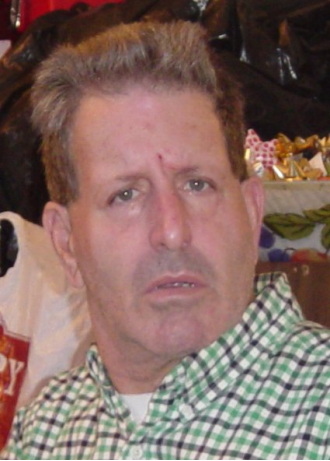
For those readers in the San Francisco Bay Area–an autistic man has gone missing. He’s been missing since July 31st. He needs medication and he needs support. I’ve copied his picture and the flyer (both the original and the text) below.

If you see him or think you have seen him, please call 911 and tell them what you know.

Edward Gaskill Flyer

MISSING

EdwardGaskill

EDWARD A. GASKILL
6 FT, 195 LBS, AGE 67, MAY SEEM LOST OR CONFUSED
AUTISTIC, cannot think rationally but communicates fairly well.
DIABETIC, requires daily medication
.
Missing fom Berryessa area, San Jose, CA, since Friday, July 31, 2015
May be in San Jose, Fremont, or Livermore area
IF YOU SEE THIS MAN, PLEASE CALL 911
San Jose PD missing person police report #152129505

EDWARD ANTHONY GASKILL
930 FOXRIDGE WAY, SAN JOSE CA 95133
408-923-0475 home phone (Diane Gaskill, Ed’s sister, legal conservator, and caregiver)
DOB : March 8, 1948
Height: 6 ft 0 in.
Weight: 195 Lb
Hair: Dark Brn with gray
Eyes: Brown
Last seen wearing: Short sleeved plaid shirt, tan pants, tan slip on loafers.
CA ID N3149991
Kaiser medical number 12183023

ILLNESSES • Autism from birth. He cannot think rationally, does not learn from experiences, and cannot
understand the consequences of his actions or not taking his medications,
• High functioning, can talk fairly well, reads and writes at a 2nd grade level.
• Diabetes II, (adult onset), required medication with meals.
• High Cholesterol

MEDICATIONS
Medication Name Dose ( How much is given each time) Frequency (times of day meds are given) Illness controlled by medication.
Metformin 1000 mg (1 tablet) Morning and evening meals Diabetes II
Levothyroxine 150 micrograms Morning Thyroid (1)
Simvastatin 20 mg (1 tablet) Evening meal High colesterol
Risperdal 2 mg (1 tablet) Morning and evening meals and at bedtime Psychiatric med Autism / Anxiety
Multivitamin 1 tablet Morning meal General health

1. Ed had cancer of the thyroid gland and it was removed. This med is mandatory every morning to
maintain several bodily functions.
Note: Ed will often hide if he sees PD personnel because he knows they will stop him and call me. Part
of his mental disability is that he thinks if goes back to places that he lived in the past, everything will be
the same as it was when he was a child.

Yes, we still need action to hep save community services

3 Aug

I was on vacation for a while and wasn’t keeping up with the action alerts. But they are still coming. In case you don’t know what these alerts are about: we in California are fighting to restore funding for services in our disability community. It’s easy, it’s fast (even faster than before). Click this link.

I know it seems like the same thing over and over. And if we don’t do this, we get the same thing over and over: decreasing services levels.

It’s fast and easy. If you want more details, here’s the letter I got for this action:

Dear Friends,
I got some constructive criticism last week. Among other things, one of you said my last Action Alert had so much for people to do that it made her tired just to read it.
I know what tired feels like. Trust me on this. So if you feel that way but still want to help our community, here’s a step that’s about as quick and easy as it gets. If you haven’t emailed your state legislators this month, click here to email them now.
 
Believe it or not, emails – if we generate enough of them – sometimes really do make a difference. We’re doing well generating emails to legislators this month, but we need more.
If that’s all the energy you have, stop here. And thank you for your advocacy.
For others who have more energy, or who get energized by sending the easy emails, here are three more things you can do:
1.    Call your state senator’s and assembly member’s offices and ask for appointments during the legislative recess that ends August 17 to ask their help with saving our developmental services. Here’s how to find them. Even if you don’t get an appointment, their schedulers will tell them that you asked and why, and that alone will help keep their attention. And you certainly will be able to talk to with a staffer in person or on the phone.
2.    Ask your legislators’ offices if they have any town halls or other public events coming up. If so, go to one, take some friends, and talk to them there.
3.    Check the Lanterman Coalition site later this month or in early August to find out when and where the rallies around the state will be. Plan on going if you can. If you’re feeling isolated and maybe discouraged, going to a rally should help you a lot with that. If you’re a self-advocate or family member and can’t get there on your own, talk to your community service provider about getting rides for you and others from our community. Your provider may be feeling tired or discouraged, too, and talking to you could be good for them as well as you and our whole community.
And what can you say when you talk to a legislator or their staff? Start by telling them why your care. Speak from the heart. Ask them to coauthor the bill to provide the funding needed to stop the system collapse – it’s SBx2-1 by Senators Jim Beall, Bill Monning, and Fran Pavley. If you want more talking points from the perspectives of self-advocates, families, and other stakeholders in the developmental services system, here they are.
Simple enough?
Thank you for your advocacy.
Greg

Autistic kids are more likely to be hospitalized–and that includes for vaccine preventable diseases

15 Jul

There’s a lot of talk about comorbid conditions and autism. Sadly that conversation is often used to suggest that vaccines cause autism. As in, “look at how much GI disease there is in autism. Must be caused by vaccines!”

And because of that discussion, probably most of the people drawn to read this article will be because I highlighted vaccines in the title. So let’s get that out of the way first. A group of researchers looked at what leads to hospitalization of autistic kids. In specific, they looked at “Ambulatory care sensitive conditions” which are defined as: (ACSCs) are conditions for which appropriate outpatient care prevents or reduces the need for hospitalization. The study was presented at IMFAR and is titled Ambulatory Care Sensitive Hospitalizations Among Children with Autism Spectrum Disorder

What did they find for vaccine preventable diseases? Autistic kids are 3 times more likely to be hospitalized for vaccine preventable diseases than are kids with no chronic conditions.

Hospitalized.

Three times more often.

For diseases that can be easily prevented with vaccines.

But sadly some of the most vocal opponents to vaccines are autism parents. All due to the misinformation that claims that autism is caused by vaccines. And the result is that autistic kids suffer from preventable diseases.

Not only do these parents contribute to the misinformation campaign against vaccines, they also ignore the fact that other conditions are even more common among autistics than, say, GI disease. Not to downplay GI disease. Not at all. From this study, hospitalization from constipation occurred in 1.2% of autistic kids. That’s over 4 times higher than for kids without chronic conditions and that’s a big deal. But what fraction of autistic kids hospitalized for mental health conditions? 23.5%. That’s over 8 times more often than kids without chronic conditions. And nearly 10 times more common than hospitalization from constipation and gastroenteritis combined.

14.5% of autistic kids were hospitalized for epilepsy. Nearly 10 times the value for the general population.

But as a community, autism parents are not talking about mental health conditions and epilepsy much. The most vocal among us have let themselves focus on the (now dead) vaccine debate. And it is hurting us as a community. It is hurting the people we are supposedly working to serve: autistics.

To bring this back from a critique of the harm that vocal minority of the parents cause–

Yes, autistics are more likely to be hospitalized than are the general population. And big issues for us include mental health and epilepsy.

Hospitalization–any hospitalization–is a big deal. Especially in the autistic population. Not too long ago we saw that autistics were more likely to be restrained in the ER. I remember being left overnight in the hospital when I was a kid. No way I could do that with my autistic kid, and I don’t see being left alone as a viable option for many of the autistics (both kids and adults) I know. How do we support autistics (and other disabled people) when hospitalized? From my experiences, I can say “not well”.

And that’s something I hope we can change. I hope enough people read past the vaccine part of this article and take the time to really think about where we are applying our advocacy in the autism communities.

Here’s the table from a paper
Paper_18942_abstract_10437_0

Ambulatory Care Sensitive Hospitalizations Among Children with Autism Spectrum Disorder

P. S. Carbone1, P. Young1, G. Stoddard1, J. Wilkes1 and L. Trasande2, (1)University of Utah, Salt Lake City, UT, (2)NYU School of Medicine, New York, NY

Background: “Ambulatory care sensitive conditions” (ACSCs) are conditions for which appropriate outpatient care prevents or reduces the need for hospitalization. Children with autism spectrum disorder (ASD) may be at risk for hospitalization for ACSCs because of difficulty accessing high quality primary care.
Objectives: The purpose of this study is to describe the prevalence and health care utilization of children with ASD who are hospitalized for ACSCs and compare them with the prevalence and health care utilization for the same conditions in hospitalized children without ASD.

Methods: Using the 2009 Kids Inpatient Database, hospitalizations for an ACSC were examined within three cohorts of children aged 3-20 years: children with ASD, children with chronic conditions without ASD (CC), and children with no chronic conditions (no-CC). In order to compare the prevalence of each ACSC for the three cohorts we separately analyzed discharges with a primary diagnosis ICD-9-CM code that corresponded to each of ACSCs listed in the table. In order to compare inpatient health care utilization for the three cohorts we analyzed total charges (TC) and length of stay (LOS), for each ACSC.

Results: Within the 24,174 in the ASD cohort, we found that the proportion of hospitalizations for an ACSC was 55.9%, compared with 28.2% in the CC cohort and 22.9% in the no-CC cohort (p<0.001). The most prevalent ACSCs among children with ASD were mental health conditions (e.g. anxiety, depression, mood disorder) (23.5%) and epilepsy (14.7%). Children with ASD were more likely to be hospitalized for a mental health condition, epilepsy, constipation, dehydration, underweight and a dental condition compared with the other cohorts (Table). After adjusting for covariates (age, gender, race, median household income, primary payor, hospital variables [size, location region, teaching status, type] and point of origin of admission), we found that children with ASD were nearly ten times more likely to be hospitalized for a mental health condition (OR: 9.72; 95% CI: 8.39-11.26; p <0.001), nearly seven times more likely to be hospitalized for epilepsy (OR: 6.58; 95% CI: 5.95-7.29; p <0.001) and more likely to be hospitalized for constipation, pneumonia, dehydration, vaccine preventable diseases, underweight and nutritional deficiencies, compared with the no-CC cohort. Adjusting for the same covariates we found that children with ASD were twice as likely to be hospitalized for mental health conditions (OR: 2.19; 95% CI: 1.99-2.41; p <0.001), five times more likely to be hospitalized for epilepsy (OR: 4.99; 95% CI: 4.60-5.41; p <0.001), and were significantly more likely to be hospitalized for constipation, dehydration, and underweight compared with the CC cohort. The ASD cohort had higher TC and longer LOS for mental health conditions compared with the other two cohorts.

Conclusions: Outpatient efforts to prevent hospitalizations in children with ASD should focus on mental health care needs and seizure management. Other strategies should include actively managing constipation and dehydration, monitoring nutritional status, and immunizing against vaccine preventable conditions. Understanding the reasons for the higher healthcare utilization among children with ASD hospitalized for mental health conditions should be the subject of further research.


By Matt Carey

Jim Carrey, you are part of the problem for us in the Autism Community

15 Jul

Years back Jim Carrey was and autism were mentioned together regularly in the news.  This was at the height of the vaccine misinformation campaign of his then partner, Jenny McCarthy.  Mr. Carrey went so far as to be a speaker at the “Green Our Vaccines” rally in Washington.  That was 2008. Since then the Green Our Vaccines as a movement has died, Jenny McCarthy has tried to distance herself from her very vocal stance on vaccines, and given that Mr. Carrey and Ms. McCarthy split, it seemed like we had seen the last of Mr. Carrey.

Until recently.

You see Mr. Carrey took offense to new legislation in California.  A bill that will roll back vaccine exemptions to where personal belief exemptions will no longer be accepted in the schools here.  In other words, for the most part one will now need an actual medical reason to avoid vaccination in order to register for public school.

Mr. Carrey took to twitter with his complaints about the new law.  All well and good, free speech and all.  But Mr. Carrey went too far. He decided to take pictures of kids in distress and the implication that this is what happens when you vaccinate your kids. One tweet read ““A trillion dollars buys a lot of expert opinions. Will it buy you? TOXIN FREE VACCINES, A REASONABLE REQUEST!”” and included a picture of an autistic kid (the other pictures he used appear to have been stock images). The story is discussed by Emily Willingham as Jim Carrey Unwittingly Brings Attention To Something Actually Linked To Autism

And Time Magazine in Jim Carrey Apologizes for Using Photo of Autistic Boy in Anti-Vaccination Tweet.

Because, to give him credit, Mr. Carrey did apologize to that family. (Ironically, it turns out that the kid was unvaccinated when he was first diagnosed autistic).

I harken back to Mr. Carrey’s time with the autism community (remember when Generation Rescue was tagged as “Jenny McCarthy and Jim Carrey’s Autism Organization”?). At one speech, probably the Green Our Vaccines Rally, Mr. Carrey made the pseduo-profound statement, “We are not the problem. The problem is the problem.”

So while I do appreciate Mr. Carrey stepping up and apologizing to one family, I do want to point out: Mr. Carrey, you were one of the problems for the autism community. And you apparently still are.

Ms. McCarthy introduced you to a closed group of people, a small sampling of the autism community. You likely came away thinking that they *are* the autism community, because that’s how they think of themselves.

They aren’t.

Most of us autism parents don’t subscribe to the vaccine causation idea. I can provide the links to multiple studies if you like, but it’s just the way things are.

And autism parents are not the autism community. One thing that Generation Rescue and like organizations have done is act like autistics are some sort of second class citizens in the community. Who do you think the community primarily is, autistics or parents?

Here’s the thing: the vaccine-causation idea is probably the most damaging notion to have hit the autism community. Did you hear about the “refrigerator mother” theory during your time at Generation Rescue? It’s second to the vaccine causation theory. Telling generations of disabled kids that they are less than they are, that they should be someone else, is damaging. Mr. Carrey, did you attend any of those parent conventions, like AutismOne? Perhaps you look at alternative medicine favorably. Well, the vaccine causation idea is used to sell “therapies” that aren’t close to being “alternative”. They are just wrong. And, frankly, abusive. Chemical castration of disabled children? This was promoted multiple times at conventions where your former partner was a keynote speaker. Fake diagnoses of mercury poisoning, followed by chelation? Same. And even a major promoter of chelation has a new study showing it doesn’t work. Did anyone tell you why the NIH autism/chelation trial was stopped? Because if you chelate test animals who do not have mercury intoxication, they go down cognitively. If the same happens in humans, tens of thousands of autistic children lost some IQ due to chelation. Think that one over, since GR started out as primarily an org promoting chelation. Daily bleach drinks and bleach enemas? That one is probably new since you dropped out. But, yep, that gets sold as a cure for “vaccine injury”. Shall I go on? Because I can. The autism=vaccine injury idea sells junk medicine which is subjected upon disabled children.

And you added your voice to the vaccine-causation idea.

You’ve apologized to one family. That took guts. Now step up and start making amends to the rest of us. Parents and, especially, autistics.


By Matt Carey