Archive | Autism RSS feed for this section

There can’t be a genetic epidemic?

20 Nov

It’s a phrase that is heard a great deal in online discussions about autism: there are no genetic epidemics. Genes don’t change quickly enough for a genetic condition to see an increased prevalence over a single generation, right? Well, yes and no.

Consider Down Syndrome. A condition almost everyone would agree is genetic. Per the NIH website: Down syndrome is a genetic condition in which a person has 47 chromosomes instead of the usual 46. Most Down Syndrome children are born to non-Down Syndrome parents. I.e. the genetic condition is not inherited. DS risk increases significantly with the age of the mother. Here is a graph showing estimated DS risk as a function of maternal age (source):

Down Syndrome genetic testing is well established, allowing for prenatal testing and parental choice to terminate pregnancies. An estimated 2/3 of Down Syndrome pregnancies are terminated.

Thus there are at least two social factors which impact Down Syndrome incidence: maternal age and parental choice. Average maternal age is going up, and there are indications that termination rates are going down. These social factors and possibly other factors have led to–a genetic epidemic. Down Syndrome prevalence has been steadily climbing for years:

Per the article in Pediatrics, Prevalence of Down Syndrome Among Children and Adolescents in 10 Regions of the United States:

From 1979 through 2003, the prevalence of DS at birth increased by 31.1%, from 9.0 to 11.8 per 10000 live births in 10 US regions. In 2002, the prevalence among children and adolescents (0–19 years old) was 10.3 per 10000. The prevalence of DS among children in a given age group consistently increased over time but decreased with age within a given birth cohort. The pooled prevalence of DS among children and adolescents was lower among non-Hispanic black individuals and other racial/ethnic groups compared with non-Hispanic white individuals; it was also lower among females than males.

What does this mean for autism? At present there is no commonly used test for autism, but there are strong indications that parental age (both maternal and paternal) increase autism risk. Peter Bearman at Columbia calculated that about 11% of the increase in the administrative autism prevalence in California was due to increased parental age. Groups that promote autism as vaccine injury have been antagonistic towards the idea that parental age, especially paternal age, increases autism risk. The reasons are fairly obvious: they indicate that the idea of “there can be no genetic epidemic” is, at best, a much more complicated statement than they would have us believe.


By Matt Carey

Genetic tests for autism debut amid concerns about validity

20 Nov

One of the best, if not the best, blogs on autism science is that run by the Simons Foundation: SFARI.org. One of my favorite science writers is Virginia Hughes, who has written well on autism over many years. So, you can imagine I was pleased to see a recent article was hosted on SFARI and written by Ms. Hughes. But this one touches on a very serious topic: genetic testing. The article (Genetic tests for autism debut amid concerns about validity) is well done, but incomplete. One obvious concern about genetic testing is whether it would be used for prenatal screening.

The tests, as the title of the article suggest, are not completely accurate. Frankly I’m a bit surprised that teams are offering these as a product given the current accuracy attainable. That said, they are being offered. And this ushers in an era that is, to me, frightening. An era when parents might use a test, accurate or not, to terminate a pregnancy based on the possibility of having an autistic child.


By Matt Carey

Oversight panel plans autism hearing

17 Nov

The Hill dot com is reporting that the U.S. House Committee on Oversight and Government Reform will hold a hearing on autism on November 29. This meeting is not yet on the Committee’s calendar and when I called them earlier in the week the meeting itself was not firm (they expected it to happen but it wasn’t certain).

In Oversight panel plans autism hearing Sam Baker writes:

The House Oversight and Government Reform Committee is planning a hearing later this month on rising autism rates and the federal government’s response.

The panel, chaired by Rep. Darrell Issa (D-Calif.), has invited witnesses from the National Institutes of Health and the Centers for Disease Control and Prevention, as well as Autism Speaks and other advocacy groups.

Autism rates are rising quickly. One in 88 children has been diagnosed with autism spectrum disorder (ASD) by age 8, the CDC reported in March, a dramatic increase from its previous estimates.

The Oversight Committee’s witness invitations say the Nov. 29 hearing “will address the federal response to the recent rise in ASD diagnoses, as well as the allocation of government resources for ASD. It will also review research and treatment options for those diagnosed with ASDs.”

The Committee held meetings 10 years ago which caused major harm to the autism communities. A platform was given for Andrew Wakefield (granted, his work was only questionable then but his ethical breaches were unknown) and the now disproved notion that the rise in the number of people diagnosed with autism was due to mercury in vaccines.

Much has happened in the past decade, but there’s a long way to go yet. The US government has a large effort on autism research, but more is needed. More effort on understanding the needs of adults, the broad spectrum of adults, for one thing. So many topics could use attention. The hearings of a decade ago helped to steer focus into unproductive areas. Let’s hope that doesn’t happen again. I’d like to do more than hope on that.


By Matt Carey

Note: this was edited after publishing to add the signature and correct a misspelled word (overnight instead of oversight)

Youth with autism gravitate toward STEM majors in college — if they get there

16 Nov

Recent research has shown that there is a lack of support for the transition from school to adulthood for autistics in the U.S.. That research came from one of the researchers I admire most: Prof. Paul Shattuck of Washington University in St. Louis. Prof. Shattuck’s team has a new paper out with : Science, Technology, Engineering, and Mathematics (STEM) Participation Among College Students with an Autism Spectrum Disorder.

Here is the abstract:

Little research has examined the popular belief that individuals with an autism spectrum disorder (ASD) are more likely than the general population to gravitate toward science, technology, engineering, and mathematics (STEM) fields. This study analyzed data from the National Longitudinal Transition Study-2, a nationally representative sample of students with an ASD in special education. Findings suggest that students with an ASD had the highest STEM participation rates although their college enrollment rate was the third lowest among 11 disability categories and students in the general population. Disproportionate postsecondary enrollment and STEM participation by gender, family income, and mental functioning skills were found for young adults with an ASD. Educational policy implications are discussed.

The press release can be found at Youth with autism gravitate toward STEM majors in college — if they get there, but here are a few quotes:

It’s a popularly held belief that individuals with an autism spectrum disorder (ASD) gravitate toward STEM majors in college (science, technology, engineering and mathematics).

A new study, co-authored by Paul Shattuck, PhD, assistant professor at the Brown School at Washington University in St. Louis, confirms that view yet finds that young adults with an ASD also have one of the lowest overall college enrollment rates.

and,

The study found that 34.3 percent of students with an ASD gravitated toward STEM majors. That’s not only higher than their peers in all 10 other disability categories, but also higher than the 22.8 percent of students in the general population who declared a STEM major in college. Science (12.1 percent) and computer science (16.2 percent) were the fields most likely to be chosen by students with an ASD.

Prof. Shattuck put the need for attention to the needs of autistic adults much better than I:

“More and more children are being identified as having autism,” Shattuck says, “children who grow up to be adults. With the majority of a typical lifespan spent in adulthood, that phase of life is the one we know least about when it comes to autism spectrum disorders.

“This study is the latest addition to a growing body of evidence we are building here at the Brown School about the needs, strengths and challenges facing this vulnerable population,” Shattuck says.

While for many of us parents, college is not really in the likely future for our autistic children. The basic theme is still the same: “With the majority of a typical lifespan spent in adulthood, that phase of life is the one we know least about when it comes to autism spectrum disorders”


By Matt Carey

Clinical features of suicide attempts in adults with autism spectrum disorders

16 Nov

For those who don’t read Left Brain/Right Brain regularly, know that I am constantly bothered by the lack of attention to understanding the needs of autistic adults that I see in much of the ongoing research and in many parent-advocacy groups. My child is still somewhat young, but I realize that real understanding comes with time. Not only will attention to autistic adults provide benefit for those already of age, but it will set the stage for a better life for the autistic children of today.

When I see an study titled “Clinical features of suicide attempts in adults with autism spectrum disorders”, I am taken aback by just how serious this question is. The study out of Japan is preliminary but they found 7.3% of patients seen for attempted suicide are autistic. Take whatever prevalence for autism among adults you think is appropriate. I suspect the autism prevalence in adults is closer to 1%, but that’s still a 7x higher rate of attempted suicide. Much of the resistance to focusing attention on the needs of adults comes from groups promoting the idea of a vaccine-induced autism epidemic. If you believe the autism prevalence in adults is something like 1 in 10,000 (0.01%), this is would mean that autistic adults are attempting suicide in Japan at a rate of 700 times greater than the general population.

Our results indicate that ASDs should always be a consideration when dealing with suicide attempts in adults, in particular, in cases of males. Individuals with ASDs attempted suicide using serious methods, and, therefore, they may have a tendency to complete it at a first attempt. This was only a preliminary study. Thus, the clinical features of individuals with ASDs who attempt suicide must be clarified. In addition, interventions focusing on preventing suicide attempts in individuals with ASDs are required.

Yes, autistics are not only attempting suicide more often, they are using more serious methods. Like cutting/stabbing one’s self. Like jumping from heights or carbon monoxide intoxication.

The autistics in this study had the same (or a little higher) education level as the non-autistics who were attempting suicide. While psychiatric history was high (about 50%) it was lower in the autistic group than the non-autistics.

There are more comparisons made and which could be discussed but, for now, I’ll bring this back to: autistics in this study are attempting suicide more often and with more serious methods than non-autistics. If that doesn’t make people consider the importance of understanding the unique needs of autistic adults, I don’t know what will.

Here is the abstract:
Clinical features of suicide attempts in adults with autism spectrum disorders

OBJECTIVE:
The objective of this study was to investigate the frequency and clinical features of suicide attempts in adults with autism spectrum disorders (ASDs).

METHODS:
We enrolled 587 consecutive patients aged 18 or over who attempted suicide and were hospitalized for inpatient treatment. Psychiatric diagnoses, suicide attempt frequency and clinical features were compared between ASD and non-ASD patients.

RESULTS:
Forty-three (7.3%) of the 587 subjects who attempted suicide had ASDs. The incidence of patients with mood disorders was significantly lower (Fisher’s Exact Test, P=.043) and that of those with an adjustment disorder was significantly higher (Fisher’s Exact Test, P<.001) in the ASD group than in the non-ASD group. The average length of stay at both the hospital and intensive care unit in the ASD group was longer than that in the non-ASD group (z=-2.031, P=.042; z=-2.322, P=.020, respectively).

CONCLUSIONS:
ASDs should always be a consideration when dealing with suicide attempts in adults at the emergency room.


By Matt Carey

Prof. Walker Smith’s memories perhaps not so enduring

12 Nov

Prof. John Walker-Smith was a pediatric gastronterologist  (now retired) who worked with Andrew Wakefield on the research that formed the basis for the now retracted 1998 article in The Lancet that sparked the public fear over a possible link between the MMR vaccine and autism. Multiple studies since have demonstrated that the MMR does not increase autism risk and even Prof. Walker-Smith has stated through his attorney that the Wakefield autism/MMR hypothesis is without merit.

Prof. Walker-Smith was found guilty of misconduct and stripped of his medical license by the General Medical Council (GMC), but that ruling was quashed on appeal. In the appeal decision the judge ruled:

It had to decide what Professor Walker-Smith thought he was doing: if he believed he was undertaking research in the guise of clinical investigation and treatment, he deserved the finding that he had been guilty of serious professional misconduct and the sanction of erasure; if not, he did not, unless, perhaps, his actions fell outside the spectrum of that which would have been considered reasonable medical practice by an academic clinician.

Prof. Walker-Smith and Andrew Wakefield took the position that the work they performed was not research driven, but was clinically indicated tests on children later collected as a case series. That the study for which they received ethical approval was not performed. So there was no problem in that children were seen before the approval was granted.

Prof. Walker-Smith wrote an autobiography (Enduring Memories). Two autobiographies, really. One in 2003 (before Brian Deer exposed the ethical lapses involved in the Royal Free Hospital’s research program) and another in 2012 (after the GMC hearings).

Mr. Deer has contrasted some excerpts from the two versions. Here is a snippet fro the 2002 edition:

The centre piece of the research however would be first a study to see if there was significant bowel inflammation in these children which could be treated. A secondary but important question would be whether measles virus, especially the vaccine virus strain, was present in any inflamed tissue which might be found. ”

The inflammation study-the Lancet work-was the center piece of the research with the measles virus work as a secondary project. The first measles virus effort was unpublished.

According to Prof. Walker-Smith in 2003, ethical approval was obtained and a pilot study went ahead:

My own role in all this was permissive as Andy Wakefield was the research leader, the conductor of the orchestra, a classical role in research for a gastroenterologist. A team was assembled, an ethical committee application was obtained and a pilot study went ahead.

The 2012 version differs notably from the above. The center piece is no longer the inflammation study, but the measles virus study and the work was not part of an ethics board approved study, but as a byproduct of routine investigation:

The centre piece of the research per se would be to determine whether measles virus, especially the vaccine virus strain, was resent in any inflamed tissue which might be found in these children and to investigate a pathogenetic hypothesis. This research could only be contemplated as a by-product of routine investigation.

Where the ethical approval statement from 2003 says a study went ahead, in 2012 the statement indicates that the project “was not implemented”.

A team was assembled, an ethical committee application was developed to investigate an hypothesis and was submitted by Andy Wakefield but based upon our clinically indicated diagnostic approach. The Ethical Committee approved the application but in the event the study was not implemented.

More modest studies based upon ethically approved research biopsies went ahead

The 2003 version is basically consistent with the GMC charges and the story unearthed by Brian Deer. The 2012 version is consistent with the failed defense Prof. Walker-Smith and Andrew Wakefield gave to the GMC. The decision against Prof. Walker-Smith was quashed.

For many reasons the argument that the quash of the GMC decision somehow exonerated Andrew Wakefield was not convincing from the start. From where I sit, it is even less so in light of a 2003 account clearly setting out the work as a research project.

Complementary and alternative medicine use in a large pediatric autism sample

9 Nov

The journal Pediatrics has a large number of autism related articles in a recent supplement. One of these covers a topic discussed a great deal by parent groups online: alternative medical approaches to the treatment of autism. In Complementary and alternative medicine use in a large pediatric autism sample, James Perrin (this one of his five articles in the Supplement; Dr. Perrin is the president elect of the American Academy of Pediatrics) and his coauthors use the Autism Treatment Network (ATN) to review parent report of use of complementary and alternative medicine (CAM) in regards to autism.

The authors find that while CAM is used by a significant minority of parents, it is a minority: 28% (896 out of 3173). Special diets are the most common (548 respondents, 17%). Various methodologies are listed below:

Characteristic N
Any CAM 896
Special diets 548
Gluten-free diet 249
Casein-free diet 289
No processed sugars 69
No sugars or salicylates 28
Feingold diet 14
Other specified special diet 293
Other CAM 643
Other vitamin supplements 413
Probiotics 274
Essential fatty acids 171
Digestive enzymes 116
Higher dosing vitamin B6 and magnesium 99
Chiropractic 77
Amino acids 59
Antifungals 58
Glutathione 33
Chelation 19
Hyperbaric oxygen 12
Acupuncture 10
Sulfation 7
Other specified CAM 173

Some of the most talked about methodologies are rarely used. Chelation, for example, had only 19 respondents or 0.6%. Hyperbaric oxygen, 0.4%. Previously, chelation had been reported as being used by about 7% of families. If these studies are comparable, this would indicate that chelation has dropped from low to very low in use by parents.

CAM usage is higher among the wealthy, whites, those with children with autism vs PDD NOS or Asperger syndrome, and higher among those whose children have gastrointestinal complaints and/or seizures. The authors note:

As with other CAM use, it will help to determine more about the potential synergistic effects of CAM with medical treatments as well as ways that CAM use may interfere with improvement in medical conditions.

The full article is available free online including a discussion of limitations of the study. The abstract is copied below:

BACKGROUND AND OBJECTIVE Children and adolescents with autism spectrum disorder (ASD) often use complementary and alternative medicine (CAM), usually along with other medical care. This study aimed to determine associations of ASD diagnostic category, co-existing conditions, and use of medications with use of CAM.

METHODS We used the Autism Speaks Autism Treatment Network patient registry, which collects information on CAM use, medical conditions, and psychotropic medication at enrollment. CAM was categorized as special diets versus “other” CAM; ASD was defined as autism, pervasive developmental disorder (PDD), or Asperger’s. Gastrointestinal symptoms, seizure disorders, sleep problems, and medication use were determined from parent report. Child Behavior Checklist (CBCL) scores were used to measure behavioral symptoms. Logistic regression was used to determine associations of diagnostic category, other medical conditions, and medication use with CAM treatments, controlling for demographic characteristics.

RESULTS Of 3413 subjects in the registry as of April 2011, 3173 had complete data on CAM use: 896 (28%) reported any use; 548 (17%), special diets; and 643 (20%), other CAM. Higher rates of CAM use were associated with gastrointestinal symptoms (odds ratio [OR] = 1.88), seizures (OR = 1.58), and CBCL total score >70 (OR = 1.29). Children with PDD (OR = 0.62), Asperger’s (OR = 0.66), or using medications (0.69) had lower rates.

CONCLUSIONS Children with ASD use more CAM when they have co-existing gastrointestinal symptoms, seizure disorders, and behavior problems. This study suggests the importance of asking about CAM use in children with ASD, especially those with complex symptoms.

With thanks to OARC

5 Nov

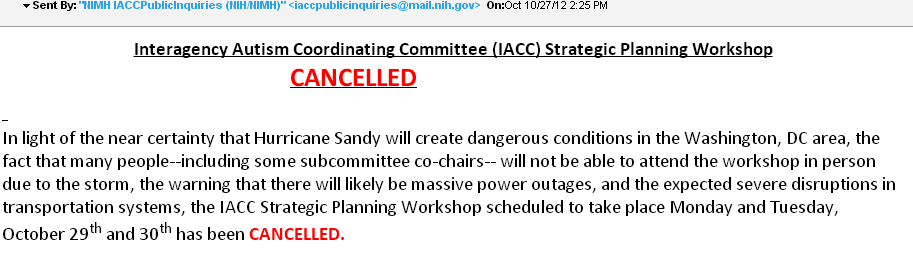
Last week there was supposed to be a 2 day workshop of the the U.S. Interagency Autism Coordinating Committee (IACC) to update the Strategic Plan. The workshop was to be held in Washington DC. The meeting was cancelled due to Hurricane Sandy.

Behind the scenes, making things work for the IACC is OARC: the Office of Autism Research Coordination. The people of OARC do a lot, including managing the meetings. No small task for this workshop. There are about 30 IACC members and about 20 experts were brought in to consult on the Plan update. These meetings are a lot of work and OARC staff were preparing long in advance and still, I am sure, were going to be working through the weekend before the workshop. And that without hurricane Sandy. With Sandy bearing down, they had to put together contigency plans. What if some people don’t make it in time? What if people can’t come? What if power goes out? Lots of contingencies which I am sure made this whole process very complicated. I was working with them to make sure I could get in and out of DC for the meeting. Or, at least I hoped to. Airports ended up shut down. Luckily OARC saw that it was going to be unworkable and cancelled the meeting the Saturday before.

Here’s a screen shot from my email on Saturday(Click to enlarge):

The people of the Office of Autism Research Coordination (OARC) were working very hard to put this workshop together. Working hard on contingency plans. Working on the weekend. All this while a hurricane was bearing down on their homes. Thank you, OARC staff. I appreciate the dedication and the hard work.


By Matt Carey

Note: I serve as a public member to the IACC but my comments here and elsewhere are my own.

OIG Fugitive: Poul Thorsen

30 Oct

The Office of the Inspector General (OIG) for the U.S. Department of Health and Human Services (HHS) lists Paul Thorsen as their number one fugitive and states that he is in his home country of Denmark awaiting extradition to the U.S. to stand trial.

The OIG statement on Paul Thorsen is below. He is alleged to have defrauded the U.S. government by diverting funds intended to support research contracted by the CDC.

While he is indicted on multiple counts of wire fraud and money laundering, there is no crime involved in the massive breach of the public trust involved. Poul Thorsen’s group’s work included studies into the alleged link between vaccines and autism. His indictment has been and is being exploited by groups who wish to cast doubt on his entire group’s efforts and the results they found. There is no charge, no crime for the damage potentially done to public health efforts.

Here is the OIG statement:

From approximately February 2004 until February 2010, Poul Thorsen executed a scheme to steal grant money awarded by the Centers for Disease Control and Prevention (CDC). CDC had awarded grant money to Denmark for research involving infant disabilities, autism, genetic disorders, and fetal alcohol syndrome. CDC awarded the grant to fund studies of the relationship between autism and the exposure to vaccines, the relationship between cerebral palsy and infection during pregnancy, and the relationship between developmental outcomes and fetal alcohol exposure.
Thorsen worked as a visiting scientist at CDC, Division of Birth Defects and Developmental Disabilities, before the grant was awarded.
The initial grant was awarded to the Danish Medical Research Council. In approximately 2007, a second grant was awarded to the Danish Agency for Science, Technology, and Innovation. Both agencies are governmental agencies in Denmark. The research was done by the Aarhaus University and Odense University Hospital in Denmark.
Thorsen allegedly diverted over $1 million of the CDC grant money to his own personal bank account. Thorsen submitted fraudulent invoices on CDC letterhead to medical facilities assisting in the research for reimbursement of work allegedly covered by the grants. The invoices were addressed to Aarhaus University and Sahlgrenska University Hospital. The fact that the invoices were on CDC letterhead made it appear that CDC was requesting the money from Aarhaus University and Sahlgrenska University Hospital although the bank account listed on the invoices belonged to Thorsen.
In April 2011, Thorsen was indicted on 22 counts of Wire Fraud and Money Laundering.
According to bank account records, Thorsen purchased a home in Atlanta, a Harley Davidson motorcycle, an Audi automobile, and a Honda SUV with funds that he received from the CDC grants.
Thorsen is currently in Denmark and is awaiting extradition to the United States.

Let the IACC know what you think is important

29 Oct

If you haven’t taken the chance to email the IACC with feedback on where you think autism research and policy should be going, take the time now. You can do so by emailing IACCPublicInquiries@mail.nih.gov

Today and tomorrow were supposed to include the IACC 2012 Strategic Planning Workshop. The IACC being the U.S. Interagency Autism Coordinating Committee. One of the main products of the IACC is the Strategic Plan. Per public law 109-416 (which re-instituted the IACC back in 2006):

(b) RESPONSIBILITIES.—In carrying out its duties under this section, the Committee shall—
(1) develop and annually update a summary of advances in autism spectrum disorder research related to causes, prevention, treatment, early screening, diagnosis or rule out, intervention, and access to services and supports for individuals with autism spectrum disorder;
(2) monitor Federal activities with respect to autism spectrum disorder;
(3) make recommendations to the Secretary regarding anyappropriate changes to such activities, including recommendations to the Director of NIH with respect to the strategic plan developed under paragraph (5);
(4) make recommendations to the Secretary regarding public participation in decisions relating to autism spectrum disorder;
(5) develop and annually update a strategic plan for the conduct of, and support for, autism spectrum disorder research, including proposed budgetary requirements; and
(6) submit to the Congress such strategic plan and any updates to such plan.

You can read more about the Strategic Plan, at least how it looked in 2011, to help formulate ideas on what you think is working and what isn’t. But I would suggest don’t feel constrained to work into the Strategic Plan format. If there are areas you feel need more attention, let people know.


By Matt Carey

Note: I serve as a public member to the IACC but comments here and elsewhere are my own.