Archive | Autism RSS feed for this section

Interagency Autism Coordinating Committee (IACC) Strategic Planning Workshop CANCELLED

28 Oct

The U. S. Interagency Autism Coordinating Committee (IACC) was scheduled to hold a two day workshop on planning for an update of the Strategic Plan. Draft documents outlining progress and gaps in research had been prepared including input from experts outside the IACC, and those experts were scheduled to attend next week. But with a hurricane bear in down on the greater Washington DC area, the workshop had to be cancelled.

The email announcement is below.

In light of the near certainty that Hurricane Sandy will create dangerous conditions in the Washington, DC area, the fact that many people–including some subcommittee co-chairs– will not be able to attend the workshop in person due to the storm, the warning that there will likely be massive power outages, and the expected severe disruptions in transportation systems, the IACC Strategic Planning Workshop scheduled to take place Monday and Tuesday, October 29 th and 30 th has been CANCELLED.

While I am sure the Office of Autism Research Coordination (OARC) are already working on a backup plan for the meeting, let’s wish them and all the people who have been and will be affected by the storm well.


By Matt Carey

Note: I serve as a public member to the IACC, but my comment here and elsewhere are my own.

Hyperbaric oxygen in the treatment of childhood autism: a randomised controlled trial

24 Oct

Hyperbaric Oxygen therapy (HBOT) has risen in recent years as an “alternative” therapy for many conditions, autism included. The logic behind HBOT is rather fuzzy. For example, there was some discussion of using HBOT to reduce oxidative stress a few years back. How increasing oxygen in the body would decrease oxidative stress was not clear. Some other discussions focused on oxygen perfusion. Basically, some studies have shown that some areas of the brain may be getting less oxygen in autistics than in non-autistics. The idea was that increasing the oxygen to those areas might result in some improvement in some measure or another.

This begs the question: are there areas of higher perfusion (hyperperfusion) in the brains of autistics? Seems an important question to pose when proposing increasing perfusion. But one can not find the term “hyperperfusion” in this review promoting HBOT and autism, for example. But the answer is, yes, people have measured hyperperfusion in autistic’s brains:

Brain perfusion SPECT and EEG findings in children with autism spectrum disorders and medically intractable epilepsy

In specific, they found

The areas of hypoperfusion and EEG focus were highly related in seven of 12 children, while the areas of hyperperfusion were highly related to EEG focus in six of 12 children. The areas of hypoperfusion were highly related to the focus observed on EEG, but were not always related.

Using the simplistic logic of HBOT/autism promotors, one then is left with the question of whether could HBOT make seizure activity worse? I wouldn’t put too much weight on this question other than to point out that it isn’t 100% clear that there can be no downside to HBOT. The logic “there is hypoperfusion therefore HBOT should benefit” isn’t strong; the idea that “there are areas of hyperperfusion, therefore HBOT could have a downside” is also not strong. There are three other studies mentioning hyperperfusion and autism. And, I was interested to see that there are 350 hits for a search of hyperperfusion and epilepsy in pubmed. Compare this to 30 hits for autism and hypoperfusion.

Back to HBOT. There isn’t much science for HBOT, to be frank. Most of the momentum, at least in publications, is from one source: Dan Rossignol. An early paper: Hyperbaric oxygen therapy may improve symptoms in autistic children. by Dr. Rossignol was published in Medical Hypotheses–a pseudo medical journal. I believe Dr. Rossignol’s clinic in Florida provides HBOT.

While there have been articles like the above and some small open label study reports, true randomized trials have been lacking. A recent review Hyperbaric oxygen therapy for treatment of children with autism: a systematic review of randomized trials reported

While some uncontrolled and controlled studies suggested that HBO therapy is effective for the treatment of autism, these promising effects are not replicated. Therefore, sham-controlled studies with rigorous methodology are required to be conducted in order to provide scientific evidence-based HBO therapy for autism treatment.

Also worth noting is that HBOT is currently rated as “non-accepted” by the European Committee for Hyperbaric Medicine. An indication that there was not good evidence either way at the time they prepared their statement.

Two recent studies (the one which is the focus of this article and another) have used a more randomized/blind methodology and one has looked at biomarkers considered important in HBOT and autism (cytokines). The results have not been encouraging.

First the more biomarker based study. This group studied autistic children given HBOT and looked at cytokine levels (Brief report: Hyperbaric oxygen therapy (HBOT) in children with autism spectrum disorder: a clinical trial.) Per that study,

Ten children completed 80 sessions of HBOT and all improved by 2 points on the clinician-rated CGI-I scale (much improved) as well as several parent-completed measures of behavior. The lack of a control group limits the ability to determine if improvements were related to HBOT.

and also:

“Although this study was limited by the small sample size and by the variable nature of cytokines, we found no evidence that HBOT affects cytokine levels or that cytokine levels were associated with behavioral changes”

So, if there is a benefit from HBOT, it isn’t due to changes in cytokines. Which HBOT doesn’t seem to affect.

Another somewhat recent study attempted a clinical trial as well
Controlled evaluation of the effects of hyperbaric oxygen therapy on the behavior of 16 children with autism spectrum disorders. This study, out of the old “Thoughtful House” including Andrew Wakefield as an author found ” No consistent effects were observed across any group or within any individual participant, demonstrating that HBOT was not an effective treatment for the participants in this study. This study represents the first relatively large-scale controlled study evaluating the effects of HBOT at the level of the individual participant, on a wide array of behaviors.”

Finally, a study out in the past couple of months again attempts a randomized controlled study: “Hyperbaric oxygen in the treatment of childhood autism: a randomised controlled trial.” The study is out of Thailand. One factor of note is the attempt to do a real control using a “sham” air group. Obviously HBOT studies are complicated in that study subjects can easily detect the changes in pressure. Of note, HBOT in this case is 100% oxygen:

This study was a prospective, randomised, double-blind, controlled trial of HBOT at 153 kPa (1.5 ATA) with 100% oxygen for one hour daily, weekdays to a total of 20 sessions, versus a sham air treatment consisting of pressurised room air at 116 kPa (1.15 ATA) on the same schedule.

While some reports have used 100% oxygen at 1.5ATA, many have used either air or enriched air and sometimes lower pressure (1.3ATA). I.e. this study involves higher oxygen exposure than in many studies. Air is about 21% oxygen. So, a 1.5 atmospheres of pure oxygen is about 7.5 times the oxygen partial pressure in air. Many reports in early studies were about 1.3 ATA air or slightly enriched air. 1.3 ATA (atmospheres absolute) at 25% O2 is about 32% oxygen. For divers, these levels of oxygen are comparable to Nitrox or enriched air. One can get a higher oxygen level from a mask at 1 atmosphere. Which has been a critique of HBOT from the start. Early anecdotal reports from HBOT practitioners claimed that oxygen delivered by mask was not effective. Only high pressures gave whatever results were claimed. Which is counter intuitive to the simple explanations of how HBOT should work.

But, with both high pressure and pure O2, the Thailand study should provide clarity in these questions. Which begs the question, what are those results? The full paper is online and the abstract is below.

BACKGROUND:
Promising results with hyperbaric therapy for children with autism have been reported, but most involved the use of only mild pressure with oxygen supplementation. To date, there has been no randomised, blinded trial of 100% oxygen administered at hyperbaric pressure. This study evaluated the efficacy of hyperbaric oxygen therapy (HBOT).

METHODS:
Sixty Thai children with autism, aged three to nine years, were randomly assigned to receive 20 one-hour sessions of either HBOT at 153 kPa (1.5 ATA) or sham air at 116 kPa (1.15 ATA). Effects on behaviour were measured using the Autism Treatment Evaluation Checklist score (ATEC) and clinical improvement was measured with the Clinical Global Impression (CGI) system; in particular the clinical change (CGIC) and severity (CGIS) sub-scores. These were evaluated by parents and clinicians, both of whom were blinded to the actual exposure.

RESULTS:
The mean total ATEC scores by both parents and clinicians were significantly improved after intervention in both arms of the study compared to the score before intervention (P <; 0.001 in both groups by parents, P = 0.015 in HBOT group and P = 0.004 in sham group by clinician). There were no statistically significant differences in average percentage changes of total ATEC score and all subscales scores when comparing the HBOT and sham air groups, either by parents or clinicians. Changes in the CGI scores following intervention were inconsistent between parents and clinicians. For severity scores (CGIS), parents rated their children as more improved following HBOT (P = 0.005), while the clinicians found no significant differences (P = 0.10). On the other hand, for change scores (CGIC) the clinicians indicated greater improvement following HBOT (P = 0.03), but the parents found no such difference (P = 0.28).

CONCLUSIONS:
Children with autism who received 20 sessions of either HBOT or a sham air exposure had significant improvements in overall behaviour but there were no significant differences in improvement between groups. The inconsistent changes on CGI sub-scores between parents and clinicians are difficult to interpret, but no overall clinically significant benefit from HBOT could be shown. Both interventions were safe and well tolerated with minimal side effect from middle ear barotraumas.

Repeat for emphasis: “Children with autism who received 20 sessions of either HBOT or a sham air exposure had significant improvements in overall behaviour but there were no significant differences in improvement between groups”

Reports from parents and clinicians did not agree and the authors conclude “no overall clinically significant benefit from HBOT could be shown”.

HBOT is not cheap. A single “dive” can cost in the neighborhood of $100. Parents have purchased portable chambers which run in the $10-20k range (depending on model and whether new). And have modified these to provide O2 enriched air, outside the manufacturer’s specifications. There is a resale value in these chambers so far, so the net cost is not going to be as high. But, all told, there is substantial outlay of funds and time in HBOT. The science pro is shaky at best. And now there are two negative controlled trials.

These results will likely do little to dampen the enthusiasm for HBOT. All studies of HBOT and autism in clinicaltrials.gov are completed, so future data may not be forthcoming.


By Matt Carey

Chronic Intranasal Oxytocin Causes Long-Term Impairments in Partner Preference Formation in Male Prairie Voles

21 Oct

There is a great deal of discussion here and elsewhere about alternative medicine and it’s application to autism. If one points out that a specific therapy is poorly founded in facts and/or not completely tested, a common response is that one is “anti-cure” “anti-treatment” or the like. Safety issues, always at the forefront to the point of misrepresentation when discussion of vaccines, are often completely ignored in the alt-med world when discussing proposed therapies.

One therapy that hasn’t been discussed much here at LBRB is oxytocin. Some of the studies on oxytocin and autism have been, well, odd. But others have covered those aspects better than I could. Now comes a study on lab animals exploring long-term effects:

Chronic Intranasal Oxytocin Causes Long-Term Impairments in Partner Preference Formation in Male Prairie Voles.

Here is the abstract:

BACKGROUND: Oxytocin (OT) is a hormone shown to be involved in social bonding in animal models. Intranasal OT is currently in clinical trials for use in disorders such as autism and schizophrenia. We examined long-term effects of intranasal OT given developmentally in the prairie vole (Microtus ochrogaster), a socially monogamous rodent, often used as an animal model to screen drugs that have therapeutic potential for social disorders.

METHODS: We treated voles with one of three dosages of intranasal OT, or saline, from day 21 (weaning) through day 42 (sexual maturity). We examined both social behavior immediately following administration, as well as long-term changes in social and anxiety behavior after treatment ceased. Group sizes varied from 8 to 15 voles (n = 89 voles total).

RESULTS: Treatment with OT resulted in acute increases in social behavior in male voles with familiar partners, as seen in humans. However, long-term developmental treatment with low doses of intranasal OT resulted in a deficit in partner preference behavior (a reduction of contact with a familiar opposite-sex partner, used to index pair-bond formation) by male voles.

CONCLUSIONS: Long-term developmental treatment with OT may show results different to those predicted by short-term studies, as well as significant sex differences and dosage effects. Further animal study is crucial to determining safe and effective strategies for use of chronic intranasal OT, especially during development.

Basically they exposed prairie voles to oxytocin from about the equivalent of being a toddler (weaning) to adulthood (sexual maturity). It’s a short time for these animals (21 days) but in that amount of time the males showed changes in behavior beyond those observed in short-term trials.

This isn’t a complete “put the brakes on this line of research” study, but it does shed light on the sort of caution that should (and, sadly, often isn’t) applied to alt-med. Some have jumped the gun on oxytocin as a therapy before dosage and long-term effects have been explored.

Immunization uptake in younger siblings of children with autism spectrum disorder

12 Oct

If one child has autism, the chance that a younger sibling will have autism is about 18.7%. (see the study Recurrence Risk for Autism Spectrum Disorders: A Baby Siblings Research Consortium Study and discussions here and elsewhere). Anecdotally, we hear a lot about families deciding to forgo or delay vaccines after having an autistic child. This raises a question and an opportunity for research: does delaying or stopping vaccines result in a lower risk of autism? Looking at younger siblings, one would have a population that both has a higher autism risk and a possibly higher percentage of use of alternate (including no) vaccine schedule.

A study has been published this week on this very topic: Immunization uptake in younger siblings of children with autism spectrum disorder. The answer? Immunization does not increase the risk of autism. But I get ahead of myself.

The authors divided the children into three groups

Immunization status was divided into three predefined categories: (a) Fully immunized: Children with four doses of DPTP (2, 4, 6, and 18 months) and the initial MMR dose at 12 months, (b) Partial/delayed immunizations: Children with any missing dose of DPTP or MMR at any age or a delay of 3 months or more for at least one of the doses of DPTP or MMR, and (c) Not immunized/declined: Children for whom all immunizations had been withheld as of 3 years of age.

In case you are wondering, yes, comparing groups (a) and (c) is a vaccinated/unvaccinated study design. [edit to add–see note below] (b) just gives more dimension to the study.

Yes, siblings of autistic children are vaccinated differently (on average) than younger siblings of non-autistic children:

MMR immunization uptake. The analysis revealed a significant group difference in MMR immunization status (Fisher’s exact test = 80.82, p < .001). Bearing in mind that the Public Health Agency of Canada recommends that children receive their initial MMR vaccine at 12 months (in contrast to the United States, where it is recommended at 12–15 months; Public Health Agency of Canada, 2006a; CDC, 2011), only 42 of the 98 (43%) younger sibs received the 12-month MMR vaccine ontime (i.e. by at least 15 months of age; see Figure 2); an additional 38 (39%) received the vaccine after 15 months of age, and 18 (18%) had not been immunized against MMR by the age of 3 years. In contrast, 88 of 98 (90%) probands received the MMR by 15 months, 9 (9.2%) were delayed, and only 1 had not been immunized by the age of 3 years. Similarly, 63 of 65 (97%) controls had completed their MMR immunization on time (i.e. only two were delayed, and none had parents who had fully declined).

Only 42% of younger siblings of autistics received the MMR ontime. 18% were not given the vaccine by age 3. Compare this to the control group, where 90% received the MMR by 15 months and 98% by age 3.

Differences were seen with the DPTP vaccine as well:

DPTP immunization uptake. A significant group difference was also found for DPTP immunization status (Fisher’s exact test = 38.95, p < .001), with just over half (55.1%) of the younger sibs having been immunized on time (31.6% were delayed, and 13.3% were not immunized by the age of 3 years; see Figure 3). The rates of DPTP uptake were higher for probands (86.7% immunized on time, 12.2% delayed, and 1% not immunized) and controls (90.8% immunized on time, 9.2% delayed, and none declined).

What did this do to autism risk for these un- and under-vaccinated younger siblings? Statistically nothing:

Of the 39 younger sibs who had completed their immunizations on time, 6 (15.7%) were diagnosed with ASD and 2 with speech-language delay (SLD). Of the 47 younger sibs for whom immunization as delayed, 15 (31.2%) received an ASD diagnosis and 2 had SLD. Of the 12 younger sibs who had not received any immunizations, 4 (33.3%) were diagnosed with ASD and 1 with SLD. Note that of those children who did not receive a diagnosis, 43.8% were fully immunized. The Fisher’s exact tests revealed no significant difference in the rates of diagnoses between immunized and nonimmunized groups for MMR (Fisher’s exact test = 5.46, p = .22), DPTP (Fisher’s exact test = 3.65, p = .44), or both (Fisher’s exact test = 4.13, p = .37), although small sample size renders these comparisons exploratory only.

And, by “statistically nothing”, I am not saying, “the calculated risk for vaccinated siblings are higher, but we can’t claim they are because the p values aren’t statistically significant”. No, I’m saying, “the calculated values are lower for vaccinated siblings.”

The authors found about 15.7% autism risk for baby siblings. Very close to the Baby Siblings study mentioned above which found 18.7% risk. The risk found for siblings with delayed vaccination was 31.2% and for unvaccinated was 33.3%. Again, these values are not statistically significant from the 15.7%.

So, when one does a vaccinated/unvaccinated study, one finds that autism risk (for familial autism) is not increased.

Since people will undoubtedly be looking for the conflicts of interests for the study authors, the COI statement is “The authors declare that there is no conflict of interest.” and their funding is “This research was funded by the Canadian Institutes of Health Research and Autism Speaks.”

Limitations include sample size and the fact that the authors relied upon parent recall for much of the data:

Parents of 22.2% (58/261) of the children provided a copy of their child’s immunization record or had it sent by their doctor; for the remaining 77.8%, status report was based on parent recall (note that this information was typically gathered at each visit, at 3- to 6-month intervals, to avoid recall bias). Due to the potential for recall bias (e.g. see Dorell et al., 2011, for bias in recall for the older children), we examined the influence of information source (card copy vs parent recall) on immunization status. No significant relationship was found for MMR (Fisher’s exact test = .38, p = .84), DPTP (Fisher’s exact test =1.71, p = .44), or “both” (Fisher’s exact test = 1.58, p = .48).

Here is the abstract:

Background: Parental concerns persist that immunization increases the risk of autism spectrum disorder, resulting in the potential for reduced uptake by parents of younger siblings of children with autism spectrum disorder (“younger sibs”).

Objective: To compare immunization uptake by parents for their younger child relative to their
older child with autism spectrum disorder (“proband”) and controls.

Design: Immunization status was obtained for 98 “younger sibs,” 98 “probands,” and 65 controls.

Results: A significant group difference emerged for overall immunization status (Fisher’s exact test = 62.70, p < .001). One or more immunizations in 59/98 younger sibs were delayed (47/98; 48%) or declined (12/98; 12.2%); immunizations were delayed in 16/98 probands (16.3%) and declined in only one. All controls were fully immunized, with only 6 (9.2%) delayed. Within the “younger sibs” group, 25/98 received an autism spectrum disorder diagnosis; 7 of whom (28%) were fully immunized. The rates of autism spectrum disorder diagnosis did not differ between immunized and nonimmunized younger sib groups, although small sample size limits interpretability of this result.

Conclusion: Parents who already have one child with autism spectrum disorder may delay or
decline immunization for their younger children, potentially placing them at increased risk of
preventable infectious diseases.

Edit to add: The authors have clarified that unvaccinated means not vaccinated with MMR or DPTP, not necessarily completely unvaccinated.

Autism Science Foundation Partnering with UJA-Federation to Launch Three Surveys Designed to Identify Services and Needs for Adults with Autism

11 Oct

As a follow on to the article Survey of Services Needs for Adults with Autism, here is the press release:


Date Published:
OCTOBER 11, 2012

The New Surveys — Conducted on behalf of UJA-Federation by the Autism Science Foundation and the Interactive Autism Network — Aim to Help Service Providers Expand Programs That Support AllThose Affected by Autism

(OCTOBER 11, 2012—New York, NY) UJA-Federation of New York announced today the launch of a series of surveys designed to determine which types of services for adults with autism are most needed in the New York metropolitan area. The surveys are being administered by the Autism Science Foundation and the Interactive Autism Network (IAN).

The three surveys target individuals with autism ages 18 to 35; parents of individuals with autism ages 18 to 35 who are independent; and parents of individuals with autism ages 18 to 35 who are under their parents’ guardianship. People fitting one of these three groups are invited to participate by registering at the Interactive Autism Network (IAN) and completing the “UJA-Federation Adult with Autism Spectrum Disorder (ASD) Survey.”

“The goal of this project is to identify the drivers of fulfillment and success for autistic adults in the areas of employment, leisure activities, and spirituality,” said Deborah Hilibrand, a member of UJA-Federation of New York’s Autism Task Force. “We will then use this information to help UJA-Federation and other agencies provide these critical activities by providing financial support for projects that deliver these services.”

“We also want to use the data to enhance public awareness about the critical issues facing adults with autism and their families by broadly disseminating the results of this survey,” said Alison Singer, president of the Autism Science Foundation.

The free survey is designed to be completed entirely online. Surveys must be completed by Friday, November 30, 2012. All responses and data collected will be kept anonymous and confidential. Participants in this survey do not have to be Jewish or receive services from UJA-Federation, and people of all faiths are welcome.

Eligibility to participate in the UJA-Federation Adult with ASD Survey includes:

  • Residency in the five boroughs of New York City, Long Island, or Westchester.
  • An adult with ASD who is independent and is not under anyone’s legal guardianship.
  • The parent of an independent adult with ASD (for example, one’s adult son or daughter with ASD is not under legal guardianship and maintains the right to make their own medical and legal decisions).
  • The legally authorized representative of a dependent adult with ASD (for example, you may have legal guardianship or medical power of attorney for the adult with ASD).

“This project is especially exciting because the information collected will not only have an immediate effect on improving services for adults with autism, but it will also advance autism research involving adults — a group that is sorely underrepresented,” said Dr. Paul Law, director of the Interactive Autism Network at Kennedy Krieger Institute. “I believe that community service providers like UJA-Federation of New York are key to ensuring greater involvement of adults with autism in research.”

Additional funding for this project was provided by the Hilibrand Foundation and the FAR Fund. The survey can be found by visiting http://orca.kennedykrieger.org/index.php?sid=86954&newtest=Y&lang=en

###

Contact: Roberta Lee, UJA-Federation, 1.212.836.1800, leer@ujafedny.org


To begin registration and the survey, click on the link below:

http://orca.kennedykrieger.org/index.php?sid=86954&newtest=Y&lang=en


By Matt Carey

Survey of Services Needs for Adults with Autism

11 Oct

There is a great need for more and more accurate information on the needs of autistic adults. Information will allow for better advocacy and changes.

The Autism Science Foundation and the UJA Federation of New York have teamed up with the Interactive Autism Network (IAN) to gather data in a survey.

Now is the chance to be heard. Autistic adults, parents of autistic adults and representatives of autistic adults are encouraged to participate. Details are below in a message from Alison Singer at the Autism Science Foundation.

Now is the chance to be heard.

We need your help!

As many of you know, there is little information about the changing needs of adults with autism spectrum disorders (ASD) to guide those planning programs and services. That is why the UJA Federation of New York and the Autism Science Foundation are asking adults with ASD (and their parents or guardians) to complete a survey addressing what is going well in daily life, and what is a challenge. The results of this survey will inform decision making with regard to which programs should be expanded and which may no longer be of value.

We invite you to take this survey by joining the Interactive Autism Network (IAN) – the world’s largest online autism research project — and then completing the UJA Adult with ASD Survey. As a member of IAN, you’ll be informed about future surveys and studies, with a chance to provide ongoing input regarding the experience of adults with ASD over time. IAN registration and this survey can be completed entirely online and will take approximately 20 minutes.

You are eligible to participate in IAN and the UJA Adult with ASD Survey if you are:

· An adult with ASD who is independent
(that is, you are not under anyone’s legal guardianship)

· The parent of an independent adult with ASD
(that is, your adult son or daughter with ASD is not under legal guardianship and maintains the right to make their own medical and legal decisions)

· The legally authorized representative of a dependent adult with ASD
(For example, you may have legal guardianship or medical power of attorney for the adult with ASD)

If you’d like to read the IAN Research study consent form, including privacy policies, before continuing, click here.

To begin registration and the survey, click on the link below:
http://bit.ly/ORf7d5

If you have any questions, the IAN team is happy to answer them for you. You can contact them at 1-866-348-3440 or ian@kennedykrieger.org.

Your participation is critical, and will inform those planning programs about which resources and services adults with ASD and their families need most. Thank you in advance for your support and please forward this email to any individuals or groups who may be interested in participating.

Sincerely,

Alison Singer
President, Autism Science Foundation

The press release can be found on the Autism Science Foundation’s website.


By Matt Carey

Occurrence and Family Impact of Elopement in Children With Autism Spectrum Disorders

9 Oct

In the past few years there has been a great deal of discussion on wandering and autism. Wandering as in elopement, running away, leaving a home or group. With people who are not independent this can obviously be a dangerous situation.

The U.S. Interagency Autism Coordinating Committee (IACC) had much discussion on wandering. The previous IACC had a Subcommittee on Safety and provided HHS Secretary Sebelius with a letter on the subject. One hot topic was whether a medical code should be created to track wandering as there was little hard data on the topic.

One result of this discussion was a study to answer: how prevalent is wandering? Anecdotally we knew the answer was going to be that there is a high prevalence. Now there are numbers to back that up from a study published in the journal Pediatrics.

Here is the abstract:

OBJECTIVES: Anecdotal reports suggest that elopement behavior in children with autism spectrum disorders (ASDs) increases risk of injury or death and places a major burden on families. This study assessed parent-reported elopement occurrence and associated factors among children with ASDs.

METHODS: Information on elopement frequency, associated characteristics, and consequences was collected via an online questionnaire. The study sample included 1218 children with ASD and 1076 of their siblings without ASD. The association among family sociodemographic and child clinical characteristics and time to first elopement was estimated by using a Cox proportional hazards model.

RESULTS: Forty-nine percent (n = 598) of survey respondents reported their child with an ASD had attempted to elope at least once after age 4 years; 26% (n = 316) were missing long enough to cause concern. Of those who went missing, 24% were in danger of drowning and 65% were in danger of traffic injury. Elopement risk was associated with autism severity, increasing, on average, 9% for every 10-point increase in Social Responsiveness Scale T score (relative risk 1.09, 95% confidence interval: 1.02, 1.16). Unaffected siblings had significantly lower rates of elopement across all ages compared with children with ASD.

CONCLUSIONS: Nearly half of children with ASD were reported to engage in elopement behavior, with a substantial number at risk for bodily harm. These results highlight the urgent need to develop interventions to reduce the risk of elopement, to support families coping with this issue, and to train child care professionals, educators, and first responders who are often involved when elopements occur.

Usually with papers like this I try to obtain a copy in advance to review when it is released. last week and this week are too busy for that. The Autism Science Foundation blog has a discussion of the paper in New Study Confirms Autistic Wandering is Widespread. Autism Science Foundation president Alison Singer was one of the forces behind getting this study accomplished, along with Lyn Redwood of SafeMinds and there was support from the National Autism Association and Autism Speaks.

Often on such high profile papers, the full paper is made available to the public. Apparently not in this case.


By Matt Carey

TPGA’s Position on Autism Organizations That Support Autistic People

9 Oct

The Thinking Person’s Guide to Autism has published a five point list of principles they feel organizations that support autistic people must adhere to. This can be found on their site as “TPGA’s Position on Autism Organizations That Support Autistic People“.

I was going to copy them here, but that is basically the full article. I encourage readers to take the time to check out this list and follow the discussion at TPGA.


By Matt Carey

Andrew Wakefield tops the “Retraction Epidemic”

5 Oct

We recently discussed a paper in the Proceedings of the National Academy of Sciences: Misconduct accounts for the majority of retracted scientific publications. A reader sent a copy to me and there are a couple of interesting points (OK, there are a number of interesting points, but a couple specific to the autism communities).

First, consider the abstract:

A detailed review of all 2,047 biomedical and life-science research articles indexed by PubMed as retracted on May 3, 2012 revealed that only 21.3%of retractionswere attributable to error. In contrast, 67.4% of retractions were attributable to misconduct, including fraud or suspected fraud (43.4%), duplicate publication (14.2%), and plagiarism (9.8%). Incomplete, uninformative or misleading retraction announcements have led to a previous underestimation of the role of fraud in the ongoing retraction epidemic. The percentage of scientific articles retracted because of fraud has increased ∼10-fold since 1975. Retractions exhibit distinctive temporal and geographic patterns that may reveal underlying causes

Yes, the “retraction epidemic”. My guess is the use of “epidemic” here will rankle one or more of Mr. Wakefield’s supporters.

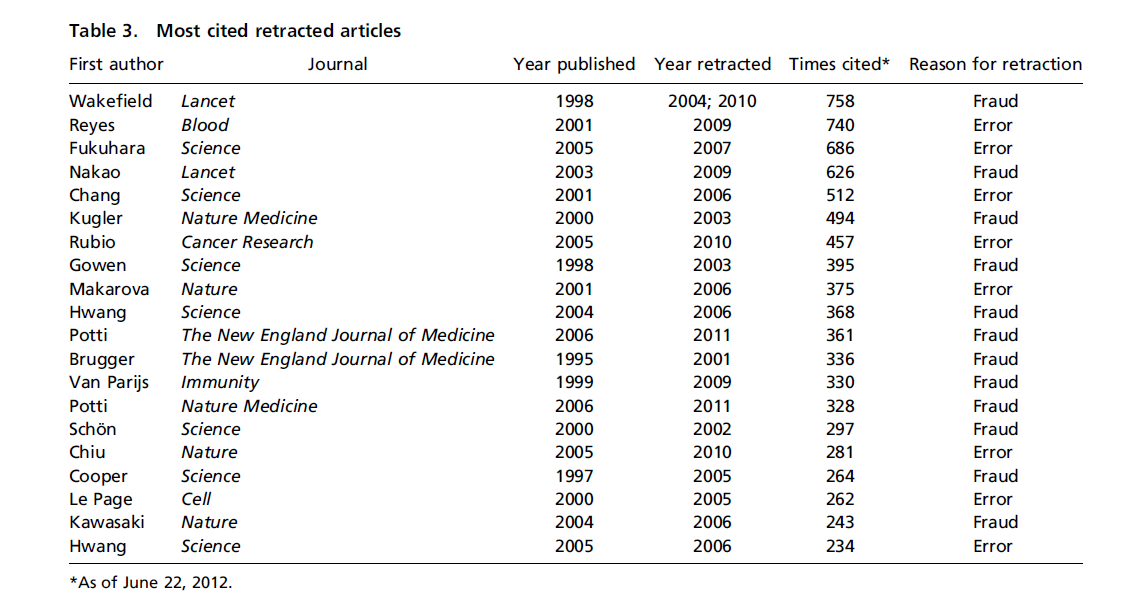
One point that I discussed previously was that Mr. Wakefield’s 1998 Lancet paper tops the list as the most cited retracted paper. The list of top cited retracted papers is shown in this figure (Click to enlarge):

The figure lists the reasons for retraction. The reason for Mr. Wakefield’s paper? Fraud.

As many readers will recall, Mr. Wakefield sued the BMJ and Brian Deer and editor Fiona Godlee for defamation for calling Mr. Wakefield’s paper fraudulent. Which begs the question: how can one call something defamatory when it is a generally accepted fact within the research community?

At present Mr. Wakefield is appealing the decision that stated he doesn’t have the standing to sue in Texas. As always in this case, it isn’t enough to show that his reputation is poor. He has to show that someone other than himself is at fault for his poor reputation. And that is a tough hurdle to cross.


By Matt Carey

Mark and David Geier, holed up in Missouri?

5 Oct

There is really no fun in writing about people whose lack of ethical standards harm disabled children. Seriously, it is painful. I know at least one autism blogger who quit in no small part because it was just too hard to keep writing about these topics.

And here in one week, both Andrew Wakefield and the Geiers (Mark and David) come back up in the news. A recent story in the St. Louis Post Dispatch discusses the Geiers: Controversial autism doctor loses license elsewhere, but can still practice in Missouri, Illinois

Mark Geier is an M.D. and was licensed in multiple states (I’ve lost count of how many and which ones). His home base is Maryland. His license was suspended there and many other states have followed suit. David Geier holds no medical credentials and is charged with practicing medicine without a license in Maryland.

As noted above, most, but not all, states have followed suit with suspending Mark Geier’s license.

The St. Louis Post Dispatch writes (reminding me of which states Mr. Geier has been licensed):

Dr. Mark Geier has opened eight autism treatment clinics called ASD Centers across the country but is only allowed to practice at two of them — in St. Peters and Springfield, Ill.

Missouri and Illinois are among the last states to seek discipline against Geier, whose hormone therapy for children with autism has been called dangerous, abusive and exploitive by various medical boards.

In the last two years, his medical license has been revoked or suspended in California, Florida, Indiana, Kentucky, Maryland, New Jersey, Texas, Virginia and Washington.

Missouri, Illinois and Hawaii have filed complaints against Geier based on other states’ actions, but his license remains active in all three states. A disciplinary hearing in Geier’s case is set for Oct. 19 before the Missouri Board of Registration for the Healing Arts in Jefferson City

The Geier hypothesis is that mercury binds with testosterone in the brain, making it difficult to chelate. They prescribe Lupron to reduce testosterone. The idea would be laughable if it weren’t being used on humans (or any animal for that matter).

Briefly–the Geier’s cited a paper showing that in hot benzene,
(more details in Miscellaneous Mercury Nonsense), mercuric chloride and testosterone can be induced to form chemical complexes.

I had hopes that the Geiers had moved away from this idea, but they stand by it:

David Geier said Wednesday that “many peer-reviewed scientific studies” have been published that support the theory. All of the research articles cited on the ASD Centers’ website are co-authored by Mark or David Geier.

The fact that the Geiers were able to get papers published in third rate journals doesn’t make their ideas true. Or even feasible.

Mr. David Geier did not attend medical school. Neither did I but I will offer him this small bit of medical advice: Among other logical problems with your idea, the human brain is not the same thing as a beaker of hot benzene.

Point two: even if your idea held any merit, Lupron lowers the level of testosterone in the blood, it doesn’t break up these mythical mercury-testosterone complexes.

The Geiers are demonstrating a major problem with the medical license system in the U.S.. It took years to bring the Geiers to hearing. Now that Mark Geier has lost his license in his home state, he has moved to other “safe havens” to continue business? How is this right.

I recall a number of med students and premeds I knew while in college and grad school. The hoops they had to jump through to get their degrees and get licensed and start working seemed enormous. Now we see why: it’s so hard to stop someone from practicing.