Archive | Orgs RSS feed for this section

Autism Baby Siblings Study: recurrence risk 19%

15 Aug

Results of the MIND Institute’s baby sibling study have been published in the journal Pediatrics. The study puts the recurrence risk of autism at 19%. In other words, a family with one autistic child has, on average, a 19% chance that a subsequent child will be autistic. The study authors stress that the risk may be higher in some families and lower in others.

More discussion can be found in various news outlets carrying the story, including

http://m.heraldextra.com/news/science/health-med-fit/article_a90c6549-3444-5b6a-800a-85aba7234914.html

Onset patterns in autism: correspondence between home video and parent report

27 Jul

Regression is a major topic in autism. Children who lose abilities at a very young age. In Onset patterns in autism: correspondence between home video and parent report, Sally Ozonoff, Ph.D. and a team of researchers at the U.C. Davis MIND Institute looked at the developmental trajectories of children, autistic and non autistic. They reviewed home videos of the children to map those trajectories. They monitored social communication as a function of time.

What they found was even more complex than expected. Instead of finding that some children show low levels of social communication from very early in life. A second group has early high levels of social communication, followed by significant decreases over time (regression). But, there was a third group: a group which was more typical in development followed by not regression, but a plateau in progress in social communication.

The numbers of children in the study are small (53 autistic children), making it unlikely to get a precise idea of what fraction of the children follow each trajectory. According to the IMFAR abstract for this study:

Bayesian Information Criteria were used to select the number of trajectories that best fit the data. There was strong support from coded home video for 3 onset trajectories. The first “early onset” trajectory (n = 20) displayed low rates of social-communication behavior at all ages. The second “regression” trajectory (n = 20) displayed high levels of social-communication behavior early in life and significantly declined over time. The third “plateau” trajectory (n = 12) was similar to the typical children early in life but did not progress as expected. There was no support for a mixed (early signs + regression) trajectory.

Here is the abstract for the published paper:

OBJECTIVE:
The onset of autism is usually conceptualized as occurring in one of two patterns, early onset or regressive. This study examined the number and shape of trajectories of symptom onset evident in coded home movies of children with autism and examined their correspondence with parent report of onset.

METHOD:
Four social-communicative behaviors were coded from the home video of children with autism (n = 52) or typical development (n = 23). All home videos from 6 through 24 months of age were coded (3199 segments). Latent class modeling was used to characterize trajectories and determine the optimal number needed to describe the coded home video. These trajectories were then compared with parent reports of onset patterns, as defined by the Autism Diagnostic Interview-Revised.

RESULTS:
A three-trajectory model best fit the data from the participants with autism. One trajectory displayed low levels of social-communication across time. A second trajectory displayed high levels of social-communication early in life, followed by a significant decrease over time. A third trajectory displayed initial levels of behavior that were similar to the typically developing group but little progress in social-communication with age. There was poor correspondence between home video-based trajectories and parent report of onset.

CONCLUSIONS:
More than two onset categories may be needed to describe the ways in which symptoms emerge in children with autism. There is low agreement between parent report and home video, suggesting that methods for improving parent report of early development must be developed.

The last statement in the results is obviously intriguing. “There was poor correspondence between home video-based trajectories and parent report of onset.”

Here is the segment of the IMFAR abstract:

There was poor correspondence between parent report and home video classifications (kappa = .11, p = .30). Only 9 of 20 participants whose home video displayed clear evidence of a major decline in social-communication behavior were reported to have had a regression by parents. Only 8 of 20 participants with evidence of early delays in social-communication on video were reported to demonstrate an early onset pattern by parents. Of the 10 whose parents described a plateau, only 3 had home video consistent with this pattern.

So, none of the three groups were able to correctly recall the trajectory. Not the parents of kids who regressed. Not the parents of kids who plateaued. Not the parents of kids who had early onset autism.

As parents we’d like to see ourselves as the experts of our children. And, frankly, we are. No one else knows them like we do. But that doesn’t make us infallible.

The study was presented at IMFAR and Shannon Rosa wrote about it for The Thinking Person’s Guide to Autism.

Another manufactured controversy

26 Jul

People are mad at Brian Deer. Really mad. His work uncovered a number of facts behind Andrew Wakefield’s research and business interests. These facts, these actions by Mr. Wakefield, led to many of the problems Mr. Wakefield has suffered in recent years. It is understandable that people are mad at Brian Deer. Andrew Wakefield is rather important to the groups who believe that vaccines caused an epidemic of autism. Mr. Wakefield is the researcher who took the parent’s hypothesis and put it into a prestigious medical journal. Mr. Wakefield has good credentials, and demeanor which makes for excellent TV footage. It is difficult to listen to him and think, “here is a man who lied to the world, caused a fear of the MMR vaccine and vaccines in general, and hid not only his faulty research, but other ethical lapses and shortcuts taken along the way”.

Difficult, but not impossible. The U.K.’s General Medical Council decided that contrary to what Mr. Wakefield had to say in his defense, he had misrepresented his work, he had taken many ethical shortcuts. While the GMC wasn’t interested in the vaccine fears promoted by the faulty, even fraudulent research, the GMC did find Mr. Wakefield guilty of ethics violations, research misconduct and dishonesty and had him struck off the U.K.’s medical register.

And, yes, it was the facts that led to the downfall of Mr. Wakefield. But, that doesn’t shield the messenger. In this case, Mr. Deer. Well, he was more than the messenger. He uncovered the facts as well as presented them.

One thing Mr. Wakefield’s supporters are mad about is the fact that Mr. Deer interviewed one parent using a pseudonym. He presented himself as “Brian Lawrence”, not “Brian Deer”. This is not news, having been in the press for at least 7 years. Much more to the point, it isn’t even a controversy, as I’ll show below. But, it is blog fodder. Apparently enough for Dan Olmsted of the Age of Autism to put out 3, count them 3, articles on the subject.

Since AoA have discussed Mr. Wakefield and Mr. Deer on their blog, it is not surprising that people came here looking to see if there would be a response to Mr. Olmsted’s pieces. There was a time when I read the Age of Autism blog, so perhaps, just perhaps, I was aware of the articles. In a comment on my piece, My comment to the IACC, I got the following

Jim Thompson, frequent commenter here, wrote:

Sullivan:

It seems that your interests parallel those on AoA with a major exception. Have you read this?

See “I was visited yesterday, Friday 28th November 2003 by Brian Lawrence…” at http://www.ageofautism.com/201…..dical.html

I used to get a lot of comments like that. Thread-jacking comments pointing me to one blog or another where some heated discussion was supposedly going on. I pulled the comment this time. In this case I felt it justified. The article it was attached to had nothing to do with the subject of the comment. In fact, to be blunt, I found it both ironic and insulting that the comment was attached to that piece.

Yes, my piece asking for research into better medical care for autistics is so like rehashing the “Brian Deer used a pseudonym” argument. If anything, this serves to show the differences between the Age of Autism and Left Brain/Right Brain. Differences which are becoming more pronounced with time. I’m pushing for a better future. They are rehashing their failures of the past.

Believe me, when I first heard that Brian Deer used a pseudonym in order to obtain an interview, I looked into the question. I asked a simple question: can a journalist lie to a source and if so, when?

The answer is, yes, a journalist can lie. As to when: there are two criteria that must be met. First, there must be a pressing need for the public to obtain the information. Second, the information is not expected to be obtainable by straightforward means.

Let’s consider the news investigation into Mr. Wakefield’s research. It is clear that there was a pressing need for the public to know whether the details were being accurately presented. Mr. Wakefield’s research was creating a fear of vaccines in general, and the MMR in specific. The vaccination rates were dropping to dangerously low levels, presenting a public health hazard. An investigation into the research, even if it required suberterfuge, was warranted, as long as the second criterion was met: there must be a valid expectation that the information would be obtainable by straightforward means.

OK, so point one is met. Let’s look at point two. Mr. Olmsted gives us insight into that question himself:

Deer had written a number of critical articles about parents’ claims of vaccine injury, and if he gave his real name, he doubtless feared, Child 2’s mother would not agree to talk to him. Once she checked his blog, she would be more likely to kick him out of the family home than sit still for what turned into a six-hour inquisition.

Mr. Deer is also described by Mr. Olmsted as being considered at the time of the interview as “a journalist notoriously hostile to people who claimed that vaccines had injured their children. ”

Clearly, the second point is met as well: the information was not expected to be obtainable by straightforward means

Mr. Olmsted is, no doubt, quite aware of the ethics of such methods. The Society of Professional Journalists have the following rules (emphasis added):

Journalists should:
— Test the accuracy of information from all sources and exercise care to avoid inadvertent error. Deliberate distortion is never permissible.
— Diligently seek out subjects of news stories to give them the opportunity to respond to allegations of wrongdoing.
— Identify sources whenever feasible. The public is entitled to as much information as possible on sources’ reliability.
— Always question sources’ motives before promising anonymity. Clarify conditions attached to any promise made in exchange for information. Keep promises.
— Make certain that headlines, news teases and promotional material, photos, video, audio, graphics, sound bites and quotations do not misrepresent. They should not oversimplify or highlight incidents out of context.
— Never distort the content of news photos or video. Image enhancement for technical clarity is always permissible. Label montages and photo illustrations.
— Avoid misleading re-enactments or staged news events. If re-enactment is necessary to tell a story, label it.
— Avoid undercover or other surreptitious methods of gathering information except when traditional open methods will not yield information vital to the public. Use of such methods should be explained as part of the story
— Never plagiarize.
— Tell the story of the diversity and magnitude of the human experience boldly, even when it is unpopular to do so.
— Examine their own cultural values and avoid imposing those values on others.
— Avoid stereotyping by race, gender, age, religion, ethnicity, geography, sexual orientation, disability, physical appearance or social status.
— Support the open exchange of views, even views they find repugnant.
— Give voice to the voiceless; official and unofficial sources of information can be equally valid.
— Distinguish between advocacy and news reporting. Analysis and commentary should be labeled and not misrepresent fact or context.
— Distinguish news from advertising and shun hybrids that blur the lines between the two.
— Recognize a special obligation to ensure that the public’s business is conducted in the open and that government records are open to inspection.

As an aside: consider the rules above and Mr. Olmsted’s reporting on autism. “Distinguish between advocacy and news reporting”. “Test the accuracy of information from all sources and exercise care to avoid inadvertent error. Deliberate distortion is never permissible.” and more…

Back to the question of whether it is permissible to use “surreptitious methods of gathering information” in obtaining a story. Aside from these being the published rules of the Society of Professional Journalists, Mr. Olmsted is likely well aware of the method. Back when he was at UPE, Mr. Olmted’s journalism partner on what may have been his real intro into medical news reporting (a series on Lariam) was a gentleman named Mark Benjamin. Mr. Olmsted included Mr. Benjamin in the dedication of his book, “The Age of Autism”.

I believe that this is the same Mark Benjamin who went on to write a series for Salon.com called “Getting straight with God“, a “four-part investigation into the Christian netherworld of “reparative therapy,” a disputed practice to convert gays and lesbians into heterosexuals. ”

How did Mark Benjamin, a straight man, obtain the information he needed for the story? ” I told Harley I was gay, although I am straight and married. I used a fake name. ”

He flat out admits, he lied:

When I arrived in Levy’s office, I was asked to fill out roughly 15 pages of questions about myself and my family. Mostly the questions centered on how I got along with my folks. In a section about my problems, I wrote “possible homosexuality.” The fact is, I’m straight, I’m married to a woman, and I have a 3-year-old daughter and a son due in October. I wrote on the form that that I was married with a kid. But I lied and said I was also living a secret life, that I harbored homosexual urges.

This is why I’m calling this out as a manufactured controversy. Brian Deer interviewed someone using a pseudonym. He misrepresented himself. It happens in journalism. It not only happens, it is clearly allowed under specific circumstances. As a journalist, a journalist whose colleagues have used the same techniques, Mr. Olmsted should be quite aware of this.

et

Thoughtful House changes name and focus

21 Jul

Thoughtful House. The name is probably indelibly linked to Andrew Wakefield. Under his tenure there as director, Thoughtful House took on a focus of Dr. Wakefield: vaccines, the gut-brain connection and the like.

The focus was strong, as shown by their early conferences. The speaker list for the first conference was described by Mr. Wakefield as:

Our meeting brought together a faculty of nationally and internationally acclaimed speakers who have not only demonstrated their capacity to adapt to the changing landscape of CDDs, but who have also driven the pace of this change though their innovation, their professional integrity, their compassion, and sometimes their own personal tragedy.

The group was heavily weighted towards the vaccine-causation hypothesis.

Mark Blaxill is a proponent of the mercury hypothesis, member of SafeMinds and writer for the Age of Autism blog. Andrew Wakefield has since been demonstrated to have been unethical in his treatment of disabled children, and unethical in his research. Dr. Elizabeth Mumper is one of the leaders of the DAN movement, founder of the Rimland Center for Integrative Medicine. David Kirby is the author of Evidence of Harm, Mercury in Vaccines and the Autism Epidemic: A Medical Controversy, a book promoting the idea that thimerosal in vaccines caused an autism epidemic. Dr. Arthur Krigsman is an American gastroenterologist who took on the Wakefield theory of gut-brain interaction. Doreen Granpeesheh is the head of CARD. Dr. Paul Ashwood is a researcher at the MIND Institute.

Not surprising with Mr. Wakefield as director, the clinical focus was weighted towards gastro-intestinal investigations.

If you are interested in receiving treatment at Thoughtful House, please call us (512-732-8400) or e-mail us (info@thoughtfulhouse.org) to request a patient packet. Our physicians will meet weekly to determine whether the completed packets indicate that a child would be best served by starting treatment with Dr. Arthur Krigsman, a gastroenterologist, or Drs. Jepson or Kartzinel. Parents will then be notified of the physicians’ opinion. Patients who are referred to Dr. Krigsman will have to complete blood and stool testing and an abdominal X-ray. Once the results are received at Thoughtful House, if warranted, an appointment for a phone consultation and an endoscopy will be made. Patients who do not have symptoms of gastrointestinal disease will be referred to either Dr. Kartzinel or Dr. Jepson, as per the parents’ request. While we prefer to see patients in our offices, we understand that this is sometimes not financially or logistically possible and appointments can be made for phone consultations. (A minimum of one visit per year is required.)

The “Wayback Machine” doesn’t seem to link to old versions of the Thoughtful House research projects page. In the past, they had projects ongoing on vaccines (the “monkey studies”, for example), HBOT and horse-riding therapy. Research funded at Thoughtful House by the Ted Lindsay Foundation took on a decidedly vaccine-causation focus:

Research funded by the Ted Lindsay Foundation at Thoughtful House breaks down into three
broad categories:
• What is causing autism; are vaccines or vaccine components to blame?
• What is the mechanism of damage in autism?
• How do we treat this damage and reverse autism?

But, there has been a shift. Thoughtful House is no more. It happened a while ago. OK, it is still there in that a building and many of the same people are there, but the name changed to the Johnson Center for Child Health and Development in honor of “Betty Wold Johnson in recognition of her ongoing generous support of this community and her exceptional commitment to philanthropy”.

And, very importantly, the focus has changed somewhat.

The Mission Statement for the Johnson Center is clear:

The mission of The Johnson Center for Child Health and Development is to advance the understanding of childhood development through clinical care, research, and education.

No mention of gastro-intestinal problems or investigations are mentioned on the FAQ. Gone are the graphs from “fightingautism.org” showing the rise in Special Education autism counts.

Gone too are some of the staff of Thoughtful House:

Andrew Wakefield left Thoughtful House in Feb. 2010. He now appears to be essentially self employed under the name “Strategic Autism Initiative“.

A google search of the Johnson Center website for “wakefield” gives no hits. Maybe I made a mistake somehow. Maybe his name just isn’t there anymore, even as history.

Dr. Arthur Krigsman, a gastroenterologist, left Thoughtful House a little earlier than Mr. Wakefield. He is reportedly currently running private practices in New York and Austin Texas (near Thoughtful House).

Dr. Bryan Jepson joined Thoughtful House about 2005, along with Dr. Krigsman. He also wrote a book on alternative medical treatments for autism, with a forward by Jenny McCarthy. Dr. Jepson is now is director of the Integrative Sports and Wellness Medical Center in Austin. Autism is only mentioned in his bio, but not in the focus of the clinic itself:

Being involved in this clinic will allow him to combine his passion for integrative medicine with his love of sports and fitness. His role at the center will be to supervise the provision of services and to provide higher level pain, injury, and disease management techniques when required.

Dr. Jerry Kartzinel (once the Thoughtful House medical director of paediatric services) is still active in the alt-med side of treating autism, from his home base in Southern California. No mention on his website bio is given to his time at Thoughtful House, from which he resigned in 2007.

The Johnson Center research page now lists four projects. None of which is vaccine-causation focused:

Identification of Biomarkers in Autism Spectrum Disorder (ASD) using Genomic, Proteomic and Metabolomic Profiling: A Case-Control Study

Elemental Diet in the Treatment of Children Diagnosed with Autism Presenting with Gastrointestinal Abnormalities (ongoing)

Bone Mineral Density in Boys Diagnosed with Autism Spectrum Disorder (on-going)

A Retrospective Analysis of Dietary and Nutrient Status of Children with Autism in an Outpatient Setting (ongoing)

The Johnson Center is a much toned down version of its former Thoughful House identity. As I wrote earlier, Generation Rescue also seems to be backing away from its former self. Sure, there are still the rather shrill voices of vaccine-causation, but I have to say that 2011 is a much different year than 2006, when I first came online in the autism communities. Heck, there’s been a shift since 2009. I’m glad to see the Johnson Center make this move. An apology would be nice, but I’m not holding my breath on that one.

My comment to the IACC

19 Jul

The IACC seeks public comment, both in-person and in writing. Below is my comment submitted for today’s meeting. I didn’t get this out until late, so it may not be included with the packets for the IACC members today, but it concerns an issue I find very important:

Dear Interagency Autism Coordinating Committee members:

I would like to thank the IACC members for their work over the recent years. It is my sincere hope that the Combating Autism Act will be reauthorized, allowing this committee to continue to guide autism research goals.

One goal I would hope that would be addressed in future Strategic Plans is the need for adequate medical care for autistics. It is my belief that the current medical system in the U.S. does not incentivize doctors for the care that is required by the disabled. One doctor told me that 70% or more of the information needed to come to a preliminary diagnosis comes from direct communication with the patient. It seems highly likely that individuals with difficulties in communication and sensory issues will require additional effort on the part of physicians. And, yet, insurance assumes that an office visit will be the same time for an autistic individual as for a non-autistic individual.

The questions that I would like to see addressed are straightforward. First, what is the appropriate amount of time doctors need to take to adequately address the needs of their autistic patients? This information could be used to allow for an additional or a different billing code for doctors to use with this population. Second, does the current system disincentivize doctors from taking on disabled patients in general, and autistic patients in specific?

A recent paper gives a view of the importance of these issues: Parenting aggravation and autism spectrum disorders: 2007 National Survey of Children’s Health. Parents without a medical home show much higher levels of aggravation. Addressing this one area could provide much benefit to not only the autistic children, but to the parents as well.

Again, I thank you for your time serving the needs of autistics.

Respectfully submitted

IACC Chairman Insel Testifies Before House Committee on the Combating Autism Act and the Accomplishments of the IACC

19 Jul

The Combating Autism Act (CAA) is set to “sunset” at the end of September of this year. With that would be the sunset of the Interagency Autism Coordinating Committee (IACC). The U.S. legislature is considering a re-authorization of the Act. Below is an announcement from the IACC about a congressional hearing, with testimony from Dr. Tom Insel, chair of the IACC and director of the National Institute of Mental Health (NIMH).

Testifying before the U.S. House of Representatives Energy and Commerce Subcommittee on Health on July 11, Dr. Thomas Insel spoke about the Combating Autism Act of 2006 and the successful federal coordination and public-private partnership efforts that have resulted from the Interagency Autism Coordinating Committee (IACC) that was created as part of the legislation. Without reauthorization of the Combating Autism Act, the IACC will sunset in September 2011. Representatives Christopher Smith (R-NJ) and Michael Doyle (D-PA) introduced the Combating Autism Reauthorization Act of 2011 (H.R. 2005) on May 26, 2011, a bill that, if enacted, would reauthorize the IACC and other federal programs that conduct research and provide services for people with autism spectrum disorders (ASD) and their families.

During his testimony, Dr. Insel, who is the director of the National Institute of Mental Health and chair of the IACC, focused on the work of the IACC in the five years since the Act was enacted, noting that the committee has “really served to focus efforts across the federal government by bringing federal agency representatives for research, services, and education, as well as parents, people with ASD, scientists, clinicians, and others together to work as a team…”

He praised the dedication of the members and noted that the collaboration between public and private members has fostered important partnerships and ensured that a range of voices and perspectives were heard. The committee’s strategic plan has guided national research efforts by creating a comprehensive blueprint for autism spectrum disorders (ASD) research.

Since the Combating Autism Act was enacted in 2006, there has been remarkable progress in the identifying symptoms of autism early, in understanding how commonly autism occurs in the community, and in developing effective interventions, particularly for very young children. This research is “moving rapidly toward translation into practical tools that can be used in clinics and community settings to change outcomes for people with ASD,” Dr. Insel said.

Health Subcommittee Members asked Dr. Insel a variety of questions, ranging from estimates of autism’s economic impact on families and society to racial disparities in diagnosis and recent research advances in the field. Asked about a recent study that suggests environmental risk factors may play a greater role in autism risk than previously thought, Dr. Insel stressed the importance of understanding how both genetics and environment interact to influence risk. He noted that, while less is known about environmental risk factors for autism than genetic factors, a number of projects were underway to follow children from before birth to early childhood to study potential environmental exposures.

When asked about the most significant gaps in ASD research, Dr. Insel cited the lack of knowledge on effectively supporting the transition from adolescence to adulthood and fixing the inconsistent service delivery systems across the country.

During the hearing, Dr. Insel was also asked how the IACC has been successful. He pointed to the committee’s achievement in improving coordination between federal agencies as well as between federal agencies and private foundations. He noted the importance of creating specific public-private partnerships around key areas of research interest and community need, citing the Autism Treatment Network (ATN) as an excellent example. The ATN is a partnership between Autism Speaks, the National Institutes of Health (NIH), and the Health Resources and Services Administration (HRSA) that creates a comprehensive model of care for children and adolescents with autism. This network helps involve families in research and provides the latest treatments directly to the community.

In addition, he pointed to the importance of public participation in the committee’s activities, creating a public forum for the community’s needs to be heard. He credited the families of people with ASD for their tireless work on behalf of the autism community, saying , “There’s no group of people that I’ve met that are more inspiring than the families of people with autism. These are really dedicated parents, who make things happen.”

While much has been accomplished, Dr. Insel emphasized the importance of continued Congressional support to build on the advances enabled by the Combating Autism Act of 2006. “While there’s been unequivocal progress, much work remains to be done. The reauthorization will be critical for continuing this momentum and the stability of the IACC over the next three years,” he said. Dr. Insel stated that reauthorization was only one step and that appropriations were critical for continued progress. He likened the reauthorization to obtaining a driver’s license, noting, “The agencies serve as our vehicle. We’ve got a great road map through this strategic plan that the IACC has put together, but at the end of the day, whether we have gas in the car or not depends on [the availability of funds appropriated by Congress].” If enacted, the Combating Autism Reauthorization Act of 2011 (H.R. 2005) would enable the committee to continue coordinating federal agency and private efforts to advance ASD research and enhance services to meet the needs of people with ASD and their families.

Dr. Insel starts at minute 21 in this video:

Here is his testimony:

Good morning Chairman Pitts, Ranking Member Pallone and members of the Committee. I am Tom Insel, Director of the National Institute of Mental Health (NIMH) at the National Institutes of Health (NIH). I have served as the Chair of the Interagency Autism Coordinating Committee (IACC), created by the Children’s Health Act of 2000 and re-established by the Combating Autism Act of 2006 (CAA), since my arrival at NIMH in 2002.

First, let me express my sincere appreciation for the opportunity to give you some background on how the existing CAA has facilitated unprecedented collaboration between federal agencies and private organizations, enabling amazing progress in the field of autism research and serving to sharpen our focus on the need for better services for people with autism and their families. We at NIH are very grateful for the strong support that you in Congress have always shown for NIH and the thousands of researchers around the country that it funds. As chair of the IACC, I’d like to express the gratitude of all the federal agencies that are members for your continued interest and encouragement.

The CAA dealt with five general provisions: centers of excellence, surveillance, education for early detection and intervention, the IACC, and authorization of funding. The 11 Autism Centers of Excellence, surveillance efforts at the Centers for Disease Control and Prevention (CDC), programs for early detection and intervention, and funding for all of these programs is authorized to continue with or without reauthorization of the CAA. The one provision that requires reauthorization to continue is the IACC, which is scheduled to sunset on September 30, 2011. For this reason, I will focus my remarks today on the IACC, but I welcome your questions about other provisions of the CAA.

In order to give you the most comprehensive yet concise background, I’ll briefly describe the IACC, its membership, its transparent process, its collaborative activities, the influential Strategic Plans that it has developed, and its various areas of intense interest. In short, this description will let you know that the IACC has fulfilled each and every requirement of the CAA. It has provided both an important forum for public discussion of autism issues and a framework for a research agenda that is optimized to take full advantage of scientific opportunities. As time permits, I also hope to share some examples of the very recent research advances that are so exciting in this field, and how these advances have been facilitated by the existence of the Strategic Plans developed by the IACC with considerable public input. Finally, I’ll discuss how the IACC has focused on the need to enhance services for people with autism.

Autism spectrum disorder (ASD) is a diverse collection of disorders that share in common impairments in verbal and nonverbal communication skills and social interactions, as well as restricted, repetitive, and stereotyped patterns of behavior. The degree and specific combination of impairments can vary from one individual to the next, creating a heterogeneous disorder that can range in impact from mild to significantly disabling. Two decades ago, ASD was considered a rare disorder. Today, with CDC’s latest prevalence estimates of 1 in 110 children in the U.S. being diagnosed with ASD, this disorder has become an urgent national health priority. In 2006, Congress passed the CAA to strengthen federal coordination around this issue and, to enhance public-private collaborations in order to accelerate research to improve the lives of people with ASD and their families.
The CAA outlines the membership of the IACC, which includes both representatives of federal agencies and public members representing a diverse set of stakeholder groups within the autism community. Currently, the IACC includes two people with ASD, several parents of children and adults with ASD, members of the advocacy, research, and service provider communities, and officials from the following federal agencies and offices that are involved in ASD research or services provision: Department of Education (ED), HHS’s CDC, Centers for Medicare & Medicaid Services (CMS), Office on Disability (OD), Substance Abuse and Mental Health Services Administration (SAMHSA), Administration on Developmental Disabilities (ADD) in the Administration for Children and Families (ACF) , Health Resources and Services Administration (HRSA), five institutes of NIH, and the NIH Director. Major autism research and services organizations represented on the IACC include Autism Science Foundation, Autistic Self Advocacy Network, Autism Speaks, SafeMinds, Simons Foundation, Southwest Autism Research & Resource Center, and the U.C. Davis M.I.N.D Institute.

In addition to the voices and perspectives added by the members of the IACC, the IACC has fostered public participation by having public comment periods at every full IACC meeting, regularly inviting written public comment, conducting formal requests for information from the public and holding town hall meetings, and has provided a high level of transparency for the public by actively disseminating information about IACC activities via e-mail, the IACC website, webcasts and even Twitter. By including both federal and public members on the committee, and by fostering public engagement through a variety of means, the IACC ensures that a diversity of ideas and perspectives on ASD are brought to the table to inform the IACC’s activities and recommendations. The IACC is a committed group—while the law only requires the committee to meet twice a year, since 2007, the committee has met around 16 times per year, including full committee and subcommittee meetings, workshops and town hall meetings.
Under the CAA, the IACC is charged with developing and annually updating a strategic plan for ASD research. In fulfilling these requirements, the committee produced its first strategic plan in January 2009 and has issued updates in 2010 and 2011. The IACC developed its Strategic Plan with a great deal of input from the public, gathered through planning meetings, town hall meetings, and requests for information. This tremendous public input, combined with that of scientific and subject matter experts and all the major federal agencies and private funders resulted in a plan that provided a clear path to move autism research forward in targeted, innovative ways to help public and private agencies prioritize activities as soon as it was released. The first IACC Strategic Plan was organized into six chapters that reflect the needs expressed by the community: early and accurate diagnosis, better understanding how autism develops, enhanced ability to identify risk factors, development of new and more effective interventions and treatments, more research needed to inform and enhance services, and the development of better approaches to meet the changing needs of people with ASD over the entire lifespan. In 2010, the committee also added a chapter on the infrastructure needed to support a robust research effort. As you can tell, our strategic plan has a broad scope, in part because it was developed through the cooperation of both research and services-focused agencies and private organizations. While the Plan is a research plan, as the law directs, it encompasses a range of research that goes from fundamental biology of ASD to inform new diagnostics and therapies, to the actual development of those needed tools and approaches, and finally to research that can inform and enhance services programs to meet the needs of people with autism across the lifespan.

Fortuitously, the first strategic plan was completed just as NIH received significant additional funding from the American Recovery and Reinvestment Act to help stimulate the economy through the support and advancement of scientific research. With a strategic plan in place to guide priorities, NIH allocated over $122 million of additional funding between FY09 ($64 million) and FY10 ($58 million) to autism research, supporting a variety of projects addressing the most critical research needs highlighted by the IACC. This was in addition to NIH’s investment of base annually appropriated funds for autism research, which was $160 million in 2010. The overall NIH investment in autism research was an unprecedented $218 million in 2010, more than double the funding prior to the CAA.

The IACC has also fulfilled the CAA requirements to produce an annual summary of advances in research and to monitor federal research activities. Since 2007, the IACC has issued four Summary of Advances documents, which describe what the committee felt were some of the most exciting advances in autism biomedical and services research each year. The IACC has also been actively monitoring not only federally-funded research, as the CAA requires, but has also tracked the research funded through private organizations, making for a much more complete picture of the research landscape across the U.S. All of the private organizations on the IACC that conduct research provided their data, and we have also collected data from all U.S. federal agencies and additional private groups. The result has been the IACC’s annual “portfolio analysis.” The first year, the data were presented at IACC meetings, but in subsequent years the IACC issued full reports on fiscal years 2008 and 2009 funding; the analysis of 2010 data is currently underway. These portfolio analysis reports have provided the first comprehensive look at autism research being conducted in the U.S. They also have facilitated a better understanding of how current research aligns with the IACC Strategic Plan. The committee has found both the summary of advances and portfolio analysis reports to be valuable tools for updating the Strategic Research Plan and determining the greatest areas of need for further action.

This year, the HHS/NIH office that supports the IACC, the Office of Autism Research Coordination (OARC), published a comprehensive Report to Congress, as required in the CAA, on federal activities that have taken place since the passage of the CAA. That report contains rich information about the programs and projects going on across HHS and the ED to meet the needs of people with autism. I urge you to take a look at this report because it provides the most comprehensive picture to date of how federal agencies are responding to the urgent needs of the autism community. The report contains details of the wide array of autism research, services and supports activities conducted by federal agencies, including biomedical and services research, public health activities, education initiatives, early screening, diagnosis and intervention services, provider training, healthcare delivery, social supports, and vocational training. We have copies of this and the other most recent reports mentioned with us and will be happy to give you copies.

Now I’d like to share with you some of the exciting advances we have seen in ASD research. Since the passage of the CAA in 2006, there has been a groundswell of activity on multiple fronts, from game-changing scientific discoveries reshaping the field of autism research to real-world applications that can help people with ASD and their families now.

As I mentioned earlier, one of the main provisions of the CAA was support for early diagnosis and intervention. CDC reports that the median age for autism diagnosis is 4 and half years of age and varies widely by sociodemographic group and geographic location. With recent advances, diagnosis by age 14 months is now a realistic possibility, and researchers are actively pushing the detection window to even younger ages. In April 2011, NIH-funded researchers demonstrated that a simple, low-cost, practical screening tool that takes only five minutes to administer can be implemented by doctors’ offices to detect ASD around one year of age for many children. More than 100 pediatricians in San Diego County, CA participated and screened over 10,000 one year old children using the checklists. Impressively, all pediatricians who participated in the study are continuing to use the tool because they recognized the tremendous potential it provides to identify autism earlier and direct families toward interventions that can result in significant positive outcomes earlier in life. Another promising diagnostic tool is a simple test that detects eye gaze patterns specific to infants with autism. A group of researchers at University of California, San Diego who have received funding from NIH to develop such a test recently reported that they could identify 1-3 year old children with autism with nearly 100 percent specificity. These promising diagnostic tools, combined with CDC’s health education campaign, “Learn the Signs. Act Early.”, to improve early identification, provide great potential for reducing the age of diagnosis and allowing children and their families to get the services and support they need when it can help the most.

Of course, early diagnosis is only valuable if effective interventions are available. Recently published results from several successful trials of early interventions have validated approaches that are effective in young children, creating real promise of improved health outcomes, and quality of life for children with ASD. In 2010, NIH investigators reported that children with ASD who receive a high intensity behavioral intervention starting by age 18-30 months show improvements in IQ, language, and adaptive behavior, to the point where the autism diagnosis no longer applies to some children who receive treatment. Soon after that groundbreaking study, a group of investigators jointly funded by HRSA and NIH reported that an intervention designed to enhance social engagement in toddlers indeed improved social, language, and cognitive outcomes. Early interventionists have noted an encouraging “problem” – new approaches that are being proven effective are being taken up so quickly by the community that it is difficult to find “control groups” for behavioral intervention trials. While this can complicate efforts to conduct randomized control trials, the real story is that parents and community practitioners are putting innovative strategies into practice quickly. Many of these recent advances in early diagnosis and intervention can be credited to NIH’s Autism Centers of Excellence (ACE), which were expanded under the CAA and now comprise 11 research centers at major research institutions across the country.

We do not know the causes of ASD, but very recent findings comparing identical and fraternal twins suggest the importance of focusing on both environmental and genetics factors. NIH and CDC are continuing to strengthen research investigations into possible environmental causes of autism, establishing expansive research networks with the capability to collect large sets of data on environmental exposures and health outcomes, and to conduct powerful analyses to determine which risk factors may be contributing to the development of autism. Population-based studies are the gold standard in epidemiology research. Large sample sizes and rigorous study designs allow researchers to examine many variables at once. Such networks, like NIH’s Childhood Autism Risks from Genetics and the Environment (CHARGE) and Early Autism Risk Longitudinal Investigation (EARLI) and CDC’s Study to Explore Early Development (SEED), will utilize data from medical records, interviews, questionnaires, developmental assessments, and physical exams to explore a host of possible risk factors, focusing heavily on factors in the environment before, during, and after pregnancy. It will take a few more years for these research networks to fully mature, but already, published findings are helping establish the evidence-base for ruling in and ruling out possible environmental triggers. In the first half of 2011 alone, the CHARGE study has implicated air pollution, mitochondrial dysfunction, and immune dysfunction as potential mechanisms for ASD. Just this month, CHARGE investigators reported that use of prenatal vitamins may reduce the risk of having children with autism. In the past week, another study, funded by CDC and a private group, showed that widely-used antidepressant medications taken during pregnancy can significantly raise the risk of having children with autism. In addition to their work on identifying risk factors for ASD, CDC also continues to provide the most comprehensive estimates to date of the prevalence of ASD in multiple areas of the U.S. through its Autism and Developmental Disabilities Monitoring (ADDM) Network. While great progress is being made for autism, CDC’s prevalence estimates have documented significant increases in autism in the US, which highlights the need to continue research efforts and service advances being made with facilitation by the IACC activities.

With the pace of research moving so rapidly, I am confident that our continued investments in novel and innovative biomedical research in ASD will pay large dividends in the future. But there’s a strong imperative to push the best of what we know now out into the community as rapidly as possible.

HHS’s OD and the Assistant Secretary for Planning and Evaluation are creating the infrastructure to support and conduct patient centered research on health services and supports for people with disabilities, including autism. Their new Center of Excellence, authorized under the American Recovery and Reinvestment Act, is part of a national strategy for quality improvement in health care and the expansion of health care delivery system research with a focus on person-centered outcomes research. Expanding on that effort, CMS is testing and implementing family-driven, person-centered and home and community-based service provision models for people with autism.

A common goal across many federal agencies is to support and empower people with autism to live more independently and enjoy an enhanced quality of life. Informed by the IACC Strategic Plan, NIH is making non-traditional investments in novel service and health delivery models, aided by the infusion of additional funds from the Recovery Act. Both the ED’s Rehabilitation Services Administration (RSA) and HHS’s SAMHSA “Supported Employment Toolkit” are helping people with autism secure and maintain jobs in the community. Medicaid continues to fund supported employment and habilitation services through States’ home and community-based waiver programs, which pay for such services for many people with intellectual and developmental disabilities across the nation.

There are also interventions and supports that can help people with autism and their families today. HRSA is helping to pave the road from research to practice. Through funds provided by the Combating Autism Act Initiative (CAAI) under the CAA, HRSA has invested substantially in autism interventions to improve physical and behavioral health of people with ASD, practitioner training, and service provision models. HRSA-funded investigators are examining critical questions, such as the impact of co-occurring health conditions in autistic individuals and the effectiveness of parent-mediated and peer-mediated behavioral interventions. HRSA’s health professionals’ training programs are designed to reduce barriers to screening and diagnosis by increasing professional capacity and raising awareness about ASD among providers in the community. HRSA’s State Implementation Grants represent nearly $2.7 million in funds to assist nine States with improving services for people with ASD. These grants promise to help identify best-practices at the individual, community, and policy level. When possible, partnerships between agencies are being formed – HRSA and CDC have joined to sponsor “Act Early” Summits in all regions of the US and to facilitate the development of professional and community teams to improve the early identification of children with autism at a local level.

The coordination in the autism research community is unparalleled, and the IACC has played a critical role in fostering the growing list of promising public-private partnerships. Last fall, the mother of a child with autism spoke at an IACC meeting about the need to examine the high prevalence of autism in the Somali community in Minnesota reported in a state-funded study based on school data. Working collaboratively, several NIH Institutes, CDC, and Autism Speaks put together a research initiative to support investigation of the reported increase in ASD prevalence in the Minnesota Somali community and to identify the diverse service needs of these Somali-American children and their families.
As the Somali study illustrates, federal agencies recognize the autism challenge is not one we can tackle alone. There are a host of private organizations funding cutting-edge research, including four that hold a seat on the IACC – Autism Science Foundation, the Southwest Autism Research & Resources Center (SARRC) and the organizations identified by the recent IACC Portfolio Analysis as being the 2nd and 3rd largest private funders of research after NIH, Simons Foundation and Autism Speaks. Jointly, NIH, Autism Speaks, and Simons Foundation are driving several significant initiatives poised to accelerate the pace and quality of autism research. By developing the infrastructure and appropriate incentives, these public-private partnerships are encouraging data-sharing on an impressive scale, enabling scientists to do more with less. Additionally, NIH’s National Database for Autism Research (NDAR) is federating with several other autism data repositories such as the Autism Speaks’ Autism Genetic Resource Exchange (AGRE) and the public/private-funded Interactive Autism Network (IAN) to enhance researchers’ access to data. And in the community, programs like AGRE, IAN and the Autism Treatment Network (ATN), that involve direct outreach to and collaboration with the patient community, are bringing together hundreds of researchers and clinicians with tens of thousands of people nationwide affected by ASD in a search for answers.

Federal IACC member, ADD, with the help of non-profit organizations, including the Arc of the United States, the Autistic Self Advocacy Network (ASAN), and the Autism Society, recently launched the AutismNOW Project, an innovative dissemination network to provide access to high-quality resources and information on community-based services and interventions for people with ASD and their families. AutismNOW offers a call center, web-based clearinghouse of resources, twice-weekly webinars on a variety of topics related to autism, and regional events for the community to connect in-person.

Looking back over the past five years since the passage of the CAA, we can see how the establishment of the IACC has served to focus efforts across the federal government, bringing federal agency representatives (research, services, and education), parents, people with ASD, scientists, clinicians and others together to work as a team to address the issues, and bringing a wide variety of expertise to a difficult area. In doing so, it has produced a strategic plan to guide and focus federal research efforts and catalyze public private partnerships, while also providing a forum for public discussion and identification of additional needs from the community.

We have also seen some remarkable progress in the identification of how common ASD is within communities, how ASD develops, how we can detect it at increasingly earlier ages and what types of interventions are most effective, especially in young children. This research is rapidly moving toward translation into practical tools that can be used in the clinic and community settings to change outcomes for people with ASD. In this time span, federal agencies have coordinated efforts to enhance critical services programs, identify best practices to support the education, health and employment needs of people on the spectrum, and develop new mechanisms and strategies to enable broad access to healthcare, services and supports – all leading toward improvement in quality of life for people with ASD and their families.

The CAA established the IACC, to provide advice to the Secretary HHS regarding matters related to ASD, to create a forum where the public could be actively involved in the process, and to develop a strategy to guide national research efforts. While there has been unequivocal progress, much work remains to be done. The reauthorization will be critical for continuing the momentum and stability of the IACC over the next 3 years. It is crucial that members of the IACC—individuals, federal agencies and member private organizations—have stable support to continue their efforts to work together on autism issues.

I thank you for this opportunity to speak with you and look forward to addressing any questions that you may have.

Letter to Massachusetts DDS Commissioner Urging Elimination of Electric Shock, Other Aversives

19 Jul

The National Council on Disability (NCD) has sent a letter to the Massachusetts Department of Developmental Services Commissioner on electric shocks and other aversives. Massachusetts is the home of the Judge Rotenberg Center which uses electric shocks as a main part of their program.

July 18, 2011

Elin Howe, Commissioner
Department of Developmental Services
500 Harrison Avenue
Boston, Massachusetts 02118

COMMENTS OF THE NATIONAL COUNCIL ON DISABILITY IN SUPPORT OF PROPOSED AMENDMENTS TO REGULATIONS ON BEHAVIOR MODIFICATION AT 115 CMR 5.14[i]

The National Council on Disability (NCD) is an independent federal agency charged with advising the President, Congress, and other Federal agencies regarding laws, policies, practices, and procedures affecting people with disabilities. NCD strongly opposes the use of aversive treatments and accordingly submits these comments.

NCD has a longstanding history of opposing aversive treatments.[ii] As stated in NCD’s 1995 Report Improving the Implementation of the Individuals with Disabilities Education Act: Making Schools Work for All of America’s Children,

While it is possible to understand the desperation of these parents, to share their exasperation with ineffective programs and treatments, and to sympathize with them in their frustration to locate appropriate programs, there are limits to what society can permit in the name of treatment. There are those in our society who would advocate for severe physical punishment or even the mutilation of prisoners convicted of what everyone would agree are heinous crimes. Yet these prisoners are afforded protection under the law from this treatment, even though there are those who would claim that such treatment would “teach them a lesson.” Students with severe behavioral disabilities are not criminals, and yet present law allows them to be subjected to procedures which cannot be used on the most hardened criminals, or, in some cases, even on animals.[iii]

NCD applauds the Massachusetts Department of Developmental Services (DDS) for taking steps toward drastically restricting use of aversive punishment, and we urge complete elimination of such methods. The use of electric shock is not a legitimate method of treatment for any person. Such measures – whose use against non-disabled individuals is already recognized as illegal and immoral – are contrary to the letter and the spirit of the Americans with Disabilities Act and the Developmental Disabilities Assistance and Bill of Rights Act. We urge the Department of Developmental Services to protect both future students and current ones from the use of contingent electric shock and all other such aversive techniques.

In light of the effect on children and youth and with disabilities nationwide, NCD is gravely concerned by the use of aversive treatments at the Judge Rotenberg Center (JRC), in Canton, Massachusetts — the only known school in the United States to provide such treatment. We are aware that students from an estimated 17 other states and the District of Columbia attend JRC and are therefore potential recipients of such aversive treatments.[iv] As such, NCD views this as a significant issue of national importance.

The treatment being provided at JRC is contrary to federal policy and the findings of mental health research. The 2003 President’s New Freedom Commission on Mental Health stated that restraint will be used only as safety interventions of last resort, not as treatment interventions.[v] Similarly, the US Department of Health and Human Services Substance Abuse (HHS) and Mental Health Administration (SAMHSA) has found that seclusion and restraints are detrimental to the recovery of persons with mental illnesses.[vi]

The practices of JRC are equally contrary to the Developmental Disabilities Assistance and Bill of Rights Act (DD Act) which states in part:

“…The Federal Government and the States both have an obligation to ensure that public funds are provided only to institutional programs, residential programs, and other community programs, including educational programs in which individuals with developmental disabilities participate, that… meet minimum standards relating to- provision of care that is free of abuse, neglect, sexual and financial exploitation, and violations of legal and human rights and that subjects individuals with developmental disabilities to no greater risk of harm than others in the general population… and prohibition of the use of such restraint and seclusion as a punishment or as a substitute for a habilitation program…” (emphasis added).[vii]

The objectionable practices at JRC have not only attracted national attention but have also been scrutinized internationally. According to the United Nations Convention against Torture and Other Cruel, Inhuman or Degrading Treatment or Punishment, “. . . the term torture means any act by which severe pain or suffering, whether physical or mental, is intentionally inflicted . . . for any reason based on discrimination of any kind, when such pain or suffering is inflicted by or at the instigation of or with consent or acquiescence of a public official or other person acting in an official capacity.”[viii]

In April 2010, Disability Rights International (formerly Mental Disability Rights International) issued an urgent appeal to the United Nations Special Rapporteur on Torture concerning the practices at JRC.[ix] Subsequently, in June 2010, the United Nations Special Rapporteur on Torture stated that the practices of the Judge Rotenberg Center in Canton, Massachusetts equate to torture and urged the US government to appeal.[x] The US Department of Justice (DOJ) is now investigating these, and other, allegations.[xi]

The regulations proposed by the Department of Developmental Services (DDS) send a strong message that aversive treatment should not be readily provided, but they must go further. It is critical that the DDS address the concerns identified here and supplement its regulations accordingly.

Thank you for considering our comments and recommendations. NCD stands ready to assist you in ways that our collaboration can best benefit students with disabilities and their families while promoting safe learning environments for all students across America. We are available to discuss these matters at your earliest convenience. Please contact me through NCD’s offices at (202) 272-2004.

Respectfully,

Ari Ne’eman
Policy and Program Evaluation Committee Chair
National Council on Disability

[i] With thanks to NCD Council Member Marylyn Howe and NCD Staff Robyn Powell for their invaluable support and assistance in research and drafting.

[ii] National Council on Disability, From Privileges to Rights: People Labeled with Psychiatric Disabilities Speak for Themselves (2002), available at http://www.ncd.gov/publications/2000/Jan202000; National Council on Disability, Improving the Implementation of the Individuals with Disabilities Education Act: Making Schools Work for All of America’s Children (1995), available at http://www.ncd.gov/publications/1995/09051995.

[iii] Id.

[iv] CNN, New York Education Officials Ban Shock Therapy (2006), available at http://articles.cnn.com/2006-06-21/politics/shock.therapy.school_1_shock-therapy-electric-shock-geds?_s=PM:EDUCATION.

[v] Mental Disability Rights International, Torture Not Treatment: Electric Shock and Long-Term Restraint in the United States on Children and Adults with Disabilities at the Judge Rotenberg Center (2010), 12, available at http://www.disabilityrightsintl.org/wordpress/wp-content/uploads/USReportandUrgentAppeal.pdf.

[vi] Id.

[vii] 42 U.S.C. § 15009(a)(3)(B)(i-iii) (2000).

[viii] UN General Assembly, Convention Against Torture and Other Cruel, Inhuman or Degrading Treatment or Punishment, Article 1(1), 10 December 1984, United Nations, Treaty Series, vol. 1465, p. 85, available at http://www.unhcr.org/refworld/docid/3ae6b3a94.html.

[ix] Mental Disability Rights International, Torture Not Treatment: Electric Shock and Long-Term Restraint in the United States on Children and Adults with Disabilities at the Judge Rotenberg Center (2010), 12, available at http://www.disabilityrightsintl.org/wordpress/wp-content/uploads/USReportandUrgentAppeal.pdf.

[x] ABC News/Nightline, UN Calls Treatment at Mass. School ‘Torture’ (2010), available at http://abcnews.go.com/Nightline/shock-therapy-massachussetts-school/story?id=11047334.

[xi] US Department of Justice, Assistant Attorney General for the Civil Rights Division Thomas E. Perez Speaks at the National Council on Independent Living Annual Conference (2010), available at http://www.justice.gov/crt/opa/pr/speeches/2010/crt-speech-100719.html.

Generation Rescue: taking another small step away from the brink?

14 Jul

Generation Rescue has over the years been one of the more vocal promoters of the vaccines-cause-autism notion. Like any organization, they have changed over the years and their website reflects that. Their website started out with the title “Autism Mercury Chelation” and a very simple (and wrong) statement:

Generation Rescue believes that childhood neurological disorders such as autism, Asperger’s, ADHD/ADD, speech delay, sensory integration disorder, and many other developmental delays are all misdiagnoses for mercury poisoning.

Of course, later during the early years of Jenny McCarthy, when Generation Rescue became “Jenny McCarthy’s autism organization. By this point, GR had a prominent link on the main page to “vaccines”. This included a page with Generation Rescue recommended vaccine schedules. Their “favorite” being a schedule that offered no protection against many diseases, including measles, mumps, rubella, pertussis, diptheria and tetanus.

They had a page of “science”, including statements claiming that Andrew Wakefield’s 1998 paper linked MMR to autism (a position Mr. Wakefield has tried to distance himself from in the past few years):

“This study demonstrates that the MMR vaccine triggered autistic behaviors and inflammatory bowel disease in autistic children.”

They had a science advisory board, which included S. Jill James, Ph.D., Richard Deth, Ph.D., Woody R. McGinnis, M.D. and Jerry Kartzinel, M.D.. Not exactly heavy hitters, but at least a couple of people who actually publish in journals.

Times have changed again. The website is revamped. And vaccines seem to be much less prominent. For example, in the current version of the Generation Rescue website, I can’t find “recommended” vaccine schedules (they refer people to Dr. Bob Sears). A search for Wakefield shows he is only mentioned once “Studies by researchers: Horvath, Wakefield, Levy, and Kushak highlight a myriad of gut problems present in children with autism, including abnormal stool (diarrhea, constipation), intestinal inflammation, and reduced enzyme function”. The science advisory board is down to one person (Jerry Kartzinel) and an unnamed “cohesive group of professionals committed to healing and preventing autism”.

Sure, it’s still not a place I would recommend to anyone, especially a parent who just found out their kid is autistic. But just a few short years ago the trajectory was increasing with the vaccine discussion, not decreasing.

Please, let’s not invoke the God of vengence in autism discussions

12 Jul

There have been times when I have had the opportunity to stand up and make a clear statement, and yet I failed to do so and lived to regret it. One case that stands out right now is when the blogger erv called Kent Heckenlively of the Age of Autism blog “you sick fuck“. That incident stands out because now I am faced with another challenge: do I stand up to what I see as dangerous speech, this time by Mr. Heckenlively himself?

In an article, When I Can Do Nothing, Mr. Heckenlively writes:

And yet, as thankful as I am for an understanding of what has happened to my child and so many others, my heart is heavy. The Dark Forces which in the past have destroyed the careers of those who have found clues to the afflictions of our children and other disease communities are once again on the move. You may very well read about their actions this week. And I can’t do anything to stop them.

The pain Mr. Heckenlively is feeling is palpable in that paragraph. I feel for him. I really do. At the same time I was quite worried by the choice of the phrase “Dark Forces”. Had the article stopped there, I would not be writing this response.

Mr. Heckenlively goes on to write how he sought guidance from the Bible. Nothing inherently worrisome about that:

I often find myself pondering such questions of faith. What is it I’m meant to do? I want to rush the barricades, but to what effect? It was with such thoughts in my mind I went to our local bookstore, picked up a Bible, opened it to a random page, and with my eyes closed, put my finger down.

The passage he found at random?

Psalm 94 – God, the Avenger of the Righteous

Perhaps now you see why I chose to write a response. Invoking God to bring forth vengeance is troublesome to me.

Here is the version (the language differs according to the bible translation) of Psalm 94 Mr. Heckenlively quotes in his piece:

O’Lord, you God of vengeance, you God of vengeance, shine forth! Rise up, O judge of the earth; give to the proud what they deserve! O’ Lord, how long shall the wicked exult?

They pour out their arrogant words; all the evildoers boast. They crush your people, O’Lord, and afflict your heritage. They kill the widow and the stranger, they murder the orphan, and they say, “The Lord does not see; the God of Jacob does not perceive.

Understand, O dullest of the people; fools, when will you be wise? He who planted the ear, does he not hear? He who formed the eye, does he not see? He who disciplines the nations, he who teaches knowledge to humankind, does he not chastise? The Lord knows our thoughts, that they are but an empty breath.

Happy are those whom you discipline, O Lord, and whom you teach out of your law, giving them respite from days of trouble, until a pit is dug for the wicked. For the Lord will not forsake his people; he will not abandon his heritage; for justice will return to the righteous, and all the upright in heart will follow it.

Who rises up for me against the wicked? Who stands up for me against evildoers? If the Lord had not been my help, my soul would soon have lived in the land of silence. When I thought, “My foot is slipping,” your steadfast love, O Lord, held me up. When the cares of my heart are many, your consolations cheer my soul.

Can wicked rulers be allied with you, those who contrive mischief by statute? They band together against the righteous, and condemn the innocent to death.

But the Lord has become my stronghold, and my God the rock of my refuge. He will repay them for their iniquity and wipe them out for their wickedness; the Lord God will wipe them out.

Mr. Heckenlively concludes his article:

God knows there are some wicked people out there trying to keep our children from getting better. If you’re listening God, and it meets with Your approval, this week would be an excellent time to deal with them.

I don’t know what Mr. Heckenlively means precisely by “deal with them”. But he has just quotes scripture ” He will repay them for their iniquity and wipe them out for their wickedness; the Lord God will wipe them out.”

Here is a comment allowed through by the Age of Autism moderators:

Can he just get on with the smiting

Which tells me that the message is being received: God should smite those who are seen as “wicked”.

Mr. Heckenlively: I wish you and your family well. I truly mean that. I also would strongly encourage you to step back and rethink the post you have put up. Look at the language: “He will repay them for their iniquity and wipe them out for their wickedness; the Lord God will wipe them out.” Ask yourself, ask a trusted friend outside of the autism communities: is this something you should have published?

Mr. Heckenlively, I know it wasn’t easy for you to write what you did. It is not easy to write this response. Finding a tone that remains respectful while voicing my very real concern for the message you are sending is difficult to say the least. I hope that both of us can take down our posts very soon.

A Positive Association found between Autism Prevalence and Childhood Vaccination uptake across the U.S. Population

8 Jul

The title for this article should have a question mark, “A Positive Association found between Autism Prevalence and Childhood Vaccination uptake across the U.S. Population?”. The paper’s faults have already been discussed, but I was unable to sleep earlier this week and I decided to graph some of the data. For some reason, even this didn’t help me to sleep.

A Positive Association found between Autism Prevalence and Childhood Vaccination uptake across the U.S. Population

here is the abstract:

The reason for the rapid rise of autism in the United States that began in the 1990s is a mystery. Although individuals probably have a genetic predisposition to develop autism, researchers suspect that one or more environmental triggers are also needed. One of those triggers might be the battery of vaccinations that young children receive. Using regression analysis and controlling for family income and ethnicity, the relationship between the proportion of children who received the recommended vaccines by age 2 years and the prevalence of autism (AUT) or speech or language impairment (SLI) in each U.S. state from 2001 and 2007 was determined. A positive and statistically significant relationship was found: The higher the proportion of children receiving recommended vaccinations, the higher was the prevalence of AUT or SLI. A 1% increase in vaccination was associated with an additional 680 children having AUT or SLI. Neither parental behavior nor access to care affected the results, since vaccination proportions were not significantly related (statistically) to any other disability or to the number of pediatricians in a U.S. state. The results suggest that although mercury has been removed from many vaccines, other culprits may link vaccines to autism. Further study into the relationship between vaccines and autism is warranted

The author made a number of strange decisions in this paper, as already discussed (and here, here, and here). First, she chose “autism prevalence” for her title when what she discussed was a combination of autism and speech or language impairment. So, I will put quotes around “autism” in “autism” prevalence, as this isn’t a real autism prevalence. Second, she chose a vaccination rate that is based on 100% completion of the 1995 vaccine schedule. This rate was changing notably, as she starts the study period when the schedule was introduced. So, as states and pediatricians and parents adopted the schedule, the “vaccination rate” as defined by the author increases notably. Again, I will use quotes around “vaccination rate” as this is an odd definition of the term.

Here is the main result of the paper:

The results suggest that if a given U.S. state has a 1% higher vaccination rate than another U.S. state, then the state with the higher vaccination rate might have, on average, a 1.7% higher prevalence of autism or speech disorder

With more than 4 × 10^6 babies born in the United States each year, this finding translates into an additional 680 children (= number of children [4 × 10^6] × coefficient [0.017] × 1% [0.01]) exhibiting autism or speech disorders for every 1% rise in children receiving the 4:3:1:3:3 series of vaccinations by age 2 years.

To put all this simply, the author is claiming that if there is some baseline prevalence of “autism” if the “vaccination rate” is 0, say 5%, then the prevalence rate of “autism” would be 5+1.7=6.7% if the “vaccination rate” were 100%.

One would expect that as “vaccination rates” go up or down, the “autism rate” would go up or down with this proportionality factor. It doesn’t happen that way, though.

The author used household income and ethnicity (%Hispanic, % African America, %Other) as variables in the model. Let’s assume that those numbers don’t change significantly during the time period considered for each state (the author appears to make this assumption, so let’s go with it.)

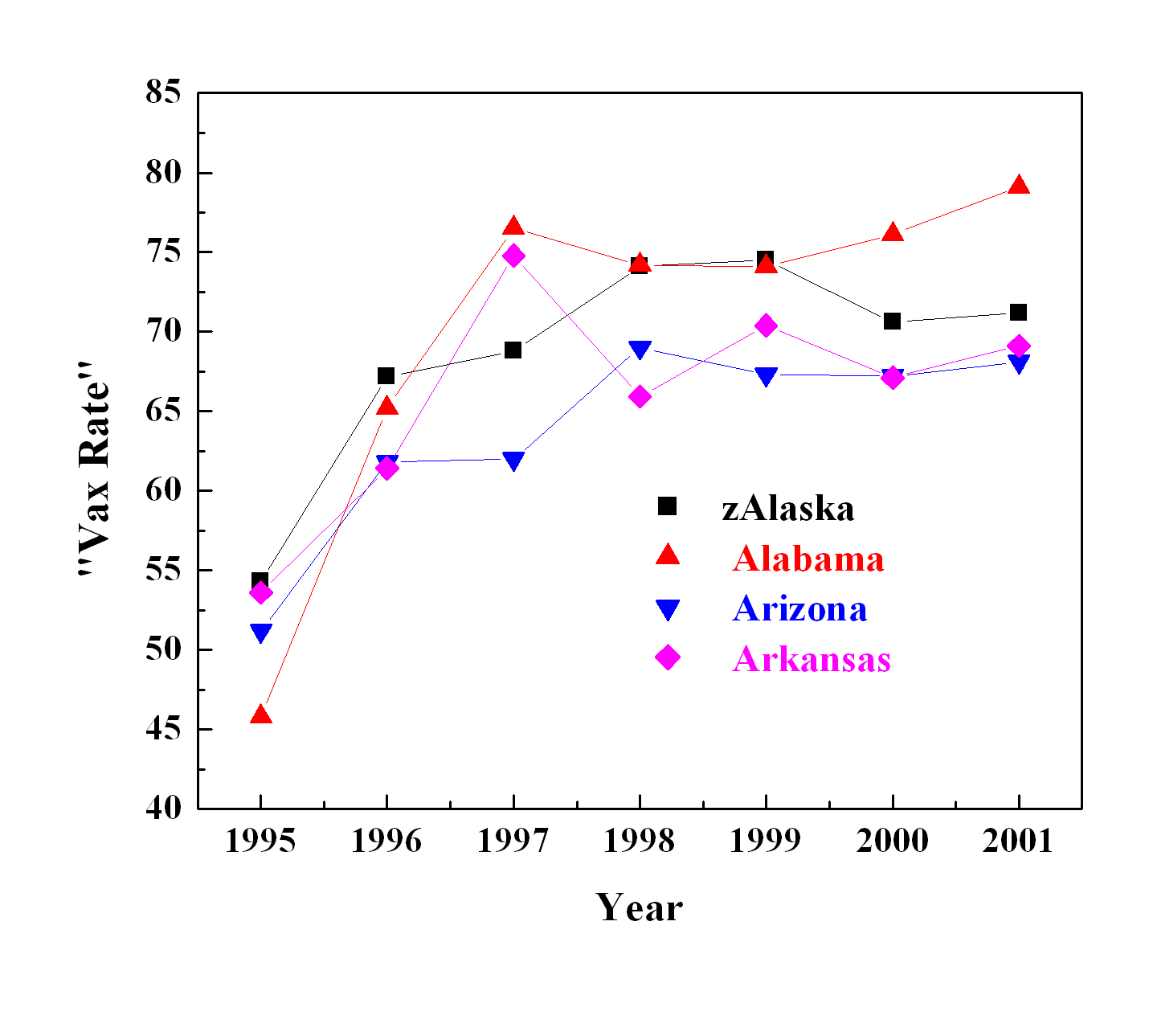
I took a look at the first 4 states in the table (listed alphabetically): Alabama, Alaska, Arizona and Arkansas. If anyone has a particular interest in any given state, I’ll graph them up (or you can do it yourself).

Here is the “vaccination rate” as a function of study year:

As Prometheus has noted, this rate shows the biggest change in the first two years. Given the result of the study, we should see the biggest changes in “autism rate” in these two years. But we don’t. I took the data for the “vaccine rates” as a function of time and applied the 1.7% increase in “autism” prevalence the author states as a result. Let’s look at these states and what the model predicts and what the actual data showed (click any graph to make bigger):

Alaska:

Alabama:

Arizona:

Arkansas:

The data not follow the predicted trends. Not even close. Not only that, but for two states, the predicted values are higher than the reported values (red curves higher than black) while for the other two states the opposite is seen.

This isn’t a case of “I don’t know how the analysis came to the conclusion but I don’t think it is right” type of paper. This is a case of “how did this get past an editor and referee” type of paper. It is just that clearly wrong.