Archive | Epidemiology RSS feed for this section

Are 20-30% of autistic children recovering?

22 Dec

Some children are identified as autistic and later found to be non autistic. How much does this represent “recovery” from autism and how much does this represent something else? The question became very big after the 2007 National Survey of Children’s Health NSCH) results were published. The survey asked parents if they had ever been told by a health care provider that their child was autistic. (Note that this is different from confirming that a child actually had a diagnosis). They then asked if the child is still autistic and about 40% said, no, I was told my kid was autistic before but he/she is not autistic now.

This raised a lot of questions. Are these kids “recovering” from autism? Were they autistic to begin with? These and more questions just couldn’t be answered in by the data collected.

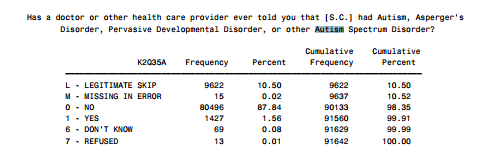
Consider the 2007 dataset.Here is a list of raw data from the 2007 NSCH. 1427 parents, or 1.56% of parents answered yes to “Has a doctor or other health care provider ever told you that [S.C.] had Autism, Asperger’s Disorder, Pervasive Developmental Disorder, or other Autism Spectrum Disorder? ” [S.C] is the code for the child being discussed (selected child or something to that effect). (as with all figures in this article, click to enlarge).

NSCH 2007 ever told

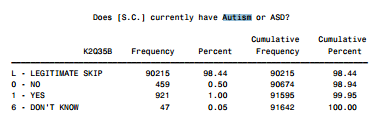
Again, 1427 parents who said that some medical professional had stated the child was autistic in the past. Of these 459 answered no to “Does [S.C.] currently have Autism or ASD?”

NSCH 2007 still autistic

What’s going on there? Again, are these kids recovering? It’s a question certainly worth looking in to. The researchers felt it needed more attention and in the 2011/12 survey, discussed below, the researchers did ask more questions about autism and this subgroup.

The 2011-12 NCSH was published this past year (March of 2013). Once again they asked autism-related questions. The prevalence estimate from this survey was about 2% (1 in 50). In all, 2.13% answered yes to “Has a doctor or other health care provider ever told you that [S.C.] had autism, Asperger’s disorder, pervasive developmental disorder, or other autism spectrum disorder? ” [S.C] is the code for the child being discussed (selected child or something to that effect).

NSCH ever told

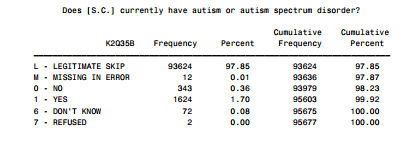
They then asked, “Does [S.C.] currently have autism or autism spectrum disorder?” and 0.36% said no. I.e. out of the 2.13%, 1.7% said that, yes, they report that their child is autistic. After controlling for some factors, an estimated prevalence of 1 in 50 (2%) was reported.

NSCH still autistic

So, what about the 343 kids who were previously identified as autistic but who aren’t now. 343 kids are about 17% of all those ever identified as autistic. But in 2007, about 33% of parents answered “no” to “Does [S.C.] currently have autism or autism spectrum disorder?” I.e. the fraction of these potentially recovered kids went down by 1/2. In 4 years. If those kids are a measure of autism recovery, something dramatic is happening. As in, autism recovery rates are dropping fast.

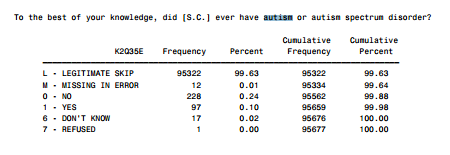
Luckily we can test whether these kids do represent autism recovery. The authors of the NSCH added new questions to the 2011-12 survey. First they asked the obvious and important question “To the best of your knowledge, did [S.C.] ever have autism or autism spectrum disorder? ” 228 parents, 0.24% of the total population surveyed, said “no”. Only 97 said “yes”.

NSCH ever had.

That’s a lot of numbers, so let’s recap. In the 2011/12 survey:

95,677 parents were surveyed
2,041 answered that at some time they were told their child was autistic
343 of those said their child is not currently autistic
228 of those said that their child never was autistic.

Most of the kids who “lost” their autism label were never autistic to begin with.

Of the total kids in the “ever identified autistic” group, 97/2041 or about 5% said that they believed their child was autistic at one time in the past but was not in the present. Not 20%, not 30% as some have suggested. 5%. Still worth investigating, but not the high numbers I sometimes hear people quote.

The survey authors asked two follow up questions to the parents who reported that their child is not currently autistic but was in the past “Treatment helped the condition go away” and “The condition seemed to go away on its own”. For those looking for support that some therapy or combination of therapies is recovering kids: 69 parents out of 2043 reported that their kid lost the autism label and that treatment was the primary factor in the loss.

69/2043: we are talking about roughly 3%.

NSCH follow up

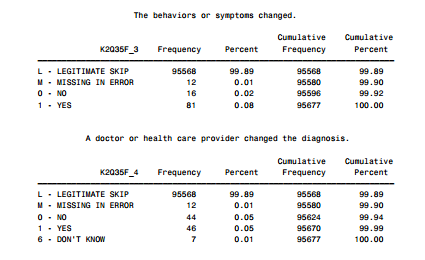
They also asked parents to comment on whether “The behaviors or symptoms changed” or “A doctor or health care provider changed the diagnosis”.

NSCH more questions

There are a few other questions on autism. For example, “With more information, the diagnosis was changed” (158 parents said yes). And “A doctor or health care provider changed the diagnosis” (46 parents said yes).

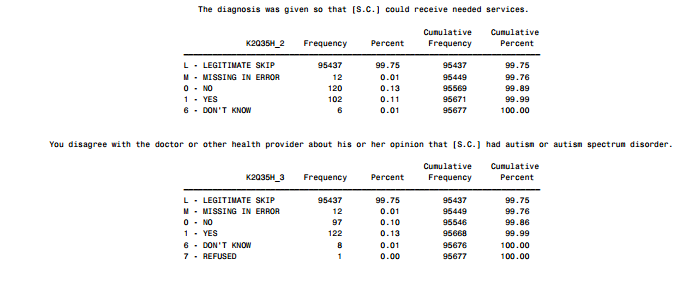
The last two autism questions are very important: “The diagnosis was given so that [S.C.] could receive needed services” and “You disagree with the doctor or other health provider about his or her opinion that [S.C.] had autism or autism spectrum disorder”. Out of the 343 children who “lost” their diagnoses, 102 (30%) parents say the diagnosis was given to obtain services. 122 (36%) of parents say they disagree with the original diagnosis.

The parents report that these kids were never autistic.

NSCH last autism questions

To summarize–Yes, a significant fraction of the children in this survey reported as once holding an autism label are not currently autistic. About 17%, to put a number on it. And, of that 17%, many have social factors involved in their “loss” of an autism diagnosis: incorrect diagnoses, the search for services, etc.. About 5% of autistic kids are reported by their parents as once really being autistic but not presently autistic. Are these kids a subgroup of actual recovery? It’s hard to tell.

One can drill down further into the data and get more insight about this group, but that will wait for another article.

The bottom line is simple, though. The National Survey of Children’s Health does not support the idea that 20-40% of autistic children are recovering. Maybe a few percent are, and with small numbers that will make studying this subgroup very difficult.


By Matt Carey

note: numerous edits were made for readability, but no substantial changes to the basic information was made.

No, the thimerosal in the flu vaccine does not explain why autism rates did not go down

6 Oct

Surprisingly enough, there are still people promoting the idea that the rise in autism diagnoses observed over the last decades was caused by thimerosal in vaccines. The original argument was this–vaccines were added to the vaccine schedule in the 1990’s and with them the infant exposure to thimerosal increased. Concurrent with this rise in infant thimerosal exposure was a rise in autism diagnoses. Add to this a poorly concocted argument that autism resembles mercury intoxication and you have the basis for the mercury hypothesis.

Thimerosal was phased out of infant vaccines over 10 years ago. Thus, if the thimerosal hypothesis were true, reported autism rates should be declining by now. As far back as 2005 David Kirby (whose book “Evidence of Harm” played a major role in promoting the mercury hypothesis) acknowledged this point in a statement

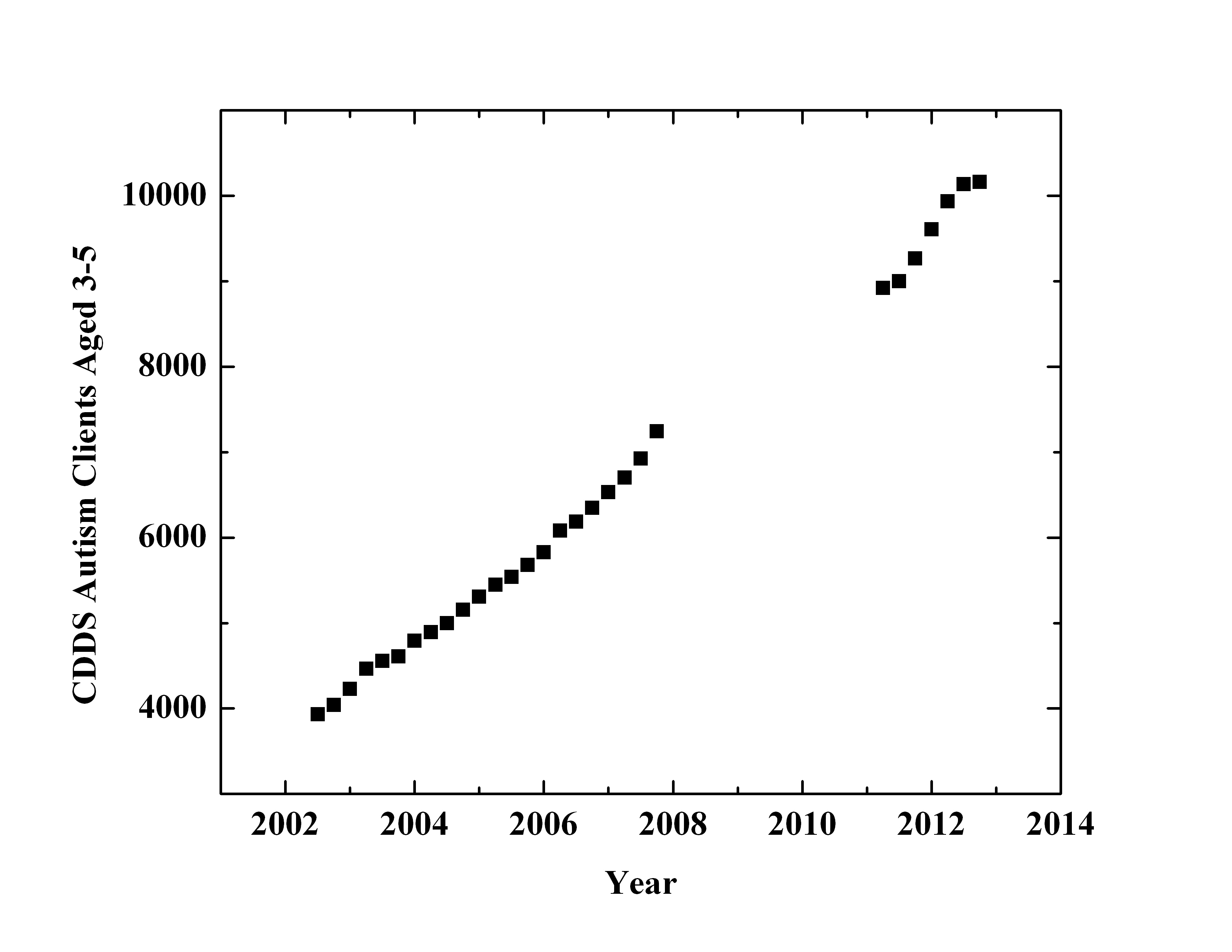
If the total number of 3-5 year olds in the California DDS system has not declined by 2007, that would deal a severe blow to the autism-thimerosal hypothesis.

It’s 2013. Autism rates in California have not declined. Not in Special Education. Not in the CDDS roles. And, yes, we are six years past the 2007 deadline that David Kirby gave us.

To be specific, let’s use the same method that David Kirby and others used to claim a thimerosal induced autism epidemic in the 1990’s (namely the California DDS client count–which not a good method, by the way). Autism “rates” have gone up by over 150% since thimerosal was phased out of infant vaccines. The age 3-5 bracket had about 4000 children in 2003 and is currently over 10,000.

CDDS 3-5

So we have more kids in California receiving services under the autism label than when thimerosal was in vaccines.

This is but one in a huge list of reasons why the thimerosal hypothesis doesn’t work.

But let’s go back in time a bit. Not so long ago one would hear proposals that we go back to the vaccine schedule of the early 1980’s when, it is claimed, the autism rate was 1 in 10,000. Fewer vaccines, less thimerosal, less autism. So goes the logic.

Generation Rescue, in fact, used to recommend the 1983 schedule as one of their alternative schedules

Turn back the clock
Comment: This is the schedule from 1983. If it worked for kids then, why doesn’t it work for kids now?”

Does it make sense to go back to the 1983 schedule? No. Why? OK a lot of reasons, but let’s focus on the fact that infants were exposed to more thimerosal in the 1980’s than today. Infant vaccines have no or only trace amounts of thimerosal.  So if thimerosal were the (or even a single) primary cause of autism risk, we would see autism rates lower today. To not only 1990’s levels, but to something like 1980’s reported levels. Assuming that the reported rates in the 1980’s were an accurate count of how many autistics there were then (a bad assumption but it’s the one they use).

To recap–Infant thimerosal exposure from vaccines peaked at nearly 200 micrograms in the 1990’s, up from about 100 micrograms in the 1980’s and is now less than 10 micrograms. And autism rates have not declined at all. Much less to 1980’s levels.

Once anyone says this the instant answer is that there is still thimerosal in some influenza vaccines. This, they say, is why autism rates have not declined. (note that thimerosal containing vaccines, including influenza vaccines, are banned in California for infants and pregnant women…and autism “rates” have continued to climb here).  

For completeness sake, let’s consider a kid who gets the maximum exposure to thimerosal from vaccines. I.e. a non California kid.  A kid who turns 6 months (the earliest age they will give a flu vaccine to a kid) during the flu season.  That kid will get 2 vaccines in the first year (6 and 7 months) then another influenza vaccine each year thereafter. Each with 25 micrograms of mercury from thimerosal. How does the thimerosal exposure compare to the 1983 schedule?  Take a look for yourself (exposures in micrograms of mercury from thimerosal):

1983 schedule 2013 schedule
DPT Inluenza
2 months 25
4 months 25
6 months 25 25
7 months 25
Total by 1 year 75 50
18 months 25 25
Total by 2 years 100 75
30 Months 25
Total by 3 years 100 100

So by age 3, the exposures are the same.  Except that the kid of today gets the thimerosal later and more spread out over time.  As an aside–most people who talk about the rise in thimerosal exposure during the 1990’s neglect to point out that the cumulative exposure in the 1980’s was already 100 micrograms. I.e. the “safe” level was significant.

If thimerosal were the driving force behind the rise in autism diagnoses, we should be back to 1983 levels, misrepresented by those claiming an epidemic as 1 in 10,000.  Instead we are at 1-2%.  The “rates” didn’t go down.

By this point the proponents of thimerosal are basically screaming, “you are forgetting the vaccines recommended to pregnant women!” No, I just put that off until now.  Sure, the influenza vaccine is recommended for pregnant women, but as the CDC notes:

Prior to 2009, influenza vaccination levels among pregnant women were generally low (~15%) (5,9).

So, from about 2000 to 2009 there wasn’t a big increase (or even a large part of the population) getting influenza vaccines while pregnant, nor were their children getting exposures higher than those in the 1983 schedule.

Take a look at that graph for California administrative autism prevalence again. Between 2002 (after the drawdown of thimerosal in vaccines) and 2012 the autism count doubled. Thimerosal exposure was down. A lot. Below 1990’s “epidemic” levels. Back to the 1983 “worked for kids then” levels. But autism “rates” continue to climb.

The people still pushing the idea that thimerosal is a (or even the) primary cause of autism are not unintelligent. We are talking about college educated people. Ivy league schools. A former journalist, an intellectual property expert and more. There is no math above. It’s all quite simple and straightforward. It uses the exact same logic and methodology they used to promote the idea that mercury causes autism. This is where intellectual honesty and basic integrity should kick in and get people to suck it up, admit their mistakes and start repairing the harm they have caused.

I’m not holding my breath.

By Matt Carey

Autism, Denmark and again no link with vaccines.

25 Aug

For a while now, I’ve been hoping that someone would publish data on the current state autism prevalence by birth year in Denmark. Denmark has been used for epidemiological studies for autism since their is a national database for health care. Thus, one can obtain a count of all people in Denmark who have been diagnosed with autism. Which is not the same thing as saying they have a count of all people in the country who are autistic. One can be autistic and not be diagnosed, as we will see.

A recent study using the Danish database is Recurrence of Autism Spectrum Disorders in Full- and Half-Siblings and Trends Over Time: A Population-Based Cohort Study. It’s an interesting study and I feel somewhat guilty for pulling the time-trend data out for my own discussion. In short, the study found that if a family has one child who is autistic, the chance for a subsequent child to be autistic is about 7 times higher than for families without an autistic child. This is fairly consistent with many other sibling studies over the years, but much lower than found in the recent baby siblings study out of the MIND Institute. That might be due to the active surveillance used by the team at MIND. I.e. they were actively monitoring and testing baby siblings.

Much more, they conclude:

Although the results from our comparison of recurrence in full- and half-siblings support the role of genetics in ASDs, the significant recurrence in maternal half-siblings may support the idea of a contributing role of factors associated with pregnancy and the maternal intrauterine environment. Finally, the lack of a time trend in the relative recurrence risk in our data suggests that the likely combination of genetic and environmental factors contributes to the risk for ASD recurrence in siblings or that the risk for recurrence because of such factors has not been affected by the rise in the ASD prevalence.

Very interesting–whatever is behind the higher prevalence among younger siblings, it seems to be the same today as 30 years ago.

What’s the overall prevalence of autism in Denmark according to this study? For childhood autism, they report 0.3%. For all ASD’s, 1.2%.

Autism, we are told by those promoting the autism/vaccine link, is unmistakable. Each autism prevalence report is not an estimate, but an accurate count of every autsitic because there is no way to miss an autistic. Back in the day, Rick Rollens was a constant fixture in the news on autism. He was a strong proponent of the idea that one could not miss autism:

WATSON:
Like many parents, Rick is convinced that Russell was damaged by a series of vaccinations. He strongly rejects the idea that the epidemic of autism can be entirely explained by poor diagnosis in the past because numbers have rose over the last few years.

ROLLENS:
Missing child with autism is like missing a train wreck. For us now to now think that somehow we have better identified a child who can’t talk, who has repetitive behaviour. Who makes no eye contact. Who is self- involved and in many cases self-abusive just defies logic.

Mr. Rollens was wrong on two counts (leaving aside his inflammatory and derogatory language). First, autism is not just the child who can not talk, self-involved and self-abusive. Second, yes, a lot of autistics have been missed. We’ve seen that time and time again. Look at the same population at different times and the later study will have found more autistics. An this goes for autistics with intellectual disability, as shown in the recent UCLA/Utah autism followup: “Today’s diagnostic criteria applied to participants ascertained in the 1980s identified more cases of autism with intellectual disability. ”

But, what about Denmark? A study from 10 years ago looked at autism incidence following the removal of thimerosal in Denmark in 1992. Thimerosal and the occurrence of autism: negative ecological evidence from Danish population-based data

In that study they found 956 children born in their study period who were diagnosed with autism by 2000:

A total of 956 children with a male to female ratio of 3.5:1 had been diagnosed with autism during the period 1971–2000.

The current Denmark study included individuals diagnosed until the end of 2010. I.e. there were 10 more years of followup. In those 10 years a lot more people were diagnosed. Where there were 956 diagnosed with autism by 2000 (for birth years 1971 to 2000), 2321 were diagnosed by 2010. That’s an increase of 240%. And the new study focused on birth years 1980 to 1999. I.e. the entire 1970’s birth cohort is not included in this count, and they still found over twice as many autistics. Where were they in 2000, when the previous study was performed? Living in Denmark, not identified as autistic.

There are a few factors which are likely behind this increase, but here we have a great example of “increased awareness” affecting autism prevalence.

And, those numbers were for childhood autism. For ASD, the increase is even larger. 10,377 Danes had an autism spectrum disorder diagnosis (for birth years 1980-1999) in the new study (the previous study included none). That’s a whopping 1080% increase. Again, there are a few reasons for this (including the increased awareness above), but here’s what “expanding the definition” does to autism.

Those increases would be an “epidemic” to some if it weren’t for the fact that those autistic Danes were there all along. They just weren’t diagnosed in 2000.

For many years, groups touting the idea that vaccines cause autism have pointed to Denmark as part of their argument. Denmark uses fewer vaccines than the U.S.. Generation Rescue used to have this on their website discussion of vaccines:

Comment: Denmark is a first world country based in Western Europe. Their schedule appears far more reasonable than ours. They have also been reported to have a much lower rate of autism than the U.S. Do they know something we don’t?

What was that Danish vaccine schedule that Generation Rescue recommended?

DTaP at 3, 5 and 12 months
Hib at 3, 5 and 12 months
IPV at 3, 5 and 12 months, plus 5 years
MMR at 15 months and 12 years

No mercury (Denmark phased that out in 1992). No birth dose of Hepatitis B. Fewer vaccines overall than in the U.S.. And the same autism prevalence of about 1%.

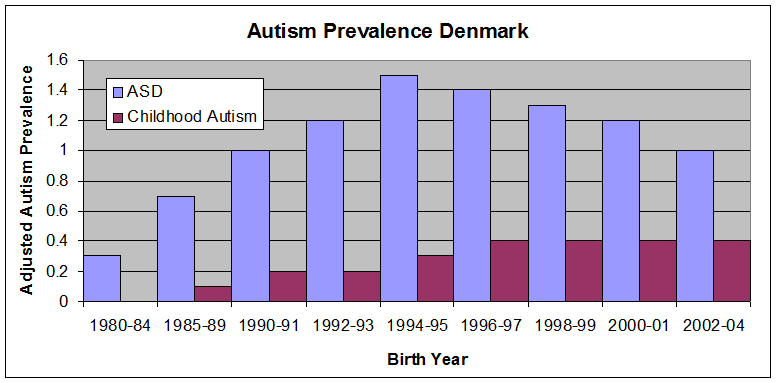
If you dive into more details, it gets even worse for the vaccines and/or thimerosal cause autism argument. Let’s look at the prevalence as a function of birth year for childhood autism and ASD from the recent study:
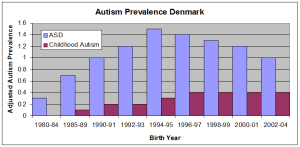
AutismPrevalenceDenmark

Consider this statement from a previous study:

This means that children who followed the full vaccination program during the period 1961–1970 had received a total of 400 g of thimerosal or 200 g of ethyl mercury by the age of 15 months and during the period 1970–1992 they had received a total of 250 g of thimerosal or 125 g of ethyl mercury at 10 months of age. In March 1992 the last batch of thimerosalcontaining vaccine was released and distributed from Statens Serum Institut in Denmark.

The thimerosal exposure was higher prior to 1992 than after. But the prevalence of both childhood autism and ASD is higher after the removal of thimerosal. This is the same result as shown in the 2003 study. The number of vaccines seems to be constant over this time period, so number of vaccines/aluminum/too-many-too-soon or other arguments don’t work either.

How about taking just a single year. The prevalence for ASD in 1996-97 was 1.4%. What is the autism prevalence in the U.S. for that year? To answer accurately, I’d contend we need a count today, not an old one. But people promoting the idea that vaccines cause autism take the CDC reports as absolute measures of autism, comparing each report and telling us all about the epidemic. So, let’s take the CDC number for kids born in 1994: 0.8%. That study was reported in 2009.

So, we have 1.4% in Denmark and 0.8%, nearly half the Danish prevalence, in the U.S.. Denmark had no thimerosal, no Hepatitis B shot (birth or otherwise), fewer vaccines and less aluminum exposure. And much higher reported autism prevalence.

Oddly enough, even though there have been many prevalence studies out of Denmark, Tomljenovic and Shaw didn’t include Denmark in their study “Do aluminum vaccine adjuvants contribute to the rising prevalence of autism?” My guess is that Denmark didn’t fit their conclusion then, and, like Iceland, would make their analysis fall apart now. It is even more odd that Tomljenovic and Shaw didn’t use Denmark as Denmark was used in a faux-study put out by Generation Rescue. In AUTISM AND VACCINES AROUND THE WORLD: Vaccine Schedules, Autism Rates, and Under 5 Mortality Someone at Generation Rescue made the first attempt at the sleight of hand of comparing the autism prevalence in various countries vs their vaccine schedules. At that time, 2009, Generation Rescue claimed that the autism prevalence in Denmark was 1 in 2,200, misrepresenting the 2003 study discussed here. The raw prevalence in this 2008 study was 0.65% or about 1 in 153. That value didn’t fit the thesis that the Generation Rescue author wanted to convey.

One argument found on the internet is that the 2003 Denmark paper fudged the results by clipping the last years off the data presented. An email involving people involved in the study is quoted as saying, “But the incidence and prevalence are still decreasing in 2001“. Oh, my, we are told, the autism prevalence and incidence actually went down after the removal of thimerosal!

But, it didn’t. The prevalence of childhood autism (basically what was studied in the 2003 paper) in Denmark is flat from birth cohorts 1996-2004. Flat. The prevalence of ASD’s do see a decline. That must be it! Evidence that thimerosal was causing autism in Denmark! But it isn’t. The prevalence of ASD in 2003-04 is the same as that in 1990-91, before thimerosal was removed. Why does the ASD prevalence go down? We can’t say for sure, but my strong suspicion is that it’s the same reason why the authors in 2003 were seeing a decrease: too few years of follow up. Autistic kids are typically diagnosed earlier than those with other ASD’s, but the average age was about 5 in Denmark in 2003 (as I recall). ASD kids can have an average age of diagnosis of 8. Recall that the recently released study followed kids up to the end of 2010. It’s no surprise to me that the estimated prevalence for ASD kids born in 2002 is lower than that for kids born in 2000 in this study. And this is consistent with the flat prevalence for kids with childhood autism diagnoses, as they are typically diagnosed earlier and 8-9 years would be enough to find the majority of the autistics in that population.

What about the idea that there’s a “changepoint” in the autism prevalence in Denmark and California pointing to some event in the late 1980s that’s contributing to autism prevalence? For one thing, the present study notes that the recurrence risk doesn’t change with time, so that’s good evidence against such an idea. There is no changepoint in the California data in the 1980’s, as it is exponential and fitting it to two straight lines is just a mistake. What about the prevalence data just released? The data are not finely spaced in birth years, in my opinion, to give a good idea of any “changepoints” in the 1980’s. But there is a changepoint of sorts in the childhood autism data in the 1990’s. The data plateaus at about 1996. But, as already noted, this doesn’t coincide with anything related to vaccines. The ASD prevalence appears to peak at about 1994, but, again, this doesn’t coincide with vaccine events and, I suspect, results largely from lack of follow up for the kids in the later birth years.

How about the MMR vaccine? MMR uptake for young children (MMR1) was basically flat from 1987-1997. Uptake rose somewhat after that. So, during the period that the estimated prevalence was increasing, MMR uptake was basically flat. During the time that the estimated prevalence was either flat (childhood autism) or decreasing (ASD’s), the MMR uptake was increasing. So if we were to play the “correlation equals causation” game, MMR prevents autism. (two notes, preventing rubella infections most likely does prevent some autism and the link above shows a nice example of rubella infections going down after MMR was introduced in 1987. The two points are not linked because most women in Denmark who were infected with rubella before 18 weeks gestation chose abortion, resulting in a low congenital rubella syndrome prevalence).

How about the “fetal cells in vaccines cause autism” argument? It’s one without biological plausibility, but then so was the thimerosal idea. I’d be interested in seeing how the vaccines were produced in Denmark in the 1990’s, but at present, the MMR vaccine there is developed using chicken eggs, not fetal cell lines. And they don’t routinely vaccinate against chickenpox, another vaccine in the U.S. using fetal cell lines. It looks like at least as far back as 1999 they were using egg-based vaccine production for MMR.

So, it appears we have a country with no vaccines grown in fetal cell lines with an autism prevalence as high or higher than that in the U.S.. In other words, the “vaccines from fetal cell lines caused the ‘autism epidemic’ theory” also appears to be debunked by the Denmark data.

In case you are looking for correlations with the vaccine program, here’s the history in Denmark.

So, how about the rise in estimated prevalence in the 1980’s. Is it “real”, as in does it represent an actual increase in the fraction of autistics in the population? It’s a good question and one which could be answered by performing a real study of autism prevalence in adults. The sort of study I and others have called for in the U.S., but that most autism-parent advocacy groups have refused to support. Such a study would not only answer the question of the prevalence, but it would give us valuable data on what has led to success and failure among the autistic adult population.

For those promoting the idea that environmental mercury emissions are a factor in the increase of autism rates, if you have data for Denmark, I’d love to see it. In the U.S., environmental mercury emissions dropped by over 50% in the 1990’s.

Lastly, let’s discuss a comment statement one will read or hear. It goes something like “the autism prevalence was 1 in 10,000 in 1980 and it’s 1 in 1,000 today”. This involves a number of sleights of hand. First, the autism prevalence wasn’t 1 in 10,000 in 1980. It was a few in 10,000 (Wing and Gould reported about 5/10,000). Doesn’t sound like a big deal, but when people start taking ratios (it went up a gazillion percent) a factor of 2 or 3 in the denominator makes a difference. Second, this was the estimated prevalence based on the number of autistics diagnosed at the time. As shown above, the childhood autism prevalence estimate for Denmark in the 1980’s increased by 240% in the past decade. This was not a real increase, but better identification. Third, the comparison is between autism (childhood autism, DSM-III autism or some other restrictive definition) vs. autism spectrum disorders. Also shown above was that the prevalence of ASD’s in the 1980’s increased by a factor of 10, increasing only in the past 10 years.

A factor of 10 in the numerator, a factor of 3 or 4 in the denominator and pretty soon you are talking about a big part of the increases observed.

In the end, none of the above arguments are that new. Or, to put it better, none of the vaccines-cause-autism arguments had much real support. The mercury idea has lost much of the support it had 10 years ago in the parent community, but it persists. The aluminum in vaccines idea has risen to try to take the place of the mercury hypothesis, but it is based on the exact same smoke and mirrors. The idea that the increase in autism is due to the MMR has been scientifically dead for years. And, yet, these ideas persist. And they cause harm, both to the community at large and to the autism community.


Matt Carey

The Amish may not be a great population for a vaccinated/unvaccinated study

10 Aug

The recent attempt to legislate brought back the subject of the Amish, vaccination and autism. It’s an old idea, made popular by a journalist whose work was, shall we say, less than complete.

House Resolution 1757 (still stuck in committee) states:

” Target Populations- The Secretary shall seek to include in the study under this section populations in the United States that have traditionally remained unvaccinated for religious or other reasons, which populations may include Old Order Amish…”

Whenever the Amish are brought forward as a population for vaccinated/unvaccinated studies, people present many reasons why such an idea lacks rigor.

1) The Amish do vaccinate. They have no prohibition against vaccination. (i.e. the statement that “because the Amish have a religious exemption from vaccination” is incorrect).

2) “The” Amish is a bit of a misnomer. Amish is more of a plural, as in a group of basically island populations which have been developing somewhat independently genetically for a few hundred years.

3) Talking about studying the Amish as though one has the right to just force them to submit is very disrespectful. And a bad assumption. One does not tell a community that they have to be study subjects. One asks. The Amish may very well not want the entire population screened for autism.

There are more arguments. Valid arguments. But without some cold, hard, numbers the response that usually comes up is, “Ah, you are afraid of what we will find!”

No, if one is going to do a study, one should be rigorous. One should get as close to the correct answer as possible. Studying the Amish as an “unvaccinated” population with “no” (or little) autistic subpopulation is to start out with little chance for success.

But how about some cold, hard numbers (I mean, beside from the fact that the Amish vaccinate and there are autistic Amish).

Here’s a talk presented this summer by the DDC Clinic in Ohio. This clinic is following the model of the cleverly hidden “Clinic For Special Children” that a certain journalist failed to contact before publishing his conclusions. In the description of the Clinic you will find:

A 501(c) (3) non-profit organization located in
Middlefield of Ohio, Geauga Amish settlement
• Total population ~95,000, Amish ~14,000 (15%)
• 50% of developmental disabilities are from Amish
• One hour (but a world) away from world class healthcare

Yes, they are 15% of the local population but account for about 50% of the developmentally disabled population for their community.

In other words, the prevalence of developmental disability is more than five times that of the general population.

Do you still want to compare this population for long term health outcomes and vaccination status? Do you want to say, “hey, here’s a population that doesn’t vaccinate and they have more developmental disability than the rest of the population?”

That’s what people have been pointing out for years in stating that genetically the Amish are somewhat distinct from the rest of the U.S. population. The proposed study will run into big problems.

Why does the Clinic for Special Children (and similar clinics) exist? They aren’t just there because the Amish are likely to be underserved in general since they lack insurance (which, I’ve been told, is something the Amish avoid). The Clinic’s mission statement is:

The Clinic for Special Children was established in 1989 as a non-profit medical service for Amish and Mennonite children with genetic disorders. The Clinic serves children by translating advances in genetics into timely diagnoses and accessible, comprehensive medical care, and by developing better understanding of heritable diseases.

Again, they are a small, island-like population. Many genetic conditions are more common in their communities. Many are metabolic conditions. (Dr. Morton’s talk at the conference was “Approach to Care for Patients with Metabolic Disorders”). Conditions which put people at greater risk of harm from infections, hence the reason that people have been working to increase vaccine uptake in the Amish over the past 3 decades.

The Clinic for Special Children has been an example of how focusing on genetic conditions can have major impacts on the well being of those with the conditions. Over the past 30 years, the Clinic has pioneered efforts which have resulted in better health and longer lives for their patients. Too often we hear in the autism communities that genetic conditions mean “no hope”.

I’ll leave you with the words of Dr. Holmes Morton of the Clinic for Special Children. Words from the Clinic’s main page:

“Special children are not just interesting medical problems, subjects of grants and research. Nor should they be called burdens to their families and communities. They are children who need our help, and if we allow them to, they will teach us compassion. They are children who need our help, and if we allow them to, they will teach us love. If we come to know these children as we should, they will make us better scientists, better physicians, and thoughtful people.”


By Matt Carey

A fishing expedition at Vaccine Court

14 Jul

The U.S. Court of Federal Claims has a section devoted to adjudicating claims of vaccine injury. This is often referred to as the “Vaccine Court”. Individuals or their families can file a claim (petition) the court for alleged vaccine injury.

Information on individuals who are vaccinated are kept by ten Managed Care Organizations (MCO’s) and the Centers for Disease Control as the Vaccine Safety Datalink (VSD) Project. Researchers working as expert witnesses for families in the Vaccine Court have accessed the VSD in the past, and in one case misused their access. Possibly as a result of this, the MCO’s stopped contributing their data to the CDC for a single VSD database. Hence the reason why there are now 11 separate databases, with each MCO retaining control over their data.

One can see how groups who want to argue vaccine injury in court might want access to the VSD. Mark and David Geier have in the past attempted to use the VSD and they were the ones caught misusing the database. They, together with Heather Young, used an older VSD dataset to produce a paper for the Petitioners Steering Committee (the attorneys arguing for the families in the Omnibus Autism Proceeding). A paper for which the PSC was charged $250,000. A paper which was of such poor quality that it was not used by the PSC in the Omnibus.

In a recent decision, the Court heard arguments that the information in the Vaccine Safety Datalink Project should be turned over to their expert, Theresa Deisher, for analysis:

Petitioners seek access to data from the Vaccine Safety Datalink Project (hereafter the VSD Project) to allow their expert, Theresa A. Deisher, Ph.D., to conduct an original study comparing the rate of autism disorder incidence among children who received a particular vaccine, with the rate among children who did not receive that vaccine. As discussed more fully below, petitioners’ expert does not seek to study the MMR vaccine at issue in this matter, but rather the varicella vaccine.

That last sentence is important. The Special Master points out the decision to research whether the varicella vaccine (chickenpox) is associated with autism for good reason. The petitioners are not arguing that the varicella vaccine caused their child’s autism. No, they argue that the child reacted to DNA in the MMR vaccine resulting in autism. So, how a study on the chickenpox vaccine would further their case is somewhat unclear. Why they are not asking for data on chickenpox is even less clear.

The petitioners asked for $260,000 up front to fund the study. To my knowledge, the Court does not fund expert witnesses for efforts not yet performed. Aside from that fact, the Special Master noted that Theresa Deisher’s studies on the subject done to date were already funded.

Dr. Deisher notes that this work was funded by the MJ Murdock Charitable Trust, Pet’rs’ Ex. 26 at 18, which according to information on Deisher’s CV, provided her with a $500,000 grant to study “Population, Bioinformatics and In Vitro Studies into the Relationship between Residual Human DNA Vaccine Contaminants and Autism.” Deisher’s CV at 3. Dr. Deisher’s inability to produce a paper of publishable quality, after receiving a substantial grant, does not lend support to petitioners’ claim that she is capable of competently leading a study.

Yes, half a million dollars so far with no papers published. A manuscript was submitted to Autism Research and rejected. My guess is that the manuscript will soon be submitted to a journal (there are those which will welcome this). Or, one of these journals will seek out Ms. Deisher for her work (I could easily see this being published in a certain Polish journal, for example).

One can apply to gain access to the VSD databases. However, Ms. Deisher has not attempted to access the data in this way, opting instead to gain access through a court order.

As discussed in more detail later in this Order, petitioners acknowledge that Dr. Deisher has not followed the CDC’s usual Data Sharing application process and that she has no intention of doing so.

She did, however, apply for an NIH grant to perform this research. The petitioners claim that the controversial nature of the study resulted in it not being funded. The referee reports, however, were clear that the planned study was weak and Ms. Deisher’s skills were not strong in epidemiology and statistics (among other weak points).

Although petitioners make assertions to the contrary, the evidentiary record before the undersigned contains a withering assessment of Dr. Deisher’s ability to competently lead the proposed study. Petitioners here seek extraordinary relief, and the undersigned is reluctant to substitute her scientific judgment for that of the NIH reviewers—a panel of Dr. Deisher’s peers—who have found her proposed study to be critically deficient. In the undersigned’s view, the NIH reviewers’ comments merit weighted consideration.

“Withering assessment”.

The special master also notes that the request for data from the VSD exceeds the data needed to do the proposed study.

The petitioners do not limit their data request to information that is needed for the study they propose:

Despite the stated limits of her study, petitioners’ request for production from respondent and the MCOs lacks correlative limits for patient age and injury. Instead: petitioners seek authority to issue subpoenae to compel [respondent and the MCOs] to grant the petitioners full and unrestricted access to all data collected by the respondent within the VSD related to the administration of vaccines, and the occurrence of neurodevelopment and other disorders from the inception of the VSD to date.

Which, in my opinion, points to this as a fishing expedition. An attempt to gather any and all data and test multiple questions later–with the probability of a chance “hit” going up with the number of questions tested.

Since the Special Master did not grant access to the VSD, the funding request was also denied.

The petitioners asked that the expert witness fees for Theresa Because petitioners’ discovery request is denied, petitioners’ motion for authorization of interim expert expenses is deemed moot.

The decision also includes much discussion of a large, broad request for information from the FDA on the vaccine approval process. Again, this appears as a “fishing expedition”

Petitioners’ motion does not appear to be a well-considered effort to meet their evidentiary burden under the Vaccine Program; but rather appears to be a brazen attempt to gain access to respondent’s comments on the various vaccine licensing applications in the hope that something therein might be of relevance. As presented, there is nothing in petitioners’ briefing or the record showing that the documents under FDA’s control are necessary to a determination of the issues in this matter

Ms. Deisher’s previous research has focused on “changepoint” analysis of autism prevalence data. She follows the method set forth by two people at the FDA who presented such a changepoint analysis previously. I found that analysis lacking and submitted a comment to the journal on it. I find Ms. Deisher’s analysis lacking as well.

In the end, the petitioners shot themselves in the foot, repeatedly. They made an overly broad request for data (essentially the entire VSD database). They requested the funding for the analysis in advance. Their expert witness’ track record was lacking. The proposed a search of FDA documents without providing a good reason why this was important for their case.

They went fishing and they got skunked.


By Matt Carey

Autism prevalence in Iceland 1.2%

5 Jul

Years back (2007 to be exact) an autistic blogger wrote a piece “Moving Toward a New Consensus Prevalence of 1% or Higher“. In the late 1990’s, studies had come out showing a prevalence of about 1% in Sweden and, at the time Joseph wrote his piece, more studies had come out, this time in the UK, showing a prevalence of about 1% or higher. Since then we’ve seen multiple reports from the U.S. of 1% or higher, including a recent study claiming 2%. Also, a study in Korea claimed 2.6%, using a whole-population screen. Japan reports 1.8%. Back in the U.S., Puerto Rico is reporting 1.6%.

With all this, it comes as no surprise that a recent study out of Iceland would report a prevalence greater than 1%. In Prevalence of autism spectrum disorders in an Icelandic birth cohort, the authors report a prevalence of 1.2% of clinically confirmed autism. The data, discussed below, shows a clear indication that better identification has played a major role in this prevalence.

For ASD, many had intellectual disability, but the majority did not (click to enlarge). For childhood autism (autistic disorder) the opposite is true. The majority (72%) had ID.

Other health conditions were reported, with epilepsy being the most prevalent co-occuring condition (other than ID). Epilepsy was more common among those with autism+epilepsy compared to autism without epilepsy, as found in other studies.

The authors note that 1.2% is much higher than previously reported, and that the prevalence just for childhood autism is also higher:

In the present study, the diagnostic category of CA represented a relatively small proportion (28%) of the total number of cases, even if the prevalence is high (0.34%). This prevalence is 7.7 times higher than that reported in the first study on autism published in Iceland. [26] and almost four times that reported in a more recent study.[27]

citation [26] is: Magnússon GT. Athugun á geðveikum börnum á Íslandi: Börn fædd 1964–1973. (An investigation of psychotic children in Iceland: children born 1964–1973). Laeknabladid 1977;63:237–43.

Citation [27] is Prevalence of autism in Iceland, from 2001.

The prevalence numbers are climbing with time even within the cohort in this study. The authors note:

In a 4-year period, from the end of 2005 to the end of 2009, the prevalence of ASD in the cohort studied doubled, moving from 0.6% to 1.2%. This increase cannot be explained by immigration to Iceland, confirmed by the National Registry,22 and migration of people from one part of the country to another is irrelevant since the area studied and the whole country are the same. As expected, children diagnosed earlier (by 2005) were more likely to have CA than AS and were generally more impaired than those diagnosed later (2006–2009), although the groups did not differ regarding the frequency of ID and medical conditions. In order to examine symptom severity from another angle than diagnostic classification, we compared the earlier and later diagnosed groups on ADI-R total score. This comparison did not reveal differences between groups. High scores on ADI-R for those diagnosed later indicate serious autistic symptoms, possibly in association with co-occurring developmental and psychiatric disorders. Another point of interest is that the number of boys did not increase, contrary to what is suggested by some investigators.33 One interpretation of these results is simply that as the cohort studied grows older, more girls are identified with ASD,34 and because girls with ASD are more likely to be cognitively impaired, it would counteract the predicted trend for fewer children with co-occurring ID as the prevalence of ASD increases. Comparing the distribution of boys and girls in the group of children with ID (n=91) diagnosed earlier or later with ASD revealed some support for this hypothesis, as the gender ratio was 2.8 and 1.2, respectively, although this difference fell short of statistical significance.

The prevalence doubled from 2005 to 2009. Doubled. This for kids who were born between 1994 and 1998. In 2005, the kids in this study were 7-11 years old, and over the next few years the fraction of those kids identified as autistic doubled. For critics of the idea that better identification is a major factor in prevalence increases, I await your explanation of this. Actually, I don’t await your explanation as this is not that surprising a result. Better identification, worldwide, has (and still is) a driving force behind increases of autism prevalence.

Here is the abstract (the full paper is online as well):

OBJECTIVES: A steady increase in the prevalence of autism spectrum disorders (ASD) has been reported in studies based on different methods, requiring adjustment for participation and missing data. Recent studies with high ASD prevalence rates rarely report on co-occurring medical conditions. The aim of the study was to describe the prevalence of clinically confirmed cases of ASD in Iceland and medical conditions.

DESIGN: The cohort is based on a nationwide database on ASD among children born during 1994-1998.

PARTICIPANTS: A total of 267 children were diagnosed with ASD, 197 boys and 70 girls. Only clinically confirmed cases were included. All received physical and neurological examination, standardised diagnostic workup for ASD, as well as cognitive testing. ASD diagnosis was established by interdisciplinary teams. Information on medical conditions and chromosomal testing was obtained by record linkage with hospital registers.

SETTING: Two tertiary institutions in Iceland. The population registry recorded 22 229 children in the birth cohort.

RESULTS: Prevalence of all ASD was 120.1/10 000 (95% CI 106.6 to 135.3), for boys 172.4/10 000 (95% CI 150.1 to 198.0) and for girls 64.8/10 000 (95% CI 51.3 to 81.8). Prevalence of all medical conditions was 17.2% (95% CI 13.2 to 22.2), including epilepsy of 7.1% (95% CI 4.6 to 10.8). The proportion of ASD cases with cognitive impairment (intellectual quotient <70) was 45.3%, but only 34.1% were diagnosed with intellectual disability (ID). Children diagnosed earlier or later did not differ on mean total score on a standardised interview for autism.

CONCLUSIONS: The number of clinically verified cases is larger than in previous studies, yielding a prevalence of ASD on a similar level as found in recent non-clinical studies. The prevalence of co-occurring medical conditions was high, considering the low proportion of ASD cases that also had ID. Earlier detection is clearly desirable in order to provide counselling and treatment.


By Matt Carey

Autism is more prevalent in urban areas

1 Jul

When my kid was first diagnosed autistic I was presented with the idea of the “autism epidemic”. There was a great deal of discussion at that time about the rising number of clients in the California Department of Developmental Services (CDDS) system receiving services for autism. One of the first thing I did was to search through another database in California–that of the California Department of Education. What I learned quickly was that autism is not identified at the same rate for various locations or various racial/ethnic groups. The disparities are quite large. In my own school district, for example, the administrative prevalence of autism is 1/3 that of Caucasians. This has remained constant over the past 10 years, even as the overall numbers increase. Another disparity that has been observed repeatedly is a disparity between cities (urban) and rural areas. The fraction of autistics identified in urban areas is higher than that in non urban areas.

Recently, a study of the Danish population finds that, yes, the more urban area a kid lives in, the higher the chances are that s/he will be diagnosed autistic:

Urbanicity and Autism Spectrum Disorders.

The etiology of autism spectrum disorders (ASD) is for the majority of cases unknown and more studies of risk factors are needed. Geographic variation in ASD occurrence has been observed, and urban residence has been suggested to serve as a proxy for etiologic and identification factors in ASD. We examined the association between urbanicity level and ASD at birth and during childhood. The study used a Danish register-based cohort of more than 800,000 children of which nearly 4,000 children were diagnosed with ASD. We found a dose-response association with greater level of urbanicity and risk of ASD. This association was found for residence at birth as well as residence during childhood. Further, we found an increased risk of ASD in children who moved to a higher level of urbanicity after birth. Also, earlier age of ASD diagnosis in urban areas was observed. While we could not directly examine the specific reasons behind these associations, our results demonstrating particularly strong associations between ASD diagnosis and post-birth migration suggest the influence of identification-related factors such as access to services might have a substantive role on the ASD differentials we observed.

Let’s repeat that last line for emphasis: “our results demonstrating particularly strong associations between ASD diagnosis and post-birth migration suggest the influence of identification-related factors such as access to services might have a substantive role on the ASD differentials we observed.”

Yes, a larger fraction of kids in rural urban areas are identified as autistic–even if they were born in a rural area.

While many will see this as a threat to the idea that there is a vaccine-induced epidemic of autism. After all, if we aren’t identifying all the autistics in a given population, how can one take services related data and claim that the true rate of autism is rising? While there is some small value in putting yet another nail into that coffin lid, the real value of a study like this is pointing out that there is likely a substantial population left unidentified. Even today. Those not identified as autistic are either (a) identified as having some other disability or (b) not identified as disabled at all. In other words, there is likely a large population who are not receiving the services and supports which are best suited to their needs. That’s real. That’s wrong. And we need more people advocating to correct it.


By Matt Carey

Comment on: A Danish population-based twin study on autism spectrum disorders.

12 May

There has been much discussion of twin studies in autism research for a long time. The reason is that if is found that “identical” (monozygotic) twins are often both autistic, that points to genetics as a major influence on the development of autism. For many years it was thought that this rate, the concordance, was about 90%. In other words, if one child is autistic, 90% of the time the other child is autistic. This was based on a number of older, small studies. More recently, a relatively large study showed a lower concordance: about 77% for ASD and 60% for autism. From this the authors claimed that the genetic contribution to autism risk was lower than previously thought, and that the environmental contribution was higher (about 55% environmental contribution).

A study just out from Denmark claims a concordance more in line with the older studies–95%. In A Danish population-based twin study on autism spectrum disorders., the authors write:

Genetic epidemiological studies of Autism Spectrum Disorders (ASDs) based on twin pairs ascertained from the population and thoroughly assessed to obtain a high degree of diagnostic validity are few. All twin pairs aged 3-14 years in the nationwide Danish Twin Registry were approached. A three-step procedure was used. Five items from the “Child Behaviour Checklist” (CBCL) were used in the first screening phase, while screening in the second phase included the “Social and Communication Questionnaire” and the “Autism Spectrum Screening Questionnaire”. The final clinical assessment was based on “gold standard” diagnostic research procedures including diagnostic interview, observation and cognitive examination. Classification was based on DSM-IV-TR criteria. The initial sample included 7,296 same-sexed twin pairs and, after two phases of screening and clinical assessment, the final calculations were based on 36 pairs. The probandwise concordance rate for ASD was 95.2 % in monozygotic (MZ) twins (n = 13 pairs) and 4.3 % in dizygotic (DZ) twins (n = 23 pairs). The high MZ and low DZ concordance rate support a genetic aetiology to ASDs.

This study is relatively small with only 13 “identical” twin pairs. Also, the concordance for “fraternal” (dizygotic) twins is relatively low at 4.3%. Sibling concordance is estimated at about 20%, so 4.3% raises a bit of a red flag. Of course the recent larger twin study is not without some controversy itself.

In the end, I doubt this new study will have much influence on the online parent community discussions (which are in themselves far from the most productive or important discussions on the topic. Just the apparently most vocal). We are left with there being some genetic contribution and some environmental contribution to autism risk. In other words, it remains important to put effort into both areas of research.


By Matt Carey

Autism reported at 1 in 50, but some parents no longer report their child is autistic. Can we say why?

16 Apr

A recent study reported that 1 in 50 children in the U.S. are autistic. This is based on parent report via a telephone survey, the National Survey of Children’s Health. The recent survey was taken in 2011-12. The last time a NSCH was performed was in 2007, and when those results were released in 2009 as Prevalence of Parent-Reported Diagnosis of Autism Spectrum Disorder Among Children in the US, 2007, a great deal of attention was focused primarily on two outcomes. First, the estimated parent-reported prevalence of ASD was about 1.1%. Second, about 0.5% of parents reported that they had been told that their child was autistic at some time in the past, but that their child was no longer autistic.

The report that came out recently presented a new parent-reported prevalence estimate: 1 in 50. (Changes in Prevalence of Parent-reported Autism Spectrum Disorder in School-aged U.S. Children: 2007 to 2011–2012). That report did not go into details about those who were no longer reported as autistic by their parents. The question was asked–as were many follow up questions.

The question and some of the responses are:

Does [the child] currently have autism or autism spectrum disorder?

No: 0.36%
yes: 1.70%
Don’t know: 0.08%

So, out of a total of a raw (uncorrected) 2.1% of parents who responded that they were told at some point that their child was autistic at some point, 0.36% said their child was no longer autistic. That’s comparable to the previous report in absolute terms (about 0.4%).

As already noted, they asked follow up questions to those who answered “no”. They asked directly “To the best of your knowledge, did [your child] ever have autism or autism spectrum disorder?”.

Of those 0.36% whose child had “lost” their diagnosis at some point, 0.24% of parents reported “No”. I.e. the parents reported that they were told that their child was autistic in the past, but out of those parents 2/3 reported that their child was never autistic. A further 0.02% said they “don’t know” if their child was ever autistic.

to put another way, in the majority of cases where a parent-reported “ever had” been told their child was autistic, the same parent reported that the child was never autistic or they didn’t know.

If you are looking for evidence of recovery, 0.07% parents said that “Treatment helped the condition go away”. Another way to look at this: that’s 69 reports out of “treatment helped the condition go away” out of 2041 who reported they had ever been told their child was autistic (ASD). That’s about 3.4% of the total “ever had ASD” population.

The survey did not ask what specific therapies parents thought helped their children go from autistic to non-autistic. They did ask if, “The condition seemed to go away on its own.” (37 parents answered yes, about 1/2 of the number who said treatment helped). 81 parents reported “The behaviors or symptoms changed” 46 reported “A doctor or health care provider changed the diagnosis.”

Out of the total 0.36% (343) reports of no to “Does [the child] currently have autism or autism spectrum disorder?”, 102 said that “The diagnosis was given so that [the child] could receive needed services” and 122 said “You disagree with the doctor or other health provider about his or her opinion that [the child] had autism or autism spectrum disorder.”

The National Survey of Children’s Health is not just about autism. Which means they can’t spend all their time on autism questions. This time they have answered some of the questions raised by the idea that a sizable fraction of parents who are ever told their child is autistic later conclude their child is not. That fraction where parents report that treament was part of what “made the condition go away” is nonzero, but at about 3.4%, it is small enough that getting accurate information on what the parents thought was involved will be difficult. And it should be about 3-4 years before we get another NSCH survey report.


By Matt Carey

IMFAR program is now online

4 Apr

IMFAR, the International Meeting for Autism Research, is held in the spring of each year. Which makes me wonder, did the people who organized this have to go through IEP meetings? I ask because IEP meetings are often are held at the end of the school year and include a lot of evaluations, making it difficult for a parent to attend a Spring research meeting? It isn’t a parent conference, so this is really just an observation.

IMFAR is the top science conference for autism. It is big and it is where a lot of new work is presented. The meeting will be held in May and the abstracts will be available May 1st. But the program, meaning the titles of the talks, are available now. I’ve just done a little browsing and found some talks which are likely to spark conversations. These may not be the talks which reflect the research most likely to impact the lives of autistics and the broader autism communities, but I suspect these will be interesting to the online parent community. For example, one doesn’t need the abstract to get the conclusion of this talk: No Differences in Early Immunization Rates Among Children with Typical Development and Autism Spectrum Disorders. This paper is by the U.C. Davis MIND Institute, which carries a lot of weight with the groups who promote the vaccine-induced autism-epidemic idea, so perhaps this will help to move the discussion forward from the vaccine-focus of the past decade. One can hope.

On the first day, a keynote talk is being held: How Severe Is Autism – Really?

This session reviews the coexisting problems that usually exist in individuals with a diagnosis of autism spectrum disorder. It concludes on the note that it is possibly these associated problems and disorders that often drive the poor outcome that so many people now almost take for granted will be a consequence of autism in the longer term perspective. Language disorders, intellectual developmental disorders, non-verbal learning disability, epilepsy, medical disorders such as tuberous sclerosis and fragile X syndrome, ADHD, and depression are often the “real” cause of negative outcome in autism. Many people in the general population have marked autistic features without major “lifetime impairment”. The focus on *autism only* in early intervention programs is most likely a mistake.

And you probably thought when I said there would be talks which would likely “spark conversations” online, I was just talking epidemiology and etiology.

A recent paper proposed a correlation between a mother’s childhood history of abuse and autism risk in her children. (Emily Willingham discusses this study at Forbes). It appears the same team has a poster at IMFAR: Maternal Exposure to Childhood Abuse Is Associated with Elevated Risk of Autism. A big open question from that work is this: are autistics more likely to be abused as children? Which could make the link heritable. Which makes it interesting that this poster is in the same session at IMFAR:Epidemiology of Neglect and Maltreatment in Children with Autism Spectrum Disorders

There is an entire session on the ethical questions posed by biomarker research.

While the development of a blood biomarker as a screening or diagnostic tool for autism spectrum disorders is of great interest to the scientific and medical communities, it is also attracting intense scrutiny from other stakeholders including people with autism, ethicists, and parents. This symposium will therefore address the scientific, ethical and social challenges associated with the development of biomarkers for autism, and provide an update on the current status of research in this field. We will describe how the heterogeneity of autism, gender bias, and potential comorbidities, could derail the promise of identifying objective, reliable, and universally accepted biomarkers. We will consider the ethical and social issues relating to the development of biomarkers for autism in order to identify and describe the implications for the ‘difference versus disability’ debate; as well as consider possible wider tensions of biomarker research in relation to issues such as pre-natal screening and reproductive choice, and identity and inclusion for individuals on the autistic spectrum. Finally, we will summarize the most promising research on blood biomarkers for autism, describing the required steps to take a putative biomarker from the ‘bench to the bedside’. This educational symposium brings together researchers from scientific, ethical and psychological disciplines to provide a unique perspective on the utility of biomarkers for ascertaining autism risk, aiding in diagnosis and identifying therapeutic targets, all within the framework of the relevant ethical and social considerations.

Here’s the sort of research I wish were the sort to “spark conversations”. Adaptive Intervention For Communication In Minimally Verbal School Aged Children. That is a study I really want to see. Likewise, I am pleased to see an entire session on Young Children, Schools. And Adults, Lifespan, Methods. And services.

Terry Brugha, who headed up the U.K.’s adult autism prevalence studies of recent years will present: The Autism Epidemic Hypothesis: the Association of Autism With Age in the General Population.

There is a large international focus, with research from India, China, South America and other areas usually under represented in research. Another keynote talk discusses this in terms of epidemiology: The Epidemiology of Autism Spectrum Disorder: Toward a More Inclusive World:

We live in an era of exciting advances in our awareness and understanding of autism spectrum disorder, but also a time of enormous global imbalance. Most of what is known about the epidemiology, genetics, clinical manifestation and course, treatment, and nearly every other aspect of autism is based on research in high income countries, where fewer than 10% of births occur and less than 20% of the population lives globally. This talk will describe opportunities to expand the horizons of autism epidemiology and service delivery to include the 80 to 90% of affected individuals and families who live in low and middle income countries, as well as those who are socioeconomically disadvantaged and living in high income countries. It will also describe some of the cultural and financial barriers to progress, and make a case for incorporating concepts of the World Health Organization’s International Classification of Disability and Functioning into the classification and epidemiology of autism spectrum disorder, with the ultimate goals to include not only primary prevention of autism but also enhancement of participation and social inclusion of people with autism spectrum disorder.

One session is: 30-Year Follow-Up of Autism in Adulthood.

The population of adults with ASD is increasing rapidly, entering systems of healthcare and adult support that are already at capacity. Understanding the nature of ASD in adults, their unique needs, and availability of service options, is essential for resource planning and service development. Investigations into this period of life are increasing, but much remains unknown. This study examines adult outcomes for a large, population-based sample of adults identified as children in the 1980’s. Outcomes of interest concern diagnostic presentation, functional abilities, co-occurring medical and psychiatric conditions, social functioning, independence, service use, and access to services. Overall, outcomes for this sample were consistent with what has been reported for similar samples, yet there were notable differences in factors contributing to outcomes compared to what has been reported for other groups. Our findings support the importance of a range of accessible healthcare and support service options for adults with ASD. Detailed analyses are underway to investigate patterns leading to specific outcomes for subgroups of the population of adults with ASD.

I would have written that abstract a bit differently, but I am very appreciative that this session is being held.

Two years ago, I was able to attend IMFAR with the help of an Autism Science Foundation grant. I really wish I was able to attend this one. There looks to be a great deal of interesting research being discussed.


By Matt Carey