Archive | Science RSS feed for this section

No, the autism prevalence did not go down in Denmark after the removal of thimerosal

25 Feb

Once there was an open question of whether the thimerosal containing vaccines, previously used for infants in the U.S. could be contributing to the increase in autism diagnoses being reported. Even with multiple studies showing no increased risk due to thimerosal exposure, there is still a group who not only believes in the mercury-induced epidemic, but they believe that there has been a concerted effort on behalf of the U.S. government and other groups to hide this “fact”.

An email obtained through a freedom of information act (FOIA) request is often cited in online discussions of not only the “fact” that the mercury-induced-epidemic is real, but that the government conspiracy is real. The email reportedly was made by one of the authors of a study from Denmark. The authors had used a sort of natural experiment: Denmark had phased out thimerosal from vaccines in the early 1990’s. They reported that the prevalence of autism continued to increase even with the phase out, thus indicating that thimerosal was not the driving force behind the increase.

The study, by Madsen, et al., was published in 2003. An email obtained by FOIA reportedly shows the authors removing data for the final years of the study period:

I need to tell you that the figures in the manuscript do not include the latest data from 2001….But the incidence and prevalence are still decreasing in 2001.

Sounds alarming, doesn’t it? Data which supposedly shows that autism rates actually dropped following the removal of thimerosal was removed from a paper. Well, I think they should have included the data, a possible explanation and done a follow-up study. That said, the statement really doesn’t bother me. Why? A few reasons but mainly because the data are clear that autism prevalence did continue to go up in Denmark. And much of that data are below.

First, what was the prevalence in the 1990s? Here’s a study from 2007. They were using data where from 2004 (followup through 2004):

Time trends in reported diagnoses of childhood neuropsychiatric disorders: a Danish cohort study. 2007
ASD:
Birth cohort 1994-1995. Prevalence: 0.58%
Birth cohort 1995-1996. Prevalence: 0.47%
Birth cohort 1998-1999. Prevalence: 0.32%

Childhood autism:
Birth cohort 1994-1995. Prevalence: 0.18%
Birth cohort 1995-1996. Prevalence: 0.17%
Birth cohort 1998-1999. Prevalence: 0.18%

Yes, they are showing ASD prevalence dropping in the 1990’s, which should be an admission that the prevalence went down after the removal of thimerosal! I guess they forgot to censor that paper. While ASD prevalence seems to be going down, Childhood Autism is relatively flat. Why would that happen, do you think? Here’s one reason: average age of diagnosis for autistic disorder (childhood autism) is lower than that for the other ASD’s. While autism is not as obvious as many would have us believe, childhood autism *is* more obvious than the other ASD’s (and even with that it gets missed). Consider 1998-1999. That’s only 5 years or so until the followup date from the study: 2004. Average age of diagnosis for ASD in Denmark was about 5 years. So, about 1/2 of the ASD kids born 1998-1999 were not diagnosed at the time of the study. More of the ASD kids born in 1995-1996 and even more of those from 1994-1995. So, what looks like a declining prevalence is most likely just an artifact of how many years of follow-up there were from birth to study date.

I’d say it is even more than “looks like”. Consider the studies below. These are the papers I could easily find that give autism prevalence values for Denmark. I give the title, with a link to pubmed, the year of the study, the birth cohorts reported and the prevalence.

Autism prevalence in the 1990’s?

a href=”http://www.ncbi.nlm.nih.gov/pubmed/14519711″>Association between thimerosal-containing vaccine and autism. 2003
Birth cohort 1990-1996. Prevalence 0.26%

Autism prevalence for cohorts including kids born after 2000? More like 1%. Consider this first paper:

Autism after infection, febrile episodes, and antibiotic use during pregnancy: an exploratory study. 2012
Birth cohorts 1997-2003. Prevalence: 1%

But there are more. The cohorts don’t always match between studies, and we don’t have individual years for kids born 2000 and later. But the prevalence is repeatedly reported as above the 0.26% found for the 1990’s.

In other words, the prevalence continued to go up.

Using maternally reported data to investigate the association between early childhood infection and autism spectrum disorder: the importance of data source. 2012
Birth cohorts 1997-2003. Prevalence: 1%

Parental age and autism spectrum disorders. 2012
Birth cohorts 1980-2003. Prevalence: 0.73%

The rising prevalence of autism: a prospective longitudinal study in the Faroe Islands. 2012
Birth cohort 2002. Prevalence: 0.56%
Birth cohort 2009. Prevalence:0.94%

A comparison of autism prevalence trends in Denmark and Western Australia. 2011
Birth cohort not in abstract. Prevalence (ASD) 0.685%

Risk of autism spectrum disorders in children born after assisted conception: a population-based follow-up study. 2011
Birth cohort 1995-2003. Prevalence: 0.61%

Association of hospitalization for infection in childhood with diagnosis of autism spectrum disorders: a Danish cohort study. 2010
Birth cohort 1980-2002. Prevalence 0.52%

Association of family history of autoimmune diseases and autism spectrum disorders. 2009
Birth Cohort 1993-2004. Prevalence: 0.48%

The incidence and prevalence of pervasive developmental disorders: a Danish population-based studyBirth cohort 1971-2000. Prevalence 34.4 (“corrected”)

Association between thimerosal-containing vaccine and autism. 2003
Birth cohort 1990-1996. Prevalence 0.26%

A population-based study of measles, mumps, and rubella vaccination and autism 2002
Birth cohort 1991-1998. Prevalence: 0.14%

The more early birth cohorts a given study uses, the lower the average prevalence. The more years included post 2000, the closer the prevalence is to 1%.

Sure, it would be great if we had data for prevalence by individual birth year going to 2000 and beyond. But there’s enough data above to make it clear that the autism prevalence in Denmark did not go down after 2000. Quite the contrary. Similarly, measures of autism prevalence in my home state, California, have continued to go up even after thimerosal was removed.

The idea that thimerosal caused an autism-epidemic is just not consistent with the facts. The same data people used over and over to make the argument that thimerosal causes autism–the various autism prevalence estimates–don’t support the idea any more. Thimerosal went away, autism prevalence continued to climb.

So I’m just not swayed when I read people write about how the autism prevalence went down in Denmark with the removal of thimerosal. It didn’t go down. It is sad that people are being misled to think there is still some substance to the mercury-epidemic idea. Cherry pick one email out of how many FOIA’d documents, present it out of context and play it up as something real–while ignoring the evidence that is right in front of you. This is not treating the autism community with respect. This is misleading people.


By Matt Carey

Folic acid supplements and autism

22 Feb

A recent study claims that women who take folic acid supplements before conception are at a lower risk of having an autistic child. In Association Between Maternal Use of Folic Acid Supplements and Risk of Autism Spectrum Disorders in Children the authors found that the odds of a child being autistic were 40% lower if the mother took prenatal folic acid supplements.  The researchers used the Norwegian Mother and Child Cohort Study(MoBa). A couple of points need to be raised: the report focused on autistic disorder, not ASD’s in general. The number of individuals with Asperger syndrome or PDD-NOS were low, limiting the ability to detect differences.  Given that limitation, they found no decreased risk for AS and PDD-NOS with pre conception folic acid supplementation.

Here is part of the abstract:

Results  At the end of follow-up, 270 children in the study sample had been diagnosed with ASDs: 114 with autistic disorder, 56 with Asperger syndrome, and 100 with PDD-NOS. In children whose mothers took folic acid, 0.10% (64/61 042) had autistic disorder, compared with 0.21% (50/24 134) in those unexposed to folic acid. The adjusted OR for autistic disorder in children of folic acid users was 0.61 (95% CI, 0.41-0.90). No association was found with Asperger syndrome or PDD-NOS, but power was limited. Similar analyses for prenatal fish oil supplements showed no such association with autistic disorder, even though fish oil use was associated with the same maternal characteristics as folic acid use.

Conclusions and Relevance  Use of prenatal folic acid supplements around the time of conception was associated with a lower risk of autistic disorder in the MoBa cohort. Although these findings cannot establish causality, they do support prenatal folic acid supplementation.

The overall prevalence is somewhat low at 0.1-0.2%, but recall that they are focusing on autistic disorder, not ASD’s in general (especially in the abstract). A 40% reduction in autism risk is quite large if real. How does that stack up against other studies? There was a study just last year in the U.S.: Maternal periconceptional folic acid intake and risk of autism spectrum disorders and developmental delay in the CHARGE (CHildhood Autism Risks from Genetics and Environment) case-control study, which also found a 40% lower risk of autism with Folic acid supplementation. From that abstract:

RESULTS: Mean (±SEM) folic acid intake was significantly greater for mothers of TD children than for mothers of children with ASD in the first month of pregnancy (P1; 779.0 ± 36.1 and 655.0 ± 28.7 μg, respectively; P < 0.01). A mean daily folic acid intake of ≥600 μg (compared with T variant genotypes. A trend toward an association between lower maternal folic acid intake during the 3 mo before pregnancy and DD was observed, but not after adjustment for confounders.

CONCLUSIONS: Periconceptional folic acid may reduce ASD risk in those with inefficient folate metabolism. The replication of these findings and investigations of mechanisms involved are warranted.

One might think this is rather coincidental that two folic acid studies came out so quickly after one another. Or, perhaps not. One study that received a lot of attention in 2009 was Prenatal and Infant Exposure to Thimerosal From Vaccines and Immunoglobulins and Risk of Autism. The study was one of many which showed no increased risk of autism from thimerosal exposure from vaccines. One side finding of the study was published in their technical report: Price C, Robertson A, Goodson B. Thimerosal and Autism. Technical report. They found a possible increased risk due to maternal folic acid supplementation. That study relied upon maternal report, i.e. memory rather than medical records. It would not surprise me if the two recent studies came out of concerns raised by and during the Price study.

What if pre conception folic acid supplementation reduces autism risk? For one thing, this would point again to the prenatal period as important in autism development. Another factor is that this would point out the fact that given the social factors driving up the autism rate, it is very difficult to pull out factors which could be “real” factors driving autism prevalence up–or down as in this case. Folic acid supplementation is a relatively new practice, and still not universal. In the U.S. fewer than 50% of women report taking these vitamins prenatally. But this fraction has increased:

Although year-to-year variation has been observed over time, the percentage of women of childbearing age who reported consumption of a daily supplement containing folic acid increased overall from 28% in 1995 to 32% in 2003 and to 40% in 2004 and 2007

It’s very much a secondary question to whether folic acid supplementation is reducing autism risk, but an interesting question nonetheless.


By Matt Carey

Comment on: Maternal autoantibodies are associated with abnormal brain enlargement in a subgroup of children with autism spectrum disorder

14 Feb

In 2008 a paper opened up a new area of research in autism risk factors: Autism: maternally derived antibodies specific for fetal brain proteins. The researchers at the U.C. Davis MIND Institute found that for a subset of autistic kids, they could find antibodies in the mothers’ sera that reacted to human fetal brain tissue. Other teams have found similar results, and the MIND researchers have continued to explore this topic.

In the present study, the researchers studied 131 ASD kids and 50 non-ASD controls. 10 of the ASD kids were born to mothers with the brain specific autoantibodies detected in their serum. Autism severity, by their measure, was the same for the two ASD groups. The rate of develpmental regression is the same for the two groups, but strikes me as rather high at 40-50% . Previous studies by this team and others indicated a higher rate of regression in the ASD kids in the maternal-autoantibody group.

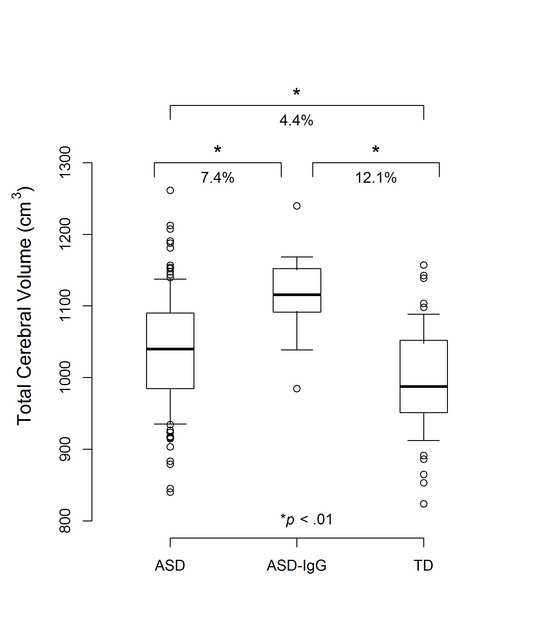
Brain volumes were measured via MRI. Most children were tested during sleep. 10 children (all ASD) were tested under anesthesia. Scans were corrected for instrument distortions before volumes were measured. Brain volumes were higher for the ASD kids than the typical kids, consistent with previous results. However, the kids in the maternal autoantibody group had brain volumes even higher than the rest of the ASD kids. The kids in the maternal autoantibody group had brains 12% larger on average than the non ASD kids, while the rest of the ASD group had about 4.4% larger volumes.

The volume differences were not the same over the entire brain:

Furthermore, the frontal lobe was selectively enlarged in the ASD-IgG children relative to other ASD children, and both gray and white matter were similarly affected.

Previous work by the authors indicate the possibility that the autoantibodies themselves might cause brain differences resulting in autism. Their animal model was rhesus monkeys, whose mothers were injected with the autoantibodies.

The authors note there are a number of open questions:

Obviously, several questions remain: What are the brain antigens recognized by the 37/73 kDa maternal IgG autoantibodies, and what is their role normal neurodevelopment? What induces the production of these antibodies in some women but not in others? What is the mechanism by which these maternal autoantibodies alter brain development? Are there processes that could be implemented to block the deleterious effects of the antibodies? Studies are currently underway to address each of these issues and they will undoubtedly shed more light on the role that maternal
autoantibodies may play in ASD and abnormal brain enlargement in ASD.

Another open question they raise has to do with siblings of the autoantibody ASD kids. In specific, since these autoantibodies can persist in the mother’s serum for many years, it is likely that younger siblings are exposed to them as well. If these children do not develop ASD, what is the reason?

The brain volume differences are shown in summarized in this figure:

Antibodies figure

There is a large spread for the brain volumes for the non-autoantibody ASD kids. While on average they are larger, a number are comparable to the average for non-ASD kids. Also, there is a large overlap between the ASD groups from parents positive for the autoantibodies and without the autoantibodies. The kids in the autoantibody group are almost all at the high end of the distribution for the non-ASD kids.

The main thing this paper adds to the autoantibody story is evidence that this may represent a separate group within the ASD population. The work is being performed on members of the Autism Phenome Project. If this is a separate group, so far the evidence is only in brain volume. The authors note: “There were no differences in age, height, autism severity, or DQ between the two ASD groups. Furthermore, the two groups did not differ in the rate of parent reported history of regression.” So on other physical measures, and on autism-based measures, there are no differences. Obviously it would be valuable to see diffrences in autism-specific measures so we could back track how those measures are related to etiology and brain structure. But it is also interesting that this group does not have differences as it could indicate multiple pathways are not always distinct in the end result in autism development.

Nordahl, C., Braunschweig, D., Iosif, A., Lee, A., Rogers, S., Ashwood, P., Amaral, D., & Van de Water, J. (2013). Maternal autoantibodies are associated with abnormal brain enlargement in a subgroup of children with autism spectrum disorder Brain, Behavior, and Immunity DOI: 10.1016/j.bbi.2013.01.084

ResearchBlogging.org


By Matt Carey

Comment on: Use of Birth Certificates to Examine Maternal Occupational Exposures and Autism Spectrum Disorders in Offspring.

13 Feb

A recent hypothesis-generating study by the epidemiology team at Kaiser in California looks at whether one can use birth certificates as a starting point to identify possible maternal exposures which might increase autism risk. Birth certificates include parental occupation. So, the authors propose, one could categorize occupations by possible exposures and, if there more autistic children are born to parents with various occupation types. The study is: Use of Birth Certificates to Examine Maternal Occupational Exposures and Autism Spectrum Disorders in Offspring.

Here is the abstract:

The continuing rise in the prevalence of autism spectrum disorders has led to heightened interest in the role of nongenetic factors, including exogenous exposures, but little research has been conducted. To explore a possible role in autism etiology, we used data available from our prior studies to examine potential occupational exposures, as these may occur at higher levels than environmental exposures. Parental occupation was obtained from birth certificates for 284 children with autism and 659 controls, born in 1994 in the San Francisco Bay Area. Self-reported occupation and industry were coded into eight exposure/chemical groups based on potential neurotoxicity or reprotoxicity by a board-certified physician in occupational medicine and an industrial hygienist blinded to case-control status. Mothers of autistic children were twice as likely to work in occupations considered exposed (14.4%) as mothers of controls (7.2%) (adjusted odds ratio [AOR] 2.3 [95% confidence interval {CI} 1.3-4.2]). The exposure categories of the greatest frequency among case mothers were exhaust and combustion products (AOR = 12.0 [95% CI 1.4-104.6]) and disinfectants (AOR = 4.0 [95% CI 1.4-12.0]). Paternal occupational exposure was not associated with autism, potentially consistent with a direct in-utero exposure effect. There are several limitations of this hypothesis-generating study, including lack of detail on workplace and job duties, leading to possible misclassification and low proportion exposed. However, this misclassification would not be biased by case-control status and is unlikely to explain the associations we did find, suggesting that further research on exogenous exposures may yield useful etiologic clues

There are a lot of limitations to this study, and the authors make that quite clear. The study is written as a “hypothesis-generating” study. I.e. they can create hypotheses of possible exposures which might increase autism risk. Taken in that context, a limited study which can generate hypotheses, this is a good study. One which takes a fairly inexpensive and straightforward route to narrow the list of possible exposures which increase autism risk.


By Matt Carey

MMS, yeah, it’s bleach

11 Jan

Last year the AutismOne parent convention hosted a talk by someone promoting MMS as a treatment for autism. MMS is a bleach. But MMS supporters and defenders rush to discussions of MMS with claims that it is not a bleach and calling it a bleach is fear mongering.

Only, it is a bleach. As in, apply it to cloth and the color goes away. Don’t believe me? Check out MMS: Yes, It Is Bleach, an article by Emily Willingham at The Thinking Person’s Guide to Autism.

Comment on: The association between bullying and the psychological functioning of children with autism spectrum disorders

10 Jan

A study published recently addressed the issues of bullying among school age autistics: The association between bullying and the psychological functioning of children with autism spectrum disorders. The abstract is below. I wrote a discussion of this for the Autism Science Foundation’s blog:

Comment on The association between bullying and the psychological functioning of children with autism spectrum disorders.

OBJECTIVE: : Bullying has become a major national concern, particularly as it affects children with disabilities. The current study aimed to determine the association between psychiatric comorbid conditions, involvement in bullying (victim, bully, or bully-victim), and the immediate psychological correlates of bullying among children with autism spectrum disorders (ASDs).

METHODS: : A national sample of 1221 parents completed a survey dedicated to the bullying and school experiences of their child with ASD, reporting on the immediate consequences of bullying involvement, including their child’s psychological well-being and any psychiatric comorbidity. Multivariate logistic regressions were performed to determine whether specific psychiatric comorbidities were associated with an increased risk of involvement as victim, bully, or bully-victim. Analyses of variance determined the relationship between bullying frequency and psychological functioning. All models adjusted for child and school covariates.

RESULTS: : Children who were frequently victimized were more likely to present with internalizing symptoms, whereas children who frequently bullied others were more likely to exhibit emotion regulation problems. Children who were identified as frequent bully-victims presented with both internalizing symptoms and emotion regulation problems. Children with attention-deficit hyperactivity disorder (ADHD) and depression were more likely to have been victimized, whereas children with conduct disorder (CD) or oppositional defiant disorder (ODD) were more likely to have bullied other children. Children identified as bully-victims were more likely to have ADHD, CD, or ODD.

CONCLUSIONS: : Children with ASDs who had displayed bullying behaviors in the past month exhibited psychological impairments, including psychiatric comorbidity. The frequency of bullying behaviors was significantly associated with the level of impairment.

Last chance to participate: UJA Adults with Autism Survey

29 Dec

IAN, the Interactive Autism Network, the UJA Federation of New York and the Autism Science Foundation have teamed up to sponsor the Adult with ASD Survey.

The survey closes on December 31, so time is short to participate.  You can take the survey here.

Here is a description of the effort from the ASF:

As many of you know, there is little information about the changing needs of adults with autism spectrum disorders (ASD) to guide those planning programs and services. That is why the UJA Federation of New York and the Autism Science Foundation are asking adults with ASD (and their parents or guardians) to complete a survey addressing what is going well in daily life, and what is a challenge. The results of this survey will inform decision making with regard to which programs should be expanded and which may no longer be of value.

We invite you to take this survey by joining the Interactive Autism Network (IAN)—the world’s largest online autism research project—and then completing the UJA Adult with ASD Survey. As a member of IAN, you’ll be informed about future surveys and studies, with a chance to provide ongoing input regarding the experience of adults with ASD over time.

Your participation is critical, and will inform those planning programs about which resources and services adults with ASD and their families need most.

Eligibility for Study Participation:

You are eligible to participate in IAN and the UJA Adult with ASD Survey if you are:

An 18-35 year old adult with ASD who is independent (that is, you are not under anyone’s legal guardianship)
The parent of an independent 18-35 year old adult with ASD (that is, your adult son or daughter with ASD is not under legal guardianship and maintains the right to make their own medical and legal decisions)
The legally authorized representative of a dependent 18-35 year old adult with ASD (For example, you may have legal guardianship or medical power of attorney for the adult with ASD)
Participation Details:

IAN registration and this survey can be completed entirely online and will take approximately 20 minutes.

If you’d like to read the IAN Research study consent form, including privacy policies, before continuing, click here:

https://www.ianresearch.org/pdfs/ian_consent.pdf

Principal Investigator: Dr. Paul A. Law

Contact Information: If you have any questions, the IAN team is happy to answer them for you. You can contact them at 1-866-348-3440 or ian@kennedykrieger.org.

To begin registration and the survey, click on the link below:
http://bit.ly/ORf7d5


By Matt Carey

SFARI looks back at 2012 autism research

29 Dec

SFARI, the Simons Foundation Autism Research Initiative, hosts one of the best autism research focused blogs there is. The Simons Foundation is the largest private funder of autism research.

SFARI has a list of 10 notable papers:
Notable papers of 2012

The list includes genetic, brain structure and treatment studies.

And a discussion of research events from 2012 I. Their director’s column:

Director’s column: 2012 in review

Which is a good discussion of highlighted results.


By Matt Carey

What has become of Autism Science Digest?

26 Dec

Autism Science Digest was an effort by AutismOne to publish their take on autism science in a magazine format for a general audience. AutismOne is best known for their annual parent convention which focused largely on alternative medicine and vaccine causation.

It is about the time that AutismOne should be publishing their speaker list for next year’s conference so I checked their website. For those interested, the speaker list reads like most past lists.  Andrew Wakefield, the former researcher who promoted the idea that the MMR vaccine causes autism, will speak. So will Keri Rivera, who last year gathered much criticism for promoting forcing disabled children to ingest bleach or undergo bleach laced enemas. Interestingly, neither Mark nor David Geier are on the list. The Geiers have been frequent speakers at AutismOne and other venues favorable to their failed ideas about mercury in vaccines causing autism, as well as bizarre proposals that using drugs to shut down sex hormone production can be used to treat autism.  While not a regular at AutismOne, Luc Montagnier will not make a return visit.  Last year Dr. Montagnier brought the prestige of a Nobel Laureate to the convention. While his presence was touted strongly by supporters of AutismOne, Dr. Montagnier’s ideas were lacking the scientific rigor one might expect from a Nobel laureate (to put it mildly). Of course Jenny McCarthy returns, perhaps to tell us all once again that those who don’t follow her ideas wish for our children to remain disabled so we can bask in the sympathy of our acquaintances.

That all said, while perusing the AutismOne website I noted that the cover for their “Autism Science Digest” hadn’t changed since my last visit.  That was some time ago. The cover informs readers about the then upcoming 2012 AutismOne convention (last April), so my interest was piqued and I checked the page for the “Digest” and found this announcement: Autism Science Digest is temporarily unavailable.

One is left wondering how “temporary” temporary is in this case. Autism Science Digest was launched in August 2011 so the lifespan (should temporary=permanent) seems a bit short.


By Matt Carey

Bloomberg: Autism Cures Promised by DNA Testers Belied by Regulators

22 Dec

Bloomberg has an article out on how genetic testing is being misused by alternative medical practitioners to justify their “treatments”. The article includes names which might be familiar to those who have followed the online discussions of autism and alt-med: Amy Yasko whose RNA therapy has been widely criticized for implausibility; James Laidler, a doctor who once worked with the DAN movement; and parent-writer Kim Wombles.

The article, Autism Cures Promised by DNA Testers Belied by Regulators begins:

April Hauge, a nurse practitioner in Weimar, California, spent $500 on a genetic test for her autistic son in 2009 that led to purchasing thousands of dollars in vitamins and supplements. Impressed with the results, she’s now selling advice on the approach to others.

There’s just one problem: the DNA tests and related treatments have scant backing from science and U.S. government officials. They’re untested, unproven, and may constitute “health fraud,” doctors, regulators and concerned parents said.

Yes, practitioners order genetic testing ($495 in one example) and then sell therapies supposedly based on these results which can cost the consumer thousands of dollars over the course of “treatment”. The tests are marketing, not science.  There is no real link between the tests, the condition and the treatment.

Discussion of “Dr. Amy’s” RNA therapies go back at least six years.  The idea that ingesting small doses of RNA could treat anything fails the biological plausibility test. Per the Photon in the Darkness blog:

This would be earth-shaking news…if it were true. The sad fact is that the cells in our body have a “thing” about stray RNA. There are enzymes – RNAse’s – that chew up RNA in order to prevent unauthorized “communication” from RNA viruses. These enzymes are in every cell and every body fluid.

There is enough RNAse in a fingerprint to degrade milligrams (1000 micrograms) of RNA in a few minutes. And it’s even worse if you try to ingest the RNA. There are high concentrations of RNAse in both saliva and pancreatic digestive enzymes, so it is highly unlikely that any RNA would survive to be absorbed.

Yes, one’s body is designed to attack and destroy foreign RNA. The full discussion The Alternate RNA Universe. Another can be found at Science Blogs as Autism & RNA????.

Government agencies are aware of the claims made and the lack of a logical link between the tests and the “treatments”.

“A lot of this skims on the edge of health fraud,” said Janet Woodcock, director of the Center for Drug Evaluation and Research at the U.S. Food and Drug Administration, referring to the use of DNA testing to recommend alternative therapies.

But for now, those offering the tests are allowed to “skim” health fraud laws. Laws which may change:

Following public hearings in July 2010, the agency developed guidance for regulating complex genetic and other tests sold by laboratories. The rules have been under review by the Obama administration since late 2011, he said. Until they are finalized, the agency is “somewhat hamstrung” in cracking down on companies that sell the tests, Gutierrez said.

The full article, Autism Cures Promised by DNA Testers Belied by Regulators is online at Blomberg.com


By Matt Carey