Archive | Vaccines RSS feed for this section

The Quacks behind the Warrior Moms

13 Oct

I accept Dr Carpenter’s opinion that there is no evidence that any of these treatments were individually beneficial for M and that collectively they were intrusive and contrary to his best interests.  M’s life was increasingly dominated by the programme of treatment to the exclusion of other activities.  I find that E has implemented a programme of diet, supplements and treatments and therapies indiscriminately, with no analysis as to whether they are for M’s benefit, and on a scale that has been oppressive and contrary to his interests.  She has exercised total control of this aspect of M’s life.’

Mr Honourable Justice Baker, In the Court of Protection, Judgment, In the matter of the Mental Capacity Act 2005 and in the matter of M, 11 August 2014

Brian Deer has once again done a service to the autism community, by putting in the public domain the judgment of Mr Justice Baker in the case arising from a dispute between a local authority and the mother (E) and father (A) of a young man (M) with autism.

http://briandeer.com/solved/mother-lied-protection-news.htm

Deer’s report, published in the Sunday Times on 12 October, focuses on the judge’s scathing judgment on E, a prominent supporter of the claim by the discredited Royal Free researcher Andrew Wakefield of a link between the MMR vaccine and autism. Mr Justice Baker concluded that E had fabricated evidence of an adverse reaction to MMR in her son, invented a range of associated diagnoses, subjected her son to unnecessary tests and treatments, neglected a dental abscess and indulged in fantasy conspiracy theories.

This Court of Protection case offered a rare opportunity to ventilate in public some of the controversies that have raged in the world of autism over the past decade. In the USA, the Omnibus Autism proceedings in 2008-9 provided a public forum in which claims regarding vaccine-autism links and associated alternative treatments were exposed as scientifically baseless and clinically irresponsible.

http://www.spiked-online.com/newsite/article/6283#.VDqLgWd0yUk

Though Mr Justice Baker did not address the MMR link or alternative treatments in general, his 92 page report provides a devastating indictment of the role of a range of therapists in relation to M, some of whom appeared as witnesses. In addition to exclusion diets and supplements, M received homeopathy, cranial osteopathy, reflexology, naturopathy, light and sound therapy, auditory integration training and hyperbaric oxygen therapy. It is clear that E’s descent into irrationality and paranoia was supported and encouraged by a number of dubious authorities and therapists, with damaging consequences for her son and her family.

Three therapists gave evidence in support of E’s treatment of her son. Shelley Birkett-Eyles, an occupational therapist working in a private clinic, was accepted by Mr Justice Baker as a ‘responsible practitioner’, though he noted that her reliability was challenged by Dr Peter Carpenter, a consultant psychiatrist with a special interest in learning disability, the expert witness called by the local authority.

Dr Peter Julu describes himself as ‘autonomic neurophysiologist’ (based at the private Breakspear Clinic), though Mr Justice Baker questioned whether this was a legitimate speciality and noted that his diagnosis of ‘neurodevelopmental dysautonomia’ was disputed by Dr Carpenter, who also challenged the reliability of his assessments and treatments, particularly his recommendation of hyperbaric oxygen therapy.

Ms Juliet Hayward, a nutritional therapist, was censured for giving ‘advice well beyond her expertise’, in endorsing a diagnosis of Lyme Disease and in prescribing a dietary protocol without taking an adequate medical history. Mr Justice Baker concluded that he ‘was left with a profound anxiety about Ms Haywood’s influence on E and her role in the treatment that M has received.’

Mr Justice Baker was particularly concerned that none of these three had received training in issues of ‘mental capacity’ as codified in the 2005 Mental Capacity Act. He observed that ‘it was clear from their evidence that none of them had given proper consideration to the question whether M had capacity to consent to their assessments or the treatment they were prescribing’.

In addition to these therapists, E called as expert witnesses two veterans of the Wakefield anti-MMR campaign: Dr Ken Aitken, a clinical psychologist formerly associated with the (now defunct) Autism Treatment Trust providing alternative treatments in Edinburgh; and Mr Paul Shattock, a retired pharmacy lecturer from Sunderland, a long-standing promoter of exclusion diets and unorthodox biomedical therapies.

http://www.spiked-online.com/newsite/article/5992#.VDqNsWd0yUk

By contrast with other expert witnesses (including Dr Peter Carpenter, Dr Alison Beck, Professor Robin Williamson, Dr Gwyn Adshead, Mr Keith McKinstrie), whom Mr Justice  Baker found to be ‘wholly reliable and professional’, he expressed considerable reservations about Aitken and Shattock:

‘I was concerned at times as to their qualifications to opine on some of the matters about which they gave evidence.’

In his conclusion, Mr Justice Baker categorically rejected the approach advocated by Aitken and Shattock in relation to M:

‘I stress, again, that I am not making any definitive findings on the efficacy of alternative treatments generally.  That is not the subject of these proceedings, which are about M.  I do, however, find that: (1) there is no reliable evidence that the alternative treatments given to M have had any positive impact on people with autism generally or M in particular and (2) the approach to prescribing alternative treatments to and assessing the impact of such treatments on people with autism in general and M in particular has lacked the rigor and responsibility usually associated with conventional medicine.’

Mr Justice Baker repudiated ‘the fallacy’ of E’s belief that there are two parallel approaches to the diagnosis and treatment of autism, each of which is equally valid:

‘The evidence in this hearing has demonstrated clearly that there is one approach – the clinical approach advocated by Dr Carpenter – that is methodical, rigorous and valid, and other approaches advocated by a number of other practitioners, for which there is no evidence of any positive impact and which (in this case at least) have been followed with insufficient rigor.  Whilst each treatment may be harmless, they may, if imposed collectively and indiscriminately, be unduly restrictive and contrary to the patient’s interests.  These disadvantages are compounded when, as in several instances in this case, insufficient consideration is given by the practitioners to the question of whether a mentally-incapacitated patient has consented to or wishes to have the treatment.’

Given his characterisation of E’s performance in court as controlling, manipulative, duplicitous and obstructive it was perhaps not surprising that Mr Justice Baker expressed some sympathy for the long-suffering family GP, Dr W. This ‘older-style family GP’ had been ‘tolerant and sympathetic’ and had maintained a good relationship with the family ‘until he went into the witness box’, when it became clear to E and her husband that, though Dr W had been attentive to the family needs and had responded to her requests to arrange investigations that he did not consider clinically indicated, he did not endorse her wilder theories and diagnoses. Though the parents later expressed ‘disillusionment’ with Dr W, Mr Justice Baker found his evidence ‘responsible, truthful and humane’.

Michael Fitzpatrick

13 October 2014

Michael Fitzpatrick has an autistic son close in age to M; he is a doctor, former GP and the author of MMR and Autism: What Parents Need to Know (2004) and Defeating Autism: A Damaging Delusion (2009)
Brian Deer: Wakefield ‘MMR mother’ fabricated injury story

12 Oct

Brian Deer, the reporter who broke the story on Andrew Wakefield’s conflicts of interests, has a new story on his website:

Wakefield ‘MMR mother’ fabricated injury story
In a newly-released judgment from England’s Court of Protection, a prominent anti-vaccine campaigner is branded a manipulative liar. Brian Deer reports

The story is quite sad. And while it presents an extreme case, there are themes here which have been seen elsewhere.

A British “mother warrior”, who claimed that the combined measles, mumps and rubella vaccine is responsible for autism, fabricated accounts of injury to her son and persistently lied about his health, a London court has ruled.

The mother, “E”, who cannot be named so as to protect her son’s identity, concocted a story about how he reacted to an MMR shot in January 1991. She said that he became distressed with fever and then lost speech, eye contact and play immediately following his three-in-one at the age of 18 months.

She claimed that he screamed after immunization, and that this was followed by six hours of convulsions and vomiting, and then six months in a “persistent vegetative state”.

But in a landmark 45,000-word judgment, which entered the public domain last week from the Court of Protection, the mother was dismissed as a manipulative liar. It was found that she had made up the story so as to bring attention to herself and had plied her developmentally delayed son with a mass of sometimes bizarre “biomedical” interventions so as to gain “total control” over his life.

Mr. Deer’s story goes on (Wakefield ‘MMR mother’ fabricated injury story) with more details. Many more details are in the court’s judgment which is linked to at the end of Mr. Deer’s article. I won’t copy it all here, I encourage you to read it there.

Here’s a paragraph from the judgment that goes to the evolution of the story surrounding the day in which the child received the MMR vaccine. The fact that the allegation of a vaccine reaction was not made until is important as this was 10 years after the event. Also worth noting is that this individual showed developmental issues well before the MMR vaccine.

After the allegation of an adverse reaction to MMR was eventually recorded in 2001, it became more dramatic in subsequent accounts. Thus, in 2001 the description was: “Distressed after injection. Had fever. Eyes glazed, dilated and fixed.” E’s account became more florid over time, with references to screaming, jolting, spasming and a persistent vegetative state. In her final statement she said that: “M died within six hours of the MMR.” In the witness box she gave a full account of the events on the day on which the MMR was administered and M’s reaction to it. E acknowledges in her final statement that she uses certain words and phrases in her own particular way. For example, for her the phrase “vegetative state” means “slipping in and out of consciousness, not responding and appearing lifeless.” And her use of the word “died” to describe what happened to M means “stopped breathing and lost consciousness”

I’d be very interested when “died” became part of the story. Reading the above I was very much reminded of Jenny McCarthy’s statement that her son died from vaccine injury. Ms. McCarthy was referring to her son’s very serious seizures. The timeline has never been made clear, but those seizures appear to have began a year or more after her son’s vaccinations. But her vague choice of words led many to claim that her son “died” shortly after vaccination.

As to “E”‘s experience taking her son to the Royal Free Hospital:

Throughout the hearing, E insisted that M had been given the diagnosis of autistic enterocolitis or leaky gut syndrome and alleged that some of the Royal Free medical records must be missing. I reject that assertion. I find that not even the Royal Free team, who at that time were leading the way and postulating the link between autism and a form of colitis, found any evidence in 2001 of significant gut disorder in M. In his case no diagnosis of autistic enterocolitis or leaky gut syndrome was ever made.

There’s a great deal more, in both Mr. Deer’s story and the 92 page judgment.


By Matt Carey

ABC News covers Brian Hooker’s study: Hooker “manipulated the data and manipulated the media in a very savvy and sophisticated way.”

10 Oct

A recent ABC story (How a Now-Retracted Autism Study Went Viral — Again) discussed Brian Hooker’s flawed and retracted study.  Here are the first few paragraphs:

An autism study that was slammed by experts and retracted this week by its publisher is still alive and well on the Internet, thanks to what critics are calling a perfect storm of lax publishing standards.

Experts say the lone study author played fast and loose with statistics to show a link between autism and the MMR vaccine for measles, mumps and rubella, some experts going as far as saying that the author deliberately did this, but the dubious results took off online anyway, quickly going viral.

“There are always going to be those people at the edges of science who want to shout because they don’t want to believe what the data are showing,” said Dr. Margaret Moon, a pediatrician and bioethicist at Johns Hopkins Berman Institute of Bioethics. She said she thought the study author “manipulated the data and manipulated the media in a very savvy and sophisticated way.”

“It’s not good. It’s not fair. It’s not honest. But it’s savvy,” Moon said.

Good to see this coming from outside the blogOsphere. Let’s pull one sentence out for emphasis, shall we?

She said she thought the study author “manipulated the data and manipulated the media in a very savvy and sophisticated way.”

When people ask about data manipulation and the MMR/Autism story, there it is.

The story continues at ABC: How a Now-Retracted Autism Study Went Viral — Again. Included in the story is a CDC statement that I’ve seen before but warrants quoting here.

Centers for Disease Control and Prevention statement regarding Brian Hooker’s reanalysis of its 2004 study Aug. 27, 2014

There was no cover up. The study did not find any statistically significant associations between age at MMR vaccination and autism. In the CDC paper, similar proportions of case (children with autism) and control children (no autism) had been vaccinated before 18 months or before 24 months. While slightly more children with autism (93.4%) than children without autism (90.6%) were vaccinated between 24 and 36 months, this was most likely a result of immunization requirements for preschool special education program attendance in children with autism.

As this topic was so sensitive and complex, the CDC study published in Pediatrics in February 2004 underwent clearance at CDC, the usual process of internal review for scientific accuracy that all CDC papers undergo. In addition, before submission to the journal, the manuscript was reviewed by five experts outside of CDC and an independent CDC statistician (see acknowledgements section of the paper for specific names). Finally, all reputable journals undergo peer-review of all submitted papers before final publication.

The 2004 CDC study was designed as a case-control study. This means, children with autism (cases) were specifically identified, and children without autism (controls) were identified to be similar to the children with autism in other respects. When data are collected in a specific way for a specific type of statistical analysis (a case-control study in this instance), using those data in a different type of analysis can produce confusing results. Because the methods in Dr. Hooker’s reanalysis were not described in detail, it is hard to speculate why his results differed from CDC’s.

Since the 2004 Pediatrics paper, CDC has conducted additional studies of vaccines and autism. In 2004 the Institute of Medicine reviewed published and unpublished findings from the US and other countries and concluded that there was no association between MMR vaccination and autism. In 2011, another IOM committee reviewed additional research, and once again found that evidence favored rejection of this association.


By Matt Carey

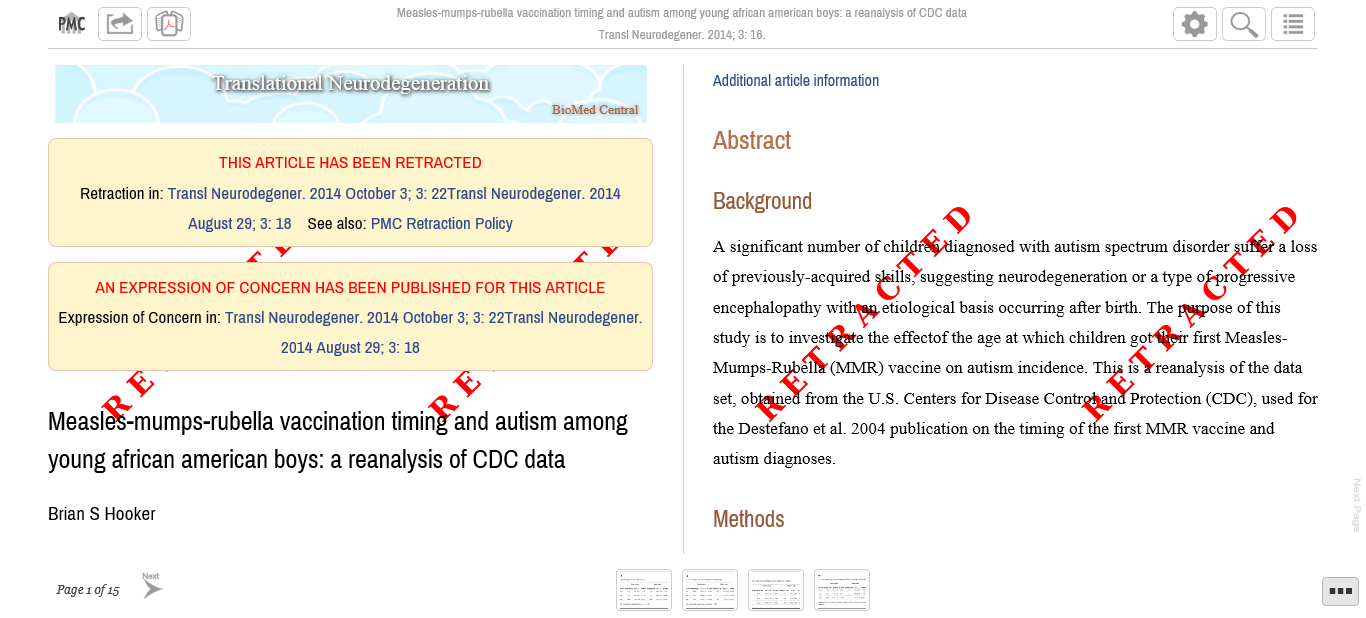
Retracted: Measles-mumps-rubella vaccination timing and autism among young african american boys: a reanalysis of CDC data

5 Oct

About two months ago an autism parent published a study: a “reanalysis” of a CDC dataset. That study: Measles-mumps-rubella vaccination timing and autism among young african american boys: a reanalysis of CDC data.

Here’s a screenshot of how the article looks online today (click to enlarge):

BadStudyRetracted

The retraction reads:

The Editor and Publisher regretfully retract the article [1] as there were undeclared competing interests on the part of the author which compromised the peer review process. Furthermore, post-publication peer review raised concerns about the validity of the methods and statistical analysis, therefore the Editors no longer have confidence in the soundness of the findings. We apologise to all affected parties for the inconvenience caused.

Previously, the editors had an “expression of concern” about the article:

The Publisher of this article [1] has serious concerns about the validity of its conclusions because of possible undeclared competing interests of the author and peer reviewers. The matter is undergoing investigation. In the meantime, readers are advised to treat the reported conclusions of this study with caution.

Further action will be taken, if appropriate, once our investigation is complete.

Comment on

Brian Hooker. Measles-mumps-rubella vaccination timing and autism among young African American boys: a reanalysis of CDC data. Translational Neurodegeneration 2014, 3:16.

An excellent discussion of this study and the questions raised by it can be found at MMR, the CDC and Brian Hooker: A Guide for Parents and the Media


By Matt Carey

Brian Deer’s original 2004 Channel 4 report on Andrew Wakefield: MMR: What they didn’t tell you

5 Oct

When Andrew Wakefield presented his hypothesis linking autism to the MMR vaccine in 2014 1998, he fueled a vaccine scare that is still alive today. It wasn’t until 6 years later that specifics about Mr. Wakefield’s actions were to surface. First in a newspaper story by Brian Deer (Revealed: MMR research scandal). Later that year in a BBC Channel 4 investigation: “MMR What they didn’t tell you.” I’ve never seen that Channel 4 program. Until today. Mr. Deer has placed it on YouTube. In three parts.

Part 1 introduces the topic. The MMR scare, the Wakefield 1998 Lancet paper and the press conference and the Royal Free’s video given out to the press. A discussion with an epidemiologist about the fact that there was nothing in Mr. Wakefield’s own work to support the triple MMR vaccine. Which leads us to the Wakefield patent for a substance that could be used as a vaccine–a vaccine which could only reasonably be expected to make a profit if the existing measles vaccine were considered unsafe–and as an autism “cure”.

Mr. Deer speaks with Ian Bruce, a researcher who worked with Andrew Wakefield on the patent. “The interpretation of that is quite clear to me..and that is that they have a vaccine for measles. Which presumably is an alternative to the existing vaccine.”

The thing is, the public was not told that Mr. Wakefield and the Royal Free had these commercial interests prior to Mr. Deer’s show.

Part 2 discusses the patent–the cure and vaccine aspects. The idea was that measles virus would be injected into a mouse. Those would be extracted, frozen, thawed, mixed with human cells, and injected into pregnant goats. The colostrum (part of the goat’s milk) would then form the basis of this vaccine/cure substance.

Sound like a strange idea to you? Well, Mr. Deer interviews medical experts who also think so. “the whole technique doesn’t make sense”. “It’s not credible”. “It’s strange”.

Mr. Deer tries to interview Dr. Roy Pounder, Mr. Wakefield’s former supervisor at the Royal Free. Mr. Pounder at first agrees then refuses to be interviewed.

Mr. Deer then goes to American and interviews Hugh Fudenberg, collaborator with Mr. Wakefield and co-inventor on the patent. Mr. Fudenberg at the time was charging up to $750 an hour to see and treat autistic children. He too considers Mr. Wakefield’s treatment to be unfounded. However, Mr. Fudenberg had a cure of his own, made from his own bone marrow.

Mr. Deer discusses some of the criticism of Mr. Wakefield’s work, including a statement from someone who worked in the Royal Free Hospital, including a comment that the work amounted to abuse.

Part 3 includes a discussion with Nick Chadwick, a student in Mr. Wakefield’s laboratory during the MMR/Autism research. Mr. Chadwick tested the tissues for measles virus, and found there was none in the autistic children being seen by Mr. Wakefield’s team. Also interviewed was Ian Bruce, a colleague of Mr. Wakefield’s, and also a supervisor for Nick Chadwick. Both Chadwick and Bruce are highly confident that if there were measles virus in the tissues, they would have detected it.

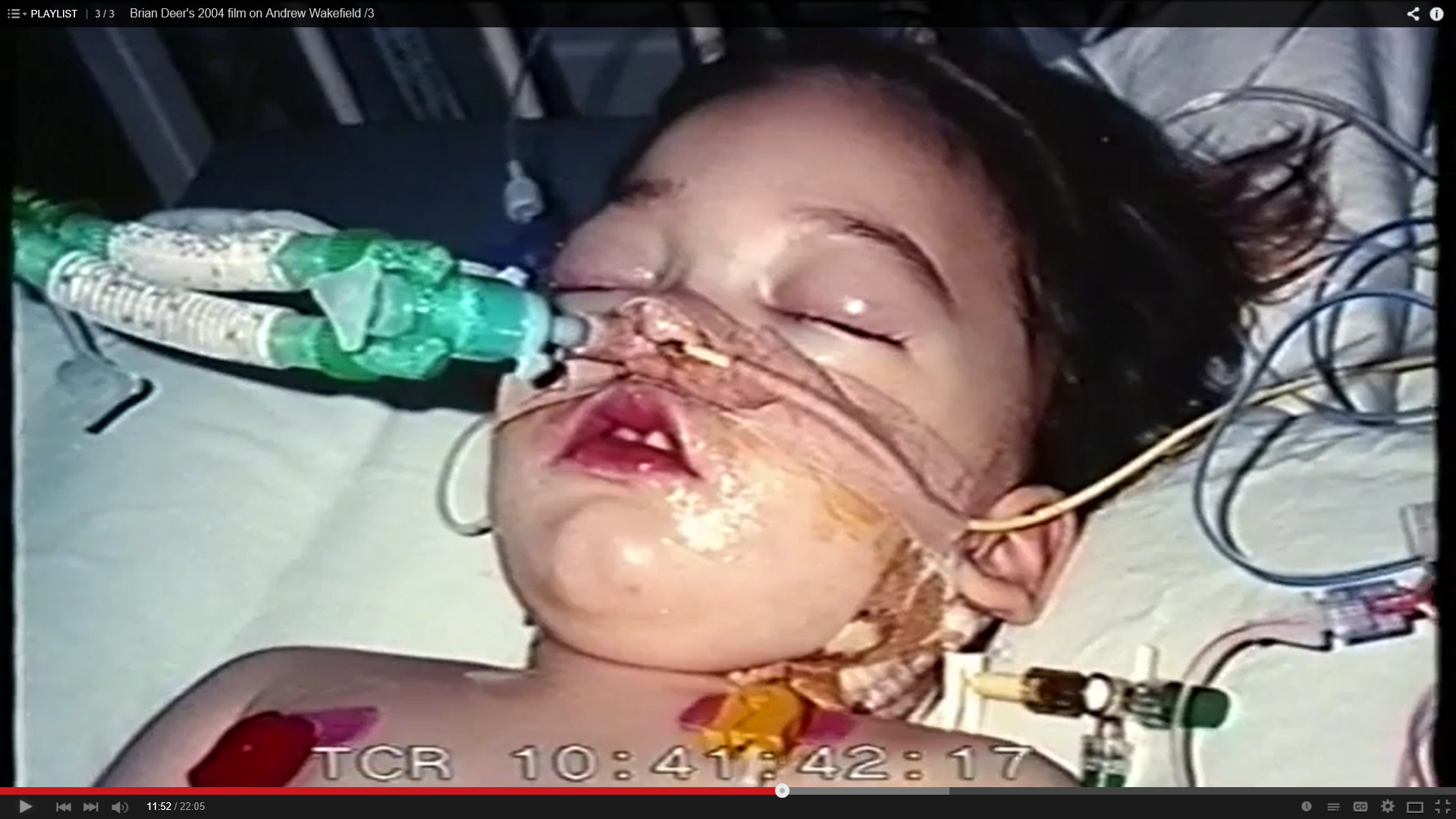
Mr. Deer discusses the 2000 measles outbreak in Ireland. He interviews the parents of one of the children who died in that outbreak. For those who keep saying that measles is mild, that in first world countries no one dies or is injured, here’s what a child dying of measles looks like in the first world. She took 11 months to die.

Result_of_Wakefields_Scare

Mr. Deer then goes to America to find and try to speak with Mr. Wakefield. Mr. Wakefield was listed as “research director” for Jeff Bradstreet’s clinic in Florida, but wasn’t there. The Bradstreet clinic had a host of supplements that one could purchase to “treat” autism. Mr. Deer eventually finds Mr. Wakefield at an Autism Society of America convention. Whereupon Mr. Wakefield runs away.

By the way–Thank you ASA for no longer inviting Andrew Wakefield to speak.

This investigative report together with the Sunday Times articles earlier in 2004 made a huge impact at the time. I know as I lived through it. The retraction of interpretation published by most of Mr. Wakefield’s co-authors on the 1998 Lancet paper (since fully retracted by the journal), was a big statement that this work was not solid. Of course, Brian Deer would eventually go on to win a U.K. Press Award for his MMR journalism and Mr. Wakefield would eventually be found to have been unethical in his research and struck off the register (lose his medical license).

The embedded version below should go through all three parts in sequence.

Andrew Wakefield apparently doesn’t understand the first rule of documentaries

27 Sep

Andrew Wakefield has tried to make a new career for himself as a film maker. He runs a website producing YouTube and Vimeo videos in which he describes himself as “director”. He also serves as presenter. He has finished his documentary on the murder of Alex Spourdalakis, even though his fundraiser fell well short of its goal (“$9,532USD RAISED OF $200,000 GOAL”).

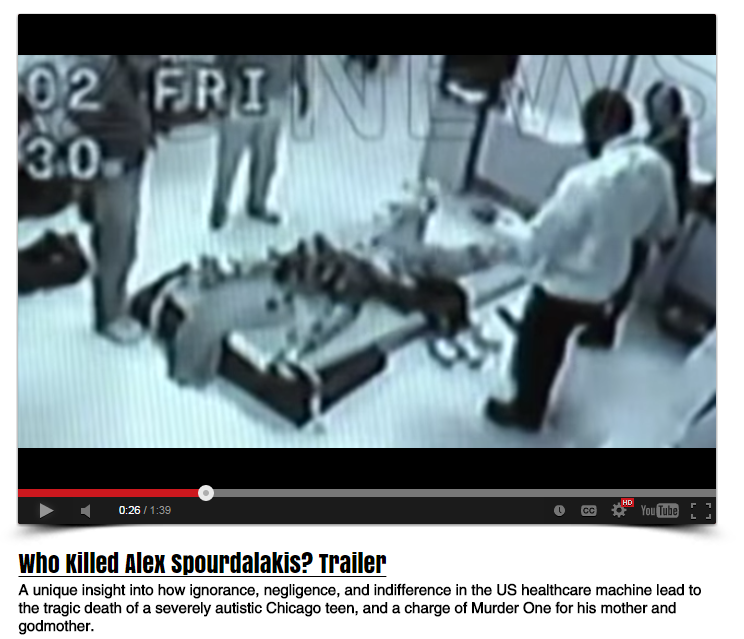
If one follows the link above to the Mr. Wakefield’s Autism Media Channel, one will find a trailer for his “Who Killed Alex Spourdalakis” video. The narration talks about him being treated “in the words of witnesses…like an animal…” and at 26 seconds in one sees this image:

ThatWouldBeHisMother.

An image from that same video is also seen at about 20 seconds into the trailer.

As one who has followed various stories in the autism community I know that video well. I know it is taken from a video that made the news. A video about a completely different autistic.

Rotenberg

That video can be found on YouTube. It’s a story of an autistic at the Judge Rotenberg Center. I’m unaware of Mr. Wakefield speaking out on the treatment at JRC, by the way.

Perhaps in the full documentary Mr. Wakefield uses the Judge Rotenberg Video and tells his audience that it is a completely different story than the one he is discussing. But he doesn’t in the trailer. In fact, he cut the frame so that one doesn’t see where the video originated.

First rule of documentary film making–document. Don’t make things up. Don’t pull in film from some other event. The second rule would probably be: the film maker should not be part of the story. Mr. Wakefield applied his “Autism Team” to give their brand of support to the Spourdalakis family. I do question whether Mr. Spourdalakis would be alive today without that interference. Without the false hope. A question one can bet will not be addressed in an unbiased fashion, if at all, in Mr. Wakefield’s documentary.

I’ll note something else odd in that trailer. Immediately after that clip from the JRC video, one hears someone talk about “exorcism needed to be performed” and “he was possessed”. What that is all about is as much your guess as mine. Is this an example of the bad support Mr. Spourdalakis was getting before Mr. Wakefield? The type of support he got from Mr. Wakefield’s “Autism Team”?

Let’s consider another of Mr. Wakefield’s recent videos. In it, Mr. Wakefield presents a little more of the audio Brian Hooker claims are from phone calls he secretly taped with a CDC researcher. Let’s assume this is correct. At about 56 seconds in, Mr. Wakefield shows us a silhouetted figure gesturing while the recording goes on.

FauxThompson

Dramatic, isn’t it? Looks like Team Wakefield got someone from the CDC into a room, spilling secrets galore. It’s like a bad spy movie.

Looks to this observer like the man in the silhouette is an actor, not the CDC researcher. Why? Well, the face doesn’t look like the same person. The actor isn’t wearing glasses, the most recent photos of the researcher show him with glasses. The movements of the actor don’t really match the words in the audio. The audio quality is the same as in the phone call, but the actor doesn’t have a phone. Why would he be talking on the phone if he’s in a room? Why not use a recorder in the room? One can go on and on.

Perhaps Mr. Wakefield felt that this was artistic license: he didn’t have that video, so he used an actor in a recreation of events. Except that in real documentaries, one tells the audience when one is doing a recreation.

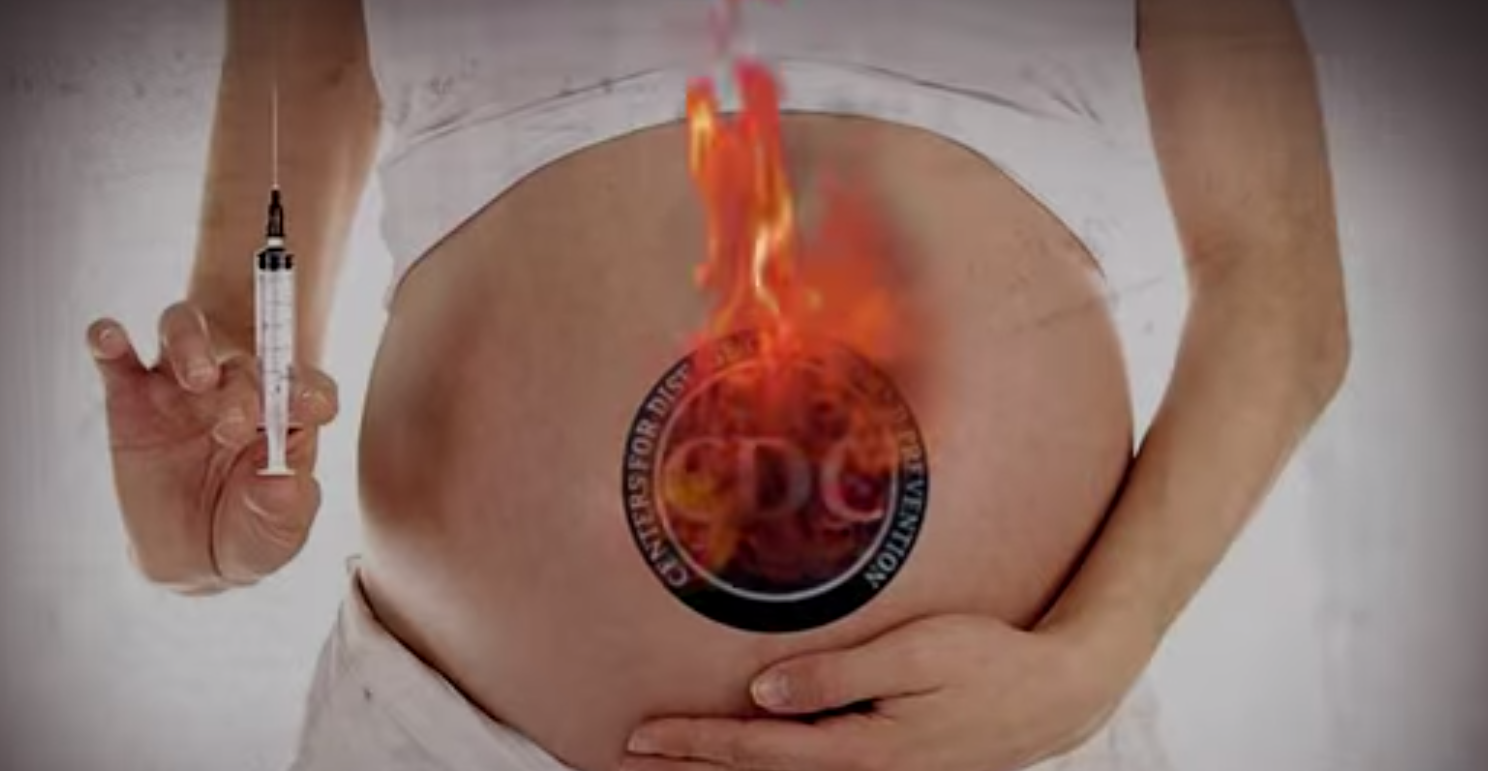
This last bit is from another of Mr. Wakefield’s recent videos. Not really relevant to the question of how does one make a good documentary. Instead this goes to one of the common complaints one hears from Mr. Wakefield’s supporters: whether he or they can be accurately called anti-vaccine. I rarely use the term, by the way. Here’s an image from another of Mr. Wakefield’s recent videos. It’s the picture of a pregnant woman holding a vaccine. The CDC logo is overlayed on her bare stomach and flames are burning from that logo. I cropped the image to remove the text imposed upon it.

WakefieldVideo

How should we classify such an action? Is this an example of the methods of the “pro safe vaccine” community (as they sometimes like to be called)?

Mr. Wakefield’s new career as a film maker is an interesting choice. Frankly, he has a lot to learn.


By Matt Carey

Andrew Wakefield loses frivolous defamation lawsuit. To pay court costs.

19 Sep

In 2011 the British Medical Journal (BMJ) published a series of articles about Andrew Wakefield and his efforts to promote the idea of the MMR vaccine causing autism. Brian Deer has a list of links on his website: Secrets of the MMR scare. Here are just a few of those links:

Piltdown medicine – the missing link between MMR and autism

Editorial: Wakefield’s article linking MMR with autism was fraudulent

How the case against the MMR vaccine was fixed

How the vaccine crisis was meant to make money

The Lancet’s two days to bury bad news

Nearly a year after those were published, Andrew Wakefield took issue with his work being declared fraudulent and sued for defamation. Not in the UK, where the laws are very favorable to him. No, instead he chose his home state of Texas. Mr. Wakefield’s original suit was denied on the grounds that he did not have the standing to bring suit against the BMJ in Texas. Mr. Wakefield appealed. And lost.

In the recent appeal the judgment the court stated:

This is an appeal from the judgment signed by the trial court on August 3, 2012. Having reviewed the record and the parties’ arguments, the Court holds that there was no reversible error in the trial court’s judgment. Therefore, the Court affirms the trial court’s judgment. The appellant shall pay all costs relating to this appeal, both in this Court and the court below.

The full judgment can also be found online.

[Edit to add–see the discussion below. It is quite possible that I did not read this correctly]

If I read this correctly, Mr. Wakefield will be paying the costs the BMJ team incurred as well as his own. And, not only in the appeal, but also “in the court below”, which I read to be in the original suit. To put it simply–Mr. Wakefield may be in the position of paying the costs going back to when he first filed his defamation case.

The BMJ team and Mr. Wakefield’s team were four attorneys each. I would expect that Mr. Wakefield’s costs run into many tens of thousands of dollars. I would expect that the BMJ’s costs are likely even higher.

Which brings us to the obvious question: with a gamble of this size, what would this appeal have accomplished had Mr. Wakefield won? Well, for starters the BMJ team’s Anti SLAPP suit would have moved forward. Texas had just enacted Anti-SLAPP legislation at the time Mr. Wakefield filed suit (as an aside, if I recall correctly this is one of the blunders of Mr. Wakefield’s suit–waiting until after the new law was in place to file). SLAPP stands for Strategic lawsuit against public participation. The BMJ suit essentially puts for the idea that Mr. Wakefield’s defamation suit was a cynical attempt to stop the BMJ (and others) from voicing public criticism about Mr. Wakefield’s actions. Mr. Wakefield faced heavy penalties had the Anti-SLAPP suit gone forward and had the BMJ won.

This is the fourth time that Mr. Wakefield has attempted to “gag the media” as Mr. Deer puts it. And now the fourth time Mr. Wakefield has lost. One can never tell for certain, but it seems likely that Mr. Wakefield would have lost the Anti-SLAPP suit.

Let’s say Mr. Wakefield avoided an Anti-SLAPP judgment. He would have been able to bring his defamation case to court on the merits. Not on the merits of his scientific work, but on the question of whether the BMJ team could rightfully call his work fraudulent. A case the BMJ team certainly prepared for before going to press. And prepared to defend in the UK, where the laws are much more favorable to Mr. Wakefield. Which is to say, I suspect the BMJ felt strongly that they had checked all their facts closely and were well defended in any and all statements they made.

From my point of view, this defamation lawsuit was a vanity exercise by Mr. Wakefield. It got his name in the news. It may have slowed criticism of him for years. He got to look like a hero to his own community.

And he threw tens if not hundreds of thousands of dollars down the tubes in the effort. Mr. Wakefield heads the “Strategic Autism Initiative” which has the purported goal of funding autism research. Last I checked the majority of the money collected for the SAI went to salaries. Mr. Wakefield’s being the lion’s share. Be that as it may, Mr. Wakefield had an option a few years ago: fund autism research or fund this lawsuit.

Well, we see his choice. And the result. Sure there may be a further appeal. Take it to the Texas Supreme Court and delay some more. And run up more bills to pay.


By Matt Carey

An open letter to the National Whistleblowers Center: David Lewis and the outing of a CDC whistleblower

11 Sep
Dear National Whistleblowers Center,
 
I appreciate the work you do but I would like some clarification on recent events.
 
A gentleman came forward from the CDC to provide information about what he felt were inappropriately withheld results on an old autism study.  This gentleman guided someone outside the CDC to reproduce the result.  These results were published and with that publication a public relations campaign was started.  This is where your board member, David Lewis, comes into the story.  Mr. Lewis can be seen in the video produced.  That video can be found here: https://www.youtube.com/watch?v=sGOtDVilkUc
 
The original video was produced with the whistleblower’s name censored and his voice modified.  However, his gender was given, making it rather simple work for the CDC and everyone else to work out who this was (only one male was an author on the paper in question).  Within 3 days of the release of the video, the online version was replaced with the uncensored version you see now–the version with “whistleblower revealed” as a title.
 
Since that time the whistleblower has released a statement including noting
 
1) he never consented to having his phone calls taped
2) he never consented to having his identity released
3) it appears, thus, that the video was not shown to the whistleblower, so he could not have approved of the rather ugly race-baiting angle it took.
 
 
Here are some other problematic details in these events.
 
1) Mr. Lewis is in the employ of the organization which did this study, Focus Autism.  Both Mr. Lewis himself and his charity/church have been paid according to public tax forms from Focus Autism.
 
2) Mr. Lewis does not make this conflict of interest known in the video.
 
3) Mr. Lewis has a history of working with the director of the video, Andrew Wakefield.  This includes soliciting donations through Mr. Lewis’ church with the purpose of using those funds to support Mr. Wakefield. 
 
4) Mr. Wakefield has major conflicts of interest in this video as he is trying to rebuild the reputation he damaged with his unethical actions (as deemed by the U.K.’s General Medical Council).
 
5) These COI’s are not disclosed in the video, although most in the autism community are well aware of Mr. Wakefield’s.
 
6) The video takes a very ugly race-baiting approach.  It takes what the whistleblower suggests is a scientific dispute and frames it as CDC officials partaking in a new “Tuskegee” experiment an compares the CDC officials unfavorably to Hitler, Stalin and Pol Pot.  This includes civil rights pioneer Marshalyn Yeagan-Allsopp.
 
Mr. Lewis has not issued a statement that I can find distancing himself from the actions of his team: the breach of confidentiality of the whistleblower nor the cynical use of the whistleblower for political and public relations gain by Mr. Wakefield.   I can not see how the treatment of this whistleblower by Mr. Lewis’ team can be construed as appropriate. In the video we can see Mr. Lewis making use of the opportunity for product placement of his book, “Science for Sale”.  Given Mr. Lewis’ tacit approval of this video, again one put together for his own benefactor Focus Autism, I see his actions as “opinion for sale”. 
 
I write for a website called LeftBrainRightBrain.co.uk.  You will see I have been highly critical of the actions of the team that outed this whistleblower.
 
Could I ask for a statement from your organization?  Do you believe these actions to be within the bounds of appropriate behavior for one working with a whistleblower?  If so, could you elaborate, because recording a whistleblower without his permission, outing a whistleblower, and using the whistleblower for such an ugly public relations campaign without his approval seem far outside the bounds to me.
 
I look forward to your reply,
Matt Carey

NOVA: Vaccines — Calling the Shots

9 Sep

The question of vaccine safety comes up a lot in the online autism parent community. The PBS program Nova is taking a look at vaccines and vaccine safety in a show “Calling the Shots”. As they point out, it is OK to question vaccine safety, but that is just the start of the conversation. The program airs tomorrow (September 10) at 9pm.

It looks like it will be an excellent program.

Here is the webpage for the show complete with a brief sneak preview:

Here is a 3 1/2 minute

here is a “behind the scenes” look at the show


By Matt Carey

Harpocrates Speaks on: MMR, the CDC and Brian Hooker: A Guide for Parents and the Media

8 Sep

Todd W. over at Harpocrates Speaks has put together a FAQ like guide on the questions that come up with regards to recent research by Brian Hooker and the allegations Mr. Hooker has made about the CDC. That article is an excellent resource for people looking for some answers on this story. The article starts:

The anti-vaccine community has been in a tizzy lately over a supposed “CDC whistleblower”, Dr. William W. Thompson, who, according to them, revealed fraud at the United States Centers for Disease Control and Prevention (CDC). To bolster their claim, they point to a new study from one of their own, Brian S. Hooker, that purports to show evidence of an increased risk of autism among African American boys who receive their first MMR vaccine late. However, the claims appear to be hollow and unfounded, and so they have chosen to rely on emotional arguments that may sound convincing to those who are not familiar with the issues and people involved. In a truly egregious fashion, they have erroneously and cynically compared this whole thing to the Tuskegee syphilis study, and equated the CDC with Adolf Hitler, Josef Stalin and Pol Pot, combined.

With that in mind, here is a brief FAQ for parents, news media and others to help them understand what the claims are and what the evidence actually says. The questions below have been raised or implied by anti-vaccine activists. Hopefully, this will prevent inaccurate reporting and help parents feel reassured about the MMR vaccine.

That FAQ can be found at MMR, the CDC and Brian Hooker: A Guide for Parents and the Media


By Matt Carey