Archive | Vaccines RSS feed for this section

Prof. Walker Smith’s memories perhaps not so enduring

12 Nov

Prof. John Walker-Smith was a pediatric gastronterologist  (now retired) who worked with Andrew Wakefield on the research that formed the basis for the now retracted 1998 article in The Lancet that sparked the public fear over a possible link between the MMR vaccine and autism. Multiple studies since have demonstrated that the MMR does not increase autism risk and even Prof. Walker-Smith has stated through his attorney that the Wakefield autism/MMR hypothesis is without merit.

Prof. Walker-Smith was found guilty of misconduct and stripped of his medical license by the General Medical Council (GMC), but that ruling was quashed on appeal. In the appeal decision the judge ruled:

It had to decide what Professor Walker-Smith thought he was doing: if he believed he was undertaking research in the guise of clinical investigation and treatment, he deserved the finding that he had been guilty of serious professional misconduct and the sanction of erasure; if not, he did not, unless, perhaps, his actions fell outside the spectrum of that which would have been considered reasonable medical practice by an academic clinician.

Prof. Walker-Smith and Andrew Wakefield took the position that the work they performed was not research driven, but was clinically indicated tests on children later collected as a case series. That the study for which they received ethical approval was not performed. So there was no problem in that children were seen before the approval was granted.

Prof. Walker-Smith wrote an autobiography (Enduring Memories). Two autobiographies, really. One in 2003 (before Brian Deer exposed the ethical lapses involved in the Royal Free Hospital’s research program) and another in 2012 (after the GMC hearings).

Mr. Deer has contrasted some excerpts from the two versions. Here is a snippet fro the 2002 edition:

The centre piece of the research however would be first a study to see if there was significant bowel inflammation in these children which could be treated. A secondary but important question would be whether measles virus, especially the vaccine virus strain, was present in any inflamed tissue which might be found. ”

The inflammation study-the Lancet work-was the center piece of the research with the measles virus work as a secondary project. The first measles virus effort was unpublished.

According to Prof. Walker-Smith in 2003, ethical approval was obtained and a pilot study went ahead:

My own role in all this was permissive as Andy Wakefield was the research leader, the conductor of the orchestra, a classical role in research for a gastroenterologist. A team was assembled, an ethical committee application was obtained and a pilot study went ahead.

The 2012 version differs notably from the above. The center piece is no longer the inflammation study, but the measles virus study and the work was not part of an ethics board approved study, but as a byproduct of routine investigation:

The centre piece of the research per se would be to determine whether measles virus, especially the vaccine virus strain, was resent in any inflamed tissue which might be found in these children and to investigate a pathogenetic hypothesis. This research could only be contemplated as a by-product of routine investigation.

Where the ethical approval statement from 2003 says a study went ahead, in 2012 the statement indicates that the project “was not implemented”.

A team was assembled, an ethical committee application was developed to investigate an hypothesis and was submitted by Andy Wakefield but based upon our clinically indicated diagnostic approach. The Ethical Committee approved the application but in the event the study was not implemented.

More modest studies based upon ethically approved research biopsies went ahead

The 2003 version is basically consistent with the GMC charges and the story unearthed by Brian Deer. The 2012 version is consistent with the failed defense Prof. Walker-Smith and Andrew Wakefield gave to the GMC. The decision against Prof. Walker-Smith was quashed.

For many reasons the argument that the quash of the GMC decision somehow exonerated Andrew Wakefield was not convincing from the start. From where I sit, it is even less so in light of a 2003 account clearly setting out the work as a research project.
Controversial autism doctor Mark Geier loses licenses in Missouri, Illinois

4 Nov

Mark Geier has been discussed a great deal here on Left Brain/Right Brain. Including very recently on the topic of this article. Much of that discussion has recently centered on his belief that not only is autism caused by mercury, but that mercury somehow is bound to testosterone and that by reducing the amount of testosterone in the body one can reduce the amount of mercury and, thus in his flawed model, treat autism. Mr. Geier’s clinical practice was found to have been flawed as well and he lost his license to practice medicine in his home state of Maryland. He was licensed in multiple other states as well, including Missouri and Illinois. With the loss of his license in Maryland, other states have followed in license actions.

The St. Louis Post Dispatch reports: ” Controversial autism doctor Mark Geier loses licenses in Missouri, Illinois”.

Todd W. Of Harpocrates Speaks writes about this in “Mark Geier on his Last Leg” where he notes that Mark Geier is still licensed in Hawai’i only.

Todd W. keeps a map of states where Mark Geier has lost his license.


By Matt Carey

For the first time in history!

29 Oct

Here’s one of those statements that seem dramatic until one puts it into historical context:

For the first time in history, a biologically plausible mechanism of action has been discovered linking a vaccine to a serious adverse event.

Who wrote that? Someone from a group calling itself “SaneVax”. And repeated by none other than Dan Olmsted, proprietor of the Age of Autism blog. Yes, a man who has for years promoted the (failed) idea that mercury in vaccines caused an epidemic of autism is repeating the claim that ” For the first time in history, a biologically plausible mechanism of action has been discovered linking a vaccine to a serious adverse event.” The same Dan Olmsted who has offered up support for Andrew Wakefield and his failed claims that the MMR vaccine also caused a rise in autism rates.

Begs the question of why Mr. Olmsted has put so much time and effort into ideas like mercury and the MMR if they had no biologically plausible mechanism.

Of course no one believes Mr. Olmsted has changed his mind. It’s fairly clear this is just sloppy writing by “SaneVax” and some quick copy-and-paste work by Mr. Olmsted (sure he cited the source but did he read it?) . It would be amusing if the thimerosal and MMR ideas didn’t cause (and didn’t continue to cause) harm both within the autism communities and the general population.

For the record, this claimed “first biologically plausible mechanism” is from a paper by Prof. Shaw. His paper proposing a link between aluminum in vaccines and autism was very poor. Add this to the lack of relavence to autism andI see little point in putting much time into this new (gardasil) paper.

Also for the record and more historical context:

There were reactions to multi dose vaccines in the pre preservative era. The biologically plausible mechanism there was the growth of bacteria introduced into the vial by the needle.

There were reactions to the early polio vaccine produced by Cutter Laboratories. The biologically plausible mechanism there was the injection of live polio virus instead of the inactivated virus that was supposed to be used.

Similarly, the live virus in the oral polio vaccine  can occasionally cause paralysis. The OPV is no longer used in the U. S. after the efforts of a true vaccine safety advocate.

It probably seems strange but it is these last examples that strike me then most sad. Sure, they forgot their own claims that vaccines cause autism. But these other examples are very real, demonstrated vaccine reactions with clear biological mechanisms. But I am being naive. I am expecting a discussion of facts rather than a public relations and political commentary.

Edit to add: I’m not the first to notice this sloppy writing.

Brian Deer: VanDerHorst-Larson: misinformed mother scatters food for the birds

19 Oct

Brian Deer recently lectured at the University of Wisconsin La-Crosse on his journalism involving Andrew Wakefield’s research efforts and the improprieties found in those efforts. Not surprisingly, this led to a response by Mr. Wakefield and his supporters. I’ve pretty much given up on fact checking their complaints. Or, in this case, even really reading them.

But, complaints were made and, in this case, Mr. Deer has responded. His written response as VanDerHorst-Larson: misinformed mother scatters food for the birds.

Mr. Deer introduces his article with these paragraphs:

After the collapse of what was only ever a fringe campaign in the United States, claiming that vaccines were responsible for an epidemic of autism, small groups of ill-informed, misguided and sometimes frankly malicious, people became desperate for attention. This led to a barrage of emails – often abusive or crammed with hate speech – to university staff following my October 2012 lectures in Wisconsin.

The complaint below by one Jennifer VanDerHorst-Larson, who said she was founder of something she called the “Canary Party”, was one of the few that didn’t ooze with personal bile. But even she hadn’t checked her facts.

Ms VanDerHorst-Larson’s complaints are numbered, and I respond beneath each.

An example of such a complaint, with a partial quote of Mr. Deer’s response is given here:

8. Mr. Deer also failed to disclose that there were no complaints against Wakefield by the children’s families, most of whom very strongly support him, and many of whom credit his team with a diagnosis that led to effective treatment of their children’s bowel disease.

The father of the only child in Wakefield’s series who was not entered in (failed) UK compensation litigation described Wakefield’s reporting in the Lancet as “a clear misrepresentation of my son’s history” and “an outright fabrication”.

If you wish to read a point by point response, again, the link is VanDerHorst-Larson: misinformed mother scatters food for the birds.

Immunization uptake in younger siblings of children with autism spectrum disorder

12 Oct

If one child has autism, the chance that a younger sibling will have autism is about 18.7%. (see the study Recurrence Risk for Autism Spectrum Disorders: A Baby Siblings Research Consortium Study and discussions here and elsewhere). Anecdotally, we hear a lot about families deciding to forgo or delay vaccines after having an autistic child. This raises a question and an opportunity for research: does delaying or stopping vaccines result in a lower risk of autism? Looking at younger siblings, one would have a population that both has a higher autism risk and a possibly higher percentage of use of alternate (including no) vaccine schedule.

A study has been published this week on this very topic: Immunization uptake in younger siblings of children with autism spectrum disorder. The answer? Immunization does not increase the risk of autism. But I get ahead of myself.

The authors divided the children into three groups

Immunization status was divided into three predefined categories: (a) Fully immunized: Children with four doses of DPTP (2, 4, 6, and 18 months) and the initial MMR dose at 12 months, (b) Partial/delayed immunizations: Children with any missing dose of DPTP or MMR at any age or a delay of 3 months or more for at least one of the doses of DPTP or MMR, and (c) Not immunized/declined: Children for whom all immunizations had been withheld as of 3 years of age.

In case you are wondering, yes, comparing groups (a) and (c) is a vaccinated/unvaccinated study design. [edit to add–see note below] (b) just gives more dimension to the study.

Yes, siblings of autistic children are vaccinated differently (on average) than younger siblings of non-autistic children:

MMR immunization uptake. The analysis revealed a significant group difference in MMR immunization status (Fisher’s exact test = 80.82, p < .001). Bearing in mind that the Public Health Agency of Canada recommends that children receive their initial MMR vaccine at 12 months (in contrast to the United States, where it is recommended at 12–15 months; Public Health Agency of Canada, 2006a; CDC, 2011), only 42 of the 98 (43%) younger sibs received the 12-month MMR vaccine ontime (i.e. by at least 15 months of age; see Figure 2); an additional 38 (39%) received the vaccine after 15 months of age, and 18 (18%) had not been immunized against MMR by the age of 3 years. In contrast, 88 of 98 (90%) probands received the MMR by 15 months, 9 (9.2%) were delayed, and only 1 had not been immunized by the age of 3 years. Similarly, 63 of 65 (97%) controls had completed their MMR immunization on time (i.e. only two were delayed, and none had parents who had fully declined).

Only 42% of younger siblings of autistics received the MMR ontime. 18% were not given the vaccine by age 3. Compare this to the control group, where 90% received the MMR by 15 months and 98% by age 3.

Differences were seen with the DPTP vaccine as well:

DPTP immunization uptake. A significant group difference was also found for DPTP immunization status (Fisher’s exact test = 38.95, p < .001), with just over half (55.1%) of the younger sibs having been immunized on time (31.6% were delayed, and 13.3% were not immunized by the age of 3 years; see Figure 3). The rates of DPTP uptake were higher for probands (86.7% immunized on time, 12.2% delayed, and 1% not immunized) and controls (90.8% immunized on time, 9.2% delayed, and none declined).

What did this do to autism risk for these un- and under-vaccinated younger siblings? Statistically nothing:

Of the 39 younger sibs who had completed their immunizations on time, 6 (15.7%) were diagnosed with ASD and 2 with speech-language delay (SLD). Of the 47 younger sibs for whom immunization as delayed, 15 (31.2%) received an ASD diagnosis and 2 had SLD. Of the 12 younger sibs who had not received any immunizations, 4 (33.3%) were diagnosed with ASD and 1 with SLD. Note that of those children who did not receive a diagnosis, 43.8% were fully immunized. The Fisher’s exact tests revealed no significant difference in the rates of diagnoses between immunized and nonimmunized groups for MMR (Fisher’s exact test = 5.46, p = .22), DPTP (Fisher’s exact test = 3.65, p = .44), or both (Fisher’s exact test = 4.13, p = .37), although small sample size renders these comparisons exploratory only.

And, by “statistically nothing”, I am not saying, “the calculated risk for vaccinated siblings are higher, but we can’t claim they are because the p values aren’t statistically significant”. No, I’m saying, “the calculated values are lower for vaccinated siblings.”

The authors found about 15.7% autism risk for baby siblings. Very close to the Baby Siblings study mentioned above which found 18.7% risk. The risk found for siblings with delayed vaccination was 31.2% and for unvaccinated was 33.3%. Again, these values are not statistically significant from the 15.7%.

So, when one does a vaccinated/unvaccinated study, one finds that autism risk (for familial autism) is not increased.

Since people will undoubtedly be looking for the conflicts of interests for the study authors, the COI statement is “The authors declare that there is no conflict of interest.” and their funding is “This research was funded by the Canadian Institutes of Health Research and Autism Speaks.”

Limitations include sample size and the fact that the authors relied upon parent recall for much of the data:

Parents of 22.2% (58/261) of the children provided a copy of their child’s immunization record or had it sent by their doctor; for the remaining 77.8%, status report was based on parent recall (note that this information was typically gathered at each visit, at 3- to 6-month intervals, to avoid recall bias). Due to the potential for recall bias (e.g. see Dorell et al., 2011, for bias in recall for the older children), we examined the influence of information source (card copy vs parent recall) on immunization status. No significant relationship was found for MMR (Fisher’s exact test = .38, p = .84), DPTP (Fisher’s exact test =1.71, p = .44), or “both” (Fisher’s exact test = 1.58, p = .48).

Here is the abstract:

Background: Parental concerns persist that immunization increases the risk of autism spectrum disorder, resulting in the potential for reduced uptake by parents of younger siblings of children with autism spectrum disorder (“younger sibs”).

Objective: To compare immunization uptake by parents for their younger child relative to their
older child with autism spectrum disorder (“proband”) and controls.

Design: Immunization status was obtained for 98 “younger sibs,” 98 “probands,” and 65 controls.

Results: A significant group difference emerged for overall immunization status (Fisher’s exact test = 62.70, p < .001). One or more immunizations in 59/98 younger sibs were delayed (47/98; 48%) or declined (12/98; 12.2%); immunizations were delayed in 16/98 probands (16.3%) and declined in only one. All controls were fully immunized, with only 6 (9.2%) delayed. Within the “younger sibs” group, 25/98 received an autism spectrum disorder diagnosis; 7 of whom (28%) were fully immunized. The rates of autism spectrum disorder diagnosis did not differ between immunized and nonimmunized younger sib groups, although small sample size limits interpretability of this result.

Conclusion: Parents who already have one child with autism spectrum disorder may delay or
decline immunization for their younger children, potentially placing them at increased risk of
preventable infectious diseases.

Edit to add: The authors have clarified that unvaccinated means not vaccinated with MMR or DPTP, not necessarily completely unvaccinated.

A breach of privacy

10 Oct

Privacy is an important point for all of us. I blogged for a long time under a pseudonym in order to protect my child’s privacy. The subject is important enough to me that when I noticed what I considered to be a breach of privacy by Andrew Wakefield and his “Dr Wakefield Justice Fund”, I wrote to them with the information in order to give them the chance to correct this. To explain: the “Dr. Wakefield Justice Fund” posted documents from Mr. Wakefield’s defamation suit filed against Brian Deer and Fiona Godlee. One of those documents includes the full names and birthdates of seven of the patients seen at the Royal Free Hospital in the 1990’s.

I sent the following email to one of the contact email addresses for the “Dr Wakefield Justice Fund” (info@drwakefieldjusticefund.org).

Hello,

if you aren’t already aware of this, you may want to know that in this document:

[link redacted by me for this article]

You have made public the full names and birth dates of seven patients seen at the Royal Free. Given the complaints levied against Mr. Deer for, as I recall, publishing the first names of the Lancet 12, I thought you might want to take the effort to redact that document.

Matt Carey

I sent this Friday of last week and so far have received no response and no correction has been made. I have not made an effort to find and remember the names of the “Lancet 12” so these names are unfamiliar to me (with the exception of two last names). I did a quick internet search on some of the names and did not find them linked to Mr. Wakefield or MMR in a relatively brief search, so this seems like a true breach of privacy. I’ll note that in the GMC hearings names were occasionally spoken but the court kept to a standard of anonymizing child and parent names in the transcript.

I would encourage the “Dr. Wakefield Justice Fund” to redact that and any other documents which contain such information.


By Matt Carey

Andrew Wakefield tops the “Retraction Epidemic”

5 Oct

We recently discussed a paper in the Proceedings of the National Academy of Sciences: Misconduct accounts for the majority of retracted scientific publications. A reader sent a copy to me and there are a couple of interesting points (OK, there are a number of interesting points, but a couple specific to the autism communities).

First, consider the abstract:

A detailed review of all 2,047 biomedical and life-science research articles indexed by PubMed as retracted on May 3, 2012 revealed that only 21.3%of retractionswere attributable to error. In contrast, 67.4% of retractions were attributable to misconduct, including fraud or suspected fraud (43.4%), duplicate publication (14.2%), and plagiarism (9.8%). Incomplete, uninformative or misleading retraction announcements have led to a previous underestimation of the role of fraud in the ongoing retraction epidemic. The percentage of scientific articles retracted because of fraud has increased ∼10-fold since 1975. Retractions exhibit distinctive temporal and geographic patterns that may reveal underlying causes

Yes, the “retraction epidemic”. My guess is the use of “epidemic” here will rankle one or more of Mr. Wakefield’s supporters.

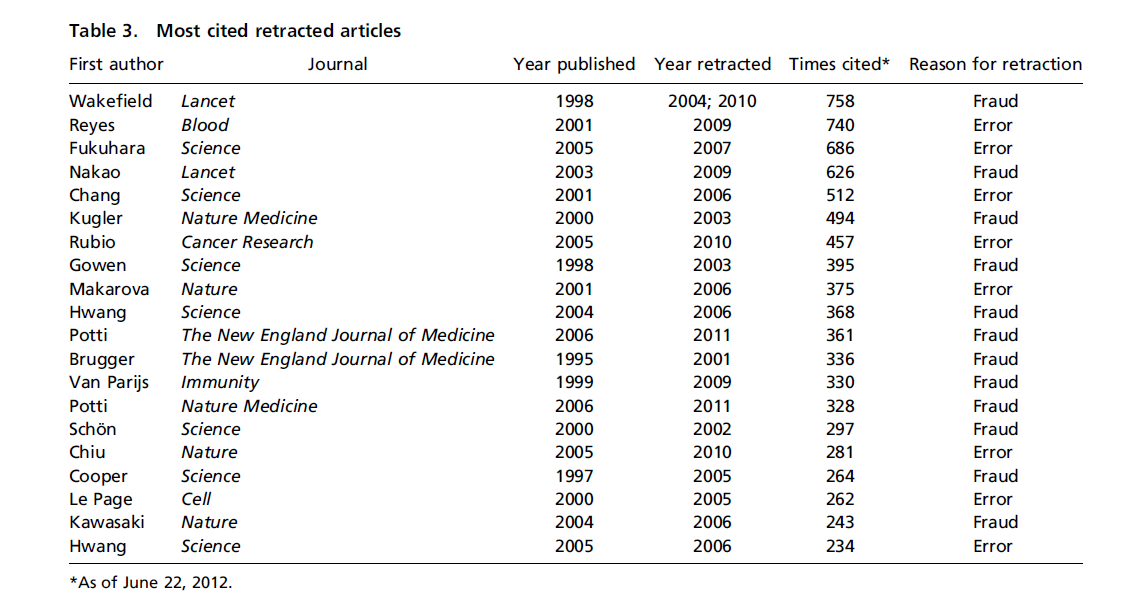
One point that I discussed previously was that Mr. Wakefield’s 1998 Lancet paper tops the list as the most cited retracted paper. The list of top cited retracted papers is shown in this figure (Click to enlarge):

The figure lists the reasons for retraction. The reason for Mr. Wakefield’s paper? Fraud.

As many readers will recall, Mr. Wakefield sued the BMJ and Brian Deer and editor Fiona Godlee for defamation for calling Mr. Wakefield’s paper fraudulent. Which begs the question: how can one call something defamatory when it is a generally accepted fact within the research community?

At present Mr. Wakefield is appealing the decision that stated he doesn’t have the standing to sue in Texas. As always in this case, it isn’t enough to show that his reputation is poor. He has to show that someone other than himself is at fault for his poor reputation. And that is a tough hurdle to cross.


By Matt Carey

Mark and David Geier, holed up in Missouri?

5 Oct

There is really no fun in writing about people whose lack of ethical standards harm disabled children. Seriously, it is painful. I know at least one autism blogger who quit in no small part because it was just too hard to keep writing about these topics.

And here in one week, both Andrew Wakefield and the Geiers (Mark and David) come back up in the news. A recent story in the St. Louis Post Dispatch discusses the Geiers: Controversial autism doctor loses license elsewhere, but can still practice in Missouri, Illinois

Mark Geier is an M.D. and was licensed in multiple states (I’ve lost count of how many and which ones). His home base is Maryland. His license was suspended there and many other states have followed suit. David Geier holds no medical credentials and is charged with practicing medicine without a license in Maryland.

As noted above, most, but not all, states have followed suit with suspending Mark Geier’s license.

The St. Louis Post Dispatch writes (reminding me of which states Mr. Geier has been licensed):

Dr. Mark Geier has opened eight autism treatment clinics called ASD Centers across the country but is only allowed to practice at two of them — in St. Peters and Springfield, Ill.

Missouri and Illinois are among the last states to seek discipline against Geier, whose hormone therapy for children with autism has been called dangerous, abusive and exploitive by various medical boards.

In the last two years, his medical license has been revoked or suspended in California, Florida, Indiana, Kentucky, Maryland, New Jersey, Texas, Virginia and Washington.

Missouri, Illinois and Hawaii have filed complaints against Geier based on other states’ actions, but his license remains active in all three states. A disciplinary hearing in Geier’s case is set for Oct. 19 before the Missouri Board of Registration for the Healing Arts in Jefferson City

The Geier hypothesis is that mercury binds with testosterone in the brain, making it difficult to chelate. They prescribe Lupron to reduce testosterone. The idea would be laughable if it weren’t being used on humans (or any animal for that matter).

Briefly–the Geier’s cited a paper showing that in hot benzene,
(more details in Miscellaneous Mercury Nonsense), mercuric chloride and testosterone can be induced to form chemical complexes.

I had hopes that the Geiers had moved away from this idea, but they stand by it:

David Geier said Wednesday that “many peer-reviewed scientific studies” have been published that support the theory. All of the research articles cited on the ASD Centers’ website are co-authored by Mark or David Geier.

The fact that the Geiers were able to get papers published in third rate journals doesn’t make their ideas true. Or even feasible.

Mr. David Geier did not attend medical school. Neither did I but I will offer him this small bit of medical advice: Among other logical problems with your idea, the human brain is not the same thing as a beaker of hot benzene.

Point two: even if your idea held any merit, Lupron lowers the level of testosterone in the blood, it doesn’t break up these mythical mercury-testosterone complexes.

The Geiers are demonstrating a major problem with the medical license system in the U.S.. It took years to bring the Geiers to hearing. Now that Mark Geier has lost his license in his home state, he has moved to other “safe havens” to continue business? How is this right.

I recall a number of med students and premeds I knew while in college and grad school. The hoops they had to jump through to get their degrees and get licensed and start working seemed enormous. Now we see why: it’s so hard to stop someone from practicing.

Christian Science Monitor: Fraud in scientific research: It happens, and cases are on the rise

4 Oct

The Christian Science Monitor has an article out today: Fraud in scientific research: It happens, and cases are on the rise

Of 2,000 retractions of published scientific papers since 1977, 866 were because of fraud, a new study finds. Another 201 were plagiarized. But it’s hard to know if more scientists are cheating, or if detection is simply better.

Is it a real increase, or just better awareness…

Who is their prime example of science fraud? I’m sure you’ve guessed it: Andrew Wakefield. Ironically, on the day when Mr. Wakefield is giving a faux press conference in a public park, the Monitor uses a photo from Mr. Wakefield’s public park appearance during a past AutismOne convention:

Why use Mr. Wakefield as the example? Many reasons come to mind, but the fact that he is probably the most publicly recognizable that the Monitor could have chosen. Also, the Monitor states:

One of the most high-profile examples involved the issue of childhood immunizations.

That paper, which the PNAS [Proceedings of the National Academy of Sciences] study identifies as the most widely cited retracted work, cited research purported to uncover a link between autism and vaccines given to children. The work was published in 1998 in the British medical journal Lancet. Subsequent studies reportedly indicated that the data were fraudulent. Meanwhile, Britain’s General Medical Council stripped the study’s author, Andrew Wakefield, of his status as a “registered medical practitioner” for misconduct after investigating his research effort.

So Mr. Wakefield has the dubious distinction of having written the most cited retracted work. He’s the best at something.


By Matt Carey

Andrew Wakefield tries to make himself relevant again

2 Oct

Andrew Wakefield is the former research surgeon who championed the idea that the MMR vaccine causes autism. Multiple researchers have told me that even at the time of Mr. Wakefield’s first research announcements, Mr. Wakefield’s idea was a stretch in terms of biological feasibility. For a few years at least, Andrew Wakefield was relevant in the autism research community. People worked to replicate his findings and otherwise answer the questions he posed. That was years ago. The result is we now know his ideas of persistent measles infection and a leaky gut causing autism were not valid and that, at best, Mr. Wakefield was a mediocre scientist who took this poorly conceived hypothesis and ran with it. Running as in a “running with scissors”, ignoring safety. As has been demonstrated since, he was also ignoring ethical concerns as well. But this is all old news.

In 2004, yes 8 years ago, Brian Deer exposed many of the ethical lapses in Mr. Wakefield’s autism career. Since then we’ve heard a lot of words from Mr. Wakefield about how it is all about the children, but seen a lot of his actions more akin to it being all about himself. He sued Mr. Deer over those 2004 reports (how is that helping autistics?). Mr. Wakefield abandoned his suit (how is that helping autistics?). Mr. Wakefield asked that the GMC look into the possible charges stemming from the reported actions (OK, that helps autistics a little by exposing Mr. Wakefield’s ethical and scientific deficiencies better, but that wasn’t exactly his intention). Mr. Wakefield attended the GMC hearings even though he sayed he didn’t need his medical license (registration) any more. This provided a great deal of drama (again, how does this help anyone but Mr. Wakefield?) but not much advancement. Mr. Wakefield was struck off the register (which could be argued helps autistics in a small way). Mr. Wakefield appealed and then dropped his appeal of the GMC decision. When Mr. Deer wrote more articles, this time for the BMJ, Mr Wakefield filed a complaint with the PCC (press complaints commission) in the UK, but he appears to be not pursuing that. Just letting it exist as a complaint (again, benefit?). Then, this year, he chose to sue Brian Deer, the editor of the BMJ and the BMJ itself this year for defamation over another set of articles and public statements (again, to what benefit to autistics?).

Mr. Wakefield’s latest day in court was short, but likely expensive. A judge in Texas ruled that Mr. Wakefield doesn’t have the standing to bring that case to trial.

Recently Mr. Wakefield appealed. Which, frankly, was enough of a non event in my view that with Respectful Insolence covering the discussion I felt no need to.

In the past eight years we can point to no advances in autism research championed by Mr. Wakefield, but we can (and just have) point to numerous occasions of Mr. Wakefield use procedural methods to keep himself in the news.

Mr. Wakefield claims essentially that calling him a fraud is defamatory. Which brings up the part of recent events that I did find interesting. Again at Respectful Insolence, in Time to rally the troops against the antivaccine movement, Orac calls on people to, well, rally. I’ll stand apart from Orac on this one. Frankly, making this appear to be a controversy, adding drama, is not helping matters.

One might rightly ask, why write about this at all? Why spend time on a topic which has obviously become irrelevant? In setting up his press conference Mr. Wakefield (through his team) made a bit of a poor move.

Mr. Wakefield’s approach to the discovery of his ethical and scientific failings has been to deny even the most clear facts. For example, when presented with direct evidence that he had major financial interests in creating a viable court case out of the MMR/autism hypothesis (being a paid expert witness, creating test kits with the idea that litigation-driven profits will be millions per year, etc.), Mr. Wakefield tells us it is all about the children, and he made all his financial ties public in advance (which he didn’t). When it was discussed on TV that he had a patent application in place covering an alternative measles patent–one whose commercial viability hinged directly on the confidence level of the current vaccine–he told us that it was all misdirection on the part of Mr. Deer. Later it became public that Mr. Wakefield had business plans in place to develop the invention as a potential vaccine.

Essentially, after being caught with his hand in the cookie jar, Mr. Wakefield tells us he was never in the kitchen and, besides, he was only getting the cookie for the children.

From a public relations standpoint (and let’s not forget that Mr. Wakefield had a PR representative since before Brian Deer entered the scene) Mr. Wakefield has played his hand somewhat well. He plays the role of a man who remains polite even in the face of this alleged adversity we are to believe has been put upon him. Mr. Deer, on the other hand, is (I believe in his own words), mercurial and has made statements which are easy to use against him.

Mr. Wakefield is portrayed as the guy you’d love to sit down to a glass of beer (or more likely wine) with while Mr. Deer is someone you’d best not provoke (I believe the term “reptilian” has recently been used by his detractors). I’m not so motivated by the opportunity to sit down to a glass of wine with unethical people, but let’s move on.

In an article on the Age of Autism blog, Ed Arranga writes about Mr. Deer being brought out to the U.S. to give talks to some academics and how Mr. Wakefield will hold a press conference. As one would expect from the Age of Autism, the approach is strongly negative. Here’s how it starts out:

Brian Deer – a liar, fraud, and former reporter for The Sunday Times of London – is coming to the University of Wisconsin-La Crosse October 4 and 5 to lecture you about Dr. Andrew…

Mr. Arranga is doing the attack here, allowing Mr. Wakefield to retain his polite persona. But with a multi-million dollar lawsuit ongoing, is this really enough distance for Mr. Wakefield? How will the above statements play out should Mr. Wakefield win the chance to sue?

Mr. Arranga runs AutismOne, whose convention presents Mr. Wakefield as a prime draw. In other words, Mr. Arranga has a financial interest in Mr. Wakefield’s reputation. A small conflict of interest which, while obvious to most of his readers, should have been made clear in Mr. Arranga’s article. Mr. Arranga also serves on the “Strategic Autism Initiative”, a charity formed after Mr. Wakefield’s ouster from Thoughtful House. [Correction: Mrs. Arranga serves on the SAI board, but Mr. Arranga is not listed in the available tax document]. Most importantly to this discussion, Mr. Arranga is also on the “executive staff” of the “Dr. Wakefield Justice Fund“.

So someone intimately involved with Mr. Wakefield’s career and defense is calling Mr. Deer a “fraud” and a “liar” and, in general, attacking Mr. Deer. Consider that Mr. Wakefield’s case is based at least in part on the idea that using terms such as “fraud” is defamatory. Mr. Wakefield’s original court filing states that defamation occurred: “Based on Defendants’ purported “reanalysis,” Defendants made and continue to make assertions that Plaintiff Dr. Wakefield committed fraud and is “a fraudster.”” Again, one should ask, did Mr. Wakefield blunder in allowing this personal attack on Mr. Deer? How will a judge or jury view a man who sets his team to attack others while claiming that the very same terms are defamatory? It’s not enough to cost him the case, but it was not a wise move.

The sad thing is that this is as close to relevance and Mr. Wakefield can currently attain in the autism communities. Holding a press conference in response to lectures by Brian Deer, who is discussing events that happened 15 years ago. Attacking Mr. Deer through surrogates. Putting time, money and effort into the latest in a string of procedural maneuvers which, even if he were right, hold no benefit for the communities.

As far as cost/benefit calculations go, Mr. Wakefield is a simple case. Costs to the autism communities in time and resources wasted chasing the ideas he championed. Costs to the public at large in terms of health scares and increased infectious disease. All this weighed against a complete lack of benefit brought to the communities by Mr. Wakefield. I guess we should put this in terms of a benefit/cost ratio to avoid dividing by zero.


By Matt Carey