Archive | Vaccines RSS feed for this section

How Much Longer?

9 Sep

The National Autism Association has a campaign afoot to raise awareness with the catch-phrase “how much longer”.

As in these quotes from their campaign:

“FDA, HOW MUCH LONGER WILL YOU APPROVE VACCINES THAT AREN’T NEARLY AS SAFE AS THEY COULD BE?”

Or

“HOW MUCH LONGER, NIH, before you adequately fund environmental research?”

I have a question:

How much longer, NAA, before you act like a reasonable member of the autism communities? (substitute Generation Rescue or SafeMinds for NAA, they are all basically the same group).

The NAA quote about NIH shows a lot about the NAA’s intent. “Adequately fund environmental research”. A lot of money is going to environmental research for autism causation at NIH. A lot. But, until it includes vaccine-causation, no amount is going to be considered “adequate” to the NAA.

NIH and most of the medical community doesn’t think that there is a good reason to do vaccine-causation research. But that isn’t the reason why groups like NIH don’t fund research. Let’s face it, NIH have an entire center devoted to spending on money that most of the medical community considers a waste.

The NAA would like to place the blame on everyone. Everyone else, that is. It’s a vast conspiracy, funded by Pharma dollars, with everyone afraid to admit the truth about the damage they caused. Do I have that right, NAA?

The real problem, NAA/Safe-Minds/Generation Rescue, is that you are your own worst enemy.

Ask yourselves a very simple question: if NIH is willing to spend money on projects with little hope of success, if NIH is willing to spend money on questions where the general expectation is that the answer will be no (remember that chelation study?), if they are willing to do that, why not spend money on a vaccine-causation project?

To answer that, you have to ask, what is the cost of a vaccine-causation project?

The real cost isn’t calculated in dollars. The real cost in is the damage to public health that such a study would bring. Yes, funding a do-vaccines-cause-autism project would hurt public health.

How can I say that? Because you guys at NAA (and sister orgs) would use the fact that NIH has funded such a project to attack vaccines. The entire time from the approval of the funds to the time the study results were published, you would be claiming “See, the government thinks vaccines are causing the autism epidemic”. What happens when the project is done? If the research doesn’t agree with your position, you will reject it. That is your clear track record.

Besides, what quality independent researcher would take on such a project? Anyone able to do such a study is is likely smart enough to realize that he/she would be hounded for the rest of his/her life if he/she doesn’t publish results that agree with your preset expectations.

You guys are stuck in the past. A past where you could say “vaccines caused an autism epidemic” and people listened. It’s time to listen to the people who support you. Really listen. Listen and realize that just because someone is supporting you doesn’t mean that he/she supports everything you say. Case in point: Dr. Bernadine Healy. Does she say there has been an epidemic of vaccine-induced autism? Does she say the epidemiology is junk? No. She says there may be small groups. Groups too small to be detected in the epidemiology that’s been done. That’s really, really small, by the way.

Get it? Even your supporters say you haven’t proven anything and that at most you represent a small fraction of the autistic population. You’ve been able to “wag the dog” for a long time, but that time is over. It’s time to realize that at most you would be a small part of the autism communities. It’s time to realize that the autism communities are part of a larger disability community.

If this seems too complicated, here are a few simple steps you can take to rebuild your credibility:

1) admit that thimerosal did not cause an “autism epidemic”
2) admit that MMR did not cause an “autism epidemic”
3) stop discounting all science that disagrees with you.
4) stop smearing people who disagree with you.
5) stop creating misleading faux research.
6) stop trying to discredit fine American institutions.
7) stop denying the existence of a large number of adult autistics.

Oh there’s more. A lot more.

As I said above, NIH is willing to fund research that constituents want even when it is very likely to be fruitless. But you have made it expensive to perform from a public health perspective and won’t accept any answer except the one you want.

How much longer until you get vaccine-autism research? You tell us. You are the ones in the way. Your “how much longer” campaign probably just set you back at least a year.

You probably see this as harsh. In reality it is probably the best advice you have been given all day.

California schools with high vaccine exemption rates

3 Sep

The Los Angeles Times has published a list of California schools where the kindergarden class has a high rate of students with vaccine exemptions.

Yes, there are vaccine-rejectionist clusters.

There are about 30 schools with over 50% of the students using exemptions.

Yuba River Charter (Nevada City) 32 of 37 (86.5%) (86%)
City School, The (Lake Balboa) 9 of 11 (81.8%) (82%)
Slvusd Charter (Ben Lomond) 13 of 16 (81.3%) (81%)
Coastal Grove Charter (Arcata) 19 of 25 (76.0%) (76%)
Sunridge Charter (Sebastopol) 25 of 33 (75.8%) (76%)
Sebastopol Independent Charter (Sebastopol) 33 of 44 (75.0%) (75%)
Carmichael Elementary (Carmichael) 82 of 112 (73.2%) (73%)
Waldorf Of The Peninsula (Los Altos) 29 of 40 (72.5%) (73%)
Dehesa Charter (Escondido) 28 of 39 (71.8%) (72%)
Ananda Living Wisdom (Nevada City) 7 of 10 (70.0%) (70%)
Westside Waldorf (Pacific Palisades) 14 of 20 (70.0%)

California is a big state. I guess I shouldn’t be so surprised that there are so many schools. I guess one could try to correlate income levels, parent education levels and the like with the exemption rate.

I’m just glad my kid isn’t at any of the schools listed.

I’m sure there are those who would say, “see, they have high exemption rates and they don’t have outbreaks of disease” and imply or state that there is no such thing as herd immunity.

All I can say is that the kids at those schools are safer because of families like mine.

Dr. Bernadine Healy talks about vaccines and autism…or does she?

1 Sep

Vaccines and autism: publicity of the topic just got a “shot in the arm” this weekend with a story on Dateline. As part of the story, Dr. Bernadine Healy was interviewed.

Dr. Healy has called for more research into the proposed vaccine-autism link. She has some good credentials (former head of the National Institutes of Health)

Take a look at what she had to say.

I really want people to actually watch her before reading my opinions. I’m very interested in what other people see, untainted by my opinion.

Did you watch? OK, go ahead.

My view: She sounds like a politician on a stump speech. She makes her “constituency” think that she made a commitment when, in fact, she never does.

“…in the area of autism, and in the area of vaccines, there are many many questions that need to be answered and they need a broad base of science.”

Does she ever say, “we need to research vaccines as a cause of autism”? No. She doesn’t. She mentions autism and she mentions vaccines, but doesn’t really put them together.

Another statement, in talking about vaccine safety:

“…it is about understanding if something is happening that we need to address in a small subset”

Her words are very imprecise, letting the reader interpret as he/she will.

“small subset”. Some will hear that and think, “children with autism, that’s the small subset” and the “take away” message will be, “she supports the idea of vaccines causing an epidemic of autism”. It’s possible that “small subset” means a small subset of autistics. In other words, she might be accepting the data that shows vaccines haven’t caused an epidemic of autism. It’s possible that “small subset” is the very small subset of people who are injured by vaccines, some of whom are autistic and some of whom are not. In which case, what she said isn’t controversial at all.

We just can’t tell what she meant from what she said.

And, yet, many would could come away thinking that her statement supports their side.

Perfect politician speak. Very reminiscent of the style Sentator McCain used in his comments courting the autism vote in the last U.S. presidential election.

Dr. Healy has not always been so cautious with her words. When she first appeared on the autism scene, she made accusations against the Institute of Medicine. She also made statements about young children having no risk for Hepatitis B, questioning the need for that vaccine. There are more examples, but these two serve the point: when we make specific statements, we run the risk of being wrong.

The rest of the interview was mostly “mom and apple pie” statements about good communication with parents, pediatricians and the American Academy of Pediatrics.

She also talks about vaccines and how there are “questions that must be addressed”. See what I mean about how that sounds like a politician? What questions must be addressed? The listener is likely to fill in the blank and feel that Dr. Healy made a statement supporting, say, questions about vaccines potentially causing autism.

Contrast Dr. Healy’s non-statements to the statement by the American Academy of Pediatrics on the Dateline website.

August 2009

Statement from the American Academy of Pediatrics to “Dateline”

The immunization schedule is considered the ideal schedule for healthy children. It is designed to stimulate children’s immune systems so they will not suffer illness, disability and death from vaccine-preventable diseases. The recommended immunization schedule is based on the latest scientific research. There is no scientific evidence to support the safety or effectiveness of alternative schedules. Delaying vaccines leaves babies unprotected when they are most vulnerable to vaccine-preventable diseases such as hepatitis B (a liver infection), rotavirus (severe diarrheal disease), whooping cough and bacterial meningitis.

Autism is a devastating, poorly understood neurodevelopmental condition. It is upsetting for families not to know what caused their child’s autism. The American Academy of Pediatrics (AAP) supports additional research to investigate genetic and environmental factors that may affect the developing brain. While it is likely that there are many environmental factors that influence the development of autism, vaccines are not the cause of autism. We know this because many careful and repeated studies show no link between vaccines and autism. Specifically, numerous studies have refuted Andrew Wakefield’s theory that MMR vaccine is linked to bowel disorders and autism. Every aspect of Dr. Wakefield’s theory has been disproven.

The AAP wants parents to have complete, science-based information so they can make the best decision for their child about immunization. The AAP urges parents who have questions about vaccines to talk to their pediatrician. For more information, visit www.aap.org.

See the difference between Dr. Healy’s interview and the AAP statement? The AAP said something concrete. They said that Wakefield’s theory has been disproven. They say that they support additional research into genetic and environmental factors.

Having done so, the AAP will almost certainly have their message picked apart and misinterpreted.

For example, one common attack I would expect to see is “if they don’t know what causes autism, how can they say that vaccines didn’t cause an autism epidemic?” This comes up enough that I have a handy counterexample: I, for one, feel safe in not applying research funding into the “refrigerator mother” theory, even though we don’t know what causes autism. I will go out on a limb and state that it is likely that most autism parents and autistics would agree with me on that. See, one can reject some ideas even without a complete understanding of autism.

What I really expect is for some people to jump on the “environmental factors” statement by the AAP. David Kirby, for one, has made a mini-career out of collecting such statements. Each time it is evidence of a “new” position on the possibility of environmental causes of autism by one group or another, Mr. Kirby jumps on it and adds it to his list.

I guess this hasn’t happened with this statement by the AAP because because this isn’t a new position. For example, this past May they stated, “A complex collection of variables, both genetic and environmental, have been associated with the development of autism spectrum disorders (ASD).”. This statement is a part of the FAQ (frequently asked questions) on the AAP autism website.

I was amazed then that Mr. Kirby didn’t extrapolate wildly on the “environmental” statements by the AAP.He tends to leave it implied that anyone who accepts “environmental causes” of autism is referring to events that happen to young children and not, as is most often the case in the studied environmental risk factors, prenatal events. Mr. Kirby tends to imply that anyone who agrees that there are environmental risk factors likely supports his contention that mercury causes autism.

In other words, he tends to claim support for his ideas even where there is none.

But, enough about Mr. Kirby. At least he sometimes makes definitive statements. Yes, he likes to hide behind the cloak of “what if” statements that are supposed to be “sparking a national debate”. But, he can and does occasionally make hard statements, unlike Dr. Healy in her interview.


The CDC also submitted a statement to Dateline
. It too has concrete statements:

August 26, 2009

NBC News
30 Rockefeller Plaza
Suite 325W-1
NY, NY 10112

CDC Statement on Vaccine Safety, Thimerosal and Autism

At the Centers for Disease Control and Prevention we understand that autism and autism spectrum disorders place a heavy burden on many families.

Despite compelling scientific evidence against a link between vaccines and autism, some parents wonder if vaccines could have caused their children to develop autism. The suggestion that MMR (Measles, Mumps and Rubella) vaccine could be related to autism was initially raised in a 1998 article by Andrew Wakefield and colleagues. Several subsequent studies by independent researchers, however, have not found an association. A study that included the same laboratory that was involved in Wakefield’s original studies was not able to replicate the original findings. Concerns have been raised about possible biases in the study by Wakefield, and 10 of the coauthors of the 1998 article have published a formal retraction of the article’s conclusions. A review by the Institute of Medicine in 2004 concluded that the evidence indicates that MMR vaccine does not cause autism.

In early 2000, concerns were raised that thimerosal, a mercury-based preservative that had been used in some childhood vaccines, could cause autism. Numerous studies have found no association between thimerosal exposure and autism. Since thimerosal was removed from all U.S. childhood vaccines by 2002 (with the exception of the flu vaccine), we have not seen a decline in children being identified with autism, indicating that thimerosal is unlikely to be related to autism.

The CDC supports research to better understand the causes of autism and to develop more effective treatments. Early intervention is critical and research is our best hope for understanding the causes of autism. Through collaborations with partners in government, research centers, and the public, CDC is focusing on three areas: 1) understanding the frequency and trends of autism spectrum disorders, 2) advancing research in the search for causes and 3) improving early detection and diagnosis.

CDC places a high priority on vaccine safety and the integrity and credibility of our vaccine safety research. CDC, along with other federal agencies, is committed to assuring the safety of vaccines through rigorous pre-licensure trials and post-licensure monitoring. This commitment not only stems from our scientific and medical dedication, it is also personal–for most of us who work at CDC are also parents and grandparents. We too, are concerned about the health and safety of children.

Frank Destefano, M.D., M.P.H. Edwin Trevathan, M.D., M.P.H.
Director Director

Immunization Safety Office, CDC National Center on Birth Defects
& Developmental Disabilities, CDC

Again, unlike Dr. Healy, the CDC makes definitive statements. On statement I am surprised I haven’t read people pointing out the “burden” statement.

I also am surprised I haven’t heard people jump on some other statements. Specifically, “understanding the frequency and trends of autism spectrum disorders”. That’s a perfect opening for people to claim that the CDC believes there could be a vaccine-caused epidemic of autism.

Most people tend to just equate the idea of the autism rate increasing with vaccines and or mercury. So, if anyone were to say, “so-and-so thinks the autism rate may be increasing”, they usually are trying to imply, “so-and-so thinks that vaccines cause autism”.

Well, guess what, the CDC does think it is possible that the autism rate is increasing. That’s why they are monitoring the autism rate.

But, bringing this back to Dr. Healy. I am on the one hand pleased that she didn’t make her false statements about the IOM or other unfounded comments. On the other hand, I would hope that if MSNBC thought it valuable to interview her, they would have found it valuable to get her to actually say something concrete.

It is interesting to look at the blog post on the Age of Autism blog about this. They show the video, with no commentary other than the title: “Dr. Bernadine Healy Implies Hubris on Part of Docs Who Deny Vaccine Autism Possibility”.

Even they couldn’t pull a concrete conclusion out of this interview. The strongest statement they are left with is “implies hubris”.

If AoA can’t spin this interview into a strong statement, it’s pretty clearly a fairly empty interview.

Huffington Post uses erroneous data to promote autism epidemic

26 Aug

correction:

As noted in the comments below, Mr. Kirby appears to be basing argument suggesting that the Hepatitis B vaccine could have caused autism on ADDM data, not on the NSCH dataset, as I assumed.

A recent blog post on the Huffington Post contains serious errors and should be edited or pulled.  At the very least a public acknowledgment of the error must be made.

Using data from the recently published 2007 National Survey of Children’s Health to estimate autism prevalence, a Huffington Post blogger (David Kirby) attempted to draw a connection between the Hepatitis B vaccine and an “explosion” of autism . Here is what he wrote:

If there is an environmental component to autism, hopefully scientists will want to know which exposures might have increased between, say, 1992 and 1996.

One possible answer is the Hepatitis B vaccine, (which also contained 25 micrograms of mercury containing thimerosal).

Introduced in 1991, it was the first vaccine ever given on a population basis to newborn babies (within the first three hours after delivery) in human history.

But according to the CDC’s National Immunization Survey (which also includes parental telephone interviews), only 8% of infant children received the Hep B vaccine in 1992, when that birth cohort showed an ASD rate of 60-per-10,000.

By 1994, the number of children receiving Hep B vaccine had reached just 27% — and the cohort showed an ASD rate of 66-per-10,000.

But the Hep B coverage rate had risen to 82% by 1996, when that cohort’s ASD rate exploded to around 100-per-10,000.

Correlation, obviously, does not equal causation. And no one is suggesting that Hepatitis B vaccine is the singular “cause” of autism. But the uptake rate of that particular immunization is at least one environmental factor that did demonstrably change during the period in question.

Emphasis is mine. I emphasized the data which  are the data that are incorrect.

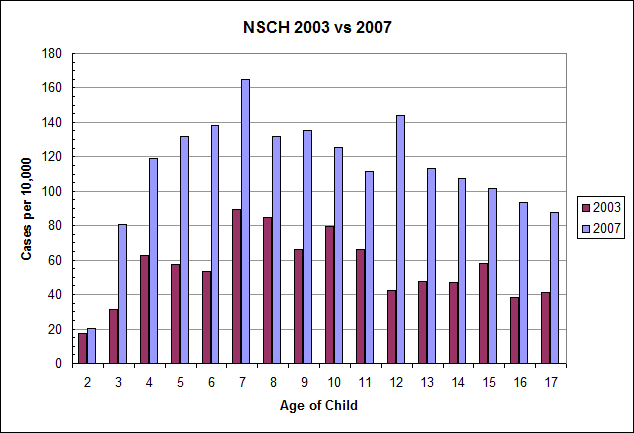
The analysis is simple. Here are the actual results compared to what Mr. Kirby misreported:

1992 “birth cohort*”:
102 per 10,000 (not 60 per 10,000 as on HuffPo)

1994 “birth cohort*”:
113 per 10,000 (not 66 per 10,000 as on HuffPo)

1996 “birth cohort*”:
111 per 10,000 (close to the “around” 100 per 10,000 quoted).

Or, to put it very simply: Mr. Kirby’s statement that there was an “explosion” in the autism rates is incorrect. The evidence that the introduction of the Hepatitis B vaccine is somehow related to the increase in autism rates is false.

That entire statement isn’t even a misinterpretation–it is just simply, demonstrably, false.

Unfortunately, this isn’t Mr. Kirby’s first clear and serious error. He has a history of mistakes. Unfortunately, he doesn’t have a history of correcting his mistakes. Consider these examples:

In June 2008, epiwonk publish a blog post “David Kirby: HuffPost Report on CDC’s Vaccine Safety Datalink Uninformative and Completely Misleading“, demonstrating clear errors in Mr. Kirby’s post “CDC: Vaccine Study Design “Uninformative and Potentially Misleading“”.

The errors were serious enough that Mr. Kirby rewrote his blog post as CDC: Vaccine Study Used Flawed Methods. This included the following introduction:

NOTE: My original post on this topic mischaracterized the 2003 CDC vaccine investigation as an “Ecological Study,” which it was not. I am reposting this piece to reflect that information accurately, but also to point out that many of the weaknesses identified in the CDC’s data and methods apply to the published 2003 “retrospective cohort” study, as much as they do to any future “ecological” ones. I regret and apologize for the error.

Mr. Kirby “regrets” and “apologizes” for the error. Yet his original, erroneous blog post is still on the Huffington Post website. He never took it down. He didn’t even add an apology or correction note to the piece. Anyone following a link to it would have no idea that even the author acknowledges the serious flaws in that piece.

It is also worth noting that the “corrected” version of Mr. Kirby’s blog post was also in error. Again, as noted by epiwonk, this time in his piece “David Kirby HuffPost, Take 2: My Original Story was Flawed, So Here’s A Second (”Corrected”) Story That’s Still Flawed, But I Hope I Can Snow You Under Again This Time…

Mr. Kirby compounded this error when he recreated it in his first “congressional briefing”, September 2008. Mr. Kirby misquoted a report by the National Institute of Enviornmental Health Sciences, and he was caught by a knowledgeable staffer.

Again, Mr. Kirbty has failed to correct his error.  He posted his power point presentation to his website, but without any acknowledgment of the error on page 6.  In the transcript for this talk, he only states, “NOTE: This statement omits important details of the CDC response” and sends you to other sites “For a more detailed explanation”. The “transcript” makes no reference to the exchange between Mr. Kirby and the congressional staffer, nor does it acknowledge that the omission was critical to the point being made. The transcript is noted as being a “Rush transcription by Nancy Hokkanen”. Being in a rush is not an excuse to leave important flaws unexplained.

Math errors are also not new to Mr. Kirby. In May 2008, Mr. Kirby wrote a piece analyzing data from Scotland. In doing so, Mr. Kirby misread a graph resulting in a factor of 10 error in a key piece of information (he misread a bar graph . After his error was blogged, Mr. Kirby corrected his Huffington Post piece. What he didn’t do, and he should have, was to note in the blog piece that he made the error and corrected it.

Mr. Kirby placed his Scotland data post in two sites: Huffington Post and the Age of Autism blog. In yet another odd move by Mr. Kirby, he left the original version of his post, complete with the factor of 10 error, on the Age of Autism blog (it still has 34,000 instead of 3,400). As noted above, Mr. Kirby obviously knows about the error, since he corrected it on the Huffington Post.

Since he clearly knew that his post on the Age of Autism blog had a big error, why didn’t he make a correction (with acknowledgment of the error) there?

Mr. Kirby had a bit of a problem with understanding the difference between Change.Org Change.Gov (the Obama transition team’s website) and Change.Org (a website that hosts blogs on important topics, including autism) (also noted here and here) He made a clear correction on the Huffington Post. However, his post on the Age of Autism blog just disappeared without a comment.

But let’s get back to the present. Mr. Kirby has blogged erroneous data and used this to show a false correlation between the Hepatitis B vaccine introduction and the rise in autism rates.

In case anyone is thinking, “are you sure you checked your own numbers, Sullivan?” The answer is yes. I double checked. I asked a frequent commenter on this blog, Dawn, to check my numbers. Another commenter independently collected and graphed the NCSH data as well. No evidence for an “explosion” of autism rates. Take a look at the graph. Mr. Kirby claimed that the 2007 survey data showed autism rates of about 60/10,000 for kids aged 13 and 15. There are no rates below 80 per 10,000 for the kids in those age ranges in that dataset.

So here we have a man with a history of errors, and with a history of failing to adequately correct his errors. He now has a new, big, obvious error. This error is likely the most serious of those listed here, in my opinion. Mr. Kirby has convinced people that the Hepatitis B vaccine could be causing autism. That was a serious accusation, and it was wrong. The question before us now is this: what will Mr. Kirby do now that he knows he made a mistake?

I’m very curious about that, so I’ve emailed Mr. Kirby and one of the editors at the Huffington Post with this information. I’ll let you all know what I hear back.

*note: the NSCH data are not given as “birth cohorts”. Instead, they are given by age. The survey was performed in 2007 and 2008. So, the 15 year old age group is roughly the “1992 birth cohort”. Likewise, 13 year olds are the 1994 “cohort” and 11 year olds are the 1996 “cohort”.

EDIT: Note that I too have a problem with keeping Change.Org and Change.Gov separate. This correction was made after the post was published.

Unscientific Americans

25 Aug

In Saturday’s Los Angeles Times, Lori Kozlowski talked to Chris Mooney in an article headed ‘Bringing science back into America’s sphere.’ The piece is about a book that Chris has co-authored with Sheril Kirshenbaum “Unscientific America: How Scientific Illiteracy Threatens Our Future.” It provoked such a lot of comments that they set up a blog so everyone could have their say.

Needless to say, as one of the book’s targets is the vaccine/autism camp and Chris mentions Age of Autism, that nest of anti-vaxers has dominated the comments with an orchestrated campaign. Here is my own attempt to stem the tide.

Those who have argued for a link between vaccines and autism adopt two contradictory positions. On the one hand we have those who point to the epidemiological studies as evidence of an autism epidemic whose growth is supposed to coincide with changes in the United States schedule for early childhood vaccinations. But when population studies fail to find a connection between vaccines and autism we get a different argument. Apparently there is a subset of genetically susceptible children that is too small to show up in population studies of vaccine safety. We have yet to hear a convincing explanation for this alleged genetic susceptibility to vaccine induced autism. But the parents who subscribe to this view are all convinced that, whatever it is, their child must have it.

It is difficult to see how this latter group could be persuaded to abandon their belief that that in their individual cases correlation does indeed equal causation. But I am at a loss to understand why they are willing to make common cause with the autism epidemicists, who are clearly and demonstrably wrong.

Regarding prevalence we have a very good idea why prevalence used to be 4 in 10000 and is now approaching 100 in 10000. In 1966 Victor Lotter carried out one of the earliest epidemiological studies in the county of Middlesex in the UK. He used a very narrow definition of autism in which only children who actively avoided human contact and engaged in elaborate repetitive behaviour qualified for diagnosis. When his students Lorna Wing and Judith Gould repeated the study in 1979 they found a similar rate of between 4 and 5 in 10000. However they also discovered a larger group who also engaged in repetitive behaviour but did not avoid human contact. However they did show difficulties in social communication and interaction. Wing and Gould defined ther problems within the triad of impairments, which also explained the aloof behaviour of the more typical Kanner type autistics. The newly identified members of the autistic spectrum numbered around 15 in 10000. Thus a simple broadening of the criteria lifted the numbers from 4 to 20 in 10000.

Lotter, Wing and Gould had all studied children excluded from mainstream education. In 1993 Stephan Ehlers and Christopher Gillberg went looking for children with the triad of impairments in mainstream education in the Swedish city of Gothenburg. They found a rate of 71 in 10000 for children with an IQ greater than 70. The children who were identified were known by their teachers to be having social and/or educational problems but the nature of their difficulties had not been recognised prior to the study.

So, as early as 1994, on the basis of epidemiological studies by Wing and Gould (1979) and Ehlers and Gillberg (1993) it was apparent that autism in all its manifestations including the classic Kanner type and the Asperger type affected at least 91 in 10000. The National Autistic Society in the UK issued a fact sheet to that effect. The modern version is available on our website.

In 15 years the figure for all autistic spectrum disorders in the UK has moved from 91 in 10000 to 116 in 10000 (Baird et al 2006). Thus it has remained flat at around 1 per cent for the whole period of the so-called autism epidemic. And that 1 percent represents the whole spectrum with perhaps a fifth to a quarter consisting of people with recognizable learning difficulties that are moderate or severe. The rest are more able.

I see no reason to doubt that the CDC estimate of 1 in 150 and the figures from recent studies that more closely approach the overall prevalence figures from the UK contain within them similar proportions of more and less able individuals. It is a shame that it has taken health and education services on both sides of the Atlantic so long to catch up with the true prevalence of autism amongst our children and begin to tailor services to meet their needs.

That still leaves those more able adults, often living a life less ordinary without the benefit of diagnosis and support, but still experiencing difficulties in their daily lives. The recent I Exist campaign by the National Autistic Society in the UK has influenced our government to take adult issues seriously

Comments are still open. Please visit and counter the collective lunacy of the anti-vaxers.

Physician’s Warranty of Vaccine Safety

25 Aug

There is an amazing document to be found on the internet: the “Physicians Warranty of Vaccine Safety”.

My take on this? It isn’t a real method of communicating one’s possible concerns about vaccines with one’s doctor. Instead, it is appears to be intended to sway parents away from vaccinating their children. They read this and go “Oh No!” and probably never even show it to their pediatricians.

The document is long and asks doctors to provide huge amounts of information supporting the idea that vaccines are safe and effective. Again, my view is that the document is more about getting parents to question vaccines.

The “Warranty” includes a scary list of vaccine “fillers” including the ever not-present “antifreeze”. It brings up the SV40 scare, including the nonsensical statement, “I hereby warrant that the vaccines I employ in my practice do not contain SV 40 or any other live viruses.” I guess whoever wrote the “Physician’s Warranty of Vaccine Safety” never heard of he MMR vaccine, with its live viruses and all. How can a physician warrant that MMR doesn’t include “live viruses”?

In the end the objective of this document appears to be: give this to your doctor and when he/she refuses to sign it, take that as proof that vaccines are not safe.

To insure that this happens, the Physicians Warranty of Vaccine Safety includes a killer clause:

Regardless of the legal entity under which I normally practice medicine, I am issuing this statement in both my business and individual capacities and hereby waive any statutory, Common Law, Constitutional, UCC, international treaty, and any other legal immunities from liability lawsuits in the instant case. I issue this document of my own free will after consultation with competent legal counsel whose name is __________________________________________, an attorney admitted to the Bar in the State of ___________________________.
________________________(Name of Attending Physician)
________________________ L.S. (Signature of Attending Physician)

Yep. The doctor is supposed to waive all legal protection from liability. He/she is supposed to put his/her business and personal assets behind this.

Make a document that says, “I want a glass of water…oh, by the way, please waive all your legal rights before doing so”. See if your doctor will sign it.

I’ve toyed with creating a “Physicians Warranty of Autistic Child Safety”. It would require the physician to provide all the evidence that the alternative medical therapies have been tested and proven to be beneficial and safe.

Oh, yeah, the physician would have to waive his/her immunities from liability lawsuits.

I considered asking a number of the prominent alternative medical practitioners if they would consider taking my kid on as a patient, then asking them to sign the “Physicians Warranty of Autistic Child Safety”.

But why when I already know the answer will be no?

I guess it says something about the vaccine-rejectionists that they have to resort to such cheesy measures as the “Physicians Warranty of Vaccine Safety”.

Autism Speaks softens message on vaccines?

24 Aug

That is the message of a recent article by Mark Roth, Autism group softens stance on vaccines .

Autism Speaks, the nation’s largest autism advocacy group, recently made its clearest public statement yet that minimizes the link between vaccines and autism.

Mr. Roth discussed a recent statement from the Autism Speaks website by Dr. Gerri Dawson, Autism Speaks’ chief science officer. He quoted Dr. Dawson as stating:

“So … given what the scientific literature tells us today,” she says, “there is no evidence that thimerosal or the MMR vaccine cause autism” and “evidence does not support the theory that vaccines are causing an autism epidemic.”

It has been, well, interesting watching the reaction to Autism Speaks in the past few years. As recently as two years ago, the vaccines-cause-autism organizations were highly critical of Autism Speaks for ignoring the vaccine question. In fact, it seems like just this year that Autism Speaks “outed” itself as supporting the vaccines-cause-autism idea. This occurred when Alison Singer was forced to resign from Autism Speaks since she wouldn’t vote for vaccine-causation research in the IACC.

From my perspective, this “softened” stance by Autism Speaks is still a stronger message than they were sending a year ago.

This all begs the question: why did Autism Speaks soften their message?

I can speculate (and that is all this is, speculation). First, the vaccine question is highly charged. My guess is that Autism Speaks put off making a definite statement as long as possible. When Alison Singer resigned over her vote in the IACC (voting to remove vaccine research from the funded projects), Autism Speaks was forced to make their views public.

The departure of two key people, Alison Singer and Eric London over the vaccine question was not good publicity for Autism Speaks. Much more, the creation of the Autism Science Foundation gives potential donors a second viable option for an autism research charity that doesn’t fund vaccine-causation research (the first being the Simons Foundation).

What is odd about Dr. Dawson’s comments is this: If there is no evidence that thimerosal causes autism, why does Autism Speaks fund thimerosal research? Here are grants from 2008:

Differential Effects of Thimerosal on Cell Division and Apoptosis in Normal vs Autism Spectrum Disorder Cell Lines ($60,000 for one year)

and

Vulnerability phenotypes and susceptibility to environmental toxicants: from organism to mechanism ($330,000 over 3 years)

Specifically, thimerosal and other vaccine adjuvants will be studied.

(sidenote: Thimerosal isn’t an “adjuvant”)

and

Analysis of developmental interactions between Reelin haploinsufficiency, male sex, and mercury exposure ($324,340 over 3 years)

and

Etiology of Autism Risk Involving MET Gene and the Environment ($659,100 over 3 years)

The next line of experiments will examine the relationship in an even larger sample, and assess the functional effect of the MET gene polymorphism on immune cell activity, and to further examine the impact of environmental toxins (including ethyl mercury) on the gene expression-dependent function of maternal immune cells.

Is Autism Speaks softening their “message” or softening their “stance” on whether vaccines and/or mercury cause autism?

sound advice: pediatricians Answer vaccine questions

20 Aug

Below is a press release from the American Academy of Pediatrics. This isn’t really about autism. But, the autism parent community is one of the biggest sources of misinformation about vaccines. I don’t mind pitching in to help AAP get some quality information out.

CHICAGO — Parents who are doing their homework on their child’s vaccines can go directly to the experts for answers – without leaving home. The American Academy of Pediatrics (AAP) offers a series of audio interviews with pediatricians, researchers, advocates and other parents at http://www.cispimmunize.org/fam/soundadvice.html.

Interviews include a conversation with former First Lady Rosalynn Carter, who discusses her passionate crusade to ensure all children receive life-saving vaccinations. Dr. Richard Besser, the pediatrician who became the public face of the government’s swine flu response in spring 2009, offers advice to families preparing for a future epidemic. Dr. Ari Brown, author of the popular “Baby 411” guides, dispels common vaccine myths. And Dr. Harvey Karp, the pediatrician who has coached thousands of new parents through his “The Happiest Baby On The Block” book and DVD, explains in clear, easy-to-understand language why vaccines are not related to autism.

Parents can listen first-hand as experts address specific questions related to immunization:

Why is it important to vaccinate on time?

What vaccines do adolescents need?

Why should infants get the Hepatitis B vaccine?

Why do kids need the flu shot?

Are some children extra-sensitive to vaccines?

Why are vaccines required for school entry?

August is National Immunization Awareness Month, which is a perfect time to remind people of all ages to catch up on their vaccinations. On the AAP’s Sound Advice page, parents can hear personal stories of people who have been affected by vaccine-preventable diseases. Frankie Milley lost her only child, Ryan, at age 18 to meningitis; she went on to found an advocacy organization devoted to protecting other children from the disease that took her son’s life. Pediatrician Anna Lincoln tells how pneumococcal meningitis threatened the life of her previously healthy infant son, Wiley, before a vaccine was available to prevent the disease. Now she counsels parents in her practice on vaccines.

“I welcome the questions,” Dr. Lincoln said. “I want parents to understand the vaccines, to understand why they’re important, to feel good and comfortable and confident in their decision to vaccinate their children. Although the diseases may seem low risk, they are not. We have to be diligent about continuing the schedule, because it can easily creep back to how it was before the vaccines, which was a time when children could be smiling one night, like Wiley, and the next morning, be fighting for their life in the intensive care unit.”

An interview with journalist Arthur Allen looks at how the media report on immunizations, and the resulting impact on public health. Ken Reibel, creator of the AutismNewsBeat blog, talks about his son’s diagnosis with autism. The audio interviews also include a message from actress Amanda Peet, who has partnered with the advocacy organization Every Child By Two to give parents the information they need about immunizations. Amy Pisani, executive director of Every Child By Two, and Mrs. Betty Bumpers, who co-founded the organization with Mrs. Carter, describe their personal reasons for promoting immunization.

Additional interviews feature pediatric infectious disease specialists Dr. Joseph Bocchini, Dr. Meg Fisher and Dr. Paul Offit; Dr. Judith Palfrey, president-elect of the AAP; Dr. Renee R. Jenkins, immediate past president of the AAP; and Dr. David T. Tayloe, Jr., president of the AAP.

“Parents are natural advocates for their children’s health,” Dr. Tayloe said, “and the AAP wants them to have the information they need about immunizations so they can make the right choices. The internet is peppered with inaccurate information about vaccines. We want parents to have a trusted place they can go for reliable advice. It’s important that immunization rates remain high or innocent children will become at risk for vaccine-preventable diseases.”

All the interviews can be downloaded to an mp3 player. Edited transcripts are posted.

The AAP has additional resources about immunization for parents and journalists:

Vaccine Studies: Examine the Evidence
o http://www.cispimmunize.org/Vaccine%20Studies.pdf

Facts for Parents About Vaccine Safety
o http://www.cispimmunize.org/fam/facts/VaccineSafety_English.doc

The Vaccine Schedule: Why is it Like That?
o http://www.cispimmunize.org/pro/pdf/Vaccineschedule.pdf

Questions and Answers About Vaccine Ingredients
o http://www.cispimmunize.org/pro/pdf/Vaccineingredients.pdf

Vaccines: What Every Parent Should Know
o http://www.aap.org/pressroom/aappr-features.htm

Jenny McCarthy: I’d like to see some action behind those words

18 Aug

Jenny McCarthy is on the cover of the latest Cookie Magazine. As part of her interview, she asserts that she is “pro safe vaccine”, not anti vaccine.

Now McCarthy, along with her boyfriend, actor Jim Carrey, serves on the board of directors of Generation Rescue, an advocacy and research organization that calls for eliminating toxins in vaccines and for delaying shot schedules.

Notice “delaying” shot schedules.

Another quote, talking about her own experiences:

Going over his medical history now, she sees a link between a series of ear infections, a severe case of eczema, and a hepatitis-B booster shot. “Looking back, I’d say, ‘God, if a kid is having more than seven ear infections in a year and he’s got eczema, there are some issues here—his immune system is obviously under attack, and we need to put him in the sensitive category. Let’s just delay some of his shots,’ ” she says. “Not eliminate, delay.”

Again, note the phrease “Not eliminate, delay”.

This isn’t exactly new. The Generation Rescue website page on vaccines tells parents to “consder delaying vaccines”. As near as I can tell, GR has had a statement like this since the vaccines page was first put up.

But here is where actions and words part company for both Jenny McCarthy and Generation Rescue. They have “recommended” vaccine schedules. Their “favorite” schedule, included in their paragraph on “consider delaying” vaccines, states flat out: no live virus vaccines. I.e. no Measles, Mumps, Rubella or Varicella (chicken pox).

That’s not “delay” that’s “eliminate”.

Let’s compare the GR alternative schedules to the CDC recommended schedule, shall we?

The childhood schedule includes vaccinations against 15 diseases:

Hepatitis B
Rotavirus
Diptheria
Tetanus
Pertussis
Haemophilus influenzae type b
Pneumococcal
Polio
Influenza
Measles
Mumps
Rubella
Varicella
Hepatitis A
Meningococcal

Now let’s check GR, Jenny McCarthy’s organization, and their recommended schedules:

First, GR’s “favorite” schedule only has protection against 4 diseases.

Pertussis
Diptheria
Tetanus
and, Polio

Again, that’s not “delay” that’s “eliminate”.

For their second option, GR claims you can “turn back the clock” and use the 1983 schedule. I don’t know how anyone could think that is supposed to be a “delay” in shots. Here’s the count (6 diseases covered):

Diptheria
Tetanus
Pertussis
Polio
Measles
Mumps
Rubella

As the third option, Jenny McCarthy’s organization suggests you “go Danish” and use the Denmark schedule (7 diseases):

Diptheria
Tetanus
Pertussis
Haemophilus influenzae type b
Polio
Measles
Mumps
Rubella

Jenny McCarthy *says* she is promoting “delaying” vaccines. Her actions speak much louder than her words.

If you want to say you are for “delaying” vaccines, then change your website. Pretty simple.

Of course, when you do, I’d love to see the science showing that the delayed schedule you pick is safer than the current one.

Chelation challenge testing: not scientific, not beneficial, may be harmful

13 Aug

Who knows about the toxic effects of mercury? Toxicologists. The premier toxicology group in the U.S, the American College of Medical Toxicologists, represents the doctors who test and treat people suffering from real heavy metal poisoning.

By contrast, many doctors have added chelation to their treatment options due to the false theory that autism is caused by heavy metal poisoning (specifically, mercury). These alternative-medicine practitioners usually depend on non-standard test to “prove” heavy metal poisoning. The favorite seems to be the “challenge” chelation test. In this test, a chelator is given to a person before a urine test. Chelators are chemicals which bind to metals in the body and allow them to be excreted more easily. Thus, if you give a chelator to a person, you expect their urine to show higher levels of heavy metals.

This has been discussed on this blog and elsewhere for a long time.

And now the American College of Medical Toxicologists has come out with an official position statement.

The practice is not scientific. There are no reference values for post-challenge urine metal testing. There is no correlation between actual metal exposure and post-challenge test results.

It is, therefore, the position of the American College of Medical Toxicology that post-challenge urinary metal testing has not been scientifically validated, has no demonstrated benefit, and may be harmful when applied in the assessment and treatment of patients in whom there is concern for metal poisoning.

It’s time for post challenge urine testing to end. It is time for chelation as a “treatment” for autism to end. It is time for those who promoted the “autism is mercury poisoning” theory to step forward and admit their mistakes.